

Inconel is used for components exposed to combinations of high temperature, mechanical stress, oxidation, or aggressive corrosion. Typical applications include aerospace and gas turbines, chemical and petrochemical processing equipment, power generation, oil and gas equipment, nuclear systems, industrial furnaces, marine hardware, and selected high-temperature automotive components. However, Inconel is not a single alloy. It is a family of nickel-based alloys with different compositions and performance characteristics, so the correct grade depends on the operating temperature, mechanical load, corrosion environment, fabrication requirements, and applicable specification. Special Metals lists multiple INCONEL® grades, including 600, 601, 625, 690, 718 and X-750, for different industrial applications.
What Does Inconel Mean?
INCONEL® is a trademark used for a family of nickel-based alloys. Different grades are engineered for different combinations of heat resistance, corrosion resistance, strength, oxidation resistance, fabrication characteristics, and long-term stability.
This distinction is important when selecting material for an industrial component. Saying that a part should be made from “Inconel” is usually not enough for procurement. The specific grade, product form, heat treatment, applicable specification, dimensions, and required mechanical or corrosion performance normally need to be identified.
For example, Inconel 718 is a precipitation-hardenable alloy widely used where high mechanical strength is important at elevated temperature. Inconel 625 is commonly selected when corrosion resistance, strength, weldability, and resistance to marine or chemical environments are important. Inconel 600 and 601 are frequently associated with heat-treatment and high-temperature industrial equipment, while Inconel 690 has established applications in nuclear steam-generator systems.
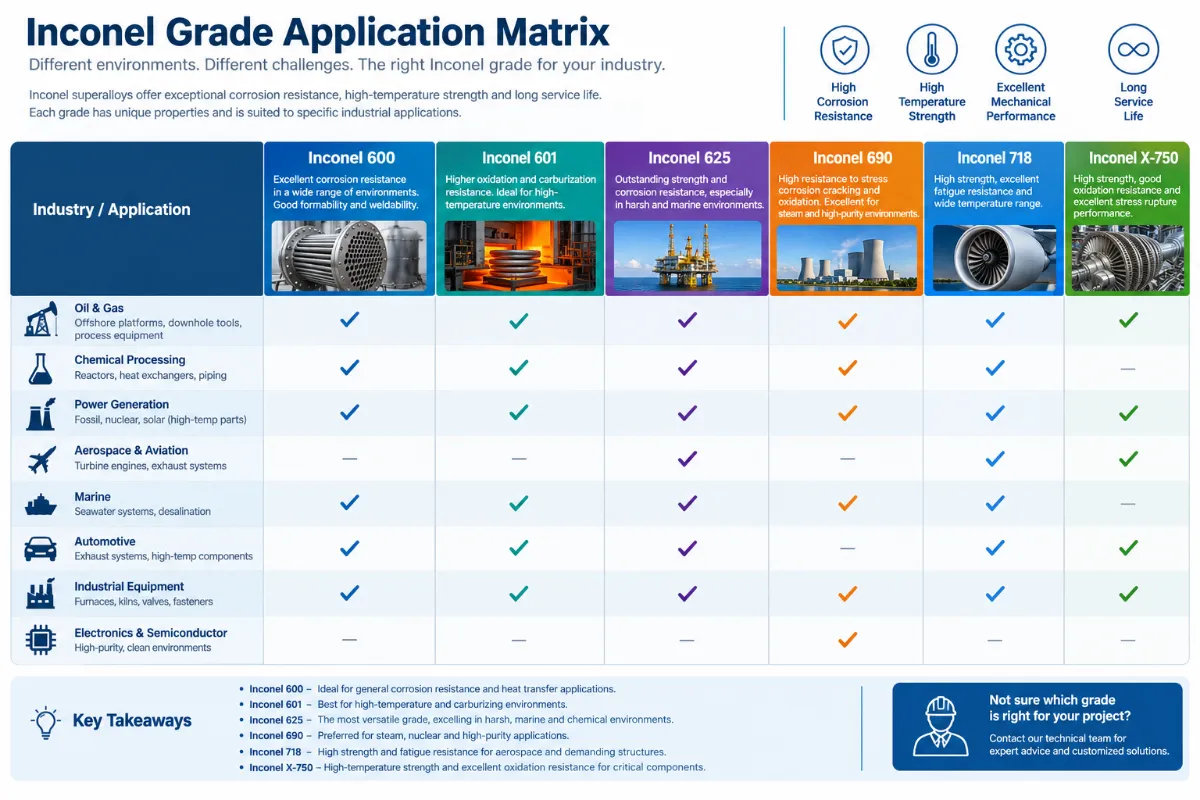
Inconel Applications by Grade
The following table provides a practical starting point rather than a universal material-selection rule.
| Inconel grade | Main characteristics | Common application areas |
|---|---|---|
| Inconel 600 | Nickel-chromium alloy with good oxidation and corrosion resistance | Furnace equipment, chemical processing, nuclear and heat-treatment equipment |
| Inconel 601 | Strong oxidation resistance and useful high-temperature corrosion resistance | Thermal processing, industrial furnaces, chemical processing, pollution control |
| Inconel 625 | Strong corrosion resistance with good strength and weldability | Marine, chemical processing, aerospace, power generation, oil and gas |
| Inconel 690 | High chromium content and strong resistance in demanding aqueous and high-temperature environments | Nuclear steam-generator tubing and related components, chemical processing |
| Inconel 718 | Precipitation-hardened, high-strength nickel alloy | Aerospace, gas turbines, oil and gas, nuclear engineering |
| Inconel X-750 | Age-hardenable alloy with high tensile and creep-rupture properties | Gas turbine components, fasteners, springs, tooling |
These application groupings are supported by Special Metals technical bulletins and market-specific information. Actual material selection should still be based on the service conditions and governing specification.
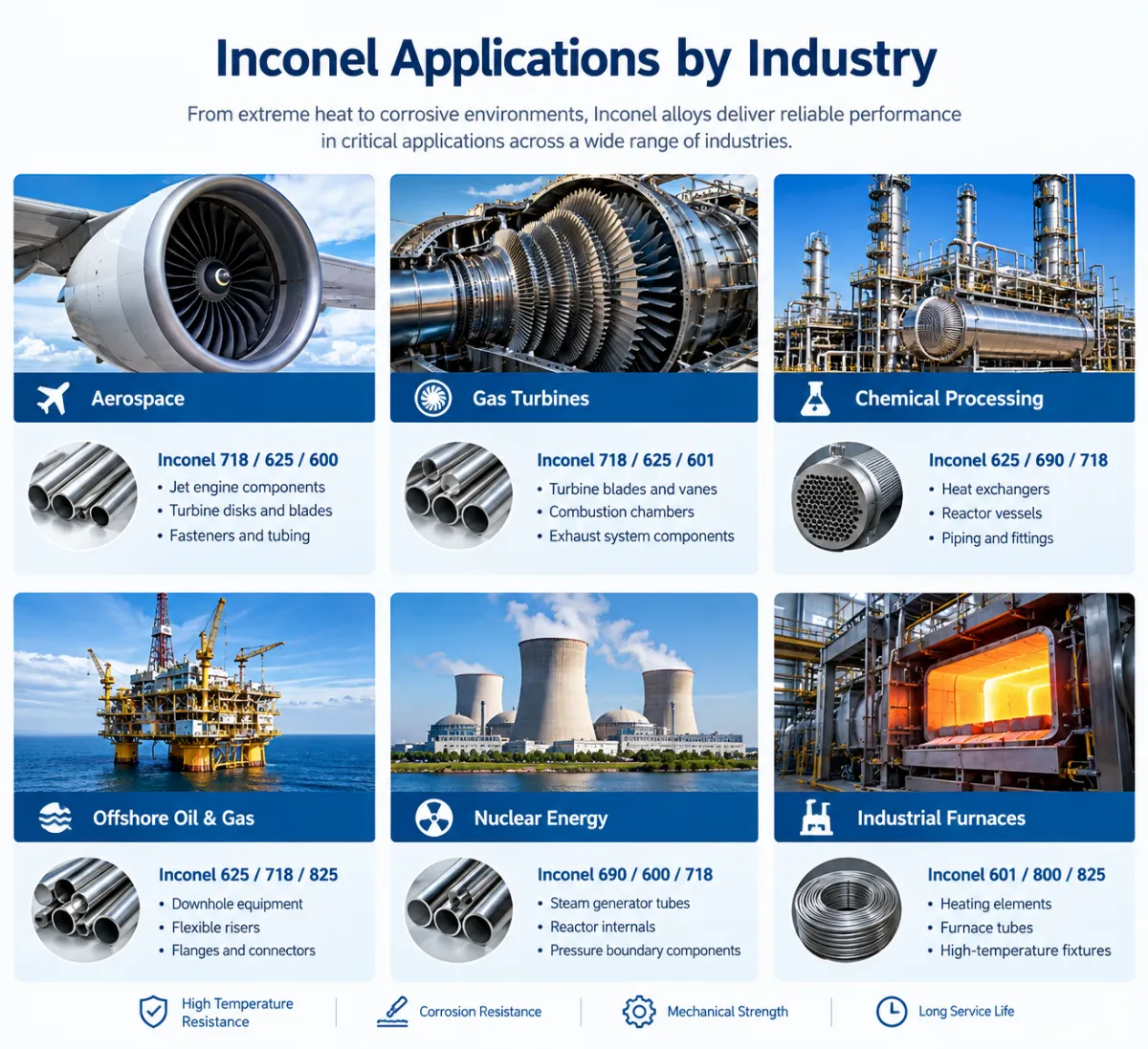
1. Aerospace and Jet Engine Components
Aerospace is one of the best-known application areas for Inconel because aircraft and rocket components can experience high temperature, cyclic loading, oxidation, vibration, and demanding requirements for mechanical stability.
Inconel 718 is widely used in aerospace and gas-turbine applications because it combines high strength, corrosion resistance, creep resistance and good weldability. Special Metals describes Alloy 718 as being used in aerospace, gas turbines, rocket motors, spacecraft and nuclear engineering.
Typical applications include:
- Engine and turbine components
- Discs and rings
- High-strength fasteners
- Rocket motor hardware
- Structural engine components
- Exhaust and hot-section hardware
- Certain combustion-related components
Inconel 625 also has aerospace applications where corrosion resistance, weldability and resistance to elevated-temperature environments are important. Special Metals includes Alloy 625 among its aerospace alloys.
The important point is that aerospace applications do not automatically require one specific Inconel grade. The selection depends on temperature, stress level, fatigue requirements, manufacturing route and qualification requirements.
2. Gas Turbines and Power Generation
Power-generation equipment operates under combinations of high temperature, pressure, oxidation and long-duration mechanical loading.
Inconel grades are used in gas turbines and other power-generation equipment where conventional materials may not provide the required combination of elevated-temperature strength and environmental resistance.
Special Metals identifies Inconel 600, 617, 625, 690, 706, 718, 740H and X-750 among its alloys for power-generation applications. Its power-generation materials are used in gas turbines, feedwater and superheater tubing, and nuclear engineering.
Depending on the design, Inconel may be used for:
- Gas turbine components
- High-temperature tubing
- Heat-resistant fasteners and hardware
- Combustion-related components
- Heat exchangers
- High-temperature structural parts
In power-generation applications, the grade should be selected from actual temperature, stress, atmosphere, corrosion chemistry and expected operating life rather than from the industry name alone.
3. Chemical and Petrochemical Processing
Chemical processing is another major use of Inconel because process equipment can encounter acids, chlorides, oxidizing environments, high temperatures and combinations of pressure and corrosion.
Special Metals identifies Inconel 600, 601, 617, 625, 690 and other nickel alloys for chemical processing. Applications include chemical and petrochemical processing equipment, industrial furnaces and heat-treatment systems.
Typical components may include:
- Heat exchangers
- Process heaters
- Reactor components
- Condenser-related equipment
- Process piping
- Valves and fittings
- Furnace components
Inconel 625 is particularly relevant where corrosion resistance and fabrication characteristics are important. Inconel 601 is also used in chemical-processing equipment where oxidation and high-temperature corrosion resistance are required.
Material selection should always consider the actual chemical media. “Corrosion resistant” does not mean resistant to every chemical under every concentration, temperature or flow condition.
4. Oil and Gas and Subsea Equipment
Oil and gas equipment can combine high pressure, mechanical loading, corrosive fluids, chlorides, hydrogen-containing environments and cyclic service.
Inconel 718 is used in oil and gas extraction, while other Inconel grades are used where corrosion resistance or high-temperature performance is needed. Special Metals identifies Alloy 718 for oil and gas extraction and includes multiple Inconel grades in its oil and gas alloy portfolio.
Potential applications include:
- Downhole components
- Wellhead hardware
- Valves
- Pumps
- High-strength shafts and hardware
- Subsea components
- Corrosion-resistant fittings
In subsea applications, Inconel 625 is particularly relevant because Special Metals identifies it for marine engineering and notes resistance to severe corrosion environments, including pitting and crevice corrosion.
For sour-service applications, buyers should specify the applicable material and environmental standard rather than assuming that every Inconel grade has the same qualification.
5. Nuclear Power
Nuclear applications place unusually demanding requirements on materials because components may experience elevated temperatures, high-purity water, corrosion, radiation-related operating conditions and long service lives.
Different Inconel grades serve different functions.
Inconel 690 is particularly important in nuclear power. Special Metals states that Alloy 690 is widely used for steam-generator tubes, baffles, tubesheets and hardware in nuclear power generation because of its resistance to corrosion and stress-corrosion cracking in high-temperature water environments.
Inconel 718 also has applications in nuclear engineering, according to Special Metals technical information.
The nuclear sector therefore illustrates why “Inconel” alone is not a sufficient procurement description. The exact grade, chemistry limits, product form, heat treatment and applicable nuclear specification can be critical.
6. Industrial Furnaces and Thermal Processing
High-temperature industrial furnaces are another established application for Inconel alloys.
Inconel 600 and 601 are used in thermal-processing environments where components are exposed to sustained heat and oxidizing furnace atmospheres.
Special Metals identifies Inconel 601 for thermal processing applications such as baskets, trays, fixtures, radiant tubes, muffles, retorts, burner components and other furnace hardware.
Inconel 600 is also used for furnace components, chemical processing, nuclear engineering and related high-temperature applications.
Typical applications include:
- Furnace trays and fixtures
- Radiant tubes
- Retorts and muffles
- Burner components
- Heat-treatment equipment
- Conveyor components
- High-temperature supports
For these applications, oxidation resistance, thermal stability and the expected furnace atmosphere can be more important than maximum room-temperature strength.
7. Marine Engineering and Seawater Service
Marine equipment can be exposed to seawater, chlorides, pressure, erosion and cyclic loading.
Inconel 625 is used in marine engineering where severe corrosion resistance is required. Special Metals specifically identifies Alloy 625 for marine applications and notes its resistance to pitting and crevice corrosion.
Potential applications include:
- Seawater equipment
- Offshore components
- Pump and valve hardware
- Subsea fittings
- Heat-exchanger components
- Marine exhaust-related systems
Not every Inconel grade has the same resistance in seawater. The choice should be based on the actual chloride concentration, temperature, flow rate, stress state and fabrication condition.
8. Automotive and High-Temperature Exhaust Applications
Although Inconel is most strongly associated with aerospace, energy and chemical industries, selected grades are also used in automotive applications.
Special Metals identifies Inconel 601 and X-750 for automotive applications, including components exposed to high thermal and mechanical fatigue. Its automotive information specifically references exhaust systems, exhaust valves, sensors, ignition equipment and catalytic-converter-related applications.
These applications are typically justified when the component experiences temperatures and thermal cycling that make ordinary engineering materials less suitable.
9. Environmental and Waste-Processing Equipment
High-temperature waste-processing and pollution-control systems can combine aggressive gases, elevated temperature and corrosive condensates.
Special Metals identifies Inconel 22 and 625 among alloys used for pollution and waste applications, including components such as scrubbers, boiler tubing, heat exchangers, bellows and related hardware.
This is another example where grade selection depends heavily on the actual chemistry and operating conditions.
Why Is Inconel Used in These Applications?
The reason Inconel appears across these industries is not simply that it can withstand “high temperatures.”
Its value comes from the combination of several characteristics.
High-temperature strength
Some Inconel grades retain useful mechanical strength and creep resistance at elevated temperatures. This is particularly important for turbine, engine and power-generation components.
Oxidation resistance
Chromium and other alloying elements contribute to protective surface oxides that help reduce deterioration in high-temperature oxidizing environments. The exact behavior depends on alloy chemistry and service conditions.
Corrosion resistance
Nickel, chromium, molybdenum and other alloying additions can provide resistance to different forms of corrosion, depending on the grade.
Fatigue resistance
Certain grades are used in components exposed to repeated thermal and mechanical cycling.
Weldability and fabrication characteristics
Several Inconel grades offer useful weldability, while others require much tighter control of welding and post-weld heat treatment. These differences are one reason why the grade must be specified rather than simply ordering “Inconel.”
What Are the Limitations of Inconel?
Inconel is not automatically the right material for every high-temperature application.
Higher material cost
Nickel-based alloys generally carry a higher material cost than many conventional engineering metals. The cost can be justified when service life, corrosion resistance or temperature capability is critical, but the economic decision should be based on the actual application.
Machining difficulty
Many nickel-based alloys work-harden and have relatively low thermal conductivity during machining. This can increase tooling demands and machining time.
Grade-specific performance
Inconel 718, 625, 600, 601 and 690 should not be treated as interchangeable materials. Their strengthening mechanisms, corrosion resistance and typical applications are different.
Heat treatment matters
For precipitation-hardened grades such as 718, the final mechanical properties depend strongly on the heat-treatment condition. Procurement documents should therefore state the required condition rather than simply naming the alloy.
Application limits still apply
No alloy should be selected solely from a generic temperature chart. Actual service conditions include temperature cycles, stress, atmosphere, chemical exposure, geometry, fabrication method and required design life.
How Should You Select an Inconel Grade?
For an engineering project, define the operating environment before choosing the grade.
A practical selection sequence is:
- Identify the maximum and minimum operating temperature.
- Define mechanical loading and expected cyclic conditions.
- Identify the process chemistry or surrounding atmosphere.
- Determine whether oxidation, pitting, crevice corrosion or stress-corrosion cracking is a major concern.
- Select candidate Inconel grades.
- Check the required product form, dimensions and heat treatment.
- Verify the applicable ASTM, ASME, AMS, ISO or industry-specific specification.
- Confirm testing, traceability and documentation requirements.
- Review fabrication, machining and welding requirements.
- Confirm supply feasibility before issuing the purchase order.
What Should Be Included in an Inconel RFQ?
A good RFQ should normally include more than just the alloy name.
For example:
| Requirement | Example |
|---|---|
| Alloy grade | Inconel 625 |
| UNS number | N06625 |
| Product form | Round bar, plate, tube, wire |
| Dimensions | Diameter, thickness, OD, wall thickness, length |
| Quantity | kg, pieces or total length |
| Material condition | Annealed, solution treated, aged, etc. |
| Standard | ASTM, ASME, AMS or customer specification |
| Testing | Tensile, hardness, PMI, NDT or other required testing |
| Documentation | MTC, certificate of conformity, traceability documents |
| Application | Aerospace, marine, chemical, oil and gas, etc. |
| Delivery | Required destination and target delivery date |
This information allows a supplier to assess the technical requirement rather than quoting against an incomplete material description.
MWalloys Inconel Supply
MWalloys supplies nickel-based alloys in different grades and product forms for industrial applications. Depending on the requested material, dimensions, specification and production route, requirements may be evaluated through MWalloys' own production capabilities and cooperation with qualified manufacturing partners.
Available forms and supply conditions should be confirmed case by case based on the specific alloy, size, quantity, standard and documentation requirements.
For Inconel purchasing, the most useful information to provide is the exact grade, UNS designation, dimensions, quantity, material condition, applicable specification and required inspection documents.
Frequently Asked Questions About Inconel Applications
What is Inconel mainly used for?
Inconel is mainly used for components exposed to high temperature, mechanical stress, oxidation, or aggressive corrosion. Common industries include aerospace, power generation, chemical processing, oil and gas, nuclear power, thermal processing, marine engineering and selected automotive applications.
What is Inconel 718 used for?
Inconel 718 is widely used in aerospace, gas turbines, rocket hardware, nuclear engineering and oil and gas equipment. Its precipitation-hardening mechanism provides high mechanical strength and useful creep resistance at elevated temperatures.
What is Inconel 625 used for?
Inconel 625 is commonly used in aerospace, chemical processing, marine engineering, power generation and corrosion-resistant equipment. It is particularly useful where strength, weldability and resistance to aggressive environments are required.
What is Inconel 600 used for?
Inconel 600 is used for furnace components, chemical-processing equipment, heat-treatment systems and nuclear-related applications. Special Metals also identifies it for food and chemical processing equipment.
What is Inconel 601 used for?
Inconel 601 is widely associated with thermal-processing equipment, industrial furnaces, chemical processing, pollution control, aerospace and power generation. Its high-temperature oxidation resistance is one of the main reasons it is selected.
What is Inconel 690 used for?
Inconel 690 is used extensively in demanding nuclear applications, particularly steam-generator tubes, baffles, tubesheets and related hardware. It is also used in selected chemical-processing and high-temperature environments.
Is Inconel suitable for marine applications?
Certain Inconel grades are suitable for marine and subsea service. Inconel 625 is specifically used in marine engineering because of its resistance to severe corrosion, including pitting and crevice corrosion.
How do I choose the correct Inconel grade?
Start with the actual service conditions: temperature, mechanical load, chemical environment, corrosion mechanism, product form, heat treatment, fabrication method and applicable specification. The grade should be selected from those requirements rather than from the general name “Inconel.”
Conclusion
Inconel is used where a component must maintain reliable performance under combinations of heat, mechanical loading, oxidation or corrosion. Aerospace engines, gas turbines, chemical-processing equipment, oil and gas hardware, nuclear systems, industrial furnaces, marine equipment and selected automotive components are established application areas.
The most important point is that Inconel is a family of different alloys, not one universal material. Inconel 718 is widely associated with high-strength aerospace and turbine applications, 625 with demanding corrosion-resistant and marine applications, 600 and 601 with high-temperature and thermal-processing environments, and 690 with specific nuclear and corrosion-resistant applications.
The correct grade should therefore be selected from the actual combination of temperature, stress, environment, fabrication route, product form and applicable specification.