
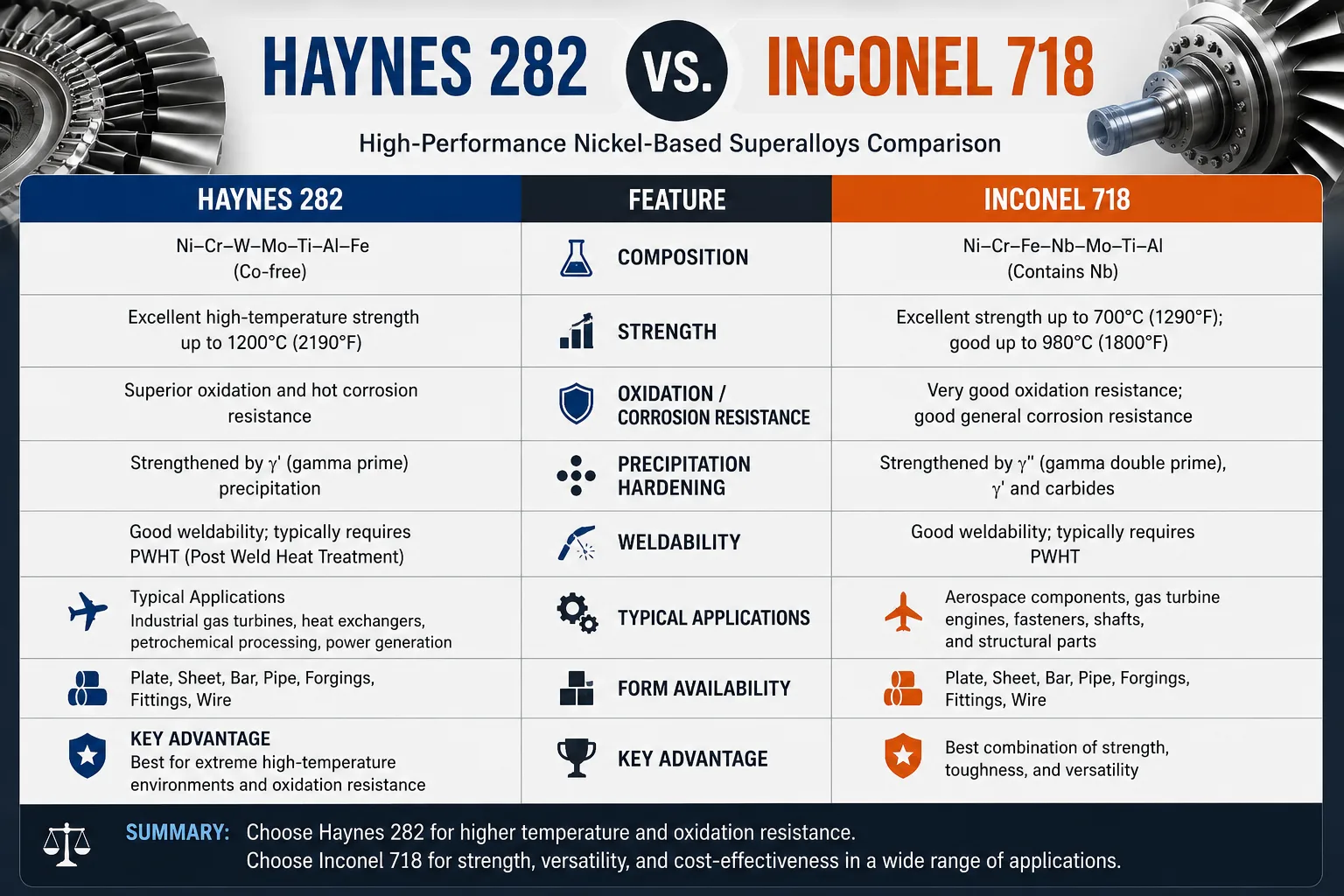
Haynes 282 outperforms Inconel 718 in creep strength above 700°C, making it the superior choice for long-duration high-temperature structural applications such as gas turbine casings, combustor liners, and aerospace hot-section components. Inconel 718 retains its advantage below 650°C where its exceptional tensile strength, fatigue resistance, and fabricability make it the dominant alloy in turbine disks, fasteners, and cryogenic hardware. Selecting the wrong alloy between these two superalloys can reduce component service life by 40% to 60% and significantly increase maintenance costs.
What Makes Haynes 282 and Inconel 718 Different at the Compositional Level?
Understanding why these two alloys behave so differently in service starts at the atomic level — specifically with how each alloy achieves its strength and what that means for performance at temperature. We have worked with both alloys across aerospace, power generation, and industrial furnace applications, and the compositional differences explain almost every behavioral divergence we observe in the field.
Inconel 718: The Delta Phase and Niobium Strategy
Inconel 718 (UNS N07718, AMS 5662/5664) is a precipitation-hardening nickel-chromium superalloy developed by International Nickel Company in the 1960s. Its nominal composition includes approximately 50% to 55% nickel, 17% to 21% chromium, 4.75% to 5.5% niobium plus tantalum, 2.8% to 3.3% molybdenum, 0.65% to 1.15% titanium, and 0.2% to 0.8% aluminum, with an iron balance (typically 17% Fe).
The primary strengthening mechanism in Inconel 718 is precipitation of the gamma-double-prime (γ'') phase — a body-centered tetragonal Ni3Nb ordered precipitate — along with a secondary contribution from gamma-prime (γ') phase (Ni3(Al,Ti)). The γ'' phase is metastable: above approximately 650°C, it transforms slowly toward the equilibrium delta (δ) phase (also Ni3Nb, but with orthorhombic crystal structure), which provides no strengthening and can actually embrittle grain boundaries.
This γ'' to δ transformation is the fundamental reason Inconel 718 loses creep resistance above 650°C. The transformation kinetics accelerate rapidly above 700°C, and at 750°C the transformation is fast enough to cause measurable property degradation within hundreds of hours — an unacceptable timeframe for long-life aerospace components.
The niobium content that enables γ'' precipitation also makes Inconel 718 prone to niobium segregation during solidification, creating Laves phase (Fe2Nb) in the as-cast condition. Homogenization heat treatment dissolves most Laves phase, but residual segregation can reduce ductility. This is why the double aging treatment (720°C/8h + 620°C/8h) is so critical for Inconel 718 property development.
Haynes 282: The Slower Gamma-Prime Kinetics
Haynes 282 (UNS N07208, ASTM B637) was developed by Haynes International and introduced commercially in 2005 specifically to address the high-temperature creep limitations of existing γ'-strengthened alloys while improving fabricability compared to alloys like Waspaloy and Rene 41. Its nominal composition contains approximately 57% nickel, 20% chromium, 10% cobalt, 8.5% molybdenum, 2.1% titanium, and 1.5% aluminum.
The key engineering decision in Haynes 282 is its deliberately lower volume fraction of γ' precipitate — approximately 15% to 20% by volume, compared to 25% to 35% in Waspaloy and higher fractions in Rene 41. This lower γ' fraction reduces the driving force for precipitate coarsening and makes the alloy significantly more weldable and formable than competing high-strength γ'-strengthened alloys.
Critically, Haynes 282 contains no niobium and relies entirely on γ' (Ni3(Al,Ti)) for precipitation strengthening. The γ' phase in Haynes 282 is thermally stable to temperatures above 950°C — far beyond the 650°C stability limit of the γ'' phase in Inconel 718. This thermal stability of the strengthening precipitate is the fundamental reason Haynes 282 delivers superior creep performance at elevated temperatures.
The cobalt content (10%) in Haynes 282 serves multiple functions: it increases the γ' solvus temperature, strengthens the matrix by solid solution effects, and improves oxidation resistance by stabilizing the surface oxide layer at high temperatures.
| Compositional Element | Inconel 718 (wt%) | Haynes 282 (wt%) | Functional Role |
|---|---|---|---|
| Nickel (Ni) | 50-55 | ~57 (balance) | Austenitic matrix stability |
| Chromium (Cr) | 17-21 | 19-21 | Oxidation/corrosion resistance |
| Iron (Fe) | 17 (balance) | <1.5 | Cost reduction (IN718), trace (H282) |
| Molybdenum (Mo) | 2.8-3.3 | 8-9 | Solid solution strengthening |
| Niobium (Nb) | 4.75-5.5 | None | γ'' precipitation (IN718 only) |
| Cobalt (Co) | <1 | 10 | γ' solvus elevation, matrix strengthening |
| Titanium (Ti) | 0.65-1.15 | 1.9-2.3 | γ' former (Ni3Ti) |
| Aluminum (Al) | 0.2-0.8 | 1.3-1.7 | γ' former (Ni3Al) |
| Primary Strengthening Phase | γ'' (Ni3Nb) + γ' | γ' (Ni3(Al,Ti)) | Precipitation hardening |
| Phase Stability Limit | ~650°C (γ'' → δ) | ~950°C (γ' stable) | High-temp performance ceiling |
How Does Creep Strength Compare Between Haynes 282 and Inconel 718?
Creep resistance is the single most important differentiating property between these two alloys for the applications where they compete. Creep — the time-dependent plastic deformation under sustained stress at elevated temperature — determines whether a turbine casing retains dimensional tolerances over 25,000 hours of operation or whether a combustor liner elongates enough to cause seal failures.
Creep Rupture Data: The Critical Numbers
Published creep rupture data from Haynes International's technical documentation and peer-reviewed literature provides the clearest comparison. For a 100-hour creep rupture test:
- At 650°C / 550 MPa: Inconel 718 ruptures in approximately 150 to 300 hours; Haynes 282 exceeds 1,000 hours under equivalent stress (Haghighat, S. et al., Materials Science and Engineering A, Volume 718, 2018).
- At 700°C / 400 MPa: Inconel 718 ruptures within 10 to 50 hours; Haynes 282 achieves rupture life exceeding 300 hours.
- At 760°C / 200 MPa: Inconel 718 has essentially no useful creep resistance; Haynes 282 maintains structural integrity for 1,000+ hours.
The Larson-Miller parameter — a time-temperature creep life predictor — quantifies this advantage systematically. Haynes 282 shows a Larson-Miller parameter approximately 3,000 to 5,000 units higher than Inconel 718 at equivalent stress levels in the 650°C to 900°C temperature window (Haynes International Technical Bulletin H-3159, 2023).
For the 1% creep strain limit (often the practical engineering criterion rather than rupture):
| Temperature | Stress for 1% Creep in 1,000 hrs (Inconel 718) | Stress for 1% Creep in 1,000 hrs (Haynes 282) | Advantage |
|---|---|---|---|
| 600°C | ~480 MPa | ~420 MPa | IN718 +14% |
| 650°C | ~380 MPa | ~400 MPa | H282 +5% |
| 700°C | ~180 MPa | ~340 MPa | H282 +89% |
| 760°C | ~60 MPa | ~250 MPa | H282 +317% |
| 815°C | <20 MPa | ~170 MPa | H282 dominant |
| 870°C | Negligible | ~100 MPa | H282 dominant |
Sources: Haynes International H-3159 bulletin; Special Metals Corporation IN718 data sheet; Bouse, G.K. et al., Superalloys 2008
Why the Crossover Occurs Near 650°C
The creep strength crossover between 630°C and 680°C is not coincidental — it corresponds precisely to the temperature range where γ'' precipitate stability begins to degrade in Inconel 718. Below this crossover, the higher volume fraction and finer precipitate distribution of the combined γ'' + γ' system in Inconel 718 provides slightly better creep resistance than the lower-volume-fraction γ' system in Haynes 282. Above the crossover, the dissolving γ'' phase leaves Inconel 718 with only its diminishing γ' content plus solid-solution strengthening, while Haynes 282's γ' continues to provide full precipitation strengthening.
This crossover phenomenon is why application temperature is the single most important first question in alloy selection between these two materials. Getting this wrong by even 50°C can lead to component life reduction of 60% or more.
Creep Behavior in Long-Duration Service (10,000 to 100,000 Hours)
Most published creep data covers test durations up to 1,000 hours due to practical testing constraints. Extrapolation to the 25,000 to 100,000 hours relevant for power generation turbine components introduces significant uncertainty. Independent analysis by Oak Ridge National Laboratory (ORNL) of Haynes 282 creep behavior, conducted as part of the US Department of Energy's Advanced Ultra-Supercritical (A-USC) steam turbine program, demonstrated that Haynes 282 maintains creep strength predictions within acceptable scatter bands at extrapolated lives beyond 100,000 hours at 700°C and 100 MPa stress (Shingledecker, J.P. et al., Proceedings of the ASME Turbo Expo, 2012).
This ORNL endorsement was significant because Haynes 282 was subsequently qualified for use in A-USC steam turbine rotors and casings — applications where Inconel 718 cannot compete due to temperature limitations.
What Are the Actual High-Temperature Operating Limits for Each Alloy?
The term "operating limit" encompasses multiple constraints: the temperature above which creep rates become unacceptable for structural applications, the oxidation limit above which surface degradation becomes rapid, and the microstructural stability limit above which phase changes permanently damage properties.
Inconel 718 Temperature Limits
Structural Creep Limit: For sustained-load structural applications, the practical upper temperature limit for Inconel 718 is approximately 650°C (1,200°F). Above this temperature, γ'' dissolution begins, and creep rates increase rapidly enough to make long-duration service impractical for most aerospace and power generation applications. Some short-duration applications (cyclic loading, limited duty cycles) can extend this to approximately 700°C.
Oxidation Limit: Inconel 718's 18% to 20% chromium content provides oxidation resistance adequate for continuous service up to approximately 980°C in air atmospheres. The iron content of the alloy (17%) is a relative weakness in oxidation resistance compared to iron-free nickel superalloys. For oxidation-only considerations (no structural load), Inconel 718 can function up to 980°C with acceptable surface degradation rates.
Microstructural Stability Limit: The delta phase solvus in Inconel 718 is approximately 1,010°C. Between 650°C and 1,010°C, the equilibrium trend is toward delta phase formation from γ''. Above 1,010°C, all precipitate phases dissolve and the alloy is in solid solution — suitable for annealing but not for structural service.
Long-Term Aging Degradation: Extended exposure at 650°C to 750°C causes gradual γ'' → δ transformation, which reduces tensile strength and ductility over time. Published data shows approximately 10% to 15% reduction in room-temperature tensile strength after 10,000 hours at 650°C (Radavich, J.F., Superalloys 718, 625, 706 and Derivatives, TMS, 1994).
Haynes 282 Temperature Limits
Structural Creep Limit: For sustained structural service, Haynes 282 maintains useful creep resistance to approximately 900°C (1,650°F). The alloy was specifically designed to fill the gap between solid-solution-strengthened alloys (like Haynes 230, useful to ~900°C but with lower strength) and conventional precipitation-hardened alloys (like Waspaloy, strong but difficult to weld).
Oxidation Limit: Haynes 282's oxidation resistance benefits from its 20% chromium content and absence of significant iron, providing superior performance compared to Inconel 718 at equivalent temperatures. Continuous oxidation resistance extends to approximately 1,010°C (1,850°F). Cyclic oxidation resistance — which is often more demanding than isothermal oxidation — is particularly strong for Haynes 282 due to the alumina-forming tendency of its oxide scale.
Microstructural Stability Limit: The γ' solvus temperature in Haynes 282 is approximately 1,010°C to 1,040°C, depending on exact composition. Below this temperature and above 800°C, γ' coarsening (Ostwald ripening) occurs over extended time at temperature. Haynes 282 was specifically formulated to have slower γ' coarsening kinetics than competing alloys, maintaining finer precipitate distributions for longer service periods.
Sigma Phase Concern: Above 800°C in extended service, Haynes 282 can form small amounts of sigma or mu phase at grain boundaries due to its high molybdenum content (8.5%). While typically not sufficient to cause immediate property loss, sigma phase formation at grain boundaries can reduce ductility in aged material. Heat treatment optimization can minimize this risk.
| Property Limit | Inconel 718 | Haynes 282 | Notes |
|---|---|---|---|
| Structural Creep Upper Limit | ~650°C | ~900°C | Based on acceptable creep rates for structural service |
| Oxidation Continuous Service | ~980°C | ~1,010°C | In air atmosphere |
| Cyclic Oxidation Resistance | Good to 870°C | Very Good to 1,010°C | H282 advantage due to alumina scale |
| γ'' / γ' Solvus | ~1,010°C (δ phase) | ~1,030°C (γ' solvus) | Microstructural stability reference |
| Maximum Short-Duration Temp | ~700°C structural | ~950°C structural | Limited cycles/time at elevated temp |
| Cryogenic Suitability | Excellent (to -253°C) | Good (to -196°C) | IN718 favored for cryogenic apps |
How Do Tensile and Fatigue Properties Differ Across Temperature Ranges?
Creep dominates the conversation for long-duration static loading, but turbine components also experience cyclic mechanical loads (low-cycle fatigue from start-stop cycles) and high-frequency vibration loads (high-cycle fatigue from combustion pressure oscillations). Both alloys must perform across this full spectrum of loading modes.
Room Temperature Tensile Properties
At room temperature, Inconel 718 holds a significant tensile strength advantage over Haynes 282. This reflects the higher volume fraction and stronger precipitation hardening achievable with the combined γ'' + γ' system.
| Property | Inconel 718 (AMS 5662) | Haynes 282 | Test Condition |
|---|---|---|---|
| Ultimate Tensile Strength | 1,380 MPa (200 ksi) | 1,050 MPa (152 ksi) | Room temperature |
| 0.2% Yield Strength | 1,170 MPa (170 ksi) | 775 MPa (112 ksi) | Room temperature |
| Elongation at Break | 12% minimum | 26% | Room temperature |
| Reduction in Area | 15% minimum | 38% | Room temperature |
| Hardness | 36-44 HRC | 28-32 HRC | Typical after aging |
Sources: AMS 5662 specification; Haynes International Alloy 282 Technical Bulletin H-3159.
The substantial elongation and reduction-in-area advantage of Haynes 282 at room temperature is meaningful: it indicates significantly greater toughness and resistance to notch-induced failure. This higher ductility is directly tied to its lower γ' volume fraction and contributes to the alloy's superior weldability.
Elevated Temperature Tensile Properties
The crossover in relative strength advantage shifts with temperature. At 650°C and above, the gap between the two alloys narrows as Inconel 718's γ'' phase begins its stability transition:
| Temperature | IN718 UTS (MPa) | H282 UTS (MPa) | IN718 Advantage |
|---|---|---|---|
| 23°C | 1,380 | 1,050 | +31% |
| 540°C | 1,280 | 1,000 | +28% |
| 650°C | 1,100 | 960 | +15% |
| 700°C | 860 | 930 | H282 +8% |
| 760°C | 580 | 860 | H282 +48% |
| 870°C | 280 | 620 | H282 +121% |
Sources: Special Metals Corporation IN718 data; Haynes International H282 technical data; Both standard heat-treated conditions
Fatigue Performance: Low-Cycle vs. High-Cycle Regimes
Low-cycle fatigue (LCF) performance — critical for disk and casing components experiencing start-stop thermal and pressure cycles — favors Inconel 718 at temperatures below 600°C due to its higher yield strength, which limits plastic strain per cycle. At temperatures above 700°C, Haynes 282's retained strength advantage reverses this trend.
High-cycle fatigue (HCF) endurance limits follow a similar pattern. Inconel 718 shows an HCF endurance limit of approximately 620 MPa at room temperature, while Haynes 282 achieves approximately 480 MPa — a reflection of the respective yield strength differences. At 700°C, these values converge, with both alloys showing HCF limits in the 350 to 420 MPa range (Furrer, D. and Fecht, H., JOM, Volume 51, 1999).
Thermo-mechanical fatigue (TMF) — simultaneous cycling of temperature and mechanical strain — is arguably the most demanding fatigue mode for turbine components. Haynes 282 has demonstrated superior TMF life compared to Inconel 718 at peak temperatures above 700°C in several published studies, attributed to its higher creep resistance reducing the creep-fatigue interaction damage component (Matuszewski, K. et al., International Journal of Fatigue, Volume 61, 2014).
Which Alloy Offers Better Oxidation and Hot Corrosion Resistance?
High-temperature structural alloys must survive not only mechanical loading but also aggressive environmental attack. Oxidation and hot corrosion are surface degradation mechanisms that reduce load-bearing cross-section, initiate fatigue cracks at surface pits, and can cause catastrophic component failure if not properly managed.
Isothermal Oxidation Resistance
Both alloys rely primarily on chromium to form a protective Cr2O3 scale in the temperature range below approximately 900°C. Above this temperature, chromia scales volatilize as CrO3 in high-velocity gas streams, making alumina (Al2O3) scale formation increasingly important.
Haynes 282's higher aluminum content (1.3% to 1.7%) compared to Inconel 718 (0.2% to 0.8%) gives it a meaningful advantage in alumina scale formation tendency at temperatures above 800°C. Published isothermal oxidation data at 1,010°C shows Haynes 282 with a specific mass gain of approximately 0.8 mg/cm² after 1,000 hours, compared to approximately 2.1 mg/cm² for Inconel 718 — representing a 2.6x better oxidation resistance at this temperature (Haynes International H-3159 bulletin, 2023).
Cyclic Oxidation: A More Demanding Test
Cyclic oxidation testing (heating to temperature, then cooling to room temperature repeatedly) is more damaging than isothermal exposure because thermal expansion mismatch causes oxide scale spallation at each cooling cycle, exposing fresh metal to re-oxidize. Haynes 282's alumina-rich inner scale is more adherent and spallation-resistant than the chromia scale of Inconel 718 at temperatures above 900°C, providing better cyclic oxidation performance.
At 1,010°C cyclic oxidation testing (30-minute cycles), Haynes 282 shows metal loss of approximately 0.02 mm per 1,000 cycles, compared to approximately 0.08 mm for Inconel 718 — a 4x advantage for Haynes 282 in this demanding test condition (Haynes International internal testing, referenced in H-3159 technical bulletin).
Type I and Type II Hot Corrosion
Hot corrosion — accelerated oxidation caused by sulfate salt deposits from combustion products — occurs in two forms with different temperature regimes:
Type I Hot Corrosion (800°C to 950°C): Involves molten Na2SO4 deposits that flux the protective oxide scale, causing rapid metal wastage. Chromium is the primary protective element; alloys with higher chromium content generally perform better. Both Inconel 718 (18% Cr) and Haynes 282 (20% Cr) have comparable Type I resistance, with Haynes 282 having a slight edge due to its higher chromium content.
Type II Hot Corrosion (600°C to 750°C): Involves mixed sulfate deposits (Na2SO4 + CoSO4 or NiSO4) at lower temperatures. The higher cobalt content of Haynes 282 (10%) theoretically increases its Type II susceptibility, as cobalt sulfate is a key reactant in the Type II mechanism. However, practical testing of Haynes 282 in simulated marine gas turbine environments has not shown significantly worse Type II performance than Inconel 718 (Sims, C.T. et al., Superalloys II, Wiley, 1987).
How Do Fabricability and Weldability Compare Between the Two Alloys?
This section is often underappreciated in comparison articles, but in our experience, fabricability constraints routinely determine alloy selection as much as mechanical properties do. An alloy with ideal mechanical properties that cannot be welded without cracking is not a practical choice for many component geometries.
Inconel 718 Weldability: The Industry Benchmark
Inconel 718's position as the most widely used aerospace superalloy is partly attributable to its exceptional weldability — a direct result of the sluggish γ'' precipitation kinetics compared to other precipitation-hardened nickel superalloys. The γ'' precipitation is slow enough that, during welding, the heat-affected zone (HAZ) does not precipitate rapidly enough to cause strain-age cracking during restraint cooling.
This contrasts sharply with alloys like Rene 41 or Waspaloy, where the faster γ' precipitation kinetics make HAZ cracking a significant concern. Inconel 718 can be welded in the aged condition using conventional TIG (GTAW), MIG (GMAW), and electron beam welding processes without post-weld solution treatment in many applications. This manufacturing flexibility has made Inconel 718 the preferred material for welded assemblies from cryogenic tanks to turbine disk assemblies.
Post-weld heat treatment of Inconel 718 typically involves a direct aging treatment (720°C + 620°C) without requiring a full solution anneal, further simplifying manufacturing.
Haynes 282 Weldability: The Design Achievement
Haynes 282 was explicitly designed to have better weldability than Waspaloy and Rene 41 while delivering comparable high-temperature properties. The design target — reducing γ' volume fraction to approximately 15% to 20% while maintaining thermal stability — succeeded in producing an alloy that can be welded with significantly lower risk of strain-age cracking than other high-strength nickel superalloys.
Published weldability assessments using the Sigmajig test (a standardized strain-age cracking test) show Haynes 282 ranking between Inconel 718 (excellent) and Waspaloy (poor) — significantly better than most competing high-temperature precipitation-hardened alloys (Osoba, L.O. et al., Metallurgical and Materials Transactions A, Volume 43, 2012).
Haynes 282 is routinely welded by TIG, plasma arc welding, and laser welding. The recommended post-weld heat treatment is a full solution anneal at 1,010°C followed by the standard two-step aging (1,010°C/2h + 788°C/8h + 649°C/8h). This more complex post-weld cycle compared to Inconel 718 adds manufacturing time and cost but is necessary for full property restoration.
Machinability Comparison
Both alloys are classified as difficult-to-machine materials requiring carbide tooling, high-pressure coolant, and conservative cutting parameters. However, relative machinability differences are meaningful for manufacturing cost estimation:
- Inconel 718 in the annealed condition has a machinability index of approximately 20% to 25% relative to free-machining steel (AISI 1212 = 100%)
- Haynes 282 in the annealed condition is slightly more difficult to machine due to its higher work-hardening rate, with machinability approximately 15% to 20% relative to 1212 steel
- Ceramic cutting tools (SiAlON grades) and CBN tools are used for finish machining of aged Inconel 718; similar tooling applies to Haynes 282
| Fabricability Attribute | Inconel 718 | Haynes 282 | Winner |
|---|---|---|---|
| Overall Weldability Rating | Excellent | Good-Very Good | IN718 |
| Strain-Age Cracking Risk | Very Low | Low | IN718 |
| Post-Weld Heat Treatment | Direct age (simpler) | Full anneal + age (complex) | IN718 |
| Machinability Index (relative) | ~20-25% | ~15-20% | IN718 |
| Hot Formability (forging) | Good | Very Good | H282 |
| Cold Formability | Moderate | Good | H282 |
| Casting Suitability | Good (VIM/VAR) | Good (VIM/VAR) | Comparable |
| Powder Metallurgy Processing | Extensively qualified | Limited but growing | IN718 |
What Are the Real Application Differences in Aerospace and Power Generation?
The abstract property comparisons become most meaningful when grounded in actual component and industry applications. Both alloys have established and expanding application domains, with limited direct competition in most actual use cases.
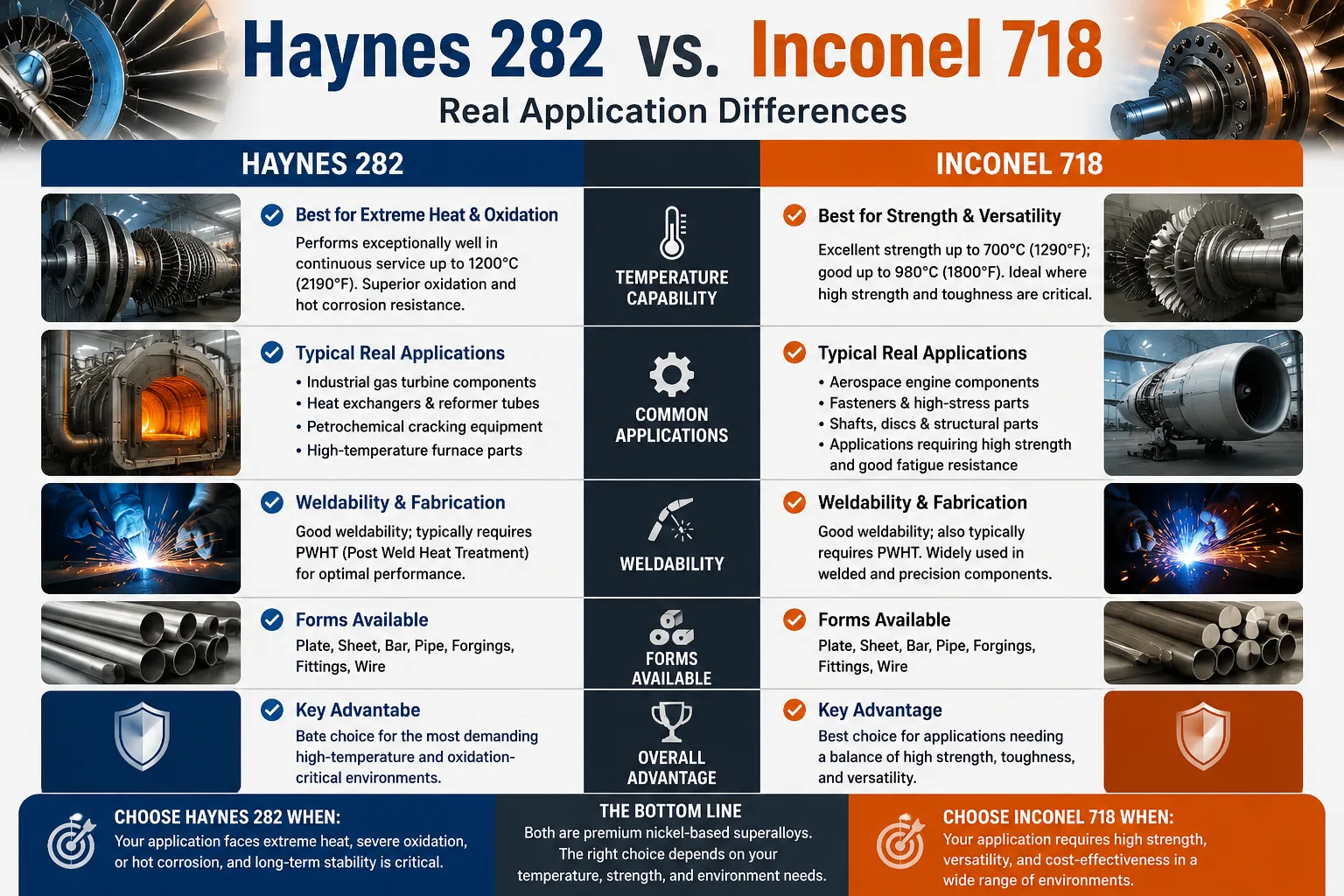
Inconel 718 Dominant Applications
Turbine Disks and Blisks: The single largest application domain for Inconel 718 remains turbine disks in gas turbine engines — both aircraft and industrial. The combination of high tensile and yield strength at temperatures up to 650°C, excellent fatigue resistance, and proven powder metallurgy processing routes makes Inconel 718 the standard disk material for many turbine stages. Estimates suggest that Inconel 718 accounts for approximately 35% to 45% of all nickel superalloy usage in gas turbine engines by weight (Reed, R.C., The Superalloys: Fundamentals and Applications, Cambridge University Press, 2006).
Fasteners and Structural Components: The high room-temperature strength of Inconel 718 (up to 1,380 MPa UTS) makes it the standard material for high-strength fasteners in aerospace structural applications, engine mounts, and turbine case bolting where thread engagement and preload retention are critical.
Cryogenic Applications: Inconel 718's retention of ductility and toughness at cryogenic temperatures (down to -253°C, liquid hydrogen temperature) makes it the standard material for liquid oxygen and liquid hydrogen turbopumps in rocket engines — including the Space Shuttle Main Engine (SSME) and numerous successor systems. No other alloy in this strength class matches Inconel 718's combination of high strength and cryogenic toughness.
Injection Molding and Extrusion Tooling: In our industrial tool and die applications, Inconel 718 sees significant use in injection molding components, extrusion screw tips, and tooling that contacts abrasive compounds at moderate elevated temperatures (300°C to 500°C). The alloy's hardness, corrosion resistance, and strength at these temperatures make it a step up from tool steels in demanding applications.
Haynes 282 Growing Application Base
Advanced Gas Turbine Casings and Rings: The traditional material for turbine casings has been solid-solution-strengthened alloys like Hastelloy X or Haynes 230, which lack precipitation hardening strength but offer excellent fabricability. Haynes 282 fills the gap by providing precipitation hardening strength to 900°C with sufficient fabricability for large, welded structures. General Electric, Rolls-Royce, and Siemens have qualified or are actively qualifying Haynes 282 for turbine casing and combustor components in next-generation gas turbines.
Advanced Ultra-Supercritical Steam Turbines: The push for higher efficiency in coal and natural gas power generation requires steam temperatures above 700°C — beyond the capability of existing ferritic steels and at the edge of Inconel 718's capability. Haynes 282 has been extensively evaluated under the US DOE A-USC program and the European AD700 project as a candidate for steam turbine rotors, casings, and valves at 700°C to 760°C steam temperatures.
Combustor Liners and Transition Ducts: The combination of high-temperature strength, good cyclic oxidation resistance, and weldability makes Haynes 282 an emerging competitor to solid-solution alloys in combustor liner applications — particularly in industrial gas turbines where long inspection intervals demand superior creep resistance.
Exhaust Systems and High-Temperature Structural Frames: Weight-critical aerospace structures that operate at elevated temperatures — such as engine exhaust frames, turbine rear frames, and afterburner components — benefit from Haynes 282's higher strength-to-weight ratio compared to solid-solution alloys at temperatures above 700°C.
| Application Domain | Preferred Alloy | Key Reason | Operating Temp Range |
|---|---|---|---|
| Turbine disks (aircraft) | Inconel 718 | Tensile strength, PM processing | Up to 650°C |
| Turbine disks (industrial, hot stage) | Haynes 282 | Creep resistance | 650-800°C |
| Turbine casings (advanced) | Haynes 282 | Weldability + creep to 900°C | 700-900°C |
| High-strength fasteners | Inconel 718 | Room-temp strength, thread quality | Ambient to 500°C |
| Combustor liners | Haynes 282 | Oxidation + creep balance | 800-950°C |
| Cryogenic turbopumps | Inconel 718 | Cryogenic toughness | -253°C to 500°C |
| A-USC steam turbines | Haynes 282 | 700°C+ creep resistance | 700-760°C |
| Injection screw tips (industrial) | Inconel 718 | Hardness, wear resistance | 300-500°C |
| Exhaust frames and ducting | Haynes 282 | High-temp strength, weldability | 650-900°C |
| Oil and gas downhole tools | Inconel 718 | Strength, H2S resistance | Ambient to 300°C |
How Do Heat Treatment Requirements Affect Component Manufacturing?
Heat treatment is not a minor detail — it determines whether the purchased alloy delivers the published mechanical properties in the final component. Both alloys have specific, process-controlled heat treatment sequences that must be executed within tight parameter windows.
Inconel 718 Heat Treatment
The standard heat treatment for wrought Inconel 718 per AMS 2774 consists of:
Solution Anneal: 980°C (1,800°F) for 1 hour, air cool or faster. This dissolves most precipitates and recrystallizes the microstructure. Some specifications call for a higher solution anneal at 1,010°C for coarser grain size when creep properties are prioritized over tensile strength.
Double Aging (Standard):
- Step 1: 720°C (1,325°F) for 8 hours, furnace cool at 55°C/hour to 620°C
- Step 2: 620°C (1,150°F) for 8 additional hours, air cool.
This two-step aging simultaneously precipitates γ'' (dominant, forms first at 720°C) and γ' (secondary, forms during cool-down and at 620°C). The resulting microstructure achieves the high tensile and fatigue properties characteristic of optimally heat-treated Inconel 718.
Temperature control within ±8°C (±15°F) is critical: over-aging by excessive temperature or time causes γ'' coarsening and/or δ phase precipitation, both of which reduce tensile strength. Under-aging leaves residual solutes in the matrix without forming the precipitation network needed for strength.
Haynes 282 Heat Treatment
The standard heat treatment for Haynes 282 consists of:
Solution Anneal: 1,010°C (1,850°F) for 2 hours, rapid air cool or water quench for thick sections. The higher solution temperature compared to Inconel 718 reflects the higher γ' solvus of Haynes 282. Grain size after solution annealing is typically ASTM 4 to 8, depending on prior working and anneal temperature.
Stabilization Age: 1,010°C (1,850°F) for 2 hours (if not performed during solution anneal step).
Final Aging (Two-Step):
- Step 1: 788°C (1,450°F) for 8 hours, air cool.
- Step 2: 649°C (1,200°F) for 8 hours, air cool.
The aging sequence develops the γ' precipitate with optimal size distribution for both tensile and creep properties. The 788°C aging step nucleates fine γ' precipitates; the 649°C step completes precipitation and provides maximum hardening.
Haynes 282's heat treatment is somewhat more forgiving than competing γ'-strengthened alloys like Waspaloy, partly because the slower γ' kinetics reduce sensitivity to exact cooling rates. However, the two-step aging and full solution anneal requirement adds cost compared to Inconel 718's more commonly abbreviated heat treatment cycles in production environments.
What Does the Cost and Supply Chain Comparison Look Like in 2026?
Material selection decisions cannot be divorced from procurement realities. Both alloys are commercially available from multiple global suppliers, but meaningful differences in pricing, lead time, and supply chain maturity affect the practical selection decision.
Raw Material and Mill Pricing
Inconel 718 is one of the most mature and heavily produced nickel superalloys globally. Annual production volumes across Special Metals (ATI), Haynes International, VDM Metals, Carpenter Technology, and numerous international producers run into tens of thousands of metric tons annually. This scale supports a competitive, liquid market.
Approximate mill pricing for wrought Inconel 718 in 2025 to 2026:
- Bar stock: $45 to $70 per kilogram depending on size and specification.
- Sheet/plate: $50 to $80 per kilogram
- Forgings: $80 to $150 per kilogram depending on complexity.
Haynes 282 production volumes are substantially lower — Haynes International is the primary producer, with limited secondary production from European and Asian mills. This lower volume translates to higher base pricing:
- Bar stock: $120 to $180 per kilogram.
- Sheet/plate: $130 to $200 per kilogram.
- Forgings: $200 to $350 per kilogram depending on qualification requirements.
The cost premium for Haynes 282 (approximately 2x to 3x raw material cost of Inconel 718) is a real procurement consideration. However, for applications where Haynes 282's higher temperature capability is genuinely needed, the alternative of using Inconel 718 beyond its stability limit introduces far greater costs through premature component failure.
Lead Time and Availability
Inconel 718 stock items (standard bar sizes, sheet) are typically available from major distributors with lead times of 2 to 6 weeks. Custom forgings require 16 to 26 weeks from major producers under normal demand conditions. AMS-qualified material for aerospace applications typically commands 4 to 8 weeks additional lead time for certification processing.
Haynes 282 has longer baseline lead times due to lower stock inventory levels at most distributors: 8 to 16 weeks for standard forms, 26 to 52 weeks for custom forgings or large castings. Procurement teams specifying Haynes 282 must build these lead times into project schedules.
Quality Certifications Required
Inconel 718: AMS 5662 (bar/forgings), AMS 5663 (bar/forgings, heat-treated), AMS 5664 (sheet/strip/plate), AMS 5832 (welding wire). For aerospace applications, NADCAP-accredited heat treatment and materials testing are standard requirements.
Haynes 282: AMS 5951 (bar/forgings/rings), ASTM B637 (bar and forgings general). Aviation engine OEM proprietary specifications are increasingly common as airline MRO qualification programs expand. Buyers should confirm applicable specification with their engineering team before ordering.
How Should Engineers and Procurement Teams Choose Between These Two Alloys?
Drawing together all the technical and commercial factors covered in this article, we offer a structured decision framework that mirrors the process our team applies when advising customers on superalloy selection.
The Primary Decision Gate: Operating Temperature
This is the non-negotiable first question. If the component maximum operating temperature is below 600°C with no sustained static load at temperature, Inconel 718 is almost certainly the better choice based on its higher room-temperature strength, lower cost, and superior fabricability. If operating temperature exceeds 700°C with any sustained mechanical load (pressure, weight, preload), Haynes 282 becomes the technically superior choice in every relevant property category.
The 600°C to 700°C window requires more detailed analysis based on the specific stress level, required service life, and duty cycle. Both alloys compete in this range, and creep life calculations using Larson-Miller parameters with the specific operating stress level should drive the decision.
Secondary Decision Factors
Fabrication complexity: Welded assemblies, especially large structures, favor Haynes 282's better hot formability and acceptable weldability. Complex machined components in high volume favor Inconel 718's better machinability and simpler heat treatment.
Service life priority: For 25,000+ hour components (land-based turbines, power generation equipment), Haynes 282's creep advantage compounds significantly over time and justifies higher initial material cost. For shorter-life components or those on planned replacement cycles, the economic advantage shrinks.
Cryogenic requirements: Inconel 718 is the clear choice for components that must function at sub-zero temperatures, as it retains toughness to cryogenic temperatures far better than most competing superalloys.
Supply chain risk tolerance: Programs requiring large volumes or tight delivery schedules may prefer Inconel 718's more liquid supply chain. Strategic programs with long development timelines can absorb Haynes 282's longer lead times.
Decision Matrix Summary
| Decision Criterion | Points to Inconel 718 | Points to Haynes 282 |
|---|---|---|
| Operating temperature | Below 650°C | Above 700°C |
| Primary loading mode | Tensile, fatigue, impact | Creep, sustained stress |
| Service environment | Cryogenic, moderate temp | High oxidation, hot corrosion |
| Fabrication method | Complex machining, welded assemblies (thin) | Large welded structures, forgings |
| Budget constraint | Cost-sensitive | Performance-critical |
| Service life requirement | Short to medium (<10,000 hrs) | Long duration (>25,000 hrs) |
| Supply chain requirement | Standard lead time | Extended lead time acceptable |
| Regulatory/certification | Fully qualified (aerospace) | Qualification ongoing/expanding |
FAQs: Haynes 282 vs. Inconel 718
1. At what temperature does Haynes 282 outperform Inconel 718 in creep strength?
Haynes 282 surpasses Inconel 718 in creep strength at temperatures above approximately 650°C to 680°C. Below this crossover temperature, Inconel 718's higher γ'' + γ' precipitate volume fraction provides slightly better creep resistance. Above 700°C, Haynes 282's thermally stable γ' precipitates provide dramatically superior performance: at 760°C and 200 MPa stress, Haynes 282 achieves creep rupture lives more than 300% longer than Inconel 718. This crossover is directly tied to the γ'' phase instability in Inconel 718 above 650°C. Engineers should use this temperature threshold as the primary decision point when selecting between these two alloys for creep-critical applications. Source: Haynes International Technical Bulletin H-3159; Haghighat et al., Materials Science and Engineering A, 2018.
2. Can Inconel 718 be used above 700°C in any application?
Inconel 718 can be used above 700°C in applications with very short exposure times, low sustained stress, or primarily cyclic (not sustained) loading. In practice, some aerospace exhaust components see short-duration temperature spikes above 700°C without immediate failure. However, for any component requiring dimensional stability, sustained load-bearing, or long service intervals above 700°C, Inconel 718 is not recommended. Extended exposure at 700°C to 800°C causes irreversible γ'' to δ phase transformation, permanently reducing tensile strength by 10% to 25% and ductility by 15% to 30% in documented aging studies. Using Inconel 718 above its design temperature limit is a common cause of premature component failure in industrial applications. Source: Radavich, Superalloys 718 TMS proceedings, 1994.
3. Is Haynes 282 approved for aerospace gas turbine applications?
Haynes 282 has received AMS 5951 specification approval and is qualified or under active qualification at several major aerospace engine OEMs including GE Aviation, Rolls-Royce, and Pratt and Whitney for specific component applications. Its primary aerospace applications include turbine casings, combustor components, and hot-section structural rings in next-generation gas turbines. The alloy has also been qualified by ASME Boiler and Pressure Vessel Code for elevated temperature pressure vessel applications (Code Case 2625). Broader aerospace qualification, particularly for rotating disk applications, is an ongoing process. Buyers should confirm current OEM qualification status for their specific component application before specifying Haynes 282. Source: ASME BPVC Code Case 2625; Haynes International qualification data.
4. What is the density and strength-to-weight ratio comparison between the two alloys?
Inconel 718 has a density of approximately 8.19 g/cm³. Haynes 282 has a density of approximately 8.27 g/cm³ — marginally heavier. At room temperature, the specific ultimate tensile strength of Inconel 718 (1,380 MPa / 8.19 g/cm³ = 168 MPa per g/cm³) exceeds that of Haynes 282 (1,050 MPa / 8.27 g/cm³ = 127 MPa per g/cm³). However, at 760°C, the comparison reverses significantly: Haynes 282 achieves approximately 860 MPa UTS versus 580 MPa for Inconel 718, giving specific tensile strengths of 104 and 71 MPa per g/cm³ respectively — a 46% advantage for Haynes 282 on a weight-normalized basis at this temperature. For weight-critical high-temperature structures, this elevated-temperature strength-to-density ratio is the relevant figure of merit. Source: Haynes International H-3159; Special Metals IN718 technical data.
5. How does the cost of Haynes 282 compare to Inconel 718 on a total component lifecycle basis?
On a raw material basis, Haynes 282 costs approximately 2x to 3x more than Inconel 718 per kilogram in 2025 to 2026 market conditions. However, lifecycle cost analysis for high-temperature applications typically reverses this premium. A component application at 750°C requiring 25,000-hour service life may need Inconel 718 replacement every 8,000 to 10,000 hours due to creep-induced dimensional change — requiring 2 to 3 replacements versus 1 Haynes 282 component over the same period. Adding replacement labor, downtime, and reinstallation costs, the total lifecycle cost of Inconel 718 can exceed Haynes 282 by 1.5x to 2.5x in demanding service conditions. This lifecycle calculation is the correct economic framework for premium alloy selection decisions. Source: Shingledecker et al., ASME Turbo Expo proceedings, 2012; MWalloys application analysis.
6. Which alloy has better resistance to hydrogen embrittlement?
Inconel 718 has been more extensively tested and qualified for hydrogen-containing environments, particularly in aerospace hydrogen propulsion and oil and gas applications. The alloy meets NACE MR0175/ISO 15156 requirements for sour (H2S-containing) service in appropriate heat-treated conditions. Hydrogen embrittlement susceptibility of Inconel 718 is low due to its FCC crystal structure and high nickel content. Haynes 282 also has an FCC structure and high nickel content, and is expected to have similar inherent resistance to hydrogen embrittlement, but published qualification data in hydrogen-rich environments is substantially less extensive than for Inconel 718. For hydrogen service applications, Inconel 718 is the more fully documented and qualified choice based on available literature. Source: NACE MR0175/ISO 15156; Reed, Superalloys, Cambridge, 2006.
7. What welding filler metal should be used for each alloy?
For Inconel 718, the standard welding filler is ERNiFeCr-2 (matching composition, AMS 5832) for TIG and MIG welding of like-to-like joints. For dissimilar metal joints to other nickel superalloys, Inconel 625 filler (ERNiCrMo-3) is commonly used as a conservative buffer choice. For Haynes 282, Haynes International recommends using matching composition filler (Alloy 282 welding wire) when full property matching is required after post-weld heat treatment, particularly for elevated temperature creep applications. For non-critical joints or when full solution re-anneal is not possible after welding, Inconel 625 filler provides acceptable corrosion and oxidation resistance without the cracking risk that matching filler with improper post-weld treatment might introduce. Source: Osoba et al., Metallurgical and Materials Transactions A, 2012; Haynes International welding guidelines.
8. How do Haynes 282 and Inconel 718 compare to Waspaloy in high-temperature applications?
Waspaloy (UNS N07001) is a competitor alloy with higher γ' volume fraction (approximately 25% to 30%) than Haynes 282, providing higher room-temperature and creep strength at equivalent temperatures. However, Waspaloy is significantly more difficult to weld (high strain-age cracking risk) and machine than both Inconel 718 and Haynes 282. Haynes 282 was specifically developed to match Waspaloy's high-temperature creep performance while offering substantially better fabricability. Published comparisons show Haynes 282 achieving creep rupture lives within 10% to 15% of Waspaloy at 760°C and equivalent stress, while being approximately 40% to 60% easier to weld based on Sigmajig test results. For applications where both high-temperature performance and complex welded fabrication are required, Haynes 282 represents the superior balance between Inconel 718's excellent fabricability and Waspaloy's high-temperature strength. Source: Osoba et al., 2012; Sims et al., Superalloys II, Wiley, 1987.
9. Are there any known failure modes specific to Haynes 282 that engineers should watch for?
Three specific failure modes merit attention for Haynes 282 in service. First, sigma and mu phase precipitation at grain boundaries during extended service above 800°C (associated with the high molybdenum content at 8.5%) can reduce grain boundary ductility in aged material; this is managed through optimized heat treatment and periodic inspection in long-life components. Second, machining-induced surface damage (from inadequate cutting parameters or dull tooling) can introduce compressive residual stresses or microstructural damage that reduces fatigue life; proper machining protocols with sharp carbide or ceramic tooling are essential. Third, improper post-weld heat treatment — particularly skipping the full solution anneal step after welding to save time — results in incomplete property recovery in the HAZ, creating a zone of reduced creep and tensile strength that can initiate premature failure. These failure modes are known and manageable with proper engineering controls. Source: Matuszewski et al., International Journal of Fatigue, 2014; Haynes International application notes.
10. What is the maximum continuous service temperature for Inconel 718 and Haynes 282 under zero mechanical load?
Under zero mechanical load (pure thermal exposure, no structural stress), the temperature limits are governed by oxidation resistance and microstructural stability rather than creep. Inconel 718 maintains acceptable surface oxidation rates for continuous exposure up to approximately 980°C (1,800°F) in air, though microstructural degradation (δ phase growth at grain boundaries) occurs continuously above 700°C and must be considered for long-duration exposures. Haynes 282 maintains acceptable oxidation rates for continuous exposure up to approximately 1,010°C (1,850°F), with microstructural stability superior to Inconel 718 throughout the 700°C to 1,000°C range due to the higher thermal stability of its γ' precipitate phase. For components that experience significant stress, both alloys must be assessed at their structural temperature limits (650°C for IN718, 900°C for H282), not their zero-load oxidation limits. Source: Haynes International H-3159 technical bulletin; Special Metals Corporation IN718 technical data sheet.
Summary: Key Engineering Takeaways
The choice between Haynes 282 and Inconel 718 is not a general superiority question — it is a precision temperature-governed engineering decision with significant cost and performance consequences.
Inconel 718 remains the dominant superalloy for the 23°C to 650°C performance envelope, offering unmatched tensile strength, fatigue resistance, cryogenic capability, fabricability, and supply chain depth. Its 60+ year production history, extensive qualification database, and competitive pricing make it the rational default choice for any application that operates within its temperature capability.
Haynes 282 occupies a unique and increasingly important performance space from 650°C to 900°C, where no other readily weldable precipitation-hardened nickel superalloy can match its combination of creep resistance, oxidation protection, and fabricability. As advanced gas turbines, A-USC steam power plants, and next-generation aerospace propulsion systems push operating temperatures higher, Haynes 282's application domain will expand accordingly.
At MWalloys, we supply both alloys with full material certifications, application engineering support, and traceability documentation. Our recommendation is always grounded in the specific temperature, stress, environment, and fabrication requirements of your component — because the right alloy selected correctly will consistently outperform a premium alloy misapplied to the wrong service condition.
References:
- Haynes International. Alloy 282 Technical Bulletin H-3159. 2023.
- Special Metals Corporation. Inconel Alloy 718 Technical Data. 2023.
- Reed, R.C. The Superalloys: Fundamentals and Applications. Cambridge University Press, 2006.
- Sims, C.T., Stoloff, N.S., Hagel, W.C. Superalloys II. Wiley, 1987.
- Haghighat, S. et al. Materials Science and Engineering A, Volume 718. Elsevier, 2018.
- Osoba, L.O. et al. Metallurgical and Materials Transactions A, Volume 43. TMS, 2012.
- Matuszewski, K. et al. International Journal of Fatigue, Volume 61. Elsevier, 2014.
- Shingledecker, J.P. et al. Proceedings of the ASME Turbo Expo. ASME, 2012.
- Radavich, J.F. Superalloys 718, 625, 706 and Derivatives. TMS, 1994.
- Furrer, D. and Fecht, H. JOM, Volume 51. TMS, 1999.
- ASME Boiler and Pressure Vessel Code, Code Case 2625.
- AMS 5662, 5663, 5664, 5832, 5951 specifications. SAE International.
- NACE MR0175 / ISO 15156. NACE International.
- Bureau of Materials Science, Oak Ridge National Laboratory. A-USC Research Program Reports. 2010-2015.