

ASTM B574 and ASTM B637 are not interchangeable specifications. ASTM B574 covers rod made from specified corrosion-resistant, low-carbon nickel alloys, including commonly purchased grades such as UNS N10276 (Alloy C-276) and UNS N06022 (Alloy C-22). ASTM B637 covers specified nickel-alloy bars, forgings, and forging stock supplied in the heat-treated or cold-worked conditions defined by that standard; UNS N07718 (Alloy 718) is a familiar example. The choice therefore depends on alloy designation, product form, required condition, and service requirements, not simply on whether both materials are called “nickel alloy.” A purchase order that names the wrong standard can request an unavailable product form, the wrong mechanical condition, or documentation that does not establish the properties the design needs.
The distinction sounds straightforward until a drawing calls for “Hastelloy bar,” “Inconel rod,” or “nickel alloy forging” without an UNS number or heat-treatment condition. Those descriptions leave important questions unanswered. Which chemistry is required? Will the component face aggressive process fluids or sustained mechanical loading at elevated temperature? Is the material a mill-produced rod, a forged blank, or a finished machined part? What evidence must accompany delivery?
At MWalloys, we recommend settling those questions before comparing quotations. A correct standard designation does more than name a material. It establishes the product covered, the tests used to accept it, and the condition in which the mill must supply it.
What is the main difference between ASTM B574 and ASTM B637?
The shortest useful answer is that B574 is a rod specification centered on listed corrosion-resistant nickel alloys, while B637 is a specification for listed nickel-alloy bars, forgings, and forging stock with defined strengthening conditions. Neither standard is a universal specification for every nickel alloy.
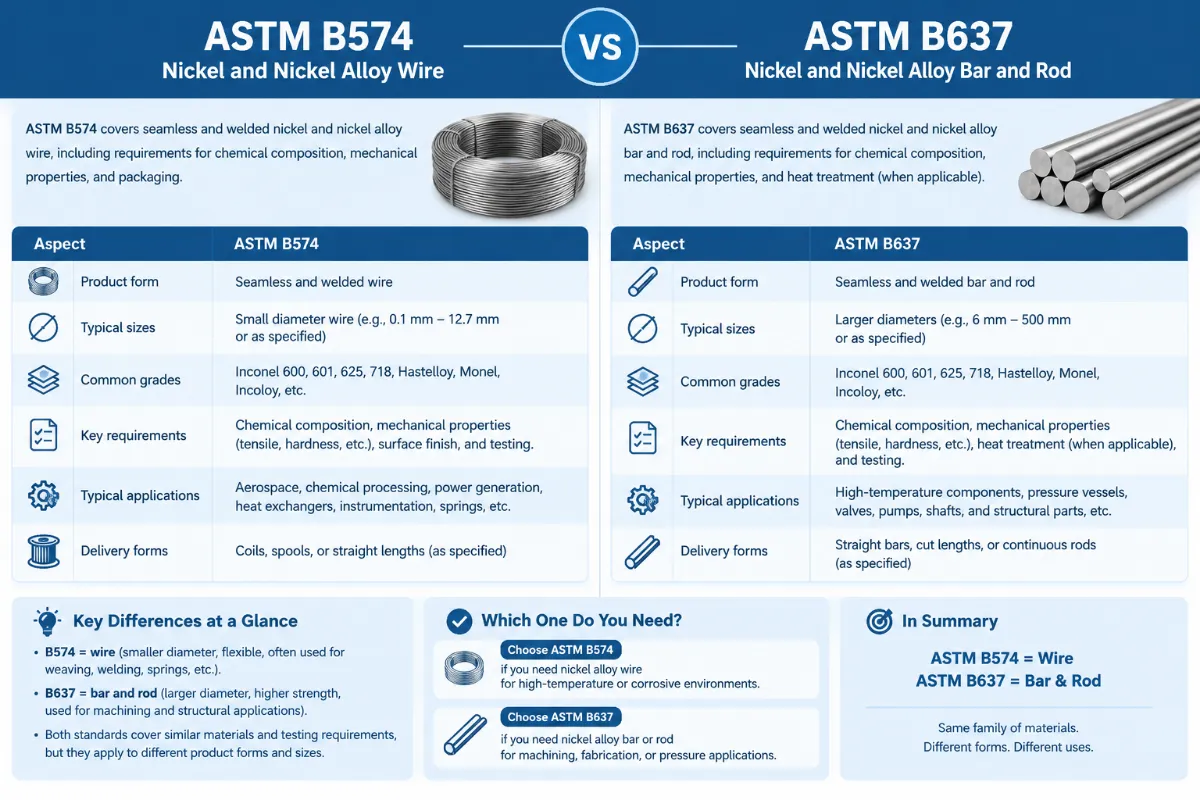
| Purchase question | ASTM B574 | ASTM B637 |
|---|---|---|
| What products does it cover? | Rod | Bars, forgings, and forging stock |
| What alloy group is commonly associated with it? | Listed low-carbon, corrosion-resistant nickel alloys, notably nickel-chromium-molybdenum grades | Listed precipitation-hardening and cold-worked nickel alloys |
| Familiar alloy example | UNS N10276, Alloy C-276 | UNS N07718, Alloy 718 |
| What usually drives selection? | Required corrosion-resistant alloy in rod form | Required listed alloy, product form, and mechanical condition |
| Can the standard number replace an UNS designation? | No | No |
| Does the standard alone establish suitability in a particular environment? | No | No |
The descriptions above are a comparison, not a substitute for either specification. The controlling requirements are those in the edition cited on the purchase order. Alloy listings, dimensional provisions, tests, and supplementary requirements must be checked against that edition.
“Rod” and “bar” are sometimes used loosely in conversation. In procurement, that shortcut creates avoidable risk. If a buyer requests a forging under a rod specification, the problem is not fixed by noting that the forging was machined into a round shape. Product standards apply to defined manufacturing forms and acceptance routes, not merely to the appearance of the finished component.
What products and alloys does ASTM B574 actually cover?
ASTM B574 is titled as a specification for rod made from specified families of low-carbon nickel alloys. Its scope includes listed nickel-chromium-molybdenum compositions and related alloy families. The exact title and alloy list can change with revisions, so an engineer should consult the purchased edition rather than rely on a shortened distributor description.
Two widely recognized examples are:
- UNS N10276, Alloy C-276: a nickel-chromium-molybdenum-tungsten alloy frequently considered in severe chemical-processing environments.
- UNS N06022, Alloy C-22: a nickel-chromium-molybdenum-tungsten alloy known for its chromium-rich corrosion-resistant chemistry.
These names identify different materials. “C-series alloy,” “Hastelloy-type material,” and “corrosion-resistant nickel alloy” are not adequate substitutions for a specified UNS number. Nor does the presence of nickel, chromium, and molybdenum prove that an alloy appears in B574.
Why does the word “low-carbon” matter?
Carbon limits help control the formation of certain carbide phases and support the intended corrosion performance of these alloy systems. They do not mean a component is immune to corrosion. Resistance still depends on the medium, concentration, temperature, contaminants, fabrication history, and surface condition.
Low carbon also should not be mistaken for a heat-treatment instruction. The ordering document must establish the applicable material condition and any project-specific processing requirements. If corrosion resistance after fabrication is critical, the engineer should evaluate the finished component and its thermal history, not only the chemistry reported by the mill.
Does B574 cover plate, tube, pipe, or every type of forging?
No. A B574 certificate does not turn plate, tube, pipe, or a forging into B574 rod. Nickel-alloy product forms are addressed through different specifications, often with different manufacturing and inspection requirements. For example, ASTM B575 is associated with specified nickel-alloy plate, sheet, and strip, while ASTM B564 addresses nickel-alloy forgings within its scope. The appropriate specification must still be checked against the particular UNS grade.
A machined part can originate from B574-compliant rod. In that case, the certificate establishes the starting material’s reported compliance. It does not, by itself, certify every later operation performed on the finished part.
What products and conditions does ASTM B637 cover?
ASTM B637 addresses listed nickel-alloy bars, forgings, and forging stock intended for moderate- or high-temperature service. Its title identifies precipitation-hardening and cold-worked materials. Alloy 718, designated UNS N07718, is one of the best-known materials purchased to this specification; Alloy X-750, UNS N07750, is another commonly associated grade.
Those examples should not be read as permission to order any nickel alloy to B637. The applicable edition must list the grade and provide requirements for the requested form and condition.
B637 also raises a question that a simple alloy name cannot answer: what condition must be delivered? A precipitation-hardenable alloy can exhibit materially different properties before and after the specified thermal processing. Cold working can likewise alter strength and ductility. Chemistry alone cannot demonstrate compliance with a required mechanical condition.
How does precipitation hardening change the procurement decision?
In precipitation hardening, a controlled thermal sequence produces strengthening phases within the alloy. For Alloy 718, the resulting properties depend on both the material’s earlier processing and the specified solution-treatment and aging route. A supplier must therefore know the required condition before pricing, testing, or promising a delivery date.
An engineer should not assume that any component labeled “718” meets a drawing’s strength requirement. The acceptance question is narrower: Does this identified heat and product form meet the specified edition, condition, and mechanical-property requirements?
Cold-worked conditions require equal care. Deformation used to develop strength may affect formability, residual stress, and subsequent manufacturing steps. A purchaser who needs an age-hardened forging should not accept a cold-worked bar merely because both materials appear under B637.
How do alloy chemistry and strengthening mechanisms differ?
The two specifications should not be reduced to “corrosion alloy versus strong alloy.” Both groups contain useful combinations of corrosion resistance, strength, and temperature capability. Their alloy designs and typical selection priorities differ, however.
| Example alloy | Common specification context | Important alloy-design feature | Typical engineering question |
|---|---|---|---|
| UNS N10276, Alloy C-276 | B574 rod | Nickel-chromium-molybdenum-tungsten chemistry | Will the material withstand the specified chemical environment and fabrication route? |
| UNS N06022, Alloy C-22 | B574 rod | Nickel-chromium-molybdenum-tungsten chemistry with a different elemental balance | Which alloy performs better under the actual oxidizing, reducing, or mixed conditions? |
| UNS N07718, Alloy 718 | B637 bar, forging, or forging stock, when covered by the cited edition | Nickel-chromium chemistry with elements used to develop precipitation-hardened strength | Will the delivered condition meet the required strength and service-temperature criteria? |
| UNS N07750, Alloy X-750 | B637 product forms covered by the cited edition | Precipitation-hardenable nickel-chromium alloy | Are the specified condition and properties suitable for the component’s duty? |
This table deliberately avoids presenting nominal compositions as acceptance limits. Composition compliance is determined from the actual chemical limits in the specified standard and edition, together with any stricter project requirements. A supplier’s brochure value may be useful background, but it is not the acceptance criterion.
We also advise against choosing between C-276 and 718 by comparing a single tensile-strength figure. The former may be selected for a particular corrosive environment; the latter may be selected for a demanding strength and temperature requirement. Replacing either one with the other can change the component’s failure risks, even when both are nickel-based.
Why are product form and manufacturing route important?
A standard describes material at a defined point in its manufacturing route. Later operations can change the questions an inspector needs to ask.
Consider three components that all arrive as round, machined blanks:
- One was cut from mill-produced rod.
- One was machined from bar.
- One was produced from a forged preform.
Their final appearance does not establish a shared product specification. The forging may need requirements tied to forging practice and its specified heat treatment. The rod may be accepted under a rod specification. Dimensional checks on the finished blank cannot reconstruct the acceptance history of the original material.
| Manufacturing detail | Why an engineer or buyer should ask about it |
|---|---|
| Original mill form | Determines which product specification may apply |
| UNS designation | Identifies the alloy chemistry being purchased |
| Heat or lot identification | Connects delivered pieces to test results and records |
| Hot working or cold working | Can affect structure and mechanical properties |
| Solution treatment or aging | May determine the delivered property condition |
| Machining after certification | Changes dimensions and may introduce new inspection needs |
| Welding or subsequent heating | May require separate assessment of the finished component |
A practical example is a drawing that specifies “ASTM B637 Alloy 718 forging” while the supplier offers a machined part cut from certified 718 bar. Both may use the same UNS alloy, but the offered product is not automatically the specified forging. The designer must decide whether bar stock is an acceptable substitution, then document any approved change.
The reverse issue occurs when a buyer requests “B574 C-276 forging.” The chemistry and intended shape may be understandable, but the specification-form combination needs clarification. Do not resolve that conflict by issuing a certificate with an unsupported standard number.
How should engineers compare mechanical properties under the two standards?
Compare properties within the exact grade, size range, form, condition, test orientation where applicable, and specification edition. A headline tensile value copied from a product page does not provide that context.
Mechanical testing commonly addresses properties such as tensile strength, yield strength, and elongation. Depending on the material, form, edition, and order, other tests or requirements may matter. For a precipitation-hardened product, acceptance must be tied to the prescribed thermal condition. For a corrosion-resistant rod, the specified delivery condition and any additional project requirements still need confirmation.
A useful review sequence is:
- Identify the alloy: Record the UNS number, not only a trade name.
- Identify the starting form: Rod, bar, forging, or forging stock.
- Identify the condition: State the required treatment or temper using the applicable specification’s terminology.
- Check the relevant size provisions: Requirements may depend on product dimensions.
- Compare the actual certificate results: Review reported values against the limits in the specified edition.
- Check what happened afterward: Determine whether machining, welding, forming, or additional heating affects the design assessment.
Why might an unusually high strength result need a closer look?
A higher number is not automatically evidence of a better purchase. It may indicate a different processing condition, with consequences for ductility or the intended fabrication route. It may also reflect a test result taken from a different product size or condition than the one requested.
We would rather see a certificate that clearly demonstrates compliance with the specified condition than an impressive isolated strength value without traceability. Engineering acceptance requires the right properties, not merely large numbers.
Does either specification prove corrosion resistance in service?
No. A product specification establishes requirements for the material within its scope. It does not guarantee performance in every plant, seawater system, acid mixture, or high-temperature atmosphere.
Corrosion behavior can change with:
- Fluid composition and contaminant levels
- Temperature and pressure
- Oxygen availability and flow conditions
- Crevices, deposits, and stagnant regions
- Welds, heat-affected zones, and filler-metal selection
- Surface finish and cleaning practices
- Galvanic contact with other materials
For an especially consequential application, the project may require laboratory or field testing beyond the product standard. ASTM G31 provides a framework for laboratory immersion corrosion testing, while ASTM G48 addresses specified pitting and crevice-corrosion tests. Whether either method is relevant depends on the failure mechanism being evaluated. A test result should never be treated as a universal ranking of alloys in all media.
For sour oil and gas service, additional requirements may arise under the applicable edition of NACE MR0175/ISO 15156 or project documents. A certificate stating B574 or B637 compliance alone does not establish sour-service qualification. Material, hardness, condition, environment, and application limits need separate review.
Can ASTM B574 and ASTM B637 be substituted for one another?
No, not by changing the standard number on the purchase order. The standards cover different defined products and alloy selections. An acceptable substitution requires an engineering evaluation of the actual material and component.
| Proposed change | Main issue | Appropriate next step |
|---|---|---|
| B574 C-276 rod instead of B637 718 bar | Different alloy systems and likely different design priorities | Reassess corrosion, strength, temperature, and component design |
| B637 718 bar instead of a specified B637 718 forging | Same UNS number may be possible, but product form differs | Obtain engineering approval and revise the drawing or purchase order |
| C-22 rod instead of C-276 rod under B574 | Different UNS chemistry and corrosion behavior | Evaluate the actual service environment before approving |
| Unaged 718 stock instead of a required aged condition | Mechanical condition may not meet the design requirement | Specify an approved processing and verification route |
| Machined round blank instead of specified mill rod | Finished shape does not establish original form | Confirm starting material, traceability, and applicable standard |
An approved deviation should identify what has changed and what evidence supports acceptance. It should not be hidden behind wording such as “equivalent nickel alloy.” Equivalence is a conclusion reached for a defined application, not an inherent property of two product names.
What should a purchase order state to prevent a costly mismatch?
A well-written purchase order lets the mill or distributor quote a specific, verifiable product. At minimum, it should identify the UNS grade, ASTM specification and edition, product form, dimensions, quantity, delivery condition, and required documentation. Application-specific testing belongs in the same ordering package when it is necessary for acceptance.
| Purchase-order field | Clear instruction | Ambiguous instruction to avoid |
|---|---|---|
| Material | “UNS N10276” | “Hastelloy-type nickel alloy” |
| Specification | “ASTM B574, [required edition]” | “ASTM nickel standard” |
| Product form | “Rod, [required shape and size]” | “Round material” |
| Condition | Condition required by the drawing and applicable specification | “Standard condition” without confirmation |
| Identification | Heat traceability maintained through delivery | “Material certificate available” |
| Testing | List project-specific tests and acceptance criteria when required | “Corrosion tested” without a method or criteria |
| Documentation | State the required inspection document and reported results | “Full papers” |
When sourcing Alloy 718, replace the B574 entry with the applicable B637 requirement and state whether the order is for bar, a forging, or forging stock. Specify the required condition precisely. If a fabrication shop will perform the final aging operation, responsibilities and acceptance testing need to be agreed upon before material is released.
A sample inquiry can be concise:
Please quote UNS N07718 bar to ASTM B637, [specified edition], in the required condition stated on drawing [number and revision]. Provide dimensions, quantity, heat traceability, chemical analysis, mechanical test results, and the requested inspection document. Identify any proposed deviation before order acceptance.
The bracketed details are not optional in a final purchase order. They are placeholders the buyer must complete.
What should engineers check on a mill test certificate?
A mill test certificate, often called an MTC or MTR, should let the recipient connect the delivered material to the requirements ordered. The name of a standard printed at the top is not sufficient.
Check the following:
- Manufacturer and product identification: Who made the material, and what product form was supplied?
- Standard and edition: Do they match the purchase order?
- UNS designation: Does the reported grade match the drawing?
- Heat or lot number: Can each delivered piece be traced to the reported results?
- Dimensions and condition: Are they consistent with what was ordered?
- Chemical analysis: Are the reported results within the applicable limits?
- Mechanical results: Were the required properties tested and reported for the relevant condition?
- Heat-treatment information: Is it adequate to establish the required delivery condition?
- Additional tests: Are project-specific results and acceptance criteria documented?
- Authorized certification: Is the document issued and endorsed in the required manner?
If an order requests an EN 10204 type 3.1 or 3.2 inspection document, state that explicitly and agree on the documentation route before production. The document type concerns inspection and validation arrangements; it is not a replacement for identifying the correct ASTM material requirements.
Can portable PMI replace the material certificate?
Positive material identification can be a valuable verification step, especially when several alloys are handled in one shop. It does not replace full certification. Portable X-ray fluorescence equipment, for instance, has limitations for light elements such as carbon. Instrument capability, calibration, surface condition, and the elements needing verification all matter.
Use PMI to answer the question it can reliably answer: whether a tested item’s measurable elemental signature is consistent with its identification. Use the specified material tests and traceable records to establish full product-standard compliance.
B574 or B637 may be only one line in a larger materials package. Other documents can govern testing, fabrication, the component, or the service environment.
| Document or standard family | Why it may matter | What it does not do |
|---|---|---|
| Applicable ASTM tensile-test methods, such as ASTM E8/E8M where invoked | Establishes how relevant tensile testing is performed | Selects the correct alloy or product form |
| ASTM G31 or ASTM G48, when technically appropriate | Provides defined corrosion-test methods | Guarantees universal field performance |
| EN 10204 | Defines inspection-document types | Changes the alloy’s ASTM requirements |
| NACE MR0175/ISO 15156, where applicable | Adds material-selection considerations for defined sour-service environments | Makes every nickel alloy automatically acceptable |
| ASME-adopted material specifications, when required by the design code | May establish the permitted specification edition for code work | Automatically approve every condition or component design |
| Project drawings and fabrication specifications | Define finished geometry, welding, examination, and acceptance requirements | Correct an incorrect starting-material certificate |
This separation matters. A mill can correctly supply material to a product standard while a finished pressure-containing component still fails to meet its drawing, welding specification, examination plan, or governing design code.
How can buyers compare quotations without rewarding the wrong material?
A low unit price is meaningful only after the offers have been normalized. When we review a nickel-alloy inquiry, the first comparison should be technical compliance, followed by delivery and commercial terms.
Ask each bidder to confirm:
- The exact UNS number and specification edition.
- The original mill product form.
- The supplied condition and who performs any remaining heat treatment.
- Available sizes and dimensional tolerances.
- Whether the quoted stock has heat-level traceability.
- Which chemical and mechanical results will appear on the certificate.
- Whether requested supplementary tests are included.
- Any substitution involving form, condition, source, or grade.
- Lead time for the compliant material, not merely available stock.
- How material identification will be maintained if stock is cut into pieces.
An offer that says “718 equivalent” without a condition is incomplete. So is a quotation for “C-276 round bar” when the inquiry specifically requires B574 rod and the bidder has not confirmed the applicable product designation. Clarifying these points before award is usually less disruptive than discovering them during incoming inspection.
What are the most common questions about ASTM B574 and B637?
1. Is ASTM B574 the same specification as ASTM B637?
No. They have different scopes. B574 addresses specified nickel-alloy rod, while B637 addresses specified nickel-alloy bars, forgings, and forging stock under its defined material and condition requirements.
2. Is Alloy C-276 covered by ASTM B574?
UNS N10276, commonly called Alloy C-276, is a familiar B574 rod grade. Confirm its requirements and the product’s condition against the edition stated on the purchase order.
3. Is Alloy 718 covered by ASTM B637?
UNS N07718, Alloy 718, is a commonly specified B637 grade. The order must still identify the applicable form and required condition. “718 to B637” alone may leave essential acceptance details unresolved.
4. Can a B574 certificate be issued for a forging?
B574 is a rod specification. If a component is genuinely supplied as a forging, the purchaser should identify an applicable forging specification and obtain documentation for that route. A part machined from certified rod has a different starting-material history.
5. Can an Alloy 718 bar replace an Alloy 718 forging?
Not automatically. The UNS designation may match, but product form, processing, inspection, and design assumptions may differ. The responsible engineer should review and approve the proposed change.
6. Does B637 mean every product is precipitation hardened?
No. B637’s scope includes precipitation-hardening and cold-worked nickel alloys, and requirements differ by listed grade and condition. Read the relevant provisions instead of treating the title as one universal heat-treatment instruction.
7. Does B574 guarantee that a rod will resist hydrochloric acid?
No. Corrosion performance depends on the specific alloy and the actual acid concentration, temperature, impurities, aeration, and operating conditions. The product standard is not a service-performance guarantee.
8. Is a trade name enough to place an order?
No. Trade names can aid communication, but the order should state the UNS designation, applicable specification and edition, form, dimensions, and condition. That information gives the supplier measurable acceptance criteria.
9. Should a buyer request PMI when an MTR is supplied?
PMI can add useful identity verification, particularly after cutting or machining. It is not a substitute for a traceable MTR or required chemical and mechanical testing. Choose the PMI method with its elemental limitations in mind.
10. What is the first thing to check when a quotation says “equivalent material”?
Ask what, specifically, is being changed: UNS grade, standard, product form, edition, or condition. Then request an engineering assessment tied to the component’s environment and design requirements. Do not approve equivalence based on a broad alloy-family label.
What is the safest way to specify the right nickel-alloy product?
Start with the component’s duty, then specify the UNS alloy, original product form, relevant standard and edition, required condition, dimensions, tests, and traceability. Use ASTM B574 when the required material is a listed alloy supplied as rod under that specification. Use ASTM B637 when the required alloy and bar, forging, or forging-stock product fall within its scope and the correct condition is defined.
That approach avoids the central procurement mistake: treating two nickel-alloy standard numbers as alternate names for the same material. They are separate acceptance routes. A reliable purchase is one in which the drawing, purchase order, supplied product, and certificate all describe the same thing.