
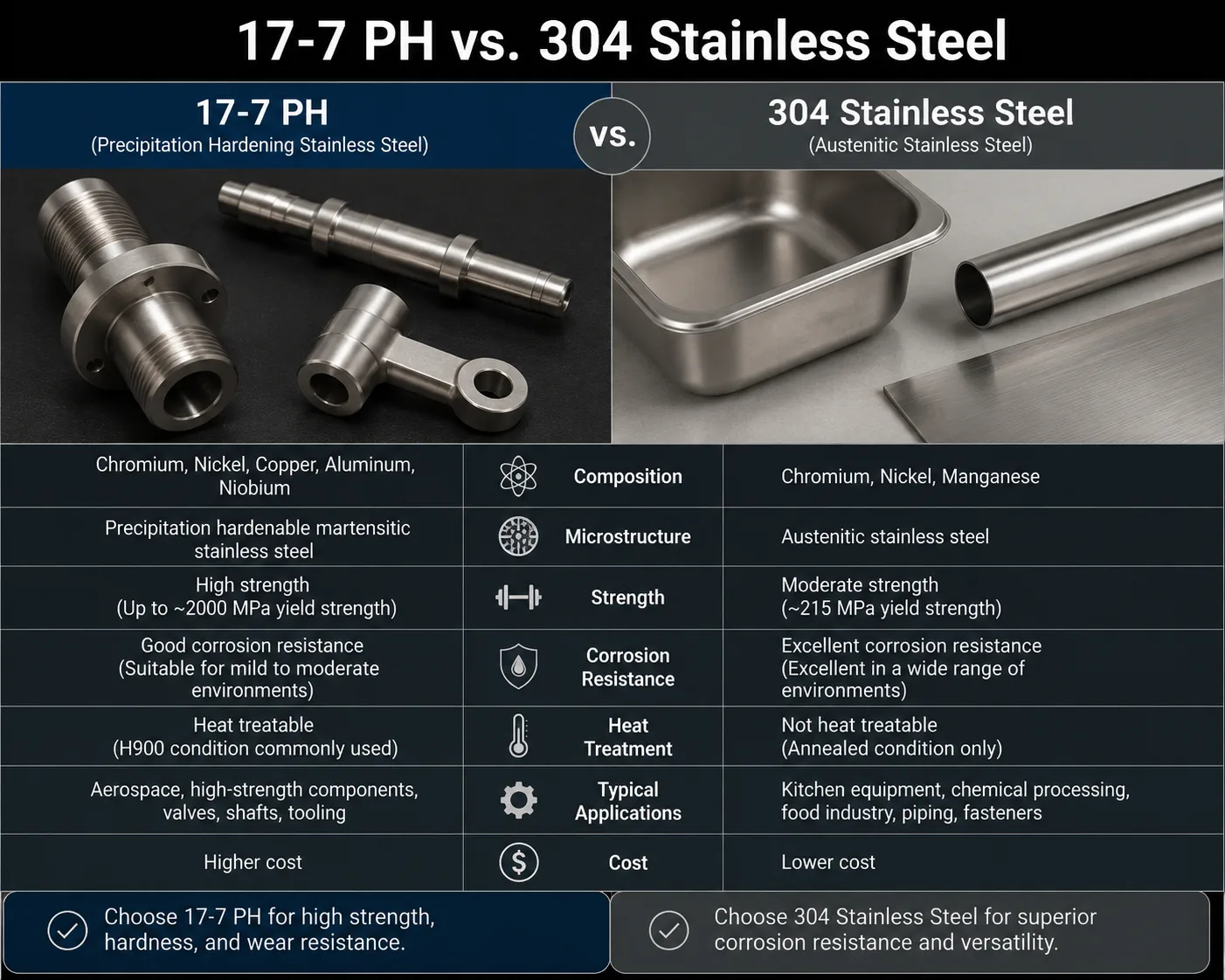
17-7 PH stainless steel outperforms 304 in tensile strength by 200–300%, delivers fatigue limits exceeding 75,000 psi in CH900 condition, and is the correct choice for springs, aerospace brackets, and high-cycle load-bearing components. Grade 304, however, remains superior for corrosion-critical food processing, architectural, and general fabrication applications where forming ease and weldability matter more than strength. Choosing the wrong alloy between these two grades is one of the most common and costly specification errors we see in manufacturing procurement. This technical comparison covers every dimension that matters.
If your project requires the use of 17-7 PH or 304 Stainless Steel, you can contact us for a free quote.
What Exactly Are 17-7 PH and 304 Stainless Steel, and Why Does the Distinction Matter?
These two alloys belong to fundamentally different stainless steel families, which is the root of why their properties diverge so dramatically. Understanding the metallurgical classification is not academic background — it is the foundation of every performance difference discussed throughout this article.
Grade 304 is an austenitic stainless steel, the most widely produced stainless alloy on earth. It achieves its corrosion resistance through a face-centered cubic (FCC) crystal structure stabilized by nickel additions, which also makes it non-magnetic in the annealed condition and highly formable. The AISI 304 designation corresponds to UNS S30400, and it is governed by specifications including ASTM A240, ASTM A276, and EN 1.4301. Global production of 304-series material represents approximately 40–45% of all stainless steel output (International Stainless Steel Forum, 2025 Annual Report).
Grade 17-7 PH is a precipitation-hardening (PH) semi-austenitic stainless steel, corresponding to UNS S17700, AMS 5528 (sheet/strip/plate), AMS 5529 (strip), and AMS 5568 (wire). The "17-7" designation refers to its nominal composition: 17% chromium and 7% nickel. What makes it fundamentally different from 304 is not just the composition but the metallurgical transformation mechanism. In the annealed (Condition A) state, 17-7 PH is austenitic and relatively easy to form. After controlled heat treatment, it transforms to a martensitic structure with aluminum-containing precipitates that dramatically increase strength — a mechanism that 304 is physically incapable of replicating through any heat treatment.
The practical consequence: you can take a flat sheet of 17-7 PH in Condition A, form it into a complex spring geometry with conventional tooling, then harden it to 200,000+ psi tensile strength through an oven treatment. No equivalent processing path exists for 304.
At MWalloys, we have handled specification reviews where engineers defaulted to 304 for spring applications purely because it was familiar, then encountered fatigue failures within weeks of commissioning. The metallurgical difference between these grades is not subtle — it is the difference between a structural alloy and a high-performance engineered material.
What Is the Chemical Composition of 17-7 PH Compared to 304?
Chemical composition drives every downstream property. The table below shows the full chemistry comparison, which reveals why these alloys behave so differently in service.
Chemical Composition Comparison: 17-7 PH vs. 304 Stainless Steel
| Element | 17-7 PH (UNS S17700) | 304 (UNS S30400) | Functional Role |
|---|---|---|---|
| Chromium (Cr) | 16.0 – 18.0% | 18.0 – 20.0% | Corrosion resistance (passive film) |
| Nickel (Ni) | 6.5 – 7.75% | 8.0 – 10.5% | Austenite stabilizer, formability |
| Aluminum (Al) | 0.75 – 1.50% | None | Precipitation hardening agent |
| Carbon (C) | 0.09% max | 0.08% max | Strength; limited to avoid sensitization |
| Manganese (Mn) | 1.00% max | 2.00% max | Austenite stabilizer, deoxidizer |
| Silicon (Si) | 1.00% max | 0.75% max | Deoxidizer, oxidation resistance |
| Phosphorus (P) | 0.04% max | 0.045% max | Tramp element, limited |
| Sulfur (S) | 0.03% max | 0.030% max | Tramp element, limited |
| Molybdenum (Mo) | None (standard) | None (standard) | Not present in either base grade |
| Iron (Fe) | Balance | Balance | Matrix element |
Sources: ASTM A240/A240M (304); AMS 5528 (17-7 PH); ASM Handbook Volume 2, Properties and Selection: Nonferrous Alloys and Special-Purpose Materials.
The critical compositional difference is aluminum. This element, present only in 17-7 PH, forms NiAl intermetallic precipitates during the aging heat treatment cycle. These nanoscale precipitates pin dislocation movement within the martensitic matrix, creating strength levels that are physically impossible to achieve in aluminum-free austenitic grades like 304.
The lower nickel content in 17-7 PH (6.5–7.75% vs. 8–10.5%) is intentional. Reducing nickel content pushes the alloy toward the austenite/martensite phase boundary, enabling the transformation required for precipitation hardening. If nickel content were as high as 304, the alloy would remain fully austenitic through heat treatment and precipitation hardening would not occur.
The slightly lower chromium in 17-7 PH versus 304 (minimum 16% vs. 18%) is the primary reason 304 has marginally better general corrosion resistance in mild environments — though the gap is smaller than most buyers assume.
How Do the Mechanical Properties of 17-7 PH and 304 Actually Compare?
This section contains the numbers that engineering specifications require. We have organized the data by heat treatment condition for 17-7 PH because condition selection is the most consequential variable in the alloy's performance profile.
Mechanical Properties: 17-7 PH (All Conditions) vs. 304 Annealed
| Property | 304 Annealed | 17-7 PH Cond. A | 17-7 PH Cond. TH1050 | 17-7 PH Cond. RH950 | 17-7 PH Cond. CH900 |
|---|---|---|---|---|---|
| Ultimate Tensile Strength (UTS) | 73,200 psi (505 MPa) | 130,000 psi (896 MPa) | 170,000 psi (1,172 MPa) | 190,000 psi (1,310 MPa) | 235,000 psi (1,620 MPa) |
| 0.2% Yield Strength | 31,900 psi (220 MPa) | 40,000 psi (276 MPa) | 155,000 psi (1,069 MPa) | 175,000 psi (1,207 MPa) | 220,000 psi (1,517 MPa) |
| Elongation (% in 2") | 40% | 35% | 6% | 6% | 1–2% |
| Reduction of Area | 70% | 60% | 25% | 10% | 5% |
| Hardness (Rockwell) | B80 max | B85–C28 | C37–C41 | C41–C44 | C44–C48 |
| Hardness (Brinell) | 187 max | ~262 | ~375 | ~400 | ~460 |
| Modulus of Elasticity | 28.0 × 10⁶ psi | 28.0 × 10⁶ psi | 28.5 × 10⁶ psi | 28.5 × 10⁶ psi | 29.0 × 10⁶ psi |
| Fatigue Limit (R.R. Moore) | ~35,000 psi | ~45,000 psi | ~68,000 psi | ~72,000 psi | ~75,000–80,000 psi |
| Charpy Impact (ft·lb) | 110+ | 75 | 35 | 20 | 5–10 |
| Magnetic Response | Non-magnetic | Slightly magnetic | Strongly magnetic | Strongly magnetic | Strongly magnetic |
Sources: AMS 5528 Rev. G; ASM Handbook Vol. 2; Carpenter Technology 17-7 PH Technical Data Sheet (2024); ASTM A240 Mechanical Requirements.
Understanding What These Numbers Mean in Practice
The raw strength numbers are dramatic, but the practical implications deserve specific attention:
Yield strength jump from Condition A to CH900: The yield strength of 17-7 PH increases from approximately 40,000 psi in Condition A to 220,000 psi in CH900 — a 450% increase through heat treatment alone. This is the defining capability of precipitation-hardening alloys. No thermal process applied to 304 can raise its yield strength above approximately 35,000–40,000 psi (it can only be work-hardened through cold working, not through precipitation).
Ductility trade-off: CH900 condition 17-7 PH elongation drops to 1–2%, meaning it is relatively brittle in impact loading. For applications involving sudden shock loads, TH1050 condition (6% elongation) or even Condition A may be preferable despite lower strength. Charpy impact values of 5–10 ft·lb in CH900 versus 110+ ft·lb for 304 illustrate why 17-7 PH in maximum strength condition is not appropriate for cryogenic or impact-dominated applications.
304 cold-worked strength: It is worth noting that heavily cold-worked 304 (e.g., 1/2 hard or full hard temper sheet) can achieve UTS values of 125,000–185,000 psi, with yield strengths of 100,000–140,000 psi. However, this cold-worked condition reduces ductility severely and applies only to specific product forms (strip and sheet), not to complex fabricated shapes. Cold-worked 304 also cannot be further strengthened by heat treatment.
What Are the 17-7 PH Heat Treatment Conditions and How Do You Choose Between Them?
The heat treatment designation system for 17-7 PH is more complex than for austenitic grades, and misunderstanding it leads to specification errors. Here is a clear breakdown of every standard condition.
17-7 PH Condition Definitions and Processing Parameters
| Condition | Processing Route | Typical Application | Key Characteristics |
|---|---|---|---|
| Condition A (Annealed) | Solution annealed at 1950°F (1066°C), quenched | Starting point; forming and machining state | Austenitic, formable, lower strength |
| Condition C (Cold worked) | Condition A + cold reduction 50%+ | High-strength strip/wire | Improved strength vs. A; still austenitic |
| Condition T (Austenite conditioning) | Heated to 1400°F (760°C), held, cooled to -100°F | Intermediate step before aging | Transforms austenite to martensite |
| Condition TH1050 | Condition T + aged at 1050°F (566°C) for 90 min | General structural aerospace; springs | Moderate strength, good ductility balance |
| Condition RH950 | Conditioned at 1750°F + refrigerated + aged at 950°F | Aerospace fasteners, shafts | High strength, moderate toughness |
| Condition CH900 | Condition C + aged at 900°F (482°C) for 60 min | Maximum strength springs; precision parts | Highest strength; lowest ductility |
Source: AMS 2759/3 Heat Treatment of Precipitation Hardening Corrosion and Heat Resistant Alloys; AMS 5528; Carpenter Technology Processing Guide (2024).
The TH1050 vs. CH900 Decision
In our experience working with aerospace and defense procurement teams, the TH1050 versus CH900 decision comes down to one question: is ductility or maximum strength the priority?
TH1050 offers a UTS of approximately 170,000 psi with 6% elongation. This condition is specified for components that need high strength but also must tolerate some deflection or minor impact without fracturing. Many aerospace structural brackets, clips, and formed parts fall into this category.
CH900 maximizes strength at 235,000 psi UTS but reduces elongation to near-zero (1–2%). This condition is appropriate for springs, clips, and precision components where the loading is purely cyclic or compressive, and where brittle fracture risk is managed through geometry (no stress concentrations, smooth radii, shot-peened surfaces).
RH950 represents a middle ground that many engineers overlook. It delivers 190,000 psi UTS with slightly better toughness than CH900 and requires refrigeration treatment rather than cold working, making it accessible for thicker sections that are difficult to cold-reduce uniformly.
How Do 17-7 PH and 304 Compare in Corrosion Resistance Across Different Environments?
Corrosion resistance is frequently cited as the primary reason to use stainless steel, yet the comparison between 17-7 PH and 304 in this domain is more nuanced than most comparison articles acknowledge.
Corrosion Resistance Comparison by Environment
| Environment | 304 Performance | 17-7 PH Performance | Preferred Grade |
|---|---|---|---|
| Atmospheric (mild, rural) | Excellent | Excellent | Either |
| Industrial atmosphere | Good | Good | Either |
| Freshwater immersion | Excellent | Excellent | Either |
| Seawater / marine splash zone | Limited; pitting risk | Similar to 304 | Neither (use 316 or duplex) |
| Dilute acids (acetic, citric) | Good | Moderate | 304 |
| Chloride solutions | Moderate | Moderate; slightly lower | 304 marginally |
| Oxidizing acids (dilute HNO₃) | Excellent | Good | 304 |
| Reducing acids (HCl, H₂SO₄) | Poor | Poor | Neither (use higher alloys) |
| Elevated temperature oxidation | Good to ~870°C | Good to ~870°C | Similar |
| Stress corrosion cracking (Cl⁻) | Susceptible | Susceptible | Neither in high-Cl⁻ |
| Crevice corrosion | Moderate susceptibility | Moderate susceptibility | Similar |
| Food contact / FDA environments | Approved | Approved (note finish) | 304 preferred for hygiene |
Sources: ASM Handbook Vol. 13A Corrosion; NACE International MR0175; Outokumpu Corrosion Handbook (12th Edition, 2023).
Why 304 Has a Slight Edge in Corrosion Resistance
The 18% minimum chromium in 304 versus 16% minimum in 17-7 PH gives 304 a slightly more robust passive film, particularly in oxidizing environments. This chromium advantage is not dramatic in most service conditions but becomes relevant in borderline environments where passive film stability is marginal.
More importantly, the martensitic microstructure of hardened 17-7 PH (in TH, RH, or CH conditions) is inherently somewhat more susceptible to hydrogen embrittlement and stress corrosion cracking in chloride-containing environments than the austenitic 304 structure. NACE guidelines for sour service (hydrogen sulfide) environments, for example, place strict hardness limits that would exclude CH900 and RH950 condition 17-7 PH.
For pharmaceutical manufacturing, food processing, and beverage applications, 304 is the preferred choice — not primarily because of its corrosion resistance over 17-7 PH, but because its austenitic structure allows polishing to Ra values below 0.8 µm consistently across large sheet areas, meeting FDA and 3-A Sanitary Standards surface requirements. The martensitic structure of hardened 17-7 PH can be polished, but achieving consistent hygienic surface finishes at production scale is more challenging.
Which Alloy Is Easier to Fabricate, Weld, and Form?
Fabricability is often the deciding factor for shops that are not equipped for specialty heat treatment. The difference between these alloys in the shop is significant.
Fabrication Property Comparison
| Fabrication Aspect | 304 | 17-7 PH (Cond. A) | 17-7 PH (Hardened) |
|---|---|---|---|
| Cold formability | Excellent | Good | Very poor |
| Deep drawing | Excellent | Moderate | Not recommended |
| Springback | Low-moderate | Moderate | High (must overcompensate) |
| Machinability rating (free-machining = 100%) | ~45% | ~40% | ~25–30% |
| Weldability | Excellent | Good with precautions | Not recommended |
| Post-weld heat treatment required | No (for most apps) | Yes (re-solution anneal recommended) | N/A |
| Cutting (laser, plasma, waterjet) | Excellent | Good | Good |
| Grinding | Excellent | Good | Moderate (generates heat) |
| Shot peening (for fatigue improvement) | Standard | Standard | Critical for CH900 springs |
Sources: AWS D1.6 Structural Welding Code — Stainless Steel; AWS Welding Handbook Vol. 4; Carpenter Technology Fabrication Guide for 17-7 PH (2024).
Welding 17-7 PH — What Engineers Need to Know
Welding 17-7 PH in Condition A is feasible using either 17-7 PH filler (AWS A5.9 ER630 or ER630 substitute) or 308L filler depending on strength requirements at the weld. However, welding introduces critical complications:
- The heat-affected zone (HAZ) of 17-7 PH welds can develop a mixture of austenitic and martensitic phases with inconsistent properties.
- Post-weld solution annealing at 1950°F (1066°C) is recommended before any aging treatment to re-homogenize the microstructure. Skipping this step can result in HAZ properties well below parent metal specifications.
- Weld joint efficiency is typically specified at 85–90% of base metal for aerospace applications.
For 304, welding is considerably more straightforward. Standard GTAW (TIG) or GMAW (MIG) with 308L filler, no preheat, no post-weld heat treatment required for most applications, and good weld pool behavior. This fabrication simplicity is a genuine competitive advantage for 304 in applications where complex assemblies need to be field-welded or where heat treatment ovens are unavailable.
Forming and Spring Manufacturing in 17-7 PH
One of the most valuable characteristics of 17-7 PH is the ability to form it in Condition A (soft, austenitic, ductile) and then strengthen it through heat treatment after fabrication. This processing sequence is fundamental to spring manufacturing:
- Form the spring geometry from Condition A strip or wire.
- Apply TH, RH, or CH heat treatment in a controlled atmosphere furnace.
- The formed part reaches maximum strength without the deformation problems of trying to form fully hardened material.
This process requires controlled atmosphere or vacuum furnaces to prevent surface oxidation. For CH900 treatment, a 900°F aging cycle for 60 minutes in a neutral atmosphere followed by air cooling is standard. Temperature uniformity within ±10°F across the load is critical — non-uniform aging creates strength variations that compromise fatigue life.
What Is the Fatigue Performance Difference Between 17-7 PH and 304?
Fatigue life is where the engineering argument for 17-7 PH becomes most compelling. For components subjected to repeated cyclic loading — springs, diaphragms, flex members, clips, retaining elements — fatigue strength determines service life more than static tensile strength does.
Fatigue Data Comparison: 17-7 PH vs. 304
| Condition | Fatigue Limit (10⁷ cycles, R.R. Moore) | Fatigue Ratio (Fatigue Limit / UTS) | Typical Stress Amplitude at 10⁶ cycles |
|---|---|---|---|
| 304 Annealed | ~35,000 psi (241 MPa) | ~0.48 | ~40,000 psi (276 MPa) |
| 304 1/2 Hard (cold worked) | ~55,000 psi (379 MPa) | ~0.38 | ~60,000 psi (414 MPa) |
| 17-7 PH Cond. A | ~45,000 psi (310 MPa) | ~0.35 | ~50,000 psi (345 MPa) |
| 17-7 PH TH1050 | ~68,000 psi (469 MPa) | ~0.40 | ~74,000 psi (510 MPa) |
| 17-7 PH RH950 | ~72,000 psi (496 MPa) | ~0.38 | ~78,000 psi (538 MPa) |
| 17-7 PH CH900 | ~75,000–80,000 psi (517–552 MPa) | ~0.33 | ~85,000 psi (586 MPa) |
| 17-7 PH CH900 + shot peened | ~90,000–100,000 psi (620–690 MPa) | ~0.40 | ~100,000 psi (690 MPa) |
Sources: Carpenter Technology PH Alloy Fatigue Data (2024); ASM Handbook Vol. 19 Fatigue and Fracture; MIL-HDBK-5J (MMPDS-01) Metallic Materials Properties Development and Standardization.
Why Shot Peening Matters So Much for 17-7 PH Springs
Shot peening introduces compressive residual stresses at the surface of 17-7 PH components, counteracting the tensile stresses that initiate fatigue cracks. The data above shows that CH900 plus shot peening can raise the effective fatigue limit to 90,000–100,000 psi — a 150–185% improvement over annealed 304 at the same loading frequency.
For aerospace-quality springs specified to AMS 13165 (shot peening) or MIL-S-13165C, this treatment is mandatory for safety-critical applications. Commercial spring manufacturers typically apply this process as standard practice for 17-7 PH CH900 springs in high-cycle applications (>10⁷ load cycles).
The practical fatigue life advantage means that an engineer designing a spring to survive 10 million cycles under ±40,000 psi stress amplitude has the following options:
- 304 annealed: Inadequate (fatigue limit ~35,000 psi; this load exceeds it)
- 304 1/2 hard: Marginal (fatigue limit ~55,000 psi; 73% utilization)
- 17-7 PH TH1050: Comfortable margin (fatigue limit ~68,000 psi; 59% utilization)
- 17-7 PH CH900: Generous margin (fatigue limit ~80,000 psi; 50% utilization)
The choice is not a matter of preference — it is a matter of physics.
What Industries and Applications Use 17-7 PH vs. 304, and Why?
Application mapping clarifies the real-world decision criteria better than abstract property comparisons. Each industry has developed its grade preferences through decades of field experience, failure analysis, and cost optimization.
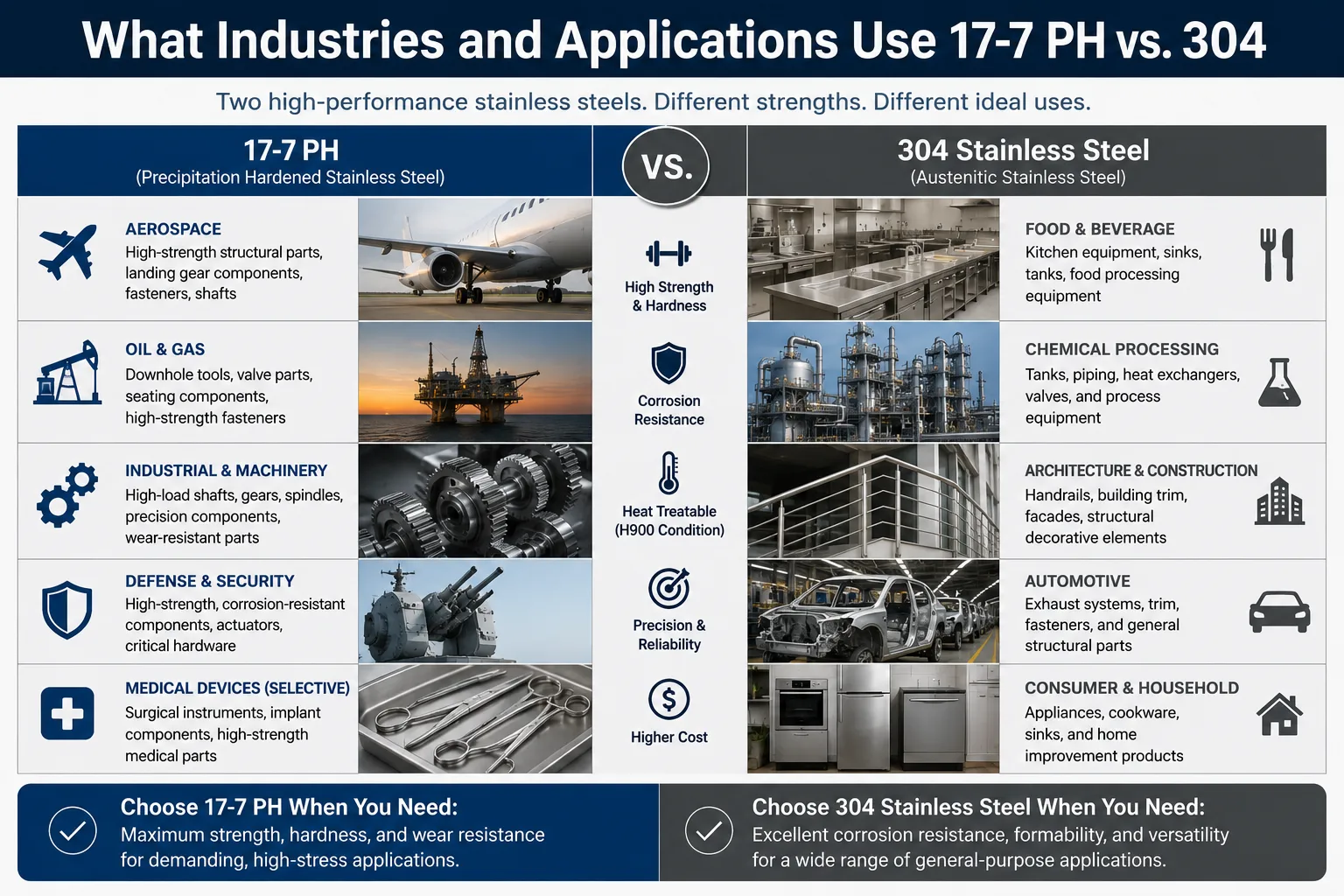
Industry Application Matrix: 17-7 PH vs. 304
| Industry / Application | Preferred Grade | Governing Factor | Key Specifications |
|---|---|---|---|
| Aerospace springs and clips | 17-7 PH CH900 | Fatigue strength, weight | AMS 5528, AMS 5529 |
| Aircraft structural brackets | 17-7 PH TH1050 | Tensile strength, weight | AMS 5528, MIL-S-25043 |
| Medical springs (implantable) | 17-7 PH or 316L | Biocompatibility + fatigue | ASTM F899 |
| Surgical instruments (non-implant) | 304 or 17-4 PH | Formability + corrosion | ASTM A276 |
| Food processing equipment | 304 | Hygiene surface, weldability | 3-A Sanitary; FDA 21 CFR |
| Chemical processing vessels | 304 (or 316L) | Corrosion resistance | ASTM A240, ASME SA-240 |
| Architectural cladding and trim | 304 | Aesthetics, weld appearance | ASTM A240 |
| Automotive exhaust components | 304 (or 439/409) | Heat resistance, cost | SAE J405 |
| Pharmaceutical piping (non-sterile) | 304L | Weldability, cleanliness | ASME BPE |
| Electronic contact springs | 17-7 PH | Fatigue, electrical conductivity | AMS 5529 |
| Diaphragms and bellows | 17-7 PH TH1050 | Fatigue, elastic deflection | AMS 5528 |
| Retaining rings (heavy duty) | 17-7 PH RH950 | Strength, hardness | AMS 5528 |
| Flatware and cookware | 304 | Formability, appearance | FDA compliance |
| Marine hardware (non-structural) | 304 | Availability, cost | ASTM A276 |
| Firearms components (springs) | 17-7 PH | Fatigue life, strength | AMS 5529 |
| Pressure vessel heads | 304 or 304L | Weldability, ASME compliance | ASME Section VIII |
| High-cycle valve springs | 17-7 PH CH900 | Fatigue life | AMS 5528 |
The Aerospace Spring Case Study
In commercial and military aviation, 17-7 PH in CH900 condition is essentially the default specification for springs, retaining clips, and formed sheet metal components requiring both high strength and fatigue resistance. Boeing Material Specification BMS 7-214 and Airbus Process Specification AP2227 both reference 17-7 PH sheet and strip for this application family.
A landing gear door hinge spring, for example, may cycle 50,000–100,000 times over an aircraft's service life. A 304 spring at these stress amplitudes would fail in fatigue within a fraction of its design life. The weight saved by using thinner-section 17-7 PH springs over thicker 304 springs to achieve the same spring rate also contributes to the design justification.
Why 304 Dominates Food and Pharmaceutical Applications
The food and pharmaceutical industries are not generally seeking maximum strength — they prioritize surface finish consistency, weldability without filler metal color mismatch, compliance with FDA 21 CFR 177 and 21 CFR 170 regulations, and cleanability. Grade 304 excels in all of these criteria:
- Consistent electropolishing response for Ra < 0.5 µm surfaces
- Full approval under FDA, EU food contact material regulations, and NSF International
- Easy orbital welding for hygienic piping systems per ASME BPE
- No heat treatment required post-fabrication that could cause dimensional changes
The magnetic properties of hardened 17-7 PH would also trigger metal detection systems in food production lines — a practical operational problem that eliminates it from many food equipment applications regardless of other properties.
How Do Prices and Availability Compare Between 17-7 PH and 304 in 2026?
Cost is always part of the engineering decision. Understanding the price differential and why it exists prevents sticker shock and informs make-versus-buy analysis.
Price Per Pound Comparison: 17-7 PH vs. 304 (US Market, May 2026)
| Product Form | 304 Price/lb (USD) | 17-7 PH Price/lb (USD) | Premium Factor |
|---|---|---|---|
| Sheet / Strip (Annealed) | $1.55 – $1.85 | $4.20 – $5.80 | 2.5 – 3.5× |
| Cold Rolled Strip (tight tol.) | $1.75 – $2.10 | $4.80 – $6.50 | 2.5 – 3.5× |
| Round Bar | $1.75 – $2.20 | $4.50 – $6.20 | 2.4 – 3.2× |
| Wire (spring wire) | $2.20 – $3.50 | $5.50 – $8.00 | 2.2 – 2.8× |
| Flat bar / plate | $1.55 – $1.80 | $4.40 – $5.90 | 2.6 – 3.4× |
Source: MWalloys procurement data and service center quotes, Q1–Q2 2026; cross-referenced against Aerospace Metals distribution pricing.
The 2.5–3.5× price premium for 17-7 PH reflects several cost factors:
- Lower production volume: 17-7 PH represents a fraction of 1% of total stainless steel output, with no comparable economies of scale to 304.
- Tighter process controls: AMS specifications require chemistry verification, mechanical testing, and often ultrasonic inspection at levels above ASTM commodity grades.
- Heat treatment complexity: AMS 2759-series heat treatment requirements add cost and require certified furnace facilities.
- Aluminum addition: The aluminum alloying addition introduces process complexity in melting and controls that commodity austenitic steels do not require.
Availability Considerations
Grade 304 is available from hundreds of service centers worldwide in virtually any form, thickness, width, and finish from stock. Lead times for standard sizes are typically 1–5 days domestic.
Grade 17-7 PH in standard AMS 5528 sheet and AMS 5529 strip is stocked by specialty aerospace metals distributors. For standard thicknesses (0.010" to 0.125"), lead times from specialty distributors are typically 3–15 business days. For heavier plate (above 0.500") or non-standard widths, lead times may extend to 8–20 weeks for mill production. At MWalloys, we maintain strategic inventory of the most common 17-7 PH strip and sheet dimensions specifically to support customers with aircraft-on-ground (AOG) requirements and production urgency.
How Should You Decide Between 17-7 PH and 304 for Your Application?
Rather than presenting this as a simple checklist, we want to walk through the decision logic that experienced metallurgical engineers apply, because the right answer depends on which constraints are actually binding in your application.
Decision Framework: 17-7 PH vs. 304 Selection
| Question | If Yes, Consider | If No, Consider |
|---|---|---|
| Is tensile strength above 100,000 psi required? | 17-7 PH | 304 may suffice |
| Will the component experience >10⁵ fatigue cycles? | 17-7 PH | Either grade |
| Is weight reduction a design driver? | 17-7 PH (thinner section) | 304 (lower cost) |
| Is corrosion in concentrated chlorides the primary risk? | Neither (use 316 or duplex) | Evaluate other factors |
| Will the part be welded in final assembly without heat treat capability? | 304 | 17-7 PH acceptable |
| Is the application food, pharma, or FDA-regulated? | 304 | Consider 17-7 PH |
| Is the budget tightly constrained and strength adequate in 304? | 304 | 17-7 PH if performance needed |
| Is the application an aerospace spring or diaphragm? | 17-7 PH | Verify with design spec |
| Does the part need non-magnetic properties? | 304 | 17-7 PH (hardened = magnetic) |
| Is the operating temperature above 600°F continuously? | 304 (better oxidation) | Verify 17-7 PH limits |
At MWalloys, our technical team regularly assists customers in working through this decision matrix with specific application data. The most common mistake we see is over-specifying 17-7 PH for applications where 304 would perform adequately — this drives up cost by 2.5–3.5× without functional benefit. Equally problematic is under-specifying and using 304 in spring or high-cycle applications where fatigue failure is predictable from the outset.
FAQs — Technical Questions Engineers and Buyers Ask Most About 17-7 PH vs. 304
1: Is 17-7 PH stronger than 304 stainless steel?
Yes, significantly. In its peak-hardened CH900 condition, 17-7 PH reaches 235,000 psi UTS versus 73,200 psi for annealed 304 — a 220% increase. Even in TH1050 condition, 17-7 PH at 170,000 psi outperforms 304 by more than 130%. This strength advantage comes from the precipitation hardening mechanism, where nanoscale NiAl intermetallic particles in the martensitic matrix resist dislocation motion. Grade 304 cannot replicate this through any heat treatment and can only increase strength through cold working, which is limited to specific product forms and provides far smaller gains. For structural applications where tensile strength above 100,000 psi is required, 17-7 PH is the appropriate choice within the stainless steel family.
2: Can 17-7 PH be used as a direct substitute for 304 in existing designs?
In most cases, no — a direct substitution is not advisable without engineering review. While both alloys are stainless steels with similar corrosion resistance profiles, their dimensional behavior during heat treatment, magnetic properties, weldability, and cost differ substantially. If you substitute 17-7 PH for 304 in a welded assembly without heat treatment capability, the weld joint properties will be unpredictable. Conversely, if you substitute 304 for 17-7 PH in a spring application because 17-7 PH is unavailable, the 304 spring will almost certainly fail prematurely in fatigue. Grade substitution in stainless steel requires engineering sign-off on the specific application constraints. MWalloys' technical team can assist with substitution analysis when supply shortages require alternative grade evaluation.
3: What is the difference between 17-7 PH and 17-4 PH stainless steel?
17-4 PH and 17-7 PH are both precipitation-hardening stainless steels, but 17-4 PH is a martensitic alloy while 17-7 PH is semi-austenitic. The key difference is that 17-4 PH (UNS S17400) transforms from austenite to martensite during cooling from solution anneal without any special conditioning step, while 17-7 PH requires controlled conditioning and refrigeration or cold working to trigger transformation. This makes 17-4 PH simpler to heat treat (H900, H925, H1025, H1075, H1100, H1150 conditions) but limits it to bar, billet, and heavier sections. 17-7 PH is preferred in thin strip and spring wire applications because its Condition A formability allows complex shapes to be formed before hardening. Both alloys reach comparable peak strengths (17-4 PH H900: ~190,000 psi UTS; 17-7 PH CH900: ~235,000 psi UTS).
4: Is 17-7 PH magnetic?
Yes, after heat treatment, 17-7 PH becomes strongly magnetic. In Condition A, 17-7 PH is slightly magnetic (partially austenitic). After TH, RH, or CH heat treatment converts the microstructure to martensite, the alloy becomes strongly magnetic with relative permeability values typically in the range of 50–200. This magnetic response has practical implications: hardened 17-7 PH components will be attracted to or retained by magnets during assembly and can interfere with electronic or magnetic-sensitive equipment. Grade 304, by contrast, is non-magnetic in the annealed condition (though it becomes slightly magnetic when cold-worked). For applications requiring non-magnetic properties throughout the service life — MRI equipment components, certain compass housings, electromagnetic interference shielding — 304 or fully austenitic higher-alloy grades are the appropriate choices.
5: What filler metal should be used when welding 17-7 PH?
The recommended filler metal for welding 17-7 PH to itself is AWS A5.9 ER630 (17-4 PH filler), which provides a weld deposit with similar precipitation-hardening response to the base metal. For applications where post-weld aging is not planned or feasible, AWS ER308L filler produces a fully austenitic weld deposit with reasonable corrosion resistance but without precipitation-hardening capability. Post-weld solution annealing at 1950°F (1066°C) followed by the appropriate aging cycle is recommended to restore uniform properties across the weld zone. Welding 17-7 PH in CH900 or RH950 hardened condition is strongly discouraged because it produces weld and HAZ properties that are unpredictable and generally inferior to properly processed material. Preheat is not required for Condition A welding, but interpass temperatures should be maintained below 300°F.
6: How does 17-7 PH perform at elevated temperatures compared to 304?
Both alloys lose strength at elevated temperatures, but 304 retains better high-temperature oxidation resistance and is generally preferred for continuous service above 600°F (315°C). The precipitation-hardening response of 17-7 PH begins to reverse (overage) at temperatures above approximately 600°F (315°C) when held for extended periods, meaning that a CH900-treated component exposed to sustained temperatures above this threshold will gradually lose its hardness and strength back toward Condition A levels. Grade 304 does not have this overaging concern because its austenitic structure does not rely on precipitates for strength. For high-temperature spring applications above 500°F, Inconel 718 or A-286 are more appropriate choices than either 17-7 PH or 304. Below 500°F continuous service temperature, 17-7 PH maintains its hardened properties reliably.
7: What is the density of 17-7 PH vs. 304, and how does that affect weight calculations?
The densities of the two alloys are very close: 0.276 lb/in³ (7.64 g/cm³) for 17-7 PH versus 0.285 lb/in³ (7.89 g/cm³) for 304 annealed. The weight difference is only approximately 3.2%, which is negligible for most weight calculations. The real weight saving from using 17-7 PH comes not from density difference but from the ability to use thinner cross-sections to achieve the same structural performance — this is the design allowable advantage. For example, a spring designed to store the same energy as a 304 spring but made from 17-7 PH CH900 can be considerably smaller in wire diameter and number of coils, reducing both weight and package size simultaneously. This design efficiency is why aerospace applications pursue the additional material cost.
8: Can 17-7 PH be used in cryogenic applications?
No. 17-7 PH in hardened conditions (TH, RH, CH) is not recommended for cryogenic service. The martensitic microstructure of hardened 17-7 PH has poor toughness at low temperatures, with Charpy impact values dropping below 5 ft·lb at cryogenic temperatures in CH900 condition. Grade 304, being fully austenitic, maintains excellent toughness down to liquid nitrogen temperatures (-320°F / -196°C) — in fact, its Charpy impact values often increase at cryogenic temperatures. For cryogenic applications requiring a stainless steel, 304, 316L, or 321 are appropriate choices. 17-7 PH in Condition A (austenitic) technically has better cryogenic toughness than in hardened conditions, but using an expensive PH alloy without taking advantage of its precipitation hardening capability defeats the purpose of the specification.
9: What ASTM or AMS specifications govern 17-7 PH material procurement?
The primary procurement specifications for 17-7 PH are AMS 5528 (sheet, strip, and plate), AMS 5529 (strip in Condition C), AMS 5568 (welding wire), and AMS 5824 (wire for springs). For heat treatment, AMS 2759/3 governs precipitation hardening of corrosion-resistant alloys. ASTM A693 also covers precipitation-hardening stainless steel plate, sheet, and strip. For aerospace and defense procurement, AMS specifications are mandatory and mill certifications must reference the specific AMS document. MIL-S-25043 covers 17-7 PH for military applications. When purchasing 17-7 PH, always specify the required condition (A, C, TH1050, RH950, or CH900) on the purchase order — material ordered without condition specification defaults to Condition A, and receiving hardened material when Condition A was needed (or vice versa) creates significant rework costs and schedule delays.
For the right applications, absolutely yes — and for the wrong applications, definitively no. The 2.5–3.5× price premium of 17-7 PH over 304 is justified when: (1) the application requires tensile strength above 100,000 psi, (2) fatigue life at high stress amplitudes is the design-limiting criterion, (3) weight reduction enables downstream system savings (fuel burn in aircraft, handling loads in robotics), or (4) the alternative to 17-7 PH is a more expensive non-stainless alloy like titanium or beryllium copper. When none of these conditions apply — general corrosion resistance, weldability, cosmetics, or moderate structural loads — 304 at one-third the cost is the more responsible engineering and commercial choice. We routinely help customers right-size their grade selection in both directions, and the total cost savings from proper grade specification across a production run frequently justify a formal material selection review.
Closing Summary: The Practical Bottom Line
The table below consolidates the most important selection criteria into a fast-reference format:
Final Selection Quick-Reference: 17-7 PH vs. 304 Stainless Steel
| Criterion | 17-7 PH Winner | 304 Winner | Equal Performance |
|---|---|---|---|
| Tensile strength | X | ||
| Yield strength | X | ||
| Fatigue resistance (high cycle) | X | ||
| Hardness | X | ||
| Cold formability | X | ||
| Weldability | X | ||
| General corrosion resistance | X (marginally) | ||
| Cryogenic toughness | X | ||
| Non-magnetic property | X | ||
| Hygienic surface finishing | X | ||
| FDA/food contact suitability | X | ||
| Raw material cost | X | ||
| Availability / lead time | X | ||
| High-temperature stability (>600°F) | X | ||
| Weight efficiency (strength/weight) | X | ||
| Density | X (nearly identical) | ||
| Oxidation resistance (to 870°C) | X |
The verdict at MWalloys, based on decades of combined procurement and application experience: use 304 as the default and shift to 17-7 PH only when mechanical performance data clearly justifies it. When it does, 17-7 PH delivers performance that no other stainless alloy can replicate at its cost point — and no amount of engineering creativity will make 304 behave like a precipitation-hardening alloy.
This technical article was prepared by the MWalloys editorial and engineering team. Data cited from AMS 5528, ASTM A240, ASM Handbook Volumes 2, 13A, and 19, Carpenter Technology technical data sheets, and CRU Group market data current through May 2026. For specific grade availability, pricing, or application support, contact MWalloys directly.