

Nickel is used mainly as an alloying element and, to a lesser extent, as commercially pure metal, a plating material, and in chemical compounds. Its most important industrial uses are in stainless and other alloy steels, nickel-based alloys and superalloys, batteries, electroplating, catalysts, chemical products, coinage, and specialized engineering applications. Nickel is particularly valuable when a material must combine corrosion resistance, strength, ductility, or performance at elevated temperatures.
The exact use of nickel depends on its form and composition. Pure or commercially pure nickel is used differently from nickel-containing steels, nickel-copper alloys, nickel-chromium alloys, nickel-molybdenum alloys, and precipitation-hardened nickel superalloys.
Why Is Nickel Used in Industry?
Nickel is useful because it can provide several important properties within a material system.
Depending on the alloy and processing condition, nickel can contribute to:
- Corrosion resistance.
- Oxidation resistance.
- High-temperature strength.
- Ductility and toughness.
- Resistance to thermal cycling.
- Stability in aggressive chemical environments.
- Good alloying compatibility with iron, chromium, copper, molybdenum and other elements.
- Useful magnetic and electrical properties in specialized alloys.
This combination explains why nickel is rarely limited to a single type of product.
For example, nickel may be added to an alloy to improve its resistance to a corrosive chemical environment. In another alloy, nickel may be part of a composition designed to retain mechanical strength at elevated temperature. In batteries, nickel is used for an entirely different function related to electrochemical energy storage.
The important distinction is therefore not simply “nickel versus another metal,” but which nickel-containing material is being used, under what conditions, and for what engineering purpose.
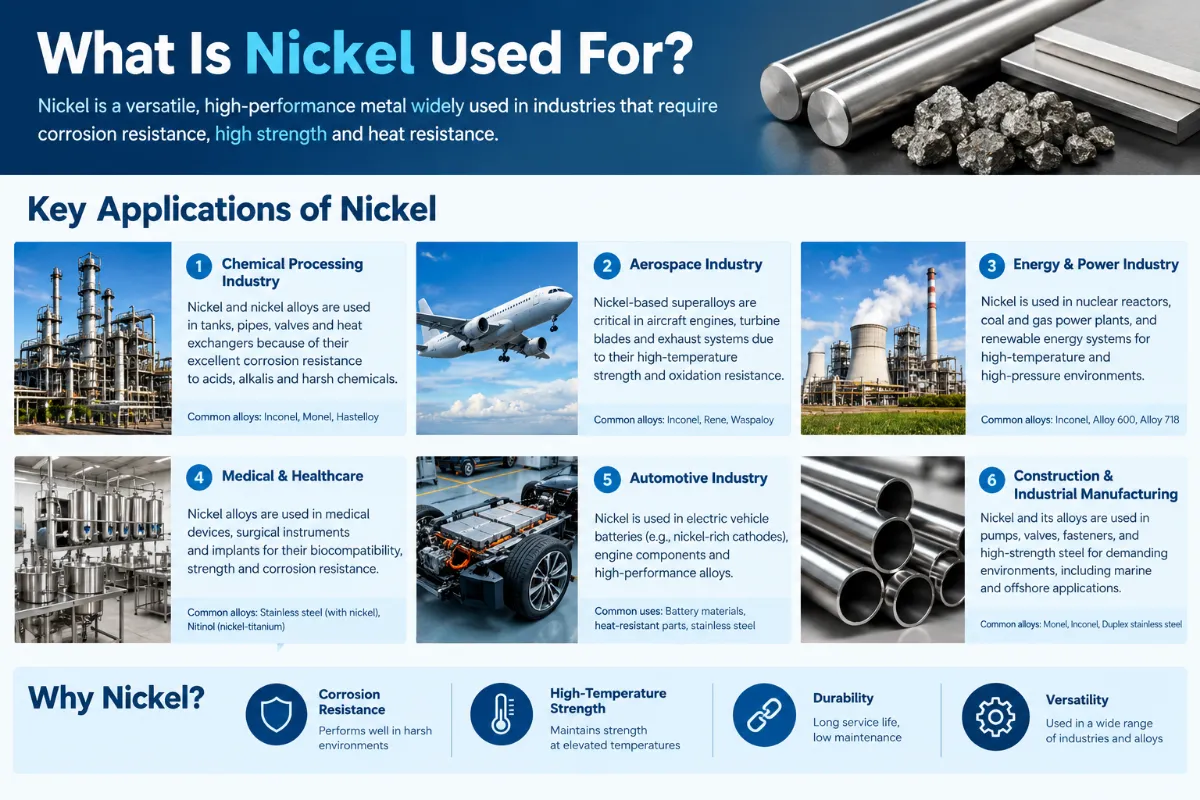
1. Nickel Is Used to Make Stainless and Other Alloy Steels
One of the largest uses of nickel is as an alloying element in steels.
Nickel can help stabilize particular metallurgical structures and can contribute to corrosion resistance, toughness and performance at low or elevated temperatures, depending on the steel composition and processing route.
A major application is austenitic stainless steel. Nickel is an important alloying element in many common austenitic grades and helps maintain the austenitic structure.
These materials are used in:
- Food-processing equipment.
- Chemical-processing equipment.
- Medical and pharmaceutical equipment.
- Kitchen and household products.
- Storage tanks
- Heat exchangers
- Piping systems
- Architectural components.
However, it is important not to treat all nickel-containing steels as interchangeable. Their nickel content, chromium content, molybdenum content, carbon level, heat treatment and intended environment can differ significantly.
For industrial buyers, the material designation and applicable specification are therefore more important than simply knowing that a product “contains nickel.”
2. Nickel Is Used in Nickel-Based Superalloys
Another important application is the production of nickel-based superalloys.
Nickel-based superalloys are designed for demanding environments where ordinary engineering materials may lose strength or suffer excessive oxidation, corrosion or deformation.
Typical applications include:
- Gas turbine components
- Jet engine components
- Turbine discs
- Combustion components.
- High-temperature fasteners.
- Furnace components.
- Heat-resistant components.
- Power-generation equipment.
Alloys such as Inconel 600, Inconel 625 and Inconel 718 illustrate different approaches to nickel alloy design.
For example, Inconel 625 combines nickel with chromium, molybdenum and niobium to provide a combination of corrosion resistance and mechanical performance. Inconel 718 uses a different alloying system and is widely associated with high-strength applications.
The correct alloy therefore depends on the operating environment rather than the generic label “nickel alloy.”
3. Nickel Is Used in Aerospace Applications
Aerospace is one of the most technically demanding application areas for nickel-based materials.
Aircraft engines and gas turbines can expose components to high temperature, mechanical stress, oxidation and thermal cycling. Nickel-based superalloys are used in selected components because their properties can remain useful under conditions where many conventional alloys would not be suitable.
Applications can include:
- Turbine discs
- Turbine blades
- Combustion components
- Engine fasteners
- Exhaust components
- High-temperature structural parts.
The USGS identifies aerospace as a major consumer of nickel-base superalloys and notes their use in turbine blades, discs and other jet-engine components.
The engineering requirement is not simply high nickel content. Alloy composition, heat treatment, microstructure, product form and operating temperature all affect suitability.
4. Nickel Is Used in Chemical Processing
Nickel and nickel-based corrosion-resistant alloys are widely used in chemical-processing environments.
The reason is straightforward: some industrial chemicals can attack conventional metals through general corrosion, pitting, crevice corrosion, stress-corrosion cracking or other mechanisms.
Depending on the environment, nickel-based alloys can be selected for:
- Chemical vessels
- Heat exchangers
- Piping
- Pumps
- Valves
- Reactors
- Process equipment.
- Pollution-control equipment.
Hastelloy alloys are an important example of nickel-based materials developed for demanding corrosion environments.
For example, Hastelloy C-276 is associated with severe corrosion-service applications, while other grades such as C-22 or B-series alloys are designed around different chemical environments.
This does not mean that one Hastelloy grade is suitable for every chemical process. Chemical concentration, temperature, impurities, aeration, flow conditions and weld condition can all affect corrosion performance.
5. Nickel Is Used in Oil, Gas and Petrochemical Equipment
Nickel-containing materials are also used in oil, gas and petrochemical equipment where corrosion, pressure and temperature can create demanding service conditions.
Applications can include:
- Process piping
- Heat exchangers
- Valves
- Pumps
- Pressure-containing components.
- Offshore equipment.
- Refinery equipment.
- Downstream chemical-processing systems.
Different nickel alloys are selected according to the specific combination of temperature, pressure and corrosive media.
For procurement, the material grade alone is not enough. The required product form, dimensions, material condition, applicable specification and inspection documentation should also be established before purchasing.
6. Nickel Is Used in Marine and Offshore Equipment
Nickel-containing alloys are also used in marine environments.
Seawater introduces chloride ions and can create severe corrosion conditions. Certain nickel-copper alloys are particularly associated with marine service.
Monel 400 is a well-known nickel-copper alloy used in applications where resistance to seawater and certain chemical environments is important.
Higher-strength nickel-copper alloys such as Monel K-500 extend this material family into applications where mechanical strength is also an important requirement.
Potential applications include:
- Marine pumps
- Valves
- Shafts
- Fasteners
- Marine fittings
- Offshore components.
- Seawater-handling equipment.
Material selection still depends on the exact service conditions. “Marine application” is not a sufficient specification by itself.
7. Nickel Is Used in Power Generation
Nickel has an important role in conventional and advanced power-generation equipment.
Nickel-based alloys can be used in areas exposed to:
- High temperatures.
- Thermal cycling.
- Oxidizing gases.
- Corrosive process fluids.
- Mechanical loading.
- Long service periods.
Gas turbines are a major example. Nickel-based superalloys are used in selected turbine and combustion components because they can maintain useful mechanical and environmental resistance at elevated temperatures.
Nickel-containing alloys are also used in heat exchangers, steam-generation systems and other power-generation equipment where the selected material must withstand the actual operating environment.
8. Nickel Is Used in Rechargeable Batteries
Nickel is also an important battery material.
Nickel-containing materials are used in several rechargeable battery systems. These include nickel-cadmium batteries and nickel-metal hydride batteries, while nickel-containing cathode materials are also used in several lithium-ion battery chemistries.
The role of nickel in batteries differs from its role in structural alloys.
In a nickel-based superalloy, nickel forms part of a metallic structure designed for mechanical and environmental performance.
In a battery, nickel participates in the electrochemical material system that enables energy storage and release.
Nickel-containing battery materials are used in applications such as:
- Portable electronics
- Power tools
- Hybrid vehicles
- Electric vehicles
- Energy-storage systems.
- Industrial batteries.
The importance of nickel in battery technology has also made battery demand an important part of the modern nickel market.
9. Nickel Is Used for Electroplating
Nickel can be deposited onto another material through electroplating.
Nickel plating can provide a combination of:
- Corrosion protection
- Surface hardness
- Wear resistance
- Decorative appearance.
- Controlled surface properties.
Nickel plating is used on various industrial and consumer products.
The substrate, plating process, nickel deposit, thickness and service environment all influence performance. Therefore, “nickel plated” does not automatically describe a specific corrosion life or wear performance.
For engineering applications, plating specifications should define the required coating system and inspection requirements.
10. Nickel Is Used in Catalysts and Chemical Production
Nickel and nickel compounds also have important chemical applications.
Nickel can function as a catalyst in certain industrial chemical reactions. Nickel compounds such as nickel sulfate, nickel chloride and nickel oxide are used in different industrial processes.
These applications are different from the use of metallic nickel and nickel-based alloys.
For this reason, the phrase “nickel use” covers several distinct material categories:
| Nickel form | Typical role |
|---|---|
| Refined nickel metal | Alloy production and specialized metallic applications |
| Nickel-containing alloys | Structural and corrosion/high-temperature applications |
| Nickel-based superalloys | High-temperature and high-stress components |
| Nickel compounds | Chemical and electrochemical applications |
| Nickel plating | Surface protection and finishing |
| Nickel-containing battery materials | Rechargeable energy storage |
This distinction is useful because the production route, specification, handling requirements and end-use performance can be very different.
11. Nickel Is Used in Coinage and Consumer Products
Nickel has also been used in coinage and consumer products.
Nickel-containing alloys can provide useful combinations of durability, corrosion resistance and appearance. The USGS notes that U.S. circulating coins other than the penny use alloys containing nickel.
Nickel can also be found in products involving:
- Decorative plating
- Household equipment
- Cutlery
- Cookware
- Electrical and electronic components.
- Durable consumer products.
The actual nickel content and material composition vary substantially between products.
12. What Nickel Alloys Are Used for High-Temperature Applications?
When the requirement involves elevated temperature, nickel-based alloys become particularly important.
Examples include:
| Alloy family | Typical application focus |
|---|---|
| Inconel | High-temperature and corrosion-resistant components |
| Incoloy | High-temperature and corrosion-resistant equipment |
| Nimonic | High-temperature mechanical applications |
| Hastelloy | Severe corrosion and selected high-temperature environments |
| Monel | Marine and chemical environments, especially nickel-copper systems |
These categories should not be treated as interchangeable.
For example, an alloy selected for high-temperature oxidation resistance may not be the best choice for a strongly reducing acid environment. Conversely, an alloy optimized for severe chemical corrosion may not provide the mechanical properties required for a highly loaded turbine component.
The correct selection begins with the service environment.
13. Nickel Is Available in Many Industrial Product Forms
Nickel and nickel-based alloys are supplied in different product forms depending on the application and manufacturing process.
Common forms include:
- Round bars
- Rods
- Plates
- Sheets
- Tubes
- Pipes
- Wires
- Strips
- Coils
- Forgings
- Fasteners
- Springs
The product form affects how the material is manufactured, processed and ultimately used.
For example:
Bars and rods may be used for shafts, fasteners, machined components and structural parts.
Plates and sheets may be fabricated into vessels, covers, heat-exchanger components and process equipment.
Tubes and pipes may be used for fluid handling, heat transfer and process systems.
Wire and strip can be used for springs, welding products, electrical components and precision applications.
MWalloys currently lists nickel alloy bars, pipes, plates, sheets, wires and other product categories, as well as specific alloy families such as Inconel, Hastelloy, Monel and Incoloy.
14. How Do Engineers Select a Nickel Alloy?
Knowing that an application uses nickel does not identify the correct alloy.
A practical material-selection process should consider at least the following factors:
| Selection factor | Why it matters |
|---|---|
| Temperature | Determines strength, oxidation and long-term stability requirements |
| Corrosive medium | Determines the relevant corrosion mechanisms |
| Chemical concentration | Corrosion behavior can change with concentration |
| Pressure | Influences mechanical and pressure-containing requirements |
| Mechanical loading | Determines required strength and fatigue performance |
| Product form | Different specifications apply to bars, plates, tubes, wire and forgings |
| Heat treatment | Can strongly affect mechanical properties and microstructure |
| Welding | Weldability and post-weld performance may be important |
| Dimensions | Affects manufacturing route and applicable specification |
| Surface condition | Important for some corrosion and precision applications |
| Inspection | May require chemical, mechanical, dimensional or nondestructive testing |
| Applicable standard | Defines requirements for a particular material/product combination |
This is why an industrial RFQ for nickel alloy products should normally specify more than just “nickel alloy.”
A better RFQ identifies the alloy grade, product form, dimensions, quantity, material condition, applicable specification, testing requirements and documentation requirements.
Nickel Alloy Examples from MWalloys
MWalloys currently organizes its nickel alloy offering around several major alloy families.
The Inconel range includes grades such as Inconel 600, 625, 718, 601, 690 and X-750.
The Hastelloy range includes grades such as C-276, C-22, B-2 and B-3.
The Monel category includes nickel-copper alloys such as Monel 400 and Monel K-500.
These pages should be used as the next step when the reader already knows the general application and needs grade-specific information.
For example, an engineer researching high-temperature and corrosion-resistant nickel alloys may move from this general article to the Inconel category. A reader dealing primarily with aggressive chemical environments may need more detailed information about Hastelloy grades. A marine equipment designer may need to investigate Monel alloys.
What Is Nickel Used for in Modern Industry?
The most important point is that nickel is not used for one single purpose.
It is used because different nickel-containing materials can provide different combinations of properties.
The major application groups include:
- Alloy and steel production.
- Nickel-based superalloys.
- Aerospace equipment.
- Power generation.
- Chemical processing.
- Oil, gas and petrochemical equipment.
- Marine and offshore equipment.
- Rechargeable batteries.
- Electroplating.
- Catalysts and chemical production.
- Coinage.
- Specialized consumer and industrial products.
The USGS and Nickel Institute both identify alloy production as a dominant use of nickel, while modern applications also include batteries, electroplating, catalysts and other specialized applications.
What Should Buyers Specify When Purchasing Nickel Alloys?
For industrial procurement, a useful nickel alloy inquiry should normally include:
- Alloy grade
- UNS number when applicable
- Product form
- Dimensions
- Quantity
- Material condition
- Applicable ASTM, ASME, EN or other specification.
- Heat-treatment requirements.
- Surface condition
- Mechanical-property requirements.
- Chemical-analysis requirements.
- Nondestructive testing requirements, if applicable.
- Material test certificate requirements.
- Packaging requirements.
- Delivery destination and commercial terms.
For example, a request for “Inconel 625 bar” is a starting point, not a complete purchasing specification.
A buyer may still need to define diameter, length, quantity, condition, standard, tolerance, testing and documentation.
MWalloys supplies nickel-based alloys in different product forms and can evaluate customized requirements based on the requested material, dimensions, specifications and production requirements. Availability and applicable documentation should be confirmed for each order.
FAQ
1. What is nickel mainly used for?
Nickel is mainly used as an alloying element in stainless steel, alloy steels and nickel-based alloys. Other important uses include batteries, electroplating, catalysts, chemical compounds and coinage.
2. What is nickel used for besides stainless steel?
Nickel is also used in nickel-based superalloys, marine alloys, chemical-processing equipment, aerospace components, power-generation equipment, rechargeable batteries, electroplating and catalysts.
3. Why is nickel used in alloys?
Nickel can contribute corrosion resistance, high-temperature performance, ductility, toughness and other useful metallurgical properties. The specific effect depends on the complete alloy composition and material condition.
4. What is nickel used for in aerospace?
Nickel-based superalloys are used in selected aircraft-engine and gas-turbine components exposed to high temperature, mechanical stress, oxidation and thermal cycling.
5. Is nickel used in batteries?
Yes. Nickel-containing materials are used in several rechargeable battery technologies, including nickel-metal hydride batteries and several lithium-ion battery cathode chemistries.
6. What nickel alloys are used in corrosive environments?
Different nickel alloy families are selected for different corrosive environments. Hastelloy, Inconel, Monel and Incoloy are examples of nickel-based alloy families used in specific corrosion-related applications, but the appropriate grade depends on the chemical environment and operating conditions.
7. What forms are nickel alloys available in?
Nickel alloys can be supplied in forms including bars, rods, plates, sheets, tubes, pipes, wires, strips, coils, forgings, fasteners and springs, depending on the alloy and applicable manufacturing specification.
8. How do I choose a nickel alloy?
Start with the operating temperature, corrosive medium, concentration, pressure, mechanical loading, product form, dimensions, heat treatment, welding requirements and applicable material specification. The alloy should then be selected based on the actual service conditions.
Conclusion
Nickel is used across a wide range of industries because it can contribute corrosion resistance, high-temperature capability, strength, ductility and other useful properties to different material systems.
Its largest industrial role is as an alloying element, particularly in stainless and other alloy steels and in nickel-based alloys. Nickel is also important in aerospace and power-generation superalloys, chemical and petrochemical equipment, marine applications, rechargeable batteries, electroplating, catalysts and other specialized products.
For engineers and industrial buyers, the important question is not simply “Is nickel used in this application?” but which nickel-containing material provides the required combination of properties under the actual operating conditions?
That distinction is the starting point for selecting an appropriate nickel alloy, product form and material specification.