

Nickel-chromium, nickel-iron, and nickel-molybdenum alloys differ primarily in their alloying chemistry, metallurgical structure, corrosion behavior, thermal properties, and intended service conditions. However, these categories are not mutually exclusive: many commercial nickel alloys contain two or more of these elements in significant proportions. For material selection, the actual alloy grade, chemical composition, operating environment, temperature, product form, and applicable specification are more important than the family name alone.
Chromium is commonly associated with oxidation resistance and the formation of protective surface films. Molybdenum can contribute to resistance in particular reducing and localized-corrosion environments, while iron is an important constituent in several nickel alloy systems and can influence composition, structure, physical properties, and cost. The effect of each element depends on the complete alloy chemistry and service conditions, not simply its presence.
The Nickel Institute explains that nickel combines readily with chromium, iron, molybdenum and other elements to produce alloy systems with different corrosion, high-temperature and physical properties. Its classification of nickel alloys includes nickel-chromium, nickel-iron, nickel-molybdenum and nickel-chromium-molybdenum groups.
1. Why Alloy Family Classification Matters
Nickel alloys are developed for different combinations of mechanical, physical and chemical performance. A manufacturer or materials engineer may use a broad family name as an initial classification, but a purchasing specification normally needs a more precise designation.
For example:
-
A nickel-chromium alloy may be selected for oxidation resistance, electrical resistance or high-temperature service.
-
A nickel-iron alloy may be designed for controlled thermal expansion, magnetic performance or high-temperature applications.
-
A nickel-molybdenum alloy may be considered for specific reducing-acid environments.
-
A nickel-chromium-molybdenum alloy may combine chromium and molybdenum to address a broader set of corrosive conditions.
These are general technical categories, not universal application rules. The Nickel Institute identifies nickel-molybdenum alloys as particularly resistant to certain reducing acids, while nickel-chromium-molybdenum alloys are characterized by strong corrosion resistance across selected environments. Actual suitability still requires evaluation of the process chemistry and operating conditions.
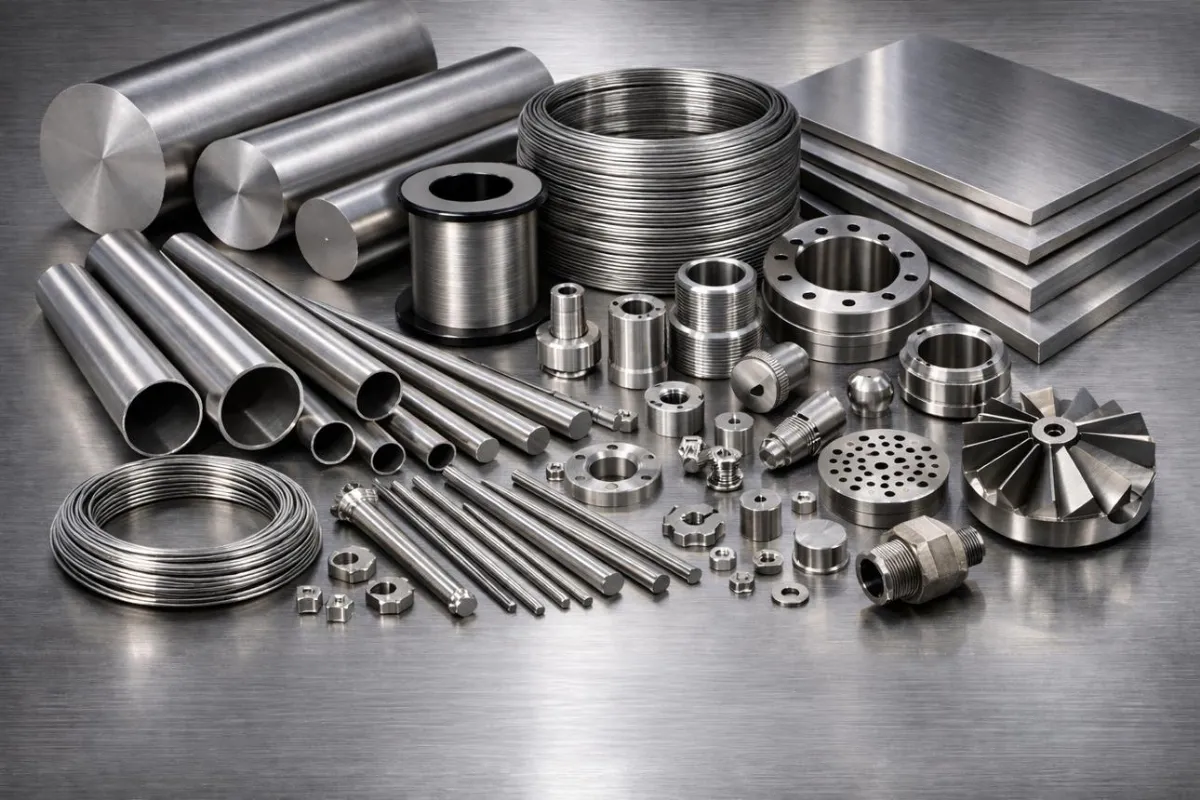
The classification problem in industrial purchasing
A request such as "nickel alloy with chromium" is not sufficient for a technically complete RFQ. It does not establish:
-
The required UNS number.
-
Chemical composition limits.
-
Product form and dimensions.
-
Required heat treatment.
-
Mechanical property requirements.
-
Corrosion environment.
-
Applicable ASTM, ASME or other specification.
-
Inspection and certification requirements.
A buyer should obtain the exact grade and specification before requesting a final commercial offer.
2. The Role of Nickel, Chromium, Iron and Molybdenum
The behavior of a nickel alloy results from the interaction of its constituent elements and metallurgical condition. A simplified description of the four elements can help establish the comparison, but it should not be used as a substitute for grade-specific engineering data.
Nickel (Ni)
Nickel is the principal element in many high-nickel alloy systems. It contributes to the development of austenitic structures and supports the ability to alloy with chromium, molybdenum, iron, copper and other elements.
Nickel alloy systems are used where combinations of corrosion resistance, ductility, high-temperature properties and other specialized characteristics are required. The exact contribution of nickel varies with the rest of the chemical composition.
Chromium (Cr)
Chromium is widely used in nickel alloys to improve resistance to oxidation and high-temperature scaling, and to contribute to corrosion resistance in appropriate aqueous environments.
Chromium's role is not identical in every alloy. Its effect depends on the environment, alloy composition, surface condition, and metallurgical structure. A high chromium content by itself does not guarantee resistance to every acid, salt or high-temperature atmosphere.
Iron (Fe)
Iron is a significant constituent in several nickel-iron and nickel-iron-chromium alloy systems. Depending on the alloy, it can form part of the principal matrix and influence physical, mechanical and thermal properties.
Some nickel-iron alloys are designed for controlled thermal expansion or magnetic characteristics. Nickel-iron-chromium grades are also used for high-temperature and corrosion-resistant applications.
Molybdenum (Mo)
Molybdenum is an important alloying addition in many corrosion-resistant nickel alloys. The Nickel Institute identifies nickel-molybdenum alloys as particularly resistant to reducing acids under specified conditions. Molybdenum is also a key constituent of several nickel-chromium-molybdenum alloys used in chemical processing and other corrosive service applications.
The performance contribution of molybdenum is environment-dependent. It should not be interpreted as an unconditional guarantee against corrosion or as a universal replacement for chromium.
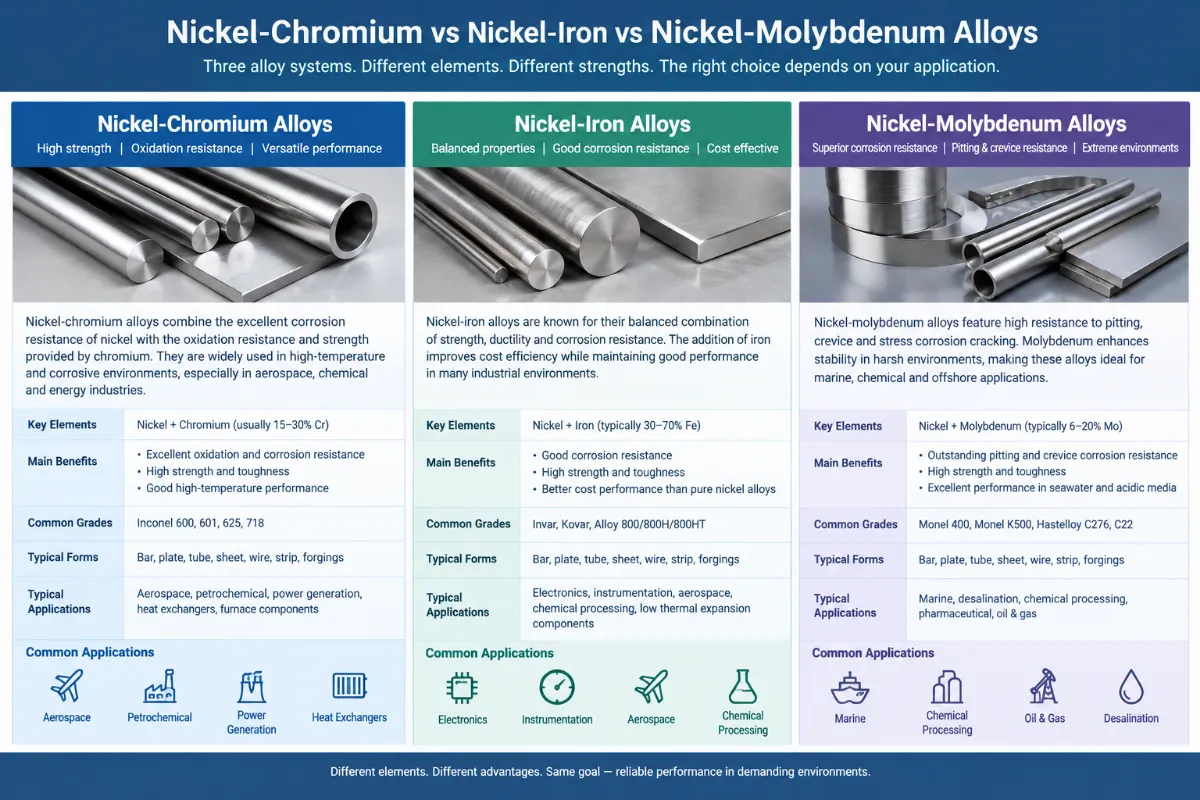
3. Nickel-Chromium Alloys
Nickel-chromium alloys contain nickel and chromium as major alloying elements. Different grades may also contain iron, molybdenum, aluminum, titanium, niobium, cobalt and other additions.
This family includes alloys designed for corrosion resistance, oxidation resistance, high-temperature strength and electrical resistance. The Nickel Institute describes nickel-chromium systems as having uses involving high-temperature scaling resistance, corrosion resistance and electrical resistance, with the specific properties varying by alloy group.
Typical performance considerations
Nickel-chromium alloys may be considered when the application requires:
-
Resistance to oxidation at elevated temperature.
-
Corrosion resistance in a specified service environment.
-
Strength retention at elevated temperature.
-
Resistance to thermal exposure and scaling.
-
Controlled electrical resistance in heating applications.
Not every nickel-chromium alloy provides the same combination of these properties. A grade developed for electrical heating elements should not automatically be treated as equivalent to a corrosion-resistant or creep-resistant grade.
|
Alloy |
UNS |
General classification |
|---|---|---|
|
Alloy 600 |
N06600 |
Nickel-chromium-iron alloy |
|
Alloy 601 |
N06601 |
Nickel-chromium-iron alloy with aluminum |
|
Alloy X-750 |
N07750 |
Nickel-chromium alloy with age-hardening additions |
|
Alloy 690 |
N06690 |
Nickel-chromium-iron alloy |
The Nickel Institute's alloy overview identifies these examples and provides nominal composition information. The table is for classification context, not a complete specification or a substitute for the applicable material standard.
Limitations in nickel-chromium selection
The phrase nickel-chromium alloy covers a wide range of chemistry and intended uses. Selection should consider:
-
Exposure to oxidizing or reducing media.
-
Temperature and thermal cycling.
-
Mechanical loading and required strength.
-
Welding and fabrication requirements.
-
Product form and material condition.
-
Specific corrosion mechanisms that may occur.
For high-temperature components, oxidation resistance alone may be insufficient. Creep, rupture, thermal fatigue, fabrication history and the applicable design requirements can also influence the selection.
4. Nickel-Iron Alloys
Nickel-iron alloys contain nickel and iron as principal elements. Some are engineered for specific thermal expansion or magnetic characteristics, while other nickel-iron-chromium systems are intended for high-temperature or corrosion-resistant service.
The Nickel Institute describes nickel-iron alloys as including materials used for soft magnetic applications, glass-to-metal seals and defined thermal expansion properties. Invar, for example, is known for its low coefficient of thermal expansion near room temperature.
Nickel-iron alloy applications
The specific application depends on the grade's properties.
|
Application area |
Relevant material consideration |
|---|---|
|
Precision instruments |
Thermal expansion and dimensional stability |
|
Glass-to-metal seals |
Thermal expansion compatibility |
|
Magnetic components |
Magnetic properties |
|
High-temperature equipment |
Strength, oxidation resistance and microstructure |
|
Corrosive service |
Chemical composition and resistance in the actual medium |
These examples show why nickel-iron alloys should not be assessed solely through their iron content. A precision alloy designed for dimensional stability has a different selection basis from a nickel-iron-chromium alloy intended for high-temperature equipment.
Nickel-iron-chromium alloys
Some materials commonly associated with nickel-iron alloys also contain substantial chromium. Alloy 800 and its variants are examples of nickel-iron-chromium systems used for high-temperature applications. The Nickel Institute identifies Alloy 800, 800H and 800HT as grades with high-temperature strength and resistance to oxidation and other forms of high-temperature corrosion.
The precise grade and heat treatment matter. ASTM B564-25, for example, distinguishes nickel-iron-chromium alloys by UNS designation and identifies different typical temperature-use conditions for several grades. The standard's scope is grade-specific, so its provisions should not be generalized to all nickel-iron alloys.
5. Nickel-Molybdenum Alloys
Nickel-molybdenum alloys are developed for applications requiring particular corrosion resistance, especially in reducing chemical environments.
The Nickel Institute identifies Alloy B-2 as a well-known nickel-molybdenum alloy and states that this group has strong resistance to reducing acids in the absence of certain oxidizing ions. This description highlights the importance of chemical conditions when evaluating a material.
Why reducing conditions matter
Corrosion performance depends on the relationship between the alloy and its environment. Relevant factors may include:
-
Acid type and concentration.
-
Temperature.
-
Presence of dissolved oxygen.
-
Oxidizing ions.
-
Contaminants and impurities.
-
Flow conditions.
-
Exposure time.
-
Welded or heat-affected regions.
A material that performs well in a particular reducing-acid environment may not provide the same level of resistance when the chemistry changes.
Nickel-molybdenum versus nickel-chromium-molybdenum
These alloy systems should not be treated as interchangeable.
Nickel-molybdenum alloys are associated with specific reducing-acid service requirements. Nickel-chromium-molybdenum alloys incorporate chromium as well as molybdenum, allowing different chemistry designs for corrosion resistance across selected environments.
The Nickel Institute describes Alloy C-276 and related nickel-chromium-molybdenum grades as corrosion-resistant materials, with variations in chromium, molybdenum, copper and tungsten used to adapt performance to different environments.
Practical implication: The presence of both chromium and molybdenum does not automatically make one alloy superior to a nickel-molybdenum grade in every chemical environment. The process conditions and grade-specific data must be evaluated.
6. Nickel-Chromium-Molybdenum Alloys: An Overlapping Family
Nickel-chromium-molybdenum alloys demonstrate why the three broad categories in the article title cannot be interpreted as separate, exclusive groups.
These alloys contain nickel as the principal element, with chromium and molybdenum as important alloying additions. Additional elements such as tungsten, copper, iron, carbon and other constituents may be controlled to obtain specific properties.
Examples include:
-
Alloy 59, UNS N06059.
-
Alloy 686, UNS N06686.
The Nickel Institute includes these alloys in its discussion of corrosion-resistant nickel alloy systems. ASTM B575 also lists multiple low-carbon nickel-chromium-molybdenum and related alloy grades for plate, sheet and strip used in general corrosive service.
Why this distinction is important
A technical comparison that classifies Alloy C-276 simply as a nickel-molybdenum alloy because it contains molybdenum would omit the importance of chromium and other additions. Conversely, describing every nickel-chromium-molybdenum grade as having identical resistance would ignore the differences in composition and application.
For engineers, the complete UNS designation and applicable specification are more useful than a broad alloy family label.
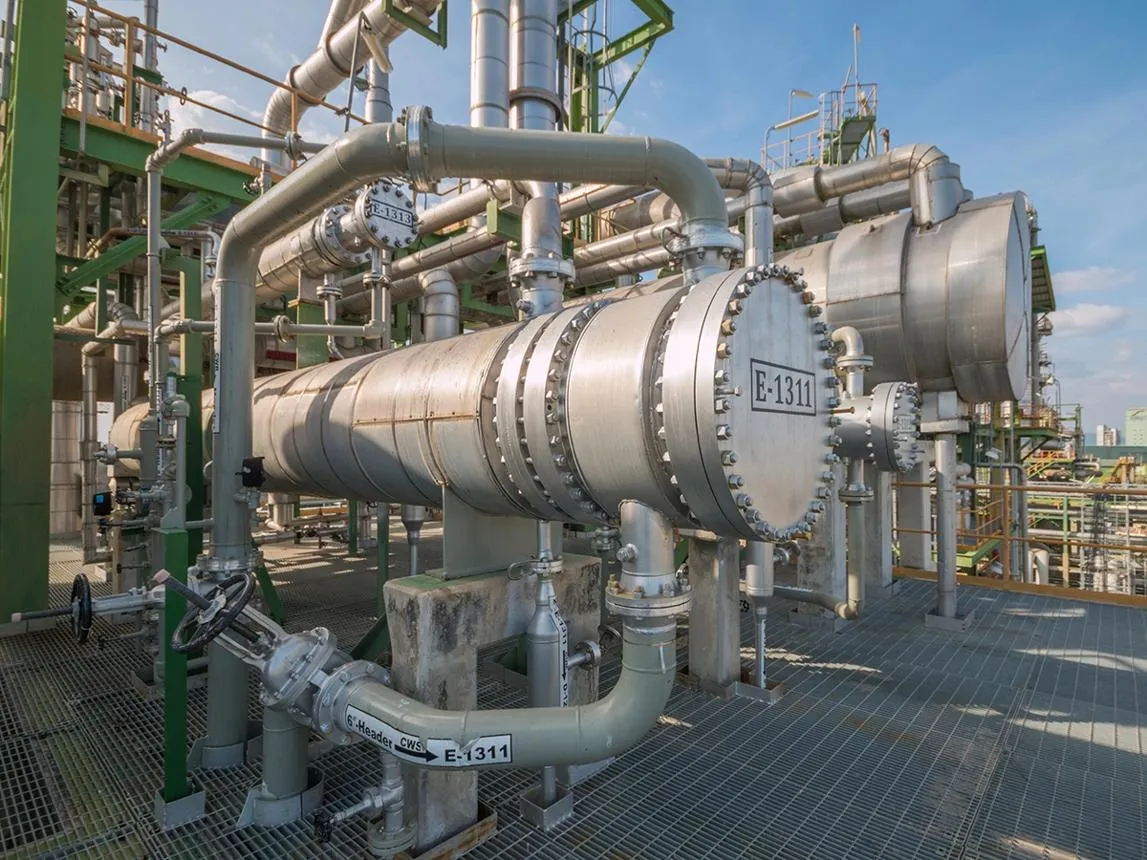
7. Corrosion Resistance: Chromium and Molybdenum Are Not Interchangeable
Corrosion resistance is one of the most important reasons for comparing nickel alloy families. However, corrosion should be evaluated by mechanism and environment rather than by alloying-element content alone.
Oxidizing and reducing environments
A simplified comparison:
|
Consideration |
General relevance |
|---|---|
|
Chromium |
Contributes to oxidation and corrosion resistance in appropriate conditions |
|
Molybdenum |
Important in selected reducing and localized-corrosion resistance designs |
|
Iron |
Influences the alloy system and can be present in substantial proportions |
|
Nickel |
Provides the principal matrix in many nickel-based alloy systems |
The Nickel Institute notes that the corrosion behavior of nickel alloys varies with the medium, alloy composition and manufacturing process. It also distinguishes specific alloy groups based on their performance in reducing acids, oxidizing environments and high-temperature conditions.
Localized corrosion and material condition
General corrosion rate is not the only relevant consideration. Depending on the service environment, engineers may need to evaluate:
-
Pitting and crevice corrosion.
-
Stress corrosion cracking.
-
Intergranular corrosion.
-
Weld and heat-affected zone behavior.
-
Corrosion under deposits.
-
Galvanic effects.
-
Surface condition and fabrication contamination.
The Nickel Institute's corrosion and fabrication material identifies these mechanisms as important aspects of corrosion-resistant alloy evaluation.
A material specification should therefore be based on the actual operating environment and the required performance evidence, rather than an assumption that a higher nominal alloying-element percentage guarantees suitability.
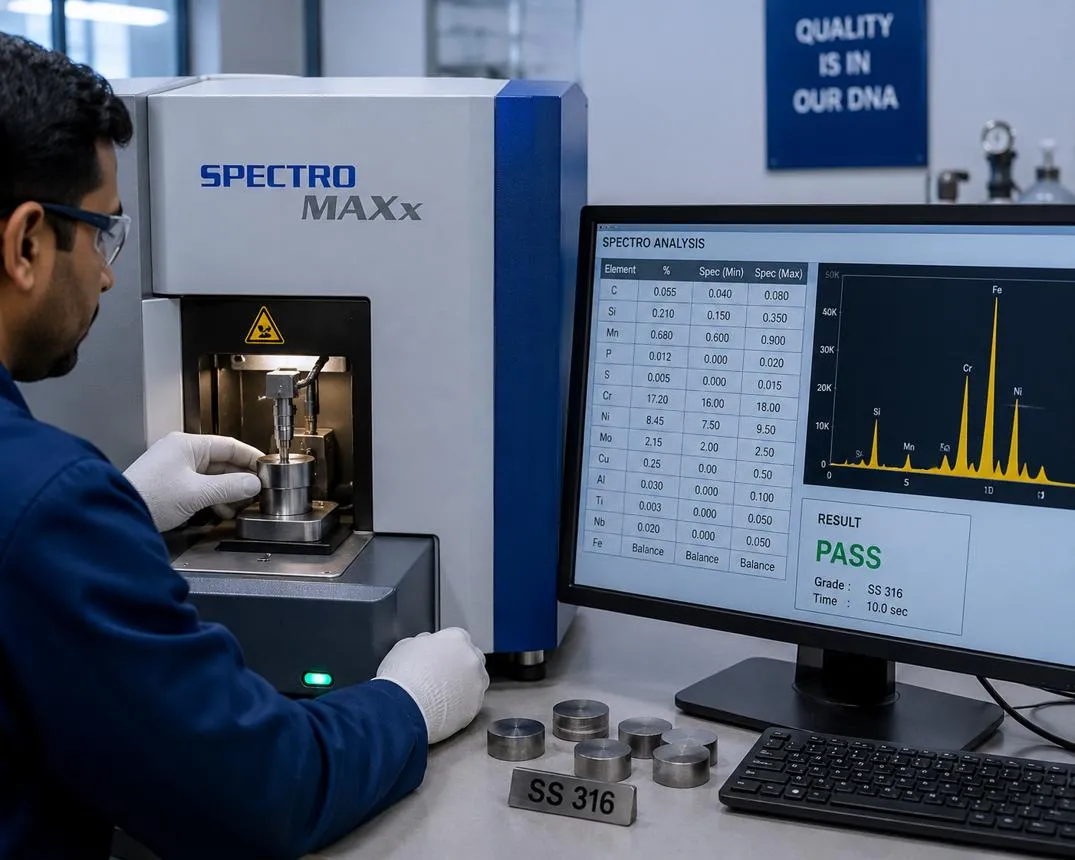
8. High-Temperature Performance and Metallurgical Considerations
Nickel alloys are widely used in high-temperature applications, but temperature resistance depends on more than chromium or nickel content.
Important factors include:
-
Alloy chemistry and phase stability.
-
Grain size and material condition.
-
Creep and rupture resistance.
-
Oxidation and other high-temperature corrosion mechanisms.
-
Thermal cycling and fatigue.
-
Manufacturing route and heat treatment.
The Nickel Institute identifies different nickel-chromium and nickel-iron-chromium alloy groups for high-temperature strength and oxidation resistance. It also provides distinctions between grades designed for general use and those developed for elevated-temperature creep and rupture requirements.
Example: Grade and heat treatment
ASTM B443-26 covers nickel-chromium-molybdenum-columbium Alloy 625 (UNS N06625) in plate, sheet and strip. Its scope distinguishes annealed and solution-annealed grades, including different typical temperature-use conditions. This illustrates why a material grade and its required condition should be specified together.
The cited standard is specific to its scope and should not be generalized to all nickel alloy product forms or all operating conditions.
9. Material Selection: Which Alloy Family Should You Consider?
There is no single alloy family that can be selected solely because it contains more chromium, iron or molybdenum. A structured selection process begins with the service environment and performance requirements.
Step 1: Define the operating environment
Record:
-
Chemical medium.
-
Concentration and impurities.
-
Temperature range.
-
Pressure.
-
Flow velocity.
-
Presence of oxidizing or reducing species.
-
Exposure duration.
-
Expected thermal cycling.
For corrosion-resistant equipment, the chemical environment is especially important. The Nickel Institute provides dedicated technical resources on corrosion resistance in hydrochloric acid, sulfuric acid and other media.
Step 2: Establish the mechanical requirements
Determine the required:
-
Tensile and yield strength.
-
Elongation and toughness.
-
Hardness, if relevant.
-
Creep and rupture performance.
-
Fatigue resistance.
-
Dimensional stability.
The appropriate properties depend on product form, test temperature, heat treatment and applicable specification.
Step 3: Identify the exact grade
Do not stop at a description such as "nickel-chromium material." Specify the grade, UNS designation and required standard where applicable.
Step 4: Confirm manufacturing and fabrication requirements
Consider whether the application needs:
-
Hot-worked or cold-worked material.
-
Solution annealing.
-
Controlled grain size.
-
Machining or forming.
-
Welding compatibility.
-
Specific surface finish.
-
Inspection or testing documentation.
Step 5: Review the procurement specification
The final RFQ should contain sufficient information for a supplier to assess feasibility and provide a technically relevant quotation.
10. Product Forms and Applicable Standards
Nickel alloys are supplied in a range of forms, including plate, sheet, strip, bar, rod, tube, pipe, wire and forgings. The appropriate specification depends on the alloy and product form.
The ASTM specification database illustrates this product-specific structure:
|
Standard |
Product form or scope example |
|---|---|
|
ASTM B443-26 |
Nickel-chromium-molybdenum-columbium Alloy 625 and related alloy plate, sheet and strip |
|
ASTM B446-26 |
Selected nickel-chromium-molybdenum alloy rod and bar |
|
ASTM B574 |
Low-carbon nickel-chromium-molybdenum and related rod |
|
ASTM B575 |
Low-carbon nickel-chromium-molybdenum and related plate, sheet and strip |
|
ASTM B564-25 |
Nickel alloy forgings, with grade-specific scope |
These are examples of published specifications, not a universal list of standards for all nickel alloys. The applicable version and grade coverage must be checked for each order.
Why standard verification matters
A material specification should be checked for:
-
Exact standard number and revision.
-
Alloy designation and UNS number.
-
Product form.
-
Heat treatment and material condition.
-
Chemical composition requirements.
-
Mechanical property requirements.
-
Dimensional tolerances.
-
Testing and inspection requirements.
A standard that covers a specific rod grade should not be assumed to cover every plate, tube or wire product made from the same alloy.
11. Procurement Checklist for Nickel Alloy Buyers
Before requesting a quotation, buyers should provide as much of the following information as possible.
Nickel alloy RFQ checklist
Alloy name and UNS designation.
Product form: bar, plate, tube, wire or other.
Required dimensions and dimensional tolerances.
Quantity and unit of measure.
Applicable ASTM, ASME or other specification.
Heat treatment and material condition.
Mechanical and chemical requirements.
Surface finish or manufacturing route.
Inspection documents and material test report requirements.
Delivery destination and commercial terms.
What a supplier needs to assess
The supplier needs sufficient technical information to determine whether the requested alloy, dimensions, manufacturing route and documentation can be supported. A material family name alone may be inadequate for a meaningful quotation.
Availability, customization feasibility, production route and delivery terms should be confirmed for the specific inquiry. The article should not promise that every specification is immediately available or that every standard can be supplied without technical review.
12. How MWalloys Can Support Alloy Sourcing
MWalloys supplies nickel-based alloy products in different forms and specifications. Depending on the material, product requirements and sourcing arrangement, support may involve product assessment, qualified manufacturing-partner coordination, customization review and inspection-document coordination.
For an inquiry, the buyer should provide the exact alloy, product form, dimensions, quantity, required standards and intended application. These details allow the request to be assessed according to the actual technical and commercial requirements.
Suggested inquiry wording:
MWalloys supplies nickel-based alloys in various product forms, sizes, and material specifications. Through its own production capabilities and cooperation with qualified manufacturing partners, we support customized requirements and sourcing requests for different industrial applications.
The above wording is a general sourcing statement. Specific manufacturing capabilities, inventory, lead time, certifications and inspection arrangements should be confirmed for the individual product and order.
13. Practical Summary
Nickel-chromium, nickel-iron and nickel-molybdenum alloys represent overlapping material families with different chemistry and engineering purposes.
-
Nickel-chromium systems are associated with corrosion resistance, oxidation resistance, electrical resistance and high-temperature applications, depending on the grade.
-
Nickel-iron alloys include specialized materials for thermal expansion and magnetic properties, as well as nickel-iron-chromium systems for high-temperature service.
-
Nickel-molybdenum alloys are relevant to specific reducing-acid corrosion environments.
-
Nickel-chromium-molybdenum alloys combine multiple alloying strategies and require grade-specific evaluation.
-
Product form, material condition, standard and test requirements are essential to a complete material selection and procurement decision.
The correct alloy should be selected according to the complete operating environment, mechanical requirements, fabrication conditions and applicable specification. The family name provides a starting point, but the exact grade and verified technical requirements determine whether a material is appropriate for a particular application.
FAQ
1. What is the main difference between nickel-chromium and nickel-molybdenum alloys?
Nickel-chromium alloys are commonly associated with oxidation resistance, high-temperature performance and corrosion resistance, depending on the grade. Nickel-molybdenum alloys are particularly relevant to selected reducing-acid environments. The actual suitability of either system depends on the complete alloy chemistry and operating conditions.
2. Are nickel-iron alloys suitable for high-temperature applications?
Some nickel-iron-chromium alloys are designed for high-temperature service. Alloy 800 and its variants are examples of grades used for high-temperature strength and oxidation resistance. The exact grade, material condition and required performance must be evaluated for the intended application.
3. Are nickel-chromium-molybdenum alloys the same as nickel-molybdenum alloys?
No. These are related but distinct composition-based categories. Nickel-chromium-molybdenum alloys contain both chromium and molybdenum as important additions, while nickel-molybdenum alloys have a different alloying design. Their corrosion behavior depends on the complete chemistry and the service environment.
4. How do I choose the correct nickel alloy for chemical processing equipment?
Begin by defining the chemical medium, concentration, temperature, impurities and operating conditions. Then evaluate suitable alloy grades using corrosion data, mechanical requirements, fabrication constraints and applicable standards. A generic alloy family label is not sufficient for final selection.
5. Do ASTM standards apply to every nickel alloy product form?
No. ASTM specifications have defined scopes that may cover particular alloy grades and product forms. For example, ASTM B575 covers specified plate, sheet and strip alloys, while ASTM B574 covers specified rod products. The applicable standard and revision must be checked against the material being purchased.
6. What information should be included in a nickel alloy RFQ?
An RFQ should include the alloy designation and UNS number, product form, dimensions, quantity, material condition, applicable standard, testing requirements, inspection documentation and delivery requirements. The more complete the technical information, the more accurately a supplier can assess the request.
7. Does a higher chromium or molybdenum content always mean better corrosion resistance?
No. Corrosion resistance is dependent on the alloy's complete composition and the actual service environment. The effects of alloying elements differ across reducing, oxidizing and localized-corrosion conditions. Grade-specific data and application requirements should be considered rather than relying on one element's percentage.