

Incoloy 825 and Incoloy 800H are both nickel-iron-chromium alloys, but they are designed around different engineering priorities. Incoloy 825 (UNS N08825) is primarily selected for corrosion resistance, particularly in aggressive aqueous and acidic environments, while Incoloy 800H (UNS N08810) is specifically controlled for higher creep and rupture resistance at elevated temperatures. ASTM specifications distinguish N08810 and N08811 from standard Alloy 800 for applications above 1100°F (593°C) where creep and rupture resistance are required.
That difference is more important than their similar nickel-iron-chromium base chemistry.
If the main design problem is wet corrosion, sulfuric or phosphoric acid, chloride-related corrosion or stress-corrosion cracking, Alloy 825 is generally the more relevant material to investigate. If the component must carry sustained mechanical stress at elevated temperature for long periods, 800H is the grade specifically developed and controlled for creep and rupture performance.
The two alloys therefore should not be treated as direct substitutes simply because both can operate at elevated temperatures.
Incoloy 825 vs 800H at a Glance
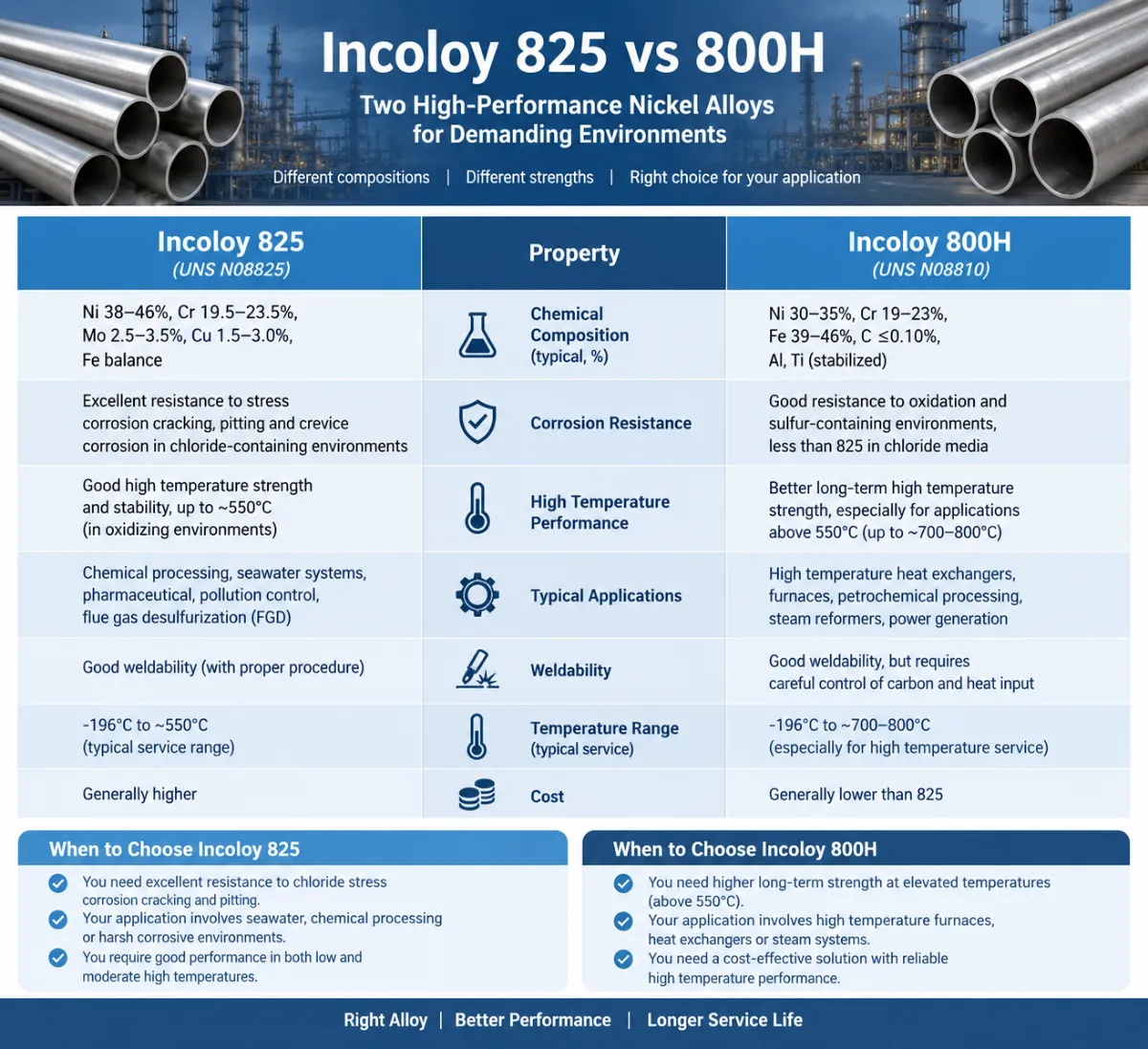
| Characteristic | Incoloy 825 | Incoloy 800H |
|---|---|---|
| UNS designation | N08825 | N08810 |
| Alloy family | Nickel-iron-chromium | Nickel-iron-chromium |
| Primary engineering emphasis | Corrosion resistance | High-temperature creep and rupture resistance |
| Nickel | 38.0–46.0% | 30.0–35.0% |
| Chromium | 19.5–23.5% | 19.0–23.0% |
| Molybdenum | 2.5–3.5% | Not a principal alloying addition |
| Copper | 1.5–3.0% | ≤0.75% |
| Titanium | 0.60–1.20% | 0.15–0.60% |
| Carbon | ≤0.05% in commonly referenced specifications | 0.05–0.10% controlled range |
| Main strength mechanism | Solid-solution strengthening and cold work depending on condition | Controlled chemistry, grain size and high-temperature annealing |
| Main corrosion role | Strong resistance to oxidizing/reducing acids and localized corrosion | Oxidation, carburization and high-temperature environmental resistance |
| Creep/rupture role | Not its principal design advantage | Major design consideration |
| Typical selection environment | Chemical processing and aggressive aqueous/acid environments | Furnaces, reformers, heat exchangers and other sustained high-temperature service |
The composition ranges shown above should always be checked against the applicable product specification and material condition for a purchase order. Public technical data can vary slightly according to the governing specification and product form. Alloy 825 composition data are supported by technical datasheets, while ASTM B409 and B407 identify N08810/N08811 as grades intended above 593°C where creep and rupture resistance is required.
1. The Fundamental Difference Between Alloy 825 and 800H
The easiest way to understand the difference is to separate corrosion resistance from high-temperature mechanical stability.
Alloy 825: corrosion is the primary design problem
Alloy 825 contains substantially more nickel than 800H and deliberately adds:
- Molybdenum
- Copper
- Titanium
The combination is important because Alloy 825 was developed for environments involving both oxidizing and reducing corrosion.
ASM's Alloy Digest describes Alloy 825 as a nickel-chromium-iron alloy containing molybdenum, copper and titanium, with resistance to chloride-ion stress-corrosion cracking, pitting, crevice attack and corrosion in oxidizing and reducing media.
This chemistry explains why Alloy 825 appears in applications such as:
- Chemical processing
- Acid-processing equipment
- Pollution-control equipment
- Oil and gas equipment
- Sour-service components
- Pickling equipment
- Heat exchangers
A technical product reference from BIBUS likewise identifies Alloy 825 for sulfuric and phosphoric acid environments and localized corrosion resistance.
800H: sustained high-temperature loading is the primary design problem
Alloy 800H is part of the 800 family, but it is not simply ordinary Alloy 800 with a different commercial name.
The H designation represents a controlled chemistry and metallurgical condition intended to improve high-temperature creep and rupture performance.
ASTM B409 states that N08810 and N08811 are normally used above 1100°F (593°C) where creep and rupture resistance is required, and that they are annealed to develop controlled grain size for optimum properties in this temperature range.
ASTM B407 provides the same basic distinction for seamless pipe and tube.
This makes 800H fundamentally different from 825 in terms of its main engineering purpose.
2. Why 800H Has Better Creep Resistance
Creep is the slow, time-dependent deformation of a material under sustained stress, particularly at elevated temperature.
This matters in components such as:
- Furnace tubes
- Reforming equipment
- High-temperature heat exchangers
- Petrochemical process equipment
- High-temperature piping
- Structural components exposed to prolonged heat
A material can have an adequate room-temperature tensile strength and still perform poorly in long-duration creep service.
That is why a simple room-temperature tensile-strength comparison between 825 and 800H can be misleading.
The importance of controlled carbon
800H uses a controlled carbon range rather than simply minimizing carbon as much as possible.
This contributes to the microstructural condition required for elevated-temperature mechanical performance.
Grain size also matters
For creep-resistant service, grain size becomes an important metallurgical variable.
ASTM B409 specifically notes controlled grain size for N08810 and N08811 when used above 593°C where creep and rupture resistance is required.
This is an important purchasing point.
A buyer should not simply specify:
"Incoloy 800"
when the engineering requirement actually calls for 800H.
The exact UNS grade, product specification, heat treatment and applicable acceptance requirements should be included in the purchase specification.
3. Why Alloy 825 Is Not the Natural Choice for Creep-Critical Service
Alloy 825 has good mechanical strength and can tolerate elevated temperatures, but that does not make it equivalent to 800H for long-duration creep service.
Its chemistry is optimized differently.
The substantial additions of molybdenum and copper are highly useful for corrosion resistance, especially in reducing acid environments. However, Alloy 825 is not the alloy family member specifically controlled for the creep-rupture design envelope represented by N08810 and N08811.
This distinction is reflected in ASTM's product standards.
ASTM B409 identifies:
- N08800 as normally used up to 1100°F (593°C)
- N08810 and N08811 as normally used above 1100°F where creep and rupture resistance is required.
Therefore, the question should not be:
"Which alloy has higher tensile strength?"
It should be:
"What temperature, stress, exposure time and environment will the component experience?"
That is the engineering question that determines whether 825 or 800H deserves consideration.
4. Chemistry Comparison: N08825 vs N08810
The chemical differences explain much of the application difference.
| Element | Incoloy 825, UNS N08825 | Incoloy 800H, UNS N08810 | Engineering significance |
|---|---|---|---|
| Ni | 38.0–46.0% | 30.0–35.0% | Austenitic stability and corrosion behavior |
| Cr | 19.5–23.5% | 19.0–23.0% | Oxidation and corrosion resistance |
| Mo | 2.5–3.5% | Not a principal addition | Important to localized and reducing-acid corrosion resistance |
| Cu | 1.5–3.0% | ≤0.75% | Important to Alloy 825's reducing-acid resistance |
| Ti | 0.60–1.20% | 0.15–0.60% | Stabilization and microstructural control |
| Al | ≤0.20% | 0.15–0.60% | Important to the metallurgical balance of 800H |
| C | ≤0.05% commonly referenced | 0.05–0.10% | Controlled differently for their respective purposes |
Alloy 825's chemistry is documented by technical datasheets from Metalcor and other material suppliers.
For 800H, publicly available technical data show the controlled carbon, aluminum and titanium ranges associated with the grade.
The important point
The chemistry should not be interpreted as:
more nickel = automatically better high-temperature performance.
The alloying strategy is designed around different performance targets.
825 invests more heavily in corrosion resistance.
800H uses controlled chemistry and metallurgical processing to improve long-term high-temperature mechanical behavior.
5. High-Temperature Performance: Which Alloy Is More Suitable?
For sustained mechanical loading at high temperature, 800H is the more directly relevant alloy.
This is not merely a general industry preference. ASTM specifications explicitly identify N08810 and N08811 for service above 593°C where creep and rupture resistance is required.
Alloy 825, by contrast, is commonly selected where elevated-temperature exposure exists together with demanding corrosion conditions.
This creates two different selection paths.
Select 800H when the dominant problem is:
- Long-term elevated-temperature stress
- Creep deformation
- Stress rupture
- Furnace service
- Reformer service
- High-temperature process equipment
- Oxidizing or carburizing atmospheres
Consider 825 when the dominant problem is:
- Sulfuric acid
- Phosphoric acid
- Chloride-containing environments
- Pitting
- Crevice corrosion
- Stress-corrosion cracking
- Mixed oxidizing/reducing aqueous environments
The actual application envelope must still be evaluated using design temperature, stress, environment and applicable construction code.
6. Creep Resistance: What Engineers Should Actually Compare
Creep resistance should not be represented by one room-temperature tensile number.
A proper creep or stress-rupture evaluation considers:
- Temperature
- Applied stress
- Exposure time
- Product form
- Heat treatment
- Grain size
- Microstructure
- Environmental conditions
- Applicable design code
For example, a creep-rupture value reported at 760°C for one product form cannot automatically be applied to a cold-worked wire or a differently heat-treated plate.
Your material specification should therefore identify the exact condition required for the component.
Why this matters for 800H
The H-grade designation exists partly because the high-temperature metallurgical condition matters.
ASTM B407 specifies annealed seamless N08810/N08811 pipe and tube and describes the role of controlled grain size for elevated-temperature creep and rupture applications.
This is much more useful to an engineer than simply saying:
"800H is stronger at high temperatures."
The real issue is the time-temperature-stress relationship.
7. Corrosion Resistance: Where Alloy 825 Has the Stronger Rationale
Alloy 825 is particularly attractive when temperature is only one part of the problem.
For example, a process vessel may encounter:
- Acidic liquid
- Chloride contamination
- Oxidizing species
- Reducing species
- Elevated temperature
- Welded joints
In such situations, corrosion resistance can become the primary material-selection criterion.
Alloy 825's Mo and Cu additions are important because they improve its resistance to several aggressive corrosion environments.
ASM's Alloy Digest specifically identifies resistance to chloride stress-corrosion cracking, pitting, crevice attack and both oxidizing and reducing media.
BIBUS similarly identifies Alloy 825 for chemical processing, pollution control, oil and gas and acid-related applications.
This is the opposite side of the selection equation from 800H.
8. Alloy 825 vs 800H for Different Industrial Applications
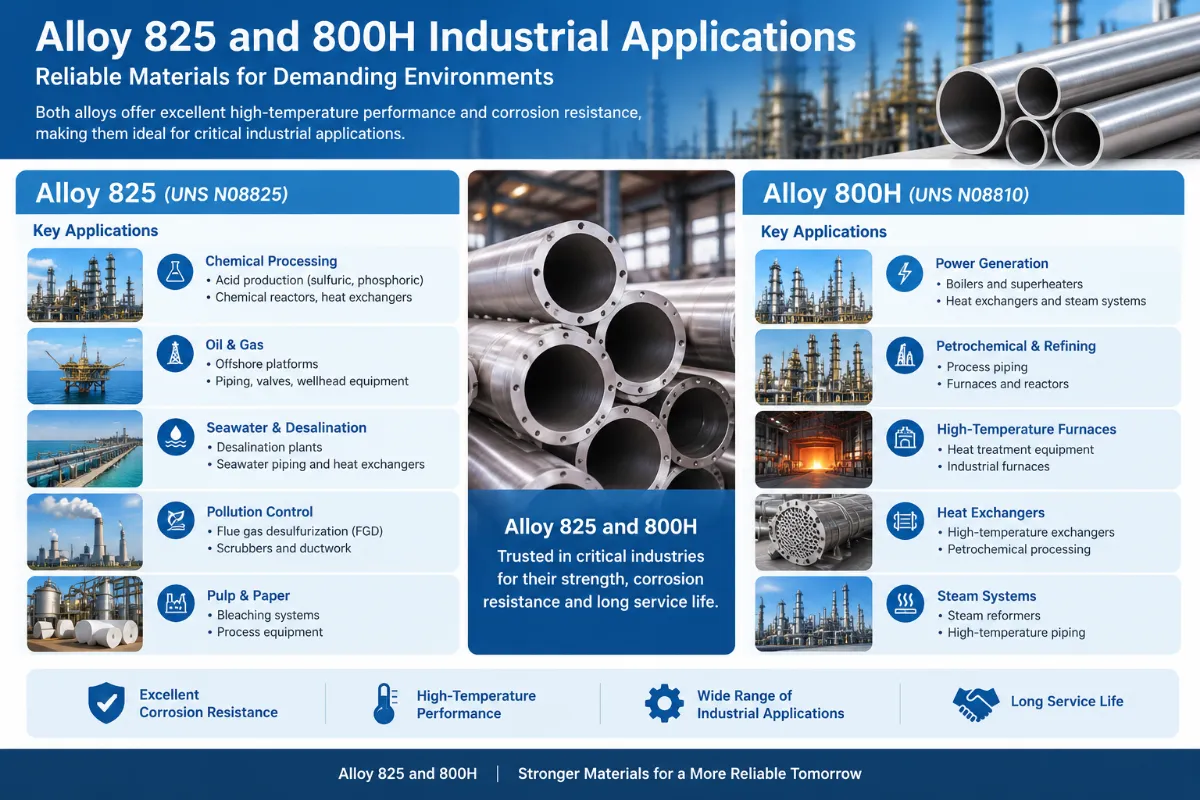
| Application | More relevant alloy to investigate | Main reason |
|---|---|---|
| Sulfuric acid equipment | Alloy 825 | Corrosion resistance |
| Phosphoric acid equipment | Alloy 825 | Acid corrosion resistance |
| Chloride-bearing aqueous service | Alloy 825 | Resistance to localized corrosion and SCC |
| Chemical processing | Depends on environment | Corrosion and temperature must both be evaluated |
| Furnace tubes | 800H | High-temperature creep/oxidation requirements |
| Reformer equipment | 800H | Long-duration high-temperature mechanical stability |
| High-temperature heat exchanger | Depends on temperature/environment | Combined thermal and corrosion requirements |
| Carburizing atmosphere | 800H | High-temperature environmental resistance |
| Long-term high-temperature structural loading | 800H | Creep and rupture resistance |
| Wet acidic service | 825 | Corrosion is generally the dominant concern |
The table is intentionally not presented as an unconditional application list. Actual material selection depends on operating temperature, stress, fluid chemistry, pressure, fabrication condition and governing design code.
9. ASTM Standards Relevant to the Comparison
The applicable standard depends heavily on product form.
For 800H, ASTM B407 covers nickel-iron-chromium alloy seamless pipe and tube, including N08810 and N08811. ASTM B409 covers rolled plate, sheet and strip and includes N08810 and N08811.
For Alloy 825, ASTM B423 is the relevant ASTM specification for nickel-iron-chromium-molybdenum-copper alloy seamless pipe and tube, and ASTM's general nickel-alloy standards listings identify B423 as covering UNS N08825 among other grades.
This illustrates an important procurement principle:
Do not specify only the alloy name. Specify the alloy, UNS number, product form, governing standard and required material condition.
For example:
Alloy 800H, UNS N08810, seamless tube, applicable ASTM/ASME specification, specified heat treatment and inspection requirements.
is substantially more precise than: Incoloy 800H tube.
10. What About Incoloy 800HT?
800H and 800HT should also be distinguished.
The 800 family includes:
- Alloy 800, UNS N08800
- Alloy 800H, UNS N08810
- Alloy 800HT, UNS N08811
800HT has tighter control of carbon and aluminum plus titanium compared with the broader 800H chemistry.
Public technical data identify N08811 as the 800HT grade and associate its controlled chemistry with improved creep-rupture performance.
This matters when comparing 825 against the broader 800 family.
The practical question may actually be:
Should the design use 825, 800H or 800HT?
For especially demanding high-temperature applications, the comparison between 800H and 800HT can be more relevant than comparing 825 with basic Alloy 800.
11. Why Room-Temperature Mechanical Properties Can Be Misleading
Suppose two alloys have similar room-temperature tensile strength.
That does not mean that they will have similar performance at 700°C, 800°C or another elevated temperature during 10,000 or 100,000 hours of service.
At high temperature:
- Diffusion becomes more active.
- Grain-boundary processes become important.
- Microstructure changes with time.
- Creep deformation accumulates.
- Oxidation and carburization can affect the surface.
- Stress rupture becomes an engineering concern.
Therefore, high-temperature design should use appropriate creep and stress-rupture data rather than simply comparing room-temperature tensile strength.
This is particularly important when comparing a corrosion-focused alloy such as 825 with a creep-focused grade such as 800H.
12. Material Condition and Product Form Matter
The same nominal alloy can exhibit different properties depending on:
- Plate versus tube
- Bar versus wire
- Hot-finished versus cold-worked material
- Annealed condition
- Grain size
- Heat-treatment history
- Section thickness
ASTM B407, for example, specifies particular conditions for seamless pipe and tube and includes requirements relating to heat treatment, grain size and mechanical properties.
Consequently, engineers should avoid copying a property value from a generic Alloy 825 or 800H datasheet into a design calculation without checking:
What product form and material condition does the value represent?
This is one of the most important practical differences between material research and material procurement.
13. Selection Decision: 825 or 800H?
A practical selection sequence is:
Step 1: Establish the maximum metal temperature
Do not rely only on nominal process temperature.
Determine the actual metal temperature under the worst credible operating condition.
Step 2: Establish sustained mechanical stress
If the component experiences significant sustained stress at elevated temperature, creep and stress rupture become increasingly important.
This points toward the 800H family when the temperature and design code requirements are appropriate.
Step 3: Characterize the environment
Determine:
- pH
- Chloride concentration
- Sulfuric acid concentration
- Phosphoric acid concentration
- H₂S
- Oxidizing species
- Reducing species
- Water content
- Pressure
- Temperature cycling
This can shift the decision toward Alloy 825.
Step 4: Identify the governing code
Pressure equipment may require ASME or another applicable construction code.
The material needs to be evaluated under the code rather than selected solely from a commercial datasheet.
Step 5: Define the product form
Specify:
- Plate
- Sheet
- Strip
- Bar
- Rod
- Tube
- Pipe
- Wire
- Forging
The applicable material specification can change with product form.
Step 6: Define the material condition
Specify the required:
- Annealing condition
- Grain size
- Cold-work condition
- Mechanical properties
- Testing requirements
Step 7: Request the correct documentation
Depending on the project, the RFQ may require:
- Material Test Report
- Chemical analysis
- Mechanical test results
- Heat-treatment information
- Grain-size results
- Nondestructive testing
- Dimensional inspection
- Certificate of conformity
- Third-party inspection
The exact requirements should be agreed before order placement.
14. Practical Comparison for Engineers and Buyers
| Question | Incoloy 825 | Incoloy 800H |
|---|---|---|
| Is corrosion resistance the primary requirement? | Strong candidate | May not be the preferred solution |
| Is sulfuric acid resistance important? | Strong candidate | Application-specific and requires evaluation |
| Is chloride SCC a major concern? | Strong candidate | Requires environment-specific evaluation |
| Is long-duration creep critical? | Not the principal reason to select it | Strong reason to investigate |
| Is sustained stress applied at high temperature? | Requires careful validation | Specifically designed around this requirement |
| Is furnace service involved? | Application-specific | Common reason for selecting 800H |
| Is the environment primarily aqueous and corrosive? | Often relevant | Depends strongly on chemistry |
| Is grain-size control important for design? | Depends on specification | Particularly relevant to high-temperature use |
| Should room-temperature tensile strength decide? | No | No |
| Should the exact ASTM/ASME specification be stated in the RFQ? | Yes | Yes |
15. Procurement Checklist for Alloy 825 and 800H
When requesting a quotation, provide as much of the following as possible:
Material
- Alloy name
- UNS number
- Product form
- Applicable ASTM/ASME specification
- Required material condition
Dimensions
- Outside diameter
- Inside diameter
- Wall thickness
- Length
- Plate thickness
- Width
- Flatness/tolerance requirements
Service conditions
- Design temperature
- Operating temperature
- Design pressure
- Process medium
- Corrosion environment
- Expected service life
- Mechanical loading
Inspection
- Chemical analysis
- Tensile test
- Yield strength
- Elongation
- Hardness
- Grain size where applicable
- NDT requirements
- Hydrostatic or eddy-current testing for applicable tube/pipe specifications
Documentation
- MTR
- Heat number traceability
- Certificate of conformity
- Inspection report
- Third-party inspection if required
This information is much more useful to a supplier than simply stating:
"Please quote Alloy 825."
16. Can 825 and 800H Be Used as Direct Substitutes?
Generally, they should not be treated as automatic substitutes.
The reason is not simply that their compositions differ.
Their engineering objectives differ.
Replacing 825 with 800H
This can introduce additional corrosion risk when the original application depends on Alloy 825's resistance to acidic or chloride-containing environments.
Replacing 800H with 825
This can introduce a high-temperature creep and rupture problem if the original design depends on 800H's elevated-temperature mechanical properties.
Therefore, substitution should be evaluated using:
- Temperature
- Stress
- Time
- Environment
- Product form
- Heat treatment
- Applicable design code
- Required service life
A material substitution should be approved through the project's engineering procedure rather than based on nominal chemical similarity.
17. Where MWalloys Fits Into This Material Selection Process
MWalloys supplies nickel-based alloys in multiple product forms and can evaluate customized material requirements according to the requested grade, dimensions, specifications and order requirements.
For Alloy 825, MWalloys currently has published product information covering forms such as round bar, pipe and wire, as well as its broader nickel-alloy category.
For a technical RFQ, the practical approach is to provide:
- Alloy designation
- UNS number
- Product form
- Dimensions
- Quantity
- ASTM/ASME requirement
- Material condition
- Inspection requirements
- Required documentation
Availability, production route, applicable certification and delivery terms should be confirmed for the specific order rather than assumed in advance.
18. Final Selection Summary
The most important distinction between Incoloy 825 and Incoloy 800H is not simply their nominal strength.
It is the problem each alloy is designed to solve.
Choose Alloy 825 for further evaluation when corrosion is the dominant engineering problem, particularly where sulfuric or phosphoric acid, chloride-bearing environments, localized corrosion or stress-corrosion cracking are important considerations.
Choose Alloy 800H for further evaluation when sustained high-temperature mechanical loading, creep and stress rupture are dominant concerns. ASTM B407 and B409 specifically identify N08810 and N08811 for elevated-temperature service above 593°C where creep and rupture resistance is required.
Neither alloy should be selected from a single room-temperature strength number.
The correct decision requires the complete combination of:
temperature + stress + time + environment + product form + material condition + applicable design code.
For that reason, Incoloy 825 and 800H are better viewed as alloys serving different engineering priorities rather than as direct substitutes.
FAQ
Is Incoloy 825 better than 800H for high-temperature service?
Not as a general rule. Alloy 825 is primarily valued for corrosion resistance, while 800H is specifically controlled for elevated-temperature creep and rupture performance. The appropriate alloy depends on temperature, stress, exposure time and environment.
Which has better creep resistance, Incoloy 825 or 800H?
800H is the relevant grade when creep and stress-rupture resistance are the primary design requirements. ASTM B407 and B409 specifically identify N08810 for elevated-temperature service where creep and rupture resistance is required.
What is the difference between UNS N08825 and N08810?
UNS N08825 is Alloy 825, which contains significant molybdenum and copper for corrosion resistance. UNS N08810 is Alloy 800H, whose chemistry and metallurgical condition are controlled for elevated-temperature mechanical performance.
Is Incoloy 825 a high-temperature alloy?
It can be used in elevated-temperature environments, but its principal engineering advantage is corrosion resistance rather than creep resistance. It should not automatically be substituted for a creep-focused grade such as 800H.
Is Incoloy 800H the same as Inconel 800H?
The commonly used designation is INCOLOY® Alloy 800H, UNS N08810. "Inconel 800H" is a naming error that can appear in searches, but Alloy 800H belongs to the Incoloy 800 family.
What standard covers 800H seamless tube?
ASTM B407 covers nickel-iron-chromium alloy seamless pipe and tube, including UNS N08810 and N08811.
What standard covers 800H plate?
ASTM B409 covers nickel-iron-chromium alloy plate, sheet and strip and includes UNS N08810 and N08811.
Can Alloy 825 replace 800H?
Not automatically. If the design depends on 800H's creep and stress-rupture properties, a substitution requires engineering review of temperature, stress, time, material condition and applicable code.
Can 800H replace Alloy 825?
Not automatically. If corrosion resistance in acidic or chloride-bearing service is the principal requirement, the corrosion performance of the proposed substitute must be specifically evaluated.