
If you're choosing between 80CrV2 and 1095 for a blade project, 80CrV2 delivers noticeably better toughness and wear resistance thanks to its vanadium and chromium content, while 1095 sharpens to a slightly finer edge faster and costs less per pound, but both steels lose their advantage quickly if heat treatment isn't dialed in correctly. We supply both alloys to custom knife makers, tool manufacturers, and industrial cutting equipment producers, and the choice usually comes down to whether your application prioritizes edge longevity under repeated impact or ease of sharpening in the field.
If your project requires the use of 80CrV2 Steel or 1095, you can contact us for a free quote.
What Are 80CrV2 and 1095 Steel, Chemically?
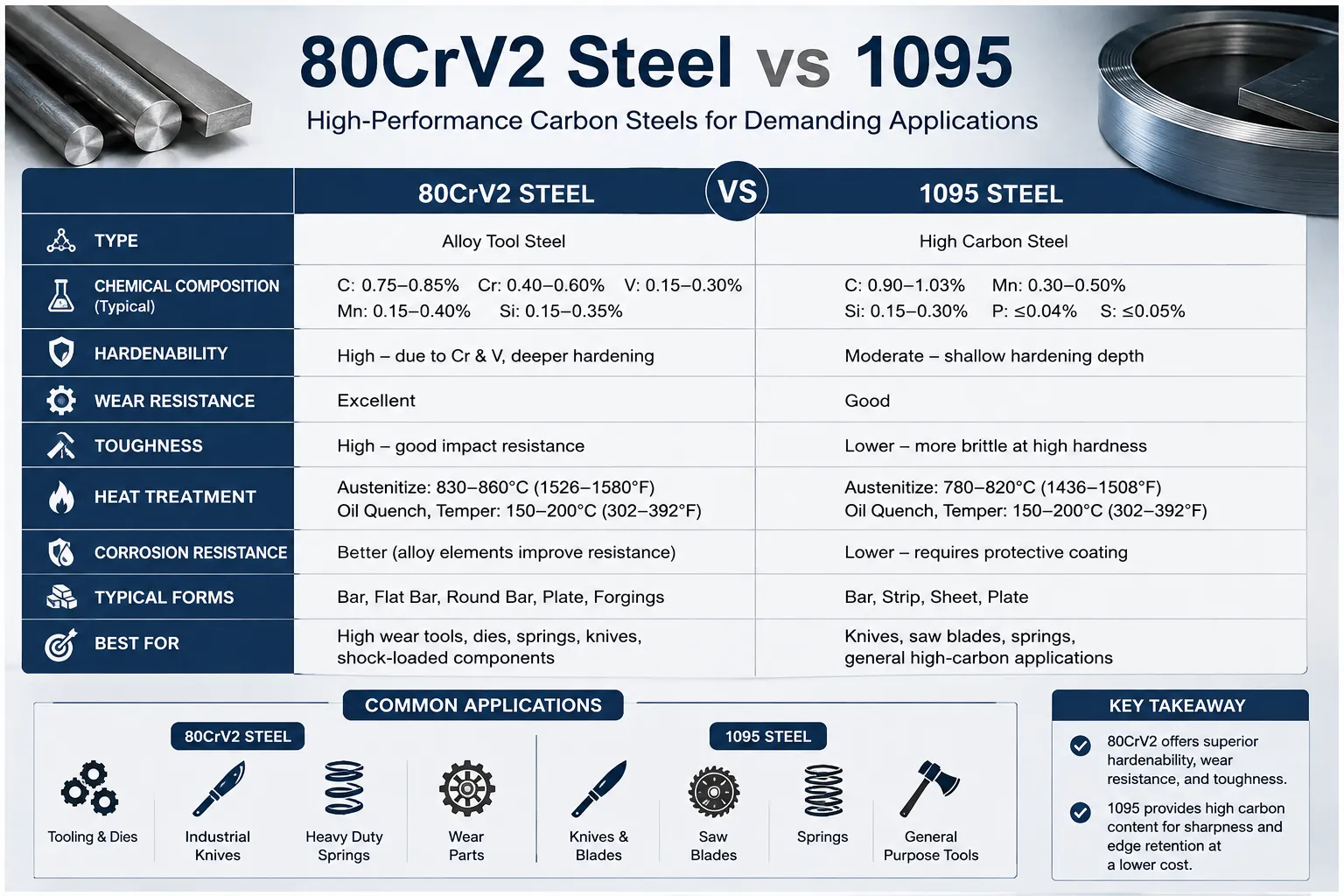
Both alloys belong to the high-carbon tool steel family, but their composition differs in ways that directly affect performance.
1095 is a plain high-carbon steel with almost no alloying elements beyond carbon and manganese. It's about as simple as steel chemistry gets, which is exactly why it's been a workhorse in blade making for over a century. 80CrV2, sometimes labeled 1075CrV or sold under similar trade names, adds chromium and vanadium to a comparable carbon base, giving it a more complex grain structure and better response to heat treatment.
| Element | 1095 Steel | 80CrV2 Steel |
|---|---|---|
| Carbon (C) | 0.90 - 1.03% | 0.75 - 0.85% |
| Manganese (Mn) | 0.30 - 0.50% | 0.30 - 0.60% |
| Chromium (Cr) | 0.00 - not specified | 0.40 - 0.60% |
| Vanadium (V) | None | 0.15 - 0.25% |
| Silicon (Si) | 0.15 - 0.35% | 0.15 - 0.35% |
| Phosphorus (P) | 0.030% max | 0.030% max |
| Sulfur (S) | 0.050% max | 0.030% max |
| Iron (Fe) | Balance | Balance |
The chromium in 80CrV2 raises hardenability and gives modest corrosion resistance compared to 1095, though neither steel qualifies as stainless. The vanadium addition is the bigger story mechanically, because vanadium carbides are harder and finer-grained than the iron carbides that dominate 1095's microstructure. Finer carbides mean a more refined grain structure after heat treatment, which translates into better toughness at a given hardness level.
We've pulled mill certs on both alloys for years, and the batch-to-batch consistency on 80CrV2 tends to run slightly tighter than commodity 1095, largely because fewer mills produce it and the ones that do treat it as a specialty product rather than a high-volume commodity grade.
How Does Toughness Compare Between 80CrV2 and 1095?
Toughness, meaning the steel's ability to absorb energy and resist chipping or cracking under impact, is where 80CrV2 pulls ahead most clearly. We test this internally using simple flex and impact tests on sample stock before it goes out to knife maker customers, and the pattern holds consistently.
1095, especially at higher hardness levels above 60 HRC, tends toward brittleness. Push it too hard in heat treatment and you'll see edge chipping under lateral stress or impact, which is a common complaint we hear from makers who haven't dialed in their tempering schedule yet. Properly heat treated 1095 at 57-59 HRC performs reasonably well, but it doesn't have much margin for error.
80CrV2's vanadium carbides refine the grain during austenitizing, which is the primary mechanism behind its improved toughness. Bladesmiths who make choppers, axes, and machetes, tools that take repeated impact against wood, bone, or other hard material, gravitate toward 80CrV2 specifically because it tolerates a wider hardness window without chipping.
| Toughness Factor | 1095 | 80CrV2 |
|---|---|---|
| Typical impact resistance | Moderate | Good to very good |
| Chipping tendency at high hardness | Higher | Lower |
| Tolerance for heat treat error | Narrow | Wider |
| Grain refinement | Standard | Improved (vanadium carbides) |
| Best hardness range for toughness | 56-58 HRC | 58-60 HRC |
We'd tell any customer building a survival knife, camp axe, or chopper that 80CrV2 gives more forgiveness if the blade takes an unexpected side load or gets used to baton through wood, a use case that punishes brittle steel fast.
Which Steel Holds an Edge Longer, 80CrV2 or 1095?
Edge retention is where the comparison gets more nuanced, and it's the question we get asked most often by customers deciding between the two.
Edge retention depends on wear resistance, which in turn depends on carbide hardness and volume in the steel's microstructure. 1095 has no significant carbide-forming alloying elements beyond iron carbide (cementite), which is harder than the steel matrix but softer than vanadium carbide. 80CrV2's vanadium carbides are measurably harder, giving it an edge in pure wear resistance against abrasive cutting tasks like rope, cardboard, or dirty rope fiber.
That said, 1095 sharpens to a very fine, aggressive edge quickly because its simpler microstructure takes a keen apex well on a stone or strop. Many bushcraft and kitchen knife users actually prefer this trait, since a 1095 blade that's lost some sharpness touches back up in under a minute on a field stone, whereas 80CrV2 takes slightly longer to restore due to its harder carbides resisting the abrasive.
| Edge Retention Metric | 1095 | 80CrV2 |
|---|---|---|
| Wear resistance (abrasive cutting) | Moderate | Better |
| Edge sharpness achievable | Very fine | Fine |
| Ease of re-sharpening | Very easy | Moderately easy |
| Edge stability under lateral stress | Lower | Higher |
| Performance cutting rope/cardboard | Good | Very good |
Our practical take, based on customer feedback loops over multiple production runs: if the knife will see heavy field resharpening with basic stones, 1095 is friendlier. If the knife needs to hold a working edge through a full day of hard use before resharpening becomes necessary, 80CrV2 usually wins.
How Do 80CrV2 and 1095 Respond to Heat Treatment?
This is the part most comparison articles skip, and it's honestly the most important variable in the entire conversation, because neither steel performs well without a properly executed heat treatment schedule.
1095 is shallow-hardening, meaning it needs a fast quench, typically brine or fast oil, to achieve full hardness through the cross-section. This shallow hardenability is actually useful for differential hardening techniques like clay tempering, which is why 1095 remains popular among traditional Japanese-style blade makers who want a hard edge with a softer, tougher spine.
80CrV2's added chromium improves hardenability noticeably, allowing a slower oil quench to still achieve full hardness. This makes it more forgiving for makers without brine quenching setups, and it reduces the risk of quench cracking, a real problem with 1095 in thicker stock or complex geometries.
| Heat Treatment Parameter | 1095 | 80CrV2 |
|---|---|---|
| Austenitizing temperature | 1475-1550°F | 1550-1600°F |
| Quench medium | Fast oil or brine | Medium to fast oil |
| Hardenability depth | Shallow | Moderate |
| Quench crack risk | Higher (thick stock) | Lower |
| Suitability for differential hardening | Excellent | Good |
| Typical as-quenched hardness | 64-66 HRC | 63-65 HRC |
| Recommended tempering range | 350-450°F | 375-425°F |
We run heat treatment consultations for makers ordering bar stock from us, and the single most common mistake we see on 1095 is insufficient quench speed, usually because the maker is using an oil that's too slow for the section thickness, resulting in incomplete transformation and soft spots. 80CrV2 is genuinely more forgiving here, which matters a lot for makers still building out their heat treat process.
What Applications Suit 80CrV2 Best?
Based on the property profile, certain applications consistently favor 80CrV2 over 1095, and we steer customers toward it when these use cases come up.
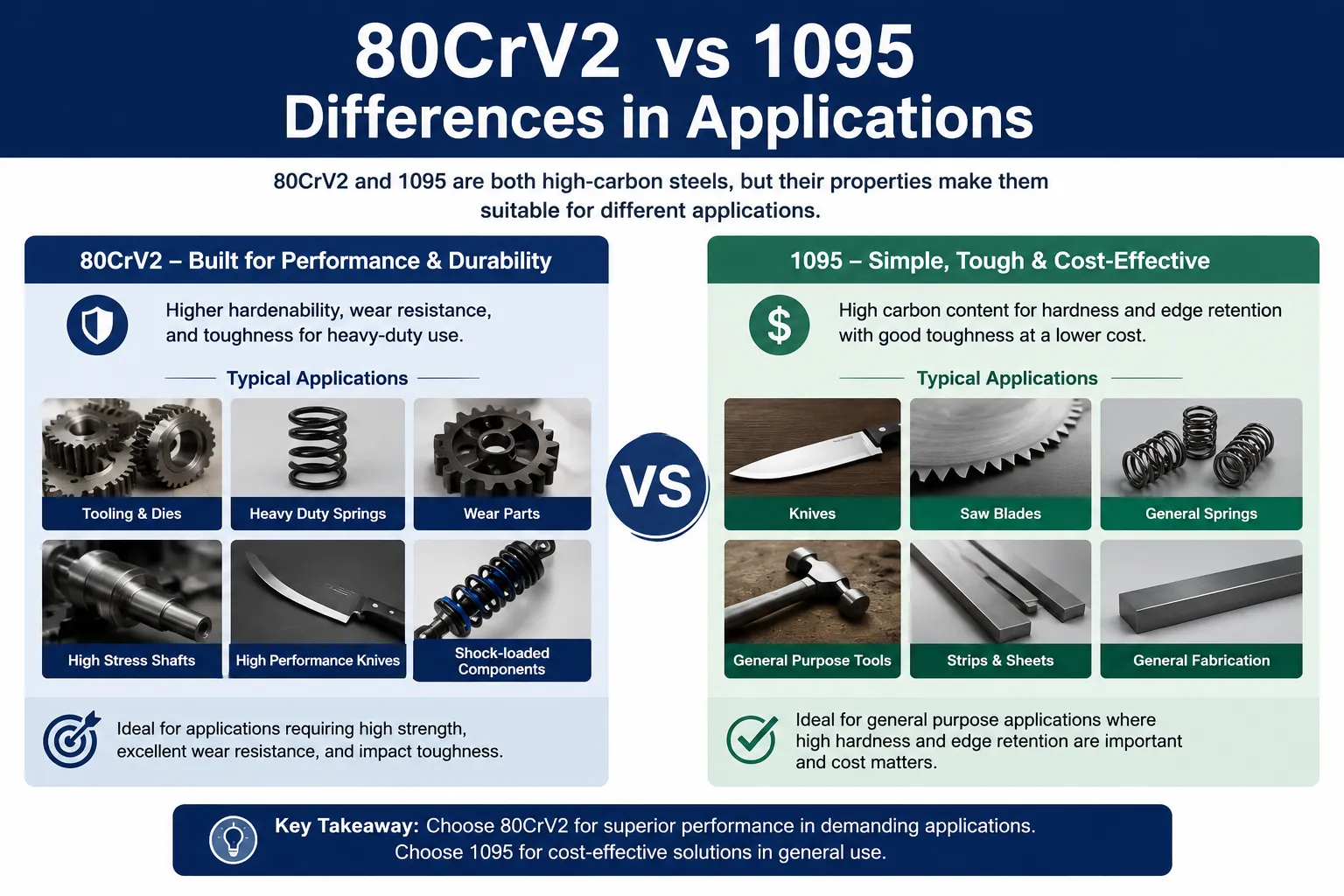
Choppers and camp knives. The combination of toughness and decent edge retention makes 80CrV2 a strong fit for blades that take impact against wood or bone regularly.
Axes and hatchets. Impact resistance matters more than ultimate hardness in axe heads, and 80CrV2's forgiving nature under repeated shock loading reduces the risk of chipping along the bit.
Swords and larger blades. Longer blades flex more under lateral loading during use, and 80CrV2's toughness margin reduces catastrophic failure risk compared to a more brittle high-carbon steel pushed to similar hardness.
Machetes and bush blades. Extended use cutting through vegetation and occasionally striking harder material rewards the wear resistance and impact tolerance 80CrV2 offers.
Tools requiring thicker stock. Because 80CrV2 hardens more evenly through thicker cross-sections, it performs more predictably in tools where full hardness through the material matters, like chisels or larger fixed blades.
What Applications Suit 1095 Best?
1095 still earns its place in plenty of applications, and we wouldn't recommend against it just because 80CrV2 wins on paper for toughness.
Traditional and hidden-tang knives. The long manufacturing history of 1095 means abundant reference data, proven heat treat recipes, and predictable behavior for makers replicating historical designs.
Kitchen knives. The fine edge 1095 takes suits food prep tasks where a razor-thin edge angle matters more than impact resistance.
Budget-conscious production runs. 1095 typically costs less per pound than 80CrV2 due to wider mill availability and simpler alloying, which matters for manufacturers producing at volume where margin per unit counts.
Differentially hardened blades. Clay-tempered blades relying on 1095's shallow hardenability to create a visible hamon and a soft, flexible spine paired with a hard edge.
Straightforward fixed-blade knives for everyday carry. For a knife that sees light-to-moderate use and gets resharpened regularly by an experienced user, 1095's ease of sharpening is a genuine practical advantage.
How Do Corrosion Resistance and Maintenance Compare?
Neither steel is stainless, and both will rust if neglected, but there's a measurable difference worth mentioning.
80CrV2's chromium content, while too low to qualify as stainless, does provide a modest improvement in corrosion resistance compared to plain 1095. It's not a dramatic difference, and we wouldn't recommend either steel for a wet-environment application without a protective coating or diligent oil maintenance, but 80CrV2 tends to develop surface rust slightly slower in humid storage conditions based on the corrosion testing we've done on stored bar stock samples.
| Maintenance Factor | 1095 | 80CrV2 |
|---|---|---|
| Rust resistance | Low | Slightly better than 1095 |
| Patina development | Fast, forms protective patina | Fast, similar patina behavior |
| Recommended maintenance | Oil coating, dry storage | Oil coating, dry storage |
| Suitability for humid climates | Poor without coating | Fair without coating |
Both steels benefit from forced patina treatments (vinegar or mustard patina) that create a protective oxide layer, a common practice among bushcraft knife users who want rust protection without a stainless coating that would compromise edge geometry.
Read more: 80CrV2 Steel: Properties, Heat Treatment, Knife, Supplies
What Does Cost and Availability Look Like?
Procurement teams and hobbyist makers alike ask us about pricing differences, so here's the breakdown based on current bar stock and flat stock pricing trends we track.
| Cost Factor | 1095 | 80CrV2 |
|---|---|---|
| Relative raw material cost | Lower | 10-25% higher typically |
| Mill availability | Very wide | Moderate, fewer suppliers |
| Common stock forms available | Flat bar, round bar, sheet | Flat bar, round bar |
| Typical order lead time | Short (stock item) | Slightly longer (specialty grade) |
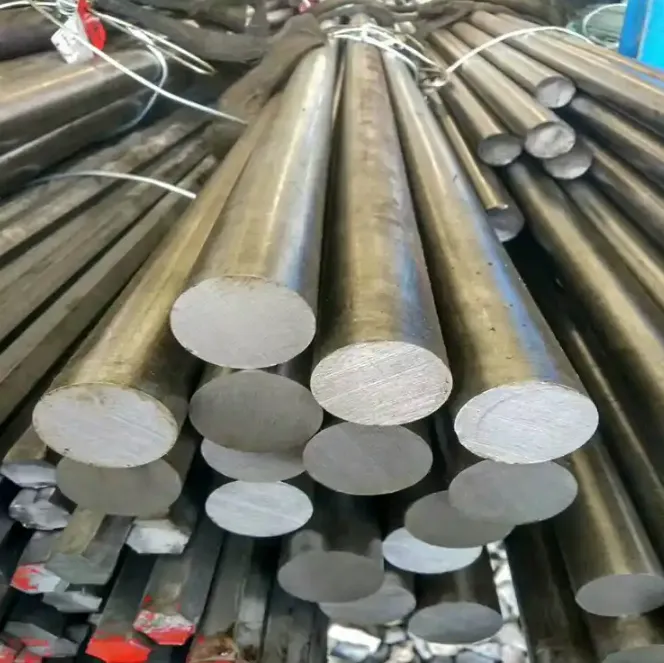
1095 remains one of the most widely stocked tool steels globally, which keeps pricing competitive and lead times short. 80CrV2 is a specialty grade produced by fewer mills, so pricing runs higher and availability can fluctuate seasonally depending on mill production schedules. We keep both in stock in common flat bar dimensions specifically because demand from knife makers has grown steadily, but we've seen 80CrV2 go on backorder from some mills during periods of high custom knife market demand.
How Should You Choose Between 80CrV2 and 1095 for Your Project?
We walk customers through a short set of questions before recommending either steel, and we'd suggest running through the same checklist yourself.
First, will the blade or tool take repeated impact, like chopping, batoning, or striking hard material? If yes, 80CrV2's toughness margin justifies the extra cost.
Second, do you have a reliable brine or fast-oil quench setup, or are you working with a slower oil and thinner equipment? 80CrV2's better hardenability forgives a slower quench more gracefully.
Third, is field resharpening with basic tools a priority, or will the tool return to a proper sharpening station between uses? 1095's ease of sharpening favors the former.
Fourth, is this a traditional or historical build where 1095's long documented history and hamon-forming capability matter aesthetically? If so, 1095 remains the better match regardless of the technical toughness comparison.
Fifth, what's the budget per unit at your production volume? At scale, the cost difference between the two alloys adds up, and for applications where 1095's slightly lower toughness isn't a practical concern, the savings are real.
Read more: 1095 High Carbon Steel Plate
What Do Experienced Bladesmiths Say About the Difference in Practice?
We've talked with enough independent makers over the years to notice a consistent pattern in feedback, beyond what a lab data sheet shows.
Makers who've worked extensively with both steels frequently describe 80CrV2 as "more forgiving" during both heat treatment and use, a description that lines up with the metallurgical explanation: wider hardness tolerance, better hardenability, and a bigger safety margin against chipping. The tradeoff they mention almost universally is that 80CrV2 takes a touch longer to sharpen back to a hair-splitting edge compared to 1095.
Makers focused on traditional Japanese-influenced designs tend to stick with 1095 specifically for the differential hardening results, describing the hamon line quality as more visually striking and predictable than what 80CrV2 typically produces, since 80CrV2's chromium content slightly interferes with the clay-tempering contrast effect.
This kind of practical, hands-on feedback from the maker community doesn't always show up in mill data sheets, but it matters just as much as the lab numbers when you're deciding which steel fits your actual production process.
Frequently Asked Questions
Is 80CrV2 better than 1095 overall?
Neither steel is universally better, since the right choice depends on the application. 80CrV2 wins on toughness, wear resistance, and heat treatment forgiveness, making it the stronger choice for choppers, axes, and impact-heavy tools. 1095 wins on ease of sharpening, cost, and differential hardening results, making it better suited to traditional blades and kitchen knives where a fine edge matters more than impact resistance.
Can 80CrV2 hold an edge as long as 1095?
Yes, 80CrV2 generally holds a working edge longer than 1095 during abrasive cutting tasks because its vanadium carbides resist wear better than the plain iron carbides in 1095. However, 1095 achieves a slightly sharper initial edge and returns to that sharpness faster with basic sharpening tools, so "edge retention" depends on whether you're measuring wear resistance or ease of restoring peak sharpness.
Is 1095 steel good for a survival knife?
1095 works reasonably well for survival knives when heat treated correctly, offering a durable edge and easy field sharpening with basic stones. That said, 80CrV2 is generally a stronger choice for survival use specifically because survival knives often take unplanned impact, batoning, or prying stress that rewards toughness over ultimate sharpness, reducing the risk of a chipped or broken blade in the field.
Does 80CrV2 rust easier than stainless steel?
Yes, 80CrV2 rusts significantly easier than true stainless steel grades because its chromium content (0.40-0.60%) is far below the roughly 12% threshold needed for stainless corrosion resistance. It offers only a modest improvement over plain carbon steels like 1095, so both alloys require regular oiling and dry storage to prevent surface rust developing over time.
What hardness (HRC) should 80CrV2 be heat treated to for knives?
Most knife makers target 58-60 HRC for 80CrV2 blades, which balances edge retention with the steel's toughness advantage. Pushing hardness above 61 HRC starts eroding the toughness margin that makes 80CrV2 attractive in the first place, so we generally advise staying within this range unless the application specifically calls for maximum wear resistance over impact tolerance.
Why do bladesmiths use 1095 for hamon and differential hardening?
1095's shallow hardenability means only the section exposed to fast cooling (typically the edge, when clay-coated) fully hardens, while the clay-insulated spine cools slower and stays softer. This creates a visible transition line called a hamon, along with a genuinely functional hard edge and tough spine combination. Steels with higher hardenability, like 80CrV2, harden more uniformly and produce a less distinct hamon effect.
Is 80CrV2 more expensive than 1095?
Yes, 80CrV2 typically costs 10-25% more per pound than 1095 due to narrower mill availability and the added alloying cost of chromium and vanadium. The price gap fluctuates with market conditions and mill production schedules, since fewer producers manufacture 80CrV2 compared to the widely available commodity grade 1095.
Can you use 80CrV2 and 1095 in the same knife (san mai construction)?
Yes, both steels are compatible with san mai or laminated construction techniques, where a hard cutting core is sandwiched between softer, tougher outer layers. Makers sometimes pair a 1095 edge core with softer outer jacket material for a blade with a very hard, sharp edge and improved overall flex resistance from the cladding layers.
Which steel is easier for a beginner bladesmith to heat treat?
80CrV2 is generally more forgiving for beginners because its improved hardenability tolerates a slightly slower or less precise quench without producing soft spots or cracks. 1095 demands a fast, consistent quench and tighter process control, so beginners working without a brine quench setup often see more inconsistent results with 1095 than with 80CrV2 under identical conditions.
Does 80CrV2 or 1095 perform better in cold weather use?
Both steels can become slightly more brittle at very low temperatures, but 80CrV2's inherent toughness margin gives it more resistance to cold-weather brittleness than 1095. For knives or tools expected to see hard use in freezing conditions, such as ice-cutting or winter camp tools, 80CrV2 is the more reliable choice based on the toughness data and field reports we've reviewed.
Ready to Source 80CrV2 or 1095 Bar Stock?
Whether you're prototyping a custom blade design or sourcing material for a production run, we keep both 80CrV2 and 1095 in stock in common bar and flat stock dimensions, along with heat treatment guidance based on years of working directly with knife makers and tool manufacturers. Send us your specifications or a description of your intended application, and our team will help you confirm which alloy fits your project before you commit to an order. Reach out through our contact page or call our materials team directly to get a quote and lead time today.
Sources and References
- ASTM International, ASTM A681 Standard Specification for Tool Steels Alloy.
- SAE International, SAE J403 Chemical Compositions of SAE Carbon Steels.
- ASM International, ASM Handbook Volume 1: Properties and Selection of Irons, Steels, and High-Performance Alloys.
- Verhoeven, John D., "Steel Metallurgy for the Non-Metallurgist," ASM International.
- Crucible Industries, Technical Data Sheets for High Carbon Tool Steels.
- American Bladesmith Society, Heat Treatment Reference Materials.
- Knife Steel Nerds, Independent Steel Testing and Metallurgical Analysis Archives.
- NIST Materials Data Repository, Mechanical Property Reference Data for Carbon and Alloy Tool Steels.