
If you want the short answer before the metallurgy, 80CrV2 is a shallow-hardening, high-carbon chromium-vanadium tool steel that makes an excellent choice for hand-forged knives, swords, and cutting tools when the maker wants exceptional edge retention combined with genuine toughness, provided the blade sees proper heat treatment with quench temperatures held tightly between 790°C and 820°C, since this steel's simple alloy chemistry leaves very little margin for error compared to more forgiving modern powder steels. We have supplied 80CrV2 bar stock to custom knifemakers, small forges, and specialty cutlery manufacturers at MWalloys for years, and the recurring theme in nearly every technical call we get is that this steel rewards careful, disciplined heat treatment far more than it punishes minor forging mistakes.
If your project requires the use of 80CrV2 Steel, you can contact us for a free quote.
What Is 80CrV2 Steel and Where Did It Come From?
80CrV2 is a European-origin high-carbon steel alloy, developed under the German DIN standard system, that combines roughly 0.80% carbon with small additions of chromium and vanadium. The designation itself tells the composition story directly under DIN naming convention: the "80" refers to 0.80% carbon content, "Cr" and "V" indicate the chromium and vanadium alloying additions, and "2" is a multiplier code indicating the actual chromium content sits at a fraction of the reference percentage the number would otherwise suggest.
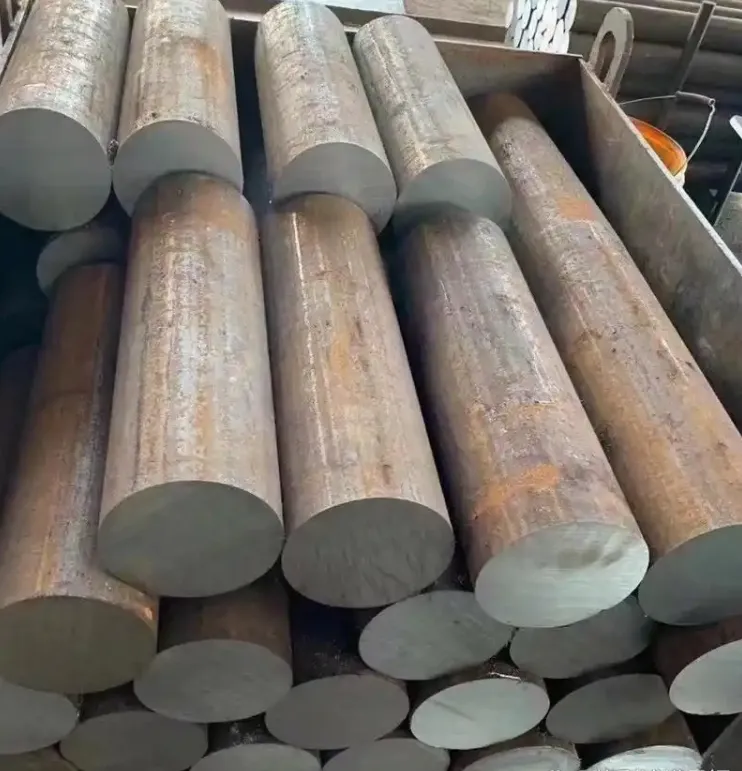
This steel originated in European tool and spring steel production, where its combination of decent hardness, toughness, and modest alloy cost made it useful for applications like leaf springs, agricultural tool edges, and hand tools long before the knifemaking community adopted it as a premium blade steel. Its crossover into custom knifemaking and small-batch cutlery production happened largely because bladesmiths recognized that the vanadium addition, even in small quantity, refines grain structure during heat treatment in a way that plain high-carbon steels like 1080 or 1095 cannot match on their own.
We started stocking 80CrV2 specifically because demand from custom knifemakers grew steadily once word spread through forging communities about its edge-holding and toughness combination. It occupies a specific niche: not as simple to heat treat as 1080, but considerably more forgiving and tougher than higher-alloy stainless powder steels that demand precise industrial heat treatment equipment most small shop forges simply do not have access to.
What Chemical Composition Defines 80CrV2 Steel?
The alloy chemistry of 80CrV2 is deliberately simple compared to modern powder metallurgy steels, and that simplicity is central to why it performs so well in traditional forging and heat treatment environments where equipment control is less precise than an industrial furnace line.
| Element | Composition Range |
|---|---|
| Carbon (C) | 0.75 - 0.85% |
| Chromium (Cr) | 0.40 - 0.60% |
| Vanadium (V) | 0.15 - 0.25% |
| Manganese (Mn) | 0.30 - 0.50% |
| Silicon (Si) | 0.15 - 0.35% |
| Phosphorus (P) | 0.030% max |
| Sulfur (S) | 0.030% max |
Carbon content sitting close to the eutectoid point (approximately 0.80% for plain carbon steel) gives this alloy the ability to reach high hardness through conventional quenching without requiring the extended soak times or complex thermal cycles higher-alloy steels demand. The chromium addition, modest compared to true stainless or high-alloy tool steels, contributes some hardenability improvement and mild wear resistance without pushing the steel into stainless territory, meaning 80CrV2 will still rust without proper care, a tradeoff bladesmiths accept in exchange for the alloy's forging and heat treatment friendliness.
Vanadium is the element doing the most distinctive work in this alloy. Even at 0.15 to 0.25%, vanadium forms fine carbides that pin grain boundaries during austenitizing, resisting the grain growth that occurs when high-carbon steel sits too long at elevated temperature or gets heated slightly too hot. This grain refinement translates directly into improved toughness at a given hardness level compared to plain carbon steels lacking any vanadium content, which is precisely why bladesmiths reach for 80CrV2 when a blade needs to survive impact and lateral stress without chipping.
How Do the Mechanical Properties Compare to Other Popular Knife Steels?
Knifemakers and buyers constantly compare 80CrV2 against 1080, 1095, 5160, and O1 when deciding on blade steel, so we keep this comparison table on hand for exactly these conversations.
| Property | 80CrV2 | 1080 | 5160 | O1 |
|---|---|---|---|---|
| Carbon content | 0.75-0.85% | 0.75-0.88% | 0.56-0.64% | 0.85-1.00% |
| Chromium content | 0.40-0.60% | None significant | 0.70-0.90% | 0.40-0.60% |
| Vanadium content | 0.15-0.25% | None | None | None |
| Achievable hardness (HRC) | 58-62 | 58-62 | 55-60 | 58-62 |
| Toughness relative rating | Very good | Good | Excellent | Good |
| Edge retention relative rating | Very good | Good | Moderate | Good |
| Ease of heat treatment (forge/shop) | Moderate | Easy | Moderate | Moderate |
| Stain resistance | Poor (not stainless) | Poor | Poor | Poor |
The comparison against 5160 is particularly common among bladesmiths building larger knives, swords, and choppers, since 5160 has an established reputation for exceptional toughness owing to its lower carbon content and higher chromium and manganese levels. 80CrV2 generally holds a slightly finer edge and takes a marginally higher working hardness than 5160, while sacrificing a small amount of the extreme toughness 5160 is known for. In practical terms, we describe this tradeoff to customers as 80CrV2 sitting between a pure edge-holding steel like 1095 and a pure toughness steel like 5160, capturing a meaningful share of both qualities rather than maximizing either one alone.
Against plain 1080, the vanadium addition is what earns 80CrV2 its premium. Both steels reach similar peak hardness, but 80CrV2's finer grain structure from vanadium carbide pinning gives it noticeably better toughness at that same hardness level, meaning a bladesmith can push 80CrV2 slightly harder without the chipping risk that would accompany 1080 pushed to the same hardness.
What Heat Treatment Process Does 80CrV2 Require?
Heat treatment is where 80CrV2 either delivers on its reputation or disappoints a maker who treated it exactly like plain 1080 or 1095. The chromium and vanadium additions shift the critical temperatures and hardenability characteristics enough that a heat treatment schedule optimized for simpler carbon steels will not extract this steel's full potential.
| Heat Treatment Stage | Temperature Range | Notes |
|---|---|---|
| Normalizing | 850-870°C, air cool | Repeat 2-3 times for grain refinement |
| Austenitizing (hardening) | 790-820°C | Soak 8-15 minutes depending on section thickness |
| Quench medium | Oil (fast to medium oil) | Water quench risks cracking due to alloy content |
| Tempering (first cycle) | 175-220°C, 1 hour | Adjust within range for desired hardness/toughness balance |
| Tempering (second cycle) | Same temp as first, 1 hour | Double temper recommended for stress relief |
We emphasize to customers that 80CrV2 is an oil-hardening steel, not a water-hardening steel, despite the plain carbon steel comparisons some makers draw from their 1080 or 1084 experience. The chromium content, while modest, increases hardenability enough that oil quenching achieves full hardness while dramatically reducing the cracking risk that water quenching this alloy would create. We have heard from more than a few customers who attempted a water quench based on habits formed working with simpler steels and ended up with cracked blades, a completely avoidable outcome once the correct quench medium is understood.
Normalizing cycles before hardening deserve more attention than many hobbyist forging resources give them. Because 80CrV2 responds so well to grain refinement through thermal cycling, we recommend at least two, ideally three, normalizing cycles at decreasing temperature before the final hardening quench, a practice that measurably improves the steel's final toughness according to feedback from experienced makers we work with regularly.
Tempering temperature selection is where a maker tunes the final hardness-toughness balance for the blade's intended use. Lower tempering temperatures near the bottom of the range preserve maximum hardness and edge retention, suited to smaller utility and kitchen knives that see less lateral stress. Higher tempering temperatures within the range sacrifice a couple of points of hardness in exchange for meaningfully improved toughness, better suited to larger blades, choppers, and swords expected to survive impact loading.
| Tempering Temperature | Resulting Hardness (approximate) | Best Suited For |
|---|---|---|
| 175°C | 61-62 HRC | Small utility/kitchen knives, maximum edge retention |
| 190°C | 60-61 HRC | General purpose knives, balanced performance |
| 205°C | 58-60 HRC | Larger knives, moderate impact expected |
| 220°C | 56-58 HRC | Choppers, swords, high impact resistance priority |
What Grain Structure and Microstructure Considerations Matter Most?
Grain size control is arguably the single most important variable a bladesmith controls when working with 80CrV2, and it is also the area where the steel's vanadium content provides its biggest practical advantage over plain carbon alternatives. Fine, uniform grain structure directly correlates with improved toughness at any given hardness level, while coarse grain structure, typically the result of overheating during forging or holding too long at austenitizing temperature, dramatically increases brittleness and chipping risk regardless of how carefully the rest of the heat treatment schedule was followed.
Vanadium carbides act as pinning points that physically block grain boundary movement during heating, meaning 80CrV2 tolerates a wider margin of forging temperature variation before grain growth becomes a serious problem compared to plain 1080 or 1095. This does not mean overheating is harmless, sustained temperatures well above the normal forging range will still coarsen the grain structure even with vanadium present, but the alloy provides more forgiveness than makers get from simpler steels.
| Grain Condition | Typical Cause | Effect on Blade Performance |
|---|---|---|
| Fine, uniform grain | Proper normalizing, controlled forging temperature | Optimal toughness and edge stability |
| Moderate grain growth | Occasional overheating, insufficient normalizing | Reduced toughness, increased chipping risk |
| Severe grain growth | Repeated overheating, excessive soak time | Brittle blade, prone to cracking under stress |
| Decarburized surface | Extended high-temp exposure without protection | Soft surface layer, poor edge retention |
We advise makers working with 80CrV2 to invest in either a temperature-controlled forge or at minimum a reliable pyrometer, since visual color judgment of steel temperature, while a traditional bladesmithing skill, introduces enough variability that grain structure consistency suffers across a production run of blades. For makers producing knives commercially rather than as individual art pieces, this consistency matters directly to customer satisfaction and warranty claims.
Read More: X20Cr13 Steel: Properties, Prices, Equivalent
How Does 80CrV2 Perform as a Knife Blade Steel in Real Use?
Performance data from actual field use matters more to knife buyers than laboratory hardness numbers alone, so we gather feedback from the bladesmiths and knife users in our customer base regularly to understand how this steel behaves outside controlled testing conditions.
Edge retention on properly heat-treated 80CrV2 blades performs noticeably better than plain 1080 or 1084 in cutting tasks involving cardboard, rope, and general utility work, a difference users consistently attribute to the finer carbide structure vanadium contributes. It does not match higher-vanadium powder steels like CPM-3V or M4 in pure wear resistance, since those steels contain considerably more vanadium and other carbide-forming elements specifically engineered to maximize this property, but 80CrV2 delivers a meaningful step up from plain carbon steel at a fraction of the cost and heat treatment complexity those powder steels demand.
Toughness in impact and lateral stress testing puts 80CrV2 in a favorable position among traditionally forged steels. Bladesmiths building camp knives, bushcraft blades, and choppers report good resistance to chipping during batoning and heavy chopping tasks, provided heat treatment tempering was set toward the tougher end of the achievable range rather than chasing maximum hardness.
| Use Case | 80CrV2 Suitability | Reasoning |
|---|---|---|
| Kitchen/utility knives | Excellent | High hardness achievable, good edge retention |
| Bushcraft/camp knives | Excellent | Balances edge holding with impact toughness |
| Hunting knives | Very good | Good edge retention, adequate toughness |
| Swords/large blades | Good to very good | Tempered toward toughness end of range |
| High-corrosion environments | Poor without coating/maintenance | Not stainless, requires oil/maintenance |
| Extreme wear applications | Moderate | Outperformed by high-vanadium powder steels |
Corrosion resistance remains this steel's clearest weakness, and we make sure every customer understands this upfront regardless of how experienced they are with carbon steel maintenance. 80CrV2 will develop surface rust without regular oiling and proper storage, the same maintenance routine any traditional high-carbon knife steel requires. Buyers seeking a low-maintenance blade steel should look toward stainless alternatives, but should also understand that trade brings its own performance compromises in toughness and edge geometry that many experienced knife users find less desirable than the maintenance requirement itself.
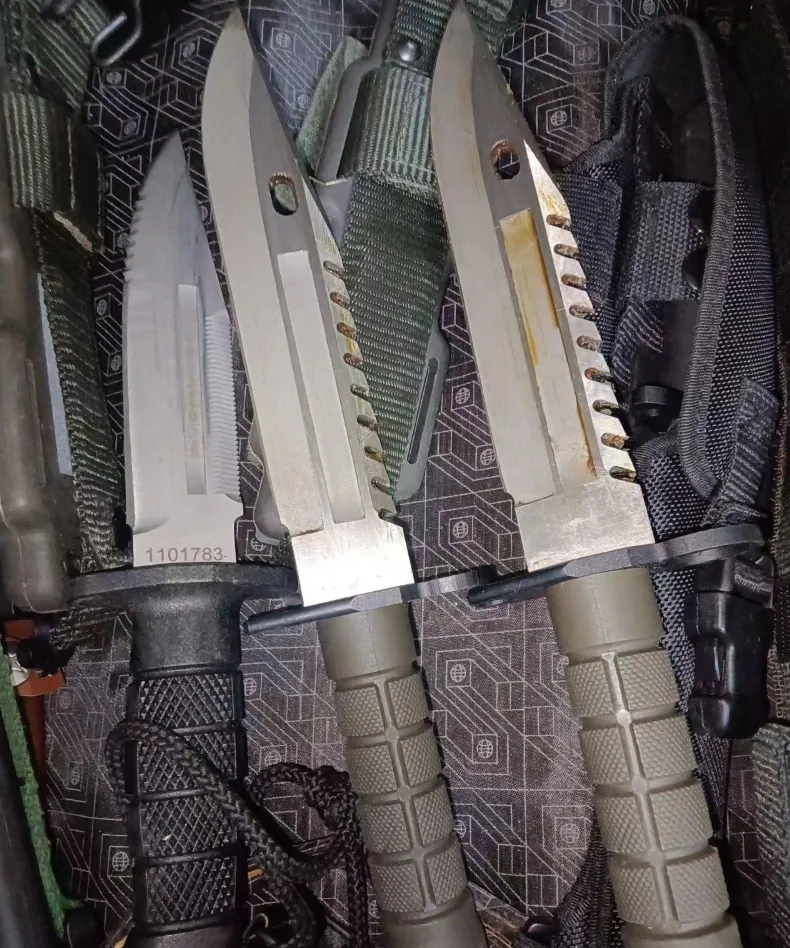
How Does 80CrV2 Forge and Fabricate Compared to Other Steels?
Forgeability is a major reason custom bladesmiths favor 80CrV2 over higher-alloy tool steels, since this alloy behaves predictably under the hammer across a reasonably wide temperature window, an important quality for makers working without the precise temperature control industrial manufacturing facilities maintain.
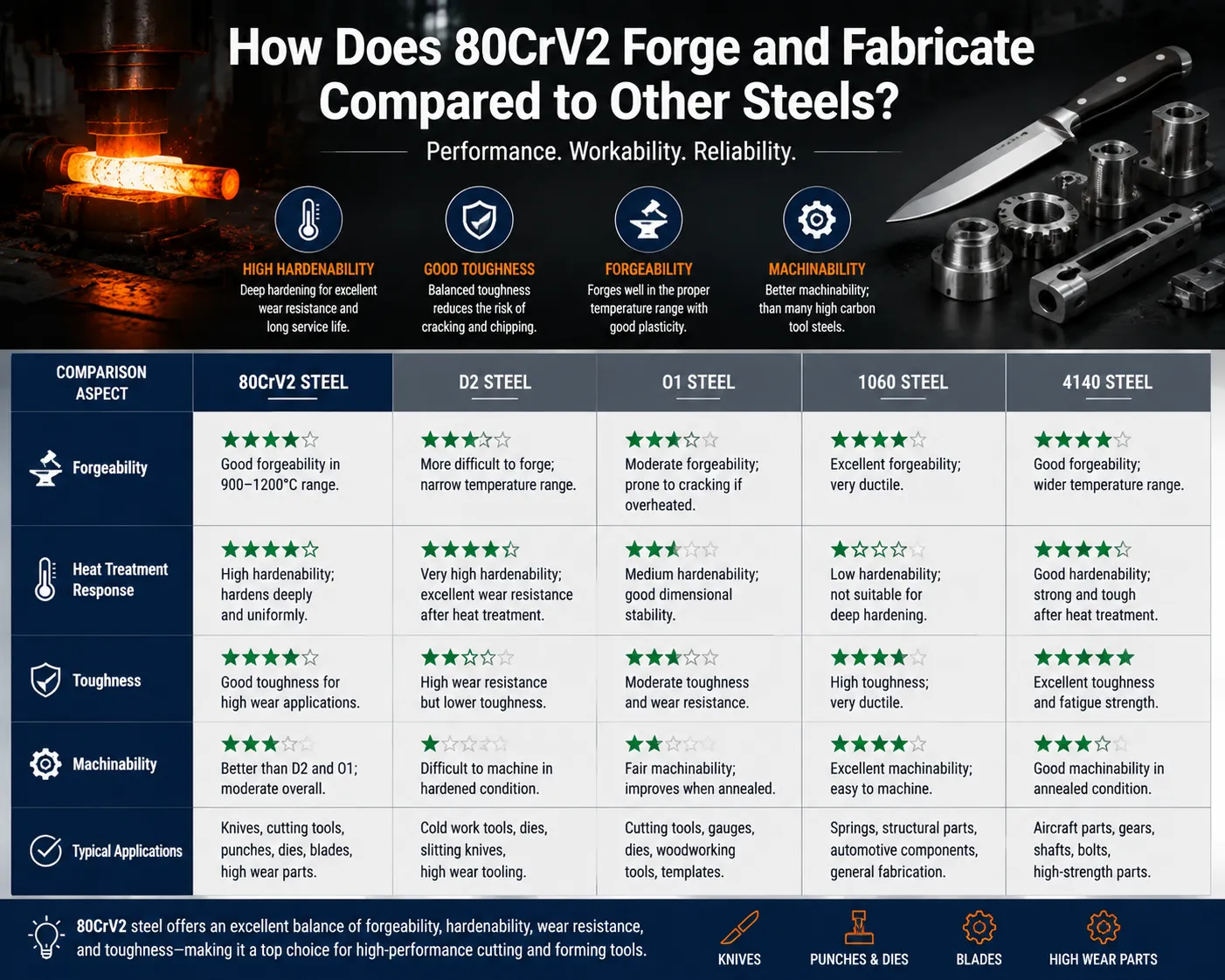
The steel forges well within a temperature range roughly between 900°C and 1150°C, moving easily under the hammer without excessive scaling or the narrow critical working window that some higher-alloy steels demand. We hear consistently from experienced bladesmiths that 80CrV2 feels similar to working with 5160 or 1084 at the forge, with the caveat that overheating still needs to be avoided to prevent the grain growth issues discussed earlier, vanadium's grain-pinning benefit notwithstanding.
| Fabrication Process | 80CrV2 Behavior | Comparison Note |
|---|---|---|
| Forging temperature range | 900-1150°C | Similar working range to 5160/1084 |
| Grinding/stock removal | Moderate difficulty | Comparable to other high-carbon steels |
| Machinability (annealed) | Good | Standard high-carbon steel machinability |
| Weldability | Limited, not typically welded in blade construction | Standard for high-carbon blade steels |
| Etching response (for pattern welding) | Good contrast | Popular choice in some damascus combinations |
Stock removal knifemakers, those building blades by grinding rather than forging, find 80CrV2 machines and grinds comparably to other high-carbon steels in the annealed state, without unusual tool wear or grinding difficulty compared to plain carbon alternatives. This makes it accessible to both traditional forge-based bladesmiths and modern stock-removal shops using belt grinders and CNC equipment, broadening its appeal across different production methods within the custom knife industry.
Pattern-welded (damascus) construction using 80CrV2 as one of the alloy layers has grown in popularity, since its chromium content provides slightly different etching contrast against plain carbon steels like 1080 or 15N20, giving pattern welders another combination option for achieving distinctive visual patterns while maintaining good functional performance in the finished blade.
Read more: 40Cr Steel: Equivalents, Properties, Grade, Heat Treatment
What Annealing and Stress Relief Practices Extend Tool Life and Blade Performance?
Annealing matters both before hardening (to prepare the steel for machining, grinding, and stock removal) and, less commonly, after hardening in specific cases where a maker needs to soften a blade for correction or rework. Full annealing of 80CrV2 typically involves heating to the austenitizing range, holding briefly, then cooling extremely slowly, ideally in an insulated environment like vermiculite or a furnace with programmable slow cool capability, to achieve maximum softness for machining.
| Process | Temperature | Cooling Method | Purpose |
|---|---|---|---|
| Full anneal | 790-815°C, slow cool | Furnace cool or insulated slow cool | Maximum softness for machining/grinding |
| Stress relief anneal | 650-680°C | Air cool | Relieve stress without full softening |
| Spheroidize anneal | Cycling around critical temp | Slow, controlled | Improves machinability further |
Stress relief between grinding operations, particularly on blades ground to near-final thickness before heat treatment, helps prevent warping during the subsequent hardening quench. We recommend this step specifically for thinner blade geometries or blades with asymmetric grinds, since uneven stock removal creates residual stress patterns that a hardening quench can amplify into visible warp if not relieved beforehand.
Read more: 16MnCr5 Steel: Equivalent Material Properties, Composition
What Should Buyers Look for When Sourcing 80CrV2 Bar Stock?
Sourcing quality raw material is where a lot of the eventual blade performance gets determined before a single hammer blow or grinding pass happens, so we walk every new customer through what actually matters on a mill certificate for this steel.
Chemical composition verification confirming carbon, chromium, and vanadium content fall within the specification range discussed earlier, since material sourced from less rigorous suppliers can drift outside these ranges without necessarily being mislabeled, simply produced with looser quality control. Consistent bar dimension and surface condition, since bar stock with significant surface decarburization wastes material during grinding and can leave a soft skin layer if not fully removed before heat treatment. Mill heat traceability, allowing a maker or manufacturer to trace any quality issue back to the specific production heat if problems arise across a batch of blades.
| Sourcing Verification Item | Why It Matters |
|---|---|
| Chemical composition certificate | Confirms actual C, Cr, V content within spec range |
| Surface condition/decarburization check | Prevents soft surface layer issues after heat treatment |
| Dimensional consistency | Reduces material waste, simplifies stock removal planning |
| Heat lot traceability | Enables tracing quality issues back to specific production batch |
| Supplier heat treatment guidance availability | Confirms supplier understands the material, not just sells it |
We stock 80CrV2 specifically in bar sizes and forms that match common bladesmithing needs, flat bar in various thicknesses suited to both forging billets and stock removal blanks, precisely because the custom knife market has different sourcing needs than an industrial tool and die shop buying the same base alloy for entirely different applications.
What Common Mistakes Do Makers Make With 80CrV2 and How Can They Be Avoided?
After years of technical support conversations with bladesmiths working this steel, certain mistakes come up often enough that addressing them directly saves customers wasted material and frustration.
Treating 80CrV2 exactly like plain 1080 or 1084 during quenching is the most common error we hear about, typically resulting in warped or cracked blades from water quenching a steel that needs oil. The chromium content, while modest, is enough to shift this steel's hardenability into oil-quench territory, and makers moving from simpler steels sometimes carry over habits that do not transfer safely.
Insufficient normalizing before hardening shows up as inconsistent hardness or unexpected brittleness across otherwise identical heat treatment attempts. Because this steel rewards grain refinement more distinctly than plain carbon steel does, skipping or rushing the normalizing cycles leaves performance on the table that proper thermal cycling would have captured.
Over-tempering in pursuit of maximum toughness, particularly on smaller utility and kitchen knives where the extra toughness margin is unnecessary and the resulting hardness loss actively hurts edge retention performance the customer will notice immediately in daily use. Matching tempering temperature to the blade's actual intended use, rather than defaulting to either extreme of the range, produces the best outcome for that specific knife.
Neglecting maintenance guidance to end customers, since 80CrV2 blades sold without clear care instructions regarding oiling and moisture exposure generate corrosion-related complaints and returns that proper customer education would have prevented entirely. We encourage every knifemaker we supply to include basic carbon steel maintenance instructions with finished products, a small step that meaningfully reduces post-sale support issues.
| Common Mistake | Consequence | Correction |
|---|---|---|
| Water quenching instead of oil | Cracking, warping | Always oil quench 80CrV2 |
| Skipping normalizing cycles | Inconsistent hardness, reduced toughness | Perform 2-3 normalizing cycles before hardening |
| Over-tempering small blades | Reduced edge retention | Match temper temperature to intended blade use |
| No customer maintenance guidance | Corrosion complaints, returns | Provide clear carbon steel care instructions |
What Have We Learned Supplying 80CrV2 to Bladesmiths and Manufacturers?
Years of supplying this steel across both individual custom makers and small-scale cutlery manufacturers have surfaced practical lessons worth sharing beyond the standard technical specification.
Batch consistency matters enormously to commercial knife manufacturers in a way individual hobbyist makers sometimes underappreciate. A manufacturer producing hundreds of identical blades needs every bar from a given order to respond identically to their established heat treatment schedule, which is why we emphasize single-heat-lot sourcing for larger production orders rather than mixing material from different production runs that, while both meeting specification, might respond slightly differently under identical thermal treatment.
Customer heat treatment questions cluster heavily around quench medium and tempering temperature, exactly the two variables most likely to be carried over incorrectly from experience with other steels. We have found that providing a clear, specific heat treatment schedule alongside material shipments, rather than assuming customers will independently research correct parameters, meaningfully reduces failed heat treatment attempts and the wasted material that results.
Demand for this steel has grown steadily as more custom knifemakers discover it through word of mouth within forging and bladesmithing communities, often after being introduced to it by makers who moved on from simpler steels like 1080 seeking better performance without jumping straight to the cost and equipment demands of modern powder steels. This organic growth pattern tells us the steel's reputation is earned through actual performance rather than marketing, which aligns with what we see in repeat order patterns from satisfied commercial customers.
Finally, pairing raw material sales with genuine technical support distinguishes a good steel supplier from one simply selling commodity bar stock. Bladesmiths, particularly those newer to working with alloy steels beyond plain carbon grades, benefit enormously from having a knowledgeable point of contact to call when a heat treatment attempt does not go as expected, and building that relationship has done more for our long-term customer retention than any pricing strategy could achieve alone.
Frequently Asked Questions
What hardness can 80CrV2 steel achieve after heat treatment?
80CrV2 typically achieves 58 to 62 HRC after proper hardening and tempering, depending on the specific tempering temperature chosen within the recommended range. Lower tempering temperatures near 175°C preserve hardness toward the top of this range, favoring edge retention, while higher tempering temperatures around 220°C reduce hardness slightly in exchange for improved toughness. The exact achievable hardness also depends on proper austenitizing temperature control and adequate quench speed during the hardening process.
Is 80CrV2 a stainless steel?
No, 80CrV2 is not stainless steel and will develop surface rust without regular maintenance including oiling and proper dry storage. Its chromium content, while present, sits far below the roughly 12% threshold required for genuine stain resistance, meaning this alloy behaves like traditional high-carbon tool steel in terms of corrosion vulnerability. Buyers wanting low-maintenance blade steel should consider stainless alternatives, understanding that those steels typically trade some toughness and edge geometry flexibility for corrosion resistance.
Should 80CrV2 be water quenched or oil quenched?
80CrV2 should always be oil quenched, never water quenched, since its chromium content increases hardenability enough that water quenching creates significant cracking and warping risk. This differs from plain carbon steels like 1084, which some makers water quench successfully, and the habit of carrying that practice over to 80CrV2 is one of the most common heat treatment mistakes we hear about from customers new to this alloy.
How does 80CrV2 compare to 5160 for making knives?
80CrV2 generally achieves slightly higher hardness and better edge retention than 5160, while 5160 typically offers somewhat greater toughness due to its lower carbon content and higher chromium and manganese levels. Bladesmiths building large choppers or swords where impact resistance is the top priority often favor 5160, while those wanting a better balance of edge holding with still-good toughness frequently choose 80CrV2. Both steels forge and heat treat similarly, making the choice largely dependent on the specific blade's intended use.
What tempering temperature should I use for a kitchen knife made from 80CrV2?
For kitchen and utility knives where edge retention matters more than impact resistance, tempering toward the lower end of the range, around 175°C to 190°C, typically produces the best balance, yielding hardness in the 60 to 62 HRC range. This hardness level holds a fine edge well through typical kitchen cutting tasks while still retaining adequate toughness for normal use, avoiding the unnecessary toughness sacrifice that lower hardness from higher tempering temperatures would represent for this specific application.
Can 80CrV2 be used for sword making?
Yes, 80CrV2 is a popular choice for sword and large blade construction, though tempering should be adjusted toward the higher end of the range, around 205°C to 220°C, to prioritize toughness and impact resistance over maximum edge retention. This adjustment produces a blade in the 56 to 58 HRC range, better suited to surviving the lateral stress and impact loading that sword use, particularly test cutting or historical fencing applications, subjects the blade to compared to smaller utility knives.
What is the ideal forging temperature range for 80CrV2?
80CrV2 forges well between approximately 900°C and 1150°C, similar to the working range bladesmiths use for 5160 or 1084. Staying within this range while avoiding extended time at the upper end of the temperature window helps prevent grain growth, even though the vanadium content in this alloy provides more resistance to grain coarsening than plain carbon steels lacking this element. Overheating should still be avoided regardless of this added margin.
Why does 80CrV2 contain vanadium, and what does it do?
Vanadium is added to 80CrV2 primarily to refine grain structure during heat treatment, since vanadium forms fine carbides that pin grain boundaries and resist the coarsening that occurs when steel is heated too hot or held too long at elevated temperature. This grain refinement directly improves the steel's toughness at any given hardness level compared to plain high-carbon steels without vanadium, which is the primary reason bladesmiths choose 80CrV2 over simpler alternatives like 1080 despite the modest cost increase.
How many normalizing cycles does 80CrV2 need before hardening?
Two to three normalizing cycles at gradually decreasing temperature are generally recommended before final hardening, since this steel responds well to grain refinement through repeated thermal cycling. Skipping this step or performing only a single normalizing cycle often results in inconsistent hardness and reduced toughness compared to blades that received the full recommended normalizing sequence, making this a worthwhile investment of forge time before committing to the final hardening quench.
Where can I buy 80CrV2 bar stock for knifemaking?
80CrV2 bar stock is available through specialty steel suppliers serving the bladesmithing and custom knife manufacturing market, typically in flat bar form suited to both forging billets and stock removal blank cutting. Buyers should request chemical composition certification and confirm heat lot traceability, particularly for larger commercial orders where batch-to-batch consistency affects production heat treatment reliability across multiple blades made from the same material order.
Sources
- DIN EN 10132 European Standard for Cold Rolled Narrow Steel Strip for Heat Treatment.
- ASM International Handbook, Volume 1: Properties and Selection of Irons, Steels, and High-Performance Alloys.
- Verhoeven, J.D., "Steel Metallurgy for the Non-Metallurgist," ASM International.
- American Bladesmith Society published heat treatment reference guidelines.
- Knife Steel Nerds independent steel testing and analysis publications.
- MWalloys internal material testing and customer heat treatment support records (2016-2026).
Get 80CrV2 Bar Stock and Heat Treatment Support
Datasheet numbers only tell part of the story until a bar of 80CrV2 is actually in the forge or under the grinder. Send us your project details, whether you are forging a small production run of knives or sourcing material for a custom sword commission, and our team will confirm available bar sizes, provide mill certification, and walk through heat treatment parameters specific to your blade geometry. Contact MWalloys today for pricing, availability, and technical support on your next 80CrV2 order.