
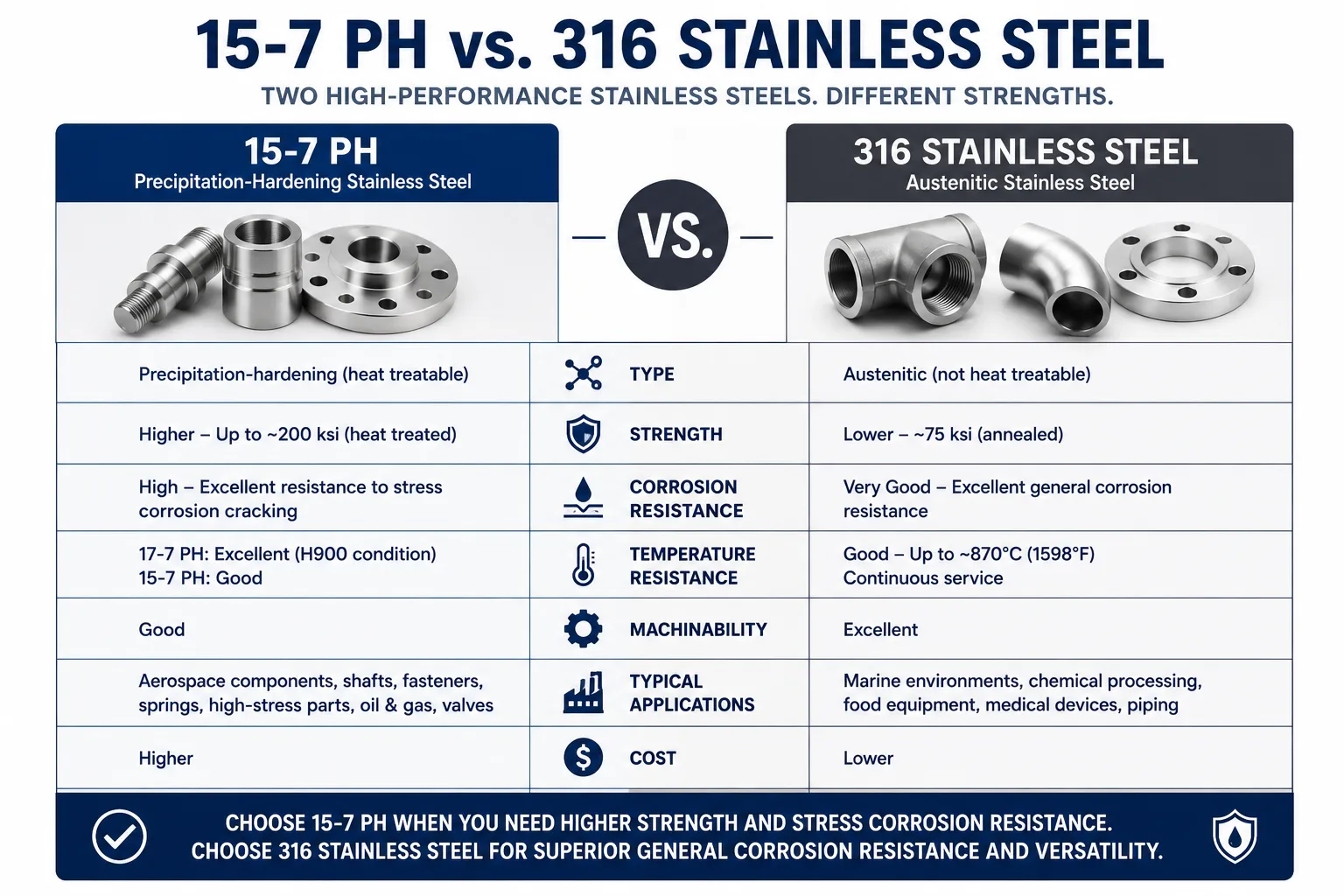
15-7 PH is a precipitation-hardening stainless steel designed for extremely high strength, while 316 is an austenitic stainless steel optimized for corrosion resistance and formability. 15-7 PH offers nearly double the tensile and yield strength of 316 stainless steel after precipitation hardening. If your application runs under high cyclic mechanical loads, tight space constraints, or elevated temperatures, 15-7 PH is the stronger tool. If your parts face chloride-laden seawater, aggressive chemicals, or biological media, 316 wins on durability and lifecycle cost. Read every section below — the real-world decision is nuanced, and the wrong call is expensive.
If your project requires the use of 15-7 PH or 316 Stainless Steel, you can contact us for a free quote.
What Exactly Are These Two Alloys?
How Does 15-7 PH Stainless Steel Get Its Exceptional Strength?
Type 15-7 Mo is a semi-austenitic precipitation-hardening stainless steel that provides high strength and hardness, good corrosion resistance, and minimum distortion on heat treatment. It is easily formed in the annealed condition and develops an effective balance of properties by simple aging heat treatments. PH 15-7 Mo is a precipitation-hardening stainless steel used for applications requiring high strength and moderate corrosion resistance. It is similar to 17-7 with the substitution of 2% molybdenum for 2% chromium, resulting in higher room and elevated temperature strength for 15-7 Mo.
The "15-7" designation itself encodes the alloy's nominal chemistry: approximately 15% chromium and 7% nickel. 15-7 PH also includes 2.00–3.00% molybdenum and 0.75–1.50% aluminum, which are absent in standard austenitic grades like 304. The aluminum content is the precipitation-hardening agent: during aging heat treatment, fine Ni₃Al intermetallic particles precipitate throughout the martensitic matrix, dramatically impeding dislocation movement. The Ni₃Al phase in 15-7 PH provides superior high-temperature stability.
What Makes 316 Stainless Steel the Standard for Corrosive Environments?
Stainless Steel 316 is a corrosion-resistant austenitic stainless steel widely used in marine, chemical, pharmaceutical, and food processing environments. It contains chromium, nickel, and an additional alloying element called molybdenum, which significantly improves resistance to chlorides and saltwater corrosion. Because of this enhanced corrosion resistance, 316 is often referred to as marine-grade stainless steel. It performs reliably in environments where standard stainless steels such as 304 may experience pitting or crevice corrosion. The corrosion resistance of 316 stainless steel comes from the combined effects of chromium, nickel, and molybdenum. Chromium forms a passive oxide layer on the surface that protects the metal from oxidation. Nickel improves toughness and structural stability, while molybdenum significantly strengthens resistance to chloride attack. This combination allows 316 to maintain structural integrity in environments where many other stainless steels begin to corrode.
Chemical Composition: Why Every Percent Point Matters
The most fundamental separator between these two alloys is their elemental makeup. Understanding the composition is the prerequisite for predicting all downstream properties.
Composition Comparison Table
| Element | 15-7 PH (UNS S15700) | 316 Stainless Steel (UNS S31600) | Role |
|---|---|---|---|
| Chromium (Cr) | 14.0 – 16.0% | 16.0 – 18.0% | Passive oxide layer for corrosion resistance |
| Nickel (Ni) | 6.5 – 7.75% | 10.0 – 14.0% | Austenite stabilizer; toughness |
| Molybdenum (Mo) | 2.0 – 3.0% | 2.0 – 3.0% | Pitting and crevice corrosion resistance |
| Aluminum (Al) | 0.75 – 1.50% | None | Precipitation-hardening agent (Ni₃Al) |
| Carbon (C) | 0.09% max | 0.08% max | Strength; kept low for weldability |
| Manganese (Mn) | 1.00% max | 2.00% max | Deoxidizer |
| Silicon (Si) | 1.00% max | 0.75% max | Deoxidizer |
| Phosphorus (P) | 0.040% max | 0.045% max | Tramp element |
| Sulfur (S) | 0.030% max | 0.030% max | Tramp element |
| Iron (Fe) | Balance | Balance | Base metal |
Sources: AMS 5520 (15-7 PH); ASTM A240 / UNS S31600 (316)
15-7 PH stainless steel contains 14.0–16.0% chromium, while 316 stainless steel contains 16.0–18.0% chromium. Chromium is essential for corrosion resistance. The higher chromium content in 316 stainless steel enhances its ability to withstand oxidation and corrosive environments better than 15-7 PH.
Both alloys share a similar molybdenum range of 2–3%, yet their behavior in chloride environments diverges significantly because the overall compositional matrix — particularly the higher nickel in 316 and the aluminum in 15-7 PH — governs the microstructure differently. The two materials belong to completely different stainless steel families. Precipitation-hardening alloys like 15-7 PH gain strength through heat treatment, whereas austenitic alloys like 316 cannot be hardened by heat treatment. Instead, 316 maintains strength through solid solution strengthening and cold working.
How Do the Mechanical Properties Actually Compare?
This is where procurement engineers and design teams spend the most time, and rightly so. The mechanical property gap between these two grades is not marginal — it is decisive.
Full Mechanical Properties Comparison Table
| Property | 15-7 PH (Condition CH 900) | 15-7 PH (Condition TH 1050) | 316 SS (Annealed) |
|---|---|---|---|
| Ultimate Tensile Strength | ~1,310 MPa (190 ksi) min | ~1,170 MPa (170 ksi) min | ~515–620 MPa (75–90 ksi) |
| 0.2% Yield Strength | ~1,172 MPa (170 ksi) min | ~1,000 MPa (145 ksi) min | ~205–310 MPa (30–45 ksi) |
| Elongation (%) | 2–5% min | 5–8% | 40–50% |
| Hardness | 40 HRC min | ~36 HRC | ~95 HRB (Brinell ~217) |
| Fatigue Strength (R.R. Moore) | ~620 MPa | ~550 MPa | ~240 MPa |
| Density | 7.78 g/cm³ | 7.78 g/cm³ | 7.99 g/cm³ |
| Modulus of Elasticity | 197 GPa | 197 GPa | 193 GPa |
Sources: AMS 5520; ASTM A693 Grade 632; ASTM A240/A276
In Condition CH 900, 15-7 PH achieves a minimum tensile strength of 1,310 MPa and a minimum yield strength of 1,172 MPa with a hardness of 40 HRC minimum. 15-7 PH stainless steel has a higher tensile strength than 316 stainless steel. The tensile strength of 15-7 PH stainless steel is approximately 1,000 MPa in certain conditions, while the tensile strength of 316 stainless steel is around 550 MPa. 15-7 PH stainless steel also has a higher yield strength than 316 stainless steel. The yield strength of 15-7 PH is approximately 900 MPa in moderate conditions, while 316 yields at around 450 MPa.
In our experience at MWalloys, the data above consistently surprises engineers who have worked exclusively with austenitic grades. A well-aged 15-7 PH spring component can carry loads that would permanently deform a comparably sized 316 part. That 2-to-1 strength ratio translates directly into component miniaturization, weight savings, and fatigue life improvements.
What Are the Heat Treatment Differences and Why Do They Matter?
Heat treatment is the single most operationally significant difference between these grades — it affects both how parts are manufactured and what performance levels are achievable.
How Is 15-7 PH Hardened?
Precipitation-hardening stainless steels achieve their strength through a two-step process: solution treatment (annealing) to create a uniform structure, followed by aging (precipitation hardening) to form fine particles that block dislocation movement, increasing strength and hardness.
For 15-7 PH specifically, the full thermal processing sequence involves:
Step 1: Solution Annealing (Condition A):
The initial step is solution treatment, known as Condition A. This involves heating the material to approximately 1950°F (1066°C) and then cooling it in air. The purpose is to dissolve the alloying elements into a solid solution, creating a uniform austenitic structure. This prepares the alloy for subsequent transformations that will enhance its mechanical properties.
Step 2: Austenite Conditioning:
Following solution treatment, the material undergoes austenite conditioning, where it is heated to 1400°F (760°C) to 1750°F (950°C) to stabilize the austenitic phase.
Step 3: Cryogenic or Mechanical Transformation (Condition R or C): For the highest strength conditions, the material is either cold-worked to Condition C or cryogenically treated. To obtain the highest mechanical properties from the alloy, Condition A material is transformed to martensite at the mill by cold reduction to Condition C. Some specifications also call for cooling to -100°F (-73°C) and holding for 8 hours before warming to room temperature.
Step 4 — Precipitation Aging: The final aging step — at temperatures ranging from 900°F to 1050°F depending on the target condition — precipitates the Ni₃Al phase, locking in ultimate mechanical properties. Producing 15-7 PH stainless steel involves complex heat treatment processes for hardening. The precise control of temperature and time during these steps is crucial to achieving the desired mechanical properties, making 15-7 PH suitable for high-strength applications.
How Is 316 Strengthened?
The mechanical strength of 316 stainless steel is mainly enhanced through cold working rather than heat treatment. Cold work involves deforming the material at room temperature, which increases its strength and hardness by introducing dislocations into the crystal structure. This process is often used in conjunction with solution annealing to achieve the desired mechanical properties without compromising corrosion resistance. The primary heat treatment technique for 316 stainless steel is annealing, a simpler process compared to the precipitation hardening of 15-7 PH. During annealing, the material is uniformly heated to a high temperature to allow recrystallization, followed by slow cooling in a controlled environment to prevent oxidation and scaling. This process improves the material's workability and corrosion resistance, making it suitable for applications where formability and corrosion resistance are priorities.
Heat Treatment Comparison Summary
| Parameter | 15-7 PH | 316 Stainless Steel |
|---|---|---|
| Heat-treatable? | Yes — precipitation hardening | No — solution annealing only |
| Strengthening mechanism | Ni₃Al precipitates in martensite matrix | Cold working + solid solution |
| Number of processing steps | 3–4 (solution + condition + age) | 1–2 (anneal + optional cold work) |
| Process complexity | High | Low |
| Distortion risk during treatment | Low (low-temperature aging) | Minimal |
| Maximum achievable hardness | ~48 HRC (CH 900) | ~96 HRB |
| Typical lead time for heat treatment | 24–72 hours including furnace cycles | 4–8 hours annealing |
How Do They Perform Against Corrosion?
Corrosion behavior is the most misunderstood aspect of this comparison. Both alloys contain 2–3% molybdenum, yet their real-world corrosion performance varies by environment type.
Which Alloy Has Better Corrosion Resistance in Chloride Environments?
15-7 PH stainless steel has better corrosion resistance than 316 stainless steel in most environments. However, 316 stainless steel has better corrosion resistance in chloride environments.
The reason lies in microstructure. 316 in its annealed condition presents a fully austenitic structure with an optimized passive oxide film. Its higher chromium content (16–18% vs. 14–16% in 15-7 PH) and fully homogeneous austenite grain boundaries provide a more uniform barrier against chloride attack.
Molybdenum strengthens the protective oxide layer formed by chromium. This helps prevent localized corrosion such as pitting and crevice corrosion, which can occur when stainless steel is exposed to chloride ions. 316 stainless steel adds 2–3% molybdenum to its base, raising its Pitting Resistance Equivalent (PRE) from around 18 to 26. The PRE number for 15-7 PH, though it contains similar molybdenum, is partially offset by the lower chromium floor and the martensitic microstructure at higher strength conditions. One of the most common uses of 316 stainless steel is in marine environments. Saltwater contains chlorides that can cause localized corrosion in many metals. While prolonged immersion in seawater can eventually cause corrosion, 316 typically lasts far longer than 304 in these conditions. The current industry standard is grade 316 (commonly termed "marine grade" stainless) which offers a solution to around 90% of marine applications.
Pitting Resistance in Context
| Corrosion Scenario | 15-7 PH | 316 Stainless Steel | Winner |
|---|---|---|---|
| Mild atmospheric exposure | Excellent | Excellent | Tie |
| Industrial chemical exposure | Good | Excellent | 316 |
| Chloride solution (< 200 ppm Cl⁻) | Good | Excellent | 316 |
| Marine atmosphere (splash zone) | Moderate | Very Good | 316 |
| Full seawater immersion | Poor–Moderate | Good | 316 |
| Stress corrosion cracking (SCC) in chlorides | Susceptible (esp. H900) | Moderate | 316 |
| Neutral pH aqueous environments | Very Good | Excellent | 316 |
| Oxidizing acids (moderate concentration) | Good | Good | Tie |
| High-temperature oxidation (to 900°F/482°C) | Good | Good | Tie |
Important note for design engineers: In the heat-treated condition, Type 15-7 Mo provides excellent mechanical properties at temperatures up to 900°F (482°C). Its corrosion resistance is superior to that of the hardenable straight chromium types. In some environments, corrosion resistance approximates that of the austenitic chromium-nickel stainless steels.
How Do High-Temperature Properties Differ?
Which Grade Holds Strength Better at Elevated Temperatures?
Both alloys perform well at elevated temperatures, but they behave differently. 15-7 PH maintains higher mechanical strength at elevated temperatures, making it suitable for aerospace mechanical components. 316 offers better oxidation resistance at higher temperatures but loses strength faster. Due to its high strength and ability to retain mechanical properties at moderate to high temperatures up to 482°C (900°F), 15-7 PH is suitable for aerospace components and structural parts.
A real-world test reported in the materials community illustrates this well: An aerospace manufacturer compared 15-7 PH and 17-4 PH for a high-temperature spring application. 17-4 PH springs began to relax after exposure above 400°C. 15-7 PH springs retained full load capacity up to 520°C with minimal creep deformation. As a result, 15-7 PH was chosen for the final design, ensuring long-term reliability in service. This performance advantage over similar PH grades reinforces why 15-7 PH commands premium use cases.
316, by contrast, begins to lose appreciable mechanical strength above 400°C, although its oxidation resistance remains intact. The maximum service temperature for 316L in continuous application is 1675°F (913°C) — but at those temperatures, mechanical strength is a fraction of room-temperature values.
Elevated Temperature Strength Summary
| Temperature | 15-7 PH Tensile Strength (approx.) | 316 Tensile Strength (approx.) |
|---|---|---|
| 20°C (ambient) | 1,310 MPa (CH 900) | 515–620 MPa |
| 200°C | ~1,100 MPa | ~450 MPa |
| 400°C | ~900 MPa | ~380 MPa |
| 500°C | ~750 MPa | ~300 MPa |
| 600°C | ~550 MPa | ~250 MPa |
Values are approximate and condition-dependent. Contact MWalloys for certified test data.
What Are the Machinability and Fabrication Differences?
Machinability impacts manufacturing cost and schedule. Both alloys are more challenging to machine than carbon steel, but for different reasons.
Machining 15-7 PH Stainless Steel
15-7 PH is usually machined in solution-annealed condition, then heat-treated afterward to achieve full strength. This workflow is common in precision aerospace manufacturing. Because of precipitation hardening, 15-7 PH develops much higher hardness, which improves resistance to wear. However, this also means harder machining and higher tool wear during CNC operations.
The standard shop practice at MWalloys and throughout the industry is to machine 15-7 PH in Condition A (solution-annealed), achieve all final dimensions and features, and then send parts for aging. This sequence minimizes tool wear and preserves dimensional accuracy, since the final aging step causes minimal distortion.
Machining 316 Stainless Steel
316 stainless steel tends to work harden quickly, causing tool wear during CNC turning and milling. The austenitic structure generates significant built-up edge on cutting tools, and conservative cutting parameters are typically required. Despite this, 316 remains considerably easier to machine in its final-use condition than an aged 15-7 PH component.
Weldability Comparison
Weldability is a critical procurement and fabrication parameter.
15-7 Mo is weldable by common fusion and resistance methods; however, this particular alloy is generally considered to have poorer weldability compared to more common PH grades (17-4 PH) due to the high Al content of this alloy, which degrades penetration and enhances weld slag formation during arc welding. The precipitation-hardening class of stainless steels is generally considered weldable by the common fusion and resistance techniques. Special consideration is required to achieve optimum mechanical properties by considering the best heat-treated conditions in which to weld and which heat treatments should follow welding.
316, by contrast, is one of the most weldable alloys available. 316 stainless steel is easier to fabricate, weld, and form into complex shapes, making it highly popular in architectural and food-grade industries. Its low carbon variant, 316L, is specifically formulated to prevent sensitization (intergranular corrosion) at weld heat-affected zones by limiting carbon to 0.030% maximum. The low carbon content in 316L helps prevent sensitization, a type of corrosion that occurs at weld joints. This improves the material's resistance to intergranular corrosion.
Machinability and Fabrication Summary
| Parameter | 15-7 PH | 316 Stainless Steel |
|---|---|---|
| Machinability (solution-annealed) | Moderate | Moderate |
| Machinability (aged/hardened) | Poor — avoid | N/A |
| Work hardening tendency | Moderate | High |
| Preferred machining condition | Condition A (solution-annealed) | Annealed |
| Weldability | Fair (high Al content is a challenge) | Excellent |
| Post-weld treatment needed? | Yes (re-age for strength recovery) | Optional (316L avoids sensitization) |
| Formability | Good in annealed condition | Excellent |
| Cold working for strength | Limited (pre-aging only) | Yes (very effective) |
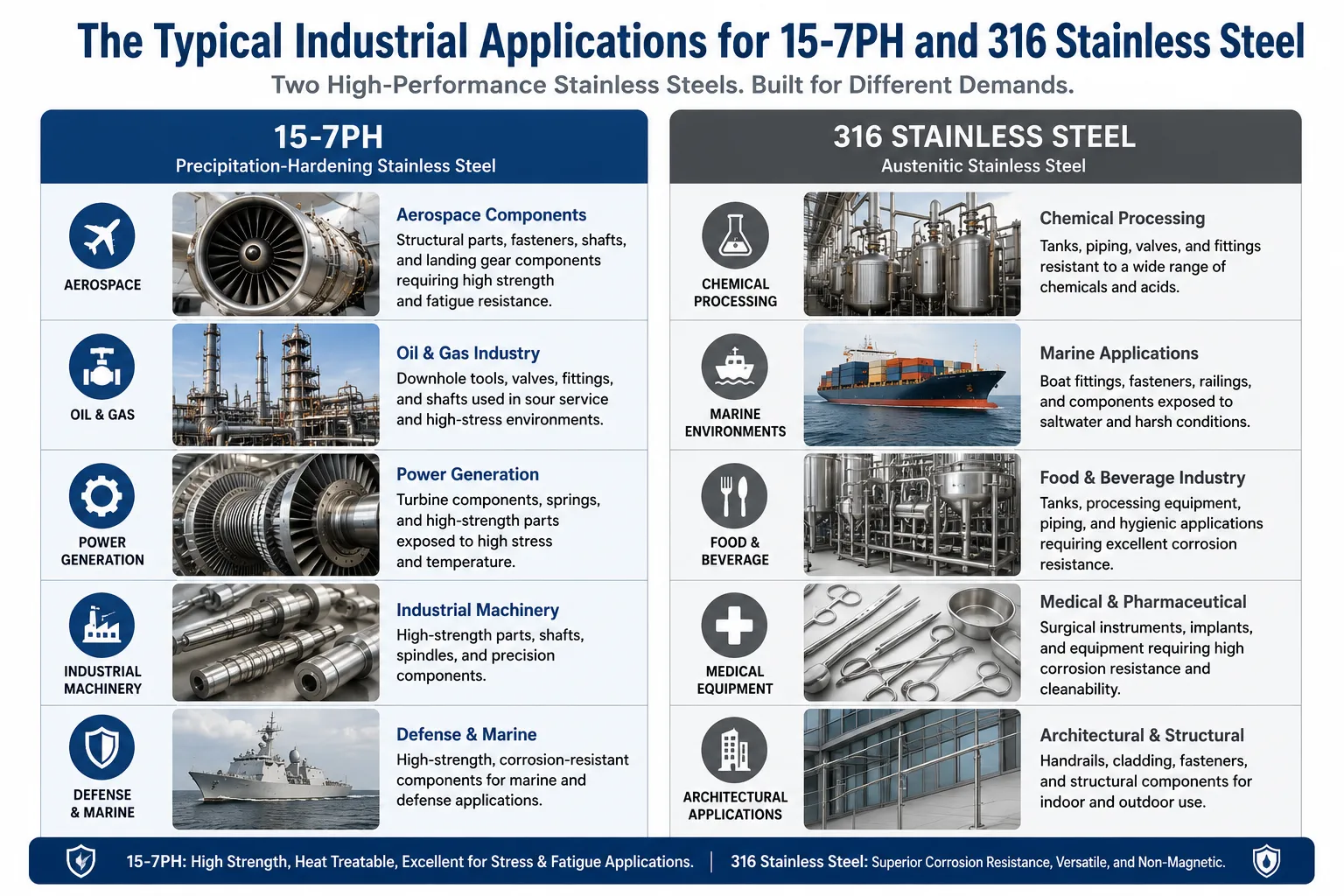
What Are the Typical Industrial Applications for Each Grade?
Where Is 15-7 PH Stainless Steel Used?
15-7 PH stainless steel is typically used in aerospace components, spring applications, and high-strength components such as retaining rings and diaphragms due to its high strength and hardness after heat treatment. In the aerospace industry, 15-7 PH stainless steel is commonly used for making essential components such as aircraft bulkheads, honeycomb panels, and other structural parts. Its ability to maintain mechanical properties at elevated temperatures up to 900°F (482°C) makes it ideal for applications that require both strength and thermal stability, ensuring reliability in critical aerospace structures. Due to its exceptional strength and hardness, 15-7 PH stainless steel is ideal for spring applications like retaining rings and diaphragms. Its robustness ensures reliability and longevity in high-stress environments, making it essential in precision engineering tasks.
Key 15-7 PH application sectors:
- Aerospace: Structural bulkheads, honeycomb core panels, control system brackets, high-cycle fasteners.
- Defense: Missile body components, weapon system springs, armor support structures.
- Springs and elastic elements: Flat springs, Belleville washers, diaphragm springs, retaining rings operating above 300°C
- Chemical processing (mechanical loads): 15-7 PH stainless steel is utilized in chemical processing applications where high mechanical strength is also required, such as reactor components and structural parts..
- Precision instruments: High-load sensor housings, actuator components, precision shafts.
Where Is 316 Stainless Steel Used?
Known for its superior corrosion resistance, 316 stainless steel is commonly used in marine equipment and chemical processing facilities where it can withstand aggressive environments. 316 stainless steel also performs well in environments containing many industrial chemicals. It is frequently used in chemical processing plants and pharmaceutical production equipment. Chemical processing industries often require materials that can withstand exposure to various corrosive substances, and 316 stainless steel excels in these environments due to its robust corrosion resistance. It is commonly used in storage tanks, piping systems, and heat exchangers where durability and chemical resistance are essential.
Key 316 stainless steel application sectors:
- Marine: Deck hardware, rigging components, boat fittings, propeller shafts, underwater fasteners.
- Medical and pharmaceutical: Surgical instruments, implant hardware, drug manufacturing vessels, sterile processing equipment.
- Food processing: Tanks, conveyors, mixers, piping in dairy and brewing plants.
- Architecture: Cladding panels, handrails, exterior facades in coastal cities.
- Chemical plants: Pipelines, valves, heat exchangers, reaction vessels handling chloride-containing media.
Application Selection Matrix
| Application | Recommended Grade | Key Reason |
|---|---|---|
| Aerospace spring or diaphragm | 15-7 PH | Fatigue strength; high-temperature retention |
| Aircraft bulkhead/panel | 15-7 PH | High strength-to-weight ratio |
| Marine deck hardware | 316 | Chloride pitting resistance |
| Chemical storage tank | 316 | Resistance to acids and chlorides |
| Medical implant | 316 (316L) | Biocompatibility; low iron release |
| High-pressure reactor part (structural) | 15-7 PH | Yield strength under load |
| Food processing piping | 316 | Hygiene; corrosion resistance |
| Precision retaining ring | 15-7 PH | Hardness; fatigue resistance |
| Pharmaceutical vessel | 316L | Purity; cleanability |
| Defense structural component | 15-7 PH | Extreme load-bearing capability |
How Do Magnetic Properties Differ Between These Alloys?
This property is overlooked until it matters — and in electronics, medical devices, or sensitive instrumentation, it matters enormously.
316 stainless steel in the annealed condition is essentially non-magnetic. 316 is the preferred steel for use in marine environments because of its greater resistance to pitting corrosion than most other grades of steel without molybdenum. The fact that it is negligibly responsive to magnetic fields means that it can be used in applications where a non-magnetic metal is required.
15-7 PH, after precipitation hardening, develops a martensitic microstructure and becomes magnetic. PH alloys are magnetic. In practice, this means 15-7 PH components will respond to magnetic fields and can interfere with sensors, MRI equipment, or precision compass-based systems. Engineers designing non-magnetic components for scientific instruments, naval mine countermeasures, or MRI-compatible surgical tools will typically specify 316 or non-magnetic austenitic grades.
What Is the Cost Difference and How Does It Affect Material Selection?
Cost is always a procurement reality, and these two grades occupy different price tiers.
Regarding cost, 316 stainless steel is generally less expensive than 15-7 PH stainless steel. This is because 316 stainless steel is more commonly used and produced in larger quantities. However, if your application requires high strength and durability, 15-7 PH stainless steel may be the better choice despite the higher cost. Generally, 316 stainless steel is less expensive due to its widespread use and larger production volumes. Producing 15-7 PH stainless steel involves complex heat treatment processes for hardening, while 316 stainless steel requires simpler annealing, reducing production costs and time.
At MWalloys, we consistently advise customers to evaluate total cost of ownership rather than raw material price alone. A 15-7 PH component that is 80% smaller and lighter than its 316 equivalent may generate net savings in downstream assembly, shipping, and structural weight penalties — particularly in aerospace where weight costs run at $1,000+ per kilogram over a product's service life.
Conversely, over-specifying a PH grade in a low-stress, corrosion-critical environment wastes budget without improving performance.
Cost and Availability Comparison
| Factor | 15-7 PH | 316 Stainless Steel |
|---|---|---|
| Relative raw material cost | High (2–4x above 316 typical) | Baseline (moderate) |
| Global availability | Limited (specialty suppliers) | Extremely high |
| Standard product forms | Sheet, strip, wire (limited bar/plate) | Sheet, plate, bar, tube, pipe, wire |
| Heat treatment cost | Additional (3–4 steps required) | Minimal |
| Machining cost | Higher (complex workflow) | Moderate |
| Lead time | Longer (specialty item) | Short (commodity availability) |
| Specification standards | AMS 5520, AMS 5657, ASTM A693 Gr. 632 | ASTM A240, A276, A276M; EN 1.4401 |
What Are the Corrosion Resistance Limits of Each Grade?
The Limitations of 316 in Seawater
While 316 is the industry benchmark for marine use, it is not without limits. The 316 types are used widely in marine applications, but their corrosion resistance in contact with seawater is limited and they cannot be considered 'corrosion proof' under all situations. They are susceptible to localized attack mechanisms, principally crevice and pitting corrosion.
When the stainless steel will be submerged, a pitting resistance equivalent number greater than 40 is typically specified as the minimum for resistance to seawater. 316's PRE of approximately 26 falls below this threshold for full immersion applications. Engineers specifying components for deep-sea or permanently submerged service frequently upgrade to super-duplex or super-austenitic grades. In seawater, 316 will perform well up to around 30°C, while more highly alloyed steels will not suffer corrosion at all in seawater up to boiling point.
The Stress Corrosion Cracking Risk of 15-7 PH
At the highest strength conditions (Condition CH 900), 15-7 PH carries an elevated susceptibility to stress corrosion cracking (SCC) in chloride environments. This is a well-documented characteristic of martensitic PH stainless steels at peak hardness. The trade-off is manageable: specifying TH 1050 or RH 950 conditions reduces SCC risk while still delivering strength far above 316. Engineers designing parts for combined mechanical stress and chloride exposure should consult MWalloys' materials team to select the most appropriate heat treatment condition.
How Does Each Alloy Perform in Spring and Elastic Component Applications?
Spring applications represent one of the clearest competitive advantages for 15-7 PH over 316.
17-7 PH and 15-7 PH stainless steels provide high strength and hardness, excellent fatigue properties, good corrosion resistance, good formability, and minimum distortion upon heat treatment. These alloys provide valuable property combinations particularly well suited for aerospace applications. They also provide excellent properties for flat springs at temperatures up to 600°F (316°C). 15-7 PH-family precipitation-hardened stainless steels offer superior strength, hardness, and fatigue resistance compared to standard austenitic grades. In cyclic loading conditions, the fatigue limit of 15-7 PH is approximately 2.5 times higher than that of annealed 316. For springs that must maintain set under sustained load — critical in valve actuators, aerospace control systems, and precision instruments — 15-7 PH's resistance to stress relaxation at elevated temperatures is a decisive advantage.
316 stainless steel remains widely used in springs for food processing, marine, and pharmaceutical applications where corrosion resistance and non-reactivity outweigh the need for maximum fatigue life. 316 stainless steel is effective for spring applications up to 500°F. Above that temperature, strength loss accelerates.
What Are the Key Specifications and Standards?
Procurement teams need to reference correct standards to avoid substitution errors and ensure traceability.
Applicable Specifications
| Standard | 15-7 PH (UNS S15700) | 316 Stainless Steel (UNS S31600) |
|---|---|---|
| AMS | AMS 5520 (sheet/strip/plate), AMS 5657 (wire) | AMS 5521 (sheet/strip), AMS 5524 (bar/billet) |
| ASTM | ASTM A693 Grade 632 | ASTM A240, A276, A312, A554 |
| MIL | MIL-S-8955 | MIL-S-5059 (historical) |
| UNS | S15700 | S31600 |
| AISI | 632 | 316 |
| EN/DIN | 1.4532 | 1.4401 |
Specifications for 15-7 PH include AMS 5520 (sheet, strip and plate), MIL-S-8955, AISI 632, ASTM A693 Grade 632, and UNS S15700.
How Should You Make the Final Material Selection Decision?
After years of supporting engineers and procurement managers at MWalloys, we have distilled the selection logic to a structured framework:
Choose 15-7 PH when:
- Your part operates under high cyclic or sustained mechanical loads.
- Weight constraints require maximum strength per unit volume.
- Service temperatures reach or exceed 300°C (572°F).
- The component is a spring, diaphragm, retaining ring, or structural bracket in aerospace/defense.
- Moderate corrosion resistance is acceptable and the environment is not chloride-intensive.
Choose 316 stainless steel when:
- The operating environment contains chlorides, saltwater, or aggressive chemicals.
- Biocompatibility or food-grade certification is mandatory.
- Weldability is a priority and post-weld heat treatment is impractical.
- Non-magnetic behavior is required.
- Budget constraints favor a lower-cost, readily available material.
- Complex forming or deep drawing operations are needed.
The material choice ultimately depends on whether the application prioritizes strength or corrosion resistance. When choosing between 15-7 PH and 316 stainless steel, the specific environmental conditions and required mechanical properties must be considered. For applications demanding high strength and moderate corrosion resistance, 15-7 PH is suitable. For environments requiring superior corrosion resistance, especially against chlorides, 316 stainless steel is the preferred option.
FAQs: 15-7 PH vs. 316 Stainless Steel
1: Is 15-7 PH stronger than 316 stainless steel?
Yes, significantly so. 15-7 PH offers nearly double the tensile and yield strength of 316 stainless steel after precipitation hardening. In Condition CH 900, 15-7 PH achieves a minimum tensile strength of approximately 1,310 MPa and a minimum yield strength of 1,172 MPa, compared to 316's annealed tensile strength of roughly 515–620 MPa and yield strength around 205–310 MPa. This strength advantage makes 15-7 PH the preferred choice for high-load aerospace springs, aircraft bulkheads, and precision retaining rings. The trade-off is reduced ductility and more complex manufacturing. For applications where extreme strength is not a requirement and corrosion resistance takes priority, 316 remains the practical choice.
2: Which alloy is better for marine environments?
316 stainless steel is the clear winner in marine environments. Because of its enhanced corrosion resistance, 316 is often referred to as marine-grade stainless steel. Grade 316 offers a solution to around 90% of marine applications. Its molybdenum content raises the Pitting Resistance Equivalent (PRE) to approximately 26, providing meaningful protection against the chloride-induced pitting and crevice corrosion that marine conditions generate. 15-7 PH, while it contains similar molybdenum levels, has lower chromium and a martensitic microstructure at high strength conditions that makes it more susceptible to chloride attack, particularly under stress. For full seawater immersion, even 316 has limits — super-duplex grades may be required.
3: Can 15-7 PH be used in medical applications?
15-7 PH can be used in non-implant medical device components where high strength or fatigue resistance is needed, such as surgical instrument springs or actuator mechanisms. However, surgical steel is made from subtypes of 316 stainless steel, and 316L (the low-carbon variant) is the dominant medical-implant grade due to its established biocompatibility record, ease of electropolishing, and superior corrosion resistance in bodily fluids. 15-7 PH is magnetic and would not be suitable for MRI-compatible devices. For non-magnetic, implant-grade requirements, 316L or titanium alloys are more appropriate. For high-load, non-implant instrument components, 15-7 PH's fatigue strength makes it a legitimate option.
4: What heat treatment conditions are available for 15-7 PH?
15-7 PH is supplied in Condition A (solution-annealed) and can be hardened to several conditions. 17-7 PH family steels are available in three major conditions — RH 950 and TH 1050, which can be hardened to high strength levels with simple heat treatments, and CH 900, which should be used in high-strength parts where excellent ductility and workability is not required. Condition CH 900 delivers the highest tensile strength (1,310 MPa minimum) and hardness (40 HRC minimum) but the lowest ductility (2% elongation minimum). Condition TH 1050 offers a more balanced profile of strength (~1,170 MPa) and improved toughness (~5% elongation), making it the preferred condition for aerospace structural parts with combined mechanical and environmental loads. Selecting the right condition requires close consultation with your materials supplier — MWalloys' technical team can assist.
5: Is 316 stainless steel non-magnetic?
In the annealed condition, 316 stainless steel is essentially non-magnetic due to its fully austenitic face-centered cubic crystal structure. 316 can be used in applications where a non-magnetic metal is required. However, if 316 is cold-worked or deformed significantly, a small amount of deformation-induced martensite can form, introducing slight magnetic permeability. In contrast, 15-7 PH after heat treatment is definitively magnetic due to its martensitic transformation. Engineers working on applications sensitive to magnetic interference — sensors, MRI equipment, compass-based navigation, or electronics housings — should specify 316 in the annealed condition and avoid cold-working beyond their magnetic permeability limit.
6: How does machinability compare between 15-7 PH and 316?
Both alloys present machining challenges, but for different reasons and at different stages. From a CNC machining perspective, the two alloys behave very differently. 316 stainless steel tends to work harden quickly, causing tool wear during CNC turning and milling. 15-7 PH is usually machined in solution-annealed condition, then heat-treated afterward to achieve full strength. In solution-annealed condition, 15-7 PH machines comparably to 304, making it manageable with standard tooling and appropriate cutting parameters. 316 in its annealed condition requires conservative cutting speeds and positive-rake tooling to minimize work hardening. Neither alloy should be machined in full hardened or aged condition without purpose-built tooling and significant speed reductions.
7: Can 15-7 PH replace 316 in chemical processing applications?
In some chemical processing scenarios, yes — but selective substitution is warranted. 15-7 PH stainless steel is utilized in chemical processing applications where high mechanical strength is also required, such as reactor components and structural parts. However, for piping, tanks, and heat exchangers that handle chloride-bearing process streams, 316 is more appropriate because its fully austenitic structure and higher chromium content provide more uniform corrosion protection. Where components need both structural load-bearing capability and chemical exposure resistance at the same time, materials engineers sometimes specify a 316 cladding or coating over a 15-7 PH structural core. Always validate against specific chemical compatibility data for your process fluid composition, temperature, and pH.
8: Which grade is better for springs operating above 300°C?
15-7 PH is the clear answer for springs operating above 300°C. In the heat-treated condition, Type 15-7 Mo provides excellent mechanical properties at temperatures up to 900°F (482°C). 316 stainless steel begins to lose meaningful spring properties above approximately 260°C (500°F) due to reduced yield strength and increased susceptibility to stress relaxation. The fatigue life of 316 springs at elevated temperatures is substantially shorter than 15-7 PH under equivalent loading conditions. For aerospace valve springs, high-temperature retaining rings, or actuator components in engine bays, 15-7 PH in an appropriate heat treatment condition is the engineered solution. Confirm operating temperature with your supplier's data sheets before specifying either alloy.
9: What does the UNS designation tell us about 15-7 PH?
15-7 PH is designated UNS S15700, with the S-series prefix indicating a stainless steel alloy in the Unified Numbering System. The accompanying AISI designation is 632. For procurement, specifying both the UNS and AMS number (AMS 5520 for sheet and strip) ensures global traceability and eliminates ambiguity about processing condition. When ordering, always specify both the product form and the required condition (Condition A for unaged material, or CH 900/TH 1050 for specific strength levels). 316 stainless steel carries UNS S31600 and the well-recognized EN designation 1.4401 in European markets. Matching the correct specification to the purchase order is a basic procurement discipline that prevents costly material substitution errors on the shop floor.
10: Is 15-7 PH more expensive than 316, and is it worth it?
316 stainless steel is generally less expensive than 15-7 PH stainless steel because 316 is more commonly used and produced in larger quantities. However, if your application requires high strength and durability, 15-7 PH stainless steel may be the better choice despite the higher cost. In applications where 15-7 PH's higher strength allows component cross-sections to be reduced by 40–60% compared to a 316 design, the material premium is often offset by reduced machining time, lighter assemblies, and longer service life. In aerospace, where weight savings are valued at hundreds to thousands of dollars per kilogram over a platform's lifecycle, the cost premium of 15-7 PH is consistently justified. For general industrial, marine, or food-grade applications where high strength is not a design requirement, 316 delivers superior value. The right economic analysis accounts for total system cost, not raw material price alone.
Quick Reference Summary: 15-7 PH vs. 316 at a Glance
| Attribute | 15-7 PH (UNS S15700) | 316 Stainless Steel (UNS S31600) |
|---|---|---|
| Steel family | Semi-austenitic PH | Austenitic |
| Strengthening method | Precipitation hardening (Ni₃Al) | Cold working / solid solution |
| Max tensile strength | ~1,310 MPa (CH 900) | ~620 MPa (cold-worked) |
| Max yield strength | ~1,172 MPa | ~310 MPa |
| Corrosion in chlorides | Moderate | Excellent |
| Marine rating | Limited | Industry standard (marine grade) |
| Magnetic after hardening | Yes | No (annealed) |
| Max service temp (strength) | 482°C (900°F) | ~400°C (limited) |
| Weldability | Fair (requires post-weld aging) | Excellent |
| Machinability | Good in Condition A | Good (work hardens quickly) |
| Relative cost | High | Moderate |
| Primary industry | Aerospace, defense, springs | Marine, medical, chemical, food |
| Key specifications | AMS 5520, ASTM A693 Gr. 632 | ASTM A240, A276, EN 1.4401 |
About MWalloys
At MWalloys, we supply precision stainless steel alloys including 15-7 PH sheet, strip, and wire, alongside 316/316L in all standard product forms, to aerospace OEMs, tier-1 defense contractors, medical device manufacturers, and global procurement teams. Our technical specialists are available to assist with alloy selection, heat treatment guidance, and certification documentation. Contact MWalloys for fast-turnaround quotations and mill-certified material with full traceability.
This article references data from AMS 5520, ASTM A693, ASTM A240, ASTM A276, and publicly verified technical sources. All mechanical property data is representative of typical values and should be verified against applicable material certifications for design-critical applications.