

If you want the answer before the technical details, here it is: precision Inconel machining succeeds when a shop combines rigid low-speed cutting parameters, carbide or ceramic tooling matched to the specific alloy grade (625, 718, or 601), and sufficient coolant pressure to manage the extreme heat this nickel-based superalloy generates during material removal, since Inconel work-hardens rapidly under light or interrupted cuts and destroys standard tooling within minutes if approached with steel-cutting techniques. We have machined Inconel 625 and 718 components for aerospace fasteners, gas turbine hardware, and marine exhaust systems at MWalloys for well over a decade, and the single biggest cost driver we see on every quote request is tool life, not material price.
If your project requires the use of Precision Inconel Parts Machining, you can contact us for a free quote.
What Makes Inconel Difficult to Machine Compared to Steel or Stainless?
Inconel is a family of nickel-chromium superalloys prized for retaining strength at temperatures where steel and standard stainless steel would soften or oxidize away entirely. That same property, strength retention at high temperature, is precisely what makes the material brutal on cutting tools, since the heat generated at the tool-workpiece interface during machining does not soften Inconel the way it would soften carbon steel, leaving the tool edge to absorb extreme thermal and mechanical stress simultaneously.
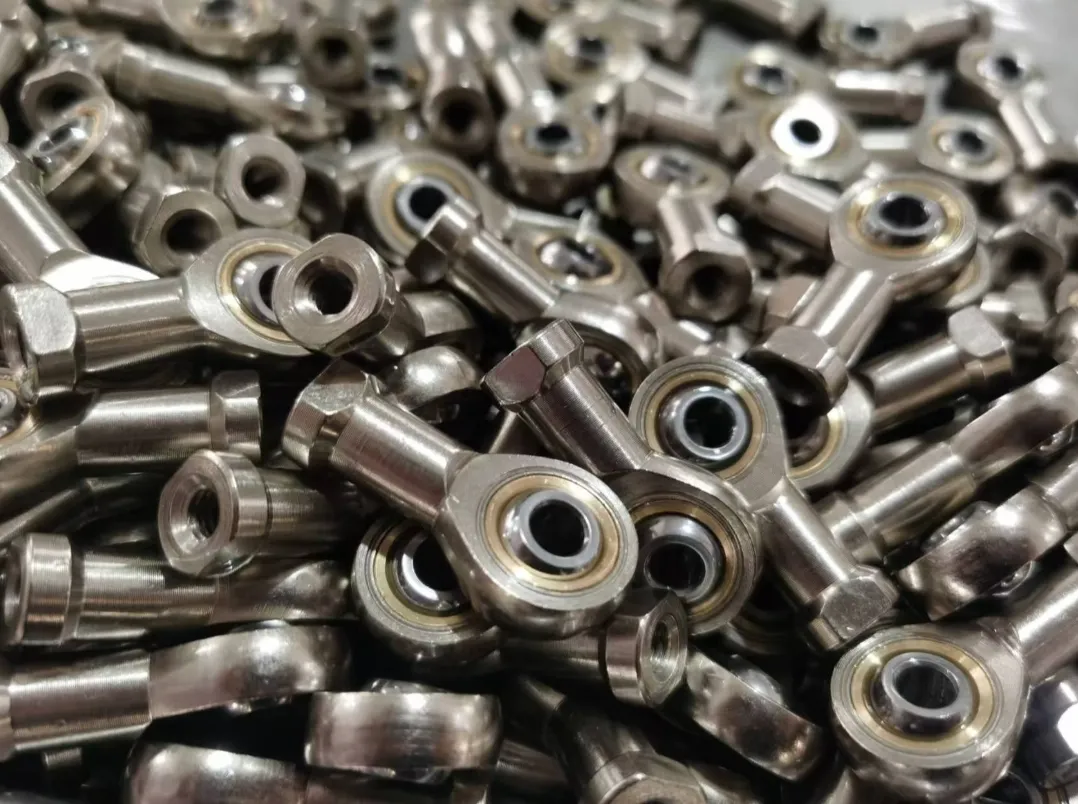
Several material characteristics compound this difficulty. Inconel work-hardens aggressively when subjected to light cuts, cold work, or tool rubbing rather than clean shearing, meaning a dull tool or incorrect feed rate creates a hardened surface layer that makes the next pass even harder to cut, a cycle that snowballs into rapid tool failure if not corrected immediately. Low thermal conductivity means heat generated during cutting stays concentrated at the tool tip rather than dissipating into the chip or workpiece, accelerating tool wear through both abrasion and chemical reaction between tool and workpiece material at elevated temperature. High shear strength requires substantially more cutting force than steel of comparable hardness, demanding rigid machine tools, secure workholding, and conservative depth of cut to avoid deflection and chatter.
| Material Characteristic | Effect on Machining |
|---|---|
| High strength retention at temperature | Tool tip does not benefit from workpiece softening during cut |
| Rapid work hardening | Light cuts or dwelling create hardened layer, accelerating tool wear |
| Low thermal conductivity | Heat concentrates at cutting edge rather than dissipating |
| High shear strength | Requires higher cutting forces, rigid setup |
| Tendency to gall and adhere to tool | Built-up edge formation degrades surface finish |
| Abrasive carbide/nitride particles in microstructure | Accelerates flank wear on cutting tools |
We tell customers new to sourcing Inconel parts that tool consumption on a given job can run five to ten times higher than an equivalent steel part, and this reality needs to factor into cost expectations from the first quote conversation rather than becoming a surprise once the job is already in production.
Which Inconel Grades Get Specified for Precision Machined Parts Most Often?
Not every Inconel grade behaves identically under the cutting tool, and grade selection depends heavily on the balance between high-temperature performance and machinability the application demands.
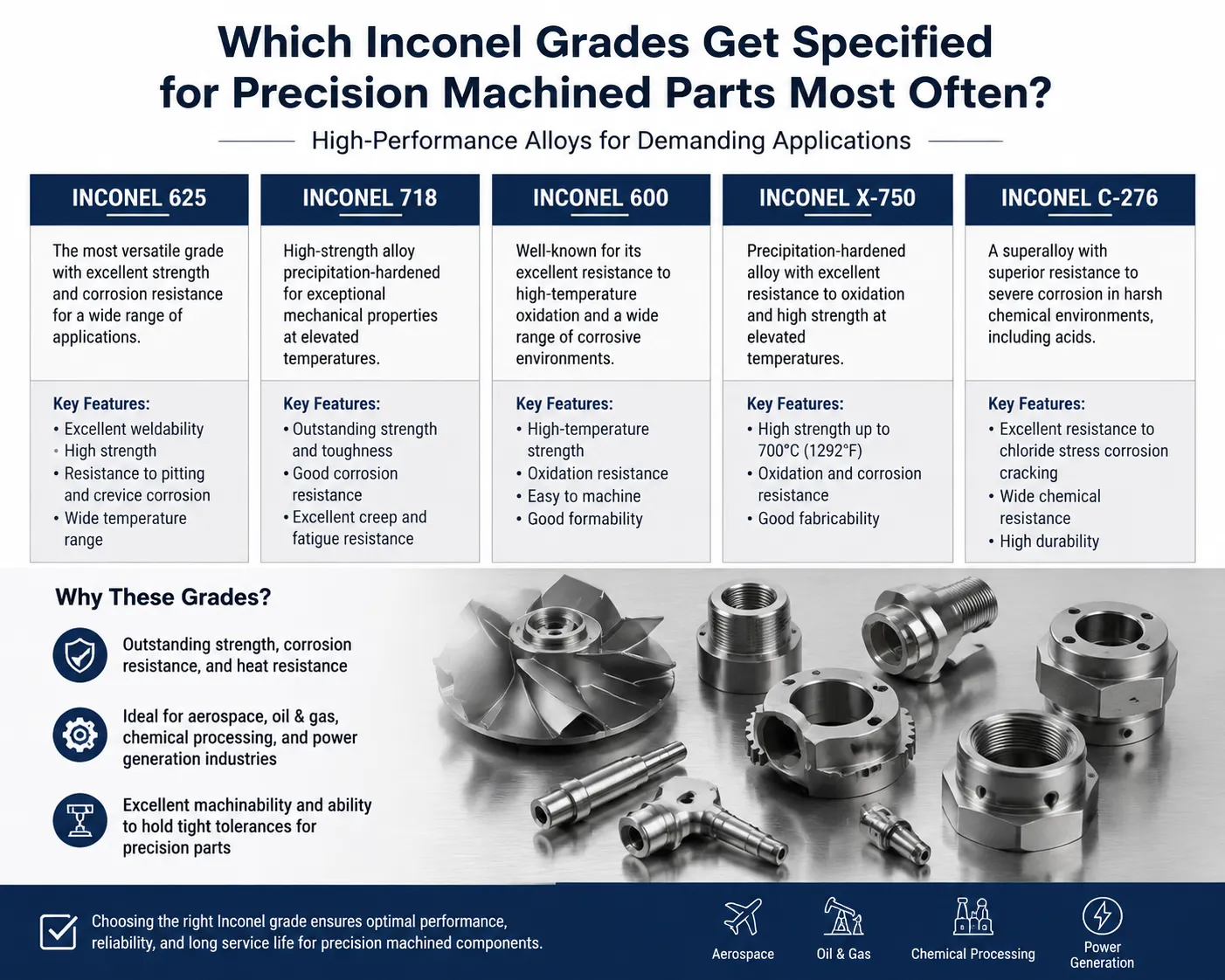
| Grade | UNS Number | Key Characteristic | Relative Machinability |
|---|---|---|---|
| Inconel 625 | N06625 | Excellent corrosion resistance, good weldability | Moderate |
| Inconel 718 | N07718 | Precipitation hardenable, high strength | Difficult (especially aged condition) |
| Inconel 601 | N06601 | High oxidation resistance at extreme temp | Moderate |
| Inconel 600 | N06600 | Good corrosion resistance, moderate strength | Moderate to good |
| Inconel X-750 | N07750 | Precipitation hardened, spring applications | Difficult |
Inconel 718 accounts for the largest share of precision machined Inconel parts we produce, largely because it is the workhorse grade for aerospace turbine disks, shafts, and fasteners where its precipitation-hardening response delivers exceptional strength-to-weight performance. The tradeoff is machinability, since 718 in the fully aged condition is considerably harder to cut than in the solution-annealed state, which is why sequencing machining operations around the heat treatment schedule matters enormously for this specific grade, a point we expand on later in this article.
Inconel 625 machines somewhat more predictably than 718 since it does not undergo the same precipitation hardening response, making it a common choice for parts where corrosion resistance matters as much as elevated temperature strength, such as marine exhaust components and chemical processing hardware.
Read more: Large Alloy Steel Machined Parts | Custom CNC Manufacturer
What Cutting Tools and Materials Actually Hold Up Against Inconel?
Tool material selection is not optional guesswork on Inconel work, it is the difference between a profitable job and a shop eating scrapped tooling costs. Carbide tooling with specific coatings dominates our shop for Inconel work, though ceramic and cubic boron nitride (CBN) tooling earn their place in specific high-volume or finishing applications.
| Tool Material | Best Application | Typical Cutting Speed Range |
|---|---|---|
| Coated carbide (AlTiN, TiAlN coatings) | General turning, milling, most operations | 20-40 m/min |
| Uncoated carbide | Low-speed roughing, specific interrupted cuts | 15-25 m/min |
| Ceramic (SiAlON, whisker-reinforced) | High-speed finishing, continuous cuts | 150-300 m/min |
| CBN (cubic boron nitride) | Hard turning, precision finishing | 100-200 m/min |
| High-speed steel (HSS) | Rarely used except specific drilling operations | 5-10 m/min |
Coated carbide handles the bulk of our roughing and general-purpose Inconel work because it provides a reasonable balance between tool life, cost, and the flexibility to handle interrupted cuts without catastrophic edge failure, something ceramic tooling struggles with due to its inherent brittleness. Ceramic tooling shines specifically in continuous, high-speed finishing passes where its heat resistance allows cutting speeds several times higher than carbide, dramatically reducing cycle time on the right application, but a single interrupted cut or unexpected chatter event can shatter a ceramic insert instantly.
Tool geometry matters as much as tool material. We specify positive rake angles with honed or slightly chamfered edges to balance edge strength against cutting force reduction, along with generous chip breaker geometry designed specifically for the long, stringy chips Inconel tends to produce, chips that can wrap around the tool or workpiece and cause surface damage if not managed properly.
| Tool Geometry Factor | Recommendation for Inconel |
|---|---|
| Rake angle | Slightly positive, 5-10 degrees typical |
| Edge preparation | Light hone or chamfer, avoid sharp fragile edges |
| Chip breaker design | Aggressive geometry to control long, stringy chips |
| Nose radius | Larger radius improves tool life but increases cutting force |
| Approach angle | 45-degree common for reduced entry shock |
What Cutting Parameters Actually Work in Real Production?
Published cutting speed charts give a starting point, but our actual production data, refined across thousands of hours of Inconel machining, tends to run more conservative than generic recommendations, particularly for roughing operations where tool life economics matter more than raw cycle time.
| Operation | Cutting Speed (m/min) | Feed Rate (mm/rev) | Depth of Cut (mm) |
|---|---|---|---|
| Turning, roughing (carbide) | 20-30 | 0.15-0.30 | 1.5-3.0 |
| Turning, finishing (carbide) | 30-45 | 0.05-0.15 | 0.2-0.5 |
| Milling, roughing (carbide) | 20-35 | 0.08-0.15 per tooth | 1.0-2.5 |
| Milling, finishing (carbide) | 35-50 | 0.05-0.10 per tooth | 0.2-0.5 |
| Drilling (carbide) | 10-20 | 0.05-0.12 per rev | Full diameter |
A recurring lesson from our shop floor: pushing cutting speed higher than these ranges to chase faster cycle time almost always backfires on Inconel, since the resulting heat buildup accelerates tool wear disproportionately compared to the modest cycle time gain achieved. We have run side-by-side trials where a 20% speed increase cut cycle time by roughly that same margin but reduced tool life by 50% or more, a trade that rarely makes economic sense once tool cost and change-over time enter the calculation.
Consistent feed rate matters more on Inconel than on steel because interrupted or inconsistent feed creates the light-cut, rubbing condition that triggers work hardening. We program toolpaths specifically to avoid dwelling or feed rate drops mid-cut, since even a momentary pause while the tool remains engaged with the workpiece can harden that localized area enough to cause problems on the next pass.
Read more: Nickel Alloy Fabrication Services | Custom Welding, CNC Factory
How Critical Is Coolant Strategy for Inconel Machining Success?
Coolant delivery is not a secondary consideration on Inconel work, it is central to tool survival. Given the alloy's low thermal conductivity, heat generated at the cutting edge has nowhere to go except into the tool itself unless coolant actively removes it, making high-pressure, high-volume coolant delivery directly at the cutting zone standard practice in our shop rather than an optional upgrade.
| Coolant Approach | Effectiveness on Inconel | Notes |
|---|---|---|
| Flood coolant (conventional) | Moderate | Baseline approach, adequate for lighter cuts |
| High-pressure coolant (70-1000+ bar) | High | Improves chip evacuation and tool life significantly |
| Through-tool coolant delivery | High | Delivers coolant directly to cutting edge |
| Minimum quantity lubrication (MQL) | Limited for heavy cuts | Better suited to finishing operations |
| Cryogenic cooling (liquid nitrogen/CO2) | Very high, specialized applications | Growing adoption for high-value aerospace parts |
High-pressure coolant systems, delivering coolant at pressures well beyond conventional flood systems, have become standard equipment investment for shops serious about Inconel work, since the improved chip evacuation and thermal control from these systems directly translates into measurable tool life improvement. We have documented tool life increases of 30-50% simply from upgrading coolant pressure and directing flow precisely at the cutting interface rather than general flood application around the tool area.
Cryogenic machining, using liquid nitrogen or carbon dioxide directed at the cutting zone, represents the leading edge of Inconel machining technology and has gained traction particularly in aerospace turbine component production where the economics of extended tool life and improved surface integrity justify the additional equipment investment. We have evaluated this approach for select high-value programs, though the capital cost means it makes sense primarily for sustained high-volume production rather than one-off or low-volume precision parts.
How Does Heat Treatment Sequencing Affect Machining Strategy for Inconel 718?
Inconel 718's precipitation hardening behavior creates a machining sequencing decision that does not exist for non-heat-treatable grades like 625 or 601. The alloy can be machined in the solution-annealed condition, where it is considerably softer and easier to cut, or in the fully aged condition, where it reaches its design strength but becomes substantially harder to machine.
Most precision Inconel 718 parts follow a sequence of rough machining in the solution-annealed or partially aged state, followed by aging heat treatment to bring the material to final strength, followed by finish machining to achieve final dimensional tolerance. This sequence exploits the easier machinability of the softer condition for bulk material removal while ensuring the final critical dimensions are cut after the material has reached its stable, aged microstructure, avoiding the dimensional shift that would occur if aging happened after finish machining.
| Machining Stage | Material Condition | Purpose |
|---|---|---|
| Rough machining | Solution annealed or mill annealed | Easier cutting, faster material removal |
| Aging heat treatment | N/A (thermal process) | Develops final strength through precipitation |
| Finish machining | Fully aged (peak strength) | Achieves final tolerance on stable microstructure |
| Stress relief (optional) | Post-machining | Reduces residual stress from finish cuts |
We coordinate closely with heat treatment partners on furnace scheduling for 718 parts specifically because getting this sequence wrong, finishing to final dimension before aging, risks dimensional shift during the aging cycle that can push critical features out of tolerance, particularly on parts with tight bore or thread specifications that aerospace customers frequently require.
What Tolerances and Surface Finishes Are Achievable on Precision Inconel Parts?
Tolerance capability on Inconel parts runs comparable to what the same machine tool would achieve on steel, provided the process accounts for the material's tendency toward tool deflection under heavy cutting forces and thermal expansion during extended machining cycles. The limiting factor is rarely the machine's positioning accuracy, it is process stability given the higher forces and heat involved.
| Feature Type | Typical Achievable Tolerance | Notes |
|---|---|---|
| General turned/milled dimensions | ±0.02 to 0.05mm | Standard precision CNC capability |
| Critical bore diameters | ±0.005 to 0.015mm | Requires finish boring or reaming |
| Thread specifications | Class 2B/3B per ASME B1.1 | Standard for fastener applications |
| Surface finish, general | 1.6 Ra (63 microinch) | Standard finish turning/milling |
| Surface finish, sealing surfaces | 0.4 Ra (16 microinch) or finer | Requires grinding or polishing |
| Flatness (larger flat surfaces) | 0.01-0.03mm per 100mm | Depends on part rigidity |
Achieving fine surface finish on Inconel demands slower finishing passes and sharp, well-maintained tooling, since a dulling tool edge on this material degrades surface finish faster than it would on steel due to the built-up edge tendency we mentioned earlier. We schedule tool changes based on cut count or elapsed time rather than waiting for visible wear, specifically to maintain consistent surface finish across a production run rather than allowing gradual degradation as a tool approaches end of life.
What Quality Documentation Should Accompany Precision Inconel Parts?
Given the aerospace, energy, and marine industries that most heavily specify Inconel components, documentation rigor on these parts typically exceeds what general machining work requires. We provide, and recommend buyers require, comprehensive certification covering multiple aspects of the finished part.
Material certification confirming the raw bar, forging, or plate stock chemistry matches the specified UNS designation, traceable to the original mill heat number. Heat treatment certification documenting solution anneal and aging cycle parameters along with resulting hardness and mechanical property test results. Dimensional inspection reports, typically CMM-generated for critical features, confirming tolerance compliance on every dimension specified on the engineering drawing. Non-destructive testing results where specified, commonly including penetrant inspection for surface defects and ultrasonic testing for internal soundness on critical structural parts. Certificate of conformance summarizing all specification requirements and confirming compliance for the specific lot or part serial number.
| Documentation Type | What It Confirms | Typical Requirement Level |
|---|---|---|
| Material certification (mill heat traceability) | Chemical composition matches specification | Every order |
| Heat treatment certification | Aging cycle, resulting hardness/strength | Precipitation-hardened grades especially |
| Dimensional inspection report (CMM) | Tolerance compliance on critical features | Aerospace, high-precision work |
| NDT reports (PT, UT) | Absence of surface/internal defects | Structural, rotating, or safety-critical parts |
| First article inspection (FAI) | Full dimensional verification before production | New part numbers, AS9100 programs |
| Certificate of conformance | Overall specification compliance summary | Standard on most precision orders |
Aerospace customers operating under AS9100 quality systems typically require first article inspection reports documenting every drawing dimension before releasing a full production quantity, a practice that catches any process drift or tooling issue before it compounds across an entire production batch.
What Industries Drive Demand for Precision Machined Inconel Parts?

Aerospace remains the dominant driver of precision Inconel machining demand, though several other industries rely on this alloy family for equally demanding applications where standard materials cannot survive the operating environment.
Aerospace and gas turbine manufacturing use machined Inconel extensively for turbine blades, disks, shafts, combustor components, and fasteners operating in the hottest sections of jet engines and industrial gas turbines. Oil and gas equipment specifies Inconel for downhole tools, wellhead components, and subsea hardware facing combined high pressure, high temperature, and corrosive service conditions. Chemical processing industries use machined Inconel valves, fittings, and reactor components handling aggressive chemical environments at elevated temperature. Marine applications, particularly exhaust systems and seawater-exposed hardware on vessels, rely on Inconel's corrosion resistance in combination with mechanical strength. Power generation equipment, including both gas and nuclear plants, uses precision Inconel components in high-temperature, high-stress locations throughout the plant.
| Industry | Common Machined Parts | Primary Driver |
|---|---|---|
| Aerospace/gas turbines | Turbine disks, blades, combustor hardware, fasteners | High-temp strength, fatigue resistance |
| Oil and gas | Downhole tools, wellhead components | Combined pressure, temperature, corrosion resistance |
| Chemical processing | Valves, fittings, reactor internals | Chemical resistance at temperature |
| Marine | Exhaust components, fasteners | Seawater corrosion resistance |
| Power generation | Turbine components, heat exchanger parts | Sustained high-temperature performance |
We have supplied precision machined Inconel 625 and 718 parts across several of these sectors, and the recurring theme across every industry is that failure consequences justify both the material cost premium and the extended machining time this alloy demands, since the alternative, a component failure in a jet engine or subsea wellhead, carries costs that dwarf any machining premium many times over.
What Should Buyers Verify Before Choosing an Inconel Machining Supplier?
Selecting a machining partner for precision Inconel work involves due diligence beyond what a standard CNC quote request typically covers, since the specialized knowledge required to machine this alloy efficiently varies enormously between shops.
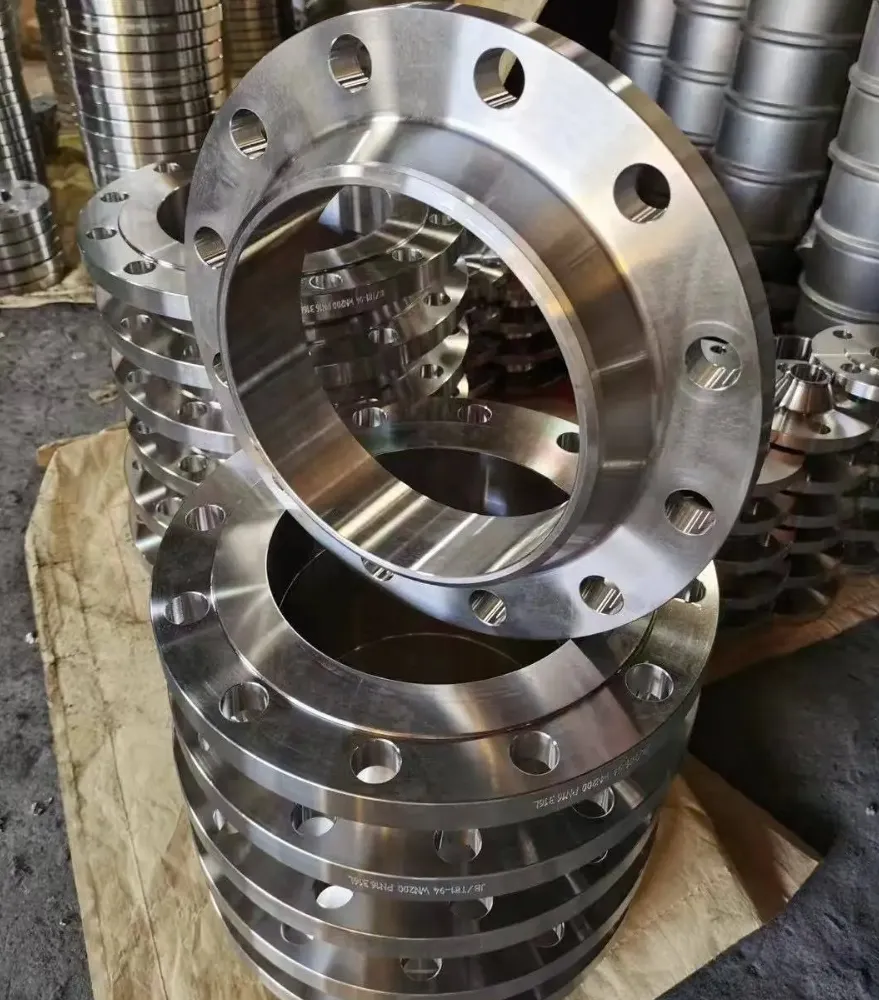
We recommend buyers ask directly about the shop's documented Inconel production volume and specific grade experience, since a shop that occasionally machines a small Inconel part alongside primarily steel and aluminum work will likely underestimate tooling costs and cycle times compared to a shop with dedicated Inconel production processes. Ask about coolant system capability, specifically whether high-pressure or through-tool coolant delivery is available, since this directly affects both tool life and achievable cycle time. Confirm heat treatment coordination capability for precipitation-hardening grades like 718, including whether heat treatment happens in-house or through a qualified subcontractor with appropriate furnace atmosphere control. Request references or examples of similar completed parts, ideally in the same grade and general complexity as the project under consideration. Verify quality system certification appropriate to the industry, typically AS9100 for aerospace work or API Q1 for oil and gas components.
| Due Diligence Question | Why It Matters |
|---|---|
| Documented Inconel production experience by grade | Predicts realistic tooling cost and cycle time estimates |
| Coolant system capability (pressure, delivery method) | Directly affects tool life and achievable speeds |
| Heat treatment coordination process | Critical for precipitation-hardening grades like 718 |
| Similar completed part references | Validates actual capability beyond general claims |
| Relevant quality certifications | Confirms documented process control appropriate to industry |
| In-house CMM and NDT capability | Affects inspection turnaround and data reliability |
What Have We Learned Machining Inconel Parts Across Different Programs?
Years of running Inconel programs across aerospace, energy, and marine customers have surfaced several practical lessons that rarely appear in general machining literature but affect project outcomes directly.
Tool life prediction improves dramatically once a shop tracks actual tool consumption data by operation type rather than relying on generic manufacturer recommendations. We maintain internal records correlating specific tool geometries, coating types, and cutting parameters against actual measured tool life for our common Inconel operations, and this data consistently outperforms published starting recommendations once refined through real production feedback across enough parts.
Fixture rigidity affects Inconel machining success more than many buyers initially appreciate. The higher cutting forces this material generates will expose any weakness in workholding that might go unnoticed on a softer material, manifesting as chatter, poor surface finish, or dimensional inconsistency that traces back to fixture deflection rather than any deficiency in the cutting process itself. We invest more heavily in dedicated fixturing for Inconel programs specifically because generic workholding solutions that work fine for steel parts often prove inadequate once cutting forces increase.
Chip management deserves more attention than it typically receives in process planning discussions. Inconel's tendency to produce long, stringy chips that resist breaking cleanly can cause chip wrapping around rotating tooling or workpieces, leading to surface damage or even tool breakage if not actively managed through chip breaker geometry and toolpath design that encourages clean chip evacuation.
Finally, realistic lead time communication protects both the shop and the customer. We build tool consumption expectations, heat treatment cycle time for precipitation-hardening grades, and the more conservative cutting parameters this material demands into our quoted lead times explicitly, rather than quoting based on steel-equivalent cycle times and then struggling to meet an unrealistic delivery commitment once actual production begins.
Frequently Asked Questions
Why does Inconel wear out cutting tools so much faster than steel?
Inconel retains its strength at the elevated temperatures generated during cutting, unlike steel which softens under cutting heat, meaning the tool edge absorbs extreme thermal and mechanical stress simultaneously throughout the entire cut. Combined with low thermal conductivity that concentrates heat at the cutting interface and a strong tendency toward work hardening under light or interrupted cuts, tool consumption on Inconel routinely runs five to ten times higher than on comparable steel parts, a factor that should be built into cost expectations from the initial quote.
What is the difference between machining Inconel 625 and Inconel 718?
Inconel 625 does not undergo precipitation hardening, making its machinability relatively consistent regardless of prior processing, while Inconel 718 hardens significantly through aging heat treatment, creating a major difference between machining it in the softer solution-annealed condition versus the much harder fully aged condition. Most 718 parts are rough machined before aging and finish machined afterward to combine easier bulk material removal with final dimensional accuracy on the stable, strengthened microstructure.
What cutting speed should be used for turning Inconel 718?
Roughing operations on Inconel 718 typically run between 20 and 30 meters per minute with carbide tooling, while finishing passes can run slightly faster, between 30 and 45 meters per minute, depending on tool coating and coolant delivery capability. Pushing speeds beyond these ranges to reduce cycle time generally causes disproportionate tool wear increases that outweigh the modest time savings, making conservative, consistent parameters more economical across a full production run.
Does Inconel machining require special coolant systems?
Yes, high-pressure or through-tool coolant delivery significantly improves tool life on Inconel compared to conventional flood coolant, since the alloy's low thermal conductivity keeps heat concentrated at the cutting edge unless actively removed. Shops running dedicated Inconel production frequently invest in high-pressure coolant systems specifically because documented tool life improvements of 30-50% from better coolant delivery justify the equipment cost across sustained production volume.
Can Inconel parts achieve the same tight tolerances as steel parts?
Yes, the same CNC machine can generally hold comparable tolerance on Inconel as on steel, since the limiting factor is process stability rather than machine positioning accuracy. Higher cutting forces and heat generation on Inconel require more attention to fixture rigidity, tool sharpness, and thermal management to consistently achieve tight tolerances, but properly managed processes routinely hold tolerances in the 0.02 to 0.05mm range on general features and tighter on critical bores.
What certifications should an Inconel machining supplier hold for aerospace parts?
AS9100 quality system certification is the standard baseline requirement for aerospace Inconel machining suppliers, often supplemented with Nadcap approval for special processes like heat treatment and non-destructive testing if performed in-house. Buyers should also confirm full material traceability capability from mill heat number through finished part serial number, since this documentation chain is a standard requirement across aerospace and gas turbine component sourcing programs.
Why do Inconel parts sometimes crack or fail during machining rather than after?
Cracking during machining typically results from excessive work hardening building up through light or inconsistent cuts, combined with residual stress from prior operations that concentrates at stress risers like sharp corners or thin sections. Maintaining consistent feed rates that avoid dwelling, using appropriately sharp tooling, and incorporating stress relief steps when significant material removal occurs across a part all reduce this risk during the machining process itself.
How much more expensive is machining Inconel compared to stainless steel?
Total machining cost for Inconel parts typically runs three to six times higher than equivalent stainless steel parts, driven by higher tooling consumption, slower cutting parameters, and longer cycle times rather than raw material cost alone. This premium is justified specifically for applications requiring Inconel's high-temperature strength or corrosion resistance beyond what stainless steel can provide, making the comparison only meaningful when both materials genuinely meet the application's performance requirements.
What surface finish is achievable on precision machined Inconel parts?
Standard finish turning and milling operations on Inconel typically achieve 1.6 Ra (63 microinch) surface finish, while critical sealing surfaces requiring finer finish can reach 0.4 Ra (16 microinch) or better through grinding or polishing operations following primary machining. Achieving fine finishes consistently requires sharp, well-maintained tooling and controlled finishing passes, since a degrading tool edge affects surface finish on Inconel more noticeably than it would on softer materials like aluminum or mild steel.
Should heat treatment happen before or after finish machining on Inconel 718 parts?
Aging heat treatment should generally happen after rough machining but before finish machining on precipitation-hardening grades like Inconel 718, since this sequence allows bulk material removal to occur on the softer, easier-to-machine solution-annealed material while final critical dimensions are cut after the aging cycle has stabilized the microstructure. Finishing to final dimension before aging risks dimensional shift during the aging heat treatment cycle that could push critical features out of specification tolerance.
Sources
- ASTM B637 Standard Specification for Precipitation-Hardening Nickel Alloy Bars, Forgings, and Forging Stock.
- ASTM B446/B564 Standard Specifications for Nickel-Chromium-Molybdenum-Columbium Alloy (UNS N06625).
- AMS 5662/5663 Aerospace Material Specifications for Inconel 718.
- ASM International Handbook, Volume 16: Machining.
- Special Metals Corporation Inconel alloy technical data publications.
- MWalloys internal machining process records and tool life data (2015-2026).
Request a Quote for Precision Inconel Machined Parts
Datasheet cutting parameters only take a project so far until actual tooling, coolant capability, and heat treatment coordination are confirmed against your specific part geometry. Send us your drawing, material grade, and required certification level, and our team will confirm machining feasibility, realistic cycle time, and delivery schedule before you commit to a production order. Contact MWalloys today for a detailed quote and tooling consultation on your next precision Inconel machining project.