

Nickel alloy surface finishes affect more than appearance: they influence dimensional accuracy, surface cleanliness, manufacturing cost, and the risk of surface-related problems in service. Bright, pickled, ground, and machined describe different surface conditions or finishing processes, and they are not interchangeable. The correct choice depends on the alloy grade, product form, operating environment, required tolerances, and whether the material will undergo further machining, welding, or fabrication.
For engineers, the priority is to specify the surface properties that matter to performance. For buyers and sourcing managers, it is to obtain those properties without paying for unnecessary finishing, creating avoidable lead-time delays, or receiving material that meets its chemical specification but fails the application's dimensional or cleanliness requirements.
What Do Bright, Pickled, Ground, and Machined Mean for Nickel Alloys?
Nickel alloys such as Inconel 625, Inconel 718, Inconel 600, Hastelloy C-276, and Monel 400 are supplied in different surface conditions depending on their product form and manufacturing route. The same alloy may be available as hot-rolled bar, peeled bar, centerless-ground rod, pickled plate, or bright-annealed tube.
These descriptions identify different aspects of the product. Bright annealing describes a heat-treatment process conducted under a controlled atmosphere. Pickling is a chemical surface-cleaning and descaling process. Grinding removes material mechanically to improve surface geometry and condition. Machining creates specified dimensions and features using cutting tools.
The distinction matters because a smooth-looking surface does not automatically mean a clean, defect-free, dimensionally accurate, or corrosion-resistant component. Surface condition must be considered separately from alloy composition, heat-treatment condition, mechanical properties, and inspection requirements. The ASM Handbook's discussion of nickel-alloy surface engineering, for example, distinguishes between several oxidation conditions requiring different pickling and finishing treatments.
Nickel alloy surface finish comparison
| Surface condition | How it is produced | Primary advantage | Main limitation | Typical applications |
|---|---|---|---|---|
| Bright or bright-annealed | Controlled-atmosphere annealing, or another specified bright-finishing process depending on product form | Clean, bright appearance; potentially good surface uniformity | The word "bright" alone does not establish roughness, dimensional tolerance, or freedom from defects | Tubes, strip, precision components, and applications requiring a controlled surface appearance |
| Pickled | Chemical removal of oxide scale and associated surface contamination | Removes adherent scale and provides a descaled surface | Requires alloy-appropriate chemical treatment, thorough rinsing, and suitable post-treatment handling | Corrosion-resistant plate, bar, forgings, and fabricated components |
| Ground | Abrasive removal of material under controlled conditions | Improved diameter control, roundness, and surface texture | Additional cost; grinding damage or subsurface defects may remain if the process and inspection are inadequate | Precision shafts, pins, sliding components, and close-tolerance round bar |
| Machined | Turning, milling, boring, drilling, or another cutting operation | Produces defined dimensions, bores, seats, threads, and functional surfaces | Cost depends on machining allowance, setup, material removal, and complexity | Finished components, valve parts, flanges, fixtures, and equipment parts |
These categories can overlap. A component may be pickled after hot working and subsequently ground, or a bright-annealed tube may be cut and machined at its ends. A machined surface can also require separate cleaning or descaling.
For procurement, the important question is not simply which finish is available. It is which combination of surface treatment, geometry, and inspection is required for the final application.
What Is the Difference Between Bright Annealed and Pickled Nickel Alloys?
Bright annealed and pickled materials are often compared because both can have a relatively clean surface without the heavy oxide scale associated with some hot-worked products. Their manufacturing routes, however, are fundamentally different.
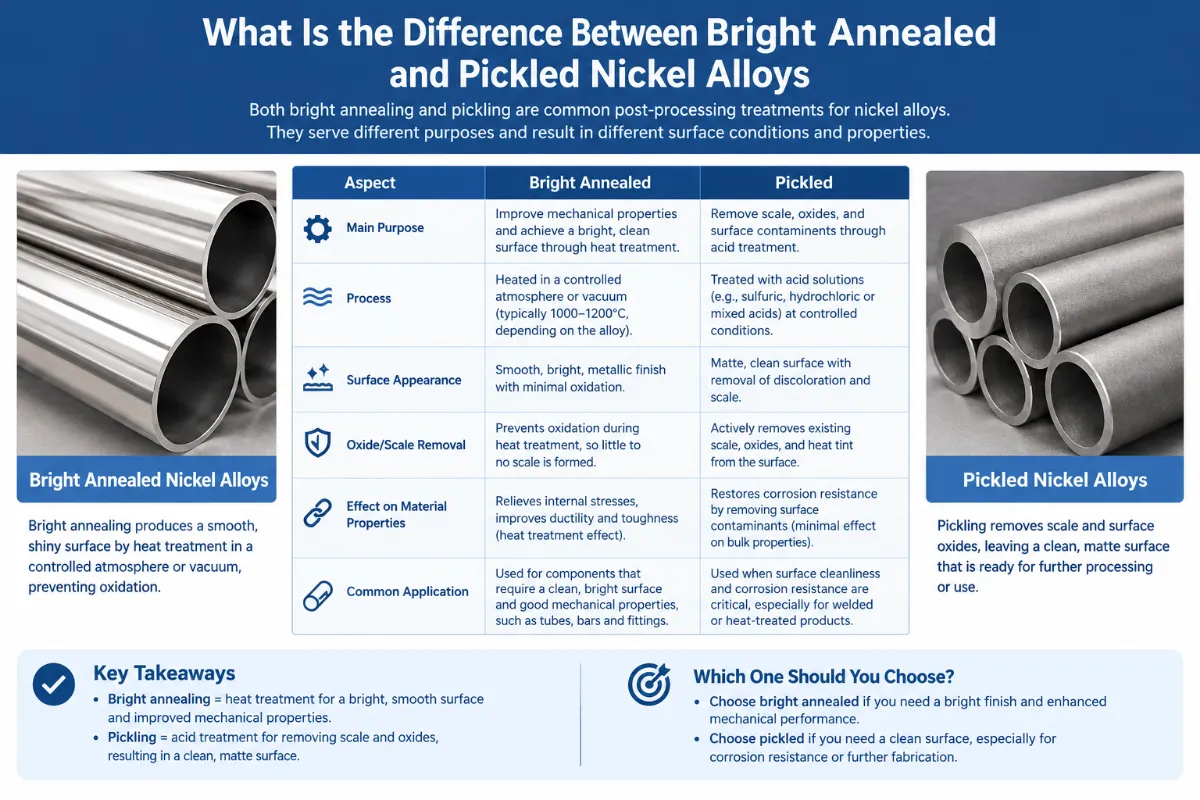
How bright annealing works
Bright annealing involves heating material under a controlled atmosphere designed to limit oxidation during heat treatment. When appropriately controlled, the process preserves a bright surface and reduces the need for subsequent aggressive descaling.
The exact result depends on the alloy, atmosphere, furnace conditions, starting surface, and product form. A bright-annealed tube, for example, should not automatically be assumed to have the same roughness or dimensional tolerances as a precision-ground bar.
Bright annealing is particularly relevant when the surface condition must be maintained through heat treatment, as with certain tube and strip products. It may also reduce the amount of post-annealing surface treatment required.
However, bright appearance is not proof of a defect-free surface. Handling damage, tooling marks, scratches, or imperfections inherited from an earlier manufacturing stage can still be present.
How pickling works
Pickling uses a chemical solution selected for the particular alloy and surface condition to remove oxide scale and other unwanted surface layers. The treatment may be required after hot rolling, forging, heat treatment, or fabrication.
Nickel alloys do not all respond identically to the same chemical treatment. High-nickel alloys, nickel-copper alloys, nickel-chromium alloys, and nickel-iron-chromium alloys may require different procedures. Pickling parameters must therefore be established for the specific material and condition, rather than copied indiscriminately from a stainless-steel cleaning procedure. The ASM Handbook's nickel-alloy surface engineering reference discusses these differences.
Following chemical treatment, rinsing, drying, and contamination control are essential. Residual process chemicals should not be allowed to remain trapped in crevices or on surfaces that will enter service.
Which finish is better for corrosion-resistant service?
Neither finish is universally superior. The choice depends on the initial surface condition and the requirements of the component.
Pickling is useful when oxide scale must be removed after hot working or heat treatment. Bright annealing is useful when a controlled-atmosphere heat-treatment route can preserve a suitable surface without creating heavy scale.
Consider a nickel alloy component destined for a chloride-bearing chemical environment. A bright-looking surface does not compensate for retained scale, an unsuitable alloy grade, or a poorly designed crevice. Likewise, a properly pickled component is not immune to corrosion if the service environment exceeds the alloy's capabilities.
The practical selection rule is to specify the required surface condition and its verification, not merely the visual appearance.
When Should You Specify Ground or Machined Nickel Alloy Material?
Ground and machined conditions are primarily selected to meet geometric and functional requirements. They should not be treated as automatically superior alternatives to bright or pickled finishes.
Ground nickel alloy bar: diameter, roundness, and surface consistency
Grinding uses an abrasive tool to remove a controlled amount of material. For round bars, centerless grinding is a common finishing method, while cylindrical grinding may be used for particular geometries and tolerances.
Ground nickel alloy bar is worth considering when:
-
A shaft, pin, or sliding component requires a controlled diameter.
-
A close-fitting assembly cannot accommodate the dimensional variation of ordinary hot-finished stock.
-
Consistent surface texture is needed across a production batch.
-
The component requires less machining during final manufacturing.
The specification should identify the final diameter tolerance and any required roundness or straightness limits. Surface roughness should be stated separately where it affects function.
There is also a limitation that is easily overlooked: grinding does not guarantee the removal of every material discontinuity. A seam, lap, or subsurface defect can remain after the surrounding material has been removed. Excessive grinding heat may also affect surface integrity, depending on the alloy, grinding parameters, and cooling conditions.
For demanding applications, dimensional inspection should be combined with appropriate nondestructive examination when required by the drawing or governing specification.
Machined nickel alloy components: functional surfaces and material allowance
Machining becomes appropriate when stock material must be converted into a finished component with defined geometry.
Common examples include Inconel valve components, Hastelloy chemical-processing parts, Monel marine hardware, and high-temperature alloy fixtures.
Nickel alloys can impose substantial machining demands because some grades retain strength at elevated temperatures, work-harden during cutting, and generate considerable cutting forces. Tool selection, cutting parameters, rigidity, and thermal management can all affect the final surface.
Before purchasing material for machining, confirm the following:
-
Starting dimensions: The stock must provide enough material for cleanup and final machining.
-
Final dimensions: Tolerances apply to the finished feature, not merely the original stock.
-
Heat-treatment condition: The required condition must be compatible with the manufacturing sequence.
-
Surface integrity: Tool marks, burrs, smeared material, or localized damage must be controlled where they matter to service.
-
Inspection access: Critical surfaces must remain accessible for measurement or nondestructive examination.
A machined finish can be appropriate for a sealing face, bearing seat, or precision bore even when the remainder of the component retains a different finish. There is rarely a technical reason to demand the same expensive surface treatment on every face of a component.
How Surface Roughness, Corrosion, and Wear Interact
Surface roughness is often expressed as Ra, the arithmetic mean deviation of a measured surface profile from its mean line. Other parameters, including Rz, describe different aspects of the surface profile.
These values provide useful information, but they do not fully describe surface integrity. Two surfaces can have similar Ra values while differing in isolated deep scratches, directional tool marks, embedded contaminants, or local defects.
The correct roughness requirement depends on the function of the surface.
Surface finish in corrosion-resistant equipment
Nickel alloy corrosion performance depends on alloy chemistry, temperature, fluid composition, concentration, flow conditions, deposits, and the geometry of the component. Surface condition can affect the likelihood of localized attack, particularly when scale, contamination, or crevice-forming imperfections are present.
For example, an Inconel 625 component in chloride-bearing process equipment needs a suitable alloy specification and a properly prepared surface. An Ra requirement alone cannot demonstrate resistance to pitting or crevice corrosion.
A bright finish is not a guarantee of better corrosion performance than a pickled finish. Conversely, a pickled surface should not automatically be assumed suitable for every corrosive environment. Material selection and surface preparation must be assessed together.
Surface finish in sliding and sealing applications
For sliding components, the relationship between surface texture and performance becomes more specific.
A rough surface may increase friction, accelerate wear, or damage a mating component. An excessively smooth surface may also be unsuitable for certain lubrication systems if the required texture is intended to retain lubricant.
For seals, surface requirements commonly depend on contact pressure, seal material, fluid compatibility, and the direction of motion. The required roughness, lay, waviness, and absence of scratches can be more important than whether a supplier describes the material as bright or ground.
For this reason, the drawing should identify the functional surface and define the applicable requirements. A generic request for a polished nickel alloy component is not an adequate substitute.
Three Surface-Finish Risks That Specifications Often Miss
The following issues deserve particular attention because they can affect project cost, product acceptance, and service performance even when the alloy grade itself is correct.
1. Grinding can improve appearance without proving surface integrity
A grinding operation may remove visible scale and irregularities while leaving an underlying discontinuity partly intact. Inadequate process control can also introduce localized thermal damage or an unfavorable surface condition.
This matters for highly loaded shafts, fatigue-sensitive components, and parts subject to cyclic stress. A defect that is harmless in an oversized noncritical component may be unacceptable in a highly stressed finished part.
Our engineering recommendation at MWalloys is to separate three acceptance questions: Is the surface texture acceptable? Are the dimensions acceptable? Has the component passed the required defect inspection?
These questions require different evidence. A profilometer measures surface texture, dimensional instruments verify geometry, and appropriate nondestructive examination addresses specified defects. None substitutes for the others.
Where the application is fatigue-sensitive, the inspection plan and acceptance criteria should be agreed before production, including whether inspection occurs before or after the final grinding or machining operation.
2. Finishing allowances can change the real delivered cost
Surface treatments and mechanical finishing operations can affect dimensions and material yield in different ways.
Pickling removes surface material through a chemical process. Grinding and machining remove material mechanically. Bright annealing generally aims to preserve the surface through controlled heat treatment rather than achieve dimensional accuracy through material removal.
The consequences for procurement are not identical.
Consider a round bar ordered near the minimum diameter needed for a finished component. If the supplier's starting stock contains surface irregularities that require significant removal, the nominal stock size may be insufficient to achieve the final diameter after machining.
Likewise, ordering an oversize bar that requires extensive grinding may increase material consumption and processing cost. A lower initial price per kilogram does not necessarily produce the lowest cost per accepted component.
Before approving an offer, compare:
| Cost factor | What the buyer should confirm |
|---|---|
| Starting dimensions | Is the quoted size nominal, minimum guaranteed, or subject to a tolerance range? |
| Finishing allowance | How much stock must remain available for descaling, grinding, or machining? |
| Finished dimensions | Are the required tolerances achievable after the agreed finishing sequence? |
| Material yield | Will the operation remove a substantial amount of expensive nickel alloy? |
| Setup and batch size | Does the supplier require additional setup or a minimum quantity for the requested finish? |
| Inspection | Are roughness measurement, dimensional reports, and specified NDT included in the quotation? |
| Packaging | Will the finished surface be protected against scratches, moisture, and contamination during transit? |
MOQ, lead time, and finishing charges are supplier-specific. They should be confirmed in the actual quotation rather than inferred from the finish name.
3. Contamination control is a separate requirement from surface finish
Nickel alloy stock can be damaged or contaminated after the finishing operation if handling and packaging are unsuitable.
A ground rod, for instance, may be scratched by contact with other bars. A machined face may pick up oil or metal particles during handling. A correctly pickled surface may be exposed to residues or contaminants during storage.
For corrosion-sensitive applications, specify handling requirements as well as the final surface condition. Depending on the application, these may include dedicated or appropriately cleaned tools, protective separators, clean packaging, dry storage, and restrictions on contact with unsuitable materials.
Pickling procedures also need suitable post-treatment rinsing and drying. Residual chemicals or rinse water retained in crevices can cause problems even when the surface appears clean. Chemical treatment must be performed with alloy-appropriate procedures and proper environmental and worker-safety controls. The Nickel Institute's technical guidance on cleaning and surface treatment describes the importance of rinsing and checking surfaces after chemical treatment, although that particular publication addresses austenitic stainless steels rather than every nickel alloy.
For export orders, packaging should match the finish actually purchased. Protective wrapping alone does not guarantee that a surface will arrive free of damage, especially if long bars or precision components can move against one another inside the package.
How Should Engineers Specify Nickel Alloy Surface Finish?
A purchase order or technical drawing should describe the required outcome in measurable terms. The finish name is only one part of that description.
Define roughness using a recognized specification
When surface texture affects performance, specify the required parameter and limit, such as a maximum Ra value. Also establish the measurement method, evaluation requirements, and inspection locations as appropriate to the product.
ISO 21920-1:2021 provides rules for indicating profile-based surface texture in technical product documentation. The current published standard can be consulted through the ISO official catalogue.
For example, a drawing might require a specified Ra limit on a bearing surface. That value should come from the engineering design, application requirements, or validated manufacturing process, not from an assumed universal relationship between a finish name and roughness.
Separate surface finish from material and heat-treatment requirements
The purchase specification should identify the alloy and product form, applicable material standard, required heat-treatment condition, dimensions, and surface condition independently.
ASTM B906-22, for example, covers general requirements for flat-rolled nickel and nickel alloy plate, sheet, and strip. It is relevant to those product forms, but it should not be treated as a universal surface-finish specification for bars, forgings, and every type of tube. Always consult the applicable product standard and the current contractual requirements.
Suggested surface-finish specification checklist
| Requirement | Example of useful wording |
|---|---|
| Material identity | Identify alloy grade, product form, and applicable material specification |
| Surface treatment | Pickled and descaled, or bright annealed, where applicable to the product |
| Mechanical finish | Ground, turned, or machined as required |
| Roughness | Specify the parameter and maximum permitted value on named functional surfaces |
| Dimensional tolerances | State final diameter, thickness, straightness, roundness, or feature tolerances as applicable |
| Defect acceptance | Reference the applicable product standard, drawing, or agreed inspection criteria |
| Surface cleanliness | Define relevant restrictions on oil, scale, residues, or foreign-material contamination |
| Traceability | Require the agreed material certificates and inspection records |
| Packaging | Specify protection appropriate to the finish and transport conditions |
This approach reduces ambiguity between buyer and supplier. It also makes competing quotations easier to compare because suppliers are pricing the same deliverable rather than interpreting words such as "bright," "smooth," or "high quality" differently.
How Do Nickel Alloy Surface Finishes Affect Procurement and Total Cost?
The least expensive finish is not automatically the most economical option. The correct comparison is the cost of receiving an acceptable material and converting it into a component that performs as required.
A hot-finished bar may be commercially attractive for a part that will undergo extensive machining. Paying for precision grinding beforehand may provide little value if the entire outer surface is subsequently removed.
By contrast, a ground bar can reduce machining operations and material waste when the final component requires a closely controlled diameter. The saving must be evaluated against the grinding premium, dimensional allowance, and material utilization.
Pickled plate may be appropriate when the surface must be free of hot-worked scale before fabrication. Bright-annealed tube may be preferred where the specified product form, cleanliness requirements, and manufacturing route make it suitable.
At MWalloys, our recommended RFQ review is to compare the delivered condition rather than the alloy price alone. Buyers should establish whether quoted finishing, dimensional inspection, surface inspection, cutting, certification, and packaging are included or treated as additional operations.
A useful supplier comparison should answer four questions:
-
Is the offered finish compatible with the actual application?
-
Will the stock arrive with enough dimensional allowance to meet the final drawing?
-
Is the requested inspection included and documented?
-
What is the total cost and lead time for the required quantity in the specified condition?
Small orders also deserve careful review. Custom grinding or machining may involve minimum processing charges, while a standard stock finish may be readily available. Neither outcome is universal, so confirm availability, MOQ, processing time, and quoted tolerances before committing to a purchase.
Frequently Asked Questions About Nickel Alloy Surface Finishes
1. Is bright-finished nickel alloy better than pickled nickel alloy?
Not universally. Bright finishing can provide an attractive and consistent surface, while pickling removes oxide scale and associated surface layers. The better option depends on the manufacturing route, corrosion environment, dimensional requirements, and cleanliness needs. Appearance alone is not a reliable measure of surface integrity.
2. Does pickling improve the corrosion resistance of Inconel 625 or Hastelloy C-276?
Pickling can improve the surface condition by removing unsuitable oxide scale and associated contamination. It does not change the bulk alloy grade or guarantee corrosion resistance in every service environment. The chemical treatment must suit the alloy, and the component must still be appropriate for the temperature, medium, and operating conditions.
3. Is ground nickel alloy bar always more accurate than hot-rolled bar?
Ground bar can offer tighter dimensional control and more consistent surface texture than ordinary hot-finished stock. Actual tolerances depend on the supplier's process and product specification. Confirm diameter, straightness, roundness, and applicable surface requirements rather than relying on the word "ground" alone.
4. Can a machined nickel alloy surface still contain defects?
Yes. Machining can expose or remove some surface imperfections, but it cannot guarantee the absence of subsurface discontinuities or defects outside the material removed. When defects are critical, establish suitable inspection methods and acceptance criteria independently of the machining finish.
5. What Ra value should I specify for a nickel alloy component?
There is no single Ra value suitable for every nickel alloy application. A sealing face, sliding shaft, general machined part, and corrosion-resistant plate have different functional requirements. Define the roughness limit from the component design and specify the measurement method where required.
6. Can pickled material be machined after delivery?
Yes. Pickled material is frequently used as a starting point for further fabrication or machining. However, machining changes the original surface condition on the areas cut. If the finished component requires a particular surface treatment or cleanliness level, determine whether additional cleaning or finishing is needed after machining.
7. Does surface finish affect the lead time and MOQ of nickel alloy products?
It can. Standard stock dimensions and common surface conditions may be easier to source than specialized ground or machined products. Additional finishing, inspection, and packaging can increase processing time and cost. Actual MOQ and delivery terms must be confirmed with the supplier for the specific alloy, product form, dimensions, and quantity.
8. What should a buyer request before approving a nickel alloy surface finish?
Request confirmation of the alloy grade, applicable material specification, heat-treatment condition, dimensions, agreed finish, and required tolerances. Where necessary, also obtain roughness measurements, dimensional inspection records, specified NDT results, material test certificates, and confirmation of packaging. The documentation should match the purchase order and the component's intended use.
Final Engineering Recommendation
Choose nickel alloy surface finishes according to the properties that the finished component actually needs. Use bright annealing when the appropriate product form and controlled-atmosphere process meet the surface requirements. Use pickling when an alloy-appropriate descaling process is needed. Use grinding for controlled geometry and surface texture, and machining for defined functional features.
The strongest purchase specification does not simply request a bright, clean, or smooth surface. It establishes the material, final dimensions, required surface condition, acceptance criteria, and verification methods. That is how engineers reduce surface-related risks while buyers control processing costs, avoid unnecessary finishing, and obtain material suited to its intended application.