

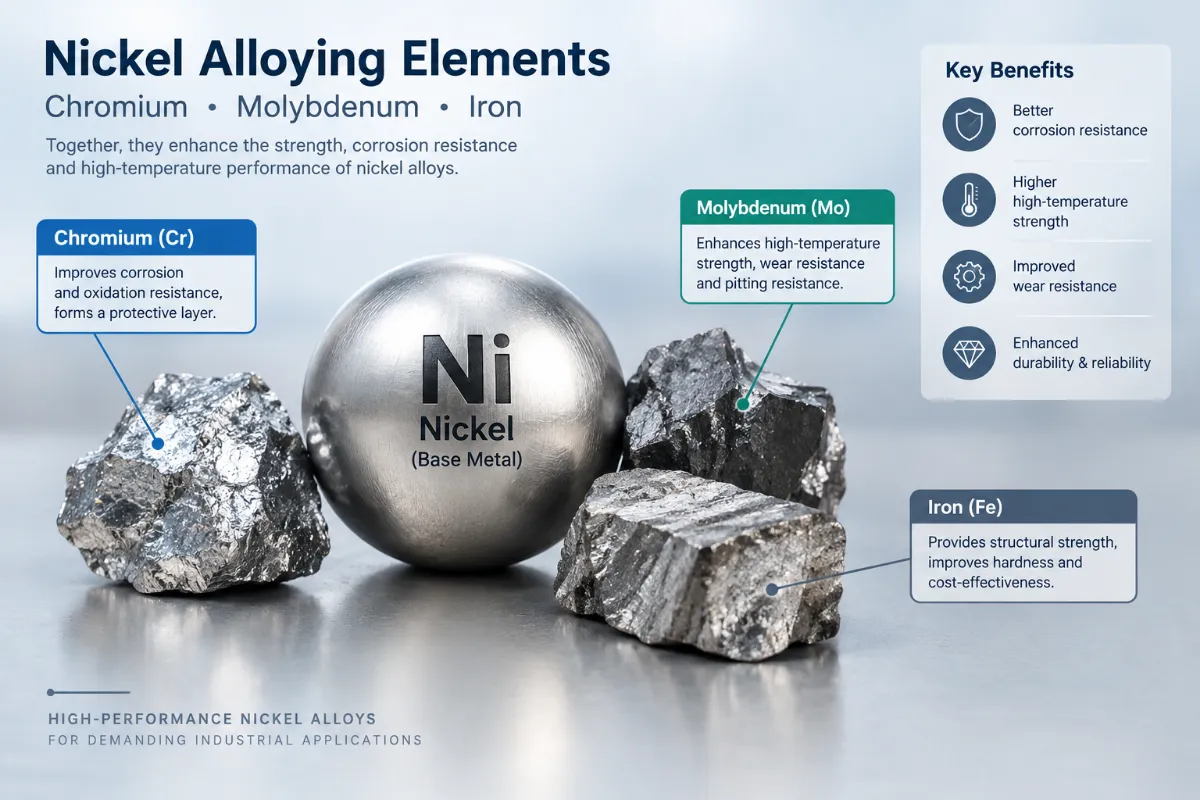
Chromium, molybdenum, and iron influence nickel alloy performance through their effects on corrosion behavior, oxidation resistance, mechanical properties, phase stability, and alloy microstructure. Chromium commonly contributes to resistance in oxidizing environments and high-temperature oxidation, molybdenum can improve resistance to reducing acids and localized corrosion under suitable conditions, and iron modifies the composition and behavior of different nickel alloy systems. However, the effect of each element depends on its concentration, the other alloying elements present, the material's processing history, and the operating environment. Engineers should therefore evaluate the complete alloy composition and applicable material requirements rather than select a nickel alloy based on one element alone.
Nickel-based alloys are used in chemical processing, power generation, aerospace, petrochemical equipment, marine environments, and other applications where conventional materials may not provide the required combination of corrosion resistance, strength, or temperature capability. Their performance is determined by carefully controlled chemical compositions and manufacturing processes.
Understanding chromium (Cr), molybdenum (Mo), and iron (Fe) helps engineers interpret alloy designations, compare materials, and identify the information needed for a technically appropriate purchase.
1. Why Alloying Elements Matter in Nickel-Based Alloys
Nickel provides a versatile base for alloy development because it can be combined with several metallic elements to produce materials with different mechanical, physical, and corrosion properties. The Nickel Institute classifies nickel alloys into groups such as nickel-chromium, nickel-iron, nickel-molybdenum, and nickel-chromium-molybdenum alloys. Each group is associated with different property combinations and industrial applications.
The performance of a nickel alloy is not determined by its nickel content alone. Alloy designers adjust the concentration of chromium, molybdenum, iron, and other elements to achieve a particular balance of properties.
The relevant mechanisms may include:
-
Formation and stability of protective surface films.
-
Resistance to chemical attack in oxidizing or reducing environments.
-
Solid-solution strengthening.
-
Precipitation of strengthening phases.
-
Grain-boundary chemistry and phase stability.
-
Oxidation and scaling resistance at elevated temperatures.
-
Weldability and response to thermal processing.
These mechanisms are interdependent. A composition that improves a particular property under one condition may introduce different considerations during welding, heat treatment, or exposure to another environment.
Composition is not the same as performance certification
A chemical composition range can identify an alloy grade and establish part of its specification requirements. It does not, by itself, establish that a particular component will meet every mechanical, corrosion, or service-life requirement.
For procurement, the composition should be considered together with:
-
Alloy designation and UNS number.
-
Product form and dimensions.
-
Applicable material standard and revision.
-
Material condition and heat treatment.
-
Required mechanical properties.
-
Testing and inspection requirements.
-
Actual operating environment.
The relevant requirements must be confirmed against the applicable specification and purchase order.
2. How Chromium Affects Nickel Alloy Performance
Chromium is an important alloying element in many nickel-based materials. Its role includes improving resistance to oxidation and contributing to corrosion resistance through the formation of chromium-containing protective surface films.
The precise effect depends on the alloy chemistry and exposure conditions. Chromium should not be treated as a universal solution for every corrosion mechanism.
2.1 Chromium and corrosion resistance
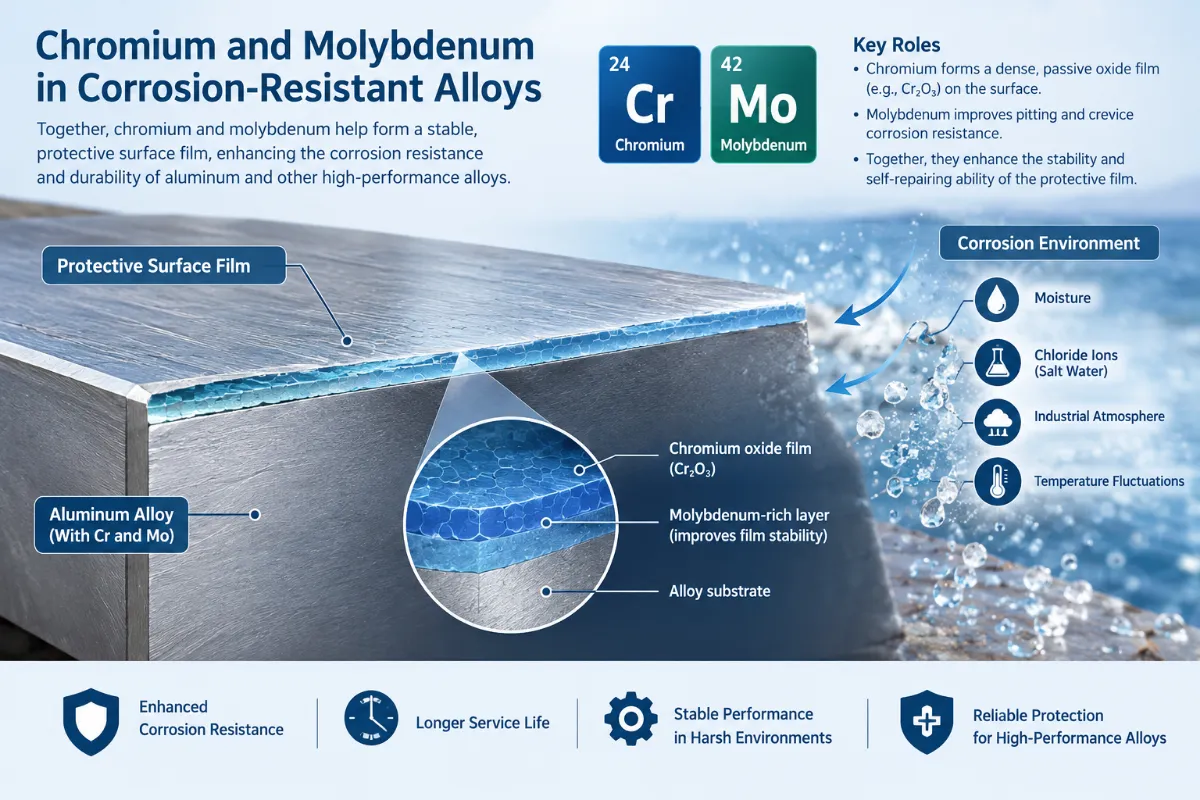
In suitable oxidizing environments, chromium can contribute to the development of a protective passive film. This film helps reduce the rate of further corrosion when it remains stable under the conditions of exposure.
The role of chromium is particularly important in nickel-chromium and nickel-chromium-molybdenum alloys. The Nickel Institute describes nickel-chromium alloys as having high resistance to corrosion at normal and high temperatures, including resistance to high-temperature scaling in relevant alloy groups.
However, the type of corrosion environment matters. Acid concentration, temperature, dissolved oxidizing species, chlorides, flow conditions, and crevices can affect the stability of protective films.
Engineering consideration: A high chromium content should not be interpreted as proof of suitability for every acidic or chloride-containing environment. The specific alloy and service conditions must be evaluated.
2.2 Chromium and high-temperature oxidation
Chromium can improve resistance to oxidation and certain forms of high-temperature corrosion by contributing to protective oxide formation.
This property is important for nickel-chromium-iron alloys and other materials intended for elevated-temperature service. The Nickel Institute identifies nickel-chromium-iron systems such as Alloy 800 and its variants as materials designed for high-temperature strength and resistance to oxidation and other high-temperature corrosion mechanisms.
Actual performance depends on factors such as:
-
Operating temperature and temperature cycling.
-
Gas composition and oxygen availability.
-
Sulfur-containing compounds and other contaminants.
-
Surface condition.
-
Alloy composition and microstructure.
-
Component geometry and stress.
An alloy suitable for oxidation resistance in one industrial atmosphere may not be suitable for another high-temperature corrosion mechanism.
2.3 Chromium and localized corrosion
Localized corrosion includes forms of attack such as pitting and crevice corrosion. These mechanisms can differ from uniform corrosion and require specific consideration.
Research on nickel-chromium-iron-molybdenum alloys indicates that chromium can play a significant role in inhibiting localized corrosion initiation, while molybdenum contributes to film stability and the behavior of localized corrosion once initiated. The relative contributions depend on the alloy and exposure conditions.
This distinction is useful when comparing alloys with different chromium and molybdenum levels. It also shows why chemical composition alone cannot replace application-specific corrosion evaluation.
3. How Molybdenum Affects Nickel Alloy Performance
Molybdenum is used in many corrosion-resistant nickel alloys, particularly materials designed for demanding chemical environments. Its role includes improving resistance to certain reducing acids and contributing to resistance against localized corrosion in appropriate alloy systems.
The effect of molybdenum is not identical across all nickel alloys.
3.1 Molybdenum and reducing acids
Nickel-molybdenum alloys are known for their resistance to reducing acids, particularly in applications where the alloy chemistry and service conditions are appropriate.
The Nickel Institute describes nickel-molybdenum alloys as highly resistant to reducing acids in the absence of oxidizing ions, with Alloy B-2 identified as a well-known example.
This illustrates an important material-selection principle: corrosion resistance must be matched to the chemical environment rather than inferred from a general label such as "acid resistant."
The presence of oxidizing species can change the corrosion behavior of a material designed primarily for reducing conditions. The actual chemical composition, temperature, concentration, and contaminants should be specified before choosing an alloy.
3.2 Molybdenum and pitting or crevice corrosion
Molybdenum is commonly associated with improved resistance to localized corrosion in many alloy systems. Research on nickel-chromium-iron-molybdenum alloys describes molybdenum's contribution to passive-film stability and its role in localized corrosion propagation and repassivation.
Pitting and crevice corrosion are influenced by factors such as:
-
Chloride concentration.
-
Temperature.
-
Electrochemical potential.
-
Crevice geometry.
-
Surface condition.
-
Alloy chemistry and microstructure.
Molybdenum content should therefore be considered as part of a complete corrosion-resistance assessment. A higher Mo percentage does not automatically mean that one alloy will perform better in every environment.
3.3 Molybdenum and mechanical properties
Molybdenum may contribute to solid-solution strengthening in nickel-based alloys. In some alloy systems, its contribution to strength is combined with the effects of other alloying elements and processing conditions.
For high-temperature materials, strength, creep resistance, corrosion resistance, and phase stability must be considered together. A material optimized for corrosion resistance is not necessarily optimized for the same temperature and mechanical loading conditions as a precipitation-strengthened superalloy.
Mechanical property requirements should be checked for the specific alloy, product form, material condition, test temperature, and applicable specification.
4. How Iron Affects Nickel Alloy Performance
Iron has different roles in different nickel-based alloy systems. It may be a substantial alloy constituent in nickel-chromium-iron materials, a controlled addition in corrosion-resistant alloys, or part of the composition balance in other nickel alloy families.
Its effect should be evaluated within the context of the complete alloy chemistry.
4.1 Iron in nickel-chromium-iron alloys
Nickel-chromium-iron alloys form an important group of materials used for combinations of high-temperature and corrosion resistance.
Examples include Alloy 600, Alloy 601, Alloy 800, and Alloy 825, although these grades have different compositions, properties, and intended applications.
The Nickel Institute identifies nickel-chromium-iron alloys as a category that includes materials designed for high-temperature performance, oxidation resistance, and corrosion resistance in specific environments.
Iron content alone does not establish whether an alloy is appropriate for a particular application. The chromium content, nickel content, other alloying additions, microstructure, heat treatment, and environmental conditions must also be considered.
4.2 Iron and alloy composition balance
Iron can influence the composition balance and metallurgical behavior of a nickel alloy. Its practical significance depends on whether it is a major constituent, a controlled addition, or part of a more complex alloy system.
When comparing two grades, buyers should avoid using iron content as an isolated indicator of material quality. The relevant question is whether the complete composition and processing condition meet the required material specification and service requirements.
4.3 Iron and phase stability
The effect of iron on phase stability is alloy-dependent. Nickel-based alloys may contain different phases depending on their composition, thermal history, and processing conditions.
For this reason, an article about iron should distinguish between:
-
The chemical composition of a specified grade.
-
The microstructure expected after a particular manufacturing process.
-
The effects of heat treatment or welding.
-
The properties required by the applicable specification.
A general statement about iron improving or reducing performance without these conditions would be too broad for engineering use.
5. Interactions Between Chromium, Molybdenum, and Iron
The three elements should not be considered separately when analyzing a complex nickel alloy.
Chromium and molybdenum can contribute to corrosion resistance through different mechanisms, and iron can be part of the composition balance in several alloy families. The resulting behavior depends on the interaction of these elements with nickel and with additional alloying additions.
5.1 Nickel-chromium-molybdenum alloys
Nickel-chromium-molybdenum alloys are designed to combine corrosion resistance under different chemical conditions.
The Nickel Institute identifies Alloy C-276 as a well-known nickel-chromium-molybdenum alloy and explains that this group is designed for high corrosion resistance, including applications involving reducing acids.
Technical literature also describes differences between specific grades. For example, Alloy C-22 has increased chromium compared with C-276 and is discussed in the literature in relation to oxidizing environments, while C-276 is recognized for strong performance in reducing conditions. These are alloy-specific comparisons, not universal rules based on chromium or molybdenum content alone.
5.2 Why higher alloying content is not always sufficient
A higher concentration of a particular element does not guarantee superior performance across all service environments.
Factors that may affect the result include:
-
The balance between chromium, molybdenum, iron, nickel, and other additions.
-
Surface-film chemistry.
-
Metallurgical phases and precipitates.
-
Welding and heat-treatment history.
-
Corrosive environment and temperature.
-
Mechanical loading and component design.
This is why material selection should be based on a defined service requirement rather than a simple ranking of alloying element percentages.
6. Representative Nickel Alloy Systems
The following table provides a high-level classification of alloy systems. It is intended to explain the relevance of composition, not to establish a comprehensive material selection ranking.
|
Alloy system |
General composition focus |
Typical performance considerations |
|---|---|---|
|
Nickel-chromium (Ni-Cr) |
Nickel and chromium, with possible additional elements |
Oxidation resistance, high-temperature scaling, corrosion behavior, and electrical properties in certain grades |
|
Nickel-iron (Ni-Fe) |
Nickel and iron |
Thermal expansion, magnetic properties, or other specialized performance characteristics in specific alloys |
|
Nickel-chromium-iron (Ni-Cr-Fe) |
Nickel, chromium, and iron |
High-temperature oxidation, corrosion resistance, and strength depending on grade and processing |
|
Nickel-molybdenum (Ni-Mo) |
Nickel and molybdenum |
Resistance to reducing acids and related environmental limitations |
|
Nickel-chromium-molybdenum (Ni-Cr-Mo) |
Nickel, chromium, and molybdenum |
Corrosion resistance across selected oxidizing and reducing environments, including localized corrosion considerations |
The classifications and associated general characteristics are consistent with the Nickel Institute's nickel alloy overview. Specific applications and performance limits must be evaluated for the actual alloy grade.
7. Material Selection: What Engineers Should Evaluate
Selecting a nickel alloy for industrial equipment requires more than identifying a material with a high chromium or molybdenum content.
A practical selection process starts with the operating environment and the required properties.
7.1 Define the service environment
Important information includes:
-
Chemical medium and composition.
-
Concentration and pH, where relevant.
-
Operating and maximum temperatures.
-
Pressure and mechanical loading.
-
Chloride or other contaminant levels.
-
Oxidizing or reducing conditions.
-
Exposure duration and cycling.
-
Presence of crevices, deposits, or stagnant zones.
A corrosion-resistant alloy must be assessed against the actual service conditions. General corrosion data from another environment should not be treated as direct proof of suitability.
7.2 Confirm the required mechanical properties
The material specification may include requirements for tensile strength, yield strength, elongation, hardness, or other properties.
The applicable requirements depend on the alloy, product form, material condition, and standard.
For example, the requirements for nickel alloy plate may differ from those for bar, wire, tube, or forgings. Buyers should specify the form and condition needed for the intended application.
7.3 Evaluate manufacturing and welding requirements
The selected alloy must be compatible with the intended manufacturing route.
Relevant questions include:
-
Is the material hot worked, cold worked, forged, or produced by another route?
-
Is solution annealing or another heat treatment required?
-
Will the component be welded?
-
Are post-weld heat treatment or corrosion testing requirements applicable?
-
Does the final product need a particular surface finish or dimensional tolerance?
Welding and thermal exposure can affect microstructure and corrosion behavior in certain nickel alloy systems. The material grade and applicable manufacturing requirements should be reviewed before production.
8. Heat Treatment, Processing, and Microstructure
The effects of chromium, molybdenum, and iron cannot be separated entirely from processing history.
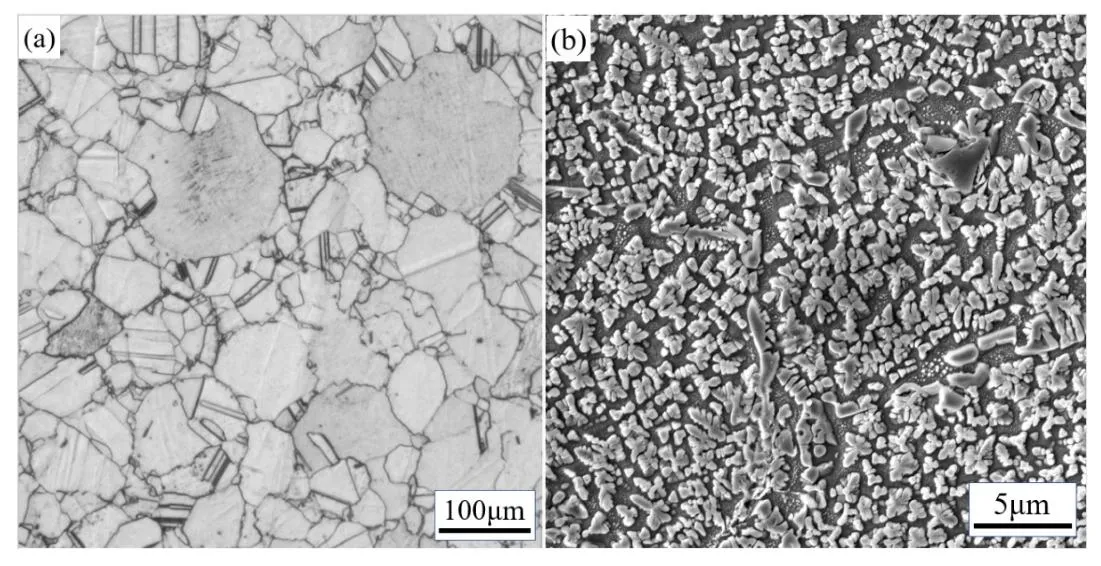
Nickel alloys may be supplied in different material conditions, and their performance can depend on the thermal and mechanical history of the product.
8.1 Why processing history matters
Processing may influence:
-
Grain structure.
-
Precipitate formation.
-
Phase distribution.
-
Residual stress.
-
Mechanical strength.
-
Corrosion behavior.
The same nominal alloy grade can require different considerations depending on whether it is supplied as a plate, bar, tube, wire, or forging.
8.2 Welding and thermal exposure
Welding introduces localized heating and cooling. Depending on the alloy chemistry and thermal cycle, this can affect microstructure and the distribution of phases or precipitates.
Technical literature discusses phase stability and corrosion behavior in nickel-base alloys, including the importance of welding metallurgy for corrosion-resistant materials.
The specific requirements for post-weld treatment, corrosion testing, or acceptance criteria should be established using the relevant alloy specification, qualified welding procedure, and application requirements.
9. Technical Procurement Considerations for Nickel Alloys
For industrial buyers, the chemical composition is one part of the purchasing specification. A complete request for quotation should identify the material and the requirements that affect supply feasibility and acceptance.
Nickel alloy RFQ checklist
Information to include in an inquiry
Alloy name and UNS number, if known.
Product form: bar, plate, sheet, tube, pipe, wire, strip, coil, or forging.
Required dimensions, tolerances, and quantity.
Material condition and applicable heat treatment.
Applicable ASTM, ASME, or other material specification.
Required chemical composition and mechanical properties.
Testing, inspection, and material certification requirements.
Intended service environment, where relevant.
9.1 Chemical composition and material documentation
The requested alloy grade should be identified clearly. When a standard is specified, the applicable edition and product form should be confirmed.
Material test certificates and inspection documents should be agreed upon before order placement. The required documents depend on the material specification, buyer's requirements, and actual supply arrangement.
9.2 Customization and supply feasibility
MWalloys supplies nickel-based alloy products in different forms and specifications through its own production capabilities and cooperation with qualified manufacturing partners. The feasibility of a specific order depends on the material, dimensions, technical requirements, and production route.
A suitable procurement statement is:
MWalloys supports customized nickel alloy sourcing requirements based on the requested material grade, product form, dimensions, and applicable specifications. Availability, production feasibility, and inspection documentation are confirmed on a case-by-case basis.
This wording does not promise that every specification is immediately available or that all requests can be fulfilled without technical review.
10. Common Mistakes When Comparing Alloying Elements
Mistake 1: Selecting an alloy by chromium content alone
Chromium is important for many nickel alloy systems, but the service environment and the complete alloy chemistry determine the practical result.
Mistake 2: Assuming more molybdenum always means better corrosion resistance
Molybdenum can improve resistance in specific environments, but its role depends on the alloy system, corrosion mechanism, and operating conditions.
Mistake 3: Treating iron as an indication of inferior material
Iron can be an intentional and important constituent of particular nickel alloy families. Its significance must be evaluated within the complete alloy composition and intended application.
Mistake 4: Comparing data from different product forms without qualification
Mechanical properties and processing requirements may differ by product form and material condition. Comparisons should identify the test conditions and applicable specification.
Mistake 5: Using a general corrosion claim as a design qualification
A published corrosion-resistance description does not establish suitability for every temperature, chemical concentration, or component design. Application-specific evaluation remains necessary.
11. Practical Summary for Engineers and Buyers
Chromium, molybdenum, and iron each contribute to the design and performance of nickel-based alloys, but their effects are interconnected.
-
Chromium: Often contributes to oxidation resistance and protective surface-film formation in suitable environments.
-
Molybdenum: Can improve resistance to reducing acids and localized corrosion in appropriate alloy systems.
-
Iron: Plays different roles across nickel-iron, nickel-chromium-iron, and more complex alloy families, depending on the composition and intended properties.
The correct alloy choice requires an evaluation of the complete material specification, service conditions, manufacturing route, and required performance.
For procurement, clearly defined material grade, product form, dimensions, condition, testing, and documentation requirements help reduce uncertainty during quotation and production.
FAQ
1. What is the main role of chromium in nickel-based alloys?
Chromium commonly contributes to oxidation resistance and corrosion resistance through protective surface-film formation in suitable environments. Its effectiveness depends on the alloy composition and service conditions.
2. Why is molybdenum added to nickel alloys?
Molybdenum is added to many nickel alloys to improve resistance to specific corrosive environments, including certain reducing acids and localized corrosion conditions. The benefits depend on the alloy system and exposure conditions.
3. Does iron reduce the performance of nickel-based alloys?
Not necessarily. Iron is an intentional constituent in several nickel alloy families. Its effect depends on the complete composition, microstructure, processing history, and intended application.
4. Is a higher chromium content always better?
No. A higher chromium content does not guarantee better performance in every corrosive environment. Alloy balance and service conditions must be considered.
5. How do chromium and molybdenum work together?
Chromium and molybdenum can contribute through different corrosion-resistance mechanisms. Chromium is associated with protective behavior in oxidizing conditions, while molybdenum can support resistance in reducing and localized corrosion environments. Their combined effect depends on the specific alloy and conditions.
6. What information should be included when purchasing nickel alloys?
Buyers should provide the alloy grade or UNS number, product form, dimensions, quantity, material condition, applicable specification, and testing or documentation requirements. Where relevant, the operating environment should also be identified.
7. Can MWalloys supply customized nickel alloy specifications?
MWalloys supports customized sourcing and supply coordination for nickel-based alloys. Feasibility, production arrangements, availability, and documentation requirements should be confirmed based on the specific request.