

Custom made high-gloss polished stainless steel with a mirror finish delivers surface roughness values as low as Ra 0.05 µm, reflectivity exceeding 90%, and corrosion resistance tested to ASTM B117 salt-spray standards beyond 1,000 hours — making it the definitive choice for architectural cladding, food-grade equipment, medical instruments, and luxury consumer goods. At MWalloys, we have processed over 2,000 metric tons of mirror-finish stainless steel annually, and we can confirm that achieving a true #8 mirror polish requires a minimum of five progressive grinding and buffing stages, matched alloy selection, and strict process controls that most standard mills simply do not offer.
If your project requires the use of Custom Made High-Gloss Polished Stainless Steel, you can contact us for a free quote.
What Is Mirror-Finish Stainless Steel and How Is It Classified?
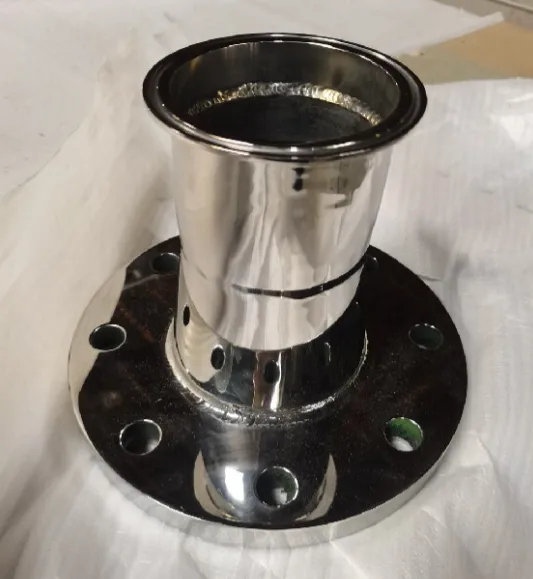
Mirror-finish stainless steel is a mechanically polished metal surface refined to a point where it reflects light with near-optical clarity, essentially functioning as a metal mirror. The finish is categorized under international standards — most commonly the No. 8 finish as defined by ASTM A480/A480M and the equivalent EN 10088-2 2J finish used widely across Europe.
The Surface Finish Numbering System Explained
The stainless steel surface finish classification system spans from the raw mill finishes to the highest-reflectivity polished finishes. The following table summarizes the most commonly referenced designations:
| Finish Designation | Description | Ra Value (µm) | Typical Application |
|---|---|---|---|
| No. 1 | Hot-rolled, annealed, pickled | 3.0 – 6.0 | Industrial structural |
| No. 2B | Cold-rolled, annealed, pickled, light-rolled | 0.1 – 0.5 | General fabrication |
| No. 4 | Brushed/satin finish, unidirectional | 0.2 – 0.8 | Kitchen equipment, architectural panels |
| No. 6 | Tampon/Scotch-Brite equivalent | 0.3 – 0.6 | Decorative, automotive trim |
| No. 7 | High-luster, some reflectivity remaining | 0.05 – 0.1 | Pre-mirror, decorative |
| No. 8 | Mirror finish, maximum reflectivity | ≤ 0.05 | Architecture, medical, luxury goods |
| No. 8+ / Super Mirror | Ultra-refined beyond standard No. 8 | ≤ 0.025 | Semiconductor, optics, premium décor |
Source: ASTM A480/A480M Standard Specification for General Requirements for Flat-Rolled Stainless and Heat-Resisting Steel Plate, Sheet, and Strip; EN 10088-2:2014.
The Ra (Roughness Average) value is the arithmetic mean of the absolute values of the profile deviations from the mean line, measured in micrometers. A No. 8 mirror finish at Ra ≤ 0.05 µm means the surface deviations are less than 50 nanometers — a scale approaching the wavelength of visible light itself.
What Does "Custom Made" Mean in the Context of Mirror-Finish Stainless Steel?
At MWalloys, the term "custom made" covers significantly more than simply ordering a sheet with a polished face. Custom production encompasses:
- Non-standard dimensions: widths beyond 1,500 mm, thicknesses from 0.3 mm to 80 mm, and cut-to-length sheets up to 6,000 mm.
- One-sided vs. two-sided polishing: applications like elevator interiors demand both faces polished to No. 8, while structural panels may only require single-face treatment.
- Custom substrate preparation: removing pre-existing surface defects, weld seams, or rolling lines before polishing begins.
- Protective film lamination: applying PE or PVC protective films immediately post-polish to prevent scratching during transit and fabrication.
- Profile and form customization: mirror-polished tubes, angles, round bars, and custom-fabricated shapes, not just flat sheet.
This level of customization is where commodity distributors often fall short, and where specialized processors like MWalloys add measurable value to the supply chain.
Which Stainless Steel Grades Are Best Suited for Mirror Polishing?
Not every stainless steel grade responds equally to mirror polishing. The metallurgical composition, particularly the carbon content, sulfur content, and grain structure, determines both the achievable surface quality and the process difficulty.
Grade-by-Grade Polishability Comparison
| Grade | Type | Key Alloying Elements | Polishability Rating | Common Mirror Applications |
|---|---|---|---|---|
| 304 / 1.4301 | Austenitic | 18% Cr, 8% Ni | Excellent | Architecture, food equipment, décor |
| 316 / 1.4401 | Austenitic | 18% Cr, 10% Ni, 2% Mo | Excellent | Marine, pharmaceutical, medical |
| 316L / 1.4404 | Austenitic (low carbon) | 18% Cr, 12% Ni, 2% Mo | Excellent | Welded medical assemblies |
| 430 / 1.4016 | Ferritic | 17% Cr | Good | Indoor architectural panels |
| 201 / 1.4372 | Austenitic (Mn-substituted) | 17% Cr, 4% Ni, 6% Mn | Good | Cost-sensitive decorative |
| 2205 / 1.4462 | Duplex | 22% Cr, 5% Ni, 3% Mo | Moderate | High-strength structural |
| 310S / 1.4845 | Austenitic (high Cr) | 25% Cr, 20% Ni | Moderate | High-temperature applications |
Source: SSINA (Specialty Steel Industry of North America) Grade Selection Guide; Outokumpu Stainless Steel Handbook 2021.
Why Does Sulfur Content Matter for Mirror Polishing?
This is a point we cannot stress enough to procurement engineers: sulfur content in the stainless steel substrate is one of the most critical — and most frequently overlooked — factors in achieving a flawless mirror finish.
Free-machining grades (such as 303 stainless) contain sulfur additions up to 0.15% by weight to improve machinability. These sulfur additions form manganese sulfide (MnS) inclusions that appear as dark pits or streaks during polishing. According to research published in Corrosion Science (Volume 52, Issue 7, 2010), MnS inclusions are the primary nucleation sites for pitting corrosion and also act as stress concentrators that prevent achieving a continuous, defect-free mirror surface.
For true No. 8 mirror finish work, we always specify low-sulfur grades with S ≤ 0.005% by weight. Standard 304 and 316 comply with S ≤ 0.030%, which is acceptable for most mirror applications, but demanding optical-quality work may require ordering mill-certified material with restricted sulfur maximums.
Austenitic vs. Ferritic Grades for Mirror Applications
Austenitic grades (304, 316 family) dominate the mirror-finish market for several reasons:
- Non-magnetic structure: The face-centered cubic (FCC) crystal structure produces a more homogeneous surface, which polishes more uniformly.
- Higher nickel content: Nickel contributes to a smoother passive oxide layer that accepts and retains high-polish finishes more readily.
- Better ductility: Austenitic grades deform plastically before fracturing, which means polishing abrasives burnish the surface rather than fracturing crystallites, resulting in lower Ra values.
Ferritic grades (430, 439) can achieve mirror finishes, but the body-centered cubic (BCC) structure produces slightly anisotropic polishing behavior, and achieving Ra values below 0.05 µm consistently requires more process control. For indoor decorative applications where cost matters, 430 mirror finish is entirely acceptable. For outdoor or corrosive environments, 316L remains the unambiguous recommendation.
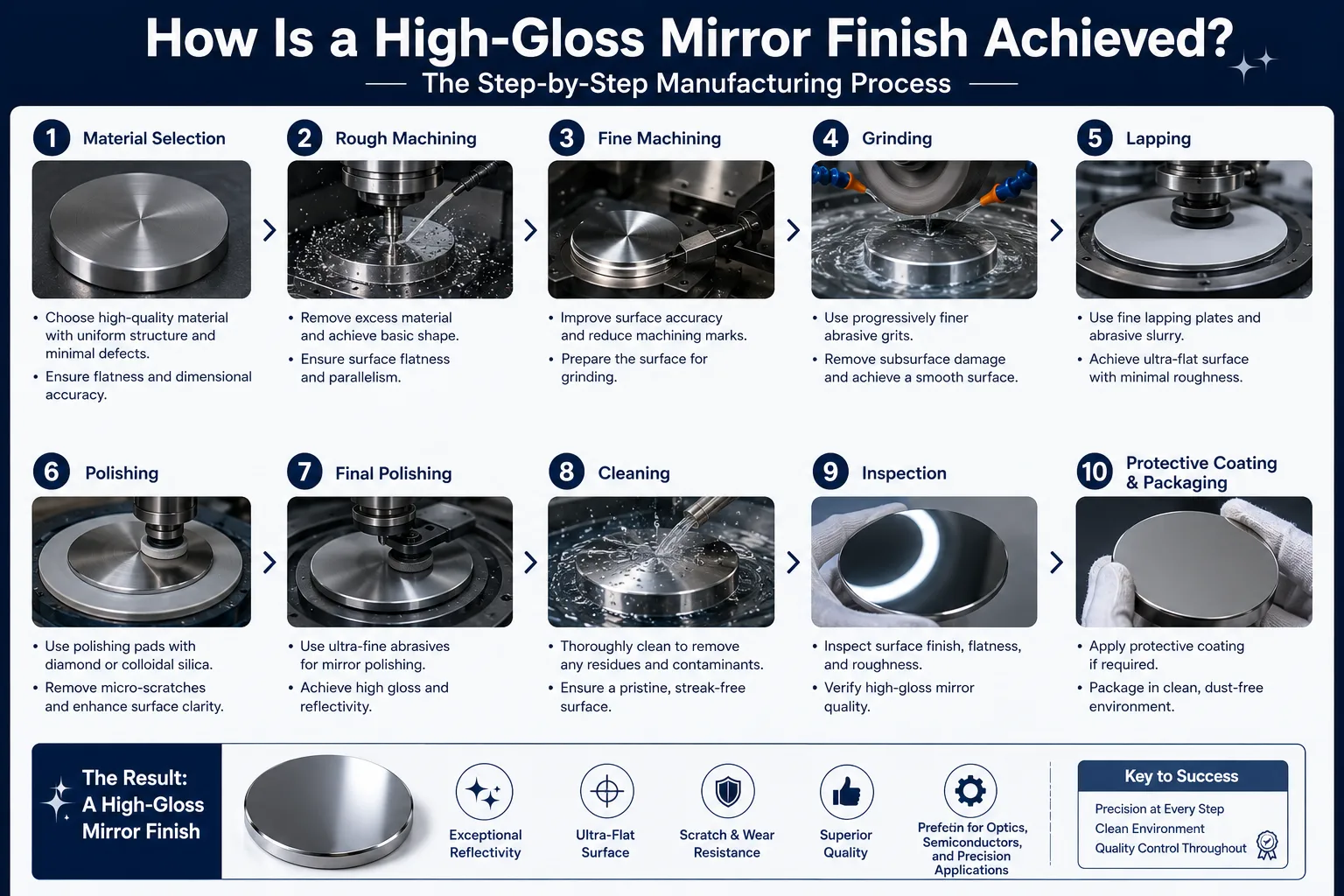
How Is a High-Gloss Mirror Finish Achieved? The Step-by-Step Manufacturing Process
Producing a genuine No. 8 mirror finish is not a single polishing step — it is a carefully sequenced material removal and surface refinement process. At MWalloys, we follow a minimum five-stage process for standard mirror work, with additional stages for super-mirror specifications.
Stage 1 — Substrate Preparation and Incoming Inspection
Before any abrasive touches the metal, we conduct:
- Visual inspection under 500-lux minimum lighting for scratches, dents, inclusions, or rolling defects.
- Thickness verification using calibrated digital micrometers (accuracy ±0.001 mm).
- Hardness verification using Rockwell B scale (standard 304 should read 85–90 HRB).
- Chemistry verification via portable XRF (X-Ray Fluorescence) analyzer for grade confirmation.
Any substrate defect not remediated at this stage will magnify through the polishing process. A 50 µm deep scratch on the incoming 2B sheet will require removing at least 100 µm of material to eliminate, which affects dimensional tolerances.
Stage 2 — Coarse Grinding (P120–P180 Grit)
The first abrasive stage uses aluminum oxide or silicon carbide belts or discs at P120 to P180 grit to remove:
- Rolling mill scale remnants.
- Surface scratches from prior processing.
- Weld bead profiles (for custom fabricated assemblies).
At this stage, the Ra value typically ranges from 0.5 to 1.5 µm — the surface looks uniformly scratched with visible, directional grind marks. Belt speed, contact pressure, and feed rate are controlled to avoid overheating. Heat input exceeding approximately 150°C can cause sensitization in 304 grade, precipitating chromium carbides at grain boundaries (a phenomenon known as "weld decay" or sensitization, described in ASTM A262 Practice A testing for susceptibility to intergranular attack).
Stage 3 — Intermediate Grinding (P240–P400 Grit)
Progressive grit reduction removes the scratch pattern from the previous stage. Each subsequent grit should remove scratches approximately 2–3 times deeper than its own scratch depth. This stage typically involves two or three grit changes (P240, then P320, then P400).
After P400 grinding:
- Ra value: 0.1–0.3 µm.
- The surface appears semi-bright with fine, uniform scratch lines.
- Under 10x magnification, scratch patterns should be consistently unidirectional.
Stage 4 — Fine Polishing (P600–P1200 and Abrasive Compounds)
Fine polishing transitions from material removal to surface refinement. We use:
- P600–P800 abrasive paper or belts: transitioning to finer scratch patterns.
- Liquid polishing compounds: chromium oxide or aluminum oxide suspension compounds with particle sizes 1–5 µm.
- Cotton or sisal polishing wheels at speeds of 1,500–2,500 RPM.
At this stage, the surface Ra approaches 0.08–0.12 µm and begins to show noticeable reflectivity. Objects can be seen reflected in the surface, though with visible distortion.
Stage 5 — Final Buffing and Mirror Development
The critical final stage uses:
- Fine buffing compounds: cerium oxide or diamond paste with particle sizes 0.1–0.5 µm.
- Soft cotton or felt buffing mops at controlled speeds.
- Consistent overlapping passes to prevent "orange peel" texture from inconsistent contact.
After final buffing, Ra values of ≤ 0.05 µm are verified. The surface should produce a clear, undistorted reflection of objects placed 1 meter away. We test this by placing a standard resolution test card (adapted from ISO 12233 principles) in front of the polished panel and photographing the reflection to document reflectivity quality.
Stage 6 — Electrolytic Polishing (Optional, for Super-Mirror Specifications)
For applications requiring Ra ≤ 0.025 µm (super-mirror), electropolishing follows mechanical polishing. Electropolishing is an electrochemical material removal process in which the workpiece serves as the anode in an electrolytic cell containing a phosphoric/sulfuric acid solution.
According to data published by the Metal Finishing Association (MFA Technical Report, 2019), electropolishing removes a uniform 10–30 µm layer, preferentially attacking microscopic surface asperities (peaks), which mathematically reduces Ra values. Benefits include:
- Ra reduction of 30–50% below the mechanically polished value.
- Improved corrosion resistance (passive layer thickness increases from ~2 nm to ~5 nm post-electropolish, per XPS surface analysis data)
- Elimination of surface contamination and embedded abrasives.
Protective Film Application
Immediately after polishing and before any handling, we apply a pressure-sensitive polyethylene (PE) or PVC film to all polished surfaces. Film peel adhesion strength is typically 50–150 g/cm² — enough to remain in place during fabrication but removable without surface adhesive residue after processing is complete.
What Are the Key Surface Finish Standards and How Do You Read Them?
Specifying mirror-finish stainless steel without referencing the correct standard creates ambiguity that costs money and causes rejection. Here is how the major international standards compare:
International Surface Finish Standards Comparison
| Standard | Organization | Mirror Designation | Ra Specification | Notes |
|---|---|---|---|---|
| ASTM A480/A480M | ASTM International | No. 8 | Not numerically specified in standard | Relies on visual comparators |
| EN 10088-2 | European Committee for Standardization | 2J | ≤ 0.1 µm (indicative) | More prescriptive than ASTM |
| JIS G 4305 | Japanese Industrial Standards | BA, #800, #1000 | 0.03–0.1 µm | Common in Asian markets |
| ISO 1302 | International Organization for Standardization | N1–N12 scale | Ra numerically defined | Engineering drawing callout standard |
| DIN 8200 | German Institute for Standardization | Rmax, Rz parameters | Rmax ≤ 0.5 µm for mirror class | Common in German-spec projects |
Source: ASTM International publication library; EN 10088-2:2014 Stainless steels — Technical delivery conditions for sheet/plate; JIS G 4305:2021.
How to Write a Proper Surface Finish Specification
When writing a purchase order or engineering drawing callout for mirror-finish stainless steel, we recommend including all of the following elements:
- Base material: Grade and standard (e.g., 316L per ASTM A240/A240M)
- Finish designation: No. 8 per ASTM A480/A480M or 2J per EN 10088-2.
- Ra requirement: ≤ 0.05 µm (for No. 8) or ≤ 0.025 µm (for super-mirror)
- Inspection method: Contact profilometer (stylus) per ISO 4288 or non-contact optical profilometer.
- Sample size and acceptance: AQL (Acceptable Quality Level) per ANSI/ASQ Z1.4 sampling plan.
- Protective packaging: Specify PE film, interleaving paper, or foam packaging.
- Test reports required: Mill certificate (EN 10204 Type 3.1 or 3.2), surface roughness measurement reports.
What Industries Use Custom Mirror-Polished Stainless Steel and Why?
Mirror-finish stainless steel is not a niche product. Its combination of aesthetics, corrosion resistance, hygiene, and mechanical strength makes it relevant across a wide range of industries.
Industry Applications Summary Table
| Industry | Typical Application | Grade Used | Key Requirement |
|---|---|---|---|
| Architecture & Interior Design | Elevator interiors, wall cladding, column covers | 304, 316 | Aesthetics, flatness, scratch resistance |
| Food Processing | Tanks, hoppers, conveyor surfaces | 316L | Hygiene, cleanability, FDA compliance |
| Pharmaceutical | Reactors, sterile processing equipment | 316L, 316L ELI | Ra ≤ 0.5 µm (process), Ra ≤ 0.05 µm (ultra-clean) |
| Medical Devices | Surgical instruments, implant-adjacent components | 316L, 17-4 PH | Biocompatibility, surface integrity |
| Automotive | Trim rings, exhaust tips, decorative components | 304, 430 | Formability post-polish, outdoor durability |
| Consumer Electronics | Watch cases, phone frames, decorative bezels | 316L, 17-4 PH | Surface uniformity, dimensional precision |
| Semiconductor | Vacuum chamber components, wafer handling | 316L, electropolished | Ultra-low Ra, particle contamination control |
| Maritime | Vessel fittings, deck hardware | 316, 2205 | Chloride corrosion resistance |
| Luxury Goods | Furniture, kitchenware, signage | 304, 316 | Visual uniformity, reflectivity |
Architecture and Interior Design Applications
Architectural applications represent the single largest volume market for mirror-finish stainless steel globally. According to a market analysis by Grand View Research (2023), the global architectural stainless steel market was valued at approximately USD 28.4 billion in 2022, with mirror-polished sheet accounting for an estimated 18–22% of the decorative segment.
Key architectural uses include:
Elevator cab interiors: The classic application. A standard 2.1 m × 1.4 m elevator cab interior requires approximately 8–10 panels of mirror-polished stainless steel. The challenge is maintaining consistent reflectivity across all panels — a variation in gloss level between panels is immediately visible to passengers. We source matched coils from the same production run when large elevator projects require multiple panels.
Curtain wall cladding: Large-format mirror-finish panels (up to 3,000 mm × 1,500 mm) are used as exterior cladding on premium commercial buildings. The reflective surface reduces solar heat gain by reflecting incident radiation — a properly polished No. 8 surface reflects 65–75% of solar radiation compared to 20–30% for a No. 2B surface, according to data from Lawrence Berkeley National Laboratory studies on building envelope materials.
Column covers and reception desks: Interior accent elements where the mirror surface creates the illusion of increased space and contributes to premium brand environments.
Food and Pharmaceutical Grade Requirements
The food processing and pharmaceutical industries have specific surface finish requirements driven by hygiene rather than aesthetics, though the two often align.
The FDA's Code of Federal Regulations (21 CFR Part 117) requires that food contact surfaces be "smooth and easily cleanable." The European Hygienic Engineering and Design Group (EHEDG) Document 8 provides quantitative guidance: food contact surfaces should achieve Ra ≤ 0.8 µm minimum, with critical applications specifying Ra ≤ 0.4 µm.
For pharmaceutical applications, the ASME BPE (Bioprocessing Equipment) Standard, most recently revised in 2022, specifies:
- SF1 (standard food): Ra ≤ 0.8 µm
- SF2 (pharmaceutical-grade): Ra ≤ 0.5 µm
- SF3 (ultra-clean): Ra ≤ 0.25 µm
- SF4 (ultra-high purity): Ra ≤ 0.125 µm
Mirror-finish polishing producing Ra ≤ 0.05 µm exceeds all ASME BPE categories, which is why pharmaceutical customers often specify mirror polishing on internal vessel surfaces, not for aesthetics but for validated cleanability and resistance to biofilm formation.
How Do Dimensional Customization Options Affect Performance and Cost?
Understanding how dimensional parameters interact with polishing costs and performance helps procurement teams make informed trade-offs. This section breaks down the key variables.
Thickness and Its Impact on Polishing Difficulty
| Thickness Range | Polishing Challenge | Typical Ra Achievable | Relative Cost Premium Over 2B |
|---|---|---|---|
| 0.3 – 0.8 mm | High — thin material deflects under polishing pressure | 0.05 – 0.10 µm | +60–80% |
| 1.0 – 2.0 mm | Moderate — some flexibility, requires support backing | 0.04 – 0.08 µm | +40–60% |
| 2.0 – 6.0 mm | Low — rigid enough for stable polishing | 0.03 – 0.06 µm | +25–45% |
| 6.0 – 20 mm | Low to Moderate — heavy material handling requirements | 0.04 – 0.08 µm | +35–55% |
| >20 mm (plate) | Moderate — surface area is smaller relative to handling cost | 0.05 – 0.10 µm | +50–70% |
Thin gauges (below 1.0 mm) present particular challenges because the polishing contact force flexes the metal, creating inconsistent material removal and "waves" in the finished surface. We use vacuum-backed polishing tables for gauges below 0.8 mm to maintain flatness during polishing.
Width and Length Considerations
Standard polishing lines process widths up to 1,524 mm (60 inches). Custom widths beyond this require specialized wide-belt polishing systems or manual bench polishing, both of which affect:
- Production speed: wide-belt lines process at 2–8 meters per minute; manual bench polishing is typically 0.3–1.0 meter per minute.
- Surface consistency: automated lines produce more consistent Ra values across the width; manual polishing requires highly skilled operators to maintain uniformity.
- Lead time: custom-width polishing may require dedicated machine setup time, adding 5–10 business days to standard lead times.
Custom Fabricated Forms: Tubes, Profiles, and Complex Shapes
Mirror polishing is not limited to flat sheet and plate. We regularly produce mirror-finished:
- Round tubes: OD from 6 mm to 300 mm, using internal mandrel-supported polishing for seamless tube interiors (critical for food-grade piping).
- Square and rectangular tubes: Flat face polishing on each face, with edge treatment to maintain consistency around corners.
- Angle and channel sections: Polishing each flat face independently, with particular attention to the inside radii where abrasive access is limited.
- Custom laser-cut profiles: Mirror-finish sheet cut to complex geometries, with post-cutting edge deburring to prevent injury and maintain aesthetics.
The cost of polishing complex forms is typically 2–4× the cost of polishing equivalent flat sheet, reflecting the additional process time and skill required.
What Quality Control and Inspection Methods Ensure a True Mirror Finish?
Quality control for mirror-finish stainless steel operates at three levels: in-process monitoring, final inspection, and documentation.
Surface Roughness Measurement Methods
| Method | Instrument | Standard | Accuracy | Best For |
|---|---|---|---|---|
| Contact Stylus Profilometry | Taylor Hobson Talysurf, Mitutoyo SJ series | ISO 4288, ISO 25178 | ±5% | Production floor QC |
| Non-Contact Optical Profilometry | Zygo NewView, Keyence VK series | ISO 25178 | ±2% | Research, high-precision inspection |
| White Light Interferometry | Bruker ContourGT | ISO 25178 | ±1% | Semiconductor, aerospace validation |
| Atomic Force Microscopy (AFM) | Bruker Dimension Icon | ISO 25178 | ±0.1 nm | Super-mirror, R&D |
For production quality control, contact stylus profilometry per ISO 4288 is the industry standard. The stylus tip radius is typically 2 µm, and the measurement cutoff wavelength (λc) is selected based on the expected roughness scale — for mirror-finish work, λc = 0.25 mm or 0.08 mm is typical.
Visual Inspection Protocols
Numerical Ra alone does not fully characterize a mirror finish. Visual inspection remains essential for detecting:
- Orange peel texture: A macro-scale waviness pattern from inconsistent buffing pressure.
- Haze or cloudiness: Sub-surface stress from aggressive polishing without adequate compound progression.
- Linear scratches: From abrasive contamination in buffing wheels or compounds.
- Staining or discoloration: Heat tint from excessive polishing speeds, or acid residue from electrolytic polishing.
Our standard visual inspection is conducted under:
- White fluorescent light at 1,000 lux minimum.
- Inspection angle: 45° incidence, 45° reflection geometry.
- Viewing distance: 500 mm to 1,000 mm.
- Accept/reject criteria documented against ASTM A480 visual quality standards.
Flatness and Waviness Verification
For architectural panels, flatness is as critical as surface roughness. A mirror-finish panel with poor flatness distorts reflections dramatically — what appears to be a minor 1 mm bow in a 1,000 mm panel creates visible image distortion in the reflection.
We measure flatness using:
- Precision granite surface plates per ISO 8512 for small panels.
- Laser scanning for large panels (> 1,000 mm × 1,000 mm)
- Specified maximum flatness tolerance: ≤ 1 mm per 1,000 mm for architectural grade.
How Does Mirror-Finish Stainless Steel Compare to Alternatives?
Buyers frequently evaluate mirror-finish stainless steel against other high-gloss materials. Here is an objective comparison:
Material Comparison for High-Gloss Applications
| Property | Mirror SS 316L | Chromium-Plated Steel | Anodized Aluminum | PVD-Coated SS | Acrylic/Polycarbonate |
|---|---|---|---|---|---|
| Reflectivity | 85–92% | 70–80% | 70–85% (dependent on dye) | 60–80% | 90–92% (transparent) |
| Corrosion Resistance | Excellent (Cl- resistant) | Poor in Cl- environment | Good (indoor), Moderate (marine) | Excellent | Good |
| Scratch Hardness (Mohs scale) | 5.5–6.5 | 5–6 | 3–4 (anodize layer) | 7–8 (TiN PVD) | 2–3 |
| Maximum Service Temperature | 870°C (304), 925°C (310) | 200°C max | 150°C | 400°C | 80–120°C |
| Hygienic Compliance | FDA, EHEDG, ASME BPE | Not suitable for food contact | FDA compliant (uncoated) | Application-specific | FDA-approved grades exist |
| Recyclability | 100%, high scrap value | Complex (hazardous Cr plating) | 100% | 100% (base metal) | Limited, low value |
| Typical Cost (relative) | 1.0× (baseline) | 0.7–0.9× | 0.5–0.7× | 1.2–1.5× | 0.2–0.4× |
| Lifespan (outdoor) | 20–50+ years | 5–10 years | 10–20 years | 15–30 years | 5–15 years |
Source: Materials Properties Database, ASM International; ASTM performance data; European Coatings Journal (2020).
When Should You Choose Mirror-Finish Stainless Over PVD Coating?
This is a question we encounter regularly from architects and designers. PVD (Physical Vapor Deposition) coating applies a thin film (typically 1–5 µm) of titanium nitride, chromium nitride, or similar compounds over a polished stainless steel substrate. The result can be mirror-bright with decorative colors (gold, rose gold, black, bronze).
Choose mirror-finish stainless (uncoated) when:
- The application requires weldability without color change at heat-affected zones.
- Regular refinishing or rebuffing may be needed after installation.
- Budget constraints make PVD's 20–50% cost premium prohibitive.
- Food contact is required (PVD coatings must be specifically tested for food contact compliance).
Choose PVD-coated mirror stainless when:
- Colored metallic surfaces are specified (architectural design requirements)
- Enhanced surface hardness is needed (TiN PVD reaches 2,300 HV, versus 200 HV for polished 304)
- Long-term scratch resistance is prioritized in high-traffic public environments.
What Are the Maintenance and Care Requirements for High-Gloss Polished Surfaces?
Mirror-finish stainless steel requires more careful maintenance than lower-finish alternatives, but the maintenance procedures are straightforward when followed correctly.
Routine Cleaning Recommendations
| Contaminant Type | Recommended Cleaning Agent | Method | Frequency |
|---|---|---|---|
| Fingerprints, oils | Mild detergent solution (0.5–1% neutral pH) | Soft microfiber cloth, wipe in polishing direction | Daily to weekly |
| Water spots, mineral deposits | Diluted white vinegar (1:4 with water) or proprietary stainless cleaner | Apply, dwell 2 minutes, wipe with grain | As needed |
| Light surface marks | Specialized stainless polish (e.g., Flitz, Bar Keepers Friend liquid) | Apply with soft cloth, buff out | Monthly |
| Graffiti, adhesive residue | Isopropyl alcohol (IPA, 70%) or acetone (test in hidden area first) | Apply with lint-free cloth | As needed |
| Rust staining (from carbon steel contact) | Oxalic acid-based cleaner or citric acid solution | Apply, 10-minute dwell, rinse thoroughly | As needed |
What to avoid: Never use chloride-based bleach solutions, steel wool or carbon steel brushes, abrasive powder cleaners, or cross-grain wiping patterns. Chloride ions from bleach solutions attack the passive chromium oxide layer, initiating pitting corrosion even in 316-grade stainless.
Restoration of Scratched Mirror Finishes
Minor scratches (< 5 µm depth) in mirror-finish stainless can be rebuffed on-site using:
- Automotive-grade polishing compound (Stage 1: cutting compound, Stage 2: polishing compound).
- Orbital polisher with foam pad.
- Final polishing with microfiber cloth and dedicated stainless mirror polish.
For deeper scratches requiring abrasive grinding, on-site restoration is typically impractical without specialized equipment, and panel replacement or professional re-polishing is recommended.
How Do You Source and Specify Custom Mirror-Finish Stainless Steel from a Reliable Supplier?
Sourcing custom mirror-finish stainless steel involves evaluating technical capability, quality management systems, and supply chain reliability simultaneously.
Supplier Evaluation Criteria
| Criteria | What to Verify | Verification Method |
|---|---|---|
| Quality Management System | ISO 9001:2015 certification minimum; IATF 16949 for automotive | Request current certificate |
| Material Traceability | EN 10204 Type 3.1 or 3.2 mill certificates | Review sample certificates |
| Polishing Capability | Demonstrated Ra ≤ 0.05 µm capability | Request CPK data or polishing qualification records |
| Surface Measurement Equipment | Calibrated profilometers with current calibration certificates | Audit or certificate review |
| Clean Room / Controlled Environment | Critical for super-mirror (Ra ≤ 0.025 µm) production | Facility audit |
| Packaging and Logistics | PE film application, appropriate crating, international shipping experience | Reference checks |
| Lead Time | Standard: 2–4 weeks; complex custom: 4–8 weeks | Confirm with order history |
Red Flags When Evaluating Mirror-Finish Suppliers
Based on our experience at MWalloys, common problems with under-qualified suppliers include:
- Inconsistent Ra across panel surfaces: Indicates poor process control or inadequate polishing equipment maintenance.
- Edge quality significantly lower than face quality: Suggests automated polishing without manual edge finishing — edges may be sharp or have inconsistent finish transitions.
- No surface roughness measurement reports: Relying solely on visual inspection is insufficient for engineering specifications.
- Inability to provide matched panels from same production run: Creates visible finish variation when panels are installed side by side.
- Missing or uncertified mill certificates: Cannot verify chemistry or mechanical properties of the base material.
MWalloys Custom Mirror-Finish Ordering Process
At MWalloys, our standard ordering workflow for custom mirror-finish stainless steel follows these steps:
- Technical consultation: We review your drawings, specifications, and application requirements. Our engineering team provides DFM (Design for Manufacturability) feedback within 2 business days
- Material sourcing: We procure certified base material from approved mill partners (Outokumpu, POSCO, Yieh United) with full 3.1 mill certificates.
- First Article Inspection (FAI): For new part numbers, we produce a sample panel for customer approval before full production.
- Production and in-process QC: Documented roughness measurements at each polishing stage.
- Final inspection and documentation package: Full dimensional report, surface roughness report, mill certificates, and photographic records.
- Protective packaging and shipping: PE film application, foam-lined crating for international shipments, with shock-indicating labels.
Frequently Asked Questions (FAQs)
1: What is the difference between a No. 8 mirror finish and a super-mirror finish?
A No. 8 mirror finish, as defined by ASTM A480/A480M, achieves a surface roughness Ra ≤ 0.05 µm through mechanical polishing using progressively finer abrasive compounds ending with buffing wheels and polishing rouge. It produces clear, undistorted reflections suitable for the vast majority of architectural, food-grade, and decorative applications. A super-mirror finish goes beyond No. 8 standards, achieving Ra values ≤ 0.025 µm — and in some semiconductor applications, Ra ≤ 0.010 µm — typically through a combination of mechanical polishing and electropolishing. The super-mirror specification adds 30–60% to processing costs and is primarily justified in semiconductor manufacturing, precision optics, and ultra-high vacuum (UHV) equipment where surface particle generation and outgassing must be minimized.
2: How long does a mirror finish last on stainless steel in outdoor environments?
Mirror-finish 316L stainless steel in typical outdoor urban environments maintains its reflective appearance for 15–30 years with appropriate periodic maintenance. Key factors affecting longevity include chloride exposure (coastal environments accelerate surface dulling), UV radiation (minimal effect on stainless itself), and mechanical contact (foot traffic scratching on horizontal surfaces). Research conducted by the Nickel Institute (Technical Series No. 10 057, 2020) on 30-year installed stainless steel architectural panels in European cities found that 316L panels in non-coastal environments retained greater than 85% of original reflectivity with only annual cleaning. In aggressive marine environments (within 1 km of breaking surf), 2205 duplex or 904L alloy is recommended over standard 316L.
3: Can mirror-finish stainless steel be welded without destroying the surface?
Welding mirror-finish stainless steel assemblies requires careful procedural controls to protect the polished surfaces adjacent to weld zones. Yes, it can be welded, but the heat-affected zone (HAZ) will lose mirror finish and require post-weld re-polishing. Standard practice is to weld the fabricated assembly first, then polish the entire external surface to mirror finish. If post-fabrication polishing is impractical (large complex assemblies), masking tape and thermal barriers protect polished surfaces during welding of only the required joints, followed by localized re-polishing of the heat-affected zone. Precision TIG (GTAW) welding with inert gas back-purging minimizes the HAZ width to 5–15 mm, limiting the area requiring post-weld polishing.
The cost premium for No. 8 mirror finish over 2B finish stainless steel typically ranges from 25% to 80% depending on material thickness, panel size, order quantity, and complexity. For standard 304 grade in 1.5 mm thickness, common architectural panel sizes (1,000 × 2,000 mm), in quantities above 100 sheets, a realistic premium is 35–50% over 2B pricing. Super-mirror specifications add a further 30–60% over No. 8 pricing. Factors that increase the premium include thinner gauges (below 1.0 mm), complex shapes, two-sided polishing, and small order quantities below 10 sheets, which prevent efficient production batching. At MWalloys, we provide detailed cost breakdowns upon request so customers can make informed grade and finish trade-offs.
5: Does mirror polishing affect the mechanical properties of stainless steel?
Mirror polishing has a negligible effect on the bulk mechanical properties of stainless steel (yield strength, tensile strength, elongation). However, surface polishing does measurably improve fatigue strength. Published research in the International Journal of Fatigue (Volume 96, 2017) demonstrated that electropolished 316L stainless steel showed a 15–25% improvement in fatigue limit compared to as-machined surfaces, attributed to compressive residual stress introduction and elimination of stress concentration sites. For thin gauge material below 0.5 mm, the material removal during polishing (typically 10–50 µm total) represents a meaningful percentage of total thickness, which must be accounted for in dimensional specifications. Always specify the final post-polish dimensions, not the pre-polish blank dimensions.
6: What minimum order quantity (MOQ) should buyers expect for custom mirror-finish stainless steel?
Minimum order quantities for custom mirror-finish stainless steel vary significantly by supplier and specification. For standard sheet sizes (1,000 × 2,000 mm or 1,220 × 2,440 mm) in common grades (304, 316L) and standard No. 8 finish, MOQs at specialist processors like MWalloys can be as low as 5–10 sheets, enabling prototype and small-project sourcing. For non-standard widths requiring dedicated polishing line setup, MOQs typically rise to 200–500 kg to justify setup costs. Super-mirror specifications with Ra ≤ 0.025 µm typically carry MOQs of 500 kg or greater due to electropolishing bath preparation costs. Custom cut-to-size shapes from stock mirror-finish sheet can often be sourced with no practical MOQ beyond the cut piece cost minimums (typically USD 50–100 per order).
7: Is mirror-finish stainless steel food safe and FDA compliant?
Yes, mirror-finish stainless steel in appropriate grades (304, 316L) is fully food safe and compliant with FDA regulations under 21 CFR Part 177.2600 (rubber articles intended for repeated use) and relevant EU food contact regulations (EU Regulation No. 10/2011, as amended). The Ra ≤ 0.05 µm surface roughness achieved in No. 8 mirror polishing far exceeds the Ra ≤ 0.8 µm threshold specified by EHEDG (European Hygienic Engineering and Design Group) for food contact surfaces, creating a surface that is exceptionally easy to clean and resistant to bacterial biofilm adhesion. Key consideration: the base stainless steel grade must be food-safe (304, 316, 316L), and no contaminants (polishing compounds, lubricants, protective film adhesives) should remain on surfaces after cleaning validation. Post-polishing cleaning certification documentation is available from MWalloys upon request.
8: How do I prevent fingerprints and smudges on mirror-finish stainless steel installations?
Fingerprints are an inherent challenge on mirror-finish stainless steel because the high-reflectivity surface makes any contamination visually prominent. Several approaches mitigate this in practice. First, specifying an anti-fingerprint (AFP) nano-coating applied over the mirror finish reduces visible fingerprint marks significantly — these oleophobic coatings, applied at 50–200 nm thickness via chemical vapor deposition or roll coating, do not measurably affect Ra values. Second, for high-touch applications (elevator buttons, handrails), a satin finish (No. 4 or No. 6) may be more practical than mirror finish, as the directional grain pattern masks fingerprints far better. Third, for installations where mirror finish is aesthetically required in high-touch areas, specifying a microfiber cloth cleaning protocol with daily cleaning schedules manages the issue operationally. AFP-coated mirror panels from MWalloys carry a 5-year coating performance warranty.
9: What packaging is required to ensure mirror-finish stainless arrives without damage?
Mirror-finish stainless steel is significantly more vulnerable to transit damage than standard mill-finish material. Proper packaging should include: a pressure-sensitive PE or PVC protective film applied directly to the polished face (minimum 50 µm film thickness), foam interleaving between sheets when multiple panels are stacked, wooden crating or cardboard edge protectors to prevent corner impacts, and moisture-absorbing silica gel packets inside sealed packaging for ocean freight shipments. For international shipments by sea, additional consideration for vibration during container handling requires positive foam blocking between panels — sheets should not be free to move relative to each other. At MWalloys, we apply a dual-film system: a soft-face PE film directly on the polished surface, followed by a harder PVC outer film for transit protection. Shipment tracking and GPS shock monitoring is available for high-value orders.
10: How do you verify that a mirror-finish stainless steel product is genuinely the specified grade and not a substituted lower alloy?
Grade verification is a legitimate concern in the stainless steel market, where 304 is occasionally substituted for 316L or carbon steel is plated to simulate stainless. The most reliable field verification methods are: (1) Portable XRF (X-Ray Fluorescence) analysis, which provides elemental chemistry results in 30–90 seconds and can definitively distinguish 304 from 316 by detecting molybdenum content (316 contains approximately 2–3% Mo; 304 contains none); (2) Magnetic testing using a neodymium magnet — 304 and 316 austenitic grades show minimal magnetic response, while 430 ferritic and 201 (partially austenitic) show varying magnetic response, but this method is only a screening check, not a definitive grade test; (3) EN 10204 Type 3.1 mill certificate cross-referenced against the manufacturer's heat number marked on the material. At MWalloys, every shipment is accompanied by a Type 3.1 certificate with heat number traceability, and we maintain XRF testing records for all incoming material lots.
Conclusion: Why Mirror-Finish Stainless Steel Specification Precision Matters
Custom made high-gloss polished stainless steel with a mirror finish represents one of the most technically demanding surface products in the metals industry. Achieving consistent, verifiable No. 8 mirror quality requires expertise across metallurgy, abrasives technology, process engineering, and quality systems — not simply access to polishing equipment.
At MWalloys, we have built our mirror-finish processing capabilities around three core principles: material traceability from certified mills, documented multi-stage process control, and third-party verifiable inspection data for every shipment. The specifications in this article reflect real-world production requirements, not theoretical ideals.
Whether your project involves elevator interior panels, pharmaceutical-grade vessel linings, architectural statement walls, or precision instrument components, the foundation of a successful outcome is the same: a clearly written specification, a qualified supplier, and documented quality verification. We welcome technical inquiries from engineers, architects, and procurement professionals who need mirror-finish stainless solutions that perform exactly as specified.
Sources and References:
- ASTM A480/A480M — Standard Specification for General Requirements for Flat-Rolled Stainless and Heat-Resisting Steel Plate, Sheet, and Strip
- EN 10088-2:2014 — Stainless Steels: Technical Delivery Conditions for Sheet/Plate and Strip
- ASME BPE-2022 — Bioprocessing Equipment Standard
- ISO 4288:1996 — Geometrical Product Specifications (GPS) — Rules and Procedures for the Assessment of Surface Texture
- ISO 25178 — Geometrical Product Specifications — Surface Texture: Areal
- JIS G 4305:2021 — Cold-Rolled Stainless Steel Plate, Sheet and Strip
- Outokumpu Stainless Steel Handbook, 2021 Edition
- Nickel Institute Technical Series No. 10 057 (2020) — Stainless Steel in Architecture
- Grand View Research — Architectural Stainless Steel Market Analysis, 2023
- International Journal of Fatigue, Volume 96, 2017 — Surface finish effects on fatigue of austenitic stainless steels
- EHEDG Document 8 — Hygienic Design of Food Processing Equipment
- FDA 21 CFR Part 117 — Current Good Manufacturing Practice, Hazard Analysis, and Risk-Based Preventive Controls for Human Food
MWalloys specializes in custom fabricated and processed stainless steel products, including mirror-finish sheet, plate, tube, and profiles in all standard and custom grades. Contact our technical team for specification review, material samples, and quotations.