

MWalloys produces precision CNC machined Hastelloy components in C276, C22, and Hastelloy X to tight dimensional tolerances, with no minimum order quantity, delivery in 10–35 days, T/T payment for first orders, and worldwide shipping by air, sea, or land freight. Our CNC machining capability covers turned parts, milled components, drilled and threaded features, and multi-axis complex geometries from certified Hastelloy bar, plate, and forging stock — serving chemical processing, oil and gas, pharmaceutical, aerospace, and marine OEM customers who require corrosion-resistant precision parts that standard 316 stainless steel cannot reliably deliver.
Machining Hastelloy alloys demands fundamentally different tooling strategies, cutting parameters, and workholding approaches compared to standard stainless steel or carbon steel. This technical reference addresses every aspect of Hastelloy CNC machining that matters to engineering teams specifying custom parts and procurement managers evaluating machining suppliers — from alloy-specific machinability data and cutting parameter tables through surface finish capabilities, tolerance achievability, and complete quality documentation packages.
Why Do Engineers Specify CNC Machined Hastelloy Components Over Other Corrosion-Resistant Materials?
The decision to specify machined Hastelloy components rather than 316L stainless, duplex stainless, or titanium is driven by specific service conditions where the combination of corrosion resistance, mechanical strength, and material availability in precise geometries cannot be achieved with lower-cost alternatives.
Engineers who have managed equipment corrosion failures know the real cost calculation. A 316L stainless valve body that fails after 14 months in a 15% hydrochloric acid stream costs not just the replacement part but the unplanned production shutdown, the emergency maintenance labor, the potential environmental incident, and the engineering time spent on failure analysis and redesign. A Hastelloy C276 machined valve body in the same service will typically outlast the facility. This is the economic logic that drives Hastelloy component specification.
The three performance attributes that no alternative alloy simultaneously provides at Hastelloy's level are:
Corrosion immunity across broad chemical families: Hastelloy C276 resists chlorides, reducing acids, oxidizing acids, and mixed acid environments that would individually or collectively destroy 316L stainless, duplex 2205, and Inconel 625 in specific conditions. A machined C276 valve body exposed alternately to hydrochloric acid during process operation and hypochlorite cleaning solution during CIP cycles maintains integrity through both chemical environments.
Precision machinability to complex geometries: Unlike some ultra-high-performance alloys (certain cobalt alloys, refractory metals) that are extremely difficult to machine to precise geometry, Hastelloy alloys can be CNC machined to tight tolerances with appropriate tooling and parameters. Valve bodies, pump impellers, nozzle inserts, thermocouple protection tubes, and heat exchanger tubesheets all require the dimensional precision that CNC machining provides.
Availability in certified bar and plate starting stock: Hastelloy C276, C22, and X are available from multiple certified mills in round bar stock from 6 mm through 400 mm diameter, enabling immediate procurement of starting material against a machining order without extended lead times for forging or casting.
We regularly receive RFQs from engineers who have tried two or three alternative materials before arriving at Hastelloy — duplex failed by stress corrosion cracking, 316L failed by pitting, Inconel 625 failed by crevice corrosion in a specific geometry. The Hastelloy specification is sometimes the fourth attempt, and when it succeeds, procurement teams typically convert to Hastelloy for all subsequent orders without re-evaluating alternatives.
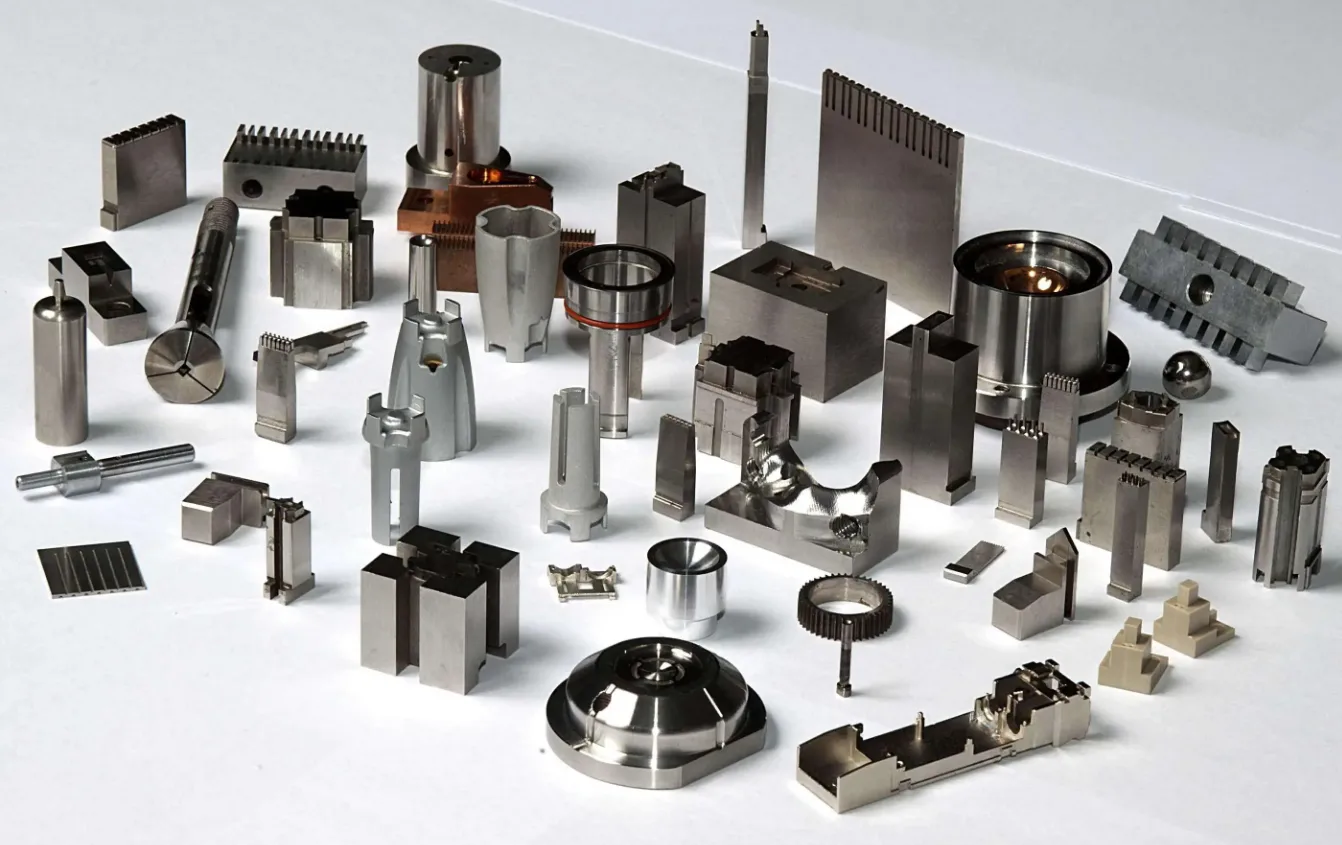
Hastelloy vs Alternative Materials for Machined Components
| Material | Corrosion Resistance Class | Machinability Rating | Typical Machined Part Cost | Best Application |
|---|---|---|---|---|
| 316L Stainless | Moderate | Very Good (80%) | Baseline (1.0×) | Non-chloride, mild acid service |
| Duplex 2205 | Good | Good (60%) | 1.3–1.7× | Higher strength; moderate chloride |
| Inconel 625 (N06625) | Very Good | Moderate (35–40%) | 2.5–3.5× | High temp + corrosion combination |
| Hastelloy C276 (N10276) | Outstanding | Moderate-Difficult (25–35%) | 3.5–5.5× | Most aggressive chemical service |
| Hastelloy C22 (N06022) | Outstanding | Moderate-Difficult (25–35%) | 3.5–5.5× | Oxidizing + reducing mixed service |
| Hastelloy X (N06002) | Good (high temp) | Moderate-Difficult (25–30%) | 3.0–5.0× | High temperature structural parts |
| Titanium Grade 2 | Excellent (seawater) | Moderate (35%) | 3.0–4.5× | Seawater; oxidizing acids |
| Zirconium 702 | Outstanding (specific acids) | Difficult (20%) | 8–12× | Hydrochloric and sulfuric acid specialty |
The machinability ratings reflect the relative cutting speed achievable versus free-machining carbon steel at equivalent tool life. Hastelloy alloys at 25–35% machinability rating require adapted tooling and lower cutting speeds, but they are not unmachinability — they are routinely machined to precision tolerances in well-equipped CNC facilities with appropriate process knowledge.
Also read:ASME Hastelloy, AL-6XN Equipment Custom Fabrication OEM Services
What Hastelloy Grades Does MWalloys Machine and What Are Their Key Differences?
MWalloys machines three primary Hastelloy grades that together cover the vast majority of corrosive service requirements. Understanding the differences between these grades is essential for correct component specification.
Hastelloy C276 (UNS N10276) — The Workhorse of Corrosion-Resistant Machined Parts
Hastelloy C276 is the most widely machined Hastelloy grade, accounting for an estimated 60–70% of all Hastelloy CNC machining volume globally. Its 15–17% molybdenum content combined with 14.5–16.5% chromium and 3–4.5% tungsten produces the broadest resistance to pitting, crevice corrosion, and mixed acid environments of any alloy in this cost tier.
Governing specifications for C276 bar (machining starting stock):
- ASTM B574 / ASME SB-574 (bar and rod)
- ASTM B575 / ASME SB-575 (plate, when machining from plate)
C276 is the correct choice when:
- The process fluid contains hydrochloric acid at any concentration above dilute.
- Chloride concentration exceeds 10,000 ppm combined with elevated temperature and stress.
- The service involves hydrogen sulfide (H₂S) combined with chlorides (NACE MR0175 qualified).
- Pitting and crevice corrosion in chloride media has caused failure in other alloys.
- The chemical composition of the process fluid is not fully characterized.
Hastelloy C22 (UNS N06022) — Superior in Oxidizing and Mixed Acid Service
Hastelloy C22 contains more chromium (20–22.5%) than C276 (14.5–16.5%) and tungsten (2.5–3.5%), giving it better resistance to oxidizing acids — particularly nitric acid, mixtures of nitric and hydrofluoric acid (pickling acids), and solutions containing ferric or cupric ions. Its molybdenum content (12.5–14.5%) is slightly lower than C276, meaning C22 is marginally less resistant to pure reducing acid conditions, but the performance difference in most practical service conditions is small.
C22 is preferred when:
- Nitric acid is present at any concentration.
- The process alternates between oxidizing and reducing conditions.
- Wet chlorine or hypochlorite cleaning is part of the service cycle.
- Mixed H₂SO₄ + HNO₃ or H₂SO₄ + HCl environments are involved.
- Pharmaceutical CIP cycles include nitric acid passivation steps.
Hastelloy X (UNS N06002) — High-Temperature Structural Components
Hastelloy X is not selected for aqueous corrosion resistance — it is selected when machined components must maintain structural integrity and oxidation resistance at temperatures from 650°C through 1200°C. The alloy's 20.5–23% chromium provides oxidation resistance in air, while its 8–10% molybdenum provides solid solution strengthening at elevated temperature.
Hastelloy X machined parts are specified for:
- Gas turbine combustor hardware (studs, bolts, brackets machined from bar).
- Industrial furnace internal fixtures and support components.
- Aerospace heat shield attachment hardware.
- High-temperature thermocouple protection tubes.
- Burner nozzle bodies and flame holder components.
Grade Comparison for Machined Component Selection
| Property | Hastelloy C276 | Hastelloy C22 | Hastelloy X |
|---|---|---|---|
| UNS Designation | N10276 | N06022 | N06002 |
| Chromium (%) | 14.5–16.5 | 20–22.5 | 20.5–23 |
| Molybdenum (%) | 15–17 | 12.5–14.5 | 8–10 |
| Tungsten (%) | 3–4.5 | 2.5–3.5 | 0.2–1.0 |
| Iron (%) | 4–7 | 2–6 | 17–20 |
| PREN equivalent | ~73 | ~65 | ~46 |
| Max service temperature (structural) | 371°C (ASME) | 371°C (ASME) | 1177°C |
| Primary corrosion strength | Reducing acids + chloride pitting | Oxidizing + mixed acids | High-temp oxidation resistance |
| ASTM Bar Specification | B574 | B574 | B572 |
| AMS Bar Specification | — | — | AMS 5754 |
| Room temperature UTS (min, MPa) | 690 | 690 | 690 |
| Room temperature YS (min, MPa) | 310 | 310 | 310 |
| Elongation (min, %) | 40 | 45 | 35 |
| Machinability relative rating | 25–35% | 25–35% | 28–38% |
Hastelloy X is slightly more machinable than C276 or C22 because its iron content (17–20%) — much higher than the C-family alloys — reduces the overall alloying element density in the matrix and moderates the work-hardening response compared to the high-Mo C-family grades. This marginal machinability advantage is rarely the primary selection criterion but becomes relevant in complex parts with many machined features where cumulative machining cost is significant.
What Types of Custom Hastelloy Parts Can MWalloys Produce?
MWalloys' CNC machining capability spans a broad range of component types and geometries. The following overview covers the most common Hastelloy machined part categories we produce, along with the specific features and tolerances involved.
Turned Components (CNC Lathe / Turn-Mill Centers)
Turned Hastelloy parts are produced on CNC lathes or multi-axis turn-mill centers from certified round bar stock. The turning process produces cylindrical and conical external profiles, internal bores, threaded features, face grooves, undercuts, and taper angles.
| Turned Part Type | Typical Hastelloy Grade | Key Machined Features | Typical Tolerance |
|---|---|---|---|
| Valve body plugs | C276, C22 | OD profile, seat taper angle, port cross-holes | ±0.013 mm on seats |
| Nozzle inserts | C276 | Internal bore, exit orifice, thread | ±0.025 mm bore |
| Thermocouple protection tubes | C276, X | Precision OD/ID, closed end, surface finish | ±0.05 mm wall uniformity |
| Pump shaft sleeves | C276 | Precision bore, keyway, set screw holes | ±0.013 mm bore |
| Flanged fittings | C276, C22 | Flange face, bore, bolt circle | Per ASME B16.5 |
| Impeller hubs | C276 | Complex internal profile, precision bore | ±0.025 mm |
| Spray nozzles | C276, C22 | Internal spray geometry, orifice | ±0.013 mm orifice |
| Heat exchanger tube plugs | C276 | Precise OD for tube ID interference fit | ±0.013 mm OD |
| Pressure gauge adapters | C276, C22 | NPT threads, hex flats, pressure port | Per ASME B1.20.1 |
| Anchor bolts / studs | X | Thread form, under-head radius, shoulder | Per ASME B18.2.1 |
Milled Components (CNC Machining Centers)
Milled Hastelloy components are produced from plate or rectangular bar stock on 3-axis, 4-axis, or 5-axis CNC machining centers. Milling enables complex prismatic features, pockets, slots, angled surfaces, and contoured geometry that turning cannot produce.
| Milled Part Type | Typical Grade | Complexity Level | Notes |
|---|---|---|---|
| Valve bodies (block style) | C276, C22 | High — multiple bores, threaded ports, flat seats | 4-axis or 5-axis machining |
| Heat exchanger tubesheets | C276, C22 | High — hundreds of precision-bored tube holes | Precision boring with jig boring or CNC bore |
| Reactor baffle plates | C276 | Medium — drilled arrays, edge machining | Tolerance on hole pattern critical |
| Pump casings | C276 | Very High — complex internal volute geometry | 5-axis machining; EDM for internal features |
| Manifold bodies | C276, C22 | High — multiple intersecting bores, ports | 5-axis with precision bore finishing |
| Instrument housings | C276 | Medium — threaded connections, precision faces | Combination turn-mill preferred |
| Agitator blades | C276, C22 | Medium — contoured surface, hub bore | 4-axis for blade contour |
| Orifice plates | C276 | Low-Medium — precision bore, beveled edge | Flatness and bore concentricity critical |
| Filter housings | C276, C22 | High — internal threads, multiple ports | 5-axis preferred |
Complex Multi-Feature Parts (Turn-Mill / 5-Axis)
Modern CNC machining centers with simultaneous 5-axis capability and turn-mill configurations enable production of Hastelloy components that combine turning and milling features in a single setup — reducing the number of part handlings, eliminating repositioning errors, and achieving the tight geometric relationships (concentricity, perpendicularity, profile) that multi-setup machining cannot consistently deliver.
At MWalloys, we use 5-axis machining for:
- Valve bodies with eccentric bores and angled ports.
- Pump impellers with complex three-dimensional blade profiles.
- Manifold blocks with multiple intersecting bores at non-orthogonal angles.
- Subsea connector bodies with precision sealing surfaces and structural features.
- Reactor internal components with complex attachment geometry.
What Makes Hastelloy CNC Machining Technically Different from Standard Alloy Machining?
The machining characteristics of Hastelloy alloys are fundamentally different from carbon steel, aluminum, or even standard 316 stainless steel, requiring significant adaptation of tooling, cutting parameters, machine setup, and process planning. Understanding these differences is the technical foundation for producing precision Hastelloy components reliably and economically.
The Four Core Machining Challenges in Hastelloy
Challenge 1 — Severe Work Hardening:
Hastelloy C276, C22, and X all work-harden rapidly when the cutting tool experiences rubbing rather than clean cutting action. The mechanism is dislocation multiplication and pile-up in the FCC nickel matrix — a process that increases surface hardness to 200–300% of base material hardness within a layer of 0.05–0.3 mm depth at the machined surface. Once this hardened layer forms, the next cutting pass encounters material significantly harder than the original bar, accelerating tool wear and risking tool fracture. The practical implication is that Hastelloy machining requires consistent, positive cutting action with no pausing at depth, no tool rubbing, and no dwelling — every aspect of the CNC program must be reviewed to eliminate any motion that allows the tool to rub rather than cut.
Challenge 2 — Low Thermal Conductivity:
Hastelloy alloys have thermal conductivity values of approximately 10–12 W/m·K at machining temperatures, compared to approximately 50 W/m·K for carbon steel and 170 W/m·K for aluminum. This low thermal conductivity means that cutting heat does not dissipate into the workpiece — it concentrates at the cutting edge and chip interface. Tool tip temperatures in Hastelloy machining reach 600–900°C even at moderate cutting speeds, dramatically accelerating tool wear through diffusion and oxidation mechanisms. High-pressure coolant delivery directly to the cutting zone is the most effective single intervention for managing this heat concentration.
Challenge 3 — High Hot Hardness:
Unlike carbon steel that softens considerably at temperatures above 400°C (which assists chip formation), Hastelloy retains significant hardness and strength at the elevated temperatures generated at the cutting zone. This high hot hardness means the alloy continues to resist deformation throughout the cutting cycle, maintaining abrasive contact with the tool edge even as the tool temperature rises. This property is precisely what makes Hastelloy valuable in high-temperature service — and it is exactly what makes it challenging to machine.
Challenge 4 — Work Hardening in Previously Machined Surfaces:
If a machined Hastelloy surface needs rework — additional material removal from a surface that has been machined in a previous operation — the existing machined surface already has a hardened layer from the previous cutting operation. The rework cutting tool must immediately penetrate this hardened layer, which can cause immediate tool failure if the approach is not adapted. All rework passes on Hastelloy must use sufficient depth of cut to get below the existing work-hardened layer in a single pass, rather than taking a series of light skimming passes that would repeatedly encounter hardened material.
How Work Hardening Differs Between Hastelloy Grades
| Property | Hastelloy C276 | Hastelloy C22 | Hastelloy X | 316L SS (reference) |
|---|---|---|---|---|
| Work hardening rate | Very High | Very High | High | Moderate-High |
| Surface hardness after machining (% of base) | 200–280% | 200–280% | 180–250% | 140–180% |
| Depth of work-hardened layer | 0.1–0.3 mm | 0.1–0.3 mm | 0.05–0.2 mm | 0.05–0.15 mm |
| Built-up edge (BUE) tendency | High | High | Moderate-High | Moderate |
| Chip character | Stringy; continuous; difficult to break | Similar to C276 | Slightly more segmented | Segmented, easier to break |
| Tool wear mechanism | Abrasion + diffusion | Abrasion + diffusion | Abrasion + diffusion | Primarily abrasion |
| Recommended insert geometry | Positive rake, sharp edge | Positive rake, sharp edge | Positive rake, sharp edge | Neutral to positive rake |
What Cutting Parameters and Tooling Work Best for Hastelloy C276, C22, and X?
Optimized cutting parameters for Hastelloy machining balance tool life, surface quality, dimensional accuracy, and machining productivity. The parameters below reflect current best practice in 2026 based on tooling manufacturer recommendations and validated production experience.
Turning Parameters for CNC Machined Hastelloy Parts
| Operation | Insert Grade | Cutting Speed (SFM) | Feed (IPR) | Depth of Cut (in) | Coolant Pressure (bar) |
|---|---|---|---|---|---|
| Rough turning — C276/C22 | PVD coated carbide (KC5025 or equivalent) | 25–55 | 0.010–0.020 | 0.080–0.200 | 70–100 bar (high pressure) |
| Finish turning — C276/C22 | TiAlN PVD sharp edge | 55–110 | 0.004–0.010 | 0.015–0.040 | 70–100 bar |
| Rough turning — Hastelloy X | PVD coated carbide | 30–65 | 0.010–0.020 | 0.080–0.200 | 70–100 bar |
| Finish turning — Hastelloy X | TiAlN coated carbide | 65–130 | 0.004–0.010 | 0.015–0.040 | 70–100 bar |
| Parting / grooving | Uncoated fine-grain carbide | 20–40 | 0.003–0.007 | Full width groove | Flood + directed jet |
| Threading (single point) | Sharp TiAlN insert | 15–30 | Per thread pitch | Multiple passes | Flood |
| Boring (internal turning) | Positive rake boring bar | 25–55 | 0.005–0.012 | 0.030–0.100 | Through-tool coolant preferred |
Milling Parameters for CNC Machined Hastelloy Components
| Operation | Tool Type | Cutting Speed (SFM) | Feed per Tooth (in) | Axial DOC | Radial DOC | Coolant |
|---|---|---|---|---|---|---|
| Rough face milling — C276/C22 | TiAlN coated indexable | 20–45 | 0.002–0.006 | 0.050–0.150 | 50–75% of cutter D | High-pressure flood |
| Finish face milling — C276/C22 | PVD sharp edge, wiper inserts | 45–90 | 0.001–0.004 | 0.005–0.020 | Full width | High-pressure flood |
| Slot milling — C276/C22 | Solid carbide 4-flute | 18–40 | 0.001–0.004 | 0.5–1.0× D | 25–50% of slot width | Flood or mist |
| Pocket milling — C276/C22 | Solid carbide, variable helix | 20–45 | 0.001–0.003 | 0.3–0.8× D | 50% of cutter D | High-pressure flood |
| Rough milling — Hastelloy X | TiAlN indexable | 25–55 | 0.002–0.006 | 0.050–0.150 | 50–75% | Flood |
| Finish milling — Hastelloy X | TiAlN solid carbide | 55–110 | 0.001–0.003 | 0.005–0.020 | Full | Flood |
| Profile milling (5-axis) — any grade | Ball nose solid carbide TiAlN | 15–35 | 0.001–0.003 per tooth | Per tool spec | 40–60% of ball D | High-pressure flood |
Drilling Parameters for Hastelloy
Drilling in Hastelloy is one of the most challenging operations because the drill geometry creates a situation where the cutting zone cannot be effectively cooled and work hardening builds in the hole bottom as drilling progresses.
| Drill Type | Cutting Speed (SFM) | Feed (IPR) | Peck Cycle | Coolant | Notes |
|---|---|---|---|---|---|
| Solid carbide drill (through-coolant) | 15–30 | 0.002–0.006 | Every 1× D | Through-spindle, high pressure | Best choice for all diameters |
| HSS-Co M42 drill | 8–18 | 0.002–0.005 | Every 0.5× D | Flood | Lower cost; shorter tool life |
| Indexable insert drill | 20–40 | 0.004–0.009 | Every 2× D (large dia) | High-pressure flood | For diameters above 25 mm |
| Carbide tipped gun drill | 15–25 | 0.001–0.003 | Continuous | Through-tool high pressure | Deep holes; excellent straightness |
The peck cycle — lifting the drill out of the hole to break the chip and allow coolant access to the cutting zone — is essential for Hastelloy drilling. Without pecking, long stringy chips pack in the flute, block coolant, cause catastrophic work hardening at the hole bottom, and frequently result in drill breakage. Through-spindle coolant delivered at 70–100 bar directly to the drill tip is the most effective approach for controlling heat and chip evacuation in Hastelloy drilling.
Tapping and Threading Hastelloy
| Thread Type | Method | Speed | Fluid | Success Rate Notes |
|---|---|---|---|---|
| Internal threads (M3–M16) | Spiral flute tap, HSS-Co | 6–12 SFM | Neat cutting oil | Spiral flute preferred; evacuates chips upward |
| Internal threads (M16+) | Single-point boring bar | 15–25 SFM | Flood coolant | Single-point avoids tap breakage in hard alloy |
| External threads (all sizes) | Single-point CNC threading | 15–30 SFM | Flood coolant | Multiple passes (minimum 6–8 passes) |
| Thread milling (internal) | Solid carbide thread mill | 20–40 SFM | High-pressure flood | Most reliable for critical threads |
Thread milling — using a rotating solid carbide thread mill interpolated in a helical path — is increasingly the preferred method for internal threads in Hastelloy. Unlike tapping, thread milling uses the same approach as milling operations, enabling high-pressure through-tool coolant delivery and avoiding the catastrophic tool breakage that occurs when standard taps fail in Hastelloy after work hardening in the hole.
What Dimensional Tolerances and Surface Finishes Are Achievable in Machined Hastelloy?
Understanding the achievable tolerances and surface finishes in Hastelloy CNC machining is essential for engineers writing part drawings and procurement managers evaluating whether a supplier's claimed capabilities match the drawing requirements.
Dimensional Tolerance Capabilities for Machined Hastelloy Parts
| Feature Type | Standard Tolerance | Tight Tolerance | Precision Tolerance | Notes |
|---|---|---|---|---|
| Turned OD (diameter) | ±0.05 mm (±0.002") | ±0.025 mm (±0.001") | ±0.013 mm (±0.0005") | Precision requires controlled temperature |
| Bored ID (diameter) | ±0.05 mm (±0.002") | ±0.025 mm (±0.001") | ±0.013 mm (±0.0005") | Through-tool coolant improves bore quality |
| Linear dimensions | ±0.10 mm (±0.004") | ±0.05 mm (±0.002") | ±0.025 mm (±0.001") | Depends on part temperature stability |
| Thread pitch diameter | per 2B/2A class | per 3B/3A class | per 3B/3A class | Hastelloy taps to 3B/3A achievable |
| Flatness | 0.10 mm/100 mm | 0.025 mm/100 mm | 0.010 mm/100 mm | Ground surfaces achieve tightest flatness |
| Roundness (cylindricity) | 0.025 mm | 0.013 mm | 0.005 mm | Requires rigid workholding |
| Concentricity | 0.05 mm TIR | 0.025 mm TIR | 0.010 mm TIR | Turn-mill single setup improves concentricity |
| Perpendicularity | 0.05 mm/100 mm | 0.025 mm/100 mm | 0.010 mm/100 mm | Machine geometric accuracy critical |
| Position of holes (true position) | ±0.05 mm | ±0.025 mm | ±0.013 mm | Hastelloy thermal expansion must be controlled |
| Angularity | ±0.1° | ±0.05° | ±0.02° | 5-axis machining for compound angles |
Surface Finish Achievable in Machined Hastelloy
| Machining Operation | Typical Ra Achievable | Notes |
|---|---|---|
| Rough turning | 3.2–6.3 µm (125–250 µin) | Tool entry and exit marks; acceptable for non-critical surfaces |
| Standard finish turning | 0.8–1.6 µm (32–63 µin) | Sharp insert, wiper edge geometry, correct feed |
| Fine finish turning | 0.4–0.8 µm (16–32 µin) | Wiper insert, light feed, rigid setup, fresh insert |
| Standard face milling | 1.6–3.2 µm (63–125 µin) | Standard insert; adequate for most flange faces |
| Fine face milling (wiper) | 0.4–0.8 µm (16–32 µin) | Wiper geometry inserts; tight spindle |
| Boring (fine finish) | 0.4–0.8 µm (16–32 µin) | Correct boring bar rigidity; sharp insert |
| Grinding (external OD) | 0.1–0.4 µm (4–16 µin) | CBN or alumina wheel; heavy flood coolant |
| Lapping / honing | 0.025–0.1 µm (1–4 µin) | Valve seats; precision bore finishing |
| Electropolishing | Less than 0.5 µm (20 µin) | Pharmaceutical parts; measured after EP |
For pharmaceutical equipment components (reactor internals, valve bodies, spray balls), electropolishing to Ra below 0.4 µm is frequently specified to comply with ASME BPE surface finish categories and FDA cGMP surface roughness requirements for product contact surfaces. MWalloys coordinates electropolishing with qualified EP service providers after mechanical machining is complete, with Ra measurement certificates included in the final part documentation package.
How Does Material Condition Affect Hastelloy Machinability and Part Quality?
The heat treatment condition of the Hastelloy starting stock — specifically whether it is in the solution annealed condition or has received additional cold work — significantly affects machining behavior, achievable surface finish, and dimensional stability of the finished part.
Solution Annealed vs Cold Drawn Hastelloy Bar for Machining
| Property | Solution Annealed Bar | Cold Drawn Bar | Impact on Machining |
|---|---|---|---|
| Hardness (typical) | 90–96 HRB (Brinell 190–210) | 96–100 HRB (Brinell 210–240) | Cold drawn harder — faster tool wear |
| Yield strength (typical) | 310–380 MPa (45–55 ksi) | 415–550 MPa (60–80 ksi) | Higher cutting forces in cold drawn |
| Elongation | 40–55% | 25–35% | Solution annealed more ductile |
| Work hardening rate | Very High | High | Solution annealed work-hardens faster from lower starting hardness |
| Machinability | Moderate-Difficult | Slightly more difficult | Solution annealed generally preferred |
| Dimensional stability | Excellent (stress relieved) | Moderate (residual stress from drawing) | Solution annealed preferable for precision parts |
| Surface finish achievable | Excellent | Good | Solution annealed produces better finish |
| Starting bar diameter tolerance | Per AMS 2241 / ASTM tolerance | Tighter than annealed | Cold drawn has tighter OD tolerance |
For precision CNC machined Hastelloy components, solution annealed bar is strongly preferred as the starting material. The lower initial hardness provides better machinability, the absence of residual drawing stress eliminates distortion during machining, and the higher ductility produces better surface finish with less tendency for tearing at cut edges. Cold drawn bar is sometimes used when the tight OD tolerance reduces the amount of material that must be removed to reach finish diameter, but this advantage must be weighed against the machining disadvantages.
Grain Size Effect on Machined Surface Quality
The grain size of Hastelloy starting material — controlled by the solution anneal temperature and time — affects the quality of machined surfaces, particularly in finishing operations and grinding.
| Grain Size (ASTM) | Typical Starting Material | Effect on Machined Surface |
|---|---|---|
| ASTM 3–4 (coarse) | Hot-rolled heavy bar; some plate | Slightly rougher finish; potential for surface tear in fine cuts |
| ASTM 5–6 (medium) | Standard hot-rolled and annealed bar | Good machinability; standard surface finish |
| ASTM 7–8 (fine) | Cold-drawn and annealed; precision bar | Best surface finish; finest detail; preferred for pharmaceutical parts |
| ASTM 9+ (very fine) | Special processing; thin strip | Excellent surface finish; highest machinability within Hastelloy class |
For pharmaceutical-grade Hastelloy machined components where electropolishing will follow machining, fine grain size (ASTM 7–8) starting material produces more uniform electropolished surfaces with less grain boundary highlighting — an important aesthetic and functional characteristic for drug synthesis equipment where visible grain boundaries in EP surfaces can be misinterpreted as corrosion during regulatory inspection.
Which Industries Order Custom CNC Machined Hastelloy Parts from MWalloys?
The industries that regularly specify CNC machined Hastelloy components are precisely those where corrosion failure of standard alloy parts has imposed unacceptable operating and maintenance costs.
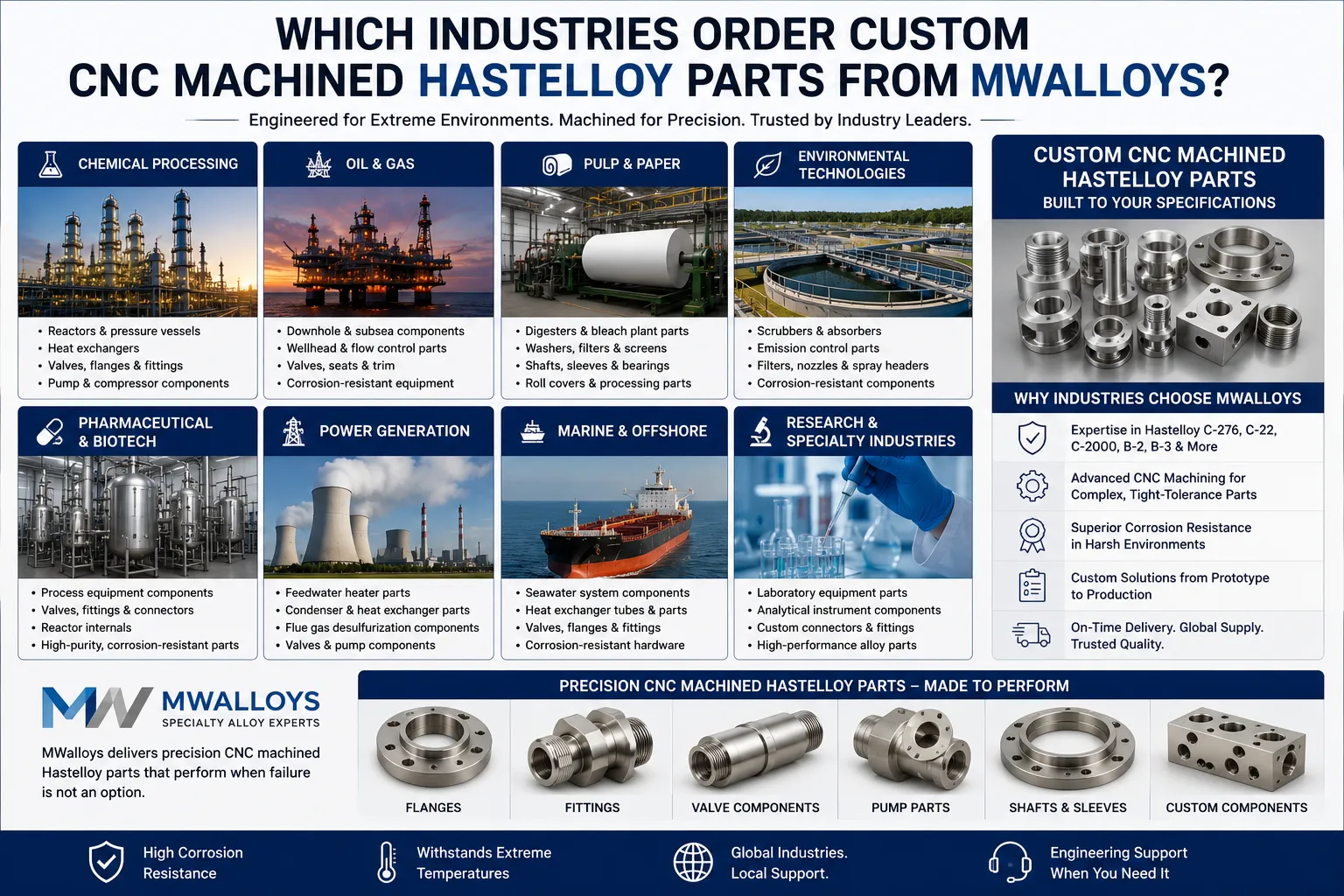
Chemical Processing Industry — The Largest Market for Machined Hastelloy Parts
Chemical plants handling hydrochloric acid, sulfuric acid, mixed acid streams, and chlorinated compounds specify Hastelloy machined components throughout their process equipment. The most commonly ordered machined parts in this sector include:
- Valve bodies and internals: Ball valves, globe valves, check valves with Hastelloy C276 bodies, seats, stems, and trim components machined to exact dimensional specifications.
- Pump components: Impellers, wear rings, shaft sleeves, stuffing box covers machined from C276 for acid transfer pumps in HCl or mixed acid service.
- Pressure vessel nozzles and fittings: Custom nozzle forgings machined to exact bore and flange face dimensions, O-ring groove geometry, and nozzle neck length.
- Agitator components: Impeller hubs, shaft couplings, baffle attachment brackets machined from C276 bar for reactors handling corrosive process media.
- Heat exchanger components: Tubesheets, floating head covers, pass partition plates machined from C276 plate for acid coolers and condensers.
Oil, Gas, and Subsea Applications
Offshore production and subsea systems specify machined Hastelloy components where the combination of H₂S, CO₂, chlorides, and elevated pressure-temperature creates conditions that eliminate standard carbon steel and even duplex stainless from consideration.
| Part Type | Hastelloy Grade | Application | Key Feature Requirements |
|---|---|---|---|
| Downhole safety valve components | C276 | SSSV trim and seats | Tight bore tolerances; smooth seat surfaces |
| Subsea connector bodies | C276, C22 | Hydraulic and gas connections | Multiple precision bores; sealing face Ra less than 0.8 µm |
| Wellhead valve trim | C276 | Sour gas wellhead control | NACE MR0175 hardness compliance |
| Chemical injection check valves | C276 | Methanol, scale inhibitor injection | Precision ball seats; small orifice geometry |
| Instrument manifold bodies | C276, C22 | Pressure measurement in sour service | Multiple threaded ports; pressure ratings to 1,000 bar |
| BOP locking mechanisms | C276 | Blowout preventer subsea actuation | Complex geometry; tight tolerances on locking surfaces |
Pharmaceutical and Biotechnology Sector
The pharmaceutical sector specifies machined Hastelloy C276 and C22 components for API synthesis reactors, purification columns, and sterile filtration systems where:
- CIP (clean-in-place) cycles use sequential caustic (NaOH), nitric acid (HNO₃), and steam sterilization.
- The active pharmaceutical ingredient synthesis involves chlorinated solvents, acids, or strongly oxidizing reagents.
- FDA cGMP regulations require surface finishes documented to Ra less than 0.5 µm on product contact surfaces.
- Full material traceability from raw material through finished machined part is required for equipment qualification.
Typical pharmaceutical-grade Hastelloy machined parts from MWalloys include: reactor internal baffles and coils, spray ball bodies, sampling valve bodies, dip tube assemblies, and agitator shaft components. All pharmaceutical parts are supplied with electropolished surface finish, Ra measurement certificates, and complete material traceability documentation suitable for IQ/OQ/PQ equipment qualification packages.
Aerospace and Defense Applications
Hastelloy X machined components serve gas turbine engine applications where the combination of high temperature (above 700°C), oxidizing combustion atmosphere, and mechanical load eliminates all iron-based alloys and most other nickel alloys.
- Combustor liner attachment hardware: Bolts, studs, and brackets machined from AMS 5754 certified Hastelloy X bar.
- Thermocouple protection tubes: Precision turned from Hastelloy X bar with close wall thickness tolerance (±0.1 mm) and smooth bore finish (Ra less than 1.6 µm).
- Flame holder attachment brackets: Complex milled components with multiple bolt patterns and precise mounting surface flatness.
- Engine test rig structural hardware: Custom fixture components machined from Hastelloy X bar for temperature-controlled engine test cell environments.
How Does MWalloys Ensure Quality and Traceability in Machined Hastelloy Components?
Quality assurance in precision machined Hastelloy components involves multiple independent verification activities from incoming material through final part inspection. The complete quality chain is what separates a reliable Hastelloy machining supplier from a general machine shop that happens to have Hastelloy starting stock.
MWalloys Quality Control Process for Machined Hastelloy Parts
Step 1: Incoming Material Verification:
Every Hastelloy bar or plate received at MWalloys is inspected for dimensional conformance, surface condition, and material identity. We perform 100% Positive Material Identification (PMI) using calibrated XRF spectrometry on every incoming piece, verifying that the elemental composition matches the certified material test report. This step catches material mix-ups that could result in the wrong alloy being machined into a customer's critical component.
Step 2: Material Test Report Review:
The MTR for each Hastelloy heat lot is reviewed against the applicable specification requirements (ASTM B574, B572, or equivalent) before the material is released to production. Non-conforming MTRs — including chemistry out of UNS limits, tensile properties below specification minimums, or missing heat treatment records — result in material quarantine and supplier corrective action before any machining proceeds.
Step 3: First Article Inspection (FAI):
For new part numbers, a complete first article inspection is performed on the first machined piece from each setup, verifying all drawing dimensions, tolerances, geometric controls (GD&T), and surface finish requirements against the customer drawing before production continues. FAI results are documented on a first article inspection report (FAIR) that is retained in the job file.
Step 4: In-Process Dimensional Inspection:
Critical dimensions are measured during machining — not just after — using calibrated digital micrometers, bore gauges, CMM probing (for machining center work), and surface profilometers. This real-time measurement allows immediate correction of tool wear effects before dimensional drift accumulates beyond tolerance.
Step 5: Final Inspection and CMM Verification:
Completed Hastelloy machined parts are inspected on a calibrated coordinate measuring machine (CMM) for all geometric controls, critical dimensions, and datum relationships specified on the customer drawing. CMM inspection reports documenting all measured vs. nominal dimensions are generated and retained.
Documentation Package for Machined Hastelloy Components
| Document | Content | Standard |
|---|---|---|
| Material Test Report (MTR) | Full alloy chemistry, tensile results, heat treatment, heat number | ASTM B574 / B572 / applicable spec |
| PMI Certificate | XRF element analysis confirming UNS designation | Customer requirement |
| First Article Inspection Report | All drawing dimensions measured and recorded | Customer drawing; AS9100 |
| CMM Inspection Report | 3D dimensional verification against CAD model or drawing | GD&T per ASME Y14.5 |
| Surface Finish Certificate | Ra measurement on specified surfaces, calibrated instrument | Per drawing requirement |
| Electropolish Certificate | Post-EP Ra measurement, passivation confirmation | ASME BPE / customer spec |
| Certificate of Conformance | Written declaration of compliance to all specified requirements | Customer requirement |
| NACE MR0175 Hardness Certificate | Measured hardness confirming compliance (when specified) | NACE MR0175/ISO 15156 |
| Country of Origin Declaration | Manufacturing country for import compliance | Customer / regulatory |
| Calibration Records | Reference to current calibration status of measurement instruments | ISO 9001:2015; AS9100 |
MWalloys operates under an ISO 9001:2015 certified quality management system. For aerospace customers requiring AS9100 Rev D compliance, we can coordinate with qualified AS9100 certified machining partners in our supply network. All inspection records are retained for a minimum of 10 years, enabling full traceability recall for any component we have manufactured.
What Is the Lead Time and Ordering Process for Custom Hastelloy Parts?
The ordering process for custom CNC machined Hastelloy components involves several distinct stages, each with specific information requirements that customers can prepare in advance to minimize overall lead time.
Lead Time Components for Custom Machined Hastelloy Parts
| Lead Time Component | Duration | How to Accelerate |
|---|---|---|
| Quotation preparation | 1–2 business days | Provide complete drawing + material specification at inquiry |
| Contract execution | 1–3 days (customer-dependent) | Pre-approved purchase order process |
| Material procurement (stock sizes) | 3–7 business days | MWalloys maintains strategic bar stock in common diameters |
| Material procurement (non-stock) | 10–20 business days | Mill order for non-standard dimensions |
| CNC programming and setup | 2–5 business days for new parts | Provide 3D CAD model (STEP format) with drawing |
| CNC machining — simple parts | 3–7 business days | Standard turning or milling |
| CNC machining — complex parts | 7–20 business days | 5-axis; multiple setups; inspection between operations |
| Inspection and documentation | 2–5 business days | CMM availability; documentation complexity |
| Electropolishing (if required) | 3–7 additional days | Coordinate with EP service provider in parallel |
| Shipping and customs | 1–5 days domestic; 3–10 days international air | Express air freight for urgent orders |
Total typical lead time:
- Simple turned parts from stock bar: 10–18 business days.
- Complex milled components from stock plate: 15–25 business days.
- Multi-feature 5-axis components with non-stock material: 25–35 business days.
- Emergency/AOG (Aircraft on Ground) priority: Contact our team for expedited assessment.
What Information Is Needed to Get an Accurate Quotation
To receive a same-day quotation for custom machined Hastelloy parts, provide the following:
- Part drawing: PDF or DXF (2D) or STEP file (3D model preferred) with all dimensions, tolerances, GD&T callouts, and surface finish requirements.
- Material specification: Hastelloy grade (C276, C22, or X) and applicable ASTM/AMS specification.
- Quantity: Number of pieces for this order; indicate if repeat orders are expected.
- Delivery requirement: Required delivery date or acceptable lead time.
- Special requirements: NACE compliance, ASME BPE, electropolish, specific documentation.
- Shipping destination: Country and city for freight cost estimation.
MWalloys Global Supply and CNC Machining Service Terms
MWalloys provides precision CNC machined Hastelloy components to customers in more than 55 countries, with supply terms structured to minimize friction for first-time orders and provide maximum flexibility for established production programs.
Service and Commercial Terms
| Term | Details |
|---|---|
| Minimum Order Quantity | None — single prototype parts through multi-thousand piece production runs |
| Standard Lead Time | 10–35 business days depending on part complexity and material availability |
| Rush / Priority Processing | Available — contact team for current availability and premium |
| First Order Payment | T/T: 50% deposit on order confirmation; 50% before shipment |
| Established Accounts | Net 30 days from shipment after credit approval |
| Quotation Validity | 30 days from issuance |
| Engineering Support | DFM (Design for Manufacturability) review at no charge for qualified projects |
| Revision Handling | Drawing revisions accepted up to CNC programming stage without cost penalty |
Shipping and Global Delivery Options
| Method | Transit Time | Best Use |
|---|---|---|
| International Air Express (DHL/FedEx/UPS) | 1–4 days | AOG, emergency replacement, small packages |
| International Air Freight (cargo) | 3–7 days | Moderate weight; standard urgency |
| Ocean Freight (FCL or LCL) | 18–45 days by destination | Large production runs; non-urgent |
| Land Freight — North America | 2–6 days | Domestic US, Canada, Mexico |
| Land Freight — Europe | 3–8 days | European customer delivery |
Available Incoterms: EXW, FCA, FOB, CIF, DAP, DDP — selected to match customer logistics and insurance requirements.
Industries and Regions Served
MWalloys machines and ships Hastelloy custom parts to customers across all major industrial regions:
| Region | Primary Industries Served |
|---|---|
| North America | Chemical, pharmaceutical, oil and gas, aerospace, defense |
| Europe | Chemical OEM, pharmaceutical, offshore, power generation |
| Middle East | Petrochemical, oil and gas, desalination |
| Asia-Pacific | Chemical, semiconductor, pharmaceutical, offshore |
| Latin America | Mining, oil and gas, chemical |
| Australia and New Zealand | Mining, chemical, offshore |
Ready to Order Custom Machined Hastelloy Parts?
Contact MWalloys today with your part drawing or design concept. Our applications engineering team provides same-day quotations for straightforward parts and within 24 hours for complex multi-feature components. We review every drawing for DFM opportunities that reduce machining cost without compromising performance — and we back every shipment with complete material and inspection documentation.
Submit your drawing today. No minimum order. Full certification. Global delivery.
FAQs About CNC Machined Hastelloy Components
1: What is the machinability rating of Hastelloy C276 compared to stainless steel?
Hastelloy C276 has a machinability rating of approximately 25–35% of free-machining carbon steel (AISI 1212 baseline = 100%), compared to approximately 45–55% for 316L stainless steel — meaning C276 requires cutting speeds roughly half those used for 316L to achieve comparable tool life, with proportionally higher tooling costs and longer cycle times for equivalent part geometry. The machinability difference between C276 and 316L stainless stems from three combined mechanisms: C276's higher work-hardening rate (work hardens to 250–280% of base hardness at the cut surface, versus 140–180% for 316L), its lower thermal conductivity (11 W/m·K vs 14–16 W/m·K for 316L, meaning more heat concentrates at the tool tip), and its higher hot hardness (C276 resists deformation at elevated temperature better than 316L). In practical machining cost terms, this translates to Hastelloy C276 machining costs that are typically 2–4 times higher per part than equivalent 316L machined parts of the same geometry, reflecting both slower cutting speeds and faster tooling consumption. MWalloys absorbs this machining complexity through optimized tooling programs, dedicated Hastelloy machining expertise, and efficient batch processing that amortizes setup costs across production quantities — enabling us to provide competitive pricing on machined Hastelloy components that reflects the true cost of correctly producing high-quality parts.
2: Can Hastelloy C276 be machined to the same tolerances as stainless steel?
Yes. Hastelloy C276 can be machined to the same dimensional tolerances as 316L stainless steel, with precision turning tolerances of ±0.013 mm (±0.0005") achievable on CNC lathes with rigid tooling, sharp inserts, and controlled workholding, though achieving these tolerances requires additional process controls not needed for standard stainless machining. The primary tolerance control challenges in Hastelloy machining are: thermal expansion of the workpiece during machining (Hastelloy's lower thermal conductivity causes more localized heating than stainless, requiring stabilization periods between rough and finish operations), and spring-back of the machined surface due to the alloy's high elastic recovery. These challenges are addressed through: allowing thermal equilibration before final dimension measurements, using finish cuts with sufficient depth to get below the work-hardened layer from rough machining, and using CMM measurement at controlled temperature (20°C ±1°C) for final dimensional verification. For standard industrial tolerances (±0.05 mm / ±0.002"), Hastelloy machining is essentially equivalent to stainless steel machining in achievability. For precision tolerances (±0.013 mm / ±0.0005"), the additional process controls add cost and cycle time but the tolerance is fully achievable in well-equipped CNC facilities with Hastelloy-specific process knowledge.
3: What is the best coolant strategy for CNC machining Hastelloy?
High-pressure through-tool coolant delivered at 70–140 bar (1,000–2,000 psi) directly to the cutting zone is the most effective coolant strategy for Hastelloy CNC machining, reducing tool tip temperature by 150–250°C compared to standard flood coolant and extending carbide insert life by 40–80% in typical turning and milling operations. The fundamental reason high-pressure coolant is so effective for Hastelloy is the alloy's low thermal conductivity (10–12 W/m·K), which traps cutting heat at the tool tip rather than dissipating it into the workpiece. Standard flood coolant applied at low pressure cannot penetrate the chip-tool contact zone effectively, particularly in turning operations where the chip is in intimate contact with the insert rake face. High-pressure coolant forcibly breaks the thermal boundary layer between chip and insert, dramatically reducing the diffusion wear mechanism that is responsible for most of the accelerated tool wear in Hastelloy machining. For CNC lathes and machining centers without integral high-pressure coolant pumps, external high-pressure coolant units providing 70+ bar can be retrofitted and directed at the cutting zone through targeted nozzles. In the absence of high-pressure capability, minimum-quantity lubrication (MQL) with sulfur-free cutting oil can improve tool life compared to dry machining, but MQL does not approach the effectiveness of high-pressure coolant for Hastelloy in sustained production machining.
4: Does Hastelloy C276 need heat treatment after CNC machining?
In most applications, CNC machined Hastelloy C276 components do not require heat treatment after machining — the solution annealed starting material maintains its certified corrosion resistance throughout the machining process provided surface contamination from tooling, coolant, and workholding is properly cleaned before service. The corrosion resistance of Hastelloy C276 derives from the solid solution distribution of chromium and molybdenum in the nickel matrix, which is established by the solution anneal heat treatment performed by the mill before shipping and is not altered by the cold working imposed during machining. However, there are specific situations where post-machining heat treatment is recommended or required: when components have been significantly cold worked during aggressive roughing operations (more than 15% local cold work) that will be exposed to chloride stress corrosion conditions in service, a stress relief anneal at 1100–1150°C followed by rapid quench restores full corrosion resistance; for pharmaceutical equipment components where electropolishing will follow machining, no additional heat treatment is needed before EP; and for components that will be welded after machining, a post-weld solution anneal is recommended per standard Hastelloy welding practice. MWalloys advises on post-machining heat treatment requirements based on the specific part application and service environment — contact our technical team with your service conditions for a specific recommendation.
5: What surface finish is required for machined Hastelloy pharmaceutical parts?
Pharmaceutical-grade machined Hastelloy components for product contact surfaces typically require Ra less than or equal to 0.5 µm (20 µin) after electropolishing, corresponding to ASME BPE surface finish category SF4, though specific requirements vary by application and regulatory jurisdiction — with some sterile manufacturing applications requiring Ra less than or equal to 0.25 µm (10 µin) per SF6 category. ASME BPE (Bioprocessing Equipment Standard) establishes six surface finish categories (SF1 through SF6) based on Ra value ranges and whether the surface has been mechanically polished only or electropolished. For most API synthesis reactors and fermentation vessels in Hastelloy C276, the standard pharmaceutical industry requirement is SF4 (Ra ≤ 0.51 µm) or SF6 (Ra ≤ 0.25 µm) with electropolished finish. The mechanical machining that precedes electropolishing should achieve Ra of 0.8–1.6 µm (matching ASME BPE SF2 or SF3), as electropolishing typically improves surface roughness by 30–50% from the pre-polished condition. MWalloys coordinates the complete pharmaceutical surface finish sequence: precision CNC machining to Ra 0.8–1.6 µm, electropolishing by a qualified EP service provider, Ra measurement with calibrated profilometer, and passivation per ASTM A967. All Ra measurement certificates are included in the documentation package provided with pharmaceutical machined components.
6: What is the difference between machined Hastelloy C276 and C22 parts in chemical service?
The primary difference between machined Hastelloy C276 and C22 components in chemical service is that C276 provides superior resistance to reducing acids and pure chloride pitting (with 15–17% Mo and calculated PREN ~73), while C22 provides better resistance to oxidizing acids and mixed acid environments (with 20–22.5% Cr and PREN ~65) — with the correct grade selection depending entirely on whether the process chemistry is primarily reducing, oxidizing, or alternates between both conditions. In purely reducing acid service — concentrated hydrochloric acid, dilute sulfuric acid without oxidizing contamination, or HF acid — C276's higher molybdenum content provides the better corrosion resistance, and machined C276 components will outlast C22 components in this service. In oxidizing acid service — nitric acid, ferric chloride solutions, hypochlorite-containing CIP fluids, or oxidizing mixed acids — C22's higher chromium content makes it superior, and machined C22 components provide better service life. For processes that alternate between reducing and oxidizing conditions — pharmaceutical synthesis with different acid catalysts in sequential steps, or chemical plants with variable feedstock composition — either C22 or Hastelloy C-2000 (N06200, which combines C276-level Mo with C22-level Cr plus copper addition) may be the better single-alloy solution. MWalloys provides application-specific alloy selection guidance based on your process chemistry data at no charge for qualified projects.
7: Can MWalloys machine Hastelloy parts to ASME B16.5 flange dimensions?
Yes, MWalloys machines Hastelloy C276, C22, and X flanges and flanged components to full ASME B16.5 dimensional requirements in pressure Class 150 through Class 2500, from 1/2" NPS through 24" NPS, typically starting from ASTM B564 forged Hastelloy blanks that are machined to the precise bore, facing, and bolt circle dimensions required by the applicable pressure class and pipe schedule. ASME B16.5 specifies the overall flange dimensions, raised face dimensions, bolt circle diameters, bolt hole quantity and diameter, and minimum bore sizes for each pressure class and pipe size combination. Machining Hastelloy forgings (ASTM B564, UNS N10276 or N06022) to B16.5 compliance involves: boring the pipe bore to the specified diameter with Ra less than 1.6 µm (63 µin) or per customer requirement; facing the flange face to the specified raised face height and Ra less than 3.2 µm; drilling and reaming the bolt holes to position tolerances of ±0.5 mm for bolt circle diameter and ±0.25 mm for individual hole position; and finishing all exterior surfaces to clean, burr-free condition. Full dimensional inspection to ASME B16.5 tolerances is performed and documented on every flange. Flanges intended for use with ASME pressure vessels (ASME SB-564 designation) carry the appropriate certification documentation including forging MTR, machining dimensional report, and PMI verification.
8: How does MWalloys handle Hastelloy parts that require both machining and welding?
MWalloys coordinates machined Hastelloy component fabrication that involves both CNC machining and welding through an integrated production workflow where weld preparation features (joint bevels, backweld grooves, fit-up surfaces) are machined first, qualified welds are performed by ASME Section IX qualified welders using ERNiCrMo-4 (C276) or ERNiCrMo-10 (C22) filler, and final precision machining of weld-affected dimensions is performed after any required post-weld annealing. The production sequence for Hastelloy components requiring both operations must account for the fact that welding may introduce dimensional distortion that affects subsequently machined features — particularly in thin-wall sections or in components where multiple welds are in close proximity. Our standard approach sequences operations to minimize weld distortion impact on precision features: machine non-critical features first; perform all welding; perform post-weld heat treatment if required by the application; allow complete thermal stabilization; then complete final precision machining of critical dimensions (bores, seats, mating faces) that must be held to tight tolerances. For components like reactor nozzle assemblies that require welding of the nozzle flange to a machined vessel shell nozzle, we machine the nozzle bore and flange face after welding to ensure these critical dimensions reference the actual as-welded assembly rather than the pre-weld individual components. Contact our engineering team with combined machining-welding requirements for project-specific sequence planning.
9: What is the minimum wall thickness achievable in a machined Hastelloy C276 tube or sleeve?
Machined Hastelloy C276 tubes and sleeves can be produced with minimum wall thicknesses of approximately 1.5–2.0 mm for OD diameters below 50 mm and 2.5–3.0 mm for diameters in the 50–150 mm range, with thinner walls achievable in precision turning with dedicated workholding and vibration damping for parts where pressure containment is not a primary function. The minimum wall thickness in machined Hastelloy is governed by two competing constraints: mechanical rigidity during the machining operation (thin walls deflect under cutting forces, causing dimensional error and vibration) and the residual mechanical properties required for the intended service loading. For parts that carry internal pressure (thermocouple protection tubes in pressure service, instrument connection sleeves), wall thickness must be calculated per ASME Section VIII or ASME B31.3 using the allowable stress for C276 at the design temperature. For non-pressure-containing covers, protective tubes, or alignment bushings, wall thickness can be reduced to the mechanical minimum that the machining operation can reliably produce with controlled tolerance. Very thin walls (below 1.5 mm in Hastelloy) typically require specialized fixturing, intermediate support during machining, vibration-damping toolholders, and reduced cutting speeds to manage workpiece deflection and vibration. MWalloys evaluates wall thickness feasibility as part of the DFM review on all new part numbers — contact our engineering team with your minimum wall thickness requirement for a specific assessment.
10: Does MWalloys provide Hastelloy machined parts with NACE MR0175 compliance documentation?
Yes. MWalloys provides NACE MR0175/ISO 15156 Part 3 compliance documentation for machined Hastelloy C276 (N10276), C22 (N06022), and X (N06002) components, confirming that each part's measured hardness is below the 40 HRC maximum specified for these alloys in H₂S sour service environments, with hardness test certificates issued as part of the standard documentation package for all sour-service-specified orders. NACE MR0175/ISO 15156 Part 3 qualifies all three Hastelloy grades for use in environments containing H₂S when maintained in the solution annealed condition with hardness below 40 HRC. Properly solution annealed Hastelloy C276, C22, and X typically measure 90–96 HRB (approximately 20–22 HRC equivalent), providing substantial margin below the 40 HRC ceiling without any special processing. For machined Hastelloy parts in sour service, MWalloys performs Rockwell hardness testing on representative production parts from each lot using NIST-traceable calibrated instruments, records the measured hardness values on a separate hardness certificate, and includes a written NACE MR0175 compliance statement in the documentation package. For critical downhole or subsea components where hardness is particularly important — valve trim in H₂S service, downhole tool components, subsea connector bodies — we can perform hardness testing on every individual machined part and provide individual piece hardness certification. Specify "NACE MR0175 documentation required" in your purchase order to trigger this documentation automatically.
Verifiable References
The following sources were consulted in preparing this technical article and are independently verifiable:
- Haynes International. Hastelloy C-276 Alloy Machining Data Sheet. Haynes International, Kokomo, IN.
- Haynes International. Hastelloy C-22 Alloy Technical Data (H-2052D). Haynes International, Kokomo, IN.
- Haynes International. Hastelloy X Alloy Data Sheet (H-3009C). Haynes International, Kokomo, IN.
- ASTM International. ASTM B574: Standard Specification for Low-Carbon Nickel-Chromium-Molybdenum Alloy Rod. ASTM International, West Conshohocken, PA.
- SAE International. AMS 5754: Nickel Alloy, Bars, Rods, and Wire, 47Ni-22Cr-18Fe-9Mo (Hastelloy X), Solution Annealed. SAE International, Warrendale, PA.
- ASME International. ASME BPE: Bioprocessing Equipment Standard — Surface Finish Requirements. ASME, New York, NY. Current Edition.
- ASME International. ASME Y14.5: Dimensioning and Tolerancing (Geometric Dimensioning and Tolerancing). ASME, New York, NY. 2018 Edition.
- NACE International / ISO. NACE MR0175 / ISO 15156-3: Petroleum and Natural Gas Industries — Materials for Use in H₂S-Containing Environments, Part 3. NACE International, Houston, TX.
- Kennametal Inc. Machining Nickel-Based Superalloys: Application and Process Data. Kennametal, Latrobe, PA.
- Sandvik Coromant. Machining Nickel-Based Alloys: Tooling Recommendations and Cutting Data. Sandvik Coromant, Sandviken, Sweden.
- ASTM International. ASTM A967: Standard Specification for Chemical Passivation Treatments for Stainless Steel Parts. ASTM International, West Conshohocken, PA.
- Machining Data Handbook, 3rd Edition. Machinability Data Center, Cincinnati, OH. (Machinability ratings and cutting data for nickel-based superalloys)
- Davis, J.R. (Editor). Nickel, Cobalt and Their Alloys (ASM Specialty Handbook). ASM International, Materials Park, OH, 2000. ISBN: 0-87170-685-7
- ISO 9001:2015. Quality Management Systems — Requirements. International Organization for Standardization, Geneva, Switzerland.
- SAE International. AS9100 Rev D: Quality Management Systems — Requirements for Aviation, Space, and Defense Organizations. SAE International, Warrendale, PA.