
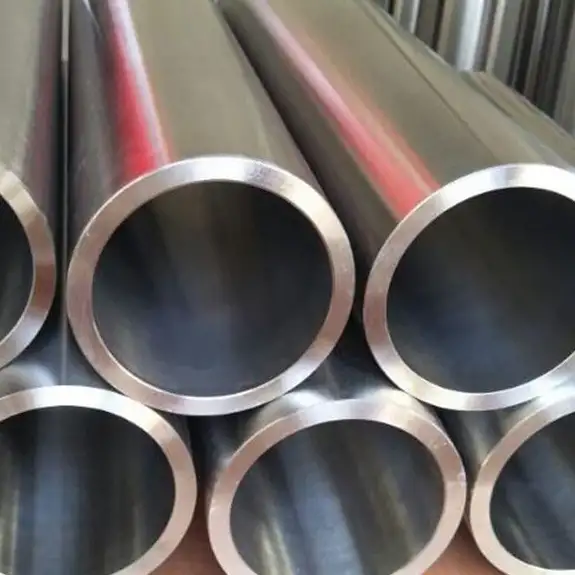
Super 2507 (UNS S32750, often sold under trade names such as SAF-2507) is a super-duplex stainless steel offering very high strength and outstanding resistance to pitting, crevice corrosion and chloride stress-corrosion cracking, making it an excellent choice for demanding seawater, oil & gas, chemical and desalination pipework. For many aggressive environments it replaces expensive nickel alloys while allowing thinner-walled, lighter pipe designs. MWAlloys supplies factory-priced, ready-stock Super 2507 seamless pipe with fast turnaround from China for global projects.
What is 2507 super duplex?
Super 2507 is a super-duplex stainless steel designed so that, when produced and handled correctly, it combines a roughly 50/50 ferrite–austenite microstructure with elevated chromium (~25%), molybdenum (~4%), nickel (~7%) and nitrogen (≈0.24–0.30%). The alloy achieves PREN values > 40, which translates into significantly better resistance to localized corrosion than standard 300-series austenitics and even conventional duplex grades (for example 2205). For pipework where chloride exposure, high mechanical loads, or thin-wall design are decisive, 2507 seamless pipe is often the most cost-effective materials selection.
Chemical composition & microstructure
Super 2507 is commonly specified to the UNS S32750 designation (EN 1.4410). Typical nominal composition ranges are shown below.
| Element | Typical % range (nominal) |
|---|---|
| Chromium (Cr) | 24.0 – 26.0 |
| Nickel (Ni) | 6.0 – 8.0 |
| Molybdenum (Mo) | 3.0 – 4.5 |
| Nitrogen (N) | 0.20 – 0.30 |
| Manganese (Mn) | ≤ 2.0 |
| Carbon (C) | ≤ 0.03 |
| Iron (Fe) | Balance |
Microstructure: duplex steels are dual-phase: an austenitic (face-centered cubic) and a ferritic (body-centered cubic) matrix approximately in equal proportion. This balance produces high yield strength and good toughness while retaining corrosion resistance. For commercial SAF/2507 materials the manufacturer-controlled chemistry (especially nitrogen) is critical to reach the target PREN and mechanical properties.
Mechanical properties & design advantages
Typical mechanical performance (indicative, full supplier datasheets must be consulted for certs and exact sizes):
-
Yield strength (0.2% proof): often ~450–550 MPa (varies with product form and heat treatment)
-
Tensile strength: typically ~800–1000 MPa
-
Elongation: generally 20–25% (depending on wall thickness and cold-work)
-
Density & thermal properties: density similar to other stainless steels; lower coefficient of thermal expansion than austenitic grades.
Because of higher strength, designers can use thinner walls for the same pressure rating — a direct weight and material-cost saving in pipelines and pressure systems. Superduplex also delivers good fatigue resistance and usable service temperatures up to roughly 250–300°C for long term, with short-term exposure possible at higher temperatures (check supplier limits).
Corrosion performance: PREN, pitting, crevice and SCC
The Pitting Resistance Equivalent Number (PREN) is commonly used to compare resistance to chloride pitting. A widely used formula is:
PREN = %Cr + 3.3 × %Mo + 16 × %N (tungsten adjustments exist where W is present). For typical 2507 chemistry PREN values exceed 40, placing 2507 well above common austenitic grades (e.g., 316L PREN ≈ 25). This high PREN explains the superior pitting and crevice corrosion resistance in seawater and chloride-bearing environments.
Stress Corrosion Cracking (SCC): duplex and super-duplex grades are far more resistant to chloride SCC than austenitics because of ferrite content and nitrogen strengthening, however SCC can still occur above certain temperatures and potentials — so material selection must consider temperature, chloride activity, and environmental control.
Practical note: localized corrosion risk depends on metallurgy, weld quality, manufacture, surface finish and environment; achieving full resistance demands correct heat control during forming and welding, and often post-weld solution anneal or specified duplex-preserving procedures.
Manufacturing standards, product forms and test protocols
Common standards and norms for super-duplex pipe and tubing (non-exhaustive):
-
ASTM A789/A790 (seamless and welded stainless steel pipe and tube for high-temperature/pressure service) — commonly used for duplex grades including 2507.
-
EN 10216-5, EN 10217 / EN 10297 (European seamless/welded pressure pipe standards) and EN steel number 1.4410 for S32750/SAF-2507.
-
UNS designation: S32750; trade names include SAF-2507, ZERON®100 (S32760 is another super duplex variant).
Testing / deliverables: typical requirements for supply include chemical analysis, mechanical testing (tensile, hardness), PMI (positive material identification) if requested, NDE (RT/UT) for pressure piping, flattening/expandability tests for tube, hydrostatic testing, and mill certificates (3.1/3.2) to EN/EN-equivalent standards.
Seamless pipe production, welding and fabrication notes
Seamless manufacture: Super 2507 seamless pipe is produced by hot-working billets or extrusion followed by heat-treatment to preserve the duplex balance. Seamless pipe retains advantage where full rotational symmetry and no weld seam are required (sour service or high pressure). Seamless products command premium manufacturing controls and inventory.
Welding: 2507 can be welded using matching or filler metals designed for duplex super grades. Key practices:
-
Use qualified duplex filler wires to maintain corrosion resistance and phase balance in HAZ.
-
Control heat input to avoid sigma-phase or intermetallic formation (these reduce toughness and corrosion resistance).
-
Post-weld heat treatment is rarely used on site; instead, welding procedures aim to preserve duplex structure — pre-qualified WPS and PWHT controls are essential.
Fabrication caution: avoid prolonged exposure in 300–1000°C where detrimental intermetallic phases may precipitate; if heavy reheating is required, consult mill datasheets.
Typical applications & project examples
Common sectors where Super 2507 seamless pipe is chosen:
-
Offshore oil & gas: risers, umbilicals, subsea manifolds, seawater injection lines
-
Desalination plants: seawater intakes, piping exposed to brine
-
Chemical processing: chloride-bearing process streams, heat exchangers
-
Power and pulp & paper: where chloride or aggressive agents exist
-
Marine valves, fasteners and fittings for high chloride exposure
Why 2507 is selected: when operators need thinner walls for the same pressure rating, combined with high localized corrosion resistance, and where long life without replacement is essential to project economics. Practical case studies from mills document significant life-extension in seawater environments when switching from 316L or 2205 to 2507.
Global price landscape (2025)
Important: alloy stainless prices vary with market metal surcharges (Cr, Mo, Ni), order size, product form, wall thickness, testing requirements and mill lead times. The table below gives indicative range bands based on international supplier listings and stockist quotes in 2025. Use these figures only for early budgetary planning; request firm quotes from MWAlloys for project pricing and freight.
| Region | Typical 2025 indicative price per metric ton (USD) | Notes / drivers |
|---|---|---|
| China (mill/stock) | $2,800 – $6,000 / t | Lower mill premiums, local stock offers; tight sizes or certification increases price. |
| India (stockists / imports) | $3,000 – $7,500 / t | Import duties and logistics can lift landed cost. |
| USA (distributors & mills) | $4,500 – $12,000 / t | Smaller inventories, higher fabrication/testing content and domestic premiums. |
| Europe (mills & stock) | $4,000 – $9,000 / t | Higher QA/inspection, traceability, and freight add to cost. |
| Middle East (project supply) | $3,500 – $8,500 / t | Large projects can negotiate supply contracts; transient marine projects drive demand. |
Why ranges are wide: super-duplex contains Mo and Ni which are price-volatile. Short deliveries, heavy testing (NDT, PMI, 3.1/3.2 certs), or special lengths will increase unit price; large tonnages and long contracting windows reduce it. Market posts in 2025 show Chinese online offers on trading platforms undercutting some western distributors — but make sure mill traceability and testing certificates match your spec.
MWAlloys supply proposition
MWAlloys is a manufacturer and export supplier based in China with a product focus on high-performance alloy pipe and fittings. Our offer for Super 2507 seamless pipe:
-
Factory direct pricing — we supply at 100% factory ex-works prices for mill certificates and standard deliverables.
-
Ready stock & fast delivery — selected sizes held in warehouse; typical stock lead times 3–10 days for common sizes (custom sizes depend on mill and finishing).
-
Custom cut and testing — we provide cut-to-length, hydrostatic testing, PMI and mill 3.1 certificates on request.
-
Global shipping & project support — experience shipping to North America, Europe, Middle East and Asia with customs documentation and export packing.
For project enquiries MWAlloys recommends early material confirmation (design size, wall thickness, test level) so we can lock mill capacity and minimize alloy surcharge exposure.
Selection checklist & specification tips
-
Confirm environment: chloride concentration, temperature, presence of oxidizers or H₂S.
-
Check pressure/temperature rating and choose wall thickness using ASME/EN pipe tables for S32750.
-
Specify standards & certificates: ASTM A789/A790 or EN 10216-5 plus mill 3.1/3.2 as required.
-
For welded systems, specify matching duplex filler and qualified WPS.
-
Ask for PMI, chemical certificate and traceability back to the mill heat number.
-
If in sour service, confirm with metallurgy experts whether additional tests or alternative alloys are needed.
Inspection, certification & traceability
For critical piping, insist on:
-
Mill test certificate (EN 10204 3.1 or equivalent) showing heat number traceability.
-
Positive Material Identification (PMI) or spectrometer report for each lot.
-
NDE: radiography (RT) or ultrasonic testing (UT) for pressure piping welded joints.
-
Mechanical test reports (tensile, hardness) and flatten/expand tests for tubes if called out.
These deliverables are commonly requested on international projects and are essential to assure long service life.
FAQs
1. Is Super 2507 better than 2205?
Yes for localized corrosion resistance and strength. 2507’s higher Cr, Mo and N yields higher PREN (>40) and greater SCC resistance than 2205. But 2507 is more costly and slightly harder to weld — project needs determine the trade-off.
2. Can I use 2507 in seawater piping?
Yes — 2507 is widely chosen for seawater and desalination service thanks to high pitting/crevice resistance. Proper design, weld practice and corrosion allowance are still important.
3. What standards should I specify for seamless 2507 pipe?
Commonly ASTM A789 / A790 for duplex pipe, and EN 10216-5 for European seamless products. Always add required certificate level (e.g., EN 10204 3.1).
4. What typical lead times should I expect?
If in stock, MWAlloys can dispatch common sizes in days; special sizes or certified heat numbers may take weeks depending on mill schedules.
5. Do you recommend matching filler metal for welding?
Yes — use approved duplex filler wires to maintain corrosion resistance and correct microstructure balance in HAZ.
6. What's the maximum service temperature?
Long-term exposure typically limited to ~250–300°C. For continuous elevated temperature consult the mill datasheet.
7. How is PREN calculated and why it matters?
PREN (e.g., Cr + 3.3×Mo + 16×N) predicts pitting resistance. Higher PREN indicates better localized corrosion resistance; 2507 typically exceeds 40.
8. Can 2507 be cold formed?
Yes, but because of high strength and work-hardening, forming requires more force and may need annealing steps depending on bend radius.
9. Are non-destructive tests required for acceptance?
For pressure applications, NDE (RT/UT) is typically required. Always list NDE requirements in the purchase order.
10. How should I procure to minimize cost risk?
Lock quantity and certificates early, consider framework contracts to stabilize alloy surcharge exposure, and ask MWAlloys for a total landed cost quote including testing and freight.
Super 2507 (UNS S32750) offers a compelling mixture of mechanical strength and resistance to localized corrosion for many aggressive fluid systems. When used correctly it reduces maintenance and lifecycle costs versus lower-grade stainless steels and can compete economically with some nickel alloys. MWAlloys can supply 2507 seamless pipe at factory prices, backed by test documentation and rapid stock delivery options — ideal for projects where specification clarity, traceability and budget are priorities. For precise quotes and certified availability please provide size, wall thickness, testing level and delivery port so we can issue a tailored mill-backed offer.