

Austenitic stainless steels, including grades 304, 316, 310, 321, 347, and their low-carbon variants, are the primary non-magnetic stainless steel family, exhibiting relative magnetic permeability values below 1.02 in the fully annealed condition, making them suitable for MRI equipment, electronic instruments, marine navigation systems, and any application where ferromagnetic behavior would cause interference or measurement errors. At MWalloys, we supply non-magnetic stainless steel to medical device manufacturers, defense contractors, and precision instrument makers who cannot tolerate even trace magnetic response in their components.
The subject of non-magnetic stainless steel is more technically nuanced than most purchasing guides acknowledge. The same grade that is genuinely non-magnetic in the annealed plate condition can develop measurable magnetic response after cold working, welding, or machining. Understanding why this happens, which grades maintain their non-magnetic behavior under processing stress, and how magnetic permeability is measured and specified is essential knowledge for any engineer or procurement professional working in magnetically sensitive applications.
Why Are Some Stainless Steels Non-Magnetic and Others Strongly Magnetic?
The magnetic behavior of stainless steel is determined entirely by its crystal structure (microstructure), which in turn is controlled by the chemical composition. This is not a surface property or a coating effect: it is a fundamental characteristic of the metal's atomic arrangement.
The Three Crystal Structures of Stainless Steel
Steel exists in three primary crystal structures relevant to stainless steel engineering:
Face-Centered Cubic (FCC) - Austenite:
The FCC structure is the key to non-magnetic behavior. In the austenitic arrangement, iron atoms occupy the corners and face-centers of a cubic unit cell. This geometric arrangement means that the magnetic moments of adjacent electrons are paired and cancel each other out, producing a material with very low or negligible net magnetic moment. Austenitic stainless steels (the 300 series and some 200 series grades) have this structure at room temperature, which is why they are non-magnetic.
Body-Centered Cubic (BCC) - Ferrite:
The BCC structure, where iron atoms occupy the corners and center of a cube, supports strong ferromagnetic behavior. Ferritic stainless steels (400 series grades like 430, 444) have this structure and are strongly magnetic, comparable to mild steel in their magnetic response.
Body-Centered Tetragonal (BCT) - Martensite:
Martensite forms when austenite is rapidly cooled (quenched) or severely cold-worked. It is also magnetic. Martensitic stainless steels (410, 420, 440C) are magnetic in all conditions. Importantly, deformation-induced martensite that forms in austenitic grades during cold working is also magnetic, which is the root cause of the cold-work-induced magnetic response problem discussed below.
The Role of Alloying Elements in Magnetic Behavior
The chemical composition determines which crystal structure is stable at room temperature. Two competing groups of alloying elements control this balance:
| Element Type | Examples | Effect on Crystal Structure | Effect on Magnetism |
|---|---|---|---|
| Austenite stabilizers | Nickel (Ni), Manganese (Mn), Nitrogen (N), Carbon (C), Copper (Cu) | Stabilize FCC austenite | Promote non-magnetic behavior |
| Ferrite stabilizers | Chromium (Cr), Molybdenum (Mo), Silicon (Si), Titanium (Ti), Niobium (Nb) | Promote BCC ferrite | Promote magnetic behavior |
This is why the balance between chromium (ferrite stabilizer) and nickel (austenite stabilizer) is so critical in austenitic stainless steel design. The standard 304 grade with 18% Cr and 8% Ni sits close enough to the austenite stability boundary that cold working can push portions of the microstructure across the boundary into martensite. Higher-nickel grades like 310 (25% Ni) sit further from the boundary and are much more resistant to deformation-induced martensite formation.
The Schaeffler-DeLong and WRC Diagrams
Metallurgists use constitution diagrams to predict the microstructure of stainless steel based on composition. The most widely used tools are:
Chromium Equivalent (Cr_eq) = %Cr + %Mo + 1.5×%Si + 0.5×%Nb
Nickel Equivalent (Ni_eq) = %Ni + 30×%C + 0.5×%Mn + 30×%N
A higher Ni_eq relative to Cr_eq shifts the alloy toward fully austenitic (non-magnetic) behavior. These equivalents help explain why nitrogen is such a powerful non-magnetic stabilizer: at 30 times the effectiveness of carbon per weight percent, even small nitrogen additions significantly strengthen austenite stability.
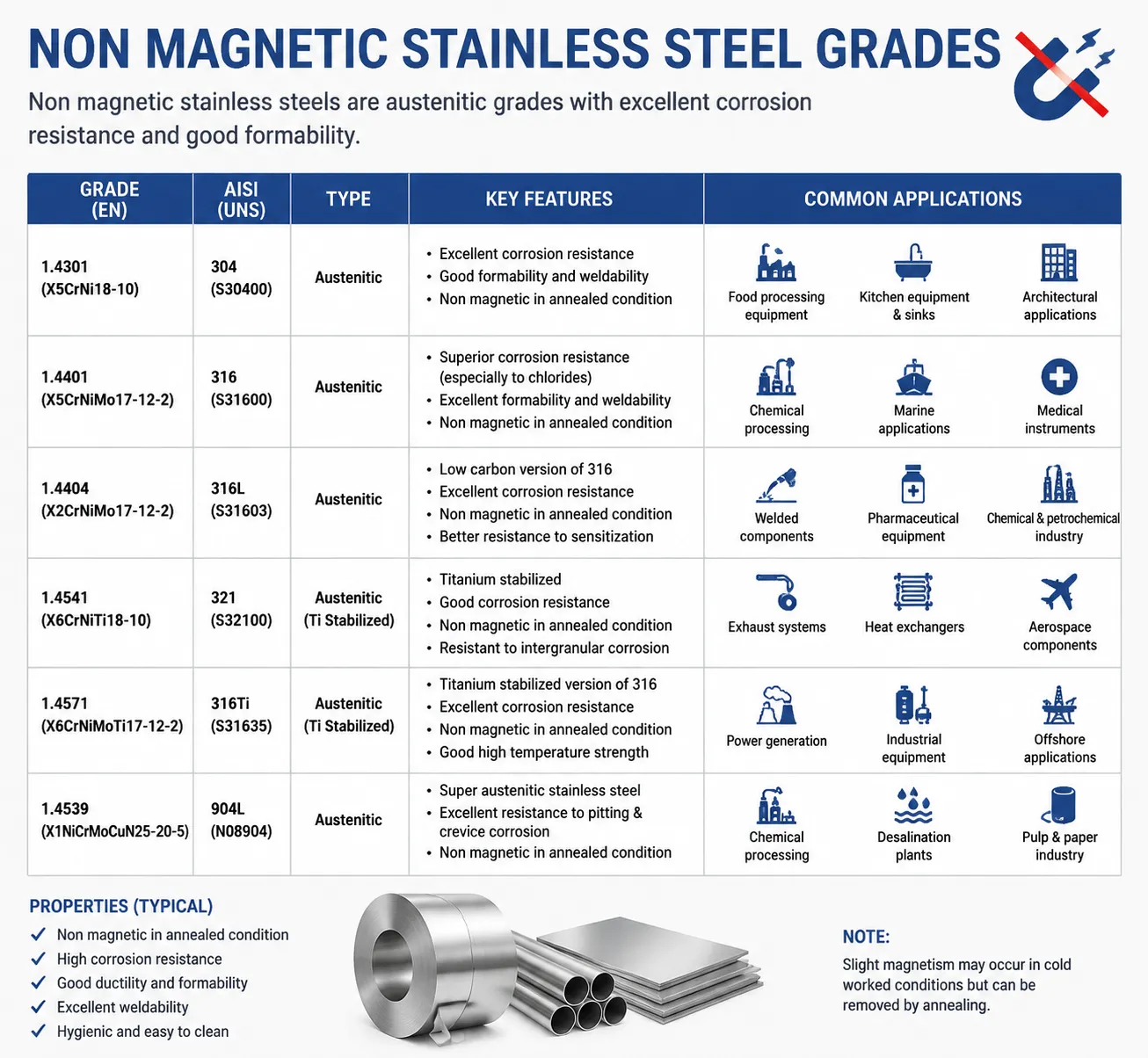
What Is the Complete List of Non-Magnetic Stainless Steel Grades?
The following tables present the most comprehensive grade-by-grade reference for non-magnetic stainless steels currently in commercial production. Grades are organized by family, with key compositional and magnetic property data.
Standard Austenitic Stainless Steel Grades (300 Series)
| Grade | UNS | Cr (%) | Ni (%) | Mo (%) | N (%) | Relative Permeability (annealed) | Non-Magnetic Stability Under Cold Work |
|---|---|---|---|---|---|---|---|
| 301 | S30100 | 16–18 | 6–8 | – | – | <1.02 | Low (very susceptible to martensite) |
| 302 | S30200 | 17–19 | 8–10 | – | – | <1.02 | Low-Moderate |
| 303 | S30300 | 17–19 | 8–10 | – | – | <1.02 | Low (free-machining, higher S) |
| 304 | S30400 | 18–20 | 8–10.5 | – | – | <1.02 | Moderate |
| 304L | S30403 | 18–20 | 8–12 | – | – | <1.02 | Moderate |
| 304N | S30451 | 18–20 | 8–10.5 | – | 0.10–0.16 | <1.02 | Moderate-Good |
| 305 | S30500 | 17–19 | 10.5–13 | – | – | <1.02 | Good (higher Ni) |
| 308 | S30800 | 19–21 | 10–12 | – | – | <1.02 | Good |
| 309 | S30900 | 22–24 | 12–15 | – | – | <1.02 | Very Good |
| 310 | S31000 | 24–26 | 19–22 | – | – | <1.01 | Excellent |
| 310S | S31008 | 24–26 | 19–22 | – | – | <1.01 | Excellent |
| 314 | S31400 | 23–26 | 19–22 | – | – | <1.01 | Excellent |
| 316 | S31600 | 16–18 | 10–14 | 2–3 | – | <1.02 | Moderate-Good |
| 316L | S31603 | 16–18 | 10–14 | 2–3 | – | <1.02 | Moderate-Good |
| 316N | S31651 | 16–18 | 10–14 | 2–3 | 0.10–0.16 | <1.02 | Good |
| 316LN | S31653 | 16–18 | 10–14 | 2–3 | 0.10–0.16 | <1.02 | Good |
| 317 | S31700 | 18–20 | 11–15 | 3–4 | – | <1.02 | Good |
| 317L | S31703 | 18–20 | 11–15 | 3–4 | – | <1.02 | Good |
| 321 | S32100 | 17–19 | 9–12 | – | – | <1.02 | Moderate |
| 347 | S34700 | 17–19 | 9–13 | – | – | <1.02 | Moderate |
| 348 | S34800 | 17–19 | 9–13 | – | – | <1.02 | Moderate |
High-Performance Austenitic and Superaustenitic Grades
| Grade | UNS | Cr (%) | Ni (%) | Mo (%) | N (%) | Special Element | Permeability (annealed) | Stability Rating |
|---|---|---|---|---|---|---|---|---|
| 904L | N08904 | 19–23 | 23–28 | 4–5 | – | Cu 1–2% | <1.01 | Excellent |
| 254 SMO | S31254 | 19.5–20.5 | 17.5–18.5 | 6–6.5 | 0.18–0.22 | Cu 0.5–1% | <1.005 | Excellent |
| AL-6XN | N08367 | 20–22 | 23.5–25.5 | 6–7 | 0.18–0.25 | – | <1.005 | Excellent |
| 654 SMO | S32654 | 24–25 | 21–23 | 7–8 | 0.45–0.55 | Cu 0.3–0.6% | <1.003 | Outstanding |
| 020 (Alloy 20) | N08020 | 19–21 | 32–38 | 2–3 | – | Cu 3–4%, Nb | <1.005 | Excellent |
| 330 | N08330 | 17–20 | 34–37 | – | – | Si 0.75–1.5% | <1.01 | Excellent |
| 800 (Incoloy) | N08800 | 19–23 | 30–35 | – | – | Ti, Al | <1.01 | Excellent |
| 825 (Incoloy) | N08825 | 19.5–23.5 | 38–46 | 2.5–3.5 | – | Cu, Ti | <1.005 | Outstanding |
Nitrogen-Strengthened Austenitic Grades (200 Series and Variants)
The 200 series uses manganese and nitrogen to partially substitute for nickel in stabilizing the austenitic structure, reducing cost while maintaining non-magnetic behavior.
| Grade | UNS | Cr (%) | Ni (%) | Mn (%) | N (%) | Permeability (annealed) | Cold Work Stability |
|---|---|---|---|---|---|---|---|
| 201 | S20100 | 16–18 | 3.5–5.5 | 5.5–7.5 | 0.25 max | <1.02 | Low-Moderate |
| 202 | S20200 | 17–19 | 4–6 | 7.5–10 | 0.25 max | <1.02 | Low-Moderate |
| 205 | S20500 | 16.5–18 | 1–1.75 | 14–15.5 | 0.32–0.40 | <1.02 | Moderate |
| Nitronic 40 (216) | S21600 | 17.5–22 | 5–7 | 7.5–9 | 0.25–0.50 | <1.01 | Good |
| Nitronic 50 (XM-19) | S20910 | 20.5–23.5 | 11.5–13.5 | 4–6 | 0.20–0.40 | <1.005 | Excellent |
| Nitronic 60 (218) | S21800 | 16–18 | 8–9 | 7–9 | 0.08–0.18 | <1.02 | Good |
| Nitronic 33 (219) | S21900 | 18–20 | 5.5–7.5 | 8–10 | 0.15–0.40 | <1.02 | Moderate-Good |
| P-900 (210N) | S21000 | 19–21.5 | 5–7 | 9–11 | 0.15–0.40 | <1.01 | Good |
Precipitation Hardening Grades with Non-Magnetic Characteristics
Most precipitation hardening (PH) stainless steels are semi-austenitic and become magnetic after the martensitic transformation involved in their hardening treatment. However, the fully austenitic PH grade A-286 retains its non-magnetic character in all heat treatment conditions:
| Grade | UNS | Condition | Magnetic Behavior | Notes |
|---|---|---|---|---|
| A-286 | S66286 | All conditions | Non-magnetic | Austenitic PH; permeability <1.02 |
| 17-4 PH | S17400 | Solution annealed | Slightly magnetic | Becomes strongly magnetic after aging |
| 17-7 PH | S17700 | Condition A | Austenitic, non-magnetic | Becomes magnetic after CH900 aging |
| PH 15-7 Mo | S15700 | Condition A | Austenitic, non-magnetic | Becomes magnetic after hardening |
A-286 is a critical material in aerospace applications where both high strength and reliable non-magnetic behavior in all conditions are required. Its austenitic stability through the aging treatment (precipitation of gamma-prime phase) distinguishes it from the semi-austenitic PH grades that transform to martensite during hardening.
How Does Cold Working Change the Magnetic Properties of Austenitic Stainless Steel?
This is arguably the most practically important topic in the non-magnetic stainless steel field, and one that is seriously underappreciated in most purchasing guides. The fact that a grade is non-magnetic in the annealed condition does not guarantee it will remain non-magnetic after your manufacturing process.
The Mechanism of Deformation-Induced Martensite
When austenitic stainless steel is cold worked (by drawing, rolling, bending, stamping, pressing, or machining), the deformation energy can trigger a transformation of austenite to martensite. This transformation does not require high temperatures or quenching: it is driven purely by mechanical work at room temperature or below. The resulting martensite is called strain-induced martensite or deformation-induced martensite (DIM), and it is ferromagnetic.
The volume fraction of DIM formed depends on:
- The degree of cold reduction (more work = more DIM)
- The deformation temperature (colder = more DIM; this is why some austenitic grades become more magnetic in winter)
- The alloy's austenite stability (Md30 temperature, discussed below)
- The strain path (some deformation modes are more efficient at inducing martensite than others)
The Md30 Temperature: Predicting Susceptibility
The Md30 temperature is the temperature at which 50% martensite forms when a standard austenitic stainless steel specimen is subjected to 30% true tensile strain. It is calculated from composition using the Angel equation:
Md30 (°C) = 413 – 462(%C + %N) – 9.2(%Si) – 8.1(%Mn) – 13.7(%Cr) – 29(%Ni + %Cu) – 18.5(%Mo) – 68(%Nb) – 1.42(grain size ASTM number – 8)
| Alloy | Approximate Md30 (°C) | DIM Susceptibility | Recommended for Critical Non-Magnetic Applications? |
|---|---|---|---|
| 301 | +60 to +80 | Very High | No |
| 304 | -10 to +20 | High | Only in annealed state |
| 304LN | -20 to +10 | Moderate-High | With caution |
| 316 | -30 to -10 | Moderate | With caution |
| 316LN | -45 to -20 | Moderate | With caution |
| 305 | -70 to -50 | Low | Yes, with moderate cold work |
| 310 | < -100 | Very Low | Yes |
| 904L | < -100 | Very Low | Yes |
| 254 SMO | < -120 | Negligible | Yes |
| Nitronic 50 | < -120 | Negligible | Yes |
| AL-6XN | < -130 | Negligible | Yes |
Alloys with Md30 temperatures well below the minimum service temperature are essentially immune to deformation-induced martensite under any practical manufacturing condition. This is why 310, 904L, 254 SMO, and Nitronic 50 are the grades of choice when non-magnetic behavior must be guaranteed through heavy cold working operations.
Effect of Cold Reduction on Magnetic Permeability
The following table illustrates how the relative magnetic permeability of 304 stainless steel changes with increasing cold reduction, compared to more stable grades:
| Cold Reduction (%) | 304 SS Permeability | 316 SS Permeability | 310 SS Permeability | 904L Permeability |
|---|---|---|---|---|
| 0 (annealed) | 1.003 | 1.002 | 1.001 | 1.001 |
| 10% | 1.02 – 1.10 | 1.01 – 1.05 | 1.001 | 1.001 |
| 20% | 1.10 – 1.50 | 1.03 – 1.15 | 1.002 | 1.001 |
| 30% | 1.50 – 3.00 | 1.10 – 1.40 | 1.003 | 1.001 |
| 50% | 3.00 – 8.00 | 1.20 – 2.50 | 1.005 | 1.002 |
| 70% | 5.00 – 15.00 | 1.50 – 4.00 | 1.008 | 1.003 |
Values represent typical ranges from published literature; actual values depend on exact chemistry and deformation conditions.
These numbers make the case for grade selection based on end-condition rather than as-annealed condition. A component machined from 304 bar stock and reduced 30% in cross-section by turning operations may have a permeability of 3 or higher, which is clearly unacceptable in MRI-room hardware or compass-sensitive navigation equipment.
Restoring Non-Magnetic Behavior After Cold Working
If a component made from a susceptible grade like 304 has developed magnetic behavior through cold working, full non-magnetic properties can be restored by solution annealing (heating to 1010 – 1120°C followed by rapid cooling). This dissolves the deformation-induced martensite back into austenite. However, this treatment also eliminates all work-hardening, softens the material, and may cause dimensional distortion that makes it impractical for finished or near-finished components. This is why selecting the correct grade before manufacturing is far more practical than trying to correct magnetic behavior after the fact.
Which Non-Magnetic Stainless Steel Grades Maintain Magnetic Stability Under Processing Conditions?
For applications where the final component will be significantly cold worked, machined, or formed, grade selection must prioritize austenite stability rather than just as-annealed magnetic properties.
Grade Stability Ranking for Manufacturing Environments
| Application Scenario | Acceptable Grades | Grades to Avoid | Reason |
|---|---|---|---|
| Precision machined components | 310, 316LN, 904L, Nitronic 50 | 301, 304, 303 | Heavy stock removal induces DIM |
| Deep drawn parts (>30% reduction) | 310, 904L, 254 SMO, 305 | 304, 316 | Severe work hardening |
| Cold headed fasteners | 316LN, Nitronic 50, A-286 | 304, 302 | Extreme cold work at head |
| Welded structures | 308L, 316L, 310, 347 | 301 (high DIM) | HAZ ferrite from weld thermal cycle |
| Cryogenic applications | 316LN, 310, 904L | 304 (low Md30 margin) | Lower temperature increases DIM rate |
| Springs (heavily cold worked) | 316LN spring temper, 305 | 301 (highly magnetic when sprung) | Maximum cold reduction |
| Lightly machined bar/plate | 304, 316, 321 | – | Moderate machining acceptable |
Grade 305: The Underappreciated Non-Magnetic Spring Material
Grade 305 (S30500) with 10.5 – 13% nickel deserves special attention. The elevated nickel content pushes its Md30 temperature well below -50°C, making it highly resistant to deformation-induced martensite at room temperature. This property makes 305 the standard material for cold-headed screws and springs in applications requiring guaranteed non-magnetic behavior after forming. It is much less frequently specified than 304 or 316 simply because fewer engineers are familiar with it, not because of any performance shortcoming.
At MWalloys, we have supplied 305 sheet and wire to spring manufacturers serving the MRI equipment sector for many years. The consistent feedback is that 305 eliminates the rework and scrap problems associated with cold-worked 304 springs failing magnetic permeability acceptance tests.
How Is Magnetic Permeability Measured and What Specifications Apply?
Quantifying magnetic behavior requires specific instruments and test methods. The qualitative "stick a magnet on it" test is completely inadequate for engineering specification purposes.
Magnetic Permeability Measurement Methods
Relative Magnetic Permeability (µr):
This is the primary engineering parameter for specifying non-magnetic behavior. It is the ratio of the material's permeability to that of free space. A value of exactly 1.000 would be perfectly non-magnetic. In practice:
| µr Value | Classification | Typical Material |
|---|---|---|
| 1.000 – 1.002 | Non-magnetic (negligible response) | Annealed 310, 904L, copper, aluminum |
| 1.002 – 1.010 | Essentially non-magnetic | Annealed 316LN, Nitronic 50 |
| 1.010 – 1.100 | Slightly magnetic (weakly paramagnetic to slightly ferromagnetic) | Cold-worked 316, annealed 304 |
| 1.100 – 2.000 | Weakly magnetic | Cold-worked 304 |
| 2.000 – 100 | Moderately magnetic | Heavily cold-worked 301, 304 |
| > 100 | Strongly magnetic (ferromagnetic) | 430, 410, carbon steel |
Measurement Instruments:
| Instrument Type | Operating Principle | Accuracy | Typical Application |
|---|---|---|---|
| Feritscope (Fischer) | Magnetic induction | ±0.1% ferrite (FN) | Production QC, weld inspection |
| Permeameter | Toroidal sample measurement | ±1% µr | Laboratory, research |
| Fluxgate magnetometer | Measures ambient field distortion | High sensitivity | MRI room acceptance testing |
| Vibrating sample magnetometer (VSM) | Measures magnetization vs field | Very high | Research, material development |
| Handheld rare-earth magnet test | Qualitative only | None | Preliminary sorting only |
Common Permeability Specifications by Industry
| Industry / Application | Typical Permeability Specification | Standard Referenced |
|---|---|---|
| MRI equipment (non-implant) | µr < 1.005 | ASTM F2503 |
| Implantable medical devices | µr < 1.003 | ASTM F2503, ISO 10993 |
| Marine magnetic compass protection | µr < 1.05 | ISO 25862, IMO MSC.36(63) |
| Nuclear instrumentation | µr < 1.02 | Customer specification |
| Scientific instruments | µr < 1.01 | Customer specification |
| Defense / degaussed vessels | µr < 1.02 | MIL-S-23190 |
| Electronic equipment housings | µr < 1.05 | Customer specification |
| General non-magnetic applications | µr < 1.10 | Customer specification |
Ferrite Number vs Permeability: Understanding the Relationship
In the welding industry, austenitic weld metals are often characterized by Ferrite Number (FN) rather than permeability. While these two parameters are related, they are not the same:
- FN = 0 corresponds approximately to µr = 1.000 – 1.005 (fully austenitic)
- FN = 3 corresponds approximately to µr = 1.01 – 1.05
- FN = 10 corresponds approximately to µr = 1.15 – 1.50
Weld metals for non-magnetic applications should specify FN < 3, and ideally FN = 0 for the most critical applications. Fully austenitic weld consumables (308L, 316L, 309L with zero ferrite) are available and are required in applications like MRI room construction where even the weld beads must meet permeability specifications.
What Are the Full Mechanical and Corrosion Properties of Key Non-Magnetic Grades?
Selecting a non-magnetic grade is not purely about magnetic permeability. The material must also meet mechanical strength, corrosion resistance, and fabricability requirements for the application.
Mechanical Properties Comparison
| Grade | Tensile Strength (MPa) | Yield Strength (MPa) | Elongation (%) | Hardness (HRB) | Charpy Impact (J, -196°C) |
|---|---|---|---|---|---|
| 304 | 515 min | 205 min | 40 min | 92 max | >100 |
| 316L | 485 min | 170 min | 40 min | 95 max | >100 |
| 310 | 515 min | 205 min | 40 min | 95 max | >80 |
| 305 | 480 min | 170 min | 40 min | 88 max | >100 |
| 321 | 515 min | 205 min | 40 min | 92 max | >100 |
| 347 | 515 min | 205 min | 40 min | 92 max | >100 |
| 904L | 490 min | 220 min | 35 min | 90 max | >100 |
| 254 SMO | 650 min | 300 min | 35 min | 100 max | >100 |
| Nitronic 50 | 690 min | 380 min | 35 min | 100 max | >100 |
| AL-6XN | 655 min | 310 min | 30 min | 100 max | >100 |
| A-286 | 895 min (aged) | 585 min (aged) | 15 min | – | >60 |
Corrosion Resistance Comparison
| Grade | Pitting Resistance (PREN) | SCC Resistance | General Corrosion Resistance | Max Service Temp (°C) |
|---|---|---|---|---|
| 304 | ~18 | Moderate | Good | 870 (intermittent) |
| 316L | ~24 | Good | Very Good | 870 (intermittent) |
| 310 | ~22 | Very Good | Good | 1150 |
| 305 | ~18 | Good | Good | 870 (intermittent) |
| 321 | ~17 | Moderate | Good | 900 |
| 347 | ~17 | Moderate | Good | 900 |
| 904L | ~36 | Excellent | Excellent | 400 (aqueous) |
| 254 SMO | ~43 | Excellent | Excellent | 400 (aqueous) |
| Nitronic 50 | ~35 | Excellent | Excellent | 650 |
| AL-6XN | ~46 | Excellent | Excellent | 400 (aqueous) |
| A-286 | ~17 | Good | Moderate | 700 (oxidizing) |
Which Industries Require Non-Magnetic Stainless Steel and What Are the Specific Application Requirements?
The demand for non-magnetic stainless steel comes from a surprisingly diverse range of industries, each with distinct performance requirements beyond just permeability.
Medical Imaging and Healthcare Equipment
MRI (Magnetic Resonance Imaging) systems operate with magnetic fields ranging from 1.5 Tesla (standard clinical) to 7 Tesla (research) and increasingly 10+ Tesla in experimental systems. Any ferromagnetic material in or near the MRI bore can:
- Experience violent projectile forces (the "missile effect") that create life-threatening situations.
- Generate image artifacts that degrade diagnostic quality.
- Interfere with gradient coil operation.
The ASTM F2503 standard classifies medical devices and items as MR Safe, MR Conditional, or MR Unsafe based on their magnetic behavior. For stainless steel components classified as MR Safe, a permeability below 1.003 is typically required.
| MRI Room Component | Preferred Grade | Permeability Requirement | Key Additional Property |
|---|---|---|---|
| Structural framing | 316LN, 310 | µr < 1.010 | Strength, weldability |
| Cabinet hardware | 316LN | µr < 1.005 | Corrosion resistance |
| Fasteners and bolts | Nitronic 50, A-286 | µr < 1.005 | High strength |
| Surgical instruments in suite | 316LN, 310 | µr < 1.005 | Sterilization compatibility |
| IV poles and stands | 316LN | µr < 1.010 | Weight, aesthetics |
| Patient table components | 316LN, 310 | µr < 1.005 | Load bearing |
Ferromagnetic materials aboard ships distort the Earth's magnetic field locally, causing compass deviations that can be safety-critical in navigation. International maritime regulations require non-magnetic materials within the compass safe distance, defined as the radius within which the compass reading deviates by more than the allowable error (typically 1° to 3°).
| Marine Application | Required Grade | Permeability Limit | Governing Standard |
|---|---|---|---|
| Compass binnacle housing | 316L, 310 | µr < 1.05 | ISO 25862 |
| Bridge console framing | 316L | µr < 1.05 | IMO requirements |
| Magnetic mine counter measures | 310, 904L | µr < 1.02 | MIL-S-23190 |
| Submarine hull sections | Non-magnetic steel (HY) | µr < 1.01 | Defense specifications |
| Degaussed vessel fittings | 316LN, 310 | µr < 1.02 | Naval specifications |
Electronics, Instrumentation, and Semiconductor Manufacturing
Sensitive electronic instruments, particle accelerators, electron microscopes, and semiconductor lithography equipment operate in environments where stray magnetic fields from structural materials can corrupt measurements or alter charged-particle trajectories.
| Instrument Application | Preferred Grade | Critical Requirement |
|---|---|---|
| Electron microscope components | 316LN, 310 | µr < 1.002, ultra-clean surface |
| Particle accelerator vacuum chambers | 316LN, 304LN | µr < 1.01, ultra-low outgassing |
| Semiconductor lithography frames | 316LN, Invar (non-SS) | µr < 1.005, dimensional stability |
| Mass spectrometer components | 316LN | µr < 1.002, ultra-high vacuum compatible |
| Nuclear counting equipment | 310, 316LN | µr < 1.02, radiation resistance |
| Magnetometer calibration equipment | 310, 904L | µr < 1.005 |
Oil and Gas and Chemical Processing
Certain downhole measurement tools, including electromagnetic logging-while-drilling (LWD) tools and formation evaluation instruments, require non-magnetic drill collar sections to prevent the tool's own magnetic field from interfering with geomagnetic measurements used for directional drilling.
| O&G Application | Required Grade | Key Requirement |
|---|---|---|
| Non-magnetic drill collars | Nitronic 50, P530 | µr < 1.005, high yield strength (>758 MPa) |
| Downhole instrument housings | 316LN, Nitronic 50 | µr < 1.005, H₂S resistance |
| Wellhead instrument fittings | 316LN, duplex caution | µr < 1.01 |
| Chemical injection systems | 316L, 904L | Corrosion resistance primary |
Non-magnetic drill collars represent one of the most demanding single applications: they must simultaneously achieve µr < 1.005, yield strength above 758 MPa (110 ksi), toughness adequate for downhole mechanical shock, and resistance to sour service conditions. Nitronic 50 (XM-19) is the dominant material for this application, with some specialized proprietary alloys also used.
How Do Non-Magnetic Stainless Steels Compare to Other Non-Magnetic Metallic Alternatives?
Stainless steel is not the only non-magnetic metallic material available. Understanding how it compares to alternatives helps engineers make the most appropriate selection when trade-offs between properties are required.
Non-Magnetic Material Comparison Matrix
| Material | Relative Permeability | Tensile Strength (MPa) | Corrosion Resistance | Cost vs 316L | Weight vs 316L |
|---|---|---|---|---|---|
| 316L stainless | <1.02 | 485 | Very Good | 1.0× | 1.0× |
| 310 stainless | <1.01 | 515 | Good | 1.3× | 1.0× |
| 904L stainless | <1.005 | 490 | Excellent | 2.5× | 0.98× |
| Nitronic 50 | <1.005 | 690 | Very Good | 2.8× | 0.99× |
| Inconel 625 | <1.005 | 830 | Outstanding | 8.0× | 0.95× |
| Titanium Grade 2 | <1.00001 | 345 | Outstanding | 5.0× | 0.57× |
| Aluminum 5083 | <1.00001 | 290 | Good (marine) | 0.4× | 0.36× |
| Copper (C11000) | <1.00001 | 220 | Good | 1.2× | 1.14× |
| Monel 400 | <1.002 | 480 | Excellent | 5.0× | 1.12× |
| Brass (C26000) | <1.00001 | 340 | Moderate | 0.8× | 1.09× |
The key observation from this table is that titanium and aluminum are magnetically superior to even the most stable austenitic stainless steels. Their relative permeability is essentially exactly 1.00000 because they are paramagnetic rather than diamagnetic or ferromagnetic. However, they cannot match the strength, wear resistance, or high-temperature capabilities of austenitic stainless steels in many applications.
For applications where absolute non-magnetic performance combined with structural strength is required, Nitronic 50 and Inconel 625 represent the practical optimum within metallic materials. Where weight reduction is prioritized, titanium Grade 5 (Ti-6Al-4V) offers substantially higher strength-to-weight ratio than any non-magnetic stainless steel.
What Specifications and Standards Govern Non-Magnetic Stainless Steel Supply?
Specifying non-magnetic stainless steel correctly requires identifying the applicable material standard and any supplemental permeability requirements that go beyond standard composition and mechanical property specifications.
Key Standards for Non-Magnetic Stainless Steel
| Standard | Issuing Body | Scope | Key Non-Magnetic Provision |
|---|---|---|---|
| ASTM A240 | ASTM International | Sheet and plate (all grades) | No permeability requirement; supplement needed |
| ASTM A276 | ASTM International | Bar and shapes | No permeability requirement; supplement needed |
| ASTM F2503 | ASTM International | MRI medical device marking | Defines MR Safe / Conditional / Unsafe criteria |
| MIL-S-23190 | US Department of Defense | Non-magnetic steel plate | µr < 1.10 for naval applications |
| ISO 25862 | ISO | Marine magnetic compasses | Non-magnetic material requirements |
| ASTM A480 | ASTM International | General flat-rolled SS requirements | Base standard only |
| NACE MR0175 / ISO 15156 | AMPP / ISO | Sour service materials | Identifies approved grades with hardness limits |
| ASTM A193 | ASTM International | Bolting materials | Covers B8M (316SS) bolts; supplement for permeability |
Writing a Correct Non-Magnetic Stainless Steel Specification
A complete purchase specification for non-magnetic stainless steel must include:
- Grade and UNS number: Do not rely on trade names alone
- Product form standard: ASTM A240 (sheet/plate), A276 (bar), A312 (pipe), A167 (sheet/strip)
- Condition: Annealed (solution heat treated + quenched)
- Supplemental permeability requirement: State maximum µr value (e.g., "µr < 1.010 per ASTM A342 or equivalent")
- Test method and instrument: Specify measurement method (permeameter, Feritscope, etc.)
- Sampling frequency: 100% test, heat lot basis, or per-piece basis.
- Certification: EN 10204 Type 3.1 including permeability test results.
- Additional restrictions: "No cold straightening after final anneal" or "Final condition annealed only" if process-induced magnetism is a concern.
How Do You Select the Right Non-Magnetic Stainless Steel Grade for Your Specific Application?
Grade selection involves balancing four key variables: magnetic permeability requirements, mechanical property needs, corrosion resistance demands, and budget constraints. The following framework reflects how we approach this selection at MWalloys.
Non-Magnetic Grade Selection Decision Tree
Step 1: Define the maximum acceptable permeability
- µr < 1.002: Need 310, 904L, 254 SMO, AL-6XN, or Nitronic 50
- µr < 1.010: 316LN, 310, 904L, or higher-nickel grades
- µr < 1.050: 316L, 316LN, 310 all suitable
- µr < 1.100: Most annealed austenitic grades acceptable.
Step 2: Assess the cold work level in manufacturing
- Heavy cold work (> 30% reduction): Eliminate 304, 301, 302; use 310, 305, 904L, Nitronic 50
- Moderate cold work (10 – 30%): Eliminate 301; evaluate 316LN, 305
- Light cold work or machining only: 316L, 316LN generally acceptable with caution.
Step 3: Match corrosion resistance to environment
- Mild atmospheric: 304, 316L sufficient
- Seawater or aggressive chloride: 254 SMO, AL-6XN, Nitronic 50, 904L
- Mixed acid: 904L, Nitronic 50
- High-temperature oxidizing: 310, 314.
Step 4: Check mechanical property requirements
- Standard structural: 304, 316L, 310 all adequate
- High strength required: Nitronic 50, A-286 (aged), cold-drawn 316LN
- Spring properties: 305, 316LN (spring temper)
Step 5: Verify supply availability and cost
Quick Reference Selection Table
| Application | Recommended Grade | Alternative | Notes |
|---|---|---|---|
| MRI room structural | 316LN | 310 | Verify µr < 1.010 on each heat |
| MRI surgical instruments | 316LN, 310 | Nitronic 50 | Must survive sterilization cycles |
| Non-magnetic fasteners | Nitronic 50, A-286 | 316LN cold drawn | A-286 for highest strength |
| Marine compass zone | 316L | 310 | Verify annealed condition |
| Non-magnetic drill collars | Nitronic 50 | Proprietary alloys | µr < 1.005, YS > 758 MPa |
| Electronic shielding housings | 316LN | 310 | Consider Mu-metal for better shielding |
| Cold-formed non-magnetic parts | 310, 305, 904L | 316LN | Grade selected for DIM resistance |
| High-temp non-magnetic service | 310, 314 | Incoloy 800 | Above 500°C service |
| Budget non-magnetic general | 316L (annealed) | 304 (annealed, light service) | Confirm annealed condition |
| Chemical plant non-magnetic | 904L, 254 SMO | Nitronic 50 | Corrosion + non-magnetic |
FAQs: Everything You Need to Know About Non-Magnetic Stainless Steel
1: Is 316 stainless steel truly non-magnetic?
316 stainless steel is non-magnetic in the fully annealed condition with a typical relative permeability of 1.002 to 1.010, but it can develop measurable and sometimes significant magnetic response after cold working, machining, or drawing. The austenite in 316 is moderately stable: its Md30 temperature falls around -20°C, meaning that at room temperature with 30% deformation, approximately 50% martensite would form. In practical manufacturing, cold-drawn 316 bar stock can have permeability values of 1.5 to 4.0, which is clearly magnetic in sensitive applications. For applications specifying µr < 1.010, 316 in the annealed condition from sheet or plate is generally satisfactory, but 316 in bar form (which is typically cold-drawn to improve dimensional tolerance) should be solution annealed after drawing and before use if non-magnetic behavior is required. The low-carbon variant 316L behaves similarly. For critical non-magnetic applications, 316LN (nitrogen-stabilized) or higher-stability grades like 310 or Nitronic 50 are more reliable choices than standard 316.
2: Why does stainless steel sometimes stick to a magnet even though it is supposed to be non-magnetic?
Stainless steel attracts magnets when cold working during manufacturing has converted some of its non-magnetic austenitic microstructure into ferromagnetic martensite, or when the grade itself is inherently magnetic (ferritic or martensitic family). This is one of the most common sources of confusion about stainless steel. When someone says "stainless steel is non-magnetic," they are referring specifically to annealed austenitic grades (300 series). But the same 304 sheet that is non-magnetic in the flat annealed condition becomes noticeably magnetic after being bent, punched, deep drawn, or cold rolled. The deformation energy transforms austenite into martensite at a local level, and that martensite is ferromagnetic. Additionally, 400-series ferritic grades (430, 439, 444) and martensitic grades (410, 420, 440C) are always magnetic regardless of heat treatment. If you pick up a stainless steel item and it sticks strongly to a magnet, it is either a 400-series grade or a heavily cold-worked 300-series grade. If it barely responds or does not respond at all, it is an annealed 300-series grade.
3: What is the most non-magnetic stainless steel available commercially?
Among standard stainless steels, grades 654 SMO (S32654), AL-6XN (N08367), and 254 SMO (S31254) achieve the lowest relative permeability values after processing, typically remaining below µr 1.003 even after moderate cold working, due to their very high nickel and nitrogen content. These superaustenitic grades have Md30 temperatures below -120°C, making deformation-induced martensite essentially impossible under any practical manufacturing condition at room temperature. For even more demanding requirements, non-stainless nickel alloys like Inconel 625 or Hastelloy C276 achieve permeabilities essentially indistinguishable from 1.000. Titanium alloys and aluminum alloys are technically "more non-magnetic" in the strict sense (their permeability is essentially exactly 1.000000 because they are purely paramagnetic), but they are not stainless steels. Within the stainless steel family, for the absolute lowest permeability combined with stainless-level corrosion resistance, 654 SMO or AL-6XN are the practical answer for engineering applications. Both are expensive and have limited availability compared to standard grades, so their use should be justified by genuine application need.
4: Can welding make non-magnetic stainless steel become magnetic?
Yes, welding can introduce magnetic behavior in two ways: delta ferrite in the weld metal (which is deliberately controlled during welding to prevent hot cracking) and the heat-affected zone microstructure changes. When austenitic stainless steel is welded, the filler metal is typically formulated to produce a small amount of delta ferrite in the weld deposit (Ferrite Number 3 – 8 FN) to prevent solidification cracking. This ferrite is ferromagnetic and produces a measurable permeability increase in the weld bead. For applications requiring non-magnetic welds, fully austenitic weld consumables (AWS ER308L, ER316L, or ER310 with FN = 0) must be specified. The heat-affected zone (HAZ) adjacent to the weld in susceptible grades like 304 can also develop sigma phase or martensite, depending on the thermal cycle. For critical non-magnetic welded structures, the entire welded assembly (not just the base metal) must be tested for permeability after fabrication, and solution annealing of the completed weldment may be required to restore fully austenitic microstructure throughout.
5: What is the difference between non-magnetic and paramagnetic stainless steel?
All non-magnetic stainless steels are technically paramagnetic (they have a small positive magnetic susceptibility and very weakly align with an applied field), but the distinction from ferromagnetic materials is so large that "non-magnetic" is the practical engineering description used. Ferromagnetism involves very strong alignment of magnetic domains with an applied field, producing permeabilities of hundreds to thousands. Paramagnetism involves very weak, temperature-dependent alignment without domain formation, producing permeabilities barely above 1.000 (typically 1.001 – 1.003 for austenitic stainless steels). In everyday engineering terms, "non-magnetic" and "paramagnetic" are used interchangeably for austenitic stainless steels because their practical magnetic behavior (they do not attract permanent magnets perceptibly, do not retain magnetization, and do not distort magnetic fields significantly) is the same. The theoretical distinction matters in physics research but not in most engineering applications. What matters for specification purposes is the actual numerical value of relative permeability, not the terminology used to classify the magnetic behavior.
6: How do I test if my stainless steel component is non-magnetic enough for an MRI environment?
The correct test for MRI environment qualification uses a handheld permeameter or Feritscope to measure relative magnetic permeability on the actual finished component, with the result compared to the project-specific permeability limit (typically µr < 1.005 for items entering the scanner room). A permanent magnet test is completely inadequate: a material that barely responds to a permanent magnet might still have a permeability of 1.10 or higher, which is unacceptable near an MRI scanner. ASTM F2503 provides the classification framework, but the testing protocol for specific items should follow the manufacturer's recommendations and the site's MRI safety policy. For items that will be permanently installed in the scanner room (structural components, cabinetry), testing every piece from every heat of material is the conservative and recommended approach. For removable items (tools, equipment), testing representative samples and implementing a materials control program that prevents mixing of magnetic and non-magnetic items is practical. Always test in the condition in which the item will be used: an annealed sheet that passes testing before fabrication may not pass after cold forming.
7: Does heat treatment restore non-magnetic properties to work-hardened austenitic stainless steel?
Yes, solution annealing at 1010 – 1120°C followed by rapid water quenching completely restores non-magnetic behavior in austenitic stainless steels by dissolving deformation-induced martensite and re-establishing a fully austenitic microstructure. The solution anneal temperature must be high enough to fully dissolve all martensite and any carbide precipitates, and the cooling rate must be fast enough to suppress re-precipitation. For 304 and 316 grades, water quenching or forced-air quenching after the anneal is standard. The treatment eliminates all cold-work strengthening, returning the material to its minimum strength condition. For components where specific mechanical properties from cold work are needed alongside non-magnetic behavior, this creates an irreconcilable conflict that must be resolved by selecting a grade with inherently stable austenite (such as Nitronic 50, 310, or 904L) that achieves the required strength through composition rather than cold work. Stress relief at temperatures below the recrystallization temperature (below approximately 800°C) does not restore non-magnetic behavior: only full recrystallization through solution annealing achieves this.
8: Are non-magnetic stainless steel grades suitable for food and pharmaceutical contact applications?
Yes, all standard austenitic non-magnetic stainless steel grades (304, 316L, 310, 321, and others) comply with food contact requirements per FDA regulations and European Regulation (EC) No 1935/2004, and pharmaceutical-grade applications typically use 316L or 316LN meeting ASME BPE surface finish standards. The non-magnetic property of austenitic stainless steels is incidental to their dominant characteristic in food and pharma service: chemical resistance to cleaning agents, low surface roughness achievable through electropolishing, and absence of reactive elements that could contaminate process streams. For pharmaceutical reactors and vessels subject to CIP (clean-in-place) and SIP (steam-in-place) protocols using oxidizing sanitizing agents, 316L is the standard specification per ASME BPE. When the equipment will also be used near sensitive instrumentation where magnetic interference must be avoided, the same 316L or 316LN grades satisfy both requirements simultaneously. Electropolished 316L achieving Ra < 0.5 µm is the baseline for most pharmaceutical applications, with Ra < 0.25 µm specified for the most demanding bioprocessing equipment.
9: What is Nitronic 50 and why is it preferred for non-magnetic drill collars?
Nitronic 50 (UNS S20910, also known as XM-19) is a nitrogen-strengthened austenitic stainless steel with 22% Cr, 12.5% Ni, 5% Mn, and 0.30% N that achieves a unique combination of µr < 1.005, yield strength above 760 MPa (in the cold-worked condition), and NACE MR0175 compliance for sour service, which no other single material fully matches. Non-magnetic drill collars used in directional drilling and measurement-while-drilling (MWD) tools must simultaneously satisfy magnetic transparency requirements (so electromagnetic measurements are not distorted by the collar material), structural strength requirements (to survive downhole mechanical loads and torque), and corrosion resistance requirements (H₂S and CO₂ in sour formations). Standard austenitic grades like 304 or 316L either lack the strength or have insufficient austenite stability to maintain µr < 1.005 after the forming and machining involved in drill collar manufacture. Nitronic 50 satisfies all three requirements and has decades of documented field performance in directional drilling applications worldwide. Higher-performance proprietary alloys and certain cobalt-nickel-chromium alloys are also used for extreme requirements, but Nitronic 50 remains the industry standard baseline.
10: How does temperature affect the magnetic permeability of non-magnetic stainless steel?
Lowering the temperature increases the magnetic permeability (magnetic response) of austenitic stainless steels because lower temperatures promote deformation-induced martensite formation and reduce the thermal energy stabilizing the austenite phase. This temperature effect is particularly important in two scenarios: cryogenic applications (liquid nitrogen at -196°C, liquid oxygen at -183°C, liquid helium at -269°C) and outdoor applications in cold climates where winter temperatures below -30°C can measurably affect magnetic behavior in susceptible grades. At -196°C, even 316L can develop significant martensite under deformation, while grades like 310, 904L, and Nitronic 50 remain essentially fully austenitic. This is why cryogenic applications specify grades with very low Md30 temperatures (well below -100°C) to maintain non-magnetic behavior throughout the operational temperature range. For elevated temperatures, the situation reverses: above room temperature, austenite becomes more thermodynamically stable and the risk of deformation-induced martensite decreases. Elevated temperatures also cause a Curie effect in any martensite present: above the Curie temperature (approximately 770°C for iron-based martensite), ferromagnetic materials lose their magnetism regardless of microstructure.
Conclusion: Choosing the Right Non-Magnetic Stainless Steel Grade Requires More Than Checking a Box
Non-magnetic stainless steel is not a simple product category where any 300-series grade will do. The combination of alloy grade, heat treatment condition, and manufacturing process determines whether a finished component truly meets the permeability specification required by the application.
The key principles to carry from this technical review:
- Non-magnetic behavior in stainless steel requires an austenitic microstructure, achieved through sufficient nickel, manganese, and nitrogen content.
- Cold working, machining, and deep drawing can convert non-magnetic austenite into ferromagnetic martensite in susceptible grades.
- Grade selection must be based on the permeability requirement of the finished component in its final manufactured condition, not just the as-annealed mill product.
- For critical non-magnetic applications, grades 310, 904L, 254 SMO, AL-6XN, and Nitronic 50 provide the most reliable permeability stability through manufacturing operations.
- Magnetic permeability must be measured with calibrated instruments; permanent magnet testing is not a valid qualification method.
- Complete specifications must include permeability limits, measurement method, test frequency, and condition requirements (annealed only).
Ready to Source Non-Magnetic Stainless Steel?
MWalloys stocks and supplies non-magnetic stainless steel in the full range of austenitic grades including 304L, 316L, 316LN, 310, 321, 347, 904L, 254 SMO, Nitronic 50, and A-286, available in plate, sheet, bar, pipe, tube, and fittings with full EN 10204 Type 3.1 certifications.
Our technical team provides:
- Grade selection consultation for specific permeability requirements.
- Magnetic permeability testing and certification on request.
- Supply in fully annealed condition with documented heat treatment records.
- MRI-safe component supply with ASTM F2503 compliance documentation.
- Precision cut-to-size and custom processing.
- Same-day quotations for standard grades from stock inventory.
Contact MWalloys today to discuss your non-magnetic stainless steel requirements. Submit a technical inquiry through our website or speak directly with our materials engineers for application-specific recommendations and immediate pricing.
Verified and Authoritative Sources
- ASM International – ASM Handbook, Volume 2: Properties and Selection: Nonferrous Alloys and Special-Purpose Materials. ASM International. ISBN 978-0-87170-378-1.
- ASM International – ASM Specialty Handbook: Stainless Steels. Edited by J.R. Davis. ASM International. ISBN 978-0-87170-503-7.
- ASTM International – ASTM F2503: Standard Practice for Marking Medical Devices and Other Items for Safety in the Magnetic Resonance Environment.
- ASTM International – ASTM A240/A240M: Standard Specification for Chromium and Chromium-Nickel Stainless Steel Plate, Sheet, and Strip for Pressure Vessels and General Applications.
- ASTM International – ASTM A342/A342M: Standard Test Methods for Permeability of Feebly Magnetic Materials.
- Angel, T. (1954) – "Formation of Martensite in Austenitic Stainless Steels." Journal of the Iron and Steel Institute, Vol. 177, pp. 165 – 174.
- Bain, E.C., Aborn, R.H., Rutherford, J.J.B. (1933) – "The Nature and Prevention of Intergranular Corrosion in Austenitic Stainless Steels." Transactions of the American Society for Steel Treating, Vol. 21, pp. 481 – 509.
- Outokumpu Stainless – Outokumpu Corrosion Handbook, 11th Edition. Outokumpu Oyj, Helsinki, Finland.
- Specialty Steel Industry of North America (SSINA) – Designer Handbook: Stainless Steel.
- ISO 25862:2009 – Ships and Marine Technology – Marine Magnetic Compasses, Binnacles and Azimuth Reading Devices.
- NACE International (AMPP) – NACE MR0175 / ISO 15156: Petroleum and Natural Gas Industries – Materials for Use in H₂S-Containing Environments.
- Carpenter Technology Corporation – Nitronic 50 Alloy Technical Datasheet.
- Beddoes, J., Parr, J.G. – Introduction to Stainless Steels, 3rd Edition. ASM International. ISBN 978-0-87170-673-7.
- European Standard EN 10088-1:2014 – Stainless Steels: List of Stainless Steels. CEN, Brussels.
- Lula, R.A. – Stainless Steel. American Society for Metals. ISBN 978-0-87170-173-3.
- MIL-S-23190 – US Military Specification: Steel Plate, Non-Magnetic, Structural. Department of Defense.