

Inconel alloys are generally non-magnetic in their annealed or solution-treated condition; however, small amounts of magnetic response can appear after cold working, certain heat treatments, or when iron content rises, and exotic low-temperature magnetic phases have been documented in laboratory studies.
What is Inconel?
Inconel denotes a family of nickel-chromium based superalloys engineered for strength and corrosion resistance at elevated temperatures. Typical chemistry includes high nickel content (generally 50% or more by mass), chromium for oxidation resistance, and alloying additions such as iron, niobium, molybdenum, titanium, and aluminum depending on the grade. The high nickel fraction tends to stabilize a face-centered cubic austenitic crystal structure in many wrought grades; that crystal symmetry strongly influences magnetic response.
Common applications include gas turbine components, rocket engine parts, chemical process equipment, and high-temperature fasteners.
Magnetism basics for engineers
To interpret statements about magnetism you need three simple categories and a couple of technical terms:
-
Ferromagnetic: strong, permanent magnetization possible (iron, Ni-Fe steels).
-
Paramagnetic: weak attraction to magnetic fields; no permanent magnetization.
-
Diamagnetic: weak repulsion from magnetic fields (very small effect).
Two practical metrics engineers use:
-
Relative magnetic permeability (µr): value near 1.000 indicates essentially non-magnetic; typical ferromagnetic steels have µr very much greater than 1.
-
Magnetic susceptibility: how strongly material responds to applied field; often measured vs temperature.
For many industrial concerns the difference between “non-magnetic” and “weakly paramagnetic” matters most. Non-magnetic Inconel will not disturb nearby sensors or imaging devices; a slightly paramagnetic piece will not behave like steel but may register on sensitive instrumentation.
Why most Inconel alloys appear non-magnetic
The majority of commonly used Inconel alloys are austenitic in their metallurgical phase at room temperature. That austenitic face-centered cubic lattice tends to be non-ferromagnetic and therefore yields a measured magnetic permeability very near 1.0. Manufacturer data and material tables show small permeability values and low susceptibility for typical production lots.
Key technical reasons:
-
High nickel content strongly stabilizes austenite.
-
The alloying balance (Cr + Ni + other elements) reduces conditions for ferromagnetic order.
-
Common production heat treatments (solution anneal then age for precipitation-hardenable alloys) produce microstructures that are not ferromagnetic.
Because of that, Inconel often qualifies for use where magnetic interference is a concern — provided the part has not been heavily cold worked or altered.
When and why Inconel can become magnetic
While "generally non-magnetic" is accurate for many service conditions, several mechanisms can introduce a measurable magnetic response in nickel-base alloys.
Cold deformation and strain-induced phases
Severe cold work can introduce strain, high dislocation densities, and sometimes stabilize ferromagnetic martensitic or other localized structures in nickel-rich alloys. The effect is typically modest but detectable with sensitive magnetometers or simple hand magnets.
Composition changes and elevated iron content
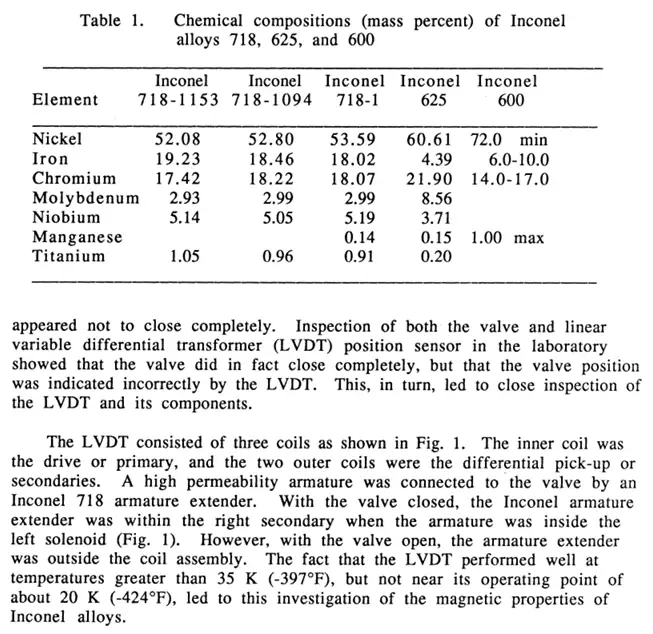
Some Inconel variants or production deviations contain higher iron fractions. Even a small increase in iron (a few weight percent) can amplify susceptibility substantially. Published studies demonstrate that a 1% rise in iron content can raise susceptibility by an order of magnitude in certain compositions. That sensitivity explains why different batches or grades may test differently.
Heat treatments, precipitates, or phase separation
Certain thermal cycles produce precipitates or local compositional changes that alter magnetic response. For example, formation of chromium carbides at grain boundaries does not typically make the bulk ferromagnetic, but complex phase evolution under service can create regions with altered magnetic properties.
Low-temperature magnetic phenomena
At cryogenic temperatures researchers have reported spin glass states and multiple magnetic phases in several nickel-base alloys, including alloy 718 and alloy 600. These effects occur well below room temperature (often under ~20 kelvin) and are relevant to fundamental physics or cryogenic sensor work rather than routine engineering.
Comparison table — common Inconel grades and practical magnetic behavior
| Alloy (typical UNS) | Typical use | Magnetic behavior in annealed/solution state | Notes on when magnetism appears |
|---|---|---|---|
| Inconel 625 (UNS N06625) | Corrosion resistance, chemical process | Essentially non-magnetic (µr≈1) | Cold work or high iron contamination may give weak response. |
| Inconel 600 (UNS N06600) | Furnaces, heat exchangers | Generally non-magnetic; some batches show slight magnetism | Microstructure, composition variations can cause weak ferromagnetism. |
| Inconel 718 (UNS N07718) | High strength, aerospace | Non-magnetic in standard heat-treated state; low permeability measured | Cold working, certain aging cycles, or iron content changes can increase susceptibility; cryogenic spin glass behavior reported. |
| Inconel X-750 (UNS N07750) | Springs, fasteners | Mostly non-magnetic; can show magnetism after extensive cold work | Precipitation hardening microstructure influences response. |
| Inconel 925 / 925-type | Corrosion resistance in seawater | Typically non-magnetic after anneal | Processing history affects reading. |
(Table compiled from manufacturer data sheets, material property databases, and peer-reviewed studies.)
How to test Inconel for magnetism — practical methods
If your application requires verification, here are tests ranked by accessibility and sensitivity.
Simple magnet test
A neodymium or ceramic magnet will quickly reveal strongly ferromagnetic material. If the magnet sticks strongly, the piece is ferromagnetic. Weak attraction is possible with cold-worked or contaminated Inconel.
Pros: Fast, zero cost.
Cons: Not quantitative; small paramagnetism may not be noticeable.
Magnetic permeability probe
Handheld probes measure relative permeability (µr). Typical Inconel in standard condition reads close to 1.00–1.01; steels exceed that by orders of magnitude.
Pros: Portable and quantitative for engineering acceptability.
Cons: Probe calibration needed for precise values.
Vibrating sample magnetometer (VSM) or SQUID
Laboratory instruments measure magnetization versus applied field and temperature. VSM and SQUID systems detect tiny moments and can map paramagnetic or spin glass effects, especially at cryogenic temperatures.
Pros: High sensitivity and full characterization.
Cons: Requires laboratory access.
Eddy current and non-destructive electromagnetic sensors
Eddy current instruments used in NDT can sense changes in conductivity and magnetic permeability; they are useful for surface or near-surface checks on parts in production.
Pros: Non-contact, suitable for production screening.
Cons: Interpretation depends on geometry and finish.
Magnetic particle inspection (MPI)
MPI detects surface and near-surface discontinuities in ferromagnetic materials; it will not work on non-magnetic Inconel unless the part became ferromagnetic.
Pros: Standard for ferromagnetic parts.
Cons: Not suitable for non-magnetic alloys.
Design and application implications
Engineers need to decide whether Inconel’s magnetic behavior matters. Below are common concerns and practical guidance.
MRI and medical imaging compatibility
MRI systems are extremely sensitive to ferromagnetic materials. For implantable devices, strict testing and certification are required. In most cases annealed Inconel alloys pose minimal disturbance, but each lot should be confirmed with magnetic testing and traceable documentation before use in MR environments.
Sensors and instrumentation
If parts sit near magnetic sensors or magnetometers, even small localized magnetism can skew measurements. For critical sensor integration, prefer solution-treated Inconel and verify with quantitative probes.
Aerospace and turbomachinery
Inconel is widely used in rotating and high-temperature components. Residual magnetism typically does not harm turbine operation; however, magnetic particles are used in some inspection methods and could be attracted to magnetized areas, complicating maintenance.
Electrical and electromagnetic compatibility (EMC)
For assemblies with coils, encoders, or magnetic shielding, confirm the magnetic profile of each alloy batch during qualification to avoid unexpected coupling or eddy losses.
Welding, heat treatment, and finishing effects
Processing history can modify magnetic behavior.
-
Welding: Fusion and heat-affected zones may undergo microstructural changes. Post-weld heat treatment and solution anneal often restore the non-magnetic austenitic state. Welding filler selection and procedure specifications influence final response.
-
Aging/precipitation hardening: Alloys such as 718 age to strengthen; some age conditions influence magnetic susceptibility slightly because of precipitate formation and local strain.
-
Cold forming and machining: Severe cold deformation may increase magnetic response. Light machining does not typically change the bulk magnetic behavior, but grinding and heavy forming can.
-
Surface treatments and carburization: Long exposure in carburizing atmospheres can alter surface chemistry (e.g., chromium depletion) which was reported to change surface magnetism in rare cases. Practical implication: inspect parts from aggressive environments for surface condition.
Measured properties summary (concise table)
| Property | Typical value / behavior |
|---|---|
| Relative magnetic permeability (annealed Inconel 718) | ≈ 1.001–1.01 (very near 1) |
| Magnetic susceptibility (varies with composition) | Very low at room temperature; increases with iron content and cold work. |
| Curie or magnetic transition | No ferromagnetic Curie transition near room temperature for typical Inconel; special low-temperature phases observed below ~20 K in research. |
| Practical magnet test result | Magnet will not strongly adhere in normal condition; weak pull may be detected after processing. |
Practical recommendations for procurement and QA
-
Specify condition: require solution-treated and aged or annealed state on drawings when non-magnetic behavior is necessary.
-
Include test method: request permeability or magnetometer readings (e.g., µr ≤ 1.02) and acceptance limits.
-
Trace composition: control iron content tolerances if magnetic neutrality is critical.
-
Accept batch certification: supplier certificates referencing manufacturer datasheets reduce surprises.
-
Post-process inspection: implement simple magnet checks at receiving or after finishing.
Frequently asked questions
1. Is Inconel magnetic at room temperature?
Short answer: No for commonly produced, annealed, or solution-treated Inconel; the material behaves non-ferromagnetically under normal conditions.
2. Can Inconel become magnetic after cold work?
Yes. Severe cold deformation may produce regions with higher susceptibility and weak magnetic attraction. For critical parts avoid heavy cold work or re-heat treat after forming.
3. Which Inconel grades are safest when magnetism is a concern?
Grades with high nickel and stable austenitic microstructures, like 625 and properly treated 718, are commonly used when non-magnetic behaviour is desired.
4. Will a magnet stick strongly to Inconel 718?
Under normal conditions no. If a strong attraction is observed, investigate processing history and composition for contamination or excessive deformation.
5. Are there temperature ranges where Inconel becomes magnetic?
Research reports unusual magnetic phases at cryogenic temperatures (below ~20 K) for some alloys; these are not relevant for most industrial use.
6. Is Inconel safe for MRI environments?
Many forms of Inconel cause minimal field distortion but strict testing and documentation are needed for any part used near MR scanners. Do not assume MRI safety without certification.
7. How should I specify magnetic testing on purchase orders?
Request a permeability reading and an acceptance limit, for example: relative permeability µr ≤ 1.02 measured at 10 kHz with an approved probe; include sample size and orientation. Work with your supplier to agree on method and calibration.
8. Can heat treatment remove induced magnetism?
Proper solution annealing followed by correct aging or cooling often restores the austenitic, non-magnetic microstructure. Follow alloy manufacturer heat treatment sheets.
9. Will surface contamination affect magnetism?
Yes. Magnetic particles embedded in or adhered to the surface can produce perceived magnetism. Cleanliness and surface inspection reduce false positives.
10. Where can I find authoritative data on magnetic properties?
Manufacturer technical bulletins, material databases, and peer-reviewed studies list permeability, susceptibility, and composition ranges. See the reference list provided below for immediate links.
Closing summary
For engineers choosing materials for low-magnetic or magnetically neutral applications, Inconel alloys are frequently appropriate when delivered in proper condition. However, do not treat “non-magnetic” as absolute — processing, composition variance, and extreme environments can change the magnetic profile. Specify material state, test criteria, and acceptance limits in procurement documents, and perform quick magnet checks plus targeted quantitative tests when required. Where ultimate certainty is required (medical implants, cryogenic sensor mounts, or precision magnetics), request laboratory magnetization curves or supply samples for VSM/SQUID testing.