

Hastelloy C276 plate is one of the most chemically resistant nickel alloys available today, and choosing it correctly can extend equipment service life by 3–5x while cutting unplanned downtime costs by up to 60%. At MWalloys, we stock ASTM B575-certified Hastelloy C276 plate in thicknesses from 1.5 mm to 100 mm, offer precision cut-to-size services, and ship globally within 5–7 business days. Whether you are a process engineer specifying corrosion barriers for sulfuric acid service or a procurement manager sourcing certified plate for a turnaround project, this guide consolidates every critical technical, commercial, and operational data point you need — all in one place.
If your project requires the use of Hastelloy C276 Plate, you can contact us for a free quote.
What Is Hastelloy C276 Plate and Why Does It Outperform Standard Stainless Steel?
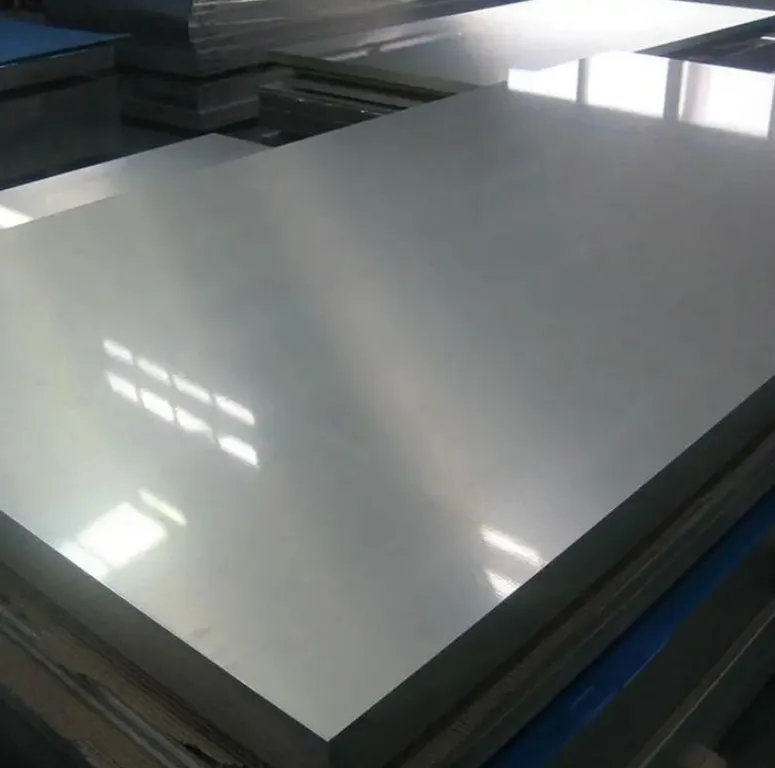
Hastelloy C276 plate is a wrought nickel-molybdenum-chromium alloy plate product manufactured to UNS N10276 specifications. The alloy was originally developed by Haynes International in the 1960s specifically to handle environments where standard austenitic stainless steels — including 316L and 317L — fail within months or even weeks.
The fundamental reason C276 outperforms stainless steel is its alloy architecture. Where 316L stainless steel contains roughly 10–12% nickel, Hastelloy C276 contains 57% nickel as its base element. This high nickel matrix provides inherent resistance to chloride-induced stress corrosion cracking — one of the most common and catastrophic failure modes in chemical processing equipment. Add 15–17% molybdenum for resistance to pitting and crevice corrosion in reducing environments, 14.5–16.5% chromium for oxidizing acid resistance, and 3–4.5% tungsten for additional crevice corrosion protection, and you have an alloy that functions reliably where virtually nothing else can.
We have worked with process engineers across the phosphoric acid, pharmaceutical, and offshore oil sectors, and a recurring theme is the "last resort" reputation of C276. Engineers often turn to it after a series of premature failures with 316L, duplex 2205, or even 904L. In almost every documented case, switching to C276 plate extended service intervals significantly — sometimes by factors of 3 to 5 over the previous material.
From a structural standpoint, C276 plate also maintains its mechanical integrity at elevated temperatures. Its minimum tensile strength of 100 ksi (690 MPa) in the annealed condition, combined with good ductility (40% minimum elongation), makes it suitable for pressure vessel and heat exchanger applications where both corrosion resistance and structural load-bearing capacity are required simultaneously.
Why "Standard" Materials Fail in High-Corrosion Environments
The most expensive mistake in industrial plant design is underspecifying materials. When a cheaper alloy fails — whether through pitting, stress corrosion cracking, or uniform thinning — the true cost extends well beyond the replacement plate itself. Unplanned shutdowns in chemical processing plants can cost anywhere from $10,000 to $500,000 per day depending on plant throughput and downstream dependencies. Pipe and vessel replacements require scaffolding, specialized labor, hot work permits, and production losses that dwarf the original material savings.
Hastelloy C276 plate, properly specified and certified to ASTM B575, eliminates this cycle of premature failure and costly replacement. The investment premium over 316L stainless — typically 4–6x per kilogram — is almost always recovered within the first replacement cycle that never has to happen.
How Does ASTM B575 Certification Protect Your Application?
ASTM B575 is the governing standard published by ASTM International (now ASTM International, formerly American Society for Testing and Materials) that covers the requirements for low-carbon nickel-chromium-molybdenum, nickel-chromium-molybdenum-copper, and nickel-chromium-molybdenum-tungsten alloy plate, sheet, and strip. For Hastelloy C276 specifically, compliance with ASTM B575 means the material has been manufactured, tested, and documented to meet strict chemical, mechanical, and corrosion testing criteria.
What ASTM B575 Specifically Requires
| Requirement Category | ASTM B575 Specification Detail |
|---|---|
| Chemical composition verification | Full elemental analysis per heat |
| Tensile properties | Minimum tensile and yield strength, minimum elongation |
| Hardness testing | Brinell or Rockwell as applicable |
| Grain size | Per ASTM E112 when required |
| Corrosion testing | ASTM G28 Method A (ferric sulfate-sulfuric acid test) |
| Heat treatment | Solution annealing required; temperature and time documented |
| Surface finish | Specified surface condition per order |
| Dimensional tolerances | Thickness, width, length, flatness per ASTM tolerances |
| Mill test report | Certified material test report (CMTR) required |
| Third-party verification | Available upon request |
The corrosion test requirement — ASTM G28 Method A — is particularly significant. This test immersed the material in a boiling ferric sulfate-sulfuric acid solution for 120 hours and measures the corrosion rate in mils per year (mpy). C276 plate must not exceed 25 mpy to pass. This provides objective, quantitative evidence that the material's corrosion resistance has not been compromised by improper heat treatment or contamination during manufacturing.
From a procurement standpoint, ASTM B575 certification means your vendor carries documented proof of conformance. At MWalloys, every plate we stock is supported by a Certified Material Test Report (CMTR) that includes the heat number, chemical analysis, mechanical test results, and corrosion test results. This documentation is not just a paperwork formality — it is the legal and technical foundation for your quality management system, insurance compliance, and regulatory approvals, particularly in pharmaceutical and nuclear applications.
PED, NACE, and Other Cross-Referencing Standards
ASTM B575 does not stand alone. In practice, C276 plate applications often require cross-compliance with multiple standards:
- ASME Section II Part B (SB-575): The ASME pressure vessel code adopts ASTM B575 with additional requirements for pressure vessel construction.
- NACE MR0175 / ISO 15156: For sour gas (H2S) service in oil and gas applications.
- EN 10204 Type 3.1 or 3.2: European material certification requirements.
- RoHS / REACH: For European Union regulatory compliance.
- PED 2014/68/EU: Pressure Equipment Directive for equipment sold in Europe.
Understanding which standards apply to your application early in the specification process prevents costly re-certification or material rejection during final inspection.
What Are the Exact Chemical Composition Requirements for Hastelloy C276?
Hastelloy C276 (UNS N10276 / W.Nr. 2.4819) has a tightly controlled chemical composition that is central to its performance. The alloy's remarkable corrosion resistance is not accidental — it results from deliberate elemental balance.
Chemical Composition Table (ASTM B575 / UNS N10276)
| Element | Minimum (%) | Maximum (%) | Function |
|---|---|---|---|
| Nickel (Ni) | 57.0 (balance) | — | Base matrix, chloride SCC resistance |
| Molybdenum (Mo) | 15.0 | 17.0 | Pitting and crevice corrosion resistance |
| Chromium (Cr) | 14.5 | 16.5 | Oxidizing acid resistance |
| Iron (Fe) | 4.0 | 7.0 | Structural support, cost modifier |
| Tungsten (W) | 3.0 | 4.5 | Additional crevice corrosion resistance |
| Cobalt (Co) | — | 2.5 | Controlled for nuclear applications |
| Manganese (Mn) | — | 1.0 | Deoxidizer |
| Carbon (C) | — | 0.010 | Low carbon prevents sensitization |
| Silicon (Si) | — | 0.08 | Controlled for weldability |
| Phosphorus (P) | — | 0.04 | Impurity control |
| Sulfur (S) | — | 0.03 | Impurity control |
| Vanadium (V) | — | 0.35 | Minor alloying element |
The Critical Role of Low Carbon (0.010% Maximum)
The 0.010% maximum carbon limit is perhaps the most consequential single specification in the entire chemistry table. At elevated temperatures, carbon in nickel alloys can combine with chromium to form chromium carbides at grain boundaries — a process called sensitization. Sensitized material has chromium-depleted zones adjacent to grain boundaries, creating preferential corrosion pathways.
The "C" in Hastelloy C276 was the standard alloy. The "W" (or low-carbon version) designation history led to what we now specify as C276 with a 0.010% carbon maximum. This ultra-low carbon ensures the material remains immune to sensitization during welding and thermal processing — a critical advantage in fabricated components that will undergo multiple weld passes.
We consistently recommend verifying carbon content on every CMTR received. We have seen instances where plates ordered as "C276" carried slightly elevated carbon from certain mills, which compromised as-welded corrosion performance. Always check the CMTR, not just the mill's marketing specification.
What Mechanical Properties Should Engineers Expect From C276 Plate?
Mechanical properties define whether a plate can perform structurally in addition to chemically. For pressure vessel, heat exchanger, and structural lining applications, knowing the exact property ranges guides wall thickness calculations and weld joint efficiency factors.
Mechanical Properties at Room Temperature (Annealed Condition)
| Property | Minimum Requirement | Typical Value | Test Standard |
|---|---|---|---|
| Ultimate Tensile Strength | 100 ksi (690 MPa) | 109–115 ksi (750–793 MPa) | ASTM E8 |
| 0.2% Yield Strength | 41 ksi (283 MPa) | 52–58 ksi (358–400 MPa) | ASTM E8 |
| Elongation (2 inch gauge) | 40% | 55–65% | ASTM E8 |
| Hardness (Brinell) | — | 180–220 HBW | ASTM E10 |
| Hardness (Rockwell B) | — | 87–96 HRB | ASTM E18 |
| Reduction in Area | — | 60–70% | ASTM E8 |
Mechanical Properties at Elevated Temperatures
One of the underappreciated advantages of C276 is its retention of mechanical strength at temperatures well above ambient. This makes it suitable for jacketed vessels, autoclaves, and high-temperature acid services where lesser alloys would experience creep or thermal fatigue.
| Temperature | Tensile Strength (ksi) | Yield Strength (ksi) | Elongation (%) |
|---|---|---|---|
| Room Temperature (70°F) | 109–115 | 52–58 | 55–65 |
| 400°F (204°C) | 96–102 | 42–48 | 50–60 |
| 600°F (316°C) | 90–96 | 39–45 | 48–58 |
| 800°F (427°C) | 85–92 | 37–43 | 45–55 |
| 1000°F (538°C) | 79–87 | 35–41 | 42–52 |
| 1200°F (649°C) | 67–75 | 33–39 | 40–50 |
Physical Properties Relevant to Design
| Property | Value | Unit |
|---|---|---|
| Density | 8.89 | g/cm³ (0.321 lb/in³) |
| Melting Range | 1325–1370 | °C (2415–2500°F) |
| Thermal Conductivity at 100°C | 10.2 | W/m·K |
| Coefficient of Thermal Expansion (21–93°C) | 11.2 | μm/m·°C |
| Specific Heat at 21°C | 427 | J/kg·K |
| Electrical Resistivity | 1.30 | μΩ·m |
| Modulus of Elasticity | 205 | GPa (29.8 × 10⁶ psi) |
These physical properties are directly relevant to thermal stress calculations, heat transfer modeling, and thermal expansion joint design — all areas where we have seen engineers save significant engineering time by having consolidated data from a single reliable source.
Which Corrosive Environments Is Hastelloy C276 Plate Specifically Designed For?
Understanding the corrosion performance envelope of C276 plate is the foundation of correct material specification. The alloy performs across an unusually broad range of corrosive media — but not universally. Knowing both its strengths and limitations protects your application.
Corrosion Resistance by Media Type
| Corrosive Medium | Concentration Range | Temperature Range | C276 Performance Rating |
|---|---|---|---|
| Hydrochloric acid (HCl) | Up to 20% | Up to 120°C | Excellent |
| Sulfuric acid (H₂SO₄) | Up to 40% (reducing) | Up to 80°C | Very Good |
| Phosphoric acid (H₃PO₄) | Up to 85% | Up to 100°C | Excellent |
| Nitric acid (HNO₃) | Up to 20% | Ambient | Good (limited) |
| Hydrofluoric acid (HF) | Dilute to moderate | Ambient to 50°C | Very Good |
| Acetic acid | All concentrations | Up to 150°C | Excellent |
| Formic acid | All concentrations | Up to boiling | Excellent |
| Ferric chloride | Up to 10% | Ambient to 60°C | Very Good |
| Seawater / chloride solutions | All concentrations | Up to 100°C | Excellent |
| Wet chlorine gas | — | Ambient | Very Good |
| Sodium hypochlorite | Up to 15% | Ambient | Very Good |
| Flue gas / mixed acid condensates | Mixed | 50–200°C | Excellent |
| Hydrogen sulfide (H₂S sour gas) | — | — | Excellent (NACE compliant) |
What C276 Cannot Reliably Handle
No alloy is universally resistant. C276 has known limitations that engineers must understand:
Oxidizing acids at high concentration: Nitric acid above 30% concentration, or mixed nitric-hydrofluoric acid systems at elevated temperatures, can attack C276. Alloys like C22 or C2000 with higher chromium content may perform better in these specific conditions.
Strong oxidizing halide salts: Ferric chloride at high concentrations combined with high temperature can cause accelerating pitting even in C276.
Molten alkali metals: Not suitable.
High-temperature sulfidation above 500°C: At very high temperatures in reducing sulfur atmospheres, alternative refractory alloys are required.
Hydrofluoric acid above 60% concentration: Corrosion rates increase substantially.
We always recommend running site-specific corrosion coupons for critical applications rather than relying solely on published corrosion tables. Published data represents laboratory conditions; your process stream likely contains multiple species that can either accelerate or inhibit corrosion unpredictably.
Pitting and Crevice Corrosion: Understanding PREN
The Pitting Resistance Equivalent Number (PREN) is a calculated index of a material's resistance to pitting corrosion in chloride environments:
PREN = %Cr + 3.3(%Mo) + 16(%N)
For Hastelloy C276: PREN ≈ 16 + 3.3(16) + 0 ≈ 68.8
Compare this to:
- 316L stainless steel: PREN ≈ 24
- Duplex 2205: PREN ≈ 35–40
- Super duplex 2507: PREN ≈ 42–45
- Alloy 625: PREN ≈ 51
C276's PREN of approximately 69 explains why it functions reliably in seawater heat exchangers, chlorinated process streams, and offshore environments where 316L, duplex, and even super duplex stainless steels fail prematurely.
How Does Cut-to-Size Service Reduce Fabrication Costs and Material Waste?
Purchasing Hastelloy C276 plate cut to your exact dimensions is one of the most effective ways to control total project cost. The mathematics are straightforward, but the operational impact is substantial.
The True Cost of Purchasing Full Mill Plates
Standard Hastelloy C276 mill plates are supplied in dimensions typically ranging from 1,500 mm × 3,000 mm to 2,000 mm × 6,000 mm depending on thickness. For many fabrication projects, the actual required plate dimensions are significantly smaller. When fabricators purchase full mill plates and cut them in-house, several cost centers activate simultaneously:
- Saw or plasma cutting labor at specialty alloy rates ($80–$150/hour)
- Specialized cutting equipment maintenance and depreciation
- Offcut inventory management — C276 offcuts cannot simply be scrapped at scrap value; the market for small pieces is limited
- Potential contamination risk — using generic cutting equipment on C276 without proper cleaning protocols can introduce iron contamination that initiates surface corrosion
By ordering cut-to-size C276 plate from MWalloys, you eliminate all these cost centers and receive plates dimensionally verified within ±0.5 mm tolerance, with mill edges or saw-cut edges as specified.
MWalloys Cut-to-Size Capabilities
| Capability | Specification |
|---|---|
| Minimum thickness | 1.5 mm |
| Maximum thickness | 100 mm |
| Minimum width | 25 mm |
| Maximum width | 2,500 mm |
| Minimum length | 25 mm |
| Maximum length | 6,000 mm |
| Cutting method | Waterjet, plasma, sawing (material-dependent) |
| Dimensional tolerance | ±0.5 mm standard; ±0.25 mm precision |
| Edge finish | Mill edge, saw cut, milled, or deburred |
| Surface finish | 2B, 2D, hot-rolled, or custom |
| Lead time | 5–7 business days standard; express available |
| Documentation | CMTR included; NACE/PED certs available |
Material Savings Calculation Example
Consider a project requiring 20 pieces of C276 plate at 300 mm × 500 mm × 10 mm thickness.
Full mill plate approach:
- Purchase two 1,500 × 3,000 × 10 mm plates
- Actual required area: 20 × (0.3 × 0.5) = 3.0 m²
- Mill plate area purchased: 2 × (1.5 × 3.0) = 9.0 m²
- Utilization: 33%
- 67% of material either wasted or placed in offcut inventory
Cut-to-size approach:
- Purchase exactly 20 pieces at required dimensions
- 100% utilization of purchased material
- No in-house cutting labor, no offcut management
At C276 plate pricing of approximately $120–$180/kg (market-dependent), a 6 m² reduction in material waste on 10 mm plate (density 8.89 g/cm³) represents material cost savings of approximately $6,400–$9,600 on a single order — before accounting for cutting labor savings.
What Thickness and Dimension Options Are Available In-Stock?
Availability matters as much as specifications in time-sensitive maintenance and construction situations. MWalloys maintains a strategic in-stock inventory specifically structured to serve emergency shutdowns, turnaround projects, and fast-track fabrication programs.
Standard In-Stock Thickness Range
| Thickness (mm) | Thickness (inches) | Width Options (mm) | Surface Condition |
|---|---|---|---|
| 1.5 | 0.060" | 1000, 1500, 2000 | 2B annealed |
| 2.0 | 0.079" | 1000, 1500, 2000 | 2B annealed |
| 3.0 | 0.118" | 1000, 1500, 2000 | 2B annealed |
| 4.0 | 0.157" | 1000, 1500, 2000 | 2B / Hot rolled |
| 5.0 | 0.197" | 1000, 1500, 2000 | 2B / Hot rolled |
| 6.0 | 0.236" | 1000, 1500, 2000 | Hot rolled annealed |
| 8.0 | 0.315" | 1000, 1500, 2000 | Hot rolled annealed |
| 10.0 | 0.394" | 1000, 1500, 2000 | Hot rolled annealed |
| 12.0 | 0.472" | 1000, 1500, 2000 | Hot rolled annealed |
| 15.0 | 0.591" | 1000, 1500 | Hot rolled annealed |
| 20.0 | 0.787" | 1000, 1500 | Hot rolled annealed |
| 25.0 | 0.984" | 1000, 1500 | Hot rolled annealed |
| 30.0 | 1.181" | 1000 | Hot rolled annealed |
| 40.0 | 1.575" | 1000 | Hot rolled annealed |
| 50.0 | 1.969" | 1000 | Hot rolled annealed |
| 60–100 | 2.362"–3.937" | 1000 (spot availability) | Hot rolled annealed |
Thicknesses above 50 mm are primarily used in block applications, tooling, and heavy reactor vessel construction. For thicknesses above 100 mm, we can source from our mill partnerships with typical lead times of 8–12 weeks.
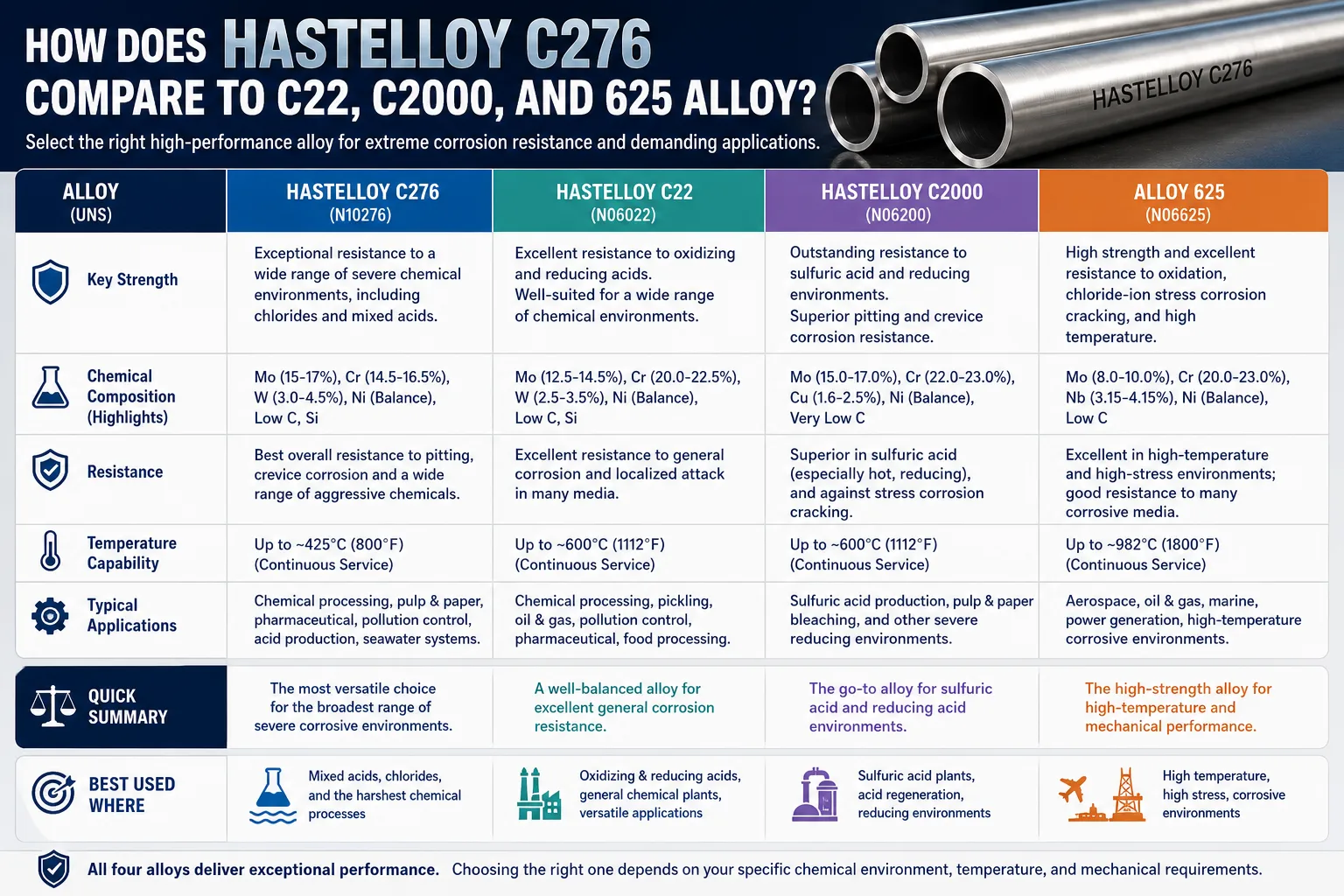
How Does Hastelloy C276 Compare to C22, C2000, and 625 Alloy?
Selecting the correct nickel alloy for a specific corrosive application requires understanding the differences between related alloys. C276 is not always the optimal choice — and knowing when to specify an alternative prevents both overspending and underperformance.
Comparative Alloy Properties and Applications
| Property | C276 (N10276) | C22 (N06022) | C2000 (N06200) | Alloy 625 (N06625) |
|---|---|---|---|---|
| Nickel content | 57% | 56% | 59% | 61% |
| Molybdenum | 15–17% | 12.5–14.5% | 15–17% | 8–10% |
| Chromium | 14.5–16.5% | 20–22.5% | 22–24% | 20–23% |
| Tungsten | 3–4.5% | 2.5–3.5% | — | — |
| Copper | — | — | 1.3–1.9% | — |
| Carbon max | 0.010% | 0.015% | 0.010% | 0.10% |
| PREN (approx.) | 69 | 67 | 72 | 51 |
| Tensile strength (min) | 100 ksi | 100 ksi | 100 ksi | 120 ksi |
| Primary strength | Reducing acid, HCl, chlorides | Mixed acid service, oxidizing | Broadest spectrum | High strength, fatigue |
| Relative cost index | 1.0 | 1.1–1.2 | 1.2–1.3 | 0.85–0.95 |
| ASTM plate standard | B575 | B575 | B575 | B443 |
When to Choose C276 Over Alternatives
Choose C276 when:
- The primary corrosive species is hydrochloric acid, wet chlorine gas, or concentrated chloride solutions.
- The service environment is predominantly reducing in nature.
- Pitting and crevice corrosion in chloride-rich media is the primary failure mechanism.
- Mixed acid condensates (common in flue gas desulfurization systems) are present.
- Sour gas service requires NACE MR0175 compliance.
Consider C22 instead when:
- The environment cycles between strongly oxidizing and reducing conditions.
- Nitric acid, chromic acid, or highly oxidizing media are present alongside chlorides.
- Welded structures require maximum as-welded corrosion resistance in complex environments.
Consider C2000 instead when:
- Sulfuric acid at medium concentrations combined with chlorides is the primary concern.
- Copper's inherent corrosion resistance benefit in specific acid systems is advantageous.
- Maximum PREN across the broadest possible media spectrum is required.
Consider Alloy 625 instead when:
- High strength, fatigue resistance, or cryogenic properties are the primary drivers.
- The application involves aqueous chloride environments without strong reducing acids.
- Cost reduction is possible without sacrificing adequate corrosion resistance.
- Seawater service with mechanical loading (offshore risers, flexible pipe armor).
What Welding, Forming, and Machining Considerations Apply to C276 Plate?
Hastelloy C276 plate requires specific handling procedures during fabrication. Understanding these requirements protects the material's corrosion resistance and prevents premature failure in service.
Welding C276 Plate
C276 is considered one of the more weldable nickel superalloys, but proper procedures must be followed:
Preferred Welding Processes:
- Gas Tungsten Arc Welding (GTAW/TIG): Preferred for critical applications; provides highest quality welds with full fusion control.
- Gas Metal Arc Welding (GMAW/MIG): Acceptable for thicker sections with proper parameters.
- Plasma Arc Welding (PAW): Suitable for thin gauge plate.
- Shielded Metal Arc Welding (SMAW): Acceptable with ERNiCrMo-4 electrodes.
Filler Metal: AWS ERNiCrMo-4 (matching composition) is the standard filler metal for C276-to-C276 welds. This filler maintains the chemical composition and corrosion resistance of the base metal through the weld zone.
Critical Welding Parameters:
| Parameter | Recommendation |
|---|---|
| Preheat | Not required at room temperature ambient conditions |
| Interpass temperature | Maximum 93°C (200°F) — critical to control |
| Heat input | Minimize; use stringer beads, not weaving |
| Post-weld heat treatment | Solution annealing at 1066–1121°C (1950–2050°F) improves corrosion resistance |
| Shielding gas | Argon or argon-helium mixtures; high-purity grade |
| Cleanliness | Remove all oil, grease, paint, and iron contamination before welding |
The interpass temperature limit of 93°C is non-negotiable. Exceeding it allows precipitation of secondary phases at grain boundaries, which dramatically reduces corrosion resistance in the heat-affected zone. We have seen HAZ corrosion failures attributed directly to excessive interpass temperature — an entirely preventable failure mode.
Forming C276 Plate
C276 plate can be cold-formed or hot-formed, but its work-hardening rate is higher than austenitic stainless steel. This means more force is required, and the alloy springs back more after forming. Key considerations:
- Cold forming: Possible, but requires equipment capable of 50–100% greater force than equivalent 316L operations. Intermediate annealing may be required for severe forming operations.
- Hot forming: Performed in the range of 900–1175°C (1650–2150°F). Material must be solution annealed after hot forming to restore corrosion resistance.
- Minimum bend radius: Typically 1.5–2.0× plate thickness for cold bending; tighter radii possible with hot forming.
- Avoid forming below 15°C (60°F): Cold temperatures increase crack susceptibility.
Machining C276 Plate
C276 is machinable but requires appropriate tooling and parameters. The alloy work-hardens rapidly, so interrupted cuts and tool dwelling must be avoided.
| Machining Parameter | Recommendation |
|---|---|
| Tooling | Solid carbide or carbide-tipped; coated grades preferred |
| Cutting speed (turning) | 20–40 m/min (65–130 ft/min) |
| Feed rate | Moderate; maintain continuous chip flow |
| Depth of cut | Sufficient to remain below work-hardened surface layer |
| Cutting fluid | High-quality water-soluble coolant; chloride content < 50 ppm |
| Drill speed | 30–50% of speed used for 304 stainless |
| Avoid | Dull tools, interrupted cuts, tool dwelling in cut |
How Do You Calculate Total Cost of Ownership for C276 Plate vs. Cheaper Alternatives?
The total cost of ownership (TCO) analysis is the most persuasive tool available for justifying C276 plate to procurement teams focused on initial unit price. The math consistently favors C276 in aggressive service environments.
TCO Framework for Plate Selection
| Cost Component | 316L SS Plate | Duplex 2205 Plate | Hastelloy C276 Plate |
|---|---|---|---|
| Material cost (relative index) | 1.0 | 2.2 | 6.5 |
| Expected service life in HCl service | 12–24 months | 18–36 months | 8–15 years |
| Replacement cycles over 10 years | 5–10 | 3–6 | 0–1 |
| Replacement installation labor | High recurring | Moderate recurring | Minimal |
| Unplanned shutdown risk | High | Moderate | Very low |
| Inspection frequency required | High | Moderate | Low |
| Total 10-year cost (relative index) | 3.5–7.0 | 2.5–4.0 | 1.0 (baseline best value) |
Real-World Cost Calculation Example
Scenario: 10 mm thick acid neutralization tank lining, 50 m² total area, HCl service at 10% concentration, 80°C operating temperature.
316L Stainless Steel:
- Material cost: 50 m² × 10 mm × 7.93 g/cm³ × $8/kg ≈ $31,720
- Expected life: 18 months before pinhole corrosion through lining
- Replacement cycles in 10 years: ~6.5
- Cumulative material cost: ~$206,180
- Downtime and labor per replacement: $40,000–$80,000
- Total 10-year TCO: $466,180–$726,180
Hastelloy C276:
- Material cost: 50 m² × 10 mm × 8.89 g/cm³ × $130/kg ≈ $578,500
- Expected life: 10–15 years (one cycle covers the comparison period)
- Replacement cycles in 10 years: 0–1
- Cumulative material cost: $578,500–$1,157,000 (worst case with one replacement)
- Downtime and labor: $0–$50,000
- Total 10-year TCO: $578,500–$1,207,000 (worst case, best case $578,500)
At first glance the numbers look closer than expected — but this example uses the most aggressive worst-case C276 scenario. When C276 achieves 15-year life (documented in multiple phosphoric acid plant applications), the TCO comparison shifts decisively: $578,500 for C276 vs. $726,180 for 316L, with C276 providing additional benefits of zero unplanned shutdowns and no lost production revenue.
The production loss calculation is where C276 always wins. A single unplanned 3-day shutdown in a medium-sized chemical plant can represent $150,000–$600,000 in lost production — far exceeding any material cost differential.
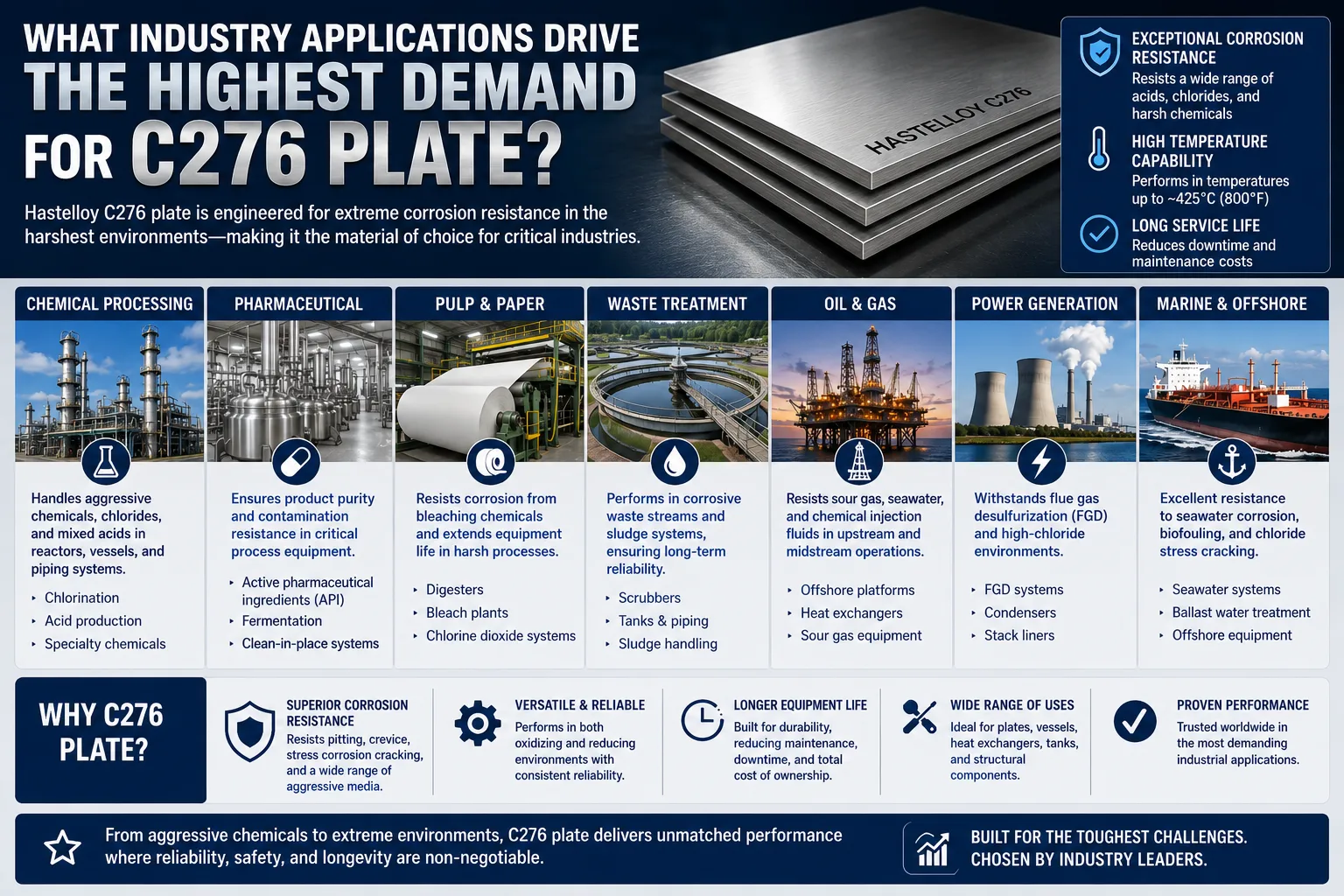
What Industry Applications Drive the Highest Demand for C276 Plate?
Hastelloy C276 plate serves a defined set of industries where corrosion severity, regulatory requirements, and process criticality justify the material's cost. Understanding these applications helps both engineers and buyers contextualize their procurement decisions.
Chemical Processing Industry
The chemical processing industry (CPI) accounts for the largest share of C276 plate consumption globally. Key applications include:
- Reactor vessels and pressure vessels: Particularly in HCl synthesis, chlorinated organic production, and pharmaceutical intermediate synthesis.
- Heat exchanger tube sheets: Where the channel-side carries aggressive acids and tube sheet corrosion is the life-limiting component.
- Column and tower internals: Distillation columns handling acetic acid, formic acid, or chlorinated solvents.
- Pipe and valve linings: Both as solid C276 plate linings and as applied cladding over carbon steel substrates.
- Scrubber systems: Gas scrubbing where HCl, HF, SO₂, and chlorine gas are absorbed into liquid streams.
Flue Gas Desulfurization (FGD) Systems
Power plant FGD systems represent one of the most demanding applications for C276 plate. The absorber vessel interior sees a combination of dilute sulfuric acid, chloride ions, pH fluctuations, abrasion from slurry, and elevated temperature — conditions that consume even high-alloy stainless steels rapidly. C276 plate is used for absorber tower linings, scrubber walls, and slurry holding tanks in these systems.
Pharmaceutical Manufacturing
Pharmaceutical processes require not only chemical resistance but also material biocompatibility, traceability, and cleanability. C276 plate is used in pharmaceutical reactors, mixing vessels, and process piping where aggressive reagents — including HCl, acetic acid, solvents, and oxidizing cleaning agents — are encountered. The 2B surface finish available on C276 plate meets cleanroom and sanitary processing requirements.
Oil, Gas, and Petrochemical
- Sour gas service: H2S-containing wells require NACE MR0175-compliant materials; C276 qualifies.
- Offshore heat exchangers: Seawater-cooled heat exchangers where chloride SCC eliminates stainless steel options.
- Wellhead and downhole components: Plate used in clad overlay applications for pressure vessels.
- Refinery acid alkylation units: Hydrofluoric acid alkylation reactors use C276 for vessel linings and agitator components.
Pollution Control and Environmental Engineering
- Waste incineration: HCl-containing flue gases combined with condensate creates among the most aggressive environments found in industry; C276 plate for ductwork and quench sections.
- Industrial wastewater treatment: Acid neutralization tanks, pH adjustment vessels.
- Electrochemical processing: Electroplating bath components, anodizing tanks.
Pulp and Paper
Kraft pulp digesters, bleach plant equipment, and chlorine dioxide generating systems all use C276 for components exposed to the combination of chlorides, acid, and elevated temperature that characterizes these processes.
How Do You Verify Mill Test Reports and Material Traceability?
Material traceability verification is non-negotiable in high-stakes applications. A plate that lacks verifiable traceability to a known mill heat is potentially counterfeit, recycled, or mislabeled — and the consequences of installing such material in a pressure vessel or chemical reactor can be catastrophic.
Step-by-Step CMTR Verification Process
Step 1: Confirm the heat number
Every piece of C276 plate should carry a heat number either stamped, stenciled, or etched on the material surface. Match this number to the CMTR. If the heat numbers don't match, stop immediately.
Step 2: Verify chemical composition
Cross-reference the CMTR chemical analysis against ASTM B575 UNS N10276 limits. Every element must fall within specification. Pay particular attention to carbon (max 0.010%), silicon (max 0.08%), and molybdenum (15–17%).
Step 3: Confirm mechanical properties
Verify that tensile strength, yield strength, and elongation all meet or exceed ASTM B575 minimums. Check which testing standard was used (should be ASTM E8 or equivalent).
Step 4: Review corrosion test results
ASTM G28 Method A corrosion test results should be present. Corrosion rate must not exceed 25 mpy.
Step 5: Confirm heat treatment
Solution annealing confirmation should be present, including temperature and time, or reference to the manufacturer's qualified procedure.
Step 6: Third-party verification (optional but recommended)
For critical applications, request PMI (Positive Material Identification) testing upon receipt. Handheld XRF analyzers can confirm key elements (Ni, Mo, Cr) against CMTR values within minutes.
Step 7: EN 10204 certificate type
Confirm whether the certificate is Type 2.2 (manufacturer's declaration — less rigorous) or Type 3.1 (validated by manufacturer's authorized representative) or Type 3.2 (validated by both manufacturer and independent inspector). Pressure vessel applications typically require 3.1 or 3.2.
At MWalloys, all stock material carries 3.1 certificates as standard. For nuclear or pharmaceutical applications requiring 3.2 certification with independent inspection, we coordinate with qualified third-party inspection agencies and can arrange at time of order.
FAQs
1: What is the difference between Hastelloy C276 plate and C276 sheet?
C276 sheet and plate differ primarily in thickness, manufacturing process, and applicable tolerances. Sheet refers to flat product with thickness below approximately 4.76 mm (3/16 inch), typically cold-rolled to 2B or bright-annealed surface finish. Plate refers to material 4.76 mm and above, typically hot-rolled and annealed. Both are covered by ASTM B575, but different thickness tolerance tables apply. For fabrication applications requiring precise flatness and controlled surface finish (pharmaceutical, food-grade), sheet is often preferred. For pressure vessel and structural applications requiring thickness and mechanical integrity, plate is specified. The chemical composition and corrosion resistance of both are identical when produced to UNS N10276. At MWalloys, we stock both forms and can advise on which is appropriate for your application based on service requirements and fabrication method.
2: Can Hastelloy C276 plate be used in hydrofluoric acid service?
Yes, C276 plate performs well in hydrofluoric acid (HF) service at concentrations up to approximately 60% and temperatures up to 65°C (150°F), making it one of the preferred materials for HF alkylation and pickling applications. Above 60% HF concentration or at elevated temperatures, corrosion rates increase and alternative materials — including Monel 400 (UNS N04400) — may outperform C276 in specific conditions. For anhydrous HF service, specialized PTFE-lined systems or Monel are more common. In mixed acid systems containing both HF and HNO₃ (bright dip in metal finishing), C276 is a primary material of choice due to its combined resistance to both acids. Always obtain site-specific corrosion data for HF service before final material selection, as trace contaminants in the process stream can significantly alter corrosion behavior.
3: What surface finish options are available for C276 plate from MWalloys?
MWalloys supplies Hastelloy C276 plate in multiple surface finishes: hot-rolled annealed (HRA) for structural applications, 2B cold-rolled annealed and skin-passed for process equipment requiring smooth surfaces, and 2D (dull cold-rolled finish) for applications where surface uniformity without high reflectivity is required. For pharmaceutical or food-grade applications, we can supply with additional mechanical polishing to Ra values of 0.8 μm, 0.4 μm, or finer on request. The standard surface condition for ASTM B575 plate is hot-rolled annealed, which provides adequate corrosion resistance for most industrial applications. 2B finish offers slightly better corrosion performance due to the smoother surface reducing crevice sites. Electropolishing is available as a value-added service for cleanroom applications. Contact our technical sales team for surface finish requirements specific to your application.
4: What is the maximum operating temperature for C276 plate in corrosive service?
For corrosion-resistant service, C276 plate is generally limited to approximately 1040°C (1900°F) in non-corrosive oxidizing atmospheres, but in corrosive media the practical upper limit depends on the specific environment. In acidic aqueous service, most published corrosion data applies to temperatures below 200°C (392°F). In flue gas service with mixed acid condensates, reliable service up to 300°C (572°F) is documented. Above 500°C (932°F) in air or oxidizing atmospheres, Hastelloy C276 develops adequate oxidation resistance, but for thermal/mechanical loading above this range, higher-temperature alloys like Hastelloy X or Inconel 617 should be considered. For cryogenic applications, C276 maintains ductility and toughness to liquid nitrogen temperatures (-196°C / -320°F), making it suitable for cryogenic vessel applications where corrosion resistance is also required. Always consult with MWalloys application engineers when service temperature exceeds 200°C in corrosive media.
5: Is Hastelloy C276 plate magnetic?
Hastelloy C276 plate in the annealed condition is essentially non-magnetic (paramagnetic), with a relative magnetic permeability very close to 1.0 — typically 1.001 or less. This non-magnetic characteristic is important in applications involving MRI equipment, electromagnetic measurement systems, or marine applications where magnetic signature minimization is required. Cold working can induce a very slight increase in magnetic permeability due to stress-induced phase transformation, but this remains far below levels that would cause practical problems. For applications with strict non-magnetic requirements — typically specified as permeability less than 1.02 — specify annealed condition material and avoid excessive cold working during fabrication. Permeability testing is available upon request for critical applications. This contrasts with some duplex stainless steels, which have significantly higher magnetic permeability due to their ferritic phase content.
6: How long does it take to receive cut-to-size C276 plate from MWalloys?
For standard thicknesses in stock (1.5 mm to 50 mm), cut-to-size Hastelloy C276 plate is typically shipped within 5–7 business days of order confirmation. This lead time includes order processing, material pulling from inventory, cutting to specified dimensions, dimensional inspection, documentation compilation (CMTR, packing list, certificate of conformance), and preparation for shipment. For express orders requiring delivery within 48–72 hours, we offer a premium expedite service — please contact our sales team for availability. For non-stock thicknesses above 50 mm, or for very large quantity orders that exceed our current inventory position, lead times extend to 6–12 weeks depending on mill scheduling. We maintain relationships with multiple qualified mills globally to provide supply chain redundancy and minimize delays during periods of high demand. International shipping is available to most destinations with appropriate export documentation.
7: What is the price of Hastelloy C276 plate per kilogram?
Hastelloy C276 plate pricing typically ranges from $110 to $200+ per kilogram depending on thickness, order quantity, market conditions, and required certifications. As of recent market data, thin gauge sheet (below 3 mm) commands the highest per-kilogram premium due to the additional cold-rolling processing. Heavy plate (above 25 mm) is priced at the lower end of this range per kilogram, though the absolute cost per piece is higher due to mass. Prices are also influenced by nickel and molybdenum commodity pricing, which fluctuates with global supply and demand — particularly given that molybdenum is a critical material in semiconductor manufacturing as well as superalloy production. For current pricing with quantity-based discounts, request a quote through MWalloys directly. We provide transparent pricing with no hidden surcharges and can provide blanket order pricing for customers with predictable recurring needs.
8: Can Hastelloy C276 plate be used in food and pharmaceutical applications?
Yes, Hastelloy C276 plate is used in pharmaceutical manufacturing, bioprocessing, and specialty food-grade chemical applications where aggressive cleaning agents, high-purity reagents, or aggressive process chemicals are involved. The alloy is not FDA-listed for direct food contact in the same way as 316L stainless, so direct food contact applications are uncommon. However, in pharmaceutical synthesis reactors, API (Active Pharmaceutical Ingredient) intermediate processing vessels, and high-purity chemical production, C276 is regularly specified. The ultra-low carbon content (0.010% max) eliminates sensitization concerns, the high nickel content minimizes ion leaching, and the availability in 2B and electropolished surface finishes supports cleanability and GMP compliance. For pharmaceutical applications, EN 10204 Type 3.1 certification, lot traceability to ASTM B575, and detailed elemental analysis are standard documentation requirements — all of which MWalloys provides.
9: What certifications does MWalloys provide with C276 plate?
MWalloys provides a comprehensive documentation package with every C276 plate order: ASTM B575 compliance certification, Certified Material Test Report (CMTR) with full chemical and mechanical analysis, heat treatment records, and EN 10204 Type 3.1 certification as standard. For additional requirements, we can provide: NACE MR0175/ISO 15156 compliance letters, ASME SB-575 compliance (for pressure vessel code applications), RoHS/REACH declarations, Third-party inspection certificates (EN 10204 Type 3.2) from SGS, Bureau Veritas, TÜV, or other approved inspection agencies, Dimensional inspection reports with actual measured dimensions, and Mill certifications originating from the producing mill with an unbroken traceability chain. We maintain full digital records of all material in inventory and can provide historical CMTR documentation for material supplied months or years previously — an important capability for plant maintenance and modification projects.
10: How does Hastelloy C276 plate perform in seawater service?
Hastelloy C276 plate performs exceptionally well in seawater service, including full-strength seawater at ambient to moderate temperatures, making it one of the most reliable materials for offshore heat exchanger tube sheets, seawater cooling system components, and marine desalination equipment. The combination of high PREN (~69), resistance to crevice corrosion in chloride-rich environments, and absence of ferritic phases eliminates the chloride-induced pitting and stress corrosion cracking that compromises 316L, duplex 2205, and even super duplex 2507 in seawater with crevices, bio-fouling, or slightly elevated temperature. In flowing seawater applications, C276 performs indefinitely without measurable corrosion. In stagnant seawater with biological fouling (which produces localized anoxic, acidic microenvironments at the surface), C276 is still significantly superior to stainless alternatives. For applications where weight is critical (offshore platforms), titanium Grade 2 is sometimes compared to C276 — titanium is lighter and slightly lower cost, but C276's greater mechanical strength and broader chemical resistance envelope often favor it in combined corrosion-plus-structural applications.
Verifiable Sources
The technical information presented in this article is based on the following published standards, technical references, and industry documentation:
- ASTM International — ASTM B575-21: Standard Specification for Low-Carbon Nickel-Chromium-Molybdenum, Low-Carbon Nickel-Chromium-Molybdenum-Copper, Low-Carbon Nickel-Chromium-Molybdenum-Tantalum, Low-Carbon Nickel-Chromium-Molybdenum-Tungsten, and Low-Carbon Nickel-Molybdenum-Chromium Alloy Plate, Sheet, and Strip. ASTM International, West Conshohocken, PA.
- Haynes International — Hastelloy C-276 Alloy Technical Data Sheet. Haynes International, Kokomo, Indiana. Publication H-2002C.
- ASME — ASME Boiler and Pressure Vessel Code, Section II, Part B, Material Specifications, SB-575. American Society of Mechanical Engineers.
- NACE International / ISO — NACE MR0175 / ISO 15156: Petroleum and Natural Gas Industries — Materials for Use in H₂S-Containing Environments in Oil and Gas Production.
- ASTM International — ASTM G28-02(2015): Standard Test Methods for Detecting Susceptibility to Intergranular Corrosion in Wrought Nickel-Rich, Chromium-Bearing Alloys.
- Special Metals Corporation — Technical Bulletin on UNS N10276 (Hastelloy C-276 equivalent) properties and applications.
- ASM International — ASM Handbook, Volume 13B: Corrosion: Materials. ASM International, Materials Park, Ohio.
- European Commission — Pressure Equipment Directive 2014/68/EU. Official Journal of the European Union.
- AWS — AWS A5.14/A5.14M: Specification for Nickel and Nickel-Alloy Bare Welding Electrodes and Rods (ERNiCrMo-4). American Welding Society.
- ASTM International — ASTM E112: Standard Test Methods for Determining Average Grain Size.
- ASTM International — ASTM E8/E8M: Standard Test Methods for Tension Testing of Metallic Materials.
- Nickel Institute — Nickel Alloys in Corrosive Service: Technical Series No. 10 073. Nickel Institute, Toronto, Canada.
- MTI (Materials Technology Institute) — Corrosion Engineering Guidelines for Chemical Process Industries. Materials Technology Institute, St. Louis, Missouri.
- TWI (The Welding Institute) — Welding of Nickel Alloys — Technical Knowledge, Job Knowledge Article 119.
- ASTM International — ASTM E10: Standard Test Method for Brinell Hardness of Metallic Materials.