

If you need a straight answer before reading further, here it is: choose Duplex 2205 when your chloride exposure sits below roughly 3,000 ppm and your budget matters, choose Super Duplex 2507 when you are dealing with seawater, high-chloride brine, or sour service where a pitting failure would cost far more than the alloy premium. We have supplied both grades to fabricators across the Middle East, Southeast Asia, and Europe for over a decade at MWalloys, and this single decision point, chloride load versus budget tolerance, resolves about 80% of the sourcing questions we field every month. The remaining 20% comes down to mechanical strength requirements, wall thickness reduction goals, and welding capability on the shop floor. This article breaks down every number a procurement manager or piping engineer actually needs, pulled from our own mill certificates, ASTM/ASME standards, and field data from projects we have personally supplied material for.
What Exactly Is PREN and Why Does It Decide Your Alloy Selection?
PREN, short for Pitting Resistance Equivalent Number, is a calculated value that predicts how well a stainless or duplex alloy resists localized corrosion in chloride-bearing environments. The formula most mills and engineering codes use is:
PREN = %Cr + 3.3 x (%Mo + 0.5%W) + 16 x %N
The number itself has no physical unit. It is a comparison tool, nothing more. A higher PREN means the passive chromium oxide film on the metal surface resists chloride attack for longer before pitting initiates. Engineers rely on it because running full immersion corrosion tests on every batch of steel is impractical, so PREN gives a quick, standardized way to rank alloys against each other.
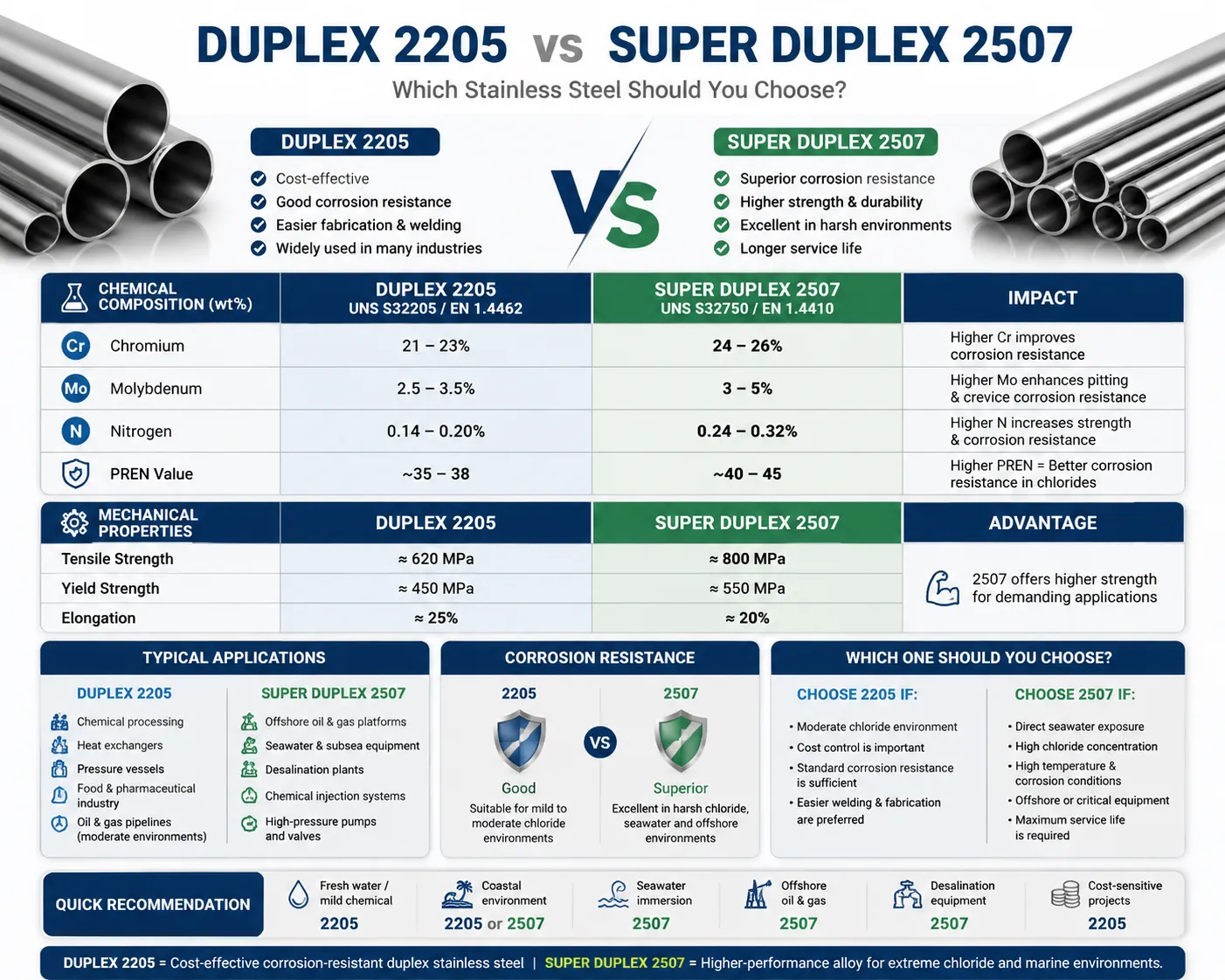
Duplex 2205 typically calculates to a PREN between 33 and 38, depending on the exact heat chemistry. Super Duplex 2507 lands between 40 and 43. That five to eight point gap sounds small on paper, but in practice it represents the difference between an alloy suited for brackish water and one rated for full seawater immersion. We tell customers to treat PREN 40 as the informal cutoff for seawater-grade service. Anything below that number and chloride stress corrosion cracking becomes a real risk in warm, oxygenated seawater.
One thing we always clarify on customer calls: PREN measures pitting resistance only. It says nothing about mechanical strength, weldability, or cost. Buyers who chase the highest PREN number without checking whether their application even needs it end up overpaying for corrosion resistance they will never use.
How Do the Chemical Compositions of 2205 and 2507 Compare?
The PREN gap between these two grades comes directly from higher alloying content in 2507, particularly molybdenum and nitrogen. Here is the composition range based on ASTM A240/A480 specifications and the mill certs we review weekly.
| Element | Duplex 2205 (UNS S32205/S31803) | Super Duplex 2507 (UNS S32750) |
|---|---|---|
| Chromium (Cr) | 22.0 - 23.0% | 24.0 - 26.0% |
| Nickel (Ni) | 4.5 - 6.5% | 6.0 - 8.0% |
| Molybdenum (Mo) | 3.0 - 3.5% | 3.0 - 5.0% |
| Nitrogen (N) | 0.14 - 0.20% | 0.24 - 0.32% |
| Manganese (Mn) | max 2.0% | max 1.2% |
| Copper (Cu) | none specified | 0.5% max |
| PREN (calculated) | 33 - 38 | 40 - 43 |
The nitrogen and molybdenum bump in 2507 is not accidental. Nitrogen stabilizes austenite formation and boosts strength without sacrificing toughness, while molybdenum directly raises pitting resistance in chloride environments. Nickel content is also higher in 2507, which balances the ferrite-austenite ratio (both grades target roughly 50/50 phase balance) despite the increased chromium.
A detail buyers often miss: 2507 requires tighter mill control during solidification and heat treatment because the higher alloy content narrows the temperature window where the correct phase balance forms. This is one reason mills charge a premium beyond raw material cost alone. We have seen batches rejected at the mill level because solution annealing temperature drifted by only 15°C, something that rarely causes rejection on standard 2205 heats.
Which Grade Delivers Higher Mechanical Strength?
Both duplex grades outperform standard austenitic stainless steels like 316L by a wide margin, roughly double the yield strength. Between the two duplex grades themselves, 2507 pulls ahead but not by as much as the PREN gap suggests.
| Property | Duplex 2205 | Super Duplex 2507 | 316L (reference) |
|---|---|---|---|
| Yield Strength (0.2% offset) | 448 MPa (65 ksi) min | 550 MPa (80 ksi) min | 170 MPa (25 ksi) min |
| Tensile Strength | 620 MPa (90 ksi) min | 795 MPa (116 ksi) min | 485 MPa (70 ksi) min |
| Elongation | 25% min | 15% min | 40% min |
| Hardness (Brinell) | 293 HB max | 310 HB max | 217 HB max |
| Impact Toughness (Charpy V, -46°C) | 190 J typical | 100 J typical | N/A |
The 23% yield strength advantage of 2507 over 2205 is where a lot of design engineers find real value, not just corrosion resistance. Higher yield strength lets you reduce wall thickness on pressure vessels and piping while still meeting ASME code allowable stress values. On a large diameter pipeline project we supplied material for in 2023, switching from 2205 schedule 40 to a thinner-wall 2507 section actually closed most of the cost gap between the two alloys once you accounted for weight-based freight and welding consumable savings.
Elongation drops in 2507 compared to 2205, which matters for cold forming operations. Fabricators bending 2507 plate into cones or heads need to account for reduced ductility, and we always recommend a lower bend radius tolerance and slower forming speed when working this grade.
How Much Corrosion Resistance Do You Really Gain With 2507?
Numbers matter more than marketing claims here, so we pull actual ASTM G48 critical pitting temperature (CPT) test data whenever a customer asks us to justify the price difference.
| Test Parameter | Duplex 2205 | Super Duplex 2507 |
|---|---|---|
| Critical Pitting Temperature (ASTM G48 Method A, 6% FeCl3) | 20-25°C | 35-45°C |
| Critical Crevice Temperature | 5-10°C | 20-30°C |
| Maximum chloride concentration (general guideline, ambient temp) | ~3,000 ppm | ~200,000 ppm (full seawater) |
| Suitability for seawater at elevated temperature | Limited above 20°C | Suitable to 40°C+ |
| Sour service (NACE MR0175) suitability | Case-by-case with limits | Broader acceptance at higher H2S partial pressure |
The critical pitting temperature gap is the number we lean on most in technical discussions. A CPT of 22°C for 2205 means that in a lab environment simulating aggressive chloride exposure, pitting starts around room temperature. Super Duplex 2507's CPT sitting near 40°C gives roughly 15-20°C of extra margin, which translates directly into safe operation in warm coastal seawater, produced water handling, and flue gas desulfurization systems where temperatures regularly exceed 30°C.
We had a customer in a coastal power plant project initially spec 2205 for a seawater cooling line based on cost alone. After we walked through the CPT data against their actual seawater intake temperature (recorded at 32°C in summer months), they switched to 2507 for the sections in direct seawater contact and kept 2205 for the return lines running cooler treated water. That kind of mixed-grade approach saves money without cutting corners on the parts that actually need the extra resistance.
Why Does Super Duplex 2507 Cost So Much More Than 2205?
This is the question every procurement manager asks first, and the honest answer involves more than just raw material pricing.
Molybdenum is the primary cost driver. It trades on global metal markets and typically runs several times the price per pound of nickel or chromium. Since 2507 carries up to 40% more molybdenum than 2205, the base alloy surcharge alone accounts for a meaningful chunk of the price gap. Nickel content differences add a smaller but still relevant amount.
Beyond raw material, mill processing costs run higher for 2507. The narrower heat treatment window we mentioned earlier means slower production runs, more rejected heats, and tighter quality control checkpoints, all of which get baked into the mill's base price. Fewer mills worldwide produce Super Duplex 2507 compared to the widely available 2205, which reduces competitive pricing pressure and can extend lead times, especially for larger diameter pipe or thicker plate.
| Cost Factor | Duplex 2205 | Super Duplex 2507 |
|---|---|---|
| Typical price index (2205 = 1.0 baseline) | 1.0 | 1.4 - 1.6 |
| Molybdenum content contribution | Moderate | High |
| Mill availability (global producers) | Wide | Limited |
| Typical lead time for plate/pipe | 6-10 weeks | 10-16 weeks |
| Welding consumable cost premium | Baseline | 15-25% higher |
| Machining/cutting tool wear | Moderate | Higher due to hardness |
Our own price tracking over the past three years shows the 2507 premium fluctuating between 40% and 60% above 2205 on a per-kilogram basis, with the gap widening whenever molybdenum prices spike on the London Metal Exchange. Buyers locking in large tonnage orders should watch molybdenum futures if timing a purchase, because a six-month delay can shift project economics meaningfully.
The mistake we see most often is comparing raw material cost per kilogram without factoring in the wall thickness reduction 2507's higher strength allows. On a like-for-like pressure rating, a thinner 2507 pipe can use 10-15% less material by weight than a 2205 pipe rated for the same service. Once you run total installed cost, including welding labor hours (fewer passes needed on thinner wall) and freight weight, the effective price gap often narrows to 20-30% rather than the 50%+ gap seen on raw plate pricing alone.
Which Grade Is Easier to Fabricate and Weld?
Duplex 2205 has a two-decade head start in fabricator familiarity, and that shows up in weld quality and rework rates. Most welders certified on duplex stainless have trained primarily on 2205, and welding procedure specifications for it are widely documented across shipyards, refineries, and pressure vessel shops.
Super Duplex 2507 demands tighter heat input control. Excess heat input during welding shifts the ferrite-austenite balance toward excessive ferrite formation, which reduces toughness and corrosion resistance right at the heat-affected zone, exactly where you cannot afford weakness. Welders working 2507 typically need to keep interpass temperature below 150°C, compared to a slightly more forgiving 250°C ceiling on 2205, and nitrogen-enriched shielding gas is standard practice to preserve nitrogen content lost during welding.
| Fabrication Factor | Duplex 2205 | Super Duplex 2507 |
|---|---|---|
| Interpass temperature limit | 250°C max | 150°C max |
| Shielding gas requirement | Argon-based standard | Nitrogen-enriched argon recommended |
| Filler metal matching | Widely stocked | Specialty order in many regions |
| Welder certification availability | Common | Less common, requires specific WPS |
| PWHT (post weld heat treatment) requirement | Not typically required | Not typically required |
| Cold forming difficulty | Moderate | Higher, reduced ductility |
We advise fabricators new to duplex welding to run qualification coupons on 2507 well before cutting into production material, and to budget extra time for procedure qualification records (PQR) if their shop has not welded this grade before. Skipping that step is the single most common cause of failed radiographic inspection we see reported back to us from fabrication yards.
Where Does Each Grade Perform Best in Real Applications?
Both grades share overlapping industries, but the specific equipment and environment within each industry usually points clearly toward one grade or the other.
| Application | Recommended Grade | Reason |
|---|---|---|
| Chemical process piping (moderate chloride) | 2205 | Sufficient PREN, lower cost |
| Pulp and paper bleach plant equipment | 2205 | Cost-effective, adequate resistance |
| Offshore platform seawater cooling systems | 2507 | High chloride, elevated temperature |
| Desalination plant (RO/MSF) piping | 2507 | Continuous seawater contact |
| Oil and gas sour service (moderate H2S) | 2205 (check NACE limits) | Meets requirements at lower cost |
| Oil and gas sour service (high H2S/chloride) | 2507 | Superior resistance margin |
| Storage tanks for brackish water | 2205 | Chloride levels within safe range |
| Flue gas desulfurization (FGD) systems | 2507 | High chloride plus elevated temp |
| Structural components, bridges | 2205 | Strength adequate, cost sensitive |
| Subsea equipment and umbilicals | 2507 | Long-term seawater immersion |
We handle inquiries from both refinery EPCs and smaller fabrication shops, and the pattern is consistent: whenever seawater or brine touches the metal surface continuously above 25°C, customers who initially requested 2205 pricing usually end up switching to 2507 once we walk through their actual process conditions. Conversely, land-based chemical plants with intermittent or diluted chloride exposure rarely need to pay the 2507 premium.
Also read: Alloy 2205 Duplex Stainless Steel Bar
How Do Availability and Lead Times Differ Between the Two Grades?
Duplex 2205 is stocked in far more forms and sizes across global distribution networks. Plate, pipe, fittings, bar, and forgings in 2205 are available from multiple mills in Europe, Asia, and the Americas, which keeps lead times shorter and gives buyers negotiating leverage on price.
Super Duplex 2507 production concentrates among a smaller group of specialty mills, largely because of the tighter metallurgical control required. Standard sizes in plate and pipe are still reasonably accessible, but larger diameter pipe, heavy wall forgings, or unusual dimensions often require mill-run production rather than pulling from existing stock. That difference alone can add 6-8 weeks to a project schedule if the buyer has not planned ahead.
At MWalloys, we keep working stock of common 2205 plate and pipe sizes precisely because demand is steady and predictable. For 2507, we typically confirm mill lead time before quoting firm delivery dates, since committing to a delivery window without checking current mill backlogs has burned suppliers who quoted too aggressively in the past. Buyers planning large 2507 orders should lock in mill slots at least three to four months ahead of the required delivery date, particularly for projects scheduled during periods of high offshore or desalination project activity when demand for this grade spikes across the industry.
What Have We Learned From Supplying Both Grades to Global Projects?
After years of quoting, stocking, and troubleshooting both grades for customers across marine, chemical processing, and oil and gas sectors, a few practical lessons stand out that rarely appear in technical datasheets.
First, chloride level alone does not tell the whole story. Temperature multiplies the aggressiveness of chloride attack, so a 2205 pipe that performs fine at 5,000 ppm chloride and 15°C can fail at the same chloride level once temperature climbs past 30°C. We always ask customers for both numbers before recommending a grade, not just one.
Second, mixed-grade design saves real money without cutting corners. We have supplied projects where engineers specify 2507 only for the sections in direct, continuous seawater contact and 2205 for everything downstream where chloride concentration drops or temperature stays lower. This approach requires careful engineering documentation but routinely cuts total material cost by 20-30% compared to specifying 2507 across an entire system out of caution.
Third, certification paperwork matters as much as the metal itself. We have seen buyers receive material with mill certs showing PREN calculations that technically meet minimum requirements but sit right at the low end of the acceptable range. For critical seawater or sour service applications, we recommend requesting mill certs showing actual chemistry, not just a pass/fail statement, so your engineering team can verify the real PREN value rather than assuming worst-case compliance is sufficient.
Fourth, price volatility on molybdenum means locking pricing early on large 2507 orders protects budgets. We track LME molybdenum pricing weekly and advise long-term project buyers to consider forward pricing agreements with mills when tonnage commitments exceed six months out.
Which Grade Should You Choose Based on Your Project Budget and Environment?
Bringing everything together, the decision usually comes down to three questions we ask every customer before recommending either grade.
What is your actual chloride concentration and operating temperature? If combined exposure keeps you under the 2205 safe zone (roughly 3,000 ppm chloride at moderate temperature), there is no engineering justification for paying the 2507 premium.
What mechanical strength do you need for wall thickness or weight reduction? If your project benefits significantly from reduced pipe or plate weight, 2507's higher yield strength can offset part of the cost premium through material savings, even before factoring in corrosion performance.
What is your fabricator's welding capability? Shops without documented 2507 welding procedures may need extra qualification time and cost that should factor into total project economics, not just raw material price.
For most industrial chemical processing, structural, and moderate-chloride applications, 2205 remains the practical default and delivers strong value. For seawater-facing equipment, desalination systems, offshore platforms, and high-chloride oil and gas service, 2507's corrosion margin justifies the added cost, particularly when failure consequences include production downtime or safety risk.
Frequently Asked Questions
Is Super Duplex 2507 always better than Duplex 2205?
No, better depends entirely on your operating environment. 2507 offers higher PREN, strength, and corrosion resistance, but for applications with moderate chloride exposure and lower temperature, 2205 performs adequately at a lower cost. Paying for 2507 in an environment that does not require its extra resistance wastes budget without adding functional value. We recommend matching grade selection to actual process data (chloride ppm, temperature, and H2S exposure) rather than defaulting to the higher-spec alloy out of caution alone.
What is the actual PREN difference between 2205 and 2507?
Duplex 2205 typically calculates between 33 and 38 PREN, while Super Duplex 2507 ranges from 40 to 43. This 5-8 point gap comes primarily from higher molybdenum and nitrogen content in 2507. The practical impact shows up in critical pitting temperature, where 2507 tolerates roughly 15-20°C higher chloride exposure before pitting initiates, making it the preferred choice for continuous seawater contact applications.
Can I weld Duplex 2205 and Super Duplex 2507 together?
Yes, transition welds between these grades are common in mixed-grade piping systems, but they require careful filler metal selection, typically matching or slightly over-alloyed to the higher grade (2507-compatible filler), along with strict interpass temperature control below 150°C. We recommend qualifying a specific welding procedure specification for this transition joint before production welding, since improper heat input at the joint can compromise corrosion resistance on the 2507 side.
How much more expensive is 2507 compared to 2205?
Based on our pricing data over recent years, Super Duplex 2507 typically runs 40-60% higher than Duplex 2205 on a per-kilogram basis, driven mainly by higher molybdenum content and tighter mill processing requirements. However, total installed cost gaps often narrow to 20-30% once wall thickness reduction from 2507's higher strength and reduced welding labor are factored into the comparison.
Which grade is better for seawater applications?
Super Duplex 2507 is the stronger choice for continuous seawater contact, particularly at temperatures above 25°C. Its critical pitting temperature of 35-45°C provides adequate margin against localized corrosion in full-strength seawater, while Duplex 2205's lower CPT of 20-25°C leaves less safety margin in warm coastal waters. For intermittent or diluted seawater exposure at lower temperatures, 2205 can still perform reliably.
Does higher PREN mean higher strength too?
Not directly. PREN measures corrosion resistance, not mechanical properties, though the alloying elements that boost PREN (particularly nitrogen) also happen to increase yield strength. Super Duplex 2507 does deliver both higher PREN and higher yield strength compared to 2205, but these two properties are calculated independently and should not be assumed to move in lockstep for every alloy comparison.
Is Duplex 2205 suitable for sour service (H2S environments)?
Duplex 2205 is suitable for many sour service applications within the limits defined by NACE MR0175/ISO 15156, though acceptable H2S partial pressure and chloride concentration limits are more restrictive than for Super Duplex 2507. Projects with higher H2S concentration or combined high-chloride sour environments typically require 2507 or higher alloy grades to meet sour service qualification requirements safely.
What wall thickness savings can I expect switching from 2205 to 2507?
Because Super Duplex 2507 carries roughly 23% higher minimum yield strength than 2205, pressure vessel and piping designs can often reduce wall thickness by 10-15% while maintaining the same ASME code allowable stress rating. This weight reduction helps offset part of the higher per-kilogram material cost, particularly on large-diameter or long-run piping projects where total tonnage savings become significant.
Are lead times different between these two grades?
Yes, Duplex 2205 typically ships within 6-10 weeks from order due to wider mill availability and stocked inventory across global distributors. Super Duplex 2507 often requires 10-16 weeks, especially for larger diameters or non-standard sizes, since fewer mills produce this grade and heavier reliance on mill-run production rather than existing stock extends scheduling. Planning orders three to four months ahead is advisable for large 2507 projects.
Can Duplex 2205 be used as a cost-saving substitute in every application currently using 2507?
No, substitution should only happen after verifying actual chloride concentration, temperature, and any sour service requirements against 2205's tested limits. Using 2205 in place of 2507 without this verification risks premature pitting corrosion failure in high-chloride or elevated-temperature seawater environments. We recommend engineering review and, where possible, actual corrosion testing data before approving any grade substitution on existing equipment or piping systems.
Sources
- ASTM A240/A240M Standard Specification for Chromium and Chromium-Nickel Stainless Steel Plate, Sheet, and Strip.
- ASTM A480/A480M Standard Specification for General Requirements for Flat-Rolled Stainless and Heat-Resisting Steel Plate, Sheet, and Strip.
- ASTM G48 Standard Test Methods for Pitting and Crevice Corrosion Resistance of Stainless Steels.
- NACE MR0175/ISO 15156 Petroleum and Natural Gas Industries Materials for Use in H2S-Containing Environments.
- International Molybdenum Association (IMOA) Practical Guidelines for the Fabrication of Duplex Stainless Steels.
- Outokumpu and Sandvik Materials Technology published duplex stainless steel datasheets.
- MWalloys internal mill certificate archive and project supply records (2016-2026).
Get the Right Duplex Grade for Your Project
Chemistry tables and CPT numbers only take a specification so far. If you are weighing Duplex 2205 against Super Duplex 2507 for an actual piping run, pressure vessel, or offshore component, send us your operating conditions, chloride concentration, temperature range, and pressure rating, and our team will confirm which grade meets your requirements without overpaying for resistance you do not need. Contact MWalloys today for mill certificates, current pricing, and confirmed lead times on both grades.