
2507 super duplex tubing, UNS S32750, delivers roughly twice the yield strength of standard 316L stainless steel alongside a pitting resistance equivalent number above 40, which is why it has become the default specification for subsea umbilical tubing, sour service instrument lines, and offshore process piping where a single leak or crack means a shutdown costing more than the entire tubing package. Seamless construction under ASTM A789, the governing standard for duplex and super duplex tubular products, remains the only acceptable form for pressure-critical instrument and process lines because weld seams introduce a heat-affected zone that can disrupt the precise 50/50 austenite-ferrite balance this alloy depends on for its corrosion resistance. That balance, not the chromium or molybdenum content alone, is what separates a 2507 tube that performs for twenty years from one that fails prematurely to stress corrosion cracking. We fabricate and supply 2507 tubing into exactly these environments, and this article walks through the metallurgy, the standard requirements, and the practical selection questions we field on nearly every quote.
If your project requires the use of 2507 Super Duplex Tubing, you can contact us for a free quote.
We have handled enough instrument tubing packages headed to Gulf of Mexico platforms and North Sea installations to know that buyers searching for this material usually fall into two camps, an engineer verifying chemistry and mechanical property compliance against a project specification, and a procurement lead trying to understand why 2507 costs what it does compared to standard duplex or austenitic alternatives. This article answers both.
What Makes 2507 a Super Duplex Alloy Rather Than Standard Duplex?
The distinction comes down to a numerical threshold most people in the industry reference constantly without always explaining, the pitting resistance equivalent number, or PREN, calculated from a formula weighing chromium, molybdenum, and nitrogen content. Standard duplex grades like 2205 land in the 33 to 35 PREN range. Super duplex grades, including 2507 and its close cousin 2507Cu variants, exceed a PREN of 40, and that jump crosses into a corrosion resistance category that opens up far more aggressive chloride and sour service environments than standard duplex can reliably handle.
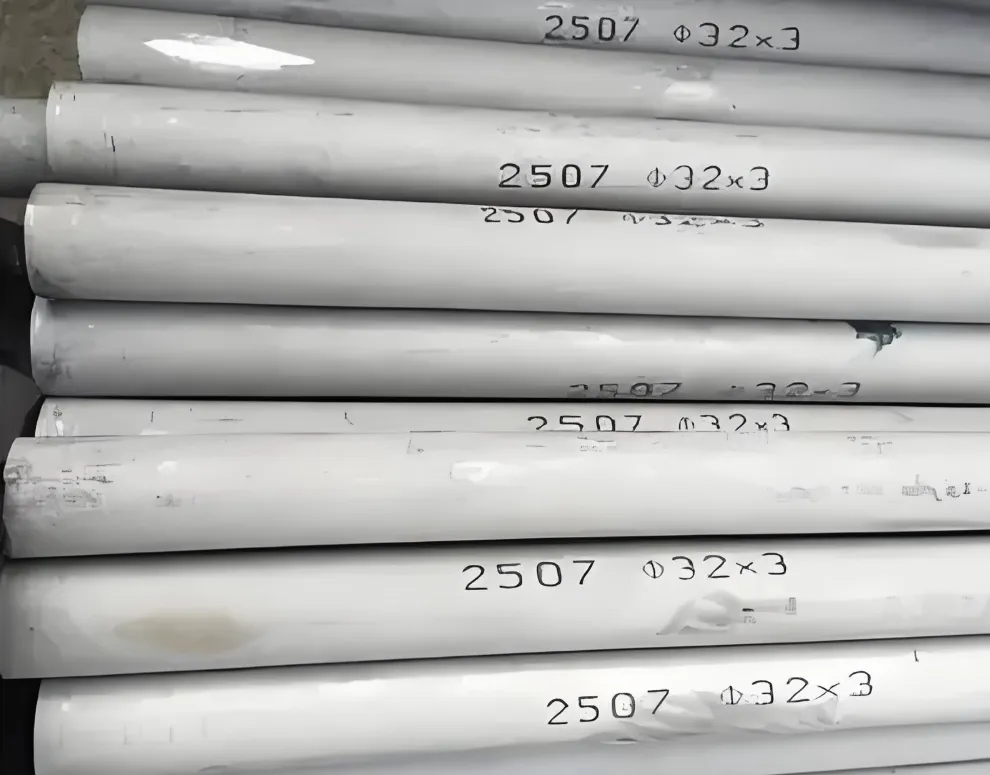
2507 achieves this through a chemistry that pushes chromium to roughly 25 percent, molybdenum to around 4 percent, and nitrogen to about 0.27 percent, all deliberately balanced against nickel content near 7 percent to maintain the roughly equal split between austenite and ferrite phases that gives duplex steels their name. Get that phase balance wrong during manufacturing, and you either lose the toughness the austenite phase provides or the strength and corrosion resistance the ferrite phase provides, which is exactly why the manufacturing controls around 2507 tubing are considerably tighter than for standard austenitic stainless products.
| Property | 2205 Duplex | 2507 Super Duplex | 316L Austenitic |
|---|---|---|---|
| UNS Designation | S32205 | S32750 | S31603 |
| PREN | 33-35 | Above 40 | ~24 |
| Chromium | 22-23% | 24-26% | 16-18% |
| Molybdenum | 3.0-3.5% | 3.0-4.5% | 2.0-3.0% |
| Nickel | 4.5-6.5% | 6.0-8.0% | 10-14% |
| Nitrogen | 0.14-0.20% | 0.24-0.32% | Trace |
| Minimum Yield Strength | 65 ksi (450 MPa) | 80 ksi (550 MPa) | 25 ksi (170 MPa) |
We point buyers to this PREN number specifically because it correlates directly with critical pitting temperature in seawater and chloride-bearing environments, and a project specification that calls out "duplex" without specifying which grade can leave a supplier legitimately quoting 2205 when the actual service environment demands 2507's superior chloride resistance.
How Does the Austenite-Ferrite Microstructure Actually Deliver This Performance?
Duplex stainless steels get their name from a two-phase microstructure, roughly equal parts austenite and ferrite, and understanding why this matters requires looking at what each phase individually contributes rather than treating "duplex" as a single homogeneous property set.
Ferrite, the body-centered cubic phase, contributes higher yield strength and better resistance to chloride stress corrosion cracking than austenitic stainless steels achieve on their own, since chloride stress corrosion cracking specifically exploits the crystal structure weaknesses of pure austenitic steel. Austenite, the face-centered cubic phase, contributes toughness and ductility that pure ferritic stainless steels lack, since fully ferritic steels tend toward brittleness, particularly at lower temperatures. Combining both phases in roughly equal proportion produces a material that resists chloride stress corrosion cracking far better than 316L while retaining enough toughness to avoid the brittle fracture concerns that plague fully ferritic grades.
The manufacturing challenge is holding that 50/50 balance through every thermal cycle the tube experiences, from initial solution annealing through any subsequent forming or, where unavoidable, welding operations. Heat exposure in the range of roughly 300°C to 1000°C can trigger the precipitation of secondary intermetallic phases, most notably sigma phase, which forms preferentially at ferrite grain boundaries and severely degrades both toughness and corrosion resistance even in small quantities. We control every heat treatment cycle on 2507 tubing specifically to avoid lingering in this precipitation temperature range, quenching rapidly from the solution annealing temperature rather than allowing slow air cooling that would give sigma phase time to form.
| Phase Balance Issue | Cause | Consequence | Prevention |
|---|---|---|---|
| Excess ferrite | Rapid cooling from very high solution temperature | Reduced toughness, increased brittleness | Controlled solution anneal temperature (1020-1100°C typical) |
| Excess austenite | Insufficient solution temperature or slow cooling | Reduced pitting and SCC resistance | Verify solution temperature against mill certificate |
| Sigma phase precipitation | Extended dwell time in 600-1000°C range | Severe embrittlement, corrosion pitting sites | Rapid water quench after solution annealing |
| Chi phase precipitation | Similar temperature range, molybdenum-rich | Localized corrosion susceptibility | Same rapid quench protocol as sigma prevention |
Why Does ASTM A789 Specifically Require Seamless Construction for Critical Applications?
ASTM A789 covers seamless and welded ferritic/austenitic duplex stainless steel tubing, and it does permit welded construction for certain applications, but nearly every instrument and process tubing specification we receive calls out seamless specifically, and there is a sound metallurgical reason behind that preference beyond simple conservatism.
A welded tube seam, even one that passes all required non-destructive testing, introduces a heat-affected zone where the base metal experienced a thermal cycle different from the rest of the tube. On duplex and super duplex alloys, that thermal cycle can shift the local phase balance away from the carefully controlled 50/50 austenite-ferrite ratio, sometimes producing excess ferrite right at the fusion line if cooling happened too quickly, or promoting the sigma phase precipitation described above if the weld thermal cycle lingered too long in the danger zone. Even when a welding procedure is properly qualified and controlled, that heat-affected zone represents a metallurgically distinct region running the full length of the tube, a permanent line of reduced margin compared to the wrought base metal everywhere else on the circumference.
Seamless tubing, produced through hot extrusion or a pierce-and-draw process followed by cold working to final dimensions, never introduces this thermal discontinuity, and its phase balance and corrosion resistance stay uniform around the entire circumference and along the full length. For instrument tubing specifically, where a single small-bore line often carries a critical process signal or a sour gas sample under pressure, the cost premium of seamless construction is trivial compared to the consequence of a weld seam becoming the initiation site for stress corrosion cracking years into service.
| Construction Type | Relative Cost | Heat-Affected Zone Risk | Typical Application |
|---|---|---|---|
| Seamless (ASTM A789) | Higher | None | Instrument tubing, sour service, subsea umbilicals |
| Welded and cold worked (ASTM A789) | Moderate | Present but controlled | Larger diameter process piping, structural tubing |
| Welded, as-welded (ASTM A928 for larger pipe) | Lower | Present, less controlled | Non-critical structural applications |
We stock seamless 2507 as standard for anything specified as instrument tubing, and we flag it clearly on any quote where a customer's drawing calls out duplex tubing without specifying construction type, since assuming welded construction to save cost on a critical line is a decision that belongs to the customer's engineering team, not something a supplier should default into silently.
What Do the ASTM A789 Chemistry and Mechanical Property Requirements Actually Specify?
Every heat of 2507 tubing we supply carries a mill test certificate verified against the specific chemistry and mechanical property table in ASTM A789, and buyers checking a certificate should know what numbers actually matter.
| Requirement | ASTM A789 Specification for S32750 |
|---|---|
| Carbon (max) | 0.030% |
| Chromium | 24.00-26.00% |
| Nickel | 6.00-8.00% |
| Molybdenum | 3.00-5.00% |
| Nitrogen | 0.24-0.32% |
| Copper (max) | 0.50% |
| Manganese (max) | 1.20% |
| Yield Strength (min) | 80 ksi (550 MPa) |
| Tensile Strength (min) | 116 ksi (800 MPa) |
| Elongation (min) | 15% |
| Hardness (max) | 32 HRC / 310 HBW |
We watch the maximum hardness figure closely because it correlates directly with susceptibility to sulfide stress cracking in sour service applications, and a supplier delivering tubing at the upper edge of the mechanical property range without checking hardness against NACE requirements can hand a customer material that technically passes ASTM A789 but fails a sour service qualification. The standard also requires a corrosion test, typically ASTM G48 Method A, verifying resistance to pitting in a ferric chloride solution, and we treat a passing G48 result as just as important as the tensile numbers on any certificate headed to an offshore or chemical processing customer.
How Do You Size 2507 Instrument Tubing Correctly for Pressure Service?
Instrument tubing sizing in 2507 follows the same fundamental wall thickness calculation used across stainless tubing generally, but the higher allowable stress values from 2507's superior yield strength let engineers specify thinner walls for equivalent pressure ratings compared to 316L, which partially offsets the material's higher per-kilogram cost.
| Nominal OD | Common Wall Thickness Range | Typical Application |
|---|---|---|
| 1/4 inch (6.35mm) | 0.028 to 0.065 inch | Instrument signal lines, sample tubing |
| 3/8 inch (9.53mm) | 0.035 to 0.083 inch | Instrument tubing, small process lines |
| 1/2 inch (12.7mm) | 0.049 to 0.109 inch | Process sampling, chemical injection lines |
| 3/4 inch to 1 inch | 0.065 to 0.156 inch | Larger process tubing, hydraulic lines |
| Above 1 inch | Per ASME B31.3 calculation | Process piping applications |
We calculate allowable working pressure against the ASME B31.3 formula for tubing, factoring in 2507's higher allowable stress value at the specified design temperature, and always confirm the design temperature range with the customer before finalizing wall thickness, since 2507's mechanical properties, like most duplex alloys, degrade meaningfully above roughly 300°C due to the same embrittlement mechanisms discussed earlier, which limits its practical upper service temperature compared to some austenitic alternatives despite its superior room-temperature strength.
What Fittings and Fabrication Methods Work With 2507 Tubing?
Instrument tubing systems depend heavily on compression fittings, and 2507's higher hardness and strength compared to 316L requires fittings specifically rated for duplex and super duplex material rather than standard austenitic fittings that may not achieve a proper seal on the harder tube surface.
Compression fitting manufacturers offer 2507-specific ferrule sets designed to bite properly into the harder tube wall, and using a standard 316 ferrule on 2507 tubing can result in an inadequate seal since the softer ferrule may not achieve sufficient grip on the harder tube surface, particularly at higher pressure ratings. We always specify matched-material fittings, meaning 2507 or compatible duplex fittings for 2507 tubing runs, rather than mixing tube and fitting alloys purely for cost savings, since a fitting failure in sour or subsea service carries consequences far exceeding the modest cost difference.
Orbital welding, where welding is required for tube-to-tube or tube-to-fitting joints rather than mechanical compression connections, demands the same low heat input, controlled atmosphere approach we apply to nickel alloy welding, with argon purge on the tube ID mandatory to prevent oxidation and to protect the phase balance at the weld root. We qualify welding procedures specifically for 2507 under ASME Section IX, verifying through ferrite content measurement, typically using a calibrated ferritescope, that the completed weld maintains an acceptable austenite-ferrite ratio rather than assuming a procedure qualified for 2205 automatically transfers to super duplex.
| Fabrication Method | Requirement for 2507 | Common Mistake to Avoid |
|---|---|---|
| Compression fittings | Duplex/super duplex rated ferrules | Using standard 316 ferrules |
| Orbital TIG welding | Argon backing purge, low heat input | Skipping backing gas, causing root oxidation |
| Bending | Cold bending preferred, minimum bend radius per tube OD | Hot bending without re-solution annealing after |
| Flaring/flanging | Possible but requires care given higher hardness | Using standard flaring tools sized for softer alloys |
Where Does 2507 Tubing Actually Get Specified in the Field?
The chemistry and mechanical numbers matter less to most buyers than knowing whether their specific application genuinely warrants the cost premium over standard duplex or austenitic alternatives.
| Industry | Application | Why 2507 Specifically |
|---|---|---|
| Offshore Oil & Gas | Subsea umbilical tubing, control lines | Combination of high strength for thin wall and chloride resistance for seawater exposure |
| Sour Gas Processing | Instrument sample lines, injection tubing | Resistance to sulfide stress cracking per NACE MR0175 when properly heat treated |
| Desalination | Process piping, heat exchanger tubing | Superior resistance to chloride pitting in concentrated brine |
| Chemical Processing | Acid handling instrument lines | Broad resistance across mixed acid and chloride environments |
| Pulp and Paper | Bleach plant instrument tubing | Resistance to chlorine dioxide and chloride combined attack |
| Marine and Shipbuilding | Seawater system instrument tubing | High strength reduces weight while resisting seawater corrosion |
We see the heaviest volume from offshore projects specifically because subsea umbilical bundles combine two demands simultaneously, extreme external hydrostatic pressure at depth and continuous seawater chloride exposure, a combination that pushes standard duplex 2205 past its comfortable service envelope while 2507's higher PREN and strength margin provide the safety factor project engineers want for equipment that is effectively unrepairable once installed on the seabed.
What NACE and Sour Service Considerations Apply to 2507 Tubing?
Sour service, meaning exposure to hydrogen sulfide-bearing fluids, introduces sulfide stress cracking as an additional failure mode beyond the chloride corrosion mechanisms discussed earlier, and NACE MR0175/ISO 15156 governs material qualification for this environment specifically.
2507 qualifies for sour service under NACE MR0175 provided hardness stays within the standard's specified maximum and the material receives proper solution annealing heat treatment, since improperly heat treated material with excess ferrite or retained cold work can exceed the hardness threshold that correlates with sulfide stress cracking susceptibility. We verify hardness against the NACE limit as a separate check from the general ASTM A789 hardness requirement, because the NACE threshold is sometimes more restrictive depending on the specific service category and partial pressure of H2S the customer's process defines.
Buyers specifying sour service tubing should request NACE compliance explicitly on the purchase order rather than assuming standard ASTM A789 certification automatically covers it, since these are two distinct qualification requirements that happen to overlap significantly but are not identical documents, and a mill certificate silent on NACE compliance should prompt a direct question to the supplier before the material ships to a sour service project.
How Does 2507 Compare on Cost Against Alternatives, and When Is It Worth Paying For?
We get asked constantly whether 2507 is simply an over-specification that drives up project cost without proportional benefit, and the honest answer depends entirely on the actual service environment.
| Material | Relative Material Cost (per kg) | Best Fit Scenario |
|---|---|---|
| 316L Stainless | 1.0x (baseline) | Mild chloride exposure, general instrument tubing |
| 2205 Duplex | 1.4x to 1.6x baseline | Moderate chloride environments, good general offshore use |
| 2507 Super Duplex | 1.8x to 2.3x baseline | Severe chloride, sour service, subsea, high-pressure thin wall |
| 6Mo Super Austenitic | 2.0x to 2.5x baseline | Extreme chloride with less strength benefit than duplex |
| Alloy 625/825 | 3.0x to 5.0x baseline | Extreme sour or acidic conditions beyond duplex capability |
The case for 2507 strengthens considerably once you factor total installed cost rather than raw material cost alone, since its higher yield strength permits thinner wall tubing at equivalent pressure rating, partially offsetting the per-kilogram premium, and its superior chloride resistance extends service life in environments where 316L would require replacement within a few years, an unacceptable outcome for subsea or embedded process tubing where replacement means a full shutdown or intervention. We walk customers through this total cost comparison whenever a project specification seems to default to 2507 out of caution rather than genuine environmental necessity, since occasionally standard 2205 duplex genuinely suffices and the customer can redirect that budget elsewhere.
Frequently Asked Questions
What is the difference between 2507 and 2205 duplex stainless steel?
2507 super duplex contains higher chromium, molybdenum, and nitrogen content than 2205, pushing its pitting resistance equivalent number above 40 compared to 2205's 33 to 35 range, and giving it roughly 20 percent higher minimum yield strength. This makes 2507 the appropriate choice for more severe chloride environments like deep subsea service and sour gas applications, while 2205 handles moderate offshore and chemical processing conditions at a lower cost. Choosing between them should be based on the actual chloride concentration and service temperature the tubing will face.
Can 2507 super duplex tubing be welded without losing corrosion resistance?
Yes, provided the welding procedure is properly qualified with controlled heat input and shielding gas coverage, including argon backing purge on the tube interior to prevent oxidation. Improper welding can shift the austenite-ferrite phase balance at the heat-affected zone, reducing both corrosion resistance and toughness locally. We verify weld quality on 2507 using ferrite content measurement to confirm the completed joint maintains an acceptable phase ratio before releasing it for service.
What does PREN mean and why does it matter for tubing selection?
PREN stands for pitting resistance equivalent number, a calculated value based on chromium, molybdenum, and nitrogen content that predicts a stainless alloy's resistance to pitting corrosion in chloride environments. Higher PREN values correlate with better performance in seawater, brine, and other chloride-bearing service. A PREN above 40, which 2507 achieves, generally indicates suitability for the most demanding offshore and sour service applications where standard duplex or austenitic grades would risk premature pitting failure.
Is 2507 tubing suitable for hydrogen sulfide sour gas service?
Yes, 2507 qualifies for sour gas service under NACE MR0175/ISO 15156 provided the material receives proper solution annealing heat treatment and meets the hardness threshold specified in the standard. Improperly heat treated material or tubing with excess cold work can exceed the allowable hardness and become susceptible to sulfide stress cracking despite being chemically identical to compliant material. Buyers should request explicit NACE compliance documentation separate from standard ASTM A789 certification when ordering for sour service.
Why is seamless construction specified instead of welded tubing for 2507 instrument lines?
Seamless construction avoids the heat-affected zone that welding introduces, a region where the thermal cycle can locally disrupt the carefully controlled austenite-ferrite phase balance that gives 2507 its corrosion resistance. For instrument tubing carrying critical process signals or sour gas samples under pressure, this uniform microstructure around the full circumference provides margin that welded and cold worked tubing, while acceptable under ASTM A789 for some applications, does not fully match. The cost premium for seamless construction is minor relative to the consequence of a failure on a critical line.
What maximum operating temperature can 2507 super duplex tubing handle?
2507's mechanical properties and corrosion resistance are generally reliable up to approximately 300°C, above which the risk of embrittling intermetallic phase precipitation, particularly sigma phase, increases significantly and degrades both toughness and corrosion performance. This makes 2507 less suitable than some austenitic or nickel alloy options for genuinely high-temperature service, even though its room-temperature and moderate-temperature strength substantially exceeds standard stainless grades. Projects with sustained service above this range should evaluate alternative alloys.
Do compression fittings for 316L stainless tubing work with 2507 super duplex tubing?
No, standard 316L-rated compression fittings and ferrules are not recommended for 2507 tubing because the softer ferrule material may not achieve adequate grip and seal on the harder super duplex tube surface, particularly at higher pressure ratings. Fitting manufacturers produce duplex and super duplex specific ferrule sets designed to properly bite into the harder tube wall. Using mismatched fitting and tube materials risks an inadequate seal that may not be apparent until the system is pressurized in service.
How much stronger is 2507 super duplex compared to standard 316L stainless steel?
2507 has a minimum specified yield strength of 80 ksi (550 MPa) compared to 316L's minimum of approximately 25 ksi (170 MPa), making 2507 roughly three times stronger in terms of yield strength. This strength advantage allows engineers to specify thinner wall tubing for equivalent pressure ratings, which can partially offset 2507's higher material cost per kilogram in pressure-critical applications like subsea umbilical systems.
What corrosion test confirms 2507 tubing meets ASTM A789 requirements?
ASTM A789 typically requires corrosion testing per ASTM G48 Method A, which exposes a sample to a ferric chloride solution at a specified temperature and measures pitting resistance through weight loss and visual examination for pit formation. Mill test certificates should include the actual test temperature and result, since a passing result at a lower test temperature does not necessarily confirm performance at the higher critical pitting temperature some severe service applications require, making it worth confirming the specific test conditions against project requirements.
Can 2507 tubing be bent without losing its mechanical properties?
Yes, cold bending is the preferred method for 2507 tubing and does not significantly compromise its properties provided the bend radius stays within manufacturer-recommended minimums for the tube outer diameter and wall thickness. Hot bending, if required for tighter radii, introduces thermal exposure that can disrupt the phase balance and typically requires a subsequent re-solution annealing and quenching cycle to restore proper microstructure, adding cost and lead time that cold bending avoids entirely when geometry allows.
Verifiable Sources
ASTM A789/A789M, Standard Specification for Seamless and Welded Ferritic/Austenitic Stainless Steel Tubing for General Service, ASTM International.
ASTM A790/A790M, Standard Specification for Seamless and Welded Ferritic/Austenitic Stainless Steel Pipe, ASTM International.
ASTM G48, Standard Test Methods for Pitting and Crevice Corrosion Resistance of Stainless Steels and Related Alloys by Use of Ferric Chloride Solution, ASTM International.
NACE MR0175/ISO 15156, Petroleum and Natural Gas Industries, Materials for Use in H2S-Containing Environments in Oil and Gas Production, NACE International and International Organization for Standardization.
International Molybdenum Association (IMOA), Practical Guidelines for the Fabrication of Duplex Stainless Steels, technical reference publication.
ASME BPVC Section IX, Welding, Brazing, and Fusing Qualifications, The American Society of Mechanical Engineers.
Outokumpu and Sandvik Materials Technology, technical data handbooks for duplex and super duplex stainless steel grades.
Ready to Source 2507 Super Duplex Tubing for Your Project?
If your project specification calls for seamless 2507 super duplex tubing, whether for subsea umbilical bundles, sour service instrument lines, or offshore process piping, we can supply material with full ASTM A789 mill certification, NACE compliance documentation, and G48 corrosion test reports ready for your quality department. Our team at MWalloys stocks certified 2507 in standard instrument tubing sizes and can support custom dimensional and testing requirements for your project. Contact our engineering team today to discuss your tubing specification and get a quote built around your actual service conditions.