
At MWalloys, we manufacture custom 17-7 PH stainless steel springs with prototyping turnaround as fast as 5 to 7 business days and full production runs shipped within 3 to 4 weeks, backed by in-house heat treatment, CNC coiling, and material certification to ASTM A313 and AMS 5528 standards. If you need a spring material that holds tight tolerances after aging, resists corrosion in humid or chemically aggressive environments, and retains spring force at elevated temperatures up to 600°F, 17-7 PH is very likely the alloy your engineering team should specify, and we build these parts every week for aerospace, medical device, and precision instrument customers who cannot afford a failed batch.
If your project requires the use of Custom 17-7 PH Springs, you can contact us for a free quote.
What Makes 17-7 PH Stainless Steel Ideal for Custom Springs?
17-7 PH (UNS S17700) is a chromium-nickel-aluminum precipitation-hardening stainless steel developed originally by Armco (now part of AK Steel) in the 1950s. The "PH" designation means the alloy hardens through a controlled aging heat treatment rather than through cold work alone, which lets manufacturers form complex spring geometries in a relatively soft, ductile condition and then harden the part afterward without distortion.
We specify this alloy for customers who need three things simultaneously: corrosion resistance close to 300-series stainless, tensile strength approaching alloy steels like music wire, and dimensional stability after thermal cycling. Very few materials hit all three targets at once. Standard 302 stainless resists corrosion well but loses spring force faster under heat. Chrome silicon or music wire delivers high fatigue life but rusts without plating. 17-7 PH sits in the gap between these two worlds, and that's exactly why aerospace actuator springs, surgical instrument springs, and connector contacts specify it by name.
The chromium content (16-18%) forms a passive oxide layer that resists atmospheric corrosion, marine environments, and many industrial chemicals. The aluminum addition (0.75-1.5%) is the key to the precipitation hardening mechanism, forming nickel-aluminide intermetallic compounds during aging that lock dislocations in place and raise yield strength dramatically without the brittleness you'd get from straight cold-working.
What Is the Chemical Composition of 17-7 PH Stainless Steel?
Buyers who need to write a material specification or verify a mill certificate should reference the following composition range, taken from ASTM A693 and AMS 5528/5529 standards.
| Element | Percentage by Weight |
|---|---|
| Chromium (Cr) | 16.00 - 18.00% |
| Nickel (Ni) | 6.50 - 7.75% |
| Aluminum (Al) | 0.75 - 1.50% |
| Manganese (Mn) | 1.00% max |
| Silicon (Si) | 1.00% max |
| Carbon (C) | 0.09% max |
| Phosphorus (P) | 0.040% max |
| Sulfur (S) | 0.030% max |
| Iron (Fe) | Balance |
We pull mill certs on every coil that comes into our facility and cross-check them against this range before releasing material to production. A batch that's off spec on aluminum content, even slightly, will age to a different hardness curve, and that's a defect you won't catch until the spring is already coiled and heat treated.
How Does MWalloys Manufacture Custom 17-7 PH Springs?
Our process runs through six stages, and we've refined the sequence specifically around how 17-7 PH behaves during forming and aging.
Wire and strip sourcing. We source condition A (annealed) or condition C material depending on the customer's forming requirements. Condition A wire is soft and easiest to coil into tight-tolerance geometries; condition C offers partial cold-work hardening for parts that need higher as-formed strength before aging.
CNC coiling and forming. Our coiling machines run tension-controlled feed systems that hold pitch and diameter tolerance within ±0.001 inch on compression and extension springs, and torsion springs down to ±0.5 degrees on leg angle. Because 17-7 PH springs back slightly differently than plain carbon steel, our tooling setups account for a spring-back compensation factor we've built from thousands of production runs, not from a generic formula.
Stress relief. Before final aging, most parts go through a low-temperature stress relief cycle around 650°F to remove residual coiling stress and stabilize dimensions.
Precipitation hardening (aging). This is the step that defines the final mechanical properties. We run programmable furnaces with tight temperature uniformity (±10°F) because a 20-degree deviation across the aging cycle can shift tensile strength by more than 15,000 psi.
Secondary finishing. Grinding of spring ends, shot peening for fatigue-critical applications, passivation per ASTM A967, and electropolishing when the application demands a mirror surface (common in medical devices).
Inspection and certification. Load testing, dimensional inspection under magnification, salt spray testing when specified, and full material traceability documentation shipped with every lot.
What Heat Treatment Conditions Apply to 17-7 PH Springs?
This is probably the single most misunderstood part of specifying 17-7 PH, and we get questions about it from engineers almost every week. The alloy can be aged to several different conditions, each producing a distinct combination of strength, ductility, and corrosion resistance.
| Condition | Heat Treatment | Typical Tensile Strength | Typical Use Case |
|---|---|---|---|
| Condition A (Annealed) | Solution annealed, no aging | 125,000 - 150,000 psi | Forming stock before final hardening |
| Condition C | Cold rolled, partial hardening | 175,000 - 200,000 psi | Springs needing moderate strength without full aging |
| TH 1050 | 1750°F solution + 1050°F age | 190,000 - 215,000 psi | Best balance of strength, ductility, corrosion resistance |
| RH 950 | Refrigerate to -100°F + 950°F age | 235,000 - 260,000 psi | Maximum strength, tighter ductility margin |
| CH 900 | Cold worked + 900°F age | 260,000 - 290,000 psi | Highest strength springs, fatigue-critical, low ductility |
We run TH 1050 for roughly 60% of the custom spring orders that come through our shop because it gives customers the most forgiving combination of properties. RH 950 and CH 900 get specified when the application genuinely needs the extra strength margin, typically in aerospace load paths or high-cycle fatigue components where every psi of margin matters. If your design doesn't clearly call for the higher-strength conditions, we'll usually recommend TH 1050 first and explain why, because over-specifying hardness on a spring that doesn't need it just increases the risk of stress corrosion cracking in service.
Read more: 17-7 PH Stainless Steel Strip, Coil | ASTM A693, Custom Slitting, Stock
What Mechanical and Physical Properties Should Engineers Expect?
Beyond tensile strength, spring designers need modulus values, fatigue data, and temperature limits to run accurate load calculations.
| Property | Value (TH 1050 Condition) |
|---|---|
| Tensile Strength | 190,000 - 215,000 psi |
| Yield Strength (0.2% offset) | 170,000 - 200,000 psi |
| Modulus of Elasticity | 29 x 10^6 psi |
| Modulus of Rigidity (Shear) | 11 x 10^6 psi |
| Elongation | 6 - 9% |
| Rockwell Hardness | C43 - C48 |
| Density | 0.276 lb/in³ |
| Max Continuous Service Temp | Up to 600°F |
| Melting Point | ~2600°F |
These numbers matter directly for spring rate calculations. Because 17-7 PH's shear modulus is close to that of standard 302/304 stainless but noticeably lower than music wire's, a direct material substitution without recalculating spring rate will produce a part that's too soft or too stiff for the original design intent. We run these calculations for customers as part of our design review, free of charge, before we ever cut a prototype.
What Spring Types Can Be Made from 17-7 PH Stainless Steel?
We manufacture the full range of precision spring geometries in this alloy, and each type carries slightly different forming and tolerance considerations.
| Spring Type | Common Applications | Typical Wire/Strip Diameter |
|---|---|---|
| Compression springs | Valve assemblies, medical devices, connectors | 0.005" - 0.250" |
| Extension springs | Actuators, latching mechanisms, agricultural equipment | 0.008" - 0.200" |
| Torsion springs | Hinges, clips, switch mechanisms | 0.010" - 0.180" |
| Flat springs / spring washers | Electrical contacts, battery terminals | 0.003" - 0.060" thick |
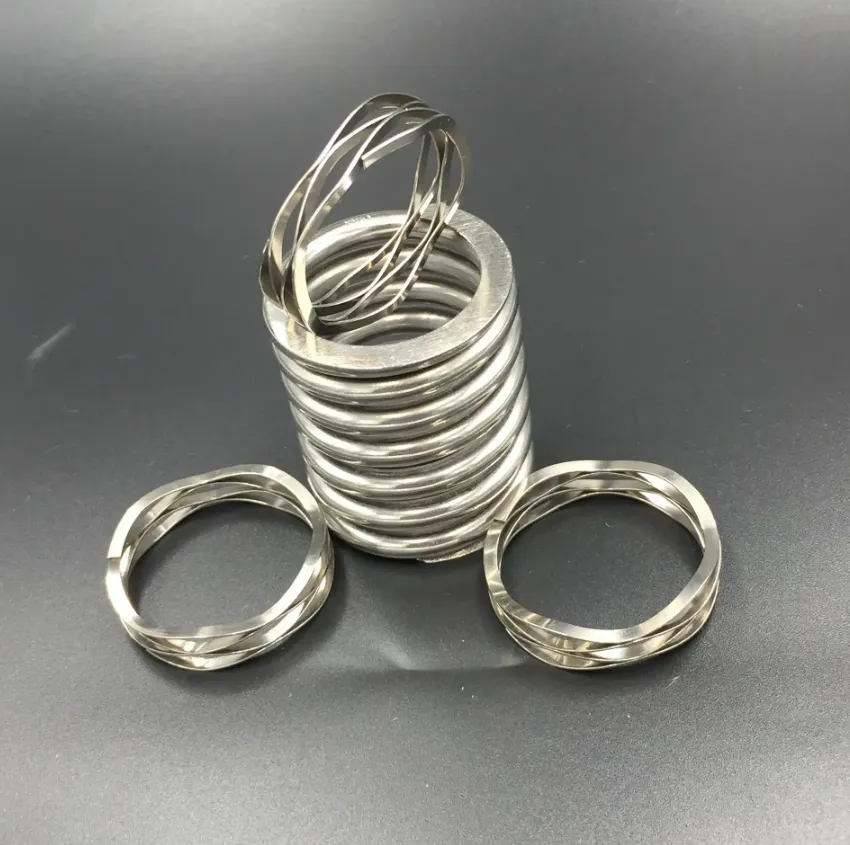
| Wave springs | Bearing preload, seal assemblies | 0.005" - 0.080" thick |
| Wire forms | Retaining clips, custom brackets | 0.010" - 0.150" |
| Conical and disc springs | High-load, low-deflection applications | Custom per drawing |
Medical device customers lean heavily toward flat springs and small compression springs because 17-7 PH passivates cleanly and holds up under repeated steam autoclave sterilization cycles without losing surface finish. Aerospace customers tend to order torsion and compression springs rated to RH 950 or CH 900 for actuator and latch mechanisms where weight and strength both matter.
How Fast Is Prototyping for Custom 17-7 PH Springs?
Speed is usually the second question after material properties, right behind price. Our standard prototyping workflow runs like this:
- Drawing or sample review, quote issued within 24-48 hours.
- Material pull and coiling setup, 1-2 business days.
- Prototype forming and stress relief, 1 day.
- Aging heat treatment cycle, 1 day (aging times run 1-4 hours depending on condition, plus furnace cool-down).
- Inspection, load testing, and shipment, 1 business day.
That sequence typically lands prototype delivery at 5 to 7 business days from drawing approval, and we've compressed it to 3 days for customers with urgent qualification deadlines by running expedited furnace scheduling. We tell customers upfront when a rush fee applies versus when we can absorb the schedule into normal shop flow, because transparency on this point avoids the frustrating back-and-forth we've seen happen with other suppliers.
For production quantities, lead time depends on order volume, but most runs between 1,000 and 50,000 pieces ship within 3 to 4 weeks of prototype approval, assuming no engineering changes mid-run.
Which Industries Use 17-7 PH Custom Springs?
We ship this alloy into a fairly concentrated set of industries where the combination of corrosion resistance and high strength genuinely matters, not just as a nice-to-have.
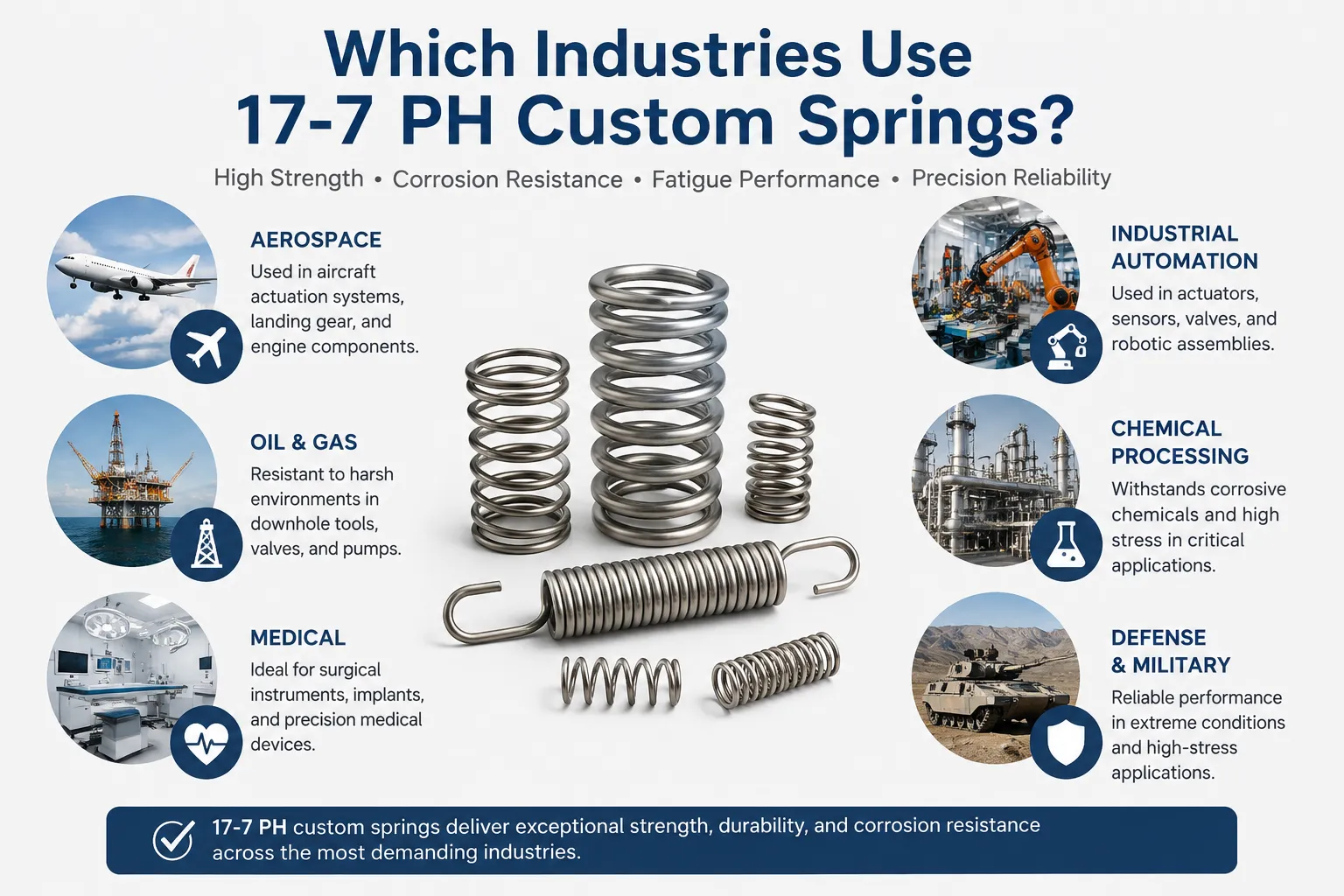
Aerospace and defense. Actuator return springs, landing gear component springs, and fastener retention springs where weight savings and reliability under vibration and temperature swings both drive the material choice.
Medical devices. Surgical instrument springs, catheter components, and implantable device springs where biocompatibility, corrosion resistance under repeated sterilization, and fine wire tolerances converge.
Electronics and connectors. Battery contact springs and connector springs where corrosion resistance protects electrical continuity over the product's service life.
Oil and gas. Downhole tool springs and valve springs exposed to corrosive fluids and elevated temperatures where standard carbon steel would corrode within months.
Food and pharmaceutical processing equipment. Springs in valve assemblies and mixing equipment that need to survive washdown cycles and chemical cleaning agents.
We've noticed over the past few years that demand from the medical device sector has grown the fastest among our 17-7 PH orders, largely driven by minimally invasive surgical tool manufacturers who need smaller, higher-strength springs than 300-series stainless can reliably deliver.
How Does 17-7 PH Compare to Other Spring Materials?
Customers frequently ask us to compare 17-7 PH against the alternatives before finalizing a design. Here's the comparison we walk through most often.
| Material | Tensile Strength | Corrosion Resistance | Max Service Temp | Relative Cost |
|---|---|---|---|---|
| 17-7 PH (TH 1050) | 190,000-215,000 psi | Very good | 600°F | Moderate-high |
| 302/304 Stainless | 170,000-190,000 psi | Excellent | 550°F | Moderate |
| 316 Stainless | 150,000-180,000 psi | Excellent (best chloride resistance) | 500°F | Moderate-high |
| Music Wire (ASTM A228) | 230,000-300,000 psi | Poor (rusts without coating) | 250°F | Low |
| Chrome Silicon | 200,000-240,000 psi | Poor | 475°F | Low-moderate |
| 17-4 PH | 190,000-220,000 psi | Good | 600°F | Moderate-high |
The choice between 17-7 PH and 17-4 PH comes up often. Both harden through precipitation hardening and both deliver comparable strength, but 17-7 PH generally forms more easily into fine spring wire and offers slightly better ductility in the annealed condition, which is why it dominates the spring market while 17-4 PH is more common in machined structural components. If a customer needs pure maximum fatigue life and doesn't care about corrosion, we'll usually recommend music wire with a protective coating instead, since it's both stronger and cheaper. We'd rather lose a sale on the "premium" material than sell someone a spring that doesn't fit their actual requirement.
Read more: 17-7 PH vs. 304 Stainless Steel: Strength, Fatigue and Application Selection Guide
What Quality Standards and Certifications Apply to 17-7 PH Springs?
Buyers sourcing for regulated industries need documentation, not just a good-looking part. Our springs are manufactured and certified against the following standards, and we issue full material traceability with every shipment.
| Standard | Scope |
|---|---|
| ASTM A313 | Spring wire, stainless steel |
| ASTM A693 | Precipitation-hardening stainless steel plate, sheet, strip |
| AMS 5528 / AMS 5529 | Aerospace-grade 17-7 PH strip and wire specifications |
| ASTM A967 | Passivation of stainless steel parts |
| ISO 9001:2015 | Quality management system |
| AS9100D | Aerospace quality management (project-dependent) |
| RoHS / REACH | Restricted substance compliance for electronics and medical applications |
For aerospace and medical customers, we also provide certificate of conformance, dimensional inspection reports, and salt spray test data on request. We've found that suppliers who can't produce full mill certs traced back to heat number are usually the ones customers end up switching away from after their first quality audit.
How Do You Choose the Right Spring Manufacturer for 17-7 PH Applications?
We'd tell any procurement manager to check four things before committing to a supplier, because we've watched customers get burned skipping these steps with previous vendors.
First, ask whether the supplier runs in-house heat treatment or outsources aging to a third party. Outsourced aging adds lead time and introduces a quality control gap, since the coiler loses direct visibility into furnace temperature uniformity.
Second, request sample load-deflection test data from a previous run of similar spring geometry, not just a generic material data sheet. This tells you whether the shop actually understands how their tooling performs on this specific alloy.
Third, confirm tolerance capability against your drawing's actual callouts, not the shop's marketed "capability" range. A supplier that lists ±0.001 inch capability on their website might only hold that on larger wire diameters, not the 0.008 inch wire your part actually needs.
Fourth, check whether they'll run a true prototype quantity (5-50 pieces) without demanding a production-level minimum order. We built our prototyping process specifically because too many customers were being forced into 5,000-piece minimums just to validate a design.
What Does Pricing Typically Look Like for Custom 17-7 PH Springs?
Pricing depends heavily on wire diameter, geometry complexity, heat treatment condition, and order volume, but we can give a general framework. Raw material cost for 17-7 PH wire runs higher than standard 302 stainless, typically 20-40% more depending on market conditions and diameter. Tooling and setup costs for prototypes usually range from $150 to $600 depending on geometry complexity, and this is often waived or credited against production orders. Production unit pricing drops significantly at volume, and we've seen per-piece costs fall by 40-60% between a 100-piece prototype order and a 10,000-piece production run, mainly due to setup amortization and material buying efficiency at scale.
We provide itemized quotes that separate tooling, material, and per-piece cost so customers can see exactly where their budget goes, rather than a single bundled number that hides the cost drivers.
Frequently Asked Questions
Is 17-7 PH stainless steel magnetic?
Yes, 17-7 PH is magnetic in both the annealed and aged conditions because its microstructure is predominantly martensitic after heat treatment. This differs from austenitic stainless steels like 302 or 304, which are largely non-magnetic. For customers building assemblies near sensitive electronics or magnetic sensors, we flag this property early in the design review so it doesn't cause a surprise during final assembly testing.
Can 17-7 PH springs be welded?
Welding is possible but not commonly recommended for finished springs, because the heat-affected zone disrupts the precipitation-hardened microstructure and creates a weak point prone to cracking. When customers need a welded assembly, we typically weld before final aging and then age the entire assembly together, which restores strength uniformly across the weld zone and the parent material.
What is the difference between 17-7 PH and 15-7 PH stainless steel?
15-7 PH contains added molybdenum (2-3%), which improves corrosion resistance in chloride-rich environments compared to standard 17-7 PH. Mechanical properties between the two alloys are very similar. We recommend 15-7 PH specifically for marine, offshore, or medical implant applications where chloride exposure is a genuine long-term concern.
How long does 17-7 PH spring material last in service?
Fatigue life depends heavily on stress amplitude, surface finish, and aging condition, but properly designed and shot-peened 17-7 PH springs routinely exceed 1 million cycles in compression and torsion applications operating within their designed stress range. We run fatigue validation testing for customers who need documented cycle-life data before qualifying a design for production.
Does 17-7 PH rust or corrode?
17-7 PH resists atmospheric corrosion and mild chemical exposure very well due to its 16-18% chromium content, but it is less corrosion resistant than 316 stainless in chloride-heavy or marine environments. Passivation per ASTM A967 significantly improves surface corrosion resistance and is standard practice on every part we ship.
What is the minimum order quantity for custom 17-7 PH springs at MWalloys?
We accept prototype orders as small as 5 to 25 pieces without requiring a production-level commitment, which is different from many manufacturers who enforce minimums of 1,000 pieces or more. This lets engineering teams validate fit, function, and load performance before committing budget to a full production run.
How does temperature affect 17-7 PH spring performance?
17-7 PH maintains stable spring force up to approximately 600°F, beyond which stress relaxation accelerates and load retention drops measurably. For applications running near or above this threshold, we often recommend RH 950 or CH 900 aging conditions, which offer slightly better high-temperature stability than the standard TH 1050 condition.
Can you match an existing spring sample without a drawing?
Yes, we regularly reverse-engineer springs from physical samples using coordinate measuring equipment and load testing to reconstruct wire diameter, coil geometry, free length, and spring rate. This service is common for customers replacing legacy parts where original drawings were lost or the original supplier is no longer in business.
What surface finishes are available for 17-7 PH springs?
Standard options include mechanical passivation, electropolishing for medical-grade smoothness, and shot peening for fatigue-critical applications where compressive surface stress extends service life. Plating is rarely necessary since the base alloy already resists corrosion, though PTFE or parylene coating is available for applications needing reduced friction or electrical insulation.
How do I know if my application needs 17-7 PH instead of a cheaper stainless grade?
If your spring must retain strength above 400°F, resist corrosion in a humid or mildly chemical environment, or fit in a tight space where a stronger material allows a smaller wire diameter, 17-7 PH is usually the right call over 302 or 304 stainless. If your application runs at room temperature in a dry environment with no strength constraints, standard austenitic stainless will often perform adequately at a lower material cost, and we'll tell customers this directly rather than upselling a premium alloy they don't need.
Ready to Start Your Prototype?
We've built our shop around a simple principle: engineers and buyers shouldn't have to choose between fast turnaround and verified material quality. Send us your drawing, a sample, or even just a rough sketch with your target load and space constraints, and our engineering team will return a quote and design feedback within 48 hours. Reach out through our contact form or call our engineering line directly, and we'll walk your project from prototype to production without the guesswork.
Sources and References
- ASTM International, ASTM A313/A313M Standard Specification for Stainless Steel Spring Wire.
- ASTM International, ASTM A693 Standard Specification for Precipitation-Hardening Stainless Steel Plate, Sheet, and Strip.
- SAE International, AMS 5528 and AMS 5529 Specifications for 17-7 PH Corrosion-Resistant Steel.
- AK Steel (Cleveland-Cliffs), 17-7 PH Stainless Steel Technical Data Sheet.
- ASM International, ASM Handbook Volume 1: Properties and Selection of Irons, Steels, and High-Performance Alloys.
- Spring Manufacturers Institute (SMI), Handbook of Spring Design.
- ASTM International, ASTM A967 Standard Specification for Chemical Passivation Treatments for Stainless Steel Parts.
- NIST Materials Data Repository, Mechanical Property Reference Data for Precipitation-Hardening Stainless Steels.