
MWalloys stocks and precision slits 17-7 PH stainless steel strip and coil that meets ASTM A693 requirements, and we can typically ship standard widths from 0.005" to 24" within days rather than the six to ten week lead times that mill-direct orders often require. If you need a semi-austenitic precipitation hardening strip that combines formability in the annealed condition with tensile strength above 200 ksi after aging, 17-7 PH is very likely the material your engineering drawing is calling out, and this article walks through the metallurgy, the ASTM specification, our slitting capabilities, and the sourcing decisions that actually matter when you place a purchase order.
We have supplied this alloy to spring manufacturers, medical device shops, aerospace subcontractors, and electronics fabricators for years, and the questions buyers ask us are remarkably consistent. They want to know which temper to specify, whether Condition A or precipitation hardened stock will machine better, how tight our slit tolerances run, and whether a small trial coil can be cut before a full production release. We answer all of that below, using the terminology the mill certifications and ASTM committee actually use, not marketing language.
If your project requires the use of 17-7 PH Stainless Steel Strip, Coil, you can contact us for a free quote.
What Is 17-7 PH Stainless Steel and Why Does It Matter for Precision Strip and Coil?
17-7 PH (UNS S17700) is a chromium-nickel-aluminum semi-austenitic precipitation hardening stainless steel that ships soft and formable, then gets heat treated by the fabricator into a martensitic structure with high strength. That two-stage behavior is the entire reason engineers specify it: you get a material that punches, deep draws, or forms like an austenitic grade at Condition A, and after a simple aging cycle it delivers spring-grade hardness and corrosion resistance that plain carbon spring steels cannot match.
The aluminum content, roughly 0.75 to 1.5 percent, is what separates 17-7 PH from ordinary 17-7 chromium-nickel grades. Aluminum forms the nickel-aluminum intermetallic precipitates during aging that produce the strength jump. Because the transformation from austenite to martensite is triggered by cooling to a specific sub-zero or intermediate temperature range before the final aging step, the strip has to be processed under tightly controlled thermal cycles, which is exactly what ASTM A693 governs.
For strip and coil buyers specifically, 17-7 PH matters because it is thin gauge friendly. Unlike bar or plate precipitation hardening grades, strip product is rolled to tolerances measured in ten-thousandths of an inch, and the alloy retains its mechanical properties down to foil-like gauges below 0.010 inch, which is why it shows up in flexures, diaphragms, bellows, retaining rings, and surgical instrument components where thickness consistency is a functional requirement, not a cosmetic one.
Read more: Custom 17-4 PH Stainless Steel Machining, Precision CNC Services
How Does ASTM A693 Define Quality Standards for 17-7 PH Strip and Coil?
ASTM A693 is the standard specification covering precipitation hardening stainless and heat resisting steel plate, sheet, and strip, and it is the document that mills and slitters reference when certifying 17-7 PH, 15-5 PH, 17-4 PH, and PH 13-8 Mo material. For strip and coil specifically, A693 sets the acceptable chemical composition ranges, mechanical property requirements by heat treatment condition, permissible thickness and width tolerances, and the testing frequency required for mill certification.
What buyers often miss is that A693 does not mandate a single hardness or tensile number for 17-7 PH. Instead it lists separate property tables for Condition A (annealed), Condition C (cold rolled), and the various aged conditions such as TH1050, RH950, and CH900. When a purchase order simply says "ASTM A693 17-7 PH," the supplier still needs the condition callout, because a Condition A coil and a CH900 coil are chemically identical but mechanically almost unrecognizable from one another.
We always confirm three things against the A693 requirement before a coil ships: the certified chemical analysis from heat lot testing, tensile and hardness testing performed on samples representative of the actual coil (not just the master heat), and dimensional inspection covering thickness, width, and camber against the tolerance tables in the specification. Every coil we slit carries a mill certification traceable to heat number, and we provide a slitting certificate referencing the original mill test report so the chain of custody holds up under aerospace or medical quality audits.
Read more: Custom 17-4 PH (Type 630) SS Stamped Parts: Heat Treated, OEM Components
What Are the Chemical Composition and Mechanical Properties of 17-7 PH Stainless Steel?
The chemistry of 17-7 PH is narrow by design because the aging response depends on consistent aluminum and carbon levels. Here is the composition range specified under UNS S17700 and referenced in ASTM A693.
| Element | Weight Percent |
|---|---|
| Carbon | 0.09 max |
| Manganese | 1.00 max |
| Silicon | 1.00 max |
| Phosphorus | 0.040 max |
| Sulfur | 0.030 max |
| Chromium | 16.00 to 18.00 |
| Nickel | 6.50 to 7.75 |
| Aluminum | 0.75 to 1.50 |
| Iron | Balance |
Mechanical properties shift dramatically depending on which heat treatment condition the strip is delivered in or processed to after forming. This is the table we send buyers who are trying to decide which condition to release into production.
| Condition | Typical Tensile Strength (ksi) | Typical Yield Strength (ksi) | Typical Hardness | Elongation (%) |
|---|---|---|---|---|
| Condition A (annealed) | 130 to 150 | 40 to 50 | Rockwell B 85 to 95 | 20 to 30 |
| Condition CH900 | 235 to 260 | 220 to 245 | Rockwell C 48 to 52 | 1 to 6 |
| Condition RH950 | 195 to 225 | 170 to 200 | Rockwell C 40 to 45 | 3 to 8 |
| Condition TH1050 | 180 to 205 | 150 to 180 | Rockwell C 35 to 40 | 5 to 9 |
We pull these ranges from actual certified test reports we have accumulated across dozens of heats, and buyers should treat mill spec sheets as a starting point rather than a guarantee, because small heat-to-heat variation in aluminum content will move the aged hardness by a few points either direction.
Which Heat Treatment Conditions Are Available for 17-7 PH Strip (Condition A, CH900, RH950, TH1050)?
Condition A is the mill annealed state and the one most fabricators buy when they need to blank, form, draw, or roll the strip before hardening it themselves. In this condition the material behaves close to an austenitic stainless steel, meaning it work hardens noticeably during forming, so tooling and press setup should account for spring-back the same way you would for 301 stainless.
CH900 is produced by cold rolling Condition A material to a specific reduction (typically 60 percent) and then aging at 900°F. This route produces the highest strength of the standard conditions but at the cost of ductility and formability, so CH900 is generally purchased already in final form for parts that need edge strength without additional bending, such as certain spring washers or contacts.
RH950 involves a sub-zero conditioning treatment (transformation at -100°F) followed by aging at 950°F, and it is a common choice when the customer needs a good balance of strength and toughness without pre-cold-rolling the strip.
TH1050 uses a higher temperature transformation step (1750°F followed by cooling to 60°F, then aging at 1050°F) and produces the most dimensionally stable, toughest of the standard aged conditions, which is why aerospace bellows and precision flexures frequently specify TH1050.
We stock Condition A as our primary slitting inventory because it gives customers the flexibility to form first and harden after, which is the sequence almost every stamping and deep-draw shop prefers. When a project calls for pre-aged CH900 or RH950 strip, we coordinate directly with heat treat partners who run these cycles to AMS and ASTM tolerances, and we verify hardness on both ends of the coil before it goes out the door.
How Is 17-7 PH Strip and Coil Custom Slit to Exact Widths and Tolerances?
Slitting 17-7 PH is not the same operation as slitting mild carbon strip, and this is where a lot of buyers get burned by suppliers who treat every stainless alloy the same way on the slitting line. Because Condition A material work hardens and CH900 or RH950 material is already hardened and brittle at the edges, blade clearance, shear angle, and rewind tension all need to be dialed in specifically for this alloy family.
In our slitting operation we run 17-7 PH on rotary shear lines with carbide blades set to clearances typically between 3 and 8 percent of material thickness depending on gauge, because too tight a clearance produces burr and edge cracking on the harder tempers, and too loose a clearance produces a ragged, feathered edge that fails burr height inspection for medical or spring applications. We routinely hold slit width tolerances of plus or minus 0.002 inch on gauges above 0.010 inch, and tighter tolerances down to plus or minus 0.0005 inch are achievable on request for critical dimension parts, though that level of precision adds lead time for setup and in-process gauging.
Edge condition matters as much as width for this alloy. Spring applications in particular are sensitive to edge burrs because a burr becomes a stress riser once the part is cycled in fatigue, so we specify maximum burr height on our slitting certificates and inspect with optical comparators rather than relying on visual check alone.
| Slitting Parameter | Typical Range for 17-7 PH |
|---|---|
| Standard width tolerance | ±0.002" to ±0.005" |
| Precision width tolerance | ±0.0005" to ±0.001" |
| Camber allowance | 0.0625" per 8 ft. max (standard) |
| Edge burr height limit | 10% of thickness (typical spring spec) |
| Coil ID options | 3", 6", 8", 10", 16" |
| Available thickness range slit | 0.001" to 0.125" |
What Thickness, Width, and Temper Options Does MWalloys Stock for 17-7 PH Strip?
We keep master coils in the gauges and tempers our customer base orders most often, which lets us cut a trial or production order without waiting on a mill run. This table reflects the stock configurations we hold routinely, though we source outside these ranges for special orders.
| Thickness Range | Width Range (Slit) | Temper Stocked | Typical Applications |
|---|---|---|---|
| 0.002" to 0.010" | 0.125" to 12" | Condition A | Foil components, sensors, thin diaphragms |
| 0.010" to 0.031" | 0.25" to 24" | Condition A, 1/2H, Full Hard | Springs, contacts, clips |
| 0.032" to 0.062" | 0.5" to 24" | Condition A, CH900 | Retaining rings, washers, flexures |
| 0.063" to 0.125" | 1" to 24" | Condition A | Structural clips, brackets |
Buyers frequently ask whether we sell full mill coils only or if smaller cut lengths and slit-to-size pieces are available. We do both. Production customers order slit master coils on standard cores, while prototype and low-volume buyers order cut-to-length sheets or short coils, which lets an engineering team validate forming and heat treat response before committing to a large coil purchase.
Where Is 17-7 PH Stainless Steel Strip Used Across Industries?
Aerospace is the largest consumer of 17-7 PH strip, and within aerospace it shows up in engine seals, bellows, ducting clips, and structural fasteners where the combination of high strength-to-weight ratio and corrosion resistance up to moderate temperatures (useful strength retention to around 600°F) outperforms alternatives like 301 full hard stainless.
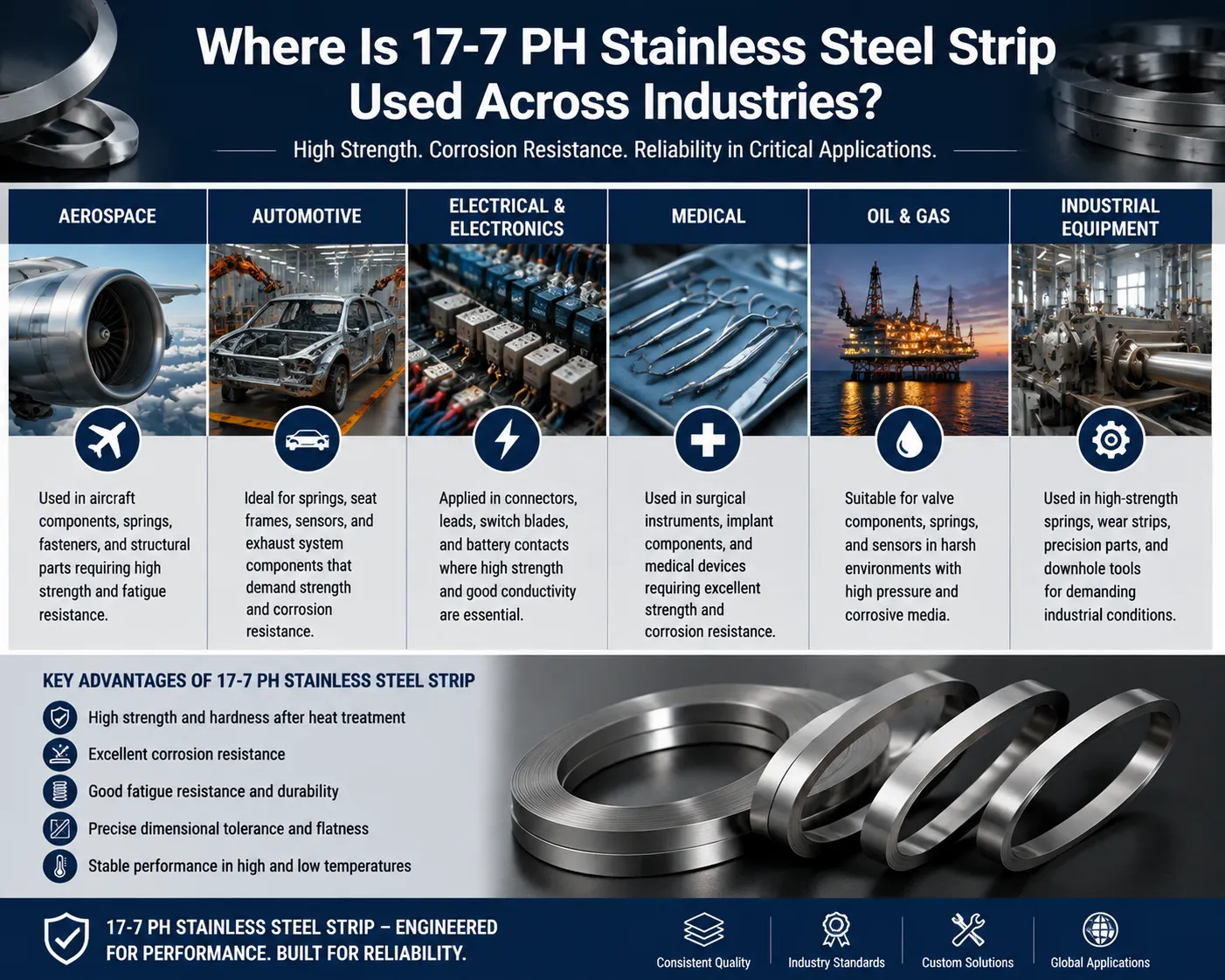
Medical device manufacturers specify 17-7 PH for surgical instrument components, orthopedic implant instrumentation, and spring-loaded mechanisms in devices that require repeated sterilization cycles, because the alloy resists the pitting and staining that carbon steel springs suffer under autoclave conditions.
Electronics and connector manufacturers use thin gauge 17-7 PH for battery contacts, switch springs, and EMI shielding fingers, taking advantage of the strip's ability to be formed at Condition A and then hardened in bulk after stamping, which keeps forming tool wear lower than stamping already-hardened material.
Firearms and precision instrument makers rely on 17-7 PH for extractor springs, sear springs, and small precision components where dimensional stability after heat treat is critical, since the TH1050 and RH950 conditions distort less during aging than many competing tool steels.
We also see steady demand from industrial gasket, seal, and diaphragm manufacturers, where the alloy's fatigue resistance in thin sections makes it a natural fit for metallic bellows and pressure-sensing diaphragms that flex thousands or millions of cycles in service.
How Does 17-7 PH Compare to 301, 302, and 15-5 PH Stainless Steels?
This is the comparison question we field most often from engineers doing material substitution studies, usually because a legacy drawing calls out one grade and a supply chain issue is forcing a look at alternatives.
| Property | 17-7 PH | 301 Stainless | 302 Stainless | 15-5 PH |
|---|---|---|---|---|
| Hardening mechanism | Precipitation hardening | Cold work (strain hardening) | Cold work (strain hardening) | Precipitation hardening |
| Max typical tensile (aged/hardened) | 260 ksi (CH900) | 185 to 220 ksi (full hard) | 125 to 185 ksi (full hard) | 190 to 210 ksi (H900) |
| Corrosion resistance | Good, moderate chromium | Good | Good | Better in some environments (martensitic base) |
| Dimensional stability after treatment | Very good (low distortion) | N/A, no aging step | N/A | Very good |
| Weldability | Fair (post-weld aging needed) | Good | Good | Fair to good |
| Typical form | Strip, sheet, coil | Strip, sheet, coil, wire | Strip, sheet, wire | Bar, plate, some strip |
The key distinction we explain to buyers considering 301 or 302 as a substitute is that those grades reach high strength only through cold rolling, which means the strength is baked in at the mill and cannot be adjusted after forming. 17-7 PH gives you the opposite sequence: form soft, then age hard, which is enormously useful when a part geometry is too complex to blank or draw once the material is already strain hardened to full hard temper.
Compared with 15-5 PH, which is more commonly supplied as bar and plate, 17-7 PH is the strip and thin sheet workhorse of the precipitation hardening family, and mills simply do not roll 15-5 PH down to the thin gauges that 17-7 PH is routinely produced in.
What Quality Certifications and Testing Does MWalloys Provide for Every Coil?
Every coil we slit ships with a certified mill test report showing heat chemistry, and we add our own slitting certificate documenting width, thickness, and edge condition inspection results tied to that heat number. For customers under AS9100 or ISO 13485 quality systems, we provide full material traceability from raw coil through slit product, and we retain records that support supplier audits years after a shipment ships.
We perform incoming inspection on every master coil before it goes to the slitting line, checking hardness with a calibrated Rockwell tester, measuring thickness at multiple points across the width with a micrometer, and verifying flatness and camber against ASTM A693 tolerance tables. Outgoing slit coils get spot-checked on width and edge burr, and for orders flagged as aerospace or medical critical, we run first-piece and last-piece inspection on every coil rather than sampling.
Buyers who need third-party lab verification, whether that is a full chemical analysis, a metallographic cross-section, or a salt spray corrosion test, can request it before shipment, and we coordinate with independent testing labs so the results carry outside certification rather than relying only on our in-house data.
How Should You Store, Handle, and Process 17-7 PH Strip to Avoid Cracking?
The most common failure mode we see reported back from customers is not a mill defect, it is improper heat treat cycling or handling after the coil leaves our facility. A few practices matter more than people expect.
Store coils in a dry environment, because while 17-7 PH resists general corrosion well, surface moisture combined with residual forming lubricants can cause light staining on unpassivated strip during long storage periods, which is a cosmetic issue but one that quality inspectors will flag.
When forming Condition A material, account for the fact that this alloy work hardens faster than 304 or 316 austenitic stainless during deep drawing or tight-radius bending, so multi-stage forming with intermediate anneals may be necessary for complex geometries, otherwise you risk edge cracking at the bend.
During aging heat treatment, hold furnace temperature uniformity tightly, because 17-7 PH's mechanical properties are sensitive to a plus or minus 25°F swing in aging temperature. A furnace that runs hot will over-age the material and reduce strength, while a furnace running cool will under-age it and leave strength below the specification minimum. We recommend customers run a hardness check on a sacrificial coupon from the same coil alongside every production heat treat load.
For welded assemblies, plan on a post-weld aging cycle to restore strength in the heat affected zone, since welding effectively re-solutionizes the material locally and undoes the precipitation hardening response achieved in the mill or prior heat treat step.
How Do You Order Custom Slit 17-7 PH Coil from MWalloys?
Placing an order starts with four pieces of information: gauge, width, temper or condition, and quantity in either linear feet, pounds, or coil weight. If your drawing references ASTM A693 without a condition callout, we will ask which condition your process needs, because that single detail changes lead time, price, and which stock coil we pull from.
For new part programs, we recommend ordering a short trial coil, sometimes as little as 25 to 50 pounds, before releasing a full production quantity. This lets your tooling and heat treat team validate forming behavior and aging response on the actual heat lot before committing budget to thousands of feet of finished strip. We have seen this trial-first approach save customers real money when a die needed minor clearance adjustment that only showed up once real coil went through the press.
Once specifications are locked, we quote slit width tolerance, coil core size, coil weight per reel, and delivery method, then confirm mill certification requirements before the coil ships. Most standard stock slitting orders leave our facility within one to two weeks, while special conditions like pre-aged CH900 or non-stock gauges may run longer depending on outside heat treat scheduling.
Frequently Asked Questions
What is the difference between 17-7 PH Condition A and hardened 17-7 PH?
Condition A is the mill annealed, soft, formable state with tensile strength around 130 to 150 ksi, while hardened conditions such as CH900, RH950, or TH1050 have gone through precipitation hardening heat treatment and reach tensile strengths between 180 and 260 ksi. Condition A is chosen when a part needs stamping, forming, or drawing before final hardening, while pre-hardened strip is chosen when the part geometry is simple enough that hardening before fabrication does not risk cracking. Most stamping and deep-draw shops purchase Condition A and age the finished part themselves.
Does ASTM A693 cover both sheet and strip for 17-7 PH?
Yes, ASTM A693 covers plate, sheet, and strip forms of precipitation hardening stainless steels including 17-7 PH, and the specification includes property tables and tolerance requirements that apply across these product forms with some dimensional distinctions. Strip typically refers to narrower, coiled product under roughly 24 inches wide, while sheet refers to flat, cut-to-length product. Buyers should specify strip or sheet clearly on purchase orders since tolerance tables differ slightly between the two forms within the standard.
Can 17-7 PH strip be welded without losing its hardness?
Welding 17-7 PH locally re-solutionizes the heat affected zone and reduces the hardness gained from precipitation hardening in that region, so most welded assemblies require a post-weld aging cycle to restore strength near the weld. The base metal away from the weld retains its original properties. For critical strength applications, engineers often design the weld location away from high-stress areas or specify post-weld heat treatment as a mandatory process step on the drawing.
What is the maximum service temperature for 17-7 PH stainless steel?
17-7 PH retains useful mechanical strength up to approximately 600°F, with some strength loss occurring above that threshold as the precipitation hardened microstructure begins to over-age in service. Below 600°F it performs reliably in continuous use for springs, seals, and structural components exposed to moderate heat. For sustained higher temperature service, other alloys like A286 or Inconel variants are typically better suited despite higher cost.
How thin can 17-7 PH stainless steel strip be slit?
We routinely slit 17-7 PH down to 0.002 inch thickness and can process narrower gauges under specific order conditions, with slit widths as narrow as 0.125 inch achievable while holding acceptable edge quality. Thinner gauges require slower line speeds and tighter blade clearance control to avoid edge waviness, which adds modest cost but does not change base material pricing significantly. Foil-gauge strip is common in sensor and diaphragm applications.
Is 17-7 PH stainless steel magnetic?
Yes, 17-7 PH is magnetic in both the annealed and aged conditions because its microstructure is martensitic after aging and largely martensitic to semi-austenitic in the annealed state, unlike fully austenitic grades such as 304 or 316 which are essentially non-magnetic. This magnetic property is sometimes a design consideration in electronics or sensor applications where non-magnetic materials are required, in which case 17-7 PH would not be a suitable substitute.
What is the typical lead time for custom slit 17-7 PH coil?
Standard stock gauges and widths typically ship within one to two weeks from order confirmation because master coil inventory is already on hand and only slitting and inspection remain. Non-stock gauges, pre-aged conditions requiring outside heat treatment, or unusually tight slit tolerances can extend lead time to three to six weeks depending on heat treat and testing scheduling. Requesting a quote early in a project timeline avoids last-minute delays.
How does 17-7 PH corrosion resistance compare to 304 stainless steel?
17-7 PH offers corrosion resistance generally comparable to or slightly below 304 stainless steel in most atmospheric and mild chemical environments, since both contain similar chromium levels, though 17-7 PH's higher strength makes it preferable when mechanical performance outweighs marginal corrosion resistance differences. In highly corrosive or chloride-rich environments, higher alloyed grades like 316 stainless would outperform both. Passivation treatment after fabrication improves corrosion resistance for either grade.
What coil core sizes are available for slit 17-7 PH strip?
We stock slit coils on standard cores including 3 inch, 6 inch, 8 inch, 10 inch, and 16 inch inside diameters, with core selection typically driven by the customer's uncoiling or stamping press feed equipment. Matching core size to existing tooling avoids the need for adapter spools on the production floor. Custom core sizes can be accommodated for larger production orders with advance notice.
Why does 17-7 PH strip sometimes crack during forming even in the annealed condition?
Cracking during forming in Condition A usually results from exceeding the material's work hardening capacity in a single forming step, tight bend radii below the recommended minimum for the gauge, or residual stress from improper slitting edge condition acting as a crack initiation point. Multi-step forming with intermediate stress relief, proper bend radius selection relative to thickness, and verified clean slit edges from a supplier experienced with this alloy typically resolve the issue. Reviewing tooling clearance and lubrication also helps when cracking appears consistently at the same feature.
Sourcing References
ASTM International, ASTM A693 Standard Specification for Precipitation Hardening Stainless and Heat Resisting Steel Plate, Sheet, and Strip.
AK Steel (now Cleveland-Cliffs), 17-7 PH Stainless Steel Product Data Bulletin.
SAE International, AMS 5528 and AMS 5529 specifications for 17-7 PH stainless steel strip and sheet.
ASM International, ASM Handbook Volume 1, Properties and Selection of Irons, Steels, and High Performance Alloys, precipitation hardening stainless steel section.
NIST Materials Data Repository, chromium-nickel-aluminum precipitation hardening alloy reference data.
If your project needs certified ASTM A693 17-7 PH strip or coil slit to an exact width and temper, reach out to our team at MWalloys with your gauge, width, and condition requirements, and we will confirm stock availability, quote a trial coil if you need one, and get certified material moving toward your production line without the mill's standard multi-month wait.