
Custom 17-4 PH stainless steel machining delivers precision components combining corrosion resistance with tensile strength exceeding 190,000 psi after heat treatment, making it the preferred material choice for aerospace fittings, medical instruments, oil field valves, and food processing equipment where both strength and dimensional accuracy matter equally. We machine this alloy daily in our shop, and what sets successful 17-4 PH machining apart from mediocre results comes down to three factors: controlling heat treatment condition before or after machining, managing the alloy's tendency to work harden during cutting, and selecting tooling that survives its abrasive martensitic structure. If you're sourcing precision CNC parts in 17-4 PH, understanding these variables before you request a quote will save you rework cycles and missed tolerances down the line.
If your project requires the use of 17-4 PH Stainless Steel Machining, you can contact us for a free quote.
What Is 17-4 PH Stainless Steel and Why Does It Machine Differently?
17-4 PH stands for precipitation hardening stainless steel containing roughly 17% chromium and 4% nickel, along with copper and niobium additions that allow it to gain strength through aging heat treatment rather than cold working alone. This is fundamentally different from austenitic grades like 304 or 316, which harden mostly through cold work and can't reach anywhere near the same strength levels through heat treatment.
We think this distinction matters more than most sourcing guides acknowledge. Because 17-4 PH can be supplied and machined in a solution annealed condition (Condition A) and then aged afterward to reach final strength, machine shops have a choice: rough and finish machine before hardening for easier metal removal, or machine after hardening for better dimensional stability on tight tolerance parts. Each path carries tradeoffs we'll cover in detail below.
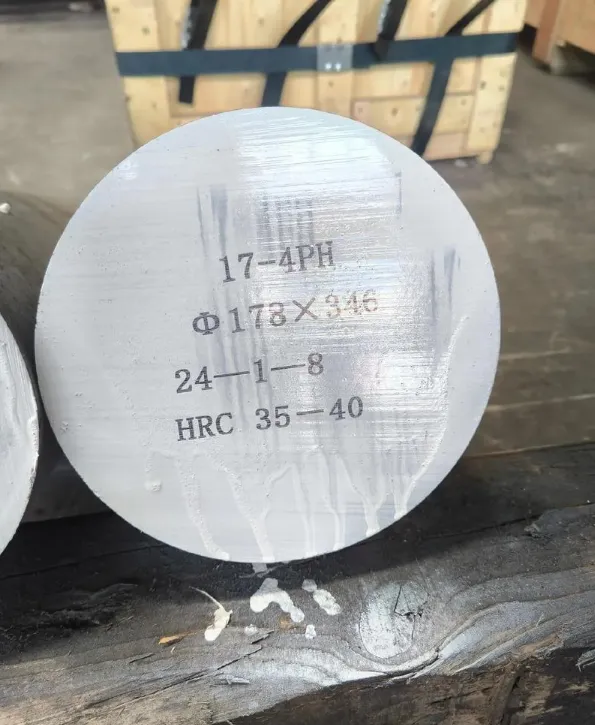
The alloy's martensitic microstructure after aging gives it hardness in the range of 33 to 44 HRC depending on the aging temperature selected, which is considerably harder than the annealed condition around 90 HRB. This hardness swing is exactly why machining strategy has to account for which condition the material sits in at each production stage.
What Are the Different Heat Treatment Conditions for 17-4 PH?
Understanding condition designations is essential before ordering material or specifying a part print, because each condition delivers a different combination of strength, hardness, and machinability.
| Condition | Aging Temperature | Typical Hardness | Tensile Strength | Machinability |
|---|---|---|---|---|
| Condition A (Annealed) | Not aged | 30-38 HRC (as supplied, varies by mill) | 150 ksi max | Best machinability |
| H900 | 900°F (482°C) | 40-47 HRC | 190 ksi min | Difficult, abrasive |
| H1025 | 1025°F (552°C) | 35-40 HRC | 155 ksi min | Moderate |
| H1075 | 1075°F (579°C) | 32-38 HRC | 145 ksi min | Moderate |
| H1150 | 1150°F (621°C) | 28-33 HRC | 125 ksi min | Easier than H900 |
| H1150-M | 1150°F double treat | 24-29 HRC | 115 ksi min | Easiest of aged conditions |
We generally recommend machining in the annealed Condition A whenever geometry allows, then aging afterward, because cutting forces and tool wear rates drop substantially compared to machining fully aged H900 material. The tradeoff is dimensional movement during aging heat treatment, typically a shrinkage of around 0.0003 to 0.0005 inches per inch, which needs to be factored into pre-hardening dimensions on tight tolerance features.
For parts requiring extremely tight tolerances after hardening, some shops machine close to final dimension in the annealed state, age the part, then perform a light finish pass or grinding operation to remove the heat treatment distortion. We use this approach regularly on aerospace bushings and valve components where post-aging tolerances run tighter than plus or minus 0.001 inches.
What Mechanical Properties Should Buyers Expect From 17-4 PH?
Procurement teams comparing quotes across suppliers need consistent property data to evaluate whether a vendor's material certification actually matches the specification called out on the drawing.
| Property | Annealed Condition | H900 Condition | H1150 Condition |
|---|---|---|---|
| Density | 7.75 g/cm³ | 7.75 g/cm³ | 7.75 g/cm³ |
| Tensile Strength | 1000-1100 MPa | 1310-1450 MPa | 930-1000 MPa |
| Yield Strength (0.2%) | 760-860 MPa | 1170-1310 MPa | 725-800 MPa |
| Elongation | 12-18% | 10-14% | 16-20% |
| Hardness | 30-38 HRC | 40-47 HRC | 28-33 HRC |
| Impact Toughness (Charpy) | Moderate | Lower | Higher |
| Max Service Temperature | 300°C | 300°C | 315°C |
Corrosion resistance across all aged conditions remains fairly comparable to 304 stainless steel in mild atmospheric and freshwater environments, though it falls short of 316 in chloride rich environments like marine or de-icing salt exposure. We always tell customers evaluating this alloy for outdoor or marine hardware to run a passivation process per ASTM A967 after machining, since residual iron contamination from tooling can create surface rust spots that have nothing to do with the base alloy's actual corrosion performance.
Also Read: 17-4 PH Stainless Maximum Service Temperature
How Do You Machine 17-4 PH Stainless Steel Successfully?
This is where experience separates shops that deliver consistent parts from those that struggle with tool breakage and dimensional drift. Machining 17-4 PH successfully requires attention to several interconnected variables.
Tooling Selection
Carbide tooling with a positive rake geometry outperforms high speed steel by a wide margin, particularly in aged conditions above 35 HRC. We favor coated carbide inserts, typically TiAlN or AlTiN coatings, because these coatings hold up against the heat generated during cutting far better than uncoated carbide or TiN coatings designed for softer materials.
For turning operations, a sharp, positive rake insert with a honed edge reduces work hardening at the cut surface, which matters because 17-4 PH work hardens noticeably when tools rub rather than cut cleanly. Dull tooling is the single biggest cause of scrapped parts we see when reviewing failed jobs from other shops, since a work hardened surface layer then requires even more aggressive cutting parameters to penetrate on the next pass, creating a compounding problem.
Cutting Speed and Feed Parameters
| Operation | Annealed Condition | H900 Condition |
|---|---|---|
| Turning (Carbide) | 300-450 SFM | 150-250 SFM |
| Milling (Carbide) | 250-400 SFM | 120-220 SFM |
| Drilling (Carbide) | 150-250 SFM | 80-150 SFM |
| Feed Rate (Turning) | 0.008-0.015 in/rev | 0.005-0.010 in/rev |
We reduce speeds significantly when working with H900 material because heat buildup accelerates tool wear exponentially past a certain threshold. Flood coolant application, rather than mist or dry cutting, helps control this heat and also flushes chips away from the cutting zone, which matters since 17-4 PH tends to produce long, stringy chips that can wrap around tooling and mar finished surfaces if not managed properly.
Managing Work Hardening
Light cuts with insufficient feed rate are actually counterproductive with this alloy, since rubbing rather than cutting hardens the surface layer and makes subsequent passes more difficult. We instruct our machinists to maintain adequate chip load on every pass, avoiding the temptation to take conservative light finishing cuts that seem safer but actually create more problems with this particular material.
Grinding Considerations
Precision ground features on 17-4 PH parts require open, sharp abrasive wheels with adequate coolant flow, since the alloy's toughness can cause wheel loading if the grit selection runs too fine or the wheel structure too dense. We typically specify aluminum oxide wheels for this material, avoiding silicon carbide, which tends to wear faster against tougher alloys like this one.
What Tolerances Can Precision CNC Machining Achieve With 17-4 PH?
Buyers frequently ask what tolerance range is realistic before quoting a job, and the honest answer depends heavily on part geometry, heat treatment sequencing, and whether features require post-hardening finishing operations.
| Feature Type | Typical Achievable Tolerance | Notes |
|---|---|---|
| General turned diameters | ±0.0005 in | Achievable in either condition with rigid setup |
| Milled flat surfaces | ±0.001 in | Tighter with proper fixturing |
| Bored holes | ±0.0003 in | Requires finish boring, not drilling alone |
| Thread features | Class 2A/2B standard | Class 3A/3B achievable with care |
| Post-heat-treat critical dimensions | ±0.0005 in | Requires machining allowance before aging |
| Surface finish (turned) | 16-32 Ra microinch | Finer finishes need grinding |
| Surface finish (ground) | 4-8 Ra microinch | Standard for precision bearing surfaces |
We've delivered valve stems and aerospace pins holding ±0.0002 inches on critical diameters, but that level of precision requires dedicated fixturing, temperature controlled shop environments, and in-process gauging rather than relying solely on final inspection. Any supplier promising extremely tight tolerances without describing their process controls deserves a follow up question about how they actually verify those numbers in production.
What Applications Commonly Use Custom Machined 17-4 PH Parts?
The versatility of this alloy across strength conditions explains why it shows up in such varied industries, from aerospace to food processing.
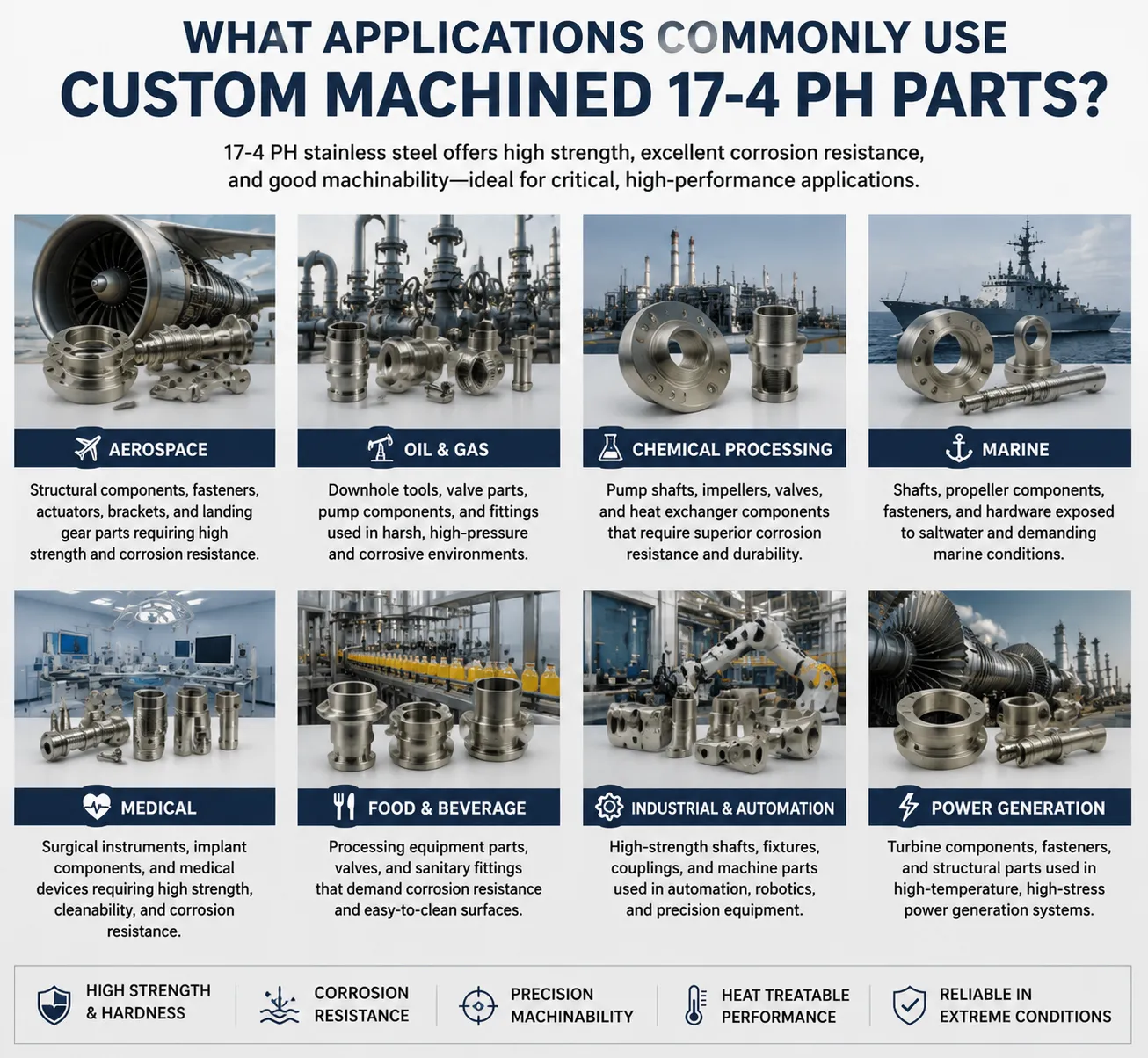
| Industry | Typical Component | Preferred Condition |
|---|---|---|
| Aerospace | Actuator components, brackets, fasteners | H900 or H1025 |
| Oil and Gas | Valve trim, pump shafts, wellhead components | H1075 or H1150 |
| Medical Devices | Surgical instrument components, implant tooling | H900 (passivated) |
| Food Processing | Pump components, mixing blades | H1150 (better corrosion resistance) |
| Marine Hardware | Fasteners, fittings (moderate exposure) | H1150 with passivation |
| Nuclear | Valve stems, control components | H1150 for toughness |
We supply oil field customers with valve trim components most often in H1075 or H1150 condition, since the slightly reduced strength compared to H900 comes with meaningfully better toughness and stress corrosion cracking resistance, which matters enormously in sour gas environments where hydrogen embrittlement risk is a real design concern. Aerospace customers more often specify H900 or H1025 where maximum strength per unit weight drives the material selection.
How Does 17-4 PH Compare to Other Stainless Steel Grades for Machining?
Buyers evaluating material options benefit from a direct comparison rather than reading separate datasheets and trying to reconcile the numbers themselves.
| Property | 17-4 PH (H900) | 304 Stainless | 316 Stainless | 15-5 PH |
|---|---|---|---|---|
| Machinability Rating | Fair | Good | Fair | Fair |
| Max Tensile Strength | 1450 MPa | 620 MPa | 580 MPa | 1450 MPa |
| Corrosion Resistance | Good | Good | Excellent | Good (slightly better than 17-4) |
| Heat Treatable | Yes | No | No | Yes |
| Weldability | Moderate | Excellent | Excellent | Moderate |
| Typical Cost Relative to 304 | 1.3-1.5x | Baseline | 1.4x | 1.4-1.6x |
15-5 PH is essentially a cleaner version of 17-4 PH with lower delta ferrite content, giving it slightly better transverse mechanical properties and marginally improved toughness, which is why aerospace specifications sometimes call it out specifically for critical rotating components. We stock both alloys and generally let the print specification decide, since converting between them without engineering approval isn't something we'd ever do even though they're closely related.
Compared to austenitic grades like 304 and 316, 17-4 PH machines somewhat similarly in the annealed condition but becomes considerably more demanding once aged, whereas 304 and 316 don't offer a heat treatable strength boost at all. This is the fundamental tradeoff: if a part needs strength beyond what austenitic stainless can deliver, 17-4 PH becomes the logical choice despite its more demanding machining characteristics.
What Post-Machining Processes Does 17-4 PH Typically Require?
Precision machined parts rarely leave the shop as-cut. Several finishing operations commonly follow machining depending on end use requirements.
Passivation per ASTM A967 or AMS 2700 removes free iron contamination left on the surface from machining operations, restoring the chromium oxide passive layer that gives stainless steel its corrosion resistance. We passivate essentially every 17-4 PH part destined for medical, food, or outdoor service, since skipping this step is the most common reason customers report unexpected rust spots on parts made from an alloy that's supposed to resist corrosion.
Heat treatment, when performed after machining, requires careful furnace temperature uniformity control, typically within plus or minus 15°F across the load, to ensure consistent hardness across all parts in a batch. We work with heat treaters who provide furnace uniformity survey documentation, since inconsistent aging temperature directly translates into inconsistent part strength, something quality conscious aerospace and medical customers will catch during incoming inspection.
Magnetic particle inspection is common for critical aerospace and oil field components, since 17-4 PH's magnetic properties in the martensitic condition make this an effective method for detecting surface and near surface cracking that visual inspection would miss. Dimensional inspection using coordinate measuring machines rounds out the typical quality process for tight tolerance parts, with full inspection reports provided alongside material certifications.
| Post-Process | Purpose | Typical Specification |
|---|---|---|
| Passivation | Remove free iron, restore corrosion resistance | ASTM A967, AMS 2700 |
| Heat Treatment (if post-machining) | Achieve final strength condition | AMS 2759/3 |
| Magnetic Particle Inspection | Detect surface/subsurface cracks | ASTM E1444 |
| CMM Dimensional Inspection | Verify tolerance compliance | Per customer drawing |
| Surface Finishing (grinding, polishing) | Achieve specified Ra | Per customer drawing |
What Should You Look for in a 17-4 PH Machining Partner?
We've reviewed enough failed parts sent to us for rework that certain red flags stand out consistently. A shop unfamiliar with this alloy's work hardening tendency often produces parts with chatter marks or dimensional drift across a production run, since their process parameters were likely borrowed from a more forgiving material like 304 stainless.
Ask potential suppliers directly about their experience machining both annealed and aged conditions, since the two require genuinely different approaches rather than simply adjusting speeds and feeds by a fixed percentage. Request to see material certifications tracing back to the mill, confirming the heat treatment condition matches what your drawing specifies, since substituting H1150 material when H900 was called out would silently compromise your part's strength without any visible indication.
A capable shop should also be transparent about dimensional allowances for heat treatment shrinkage if machining occurs before aging, and should be willing to discuss inspection methodology for verifying hardness after treatment, typically through Rockwell testing on a witness coupon processed alongside the actual parts. We test witness coupons with every heat treated batch specifically because destructive hardness testing on the actual finished part usually isn't an option.
What Quality Certifications Matter for 17-4 PH Components?
Depending on end industry, buyers should confirm their supplier can meet relevant standards before placing an order.
| Standard | Relevance |
|---|---|
| AMS 5643 | Aerospace bar, wire, forging specification for 17-4 PH |
| ASTM A564 | General purpose specification for precipitation hardening stainless bars and shapes |
| AMS 2759/3 | Heat treatment specification for precipitation hardening stainless steel |
| ISO 9001 | General quality management system certification |
| AS9100 | Aerospace specific quality management requirements |
| NADCAP | Special process accreditation, relevant for heat treatment and NDT |
We maintain AS9100 certification specifically because a meaningful share of our 17-4 PH work serves aerospace customers who require it as a baseline qualification before even submitting a quote request. Medical device customers more often ask about ISO 13485 compliance and full material traceability documentation back to the melt lot.
Frequently Asked Questions
Is 17-4 PH stainless steel hard to machine?
Yes, 17-4 PH is more difficult to machine than standard austenitic grades like 304, primarily due to its work hardening tendency and the significant hardness increase after aging heat treatment. Machining in the annealed Condition A before hardening substantially improves tool life and surface finish compared to cutting fully aged H900 material. Shops experienced with this alloy manage the difficulty through proper carbide tooling selection, adequate chip load to avoid rubbing, and coolant strategies that control heat buildup during cutting.
Should 17-4 PH be machined before or after heat treatment?
Machining before heat treatment, in the annealed condition, generally produces better tool life, faster cycle times, and lower cost, making it the preferred sequence whenever tolerance requirements allow for the dimensional shrinkage that occurs during subsequent aging. Parts requiring extremely tight post-hardening tolerances sometimes need a light finish pass or grinding operation after aging to correct for heat treatment movement. We recommend discussing this sequencing decision with your machining supplier early in the quoting process, since it affects both cost and achievable tolerance.
What is the difference between H900 and H1150 condition 17-4 PH?
H900 delivers maximum strength, around 190,000 psi tensile strength and 40-47 HRC hardness, achieved through aging at 900°F, making it the choice for applications prioritizing strength above all else. H1150 sacrifices some strength, dropping to around 125,000 psi, in exchange for significantly better toughness and corrosion resistance, achieved through aging at the higher temperature of 1150°F. Applications involving impact loading, stress corrosion cracking risk, or sour gas exposure typically specify H1150 or H1075 rather than H900 despite the lower strength numbers.
Can 17-4 PH stainless steel be welded?
Yes, 17-4 PH can be welded, though it requires careful process control since welding introduces a heat affected zone that behaves differently than the surrounding base material regarding hardness and toughness. Post-weld heat treatment is typically required to restore consistent mechanical properties across the weld zone and base metal, usually re-aging the entire assembly rather than treating only the weld area. We generally recommend welding in the annealed condition followed by a full aging cycle afterward, rather than welding already aged material, to achieve more predictable and uniform results.
What is the corrosion resistance of 17-4 PH compared to 316 stainless steel?
17-4 PH offers corrosion resistance roughly comparable to 304 stainless steel in mild environments, but it falls short of 316 stainless steel's performance in chloride rich or marine environments due to 316's molybdenum content. Applications in mild atmospheric, freshwater, or general industrial environments perform well with properly passivated 17-4 PH, while applications facing sustained saltwater exposure or aggressive chemical environments should consider 316 or a duplex stainless grade instead. Passivation after machining is essential regardless of the environment, since it removes surface iron contamination that would otherwise compromise the alloy's inherent corrosion resistance.
Why does 17-4 PH stainless steel rust after machining?
Rust spots appearing on machined 17-4 PH parts almost always trace back to free iron contamination embedded in the surface from cutting tools during machining, rather than any deficiency in the base alloy itself. This contamination disrupts the chromium oxide passive layer that normally protects stainless steel from corrosion, creating localized rust even though the surrounding material remains fully corrosion resistant. Passivation treatment per ASTM A967 after machining removes this surface iron and restores the passive layer, which is why we consider this step mandatory rather than optional for parts entering corrosive service environments.
What tolerances are achievable when CNC machining 17-4 PH?
Precision CNC machining of 17-4 PH can achieve tolerances as tight as ±0.0002 to 0.0005 inches on critical features, though this level of precision requires dedicated fixturing, rigid machine setups, and often finish grinding operations rather than turning or milling alone. General features typically hold ±0.001 inch tolerance reliably in standard production runs. Parts requiring tight tolerances after heat treatment need machining allowances built in before aging to compensate for the dimensional shrinkage that occurs during the hardening process.
How much does custom 17-4 PH machining cost compared to other stainless steels?
Custom machined 17-4 PH parts typically cost 30 to 60 percent more than equivalent 304 stainless steel parts, reflecting both higher raw material cost and increased machining time due to the alloy's work hardening tendency and tool wear characteristics. Costs increase further for parts requiring machining in the fully hardened H900 condition compared to the more machinable annealed state. Buyers should request quotes specifying the exact heat treatment condition and tolerance requirements, since both variables significantly affect final pricing beyond the base material cost.
What industries require 17-4 PH machined components most often?
Aerospace manufacturing represents the largest end use for precision machined 17-4 PH components, particularly actuator parts, structural brackets, and fasteners requiring high strength to weight ratios. Oil and gas, medical device manufacturing, and food processing equipment round out the major industries relying on this alloy, each drawn to different aspects of its property combination, whether that's strength for downhole tools, biocompatibility for surgical instruments, or corrosion resistance for processing equipment. We've supplied all four industries from the same shop floor, though each customer segment tends to specify different heat treatment conditions based on their particular performance priorities.
What certifications should a 17-4 PH machining supplier have?
Aerospace customers typically require AS9100 quality certification along with material compliance to AMS 5643 for the alloy itself and AMS 2759/3 for heat treatment processing. Medical device manufacturers more often look for ISO 13485 compliance and full material traceability documentation. General industrial and oil field customers usually accept ISO 9001 certification combined with material test reports confirming compliance with ASTM A564. We recommend buyers request specific certification documentation before placing an order rather than assuming a supplier's general quality claims cover the specific standard their industry requires.
Ready to Source Precision 17-4 PH Machined Parts?
Getting 17-4 PH machining right depends on understanding heat treatment sequencing, controlling work hardening during cutting, and following through with proper passivation and inspection processes, none of which happen by accident on a shop floor unfamiliar with this alloy's particular demands. We've built our process around these exact challenges, machining components in both annealed and aged conditions daily for aerospace, oil field, and medical customers who need parts that hold tolerance and perform reliably in service.
Send us your drawing along with your required heat treatment condition and tolerance specifications, and our team at MWalloys will provide a detailed quote along with practical guidance on machining sequence, passivation requirements, and inspection documentation based on what actually works for this material, not generic advice borrowed from easier alloys.
Verifiable Sources
- AMS 5643, Aerospace Material Specification for 17-4 PH Corrosion Resistant Steel Bars, Wire, Forgings.
- ASTM A564, Standard Specification for Hot-Rolled and Cold-Finished Age-Hardening Stainless Steel Bars and Shapes.
- AMS 2759/3, Heat Treatment Specification for Precipitation Hardening Corrosion Resistant Steel Parts.
- ASTM A967, Standard Specification for Chemical Passivation Treatments for Stainless Steel Parts.
- ASTM E1444, Standard Practice for Magnetic Particle Testing.
- AK Steel/Cleveland-Cliffs, 17-4 PH Stainless Steel Technical Data Sheet.
- ASM International, Metals Handbook Volume 1: Properties and Selection of Irons, Steels, and High-Performance Alloys.