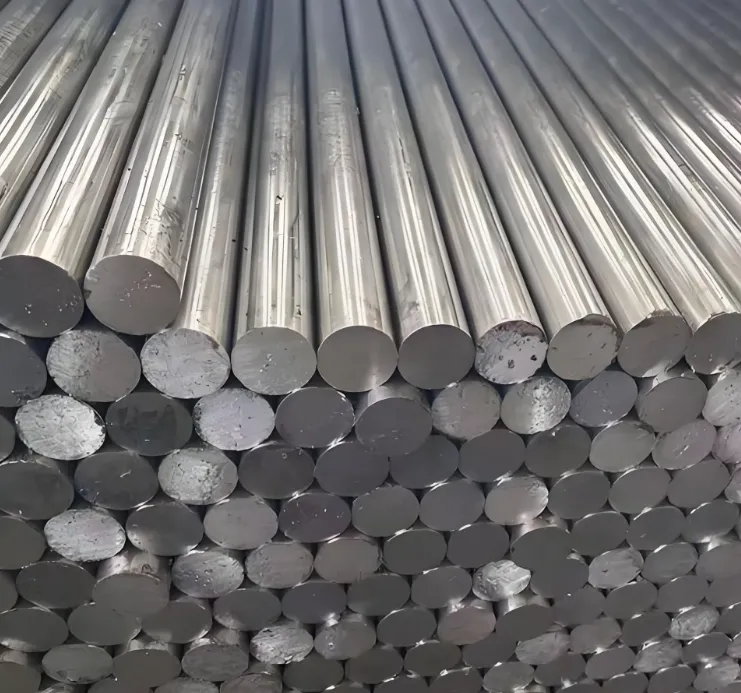

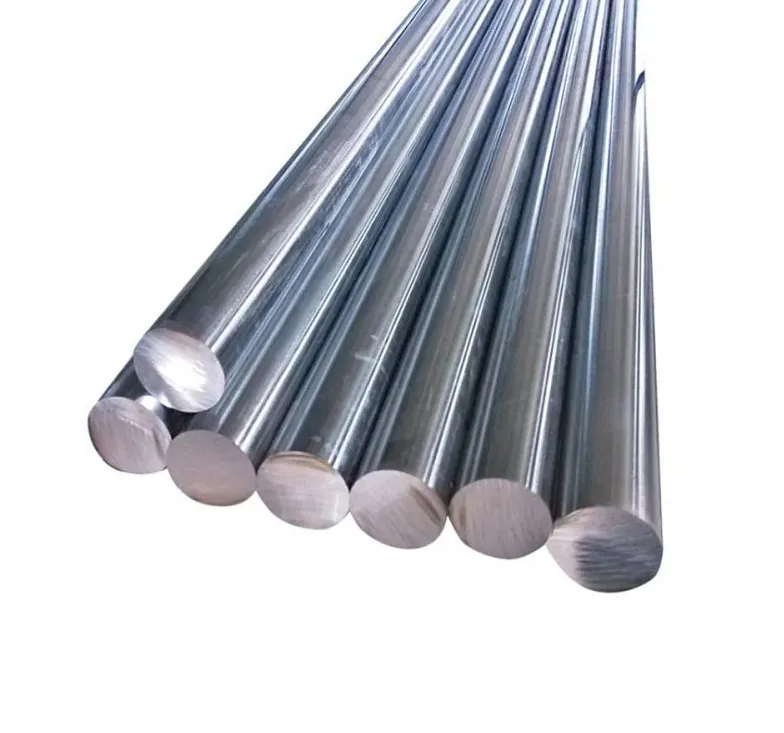
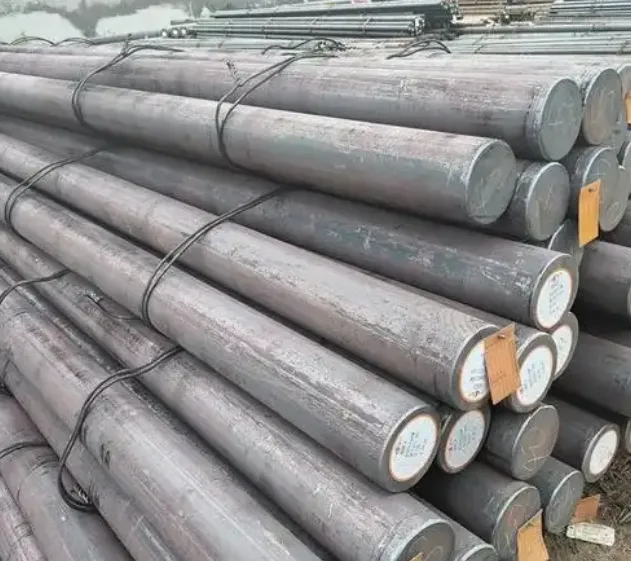
AISI 4130 steel round bar (EN 25CrMo4) remains one of the most dependable chromium molybdenum alloy bar choices when a project needs predictable heat treat response, high strength potential, solid toughness, and practical weldability, while still keeping material cost and availability under control. MWalloys supplies 4130 round bar to ASTM A29 with factory stock coverage plus custom size cutting, backed by traceable mill documentation and inspection options that satisfy both design engineers and procurement teams.
What is AISI 4130 (25CrMo4) steel round bar, and why is it specified so often?
AISI 4130 is a low alloy Cr Mo steel in the 41xx family, recognized globally due to its balanced chemistry and broad processing window. In European designation systems, the closest widely used equivalent is 25CrMo4. The chromium supports hardenability and wear resistance; molybdenum improves hardenability further while helping limit temper embrittlement risk relative to plain carbon steels.
Engineers specify 4130 round bar when they want a material that can be supplied in a “soft” condition (annealed or normalized) that machines cleanly, then can be heat treated to a wide range of strength levels without turning brittle. Procurement teams specify 4130 because mill supply chains exist in most industrial regions, with common compliance packages (heat numbers, MTRs, EN 10204 inspection types) and standard dimensional norms.
Typical value proposition:
- Broad heat treatment flexibility: normalized, quenched and tempered, annealed.
- Strength to weight efficiency versus mild steel.
- Better through hardening capability than many carbon steels.
- Practical welding procedures with correct preheat and post weld heat treatment.
- Suitable in critical parts where certification, repeatability, and traceability matter.
Which standards cover AISI 4130 round bar, including ASTM A29?
ASTM A29 is a common North American base specification used to define general requirements, dimensional tolerances, permissible variations, and ordering information related to hot worked, cold finished, or heat treated steel bars. A29 often works together with chemistry and grade definitions from SAE or other ASTM documents, depending on contract language.
In practice, an order line may reference:
- ASTM A29: general bar requirements, tolerances, ordering structure.
- AISI 4130 or SAE 4130: grade designation and typical chemistry intent.
- Heat treatment condition: annealed, normalized, quenched and tempered (Q&T).
- Testing and documentation: MTR, mechanical tests, UT, MPI, hardness mapping.
- Inspection certificate type: EN 10204 3.1 or 3.2 when requested.
Common cross standard references used during purchasing
MWalloys buyers and quality teams frequently see these comparability references during sourcing:
- EN 10083 (25CrMo4) in European supply chains.
- DIN legacy naming 25CrMo4 in technical documentation.
- JIS SCM430 in Japan related ecosystems.
- GB 42CrMo? Note: 42CrMo aligns closer to 4140 strength class; 4130 cross references need careful checking, not automatic substitution.
Key procurement rule: “Equivalent” in casual speech does not mean interchangeable in a certified build. Always confirm chemistry limits, heat treatment condition, and mechanical property requirements in the governing drawing or code.
What chemistry ranges should buyers expect in 4130 (25CrMo4), and how do they affect performance?
Chemistry drives hardenability, weld response, machinability, and final strength after tempering. Exact limits vary by standard edition and mill practice; buyers should treat any table in an article as typical and verify via the actual MTR tied to the heat number.
Typical chemical composition ranges (weight percent)
| Grade designation | C | Mn | Si | Cr | Mo | P (max) | S (max) |
|---|---|---|---|---|---|---|---|
| AISI 4130 (typical industry range) | 0.28 to 0.33 | 0.40 to 0.60 | 0.15 to 0.35 | 0.80 to 1.10 | 0.15 to 0.25 | 0.035 | 0.040 |
| EN 25CrMo4 (typical) | 0.22 to 0.29 | 0.60 to 0.90 | 0.10 to 0.40 | 0.90 to 1.20 | 0.15 to 0.30 | 0.025 to 0.035 | 0.035 |
What each element contributes in real components
- Carbon: primary lever controlling hardness and strength potential after quench. Too high raises cracking risk; too low limits strength.
- Chromium: improves hardenability, supports wear resistance, helps strength retention at moderate temperatures.
- Molybdenum: deepens hardening response in thicker sections and reduces softening during tempering.
- Manganese: supports deoxidation and strength; also influences hardenability.
- Silicon: deoxidation and modest strengthening.
- Phosphorus and sulfur: kept low to support toughness; sulfur may be raised intentionally in free machining variants, yet weldability and toughness can suffer.
How do mechanical properties vary by heat treatment condition?
A major reason 4130 stays popular: it works across a wide property range. The same chemistry can be delivered in a machinable condition, then heat treated to high strength when the part requires it.
Mechanical properties depend on:
- Heat treatment route (normalized, Q&T, annealed).
- Section size (larger diameters cool slower, which changes final microstructure).
- Quench medium and agitation.
- Tempering temperature and soak time.
- Prior hot working and grain size control.
Typical mechanical property bands
The table below summarizes realistic property windows seen in industry. These are not contractual guarantees; contractual values come from the applicable standard, the purchase order, and verified test reports.
| Condition (common supply or finish route) | Tensile strength (MPa) | Yield strength (MPa) | Elongation (percent) | Hardness (HRC) | Notes |
|---|---|---|---|---|---|
| Annealed / soft | 560 to 700 | 400 to 550 | 20 to 28 | 15 to 22 | Good machinability; good forming; lower strength |
| Normalized | 700 to 850 | 500 to 650 | 18 to 25 | 18 to 26 | Balanced strength and toughness; common pre Q&T step |
| Q&T, moderate strength | 850 to 1000 | 700 to 850 | 14 to 20 | 24 to 32 | General mechanical components; good fatigue resistance |
| Q&T, high strength | 1000 to 1200 | 850 to 1050 | 10 to 16 | 32 to 40 | Demands tighter process control; weld procedure needs rigor |
Engineering note: ultra high hardness targets raise sensitivity to notch effects, hydrogen assisted cracking, and weld HAZ brittleness. Many teams cap hardness around low to mid 30s HRC unless design requirements justify higher.
What heat treatment cycles are typical, and what should be specified on purchase orders?
A purchase order should state not only “4130” but also the delivery condition. Without it, mills may ship a default that differs by region.
Typical heat treatment parameter ranges
| Process step | Temperature range (°C) | Soak concept | Cooling method | Purpose |
|---|---|---|---|---|
| Full anneal | 830 to 870 | time per section thickness | furnace cool | soften structure, improve machinability |
| Normalize | 870 to 925 | time per section thickness | still air | refine grains, set baseline properties |
| Austenitize prior to quench | 845 to 900 | adequate equalization | oil or polymer quench (typical) | create martensite, enable high strength |
| Temper | 200 to 700 | depends on target strength | air cool | adjust hardness, improve toughness |
How to specify a Q&T target properly
A robust order line states:
- Grade: AISI 4130 / 25CrMo4
- Standard: ASTM A29 plus any grade chemistry standard reference used internally.
- Condition: quenched and tempered to a hardness window (example: 28 to 32 HRC), or a tensile window when required.
- Test basis: test frequency, sample location rules, retest rules.
- Straightness and dimensional tolerance class.
- Surface condition: hot rolled, peeled and polished, cold drawn, turned, ground.
- NDT: UT level, MPI on request, plus acceptance criteria.
- Documentation: MTR per heat, certificate type, compliance statements.
Procurement benefit: hardness windows control performance more directly than a generic “Q&T” note, and they simplify receiving inspection.
What size ranges, tolerances, and surface finishes matter when ordering round bar?
Round bar seems simple until downstream operations reveal hidden cost drivers: extra stock allowance, straightness issues, surface decarb, or out of tolerance ovality.
MWalloys supports factory stock plus custom cutting, typically delivered in random length or cut to length. Exact size availability depends on mill route (hot rolled vs peeled vs drawn vs ground).
Typical supply routes and where each fits
- Hot rolled bar: economical, wider size range, rougher surface, looser tolerance.
- Peeled and polished: improved surface quality, tighter diameter control, reduced decarb risk on the surface layer.
- Cold drawn: tighter tolerance, improved straightness, higher residual stresses that may influence machining.
- Turned and ground: best diameter control and surface finish, higher unit cost, common in precision shafts.
Practical ordering table: tolerance and finish selection
| Downstream need | Suggested bar type | Why it helps | Common tradeoff |
|---|---|---|---|
| Heavy machining with large stock removal | Hot rolled | cost efficient, broad diameters | more scale, more cleanup cuts |
| Moderate machining with controlled stock allowance | Peeled | reduced surface defects, predictable allowance | higher cost than hot rolled |
| Precision diameter with minimal machining | Cold drawn | tight diameter tolerance | residual stress, potential distortion in heat treat |
| Bearing or seal journal surfaces | Ground | superior finish and accuracy | highest cost, longer lead time |
Straightness and out of round details engineers care about
- Straightness influences turning cycle time and tool life.
- Out of round impacts press fits, sleeve fits, and balancing.
- Surface decarburization affects fatigue and wear when a surface hardened case or high stress skin is required.
If a part relies on surface integrity, specify maximum decarb depth, surface roughness requirements, and NDT if critical.
What are the most common applications of 4130 steel round bar, and why does it fit?
4130 round bar serves across industries because it can be tuned: soft state machining, then high strength heat treatment.
Application map and selection rationale
| Industry | Typical parts produced from 4130 bar | Key property requirement | Usual condition |
|---|---|---|---|
| Aerospace and aviation ground equipment | fittings, lugs, pins, structural links | strength to weight, fatigue resistance | Q&T at controlled hardness |
| Oil and gas equipment | tool joints, connectors, mechanical subs | toughness plus strength | Q&T with impact testing in some specs |
| Automotive and motorsport | axles, shafts, suspension links | fatigue, torsional strength | Q&T moderate to high strength |
| Industrial machinery | gears (non carburized), spindles, studs | wear resistance plus core toughness | Q&T or normalized |
| Defense and heavy equipment | pins, mounts, brackets | shock load tolerance | normalized or Q&T |
Design engineers like 4130 due to its predictable response to quench and temper without the cost jump that comes with higher alloy grades like 4340 when extreme toughness is required.
How does 4130 compare with 4140, 4340, 8620, and mild steel?
Many sourcing decisions hinge on close alternatives. The table below helps engineers and buyers frame tradeoffs. Exact equivalency depends on specification limits and section size.
Comparison table: practical differences
| Grade | Alloy level | Hardenability | Typical max strength potential | Weldability | Typical reason to pick it |
|---|---|---|---|---|---|
| 4130 | Cr Mo, lower carbon than 4140 | good | high, yet typically below 4140 at same process | good with procedure control | balanced strength, weldable structures |
| 4140 | Cr Mo with higher carbon | better than 4130 | higher | moderate, more crack sensitive | shafts, tooling, higher strength demand |
| 4340 | Ni Cr Mo | excellent | very high | moderate, procedure critical | thick sections, high toughness requirement |
| 8620 | Ni Cr Mo low carbon | designed to carburize | strong case with tough core | good | gears needing carburized surface |
| 1018 / mild steel | low alloy | limited | low to moderate | excellent | lowest cost, simple fabrication |
Common procurement mistake: replacing 4130 with 4140 due to availability without verifying welding procedure qualification or final hardness. That substitution can raise cracking risk in weldments and can alter fatigue behavior due to higher attainable hardness.
What should engineers know about machinability, tool choice, and chip control?
In annealed or normalized states, 4130 machines cleanly with appropriate carbide tooling. Once Q&T reaches higher hardness, machining remains possible, yet tool wear rises and chatter sensitivity increases.
Key machinability factors:
- Microstructure uniformity matters more than a small hardness difference.
- Sulfur levels influence chip breaking; standard 4130 is not a resulfurized free machining steel.
- Residual stresses from cold finishing can cause movement during roughing.
Practical machining notes
- Roughing in soft state, then heat treat, then finish grinding yields best dimensional stability in precision shafts.
- If finish machining must occur after Q&T, specify a realistic hardness cap and use coated carbide grades matched to alloy steels.
- Use stable workholding and adequate coolant flow to control heat.
Engineering note: heat treated bars can show hardness gradients across the radius in larger diameters. If machining removes the skin, the final surface may sit in a slightly different hardness zone than the original outer layer. Hardness mapping can prevent surprises.
What welding practices reduce risk in 4130 weldments?
4130 is weldable, yet not “weld it like mild steel.” The main risk modes involve hydrogen assisted cracking and brittle heat affected zones, especially when the base metal arrives in a high strength Q&T condition.
Key welding controls used in industry
- Preheat: commonly used to slow cooling and reduce cracking risk. Temperature depends on thickness, restraint, and carbon equivalent.
- Filler selection: many weld procedure specifications use low hydrogen consumables with strength matched to base metal or slightly undermatched to improve toughness.
- Interpass temperature control: avoids excessive hardness and maintains process stability.
- Post weld heat treatment: stress relief or tempering may be needed, particularly in restrained joints or high strength conditions.
- Hydrogen control: baking electrodes, dry gas, clean surfaces, controlled storage.
Procurement note: if the end item includes welding, the purchase order should state the delivery condition. Ordering pre hardened Q&T bar then welding without a qualified WPS often leads to costly rework.
What fatigue, impact toughness, and fracture behavior can be expected?
Many 4130 applications involve cyclic loading: rotating shafts, aircraft fittings, suspension links, pressure equipment fasteners. Fatigue resistance depends on surface finish, inclusion control, decarb, residual stress, and design notch severity.
Important engineering considerations:
- Smooth surface finish and generous radii often matter more than a modest strength increase.
- Shot peening can improve fatigue strength via compressive surface stress.
- Inclusion cleanliness influences crack initiation. Vacuum degassed steel variants typically show better cleanliness, subject to mill capability and order requirements.
- Charpy impact testing may be specified in critical components; results depend strongly on heat treatment and test temperature.
If an application has low temperature service or shock loading, specify impact testing temperature and minimum absorbed energy requirements, plus direction (longitudinal or transverse).
Which inspections and certifications should procurement request from a serious supplier?
EEAT level supply requires more than a grade label. A procurement checklist should target traceability, verification, and clear acceptance criteria.
Standard documentation package
- Mill Test Report (MTR) tied to heat number, listing chemistry and mechanical results.
- Heat number traceability on each bar or bundle.
- Certificate type when needed: EN 10204 3.1 is common; 3.2 when third party witness is contractually required.
- Statement of compliance to ASTM A29 and the referenced grade standard.
Optional testing and QA services that reduce downstream risk
| QA item | What it verifies | When it matters | Typical method |
|---|---|---|---|
| Ultrasonic testing (UT) | internal soundness, discontinuities | critical shafts, rotating parts | straight beam UT with defined acceptance |
| Magnetic particle inspection (MPI) | surface and near surface cracks | safety critical machined parts | wet or dry MPI |
| Hardness survey | uniformity across bars or heat lots | Q&T orders, thick diameters | portable hardness mapping |
| Dimensional inspection | diameter, ovality, straightness | precision machining plans | calibrated micrometers, straightness gauges |
| Microstructure check | heat treat quality, grain size | high reliability builds | metallographic sampling |
MWalloys can align inspection scope with the part risk profile, which prevents spending money on unnecessary testing while still protecting critical programs.
How should a purchase order be written to avoid delays, claims, and rework?
Most delivery issues happen due to ambiguous ordering language. A clean PO line reduces back and forth and accelerates receiving inspection.
PO template that works well
Include these fields:
- Material: AISI 4130 round bar (25CrMo4 acceptable only if explicitly approved).
- Standard: ASTM A29, plus any additional specification or customer standard.
- Size: diameter, length, quantity, unit weight if required.
- Tolerances: diameter tolerance class, straightness limit, out of round limit if critical.
- Condition: hot rolled, peeled, cold drawn, turned and ground; plus heat treat condition (annealed, normalized, Q&T).
- Mechanical targets: hardness window and or minimum yield tensile values when required.
- Testing: UT MPI hardness mapping impact tests, test frequency and acceptance criteria.
- Documentation: MTR per heat, certificate type, marking requirements.
- Packaging: corrosion protection, end caps, bundle weight limits, pallet type if needed.
- Delivery terms: lead time, partial shipments, inspection hold points if any.
Receiving inspection tips used by experienced buyers
- Verify heat numbers match the MTR and bundle tags.
- Check hardness on random bars, not only one end.
- Confirm diameter in multiple locations around the circumference to detect ovality.
- Inspect ends for quench cracks or handling damage.
- Confirm length and cut squareness when cut to length is purchased.
What makes MWalloys 4130 round bar supply reliable in production environments?
MWalloys focuses on three pillars that matter to engineers and procurement:
- Consistent specification control: ASTM A29 aligned ordering, clear condition labeling, and traceability discipline.
- Stock plus customization: factory stock in common diameters, plus custom size cutting to support short lead time builds and reduced scrap.
- Quality alignment: documentation packages, inspection options, and packaging suitable to global shipping and long transit cycles.
If a project needs a defined hardness band, UT requirements, or certificate type, those items should be placed directly on the RFQ. That approach yields quotes that match the real requirement and reduces change orders.
AISI 4130 / 25CrMo4: Technical FAQ
High-Strength Chrome-Moly Alloy Engineering Guide
1. Is 25CrMo4 the same material as AISI 4130?
They are close in intent and application, yet they are defined by different standards (ASTM vs. EN) with slightly different limit tables for elements like Phosphorus and Sulfur. Many builds accept 25CrMo4 via an equivalency statement, though a controlled quality program should confirm chemistry limits, heat treatment condition, and mechanical requirements before substitution.
2. What delivery condition is best when the part will be Q&T later?
3. Can 4130 round bar be welded without cracking?
Yes, but it requires disciplined controls. To avoid Hydrogen-Induced Cracking (HIC), use low-hydrogen practices, mandatory preheating (typically 150-250 C), and controlled post-weld heat treatment (PWHT). Welding high-hardness Quenched & Tempered (Q&T) bar without a qualified procedure significantly raises the risk of catastrophic failure.
4. Does ASTM A29 define the chemistry of 4130?
5. Which hardness range is common in Q&T 4130 bar?
Most mechanical designs target the high 20s to low 30s HRC. This range offers the best balance between tensile strength, fatigue resistance, and weldability. While higher hardness is possible, it increases the material's sensitivity to notch effects and stress-corrosion cracking.
6. Difference between hot rolled and cold drawn 4130 bar?
COMPARISON
Hot Rolled (HR): Features looser tolerances and a scaly surface, but possesses lower residual stress—ideal for parts requiring heavy machining.
Cold Drawn (CD): Offers tighter diameter control and a superior surface finish, but the internal residual stresses may cause "walking" or distortion during subsequent heat treatment.
7. Does 4130 resist corrosion?
8. What test certificate is needed for critical programs?
EN 10204 3.1 is the industry standard, providing test results validated by the manufacturer's authorized representative. For highly regulated industries (like subsea or nuclear), an EN 10204 3.2 may be required, which involves independent third-party witnessing of the testing process.
9. Is 4130 suitable for thick diameters requiring through-hardness?
4130 has good hardenability, but very thick sections (e.g., over 100mm) challenge the ability to achieve uniform properties in the core during quenching. For massive components requiring high through-hardness, engineers often upgrade to AISI 4340 or AISI 4140 for more consistent cross-sectional results.
10. What information should be included in an RFQ?
To ensure accurate pricing, always specify:
- Dimensions: Exact diameter and length.
- Condition: Normalized, Annealed, or Q&T.
- Tolerance Class: e.g., h9, h11, or standard HR.
- Testing: UT (Ultrasonic), MPI, or specific Charpy impact values.
- Certification: 3.1 or 3.2 requirements.
Summary: how to select and order AISI 4130 steel round bar with confidence
AISI 4130 (25CrMo4) round bar stands out because it offers a robust combination of heat treat flexibility, strength capability, toughness, and weldable behavior when procedures are followed. The highest success rates come from precise ordering language: specify ASTM A29 alignment, state delivery condition and property targets, define tolerances, and request the right inspection and certificate package. MWalloys supports factory stock and custom sizes with traceability and quality controls suitable to both engineering teams and procurement operations.