

Monel K-500 round bar is a precipitation-hardenable nickel-copper alloy (UNS N05500 / W. Nr. 2.4375) that delivers alloy-400 level corrosion resistance with dramatically higher strength and hardness after age-hardening; for many marine, oil & gas and high-stress rotating shaft applications it offers an excellent balance of durability and corrosion performance. In practice: choose K-500 when seawater or sour environments are present and a much higher yield/tensile strength than Monel 400 is required — but design and fabrication must respect its age-hardening behavior (hot work and heat-treat schedules) and possible stress-corrosion sensitivity in certain aged conditions.
1. Quick specification snapshot
-
Trade name: Monel® K-500 (also: Alloy K-500, K-Monel).
-
UNS: N05500.
-
Werkstoff / EN: 2.4375.
-
Common spec for bars/rods: ASTM B865 (and QQ-N-286 for special fastener/rod forms), AMS/ISO cross references exist.
2. What is Monel K-500?
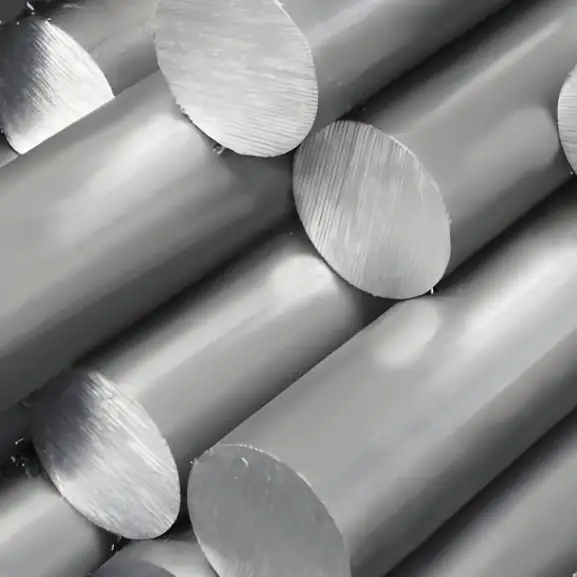
Monel K-500 is a nickel-copper base alloy that has been deliberately alloyed with aluminum and titanium to enable precipitation (γ′) hardening. That microstructural change gives K-500 much higher yield and tensile strength compared with Monel 400, while largely retaining the excellent corrosion resistance of the Ni-Cu system in seawater, brackish water, many acids (non-oxidizing), salts and alkalis. It is non-magnetic, retains toughness at subzero temperatures, and has been widely used where a high-strength corrosion-resistant bar or shaft is required.
3. Chemical composition (typical / ASTM B865 limits)
The table below shows the composition limits normally specified for Monel K-500 (wt%):
(Values listed are maximums or ranges as stated in common specifications; always confirm the certificate for each heat/batch.)
| Element | Typical / Spec (wt%) |
|---|---|
| Nickel (Ni) | 63.0 min – 70.0 |
| Copper (Cu) | 27.0 – 33.0 |
| Aluminum (Al) | 2.30 – 3.15 |
| Titanium (Ti) | 0.35 – 0.85 |
| Iron (Fe) | ≤ 2.0 |
| Manganese (Mn) | ≤ 1.5 |
| Silicon (Si) | ≤ 0.50 |
| Carbon (C) | ≤ 0.18 |
| Sulfur (S) | ≤ 0.010 |
(Source: ASTM B865 datasheets and Monel technical bulletins.)
4. Key material properties
Physical properties (commonly used values)
-
Density: ≈ 8.44–8.50 g/cm³ (≈ 0.305 lb/in³).
-
Melting range: ~ 1350 °C (≈ 2400–2460 °F) depending on analysis.
-
Modulus of elasticity: ≈ 210–220 GPa (varies with temp and temper).
Typical mechanical properties (age-hardened condition; nominal)
| Property | Typical (age-hardened) |
|---|---|
| Yield strength (0.2% offset) | ~ 690 MPa (100 ksi) or higher — depends on diameter & heat treatment |
| Tensile strength (Rm) | ~ 930–1100 MPa (135–160 ksi) typical in fully aged condition |
| Elongation (A) | ~ 15–25% dependent on diameter and process |
| Hardness | Rockwell Rc in the range 30–40 after full aging (varies) |
Notes: mechanical numbers vary by product form (cold-drawn vs hot-finished), cross-section and precise aging schedule. For small drawn rod, the tensile & yield typically are higher than for large forgings.
5. Common standards & specifications (round bar)
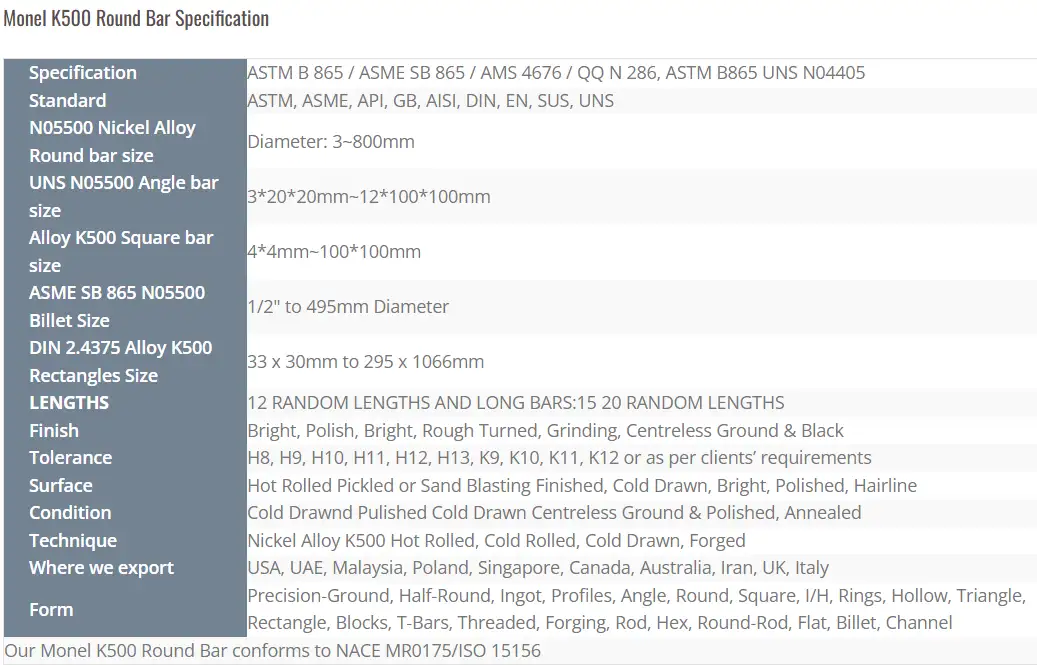
Monel K-500 round bar is produced to multiple national and industry specifications. The most used are:
-
ASTM B865: specification for nickel-copper-aluminum alloy (UNS N05500) bar, rod and wire forms.
-
QQ-N-286 (Rev E,F,G): US federal / military style specification commonly referenced for oilfield fastener and rod stock.
-
AMS / SAE AMS 4676: military/aerospace rod specification references.
-
ASME Code Case 1192: used to define allowable stresses and acceptance in boilers/pressure equipment contexts for certain temp ranges.
-
ISO / NACE MR0175 (ISO 15156-3): K-500 is listed for certain sour service applicability in oil & gas (check edition and revision).
Always request the exact spec revision in the purchase order and verify mill test certificates (MTC) to confirm compliance to the version required by your project.
6. Manufacturing & metal-forming processes for round bar
Feedstock / melting: K-500 is produced by vacuum induction melting (VIM), followed by remelting or refining steps at reputable mills to ensure cleanliness and tight chemistry control.
Primary forming:
-
Hot-finished rounds and forgings are produced by hot-rolling or forging. Hot work range is typically 1600–2100 °F (≈ 870–1150 °C) with recommended quench from at least 1450 °F (≈ 790 °C) to retain a controlled structure. Overlong soaking at very high temperatures can produce undesirable precipitates.
-
Cold-drawn bright bars / rods are common for smaller diameters; cold drawing improves straightness and surface finish. These bars are often solution-annealed then cold-worked and finally aged to the required mechanical state.
Finishing: straightening, grinding, turning, and surface treatment as required by customer. Certifications (MTC EN10204 3.1/3.2) and traceability stamping are standard for export and critical applications.
7. Heat treatment & age-hardening (practical guidance)
The strength advantage of K-500 depends on controlled solution annealing and subsequent aging that precipitates Ni₃(Ti,Al) (γ′) particles.
Common industrial heat-treat sequence (representative):
-
Solution anneal: heat to about 980–1100 °C (≈ 1800–2010 °F), times depend on section size — then water quench to freeze composition. This dissolves prior precipitates.
-
Aging (precipitation hardening): typical aging is in the range 400–620 °C (≈ 750–1150 °F). Example published cycles include 595 °C (≈ 1100 °F) for 16 h with subsequent staged cool/holds; other industry cycles use 540 °C then 480 °C holds to maximize toughness vs strength trade-offs. A single-step age at ~595 °C (16 h) after solution and quench is widely referenced.
Important cautions:
-
Excessive exposure in the age-range or prolonged high-temperature soaking can form titanium carbides (TiC) and reduce desirable properties. Short, controlled holds are typically recommended.
-
If K-500 is used in the aged condition and exposed to certain chloride/hot environments under tensile stress, stress-corrosion cracking sensitivity may increase versus Monel 400; design teams must evaluate the service environment and possibly select alternate tempers or materials if conditions are aggressive.
8. Equivalents and cross references
| Designation system | Equivalent |
|---|---|
| UNS | N05500 |
| Werkstoff / EN | 2.4375 |
| ASTM spec | B865 (bar/rod forms) |
| QQ-N-286 | Federal / military production form often used for rods/fasteners |
| AMS | AMS 4676 (rod) references exist |
| Note: there is no direct drop-in “other alloy” that duplicates K-500’s exact combination of Ni-Cu plus Al/Ti precipitation hardening — Monel 400 is the non-age-hardenable sibling; for similar high strength but different corrosion/temperature behavior, nickel-base superalloys (Inconel, etc.) are separate families. |
9. Monel K-500 round bar sizes and weight
Using density 8.44 kg/dm³ (≈ 8440 kg/m³) (density from common datasheets), weight per meter for round bars is calculated:
Weight (kg/m) = Area (m²) × 8440 (kg/m³) where Area = π × (d/2)².
| Diameter (mm) | Ø (in) | Area (m²) | Weight ≈ kg/m |
|---|---|---|---|
| 6 mm | 0.236" | 2.827e-5 | 0.238 kg/m |
| 10 mm | 0.394" | 7.854e-5 | 0.663 kg/m |
| 12 mm | 0.472" | 1.131e-4 | 0.955 kg/m |
| 16 mm | 0.630" | 2.010e-4 | 1.697 kg/m |
| 20 mm | 0.787" | 3.142e-4 | 2.652 kg/m |
| 25 mm | 0.984" | 4.909e-4 | 4.143 kg/m |
| 32 mm | 1.260" | 8.042e-4 | 6.787 kg/m |
| 50 mm | 1.969" | 1.963e-3 | 16.572 kg/m |
| 100 mm | 3.937" | 7.854e-3 | 66.288 kg/m |
(I used density ≈ 8440 kg/m³ — this is consistent with published densities ~0.305 lb/in³ or ~8.44 g/cm³.)
10. Typical applications (where round bar is commonly used)
-
Pump shafts, impellers and propeller shafts for marine service.
-
Valve trim and components in chemical processing and desalination plants.
-
Oil & gas: downhole tools, drill collars, certain fasteners and marine hardware (sour-gas compatible in defined conditions when per NACE/ISO guidance).
-
Springs, fasteners, pins and small high-strength components where corrosion resistance and non-magnetic behavior are necessary.
11.Monel K500 bar Price 2025
Important: alloy prices depend strongly on form (solid bar vs finished turned part), quantity, MTC level, surface finish, and market surcharges. Below are representative mid-2025 price ranges observed from merchant quotations and regional suppliers; treat as indicative only and always request firm quotes.
| Region | Typical finished K-500 bar price per kg (2025 range) | Representative source |
|---|---|---|
| China (FOB factory, bulk) | USD 25–40 / kg (large lots, mill TC, raw bar). Low end possible on large tonnage or partial oxidation scrap reclamation. | Alibaba / Chinese mills. |
| USA (retail, small quantity) | USD 30–90 / kg (retail merchants, cut lengths, small order premiums). Example OnlineMetals retail part prices convert to ~USD 150–900 per piece depending on size and length; per-kg implied varies by cut and overhead. | OnlineMetals retail listings. |
| Europe (merchant / distributor) | USD 35–80 / kg (depends on stock, customs, CE/MTC requirements). | European distributors & specialist suppliers. |
Notes & purchasing tips:
-
If you need certified material in large tonnages for OEMs or pipeline/oil & gas use, ask for FOB factory quotes from Chinese mills (MWAlloys can supply direct mill pricing and fast stock shipment). For small orders or fast prototyping, distributor retail prices in the USA will be substantially higher due to cutting, testing and inventory overhead.
-
Special Metals publishes alloy surcharge and rolling adjuster data that can be used to justify price swings; expect fluctuations with the nickel market.
12. Buying, inspection and MWAlloys supply offer
MWAlloys (company note): as MWAlloys we supply Monel K-500 round bars from China mills with 100% factory prices for buyers, official MTC (EN10204 3.1 / 3.2 when needed), and fast stock dispatch for common diameters. Our service includes QC photographs, surface finish options, custom cut lengths, and optional third-party inspection on request. For tight tolerances or critical oil & gas orders we can furnish QQ-N-286 or AMS documentation where the mill supports it. (Contact MWAlloys sales for current stock list and lead times.)
Inspection checklist for purchase order:
-
Mill Certificate (MTC) to EN10204 3.1/3.2 or equivalent.
-
Chemistry report showing Ni, Cu, Al, Ti, Fe, C, Mn, Si, S.
-
Mechanical test report: tensile, yield, elongation, hardness.
-
Non-destructive testing (UT/eddy/visual) as required; for threaded fasteners/critical parts consider PMI verification of chemistry.
-
Heat treatment record (solution + aging) if material supplied in an aged condition.
13. Machining, welding and fabrication notes
-
Machining: K-500 work-hardens rapidly like other high nickel alloys , use rigid tooling, low cutting speeds, steady feed, plenty of sharp carbide or CBN tips and strong coolant. Pre-heat or stress-relief is often not necessary, but chip evacuation and stable clamping are critical.
-
Welding: K-500 can be welded but the weld and HAZ will have different chemistry and precipitate behavior; matching filler (nickel-copper electrode) and post-weld heat treatment plans should be used for critical parts. AWS filler ERNiCu-7 / ERNiCu-3 types are commonly referenced.
-
Forming: cold forming in annealed condition is possible but requires higher forces; hot forming range provided earlier is preferred for substantial deformation.
14. Corrosion behaviour, sour gas and NACE/ISO considerations
-
General corrosion: K-500’s corrosion resistance is similar to Monel 400 in most media — excellent for seawater and many chemical processes.
-
Sour service: Monel K-500 is listed in NACE MR0175 / ISO 15156 for certain H₂S service conditions, but selection must follow the specific NACE/ISO tables and the actual H₂S partial pressure and temperature of your service; this is not automatic. Compliance to the correct edition and annex is essential.
-
Stress corrosion cracking: When age-hardened and under tensile stress in certain aggressive environments, K-500 can be more susceptible to SCC than the 400 alloy. Design strategies include lowering stress, selecting appropriate temper, or choosing alternative alloys if SCC margins are insufficient.
15. Testing & traceability
-
Full MTC showing heat number and chemical analysis (EN10204 3.1 or 3.2)
-
Tensile test, yield, elongation and hardness report from the same heat and product form.
-
PMI/EDX for verification when required by purchaser.
-
NDT: visual 100% and selective UT/eddy testing for long shafts/critical components.
-
If used in pressure equipment: check ASME Code Case applicability and request Code Case documentation.
16. FAQs
-
Q: Is Monel K-500 stronger than Monel 400?
A: Yes. K-500 is precipitation-hardenable and provides roughly 2× tensile and ~3× yield strength versus Alloy 400 after proper aging. -
Q: Can K-500 be used in seawater?
A: Yes, K-500 retains excellent seawater resistance similar to Monel 400 and is widely used for marine shafts and pump components. -
Q: What is the typical density?
A: ≈ 8.44 g/cm³ (≈ 0.305 lb/in³). -
Q: What standard should I request for round bar?
A: Specify ASTM B865 for bar/rod; for oilfield fasteners also QQ-N-286 or AMS 4676 where appropriate. Verify revision. -
Q: Will heat treatment from the mill be required?
A: You can buy K-500 in the annealed, aged, or solution-annealed condition. For application strength you may request aged condition and mill records of heat treatment. -
Q: Is it weldable?
A: Yes, but filler selection and post-weld treatment must be planned; welds and HAZ can alter precipitation and local properties. -
Q: Does K-500 suffer from stress corrosion cracking?
A: In some aged conditions and certain environments K-500 is more SCC-sensitive than Monel 400; check NACE/ISO guidance for sour-gas environments. -
Q: What typical diameters are stocked?
A: Common stock ranges include Ø 6–200 mm (0.25–8 in) depending on supplier; large forgings are also made. Check supplier inventory. -
Q: How much does K-500 cost?
A: Wide range: approx. USD 25–90 / kg in 2025 depending on region, quantity and processing—always request firm quotes and MTC. -
Q: Any special inspection for oil & gas?
A: Request NACE MR0175 compliance confirmation, QQ-N-286 spec if required, and full traceable MTC. Third-party inspection often used for critical downhole parts.