

In materials engineering, ksi denotes kilopound-force per square inch, which equals 1,000 psi and commonly serves to express tensile strength and yield strength for steel. Using ksi reduces unwieldy large numbers when reporting stress values, helps standardize specification sheets in imperial-unit regions, and provides a practical scale for comparing steel grades during selection and structural design.
What “ksi” means: unit definition and brief history
Definition. The abbreviation ksi stands for kilopound-force per square inch (kilo-pound per square inch). One ksi equals one thousand pounds-force per square inch (1 ksi = 1,000 lbf/in²). This unit belongs to the US customary/Imperial family and often appears on mechanical property tables for metal alloys.
Terminology note. Practitioners sometimes write kpsi or kips/in², and some documents drop the word “force,” writing kilopounds per square inch. In strict metrology, pound-force should remain explicit when forces appear in formulas.
Historical context. Imperial-derived pressure units were the engineering norm in North America during the 20th century. Steel producers and standards committees continued using psi and ksi on specifications, catalogs, engineering drawings, and building codes. This convention persists in many sectors, especially where legacy documentation and code adoption remain in place.
How the unit works: dimensional form and conversion formulas
Dimensional form. Ksi represents stress or pressure: force divided by area. In base units, stress in ksi equals (lbf)/(in²) multiplied by 1,000. That is:
1 ksi = 1,000 lbf / in²
SI conversion. The standard SI counterpart for stress is the pascal (Pa). For high stresses, the megapascal (MPa) scale is convenient. The exact conversion factor is:
1 ksi ≈ 6.894757293177 MPa (often rounded to 6.895 MPa).
Quick reference conversions (practical values)
| ksi | psi | MPa (approx) |
|---|---|---|
| 0.1 | 100 | 0.6895 |
| 1 | 1,000 | 6.895 |
| 10 | 10,000 | 68.95 |
| 36 | 36,000 | 248.21 |
| 50 | 50,000 | 344.74 |
| 100 | 100,000 | 689.48 |
(Values rounded for clarity; use direct multiplication by 6.894757 for precise conversion.)
Conversion formulas
-
From ksi to MPa:
MPa = ksi × 6.894757 -
From MPa to ksi:
ksi = MPa ÷ 6.894757 -
From ksi to psi:
psi = ksi × 1,000
Why engineers use ksi for steel properties
Clarity with large numbers. Tensile strengths and yield points for structural metals commonly appear in tens or hundreds of thousands of psi. Writing such values in ksi yields manageable numerals (e.g., 36 ksi instead of 36,000 psi), which reduces transcription error on drawings and tables.
Industry practice. Many US-based codes, material datasheets, and supplier catalogs list mechanical properties in ksi by default. Steel grade callouts frequently include yield strength in ksi. Using the same unit across documents simplifies procurement and design checks.
Specification shorthand. Specifications sometimes state minimum yield strength using the plain number plus the unit type (for example, “Grade 50: 50 ksi yield”), which engineers interpret rapidly during selection.
Design calculations. Structural formulae for bending, axial stress, and buckling remain unit-neutral if all inputs share a consistent unit system. Using ksi throughout a calculation reduces conversion steps when other geometry units are in inches.
Typical steel values expressed in ksi: datasets and tables
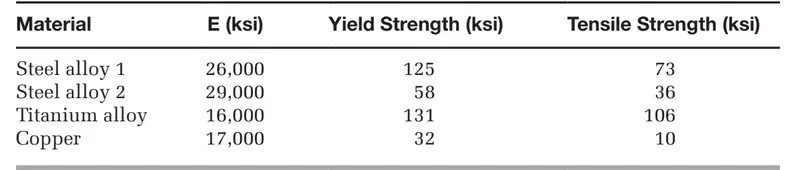
Below are practical tables engineers consult when selecting steel for structural, plate, and bar applications. Numbers shown are typical published minima and common average values; always confirm values on official mill certificates or the controlling standard.
Table 1 — Common structural steels (yield and tensile, typical ranges)
| Steel designation | Common use | Typical minimum yield (ksi) | Typical tensile (ksi) | Notes and typical standards |
|---|---|---|---|---|
| A36 (hot-rolled) | Building sections, plates | 36 | 58–80 | Widely used structural steel; check ASTM A36. |
| A572 Grade 50 | HSS, shapes | 50 | 65–75 | High-strength low-alloy; often used for lighter sections. |
| Grade 80 (HSLA plate) | High-strength plate | 80 | 100+ | Used in heavy-duty applications, higher strength may exceed 100 ksi. |
| Stainless 304 (annealed) | Corrosion resistance | 30–40 | 70–95 | Alloy-dependent; cold work raises yield. |
| Tool steels (varies) | Tooling and dies | 80–300 (post-heat-treat) | 100–350 | Strong dependence on heat treatment. |
(Values represent typical ranges; check manufacturer datasheets and the governing standard for acceptance criteria.)
Table 2 — Quick design lookup for selected grades (ksi and MPa)
| Grade | Yield (ksi) | Yield (MPa) |
|---|---|---|
| A36 | 36 | 248 |
| A572 Gr50 | 50 | 345 |
| A514 (T-1) | 100 | 690 |
| 4140 quenched & tempered | 90–140 | 620–965 (depending on temper) |
Use these conversions during finite element input, code checks, and weld qualification paperwork.
Sample worked calculation (thin-plate tensile stress)
Problem: A rectangular plate with a cross-sectional width of 2 in and thickness 0.25 in carries an axial load of 10,000 lbf. Compute engineering stress in ksi.
Step 1: Area = width × thickness = 2 in × 0.25 in = 0.5 in².
Step 2: Stress = Load ÷ Area = 10,000 lbf ÷ 0.5 in² = 20,000 psi.
Step 3: Convert to ksi = 20,000 psi ÷ 1,000 = 20 ksi.
Interpretation: If the material has yield 36 ksi, safety margin exists. If yield equals 20 ksi, permanent deformation will occur.
Measurement, tests, and standards that produce ksi values
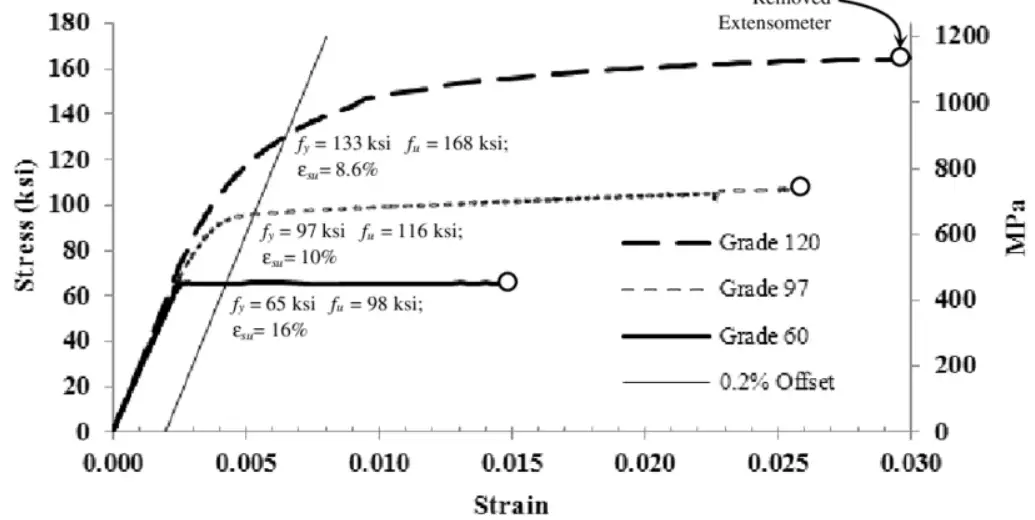
Reference tests. Tensile testing yields values reported in stress units. The common test reports include engineering yield strength (0.2% offset), ultimate tensile strength (UTS), elongation, and reduction of area. ASTM E8/E8M provides guidance for tension testing of metallic materials and indicates units may appear in ksi or MPa depending on the specification.
Standards and specifications. Standards that often specify mechanical properties in ksi include ASTM steel material specifications, SAE and military standards, and product-specific datasheets. The same underlying test specimens and machines can output raw force and original cross-sectional area. Then labs convert to psi and ksi for the final report.
Calibration and traceability. Tensile machines must undergo regular calibration traceable to national standards to ensure reported ksi values remain reliable. Labs typically report measurement uncertainty and test temperature.
Heat treatment influence. For steels, microstructure controls mechanical behavior. Processes such as quenching and tempering shift the yield and tensile values dramatically; entrants to the datasheet in ksi reflect the final heat-treated state.
Design implications: allowable stress, safety factors, weld effects
Allowable stress vs yield. Codes often prescribe allowable stresses that sit below the yield point, providing margin against plastic deformation. If yield is given as 50 ksi, a design code might permit a working stress of 25–33 ksi depending on loading type and safety factor chosen.
Welding and local strength. Welded regions and heat-affected zones can exhibit reduced toughness or altered yield. Designers choose filler metals and preheat procedures in order to match properties, with verification through mechanical coupon testing published in ksi for acceptance.
Thickness and slenderness. Higher ksi steels allow thinner sections for a given load, yielding weight savings. However, thinness increases local buckling risk or toughness concerns at low temperatures. Designers must balance the benefit of higher yield numbers with stability requirements.
Fatigue life. Fatigue limits correlate with ultimate tensile strength. Expressing these endpoints in ksi simplifies life-estimation charts and Goodman-type diagrams.
Common mistakes, unit pitfalls, and recommended practices
Pitfall: confusing psi with ksi. A common error involves missing a factor of 1,000 when converting. Always carry units through algebraic steps to avoid this error.
Pitfall: mixing metric and imperial without conversion. When geometry uses inches but material data are in MPa, convert first, then compute. Keep unit consistency across entire calculation.
Pitfall: quoting nominal instead of actual test values. Supplier minimums differ from actual measured batch values found on mill test certificates. For critical applications, specify required minimums and ask for mill certificates with values reported in ksi (or MPa) and signed by authorized personnel.
Best practice summary
-
Use explicit units in every table and calculation line.
-
Check mill certificates before acceptance.
-
Apply conversion factors with high precision if the design is marginal.
-
When preparing drawings for mixed teams, include both ksi and MPa for clarity.
Worked examples and calculator guidance
Example 1: Converting a published MPa property to ksi
A supplier lists tensile strength = 550 MPa. Convert to ksi.
ksi = MPa ÷ 6.894757ksi ≈ 550 ÷ 6.894757 = 79.8 ksi
Round according to reporting convention, typically one decimal place for datasheets: 79.8 ksi.
Example 2: Interpreting a bolt grade given in ksi
A specification calls for bolts with tensile strength 120 ksi. When selecting stock, ensure the manufacturer lists UTS ≥ 120 ksi on the mill certificate or product data sheet. If certificate gives MPa, convert using the formula above.
Tables for inclusion on product pages, datasheets, and procurement forms
Below are three tables you may copy into catalogs or technical pages. Use the exact conversion factor if legal acceptance depends on rounding.
Table 3 — Ksi to MPa conversion (compact)
| ksi | MPa |
|---|---|
| 1 | 6.8948 |
| 5 | 34.474 |
| 10 | 68.948 |
| 20 | 137.895 |
| 30 | 206.843 |
| 36 | 248.211 |
| 50 | 344.738 |
| 80 | 551.580 |
| 100 | 689.476 |
Table 4 — Example grade selection quick chart (for buyers)
| Application | Typical grade | Yield (ksi) | Why pick this grade |
|---|---|---|---|
| General structure | A36 | 36 | Economical, weldable |
| Bridges, cranes | A572 Gr50 | 50 | Higher strength, better weight economy |
| High-stress plates | A514 | 100 | Heavy-duty, reduced thickness |
| Corrosion resisting | 304 / 316 SS | 30–40 | Corrosion resistance, moderate strength |
Table 5 — Conversion checklist for engineers
| Step | Action |
|---|---|
| 1 | Confirm units on supplier sheet (ksi or MPa) |
| 2 | If converting, apply MPa ↔ ksi formula with full precision |
| 3 | Verify test method (ASTM E8 / ISO 6892 or equivalent) |
| 4 | Record mill certificate values and test temperatures |
| 5 | Apply code reduction factors if required (codes often lower allowable stress below yield) |
Frequently asked questions (FAQ)
1: What does ksi stand for?
Ksi stands for kilopound-force per square inch, equal to 1,000 pounds-force per square inch. It is a pressure or stress unit frequently used in engineering to express strength numbers.
2: How do I convert ksi to MPa?
Multiply ksi by 6.894757 to obtain MPa. Formula: MPa = ksi × 6.894757. Use full precision for tight tolerances.
3: Why do steel datasheets use ksi rather than psi?
Because mechanical strengths for metals often reach tens of thousands psi; using ksi makes numbers compact and less error-prone on printouts and drawings.
4: Is ksi the same as kpsi?
Yes. Both denote 1,000 psi. Some documents prefer kpsi; either form indicates kilopound-force per square inch.
Q5: If a steel shows “yield 50,” does that mean 50 ksi?
Typically yes, when the document uses the imperial convention. Confirm the unit line on the datasheet; occasionally documents list MPa without explicit mention.
6: Can ksi be used for gas pressures?
Ksi is rarely used for gas pressures. Gas and hydraulic pressures are commonly reported in psi, bar, or MPa. Ksi suits material strength numbers, not routine pressure gauges.
7: What errors do engineers make with ksi conversions?
Omitting the factor 1,000 or using a rounded conversion factor incorrectly are common errors. Keep explicit unit labels in all calculations.
8: How does heat treatment change ksi numbers for steel?
Quenching, tempering, or cold work shifts yield and tensile values dramatically. Post-treatment mechanical tests report final ksi numbers that reflect processing.
9: How should procurement request mill certificates in terms of ksi?
Request measured yield and tensile values with units specified, plus reference to the test standard used. Many buyers request both ksi and MPa for international clarity.
10: Are there industry tools that convert ksi to other units?
Yes; numerous conversion calculators and spreadsheets exist that use the precise factor 6.894757. For critical work, prefer verified conversion matrixes or code-sanctioned tables.
Practical recommendations for MWAlloys product pages and specification sheets
-
Present strength values in both ksi and MPa on product pages to serve global customers.
-
Include the test method and specimen orientation next to every mechanical property figure. Mention that values are “minimum guaranteed” or “typical measured” to avoid confusion.
-
Show a short conversion table (ksi ↔ MPa) on every datasheet and the formula used.
-
For each heat-treated product offer, list the temper, hardness, expected range of elongation, and at least one representative mill test certificate entry.
-
Provide a short note on how welding will affect mechanical properties and whether post-weld heat treatment is required.
These practices increase trust and reduce procurement friction when selling internationally.
Summary and closing notes
-
Ksi represents stress in kilopound-force per square inch and equals 1,000 psi. This unit simplifies handling of large stress numbers typical for metals.
-
Use precise conversion to MPa for international interchange. The exact multiplier is approximately 6.894757.
-
Always confirm mechanical values with mill certificates and test standards, and avoid mixing units in calculations. For structural steel, typical yield ranges run from about 36 ksi to 100 ksi depending on grade and treatment.