

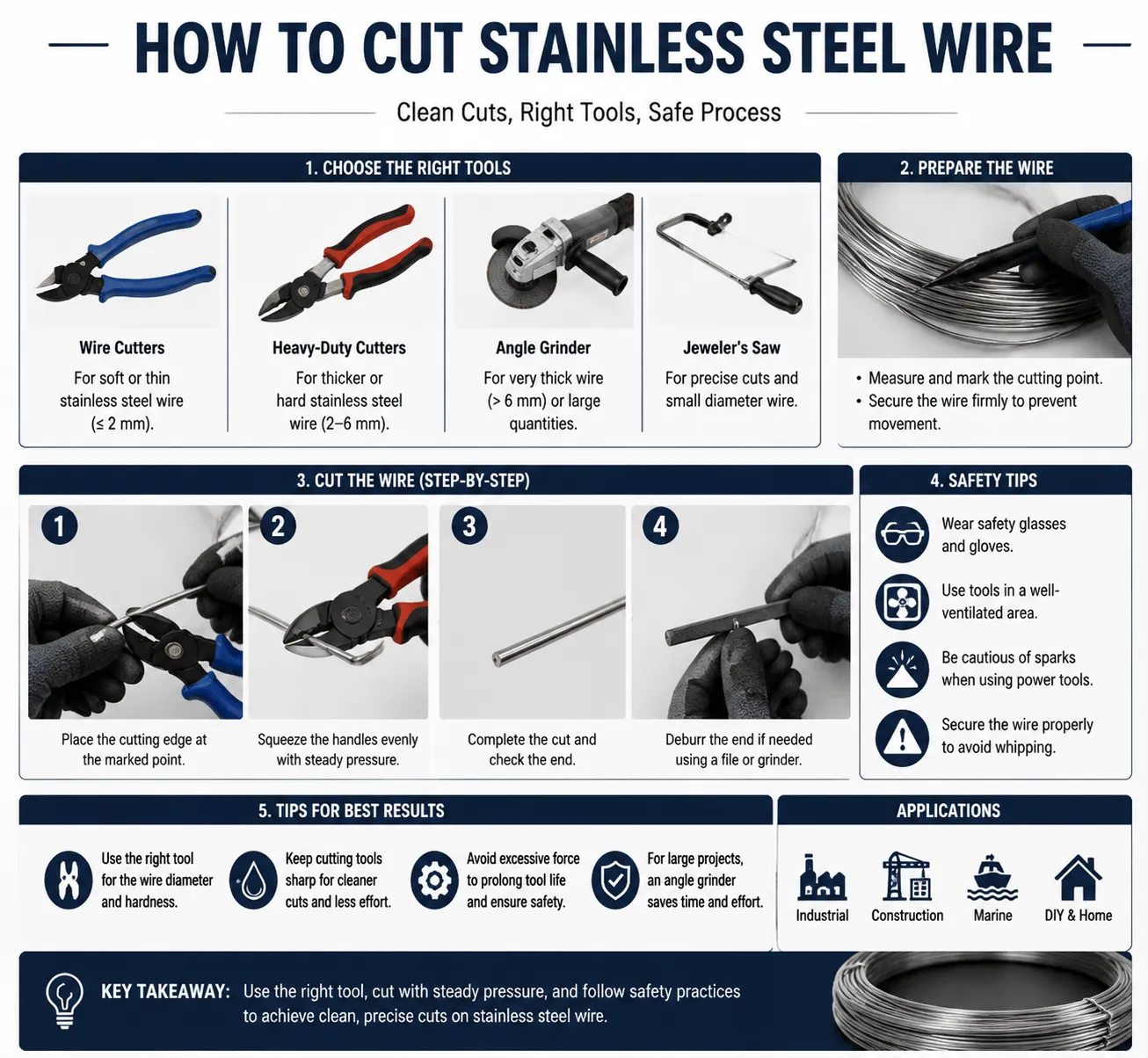
Cutting stainless steel wire cleanly comes down to matching the right tool to the wire diameter and choosing between shearing and abrasive methods based on the finish you need. For wire under 1mm, quality diagonal cutters or wire cutters handle the job in one squeeze. For wire between 1mm and 3mm, bolt cutters or a manual wire rope cutter deliver a clean shear without crushing the strand. Anything above 3mm, or any application where you need a mirror-flat, burr-free end, calls for an angle grinder with a thin cutoff wheel or a bench-mounted cold saw. The rest of this article explains why stainless behaves so differently from mild steel or copper wire under a blade, and how we approach cutting it correctly across the different grades and gauges we handle at MWalloys when preparing wire stock, safety wire, and cable assemblies for customers.
We work with stainless wire daily, from thin 304 lockwire used in aerospace fastener assemblies to heavier 316 wire rope specified for marine rigging, and the single most common mistake we see, whether from a hobbyist or an experienced fabricator new to stainless, is treating it like mild steel wire. Stainless work-hardens faster, resists shear more aggressively, and leaves burrs that mild steel simply does not produce in the same way. Getting a clean cut requires understanding that difference before you ever pick up a tool.
Why Is Stainless Steel Wire Harder to Cut Than Regular Wire?
Stainless steel wire resists cutting because of two combined properties, higher tensile strength from cold-drawing during manufacture and a strain hardening rate that increases resistance the moment a blade begins to deform the surface. Mild steel wire yields relatively smoothly under a cutting edge. Stainless wire, particularly austenitic grades like 304 and 316, hardens locally right at the point of deformation, so the harder you squeeze with a dull or undersized tool, the more the wire fights back rather than shearing cleanly.
This is the same strain hardening behavior we deal with constantly in our nickel alloy machining work, and it shows up at a smaller scale in wire cutting. A pair of cutters rated for copper or mild steel wire will often crush a stainless strand rather than shear through it, leaving a flattened, mushroomed end instead of a clean cut face. That flattened end is not just cosmetic, it creates stress risers that can crack under cyclic loading if the wire is used in a mechanical application like safety wiring or spring fabrication.
Cold-drawn stainless wire, the type most commonly sold in coils and spools, carries additional tensile strength from the drawing process itself, sometimes reaching 1800 to 2000 MPa on fully hardened tempers used in springs and safety wire. That is roughly three to four times the tensile strength of common mild steel wire at a similar diameter, which explains why a tool that breezes through a coat hanger will barely mark a stainless wire of the same thickness.
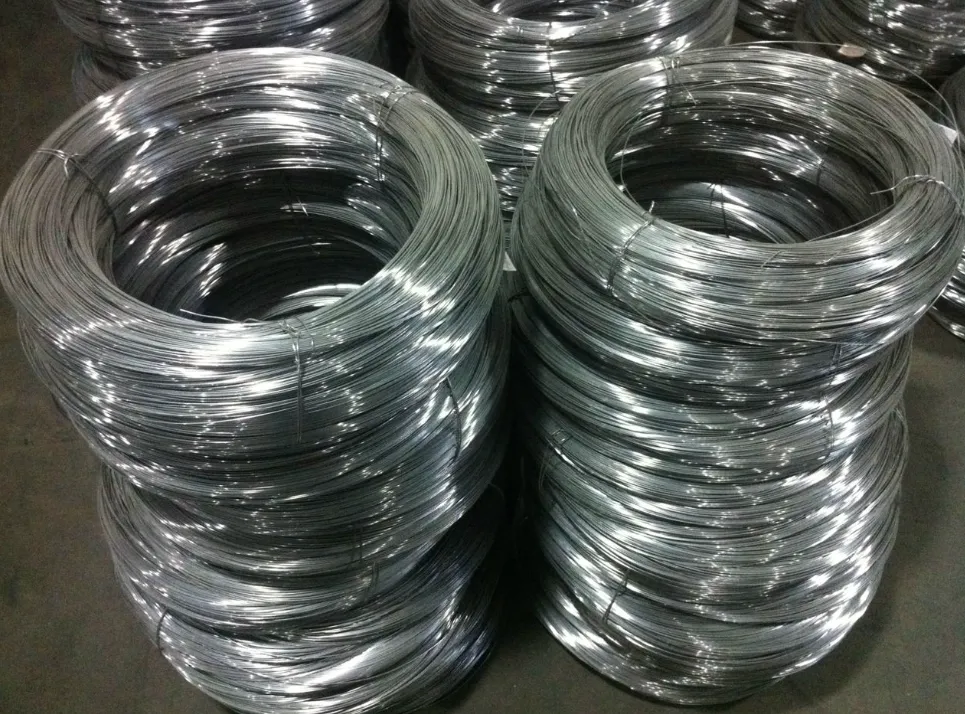
Which Stainless Wire Grade Are You Actually Cutting?
Before choosing a tool, it helps to know which grade and temper you are working with, because hardness varies considerably across the stainless wire family.
| Grade | Common Temper | Typical Tensile Strength | Cutting Difficulty | Common Application |
|---|---|---|---|---|
| 304 (soft/annealed) | Annealed | 500 to 700 MPa | Moderate | General fabrication, mesh, light wire forms |
| 304 (full hard) | Cold-drawn, spring temper | 1700 to 2000 MPa | High | Springs, safety wire, lockwire |
| 316/316L | Annealed to half-hard | 550 to 900 MPa | Moderate to high | Marine hardware, medical wire, chemical exposure parts |
| 302 | Spring temper | 1900 to 2100 MPa | Very high | Precision springs, high-tension applications |
| 430 (ferritic) | Annealed | 450 to 600 MPa | Lower than austenitic grades | Magnetic applications, lower-cost fabrication wire |
| 17-7 PH | Precipitation hardened | 1300 to 1900 MPa depending on aging condition | High | Aerospace fasteners, high-strength wire forms |
We ask customers ordering wire cutting services which temper they are working with before recommending a tool, because a soft annealed 304 wire cuts almost like mild steel, while a full-hard spring temper wire of the same diameter and grade can require an entirely different tool class. Guessing at temper and grabbing whatever cutter is nearby is how people end up with crushed ends, chipped blades, or a wire that springs and whips when it finally separates under too much force.
Also read: 17-7 PH vs. 304 Stainless Steel
What Hand Tools Actually Work on Thin Gauge Stainless Wire?
For wire under roughly 1mm, sometimes called fine gauge or lockwire diameter, quality diagonal cutters, also called dikes or side cutters, remain the standard tool, provided they are rated for hardened wire rather than general electrical wire. The distinction matters more than people expect.
| Tool | Effective Diameter Range | Cut Quality | Notes |
|---|---|---|---|
| Standard electrician's diagonal cutters | Up to 0.5mm stainless | Poor to fair, often crushes | Not rated for hardened stainless, blades chip quickly |
| Hardened jaw diagonal cutters (rated for piano wire) | Up to 1.5mm | Good, clean shear | Look for "hardened" or "piano wire rated" in the spec sheet |
| Lockwire pliers with built-in cutter | Up to 1mm | Good | Standard aerospace lockwiring tool, dual-purpose twist and cut |
| Precision flush cutters | Up to 0.8mm | Very good, minimal burr | Common in jewelry and electronics wire work |
| Fine wire rope cutters | Up to 2mm for 7x7 or 7x19 cable | Good on stranded cable, poor on solid rod | Designed specifically for stranded wire rope, not solid wire |
We keep hardened jaw cutters, the ones explicitly rated for piano wire or spring steel, as the default recommendation for anyone cutting stainless lockwire or thin spring wire by hand, because a standard electrician's cutter rated for copper and aluminum wire will dull within a few cuts on full-hard stainless and start producing the crushed, mushroomed ends we mentioned earlier. The blade hardness rating, usually expressed as a Rockwell C value on quality tools, should sit above 60 HRC for reliable stainless wire cutting.
How Do You Cut Medium Gauge Stainless Wire Without Crushing It?
Between roughly 1mm and 3mm, bolt cutters and manual wire rope cutters take over from diagonal cutters, since the leverage advantage of the longer handles overcomes the increased tensile strength without requiring excessive hand force that leads to slipping or crushing.
Bolt cutters designed for hardened materials, rather than the softer jaw versions sold for cutting padlocks and chain link fencing, use a compound leverage design that multiplies hand force considerably at the jaw. We specify bolt cutters with a jaw hardness rating specifically listed for stainless or spring steel wire, since generic bolt cutters marketed primarily for bolts and chain sometimes use a softer jaw alloy that dents rather than shears on full-hard stainless wire above 2mm.
Manual wire rope cutters, distinct from bolt cutters in jaw geometry, use a curved cutting profile specifically designed to compress a stranded cable evenly around its circumference rather than pinching it flat from two sides. This matters considerably for stranded stainless wire rope, where a standard bolt cutter jaw can splay the individual strands rather than cutting them uniformly, leaving a frayed, uneven end that is difficult to feed through a fitting or ferrule afterward.
What Power Tools Give You the Cleanest Cut on Stainless Wire?
For anything above 3mm, or for any application demanding a flat, square, burr-minimal cut face, hand tools generally stop being practical and power tools take over.
| Power Tool | Best For | Cut Quality | Heat Generated |
|---|---|---|---|
| Angle grinder with thin cutoff wheel | Wire rod 3mm to 12mm+ | Good to very good with practice | Moderate to high, can discolor and slightly harden the cut edge |
| Bench cold saw | Bulk cutting, batch production of rod or bar | Excellent, flat and square | Low, blade lubricant keeps heat down |
| Bandsaw with fine-tooth blade | Rod and bar stock, workshop setting | Very good | Low to moderate |
| Rotary tool (Dremel-type) with cutoff disc | Small diameter precision work | Good for fine detail | Low, but slow going on thicker wire |
| Plasma cutter | Thick rod or bar, not typical for wire gauge | Rough, requires cleanup | High, heavily affects nearby microstructure |
| Wire EDM (electrical discharge machining) | Precision, burr-free industrial cutting | Excellent, no mechanical stress | Minimal, thermal but highly localized |
We rely on a bench cold saw for any batch cutting of stainless rod or heavy wire stock in our own shop, because the fixed blade speed and coolant flow keep the cut face flat and largely free of the heat discoloration that shows up almost immediately on an angle grinder cut. A cold saw blade, typically a carbide-tipped or bimetal blade running at low RPM with cutting fluid, shears rather than grinds, which produces less heat-affected zone at the cut face and a far more consistent finish across dozens or hundreds of identical cuts, something that matters a great deal when a customer needs uniform wire lengths for a production run.
Angle grinders remain the most common choice in field and workshop settings because of their availability and speed, but they generate significant localized heat at the cut point, which can produce a thin discolored band, sometimes called heat tint, right at the cut face. On decorative or corrosion-critical applications, that heat tint is worth removing afterward with a pickling paste or light polishing, since the heat-affected zone has slightly reduced corrosion resistance compared to the surrounding wire until that surface layer is cleaned or passivated.
Wire EDM sits at the far end of the precision spectrum, used almost exclusively in industrial settings where burr-free, stress-free cutting matters more than speed or cost, such as preparing precision wire samples for metallurgical testing or cutting extremely hard, high-carbon stainless wire that would rapidly dull a mechanical blade.
How Do You Cut Stranded Stainless Wire Rope or Cable Differently Than Solid Wire?
Stranded wire rope, common in marine rigging, architectural cable railing, and lifting applications, behaves differently under a cutting tool than solid wire of the same nominal diameter, because the individual strands can shift and splay if the cutting force is not applied evenly around the full circumference.
| Cable Construction | Recommended Cutting Method | Key Consideration |
|---|---|---|
| 1x19 (solid strand, low flexibility) | Bolt cutters or cold saw | Behaves closest to solid wire, less prone to fraying |
| 7x7 (moderate flexibility) | Wire rope cutters, hydraulic cutter for larger diameter | Tape or clamp both sides of the cut point before cutting |
| 7x19 (high flexibility, common in rigging) | Wire rope cutters or bench shear | Highest fraying risk, always secure both ends |
| Coated/vinyl-jacketed cable | Wire rope cutters after scoring the jacket | Cut jacket first to avoid dragging coating into the strand cut |
We always recommend taping both sides of the intended cut point on stranded cable before applying any cutter, using electrical tape or a specifically designed cable ferrule clamp, because the moment the strands separate under cutting force without support, the wire rope frays back from the cut point and becomes very difficult to feed through a swage fitting, thimble, or turnbuckle afterward. This single step, taping before cutting, is probably the most overlooked detail in wire rope work, and skipping it is the most common reason we get calls asking how to fix a frayed cable end after the fact.
For larger diameter wire rope, generally above 6mm, hydraulic cable cutters designed specifically for wire rope become the practical choice, since manual bolt cutters at that diameter require force beyond what most people can comfortably generate by hand, and attempting it anyway often results in an uneven, angled cut rather than a clean square face.
How Do You Prevent Work Hardening From Ruining Your Cut?
Work hardening during cutting shows up as a wire end that becomes noticeably harder and more brittle right at the cut face, sometimes cracking slightly if the cutting tool applied excessive repeated pressure before finally shearing through. This happens most often when someone uses an undersized or dull tool and has to squeeze, release, reposition, and squeeze again multiple times to work through the wire, each partial compression adding to the cumulative strain hardening at that exact point.
The fix is straightforward once you understand the mechanism, use a tool sized correctly for the wire diameter so the cut completes in one continuous motion rather than multiple partial squeezes. A single clean shear induces far less localized hardening than repeated partial compressions, even though both methods eventually separate the wire. This is the same principle we apply in machining nickel alloys, where a single properly sized cutting pass produces a better surface than multiple light passes that burnish and harden the material before actually removing it.
Lubrication also plays a role that people underestimate on power-tool cuts. A light cutting fluid or wax on a cold saw blade reduces friction-generated heat, and lower heat means less localized microstructure change at the cut face, which matters particularly on precipitation-hardened grades like 17-7 PH where heat exposure during cutting can inadvertently alter the aging condition right at the cut point.
What Causes Burrs, and How Do You Remove Them After Cutting?
Burrs form because the cutting edge does not complete a full clean shear through the entire cross-section simultaneously, leaving a small ridge of material that got pushed rather than cut at the trailing edge of the wire. Thicker wire and duller tools both increase burr formation, since a sharp, correctly sized tool shears through the full cross-section almost instantaneously while a dull or undersized tool tears the last portion of material rather than cutting it cleanly.
| Deburring Method | Best For | Result |
|---|---|---|
| Fine file (jeweler's file for thin wire) | Wire under 2mm | Smooth, rounded end, good for hand-finished work |
| Rotary deburring tool or Dremel with sanding drum | Wire 1mm to 6mm | Fast, consistent, good for batch work |
| Bench grinder with fine wheel | Rod and heavier wire above 4mm | Quick but requires care to avoid overheating |
| Tumbling (vibratory or rotary tumbler with media) | Batch deburring of many short pieces | Excellent consistency, no manual labor per piece |
| Chemical deburring/passivation dip | Precision or medical-grade wire | Removes microscopic burrs and restores passive layer simultaneously |
We generally recommend a fine file or rotary deburring tool for one-off or small batch jobs, and tumbling for anyone processing dozens or hundreds of identical cut pieces, since tumbling handles the deburring step without individual attention to each piece. For wire destined for medical, food-grade, or aerospace applications where surface finish and corrosion resistance both matter, a chemical passivation dip after mechanical deburring restores the protective chromium oxide layer that both the cutting process and any mechanical deburring can disrupt at the cut face.
What Safety Precautions Matter Most When Cutting Stainless Wire?
Stainless wire under tension, particularly spring temper wire and pre-tensioned cable, stores energy that releases suddenly the moment the cut completes, and that release is the source of most cutting injuries we hear about, not the blade itself.
Eye protection is non-negotiable on every cut, since a severed end of thin, high-tension wire can whip several feet with enough force to cause serious eye injury, something that happens fast enough that reaction time will not save you. We wear safety glasses rated for impact, not just general work glasses, whenever cutting spring temper or pre-tensioned wire.
Hand positioning matters as much as eye protection. Always position hands so that neither the offcut piece nor the remaining wire end can whip toward your face or exposed skin after the cut completes, which usually means holding the offcut side firmly and letting the tool, not your fingers, absorb the initial release of tension.
Glove selection requires balancing cut resistance against dexterity, since heavy leather gloves protect against sharp wire ends but reduce the fine motor control needed for precision cuts on thin gauge wire. We typically use cut-resistant gloves rated at least ANSI A4 for handling stainless wire before and after cutting, switching to bare or thin-glove precision for the actual cutting motion on very fine wire where feel matters.
Power tool cuts introduce additional hazards, hot metal fragments from grinding wheels and cold saw blades, and the standard precautions of eye protection, hearing protection for extended cutting sessions, and secure workpiece clamping all apply, since an unclamped wire or rod can spin or whip when a rotating blade catches it unevenly.
What Mistakes Most Commonly Ruin a Stainless Wire Cutting Job?
We see the same handful of mistakes repeatedly, whether from first-time hobbyists or experienced fabricators working with stainless for the first time after years on mild steel.
Using an undersized tool for the wire diameter tops the list, since forcing a tool rated for thinner wire through a heavier gauge produces crushed ends, chipped blades, and the work hardening problems described earlier. Checking the tool's rated capacity against the actual wire diameter before starting takes thirty seconds and prevents most of these failures.
Skipping the securing step on stranded cable causes fraying that is genuinely difficult to fix after the fact, requiring either cutting back further past the frayed section or attempting to hand-twist strands back into alignment, neither of which fully restores the original cut quality.
Ignoring temper differences leads people to assume a cutting method that worked fine on soft annealed wire will work identically on full-hard spring temper wire of the same nominal diameter, when in practice the spring temper version can require a substantially more capable tool.
Applying excessive heat during power tool cutting, either from a dull cutoff wheel run too slowly or a grinder held against the wire too long, can visibly discolor the cut face and, on precipitation-hardened grades, alter the mechanical properties right at that critical end point where a fitting or termination will later be applied.
Not deburring before use causes downstream problems that only show up later, such as a burred wire end damaging a rubber grommet, cutting into an operator's hand during installation, or preventing a swage fitting from seating properly on wire rope.
Quick Reference: Matching Wire Diameter to Tool
| Wire Diameter | Recommended Primary Tool | Backup/Alternative |
|---|---|---|
| Under 0.5mm | Precision flush cutters, lockwire pliers | Hardened diagonal cutters |
| 0.5mm to 1.5mm | Hardened jaw diagonal cutters | Fine wire rope cutters (for cable) |
| 1.5mm to 3mm | Bolt cutters (hardened jaw) | Manual wire rope cutters |
| 3mm to 6mm | Angle grinder with thin cutoff wheel | Bandsaw, bench cold saw |
| Above 6mm | Bench cold saw, hydraulic cable cutter | Bandsaw with heavy-duty blade |
Frequently Asked Questions
What household tool can cut stainless steel wire in an emergency?
Standard household pliers or wire cutters will struggle with anything above 0.5mm stainless wire and can damage the tool without fully cutting the wire. A pair of quality diagonal cutters rated for hardened wire, or bolt cutters for anything thicker, is the minimum practical household solution. We recommend against forcing a task-inappropriate tool since it typically ruins both the tool edge and the wire finish rather than producing a usable cut.
Does cutting stainless steel wire dull scissors or regular cutters quickly?
Yes, standard scissors and general-purpose wire cutters not rated for hardened wire will dull noticeably after just a few cuts on stainless, since the wire's tensile strength and work-hardening behavior exceed what those blades are designed to handle repeatedly. Tools specifically rated for piano wire, spring steel, or hardened stainless carry a higher blade hardness, typically above 60 HRC, that resists this rapid dulling. Using the wrong tool class is the fastest way to ruin an otherwise good pair of cutters.
Can you cut stainless steel wire with a Dremel tool?
Yes, a rotary tool with a thin cutoff disc handles fine to moderate gauge stainless wire well, particularly for precision or detail work where a bolt cutter would be too bulky. The cut takes longer than a dedicated cold saw or angle grinder, and heat buildup on thicker wire is a real concern since the small disc has limited heat dissipation. We use rotary tools mainly for fine gauge precision cuts where control matters more than speed.
Why does my stainless wire cut leave a mushroomed or flattened end instead of a clean cut?
A mushroomed end means the cutting tool crushed the wire rather than shearing through it cleanly, almost always caused by using an undersized or dull tool for that wire's diameter and temper. This is a mechanical mismatch problem, not a technique problem, and the fix is switching to a properly rated, correctly sized cutting tool rather than applying more force with the same tool. Continuing to force an inadequate tool worsens the work hardening at the cut point.
Is it safe to cut stainless steel wire with an angle grinder at home?
Yes, with proper precautions, an angle grinder with a thin cutoff wheel is a common and effective method for cutting stainless wire and rod above 3mm in a home workshop setting. Safety requirements include eye protection, secured clamping of the workpiece, and awareness that the cut generates heat and sparks. We recommend a slower, steady feed rate rather than forcing the cut, which produces a cleaner edge and reduces heat discoloration at the cut face.
How do you cut stainless steel wire without leaving sharp burrs?
Preventing burrs starts with using a correctly sized, sharp tool that completes the cut in one continuous shearing motion rather than multiple partial squeezes that tear rather than cut the final portion of material. After cutting, a fine file, rotary deburring tool, or tumbling process removes any remaining burr. We consider deburring a mandatory final step for any wire that will be handled, installed, or fed through a fitting afterward.
What is the difference between cutting stainless steel wire and stainless steel wire rope?
Solid stainless wire shears as a single cross-section, while stranded wire rope consists of multiple individual wires twisted together that can shift and fray if not supported during cutting. Wire rope requires securing both sides of the cut point with tape or a clamp before cutting to prevent the strands from splaying apart. Using a tool designed specifically for stranded cable, rather than a generic wire cutter, produces a far cleaner, more usable end on wire rope.
Does cutting stainless steel wire reduce its corrosion resistance?
The cut face itself can show slightly reduced corrosion resistance immediately after cutting, particularly if heat from an abrasive tool caused discoloration, since that heat-affected zone temporarily disrupts the passive chromium oxide layer that protects stainless steel. Passivation treatment or simple exposure to air and moisture over time typically restores this protective layer naturally. For critical applications, a chemical passivation dip after cutting actively restores full corrosion resistance at the cut face.
What is the best tool for cutting stainless steel safety wire or lockwire?
Dedicated lockwire pliers with a built-in cutter, or hardened jaw diagonal cutters rated for piano wire, are the standard tools used in aerospace and mechanical assembly work for cutting stainless safety wire, typically in the 0.5mm to 1mm diameter range. These tools are specifically designed to handle the full-hard spring temper commonly used in safety wire applications without crushing the strand. Standard electrical diagonal cutters are not rated for this temper and will dull quickly.
Can you cut thick stainless steel wire or rod without power tools?
Yes, but practical diameter limits apply, since manual bolt cutters can typically handle stainless wire up to around 3mm with reasonable effort, beyond which the hand force required becomes impractical for most people. Above that diameter, a hydraulic hand-operated cable cutter extends manual capability further without requiring electrical power, making it a practical field option for wire rope up to roughly 10mm where a power source is not available.
Verifiable Sources
ASTM A313, Standard Specification for Stainless Steel Spring Wire, ASTM International.
ASTM A580, Standard Specification for Stainless Steel Wire, ASTM International.
ASM International, Properties and Selection: Irons, Steels, and High-Performance Alloys, Volume 1, ASM Handbook, wire drawing and cold work hardening reference sections.
American Wire Rope and Sling Users Manual, Wire Rope Technical Board, cutting and termination practices for wire rope.
National Institute for Occupational Safety and Health (NIOSH), hand tool safety guidance for cutting operations under tension.
Federal Aviation Administration, Aviation Maintenance Technician Handbook, safety wiring and lockwire installation procedures.
Ready to Source Properly Cut Stainless Wire for Your Project?
If your project needs precision-cut stainless wire, cable assemblies, or wire stock prepared to exact length and finish specifications, guessing your way through the process with the wrong tool wastes material and time. Our team at MWalloys processes stainless and nickel alloy wire daily for fabrication and industrial applications, and we can supply pre-cut, deburred, and passivated wire ready for your next build. Contact our team today to discuss your wire specification and order requirements.