

When a refinery engineer in Rotterdam or a subsea equipment buyer in Houston searches for a reliable Inconel 625 forging partner, MWalloys manufactures custom Inconel 625 forgings and forged parts strictly to ASTM B564 specifications, backed by full material traceability, third-party mill certification, and forging capabilities ranging from 5 kg blanks to 8,000 kg near-net-shape components. We've spent over a decade producing these parts for oil and gas, aerospace, chemical processing, and marine applications, and this article distills what we've learned about the alloy, the standard, and what actually separates a forging that survives 25 years in sour service from one that fails at year three.
If your project requires the use of Inconel 625 Forging, Forged Parts, Coil, you can contact us for a free quote.
What Makes Inconel 625 Different From Other Nickel Alloys?
Inconel 625 (UNS N06625) owes its performance to a solid-solution strengthening mechanism rather than precipitation hardening, which is exactly why it holds up so well in both cryogenic and high-temperature environments without the embrittlement issues that plague age-hardenable superalloys.
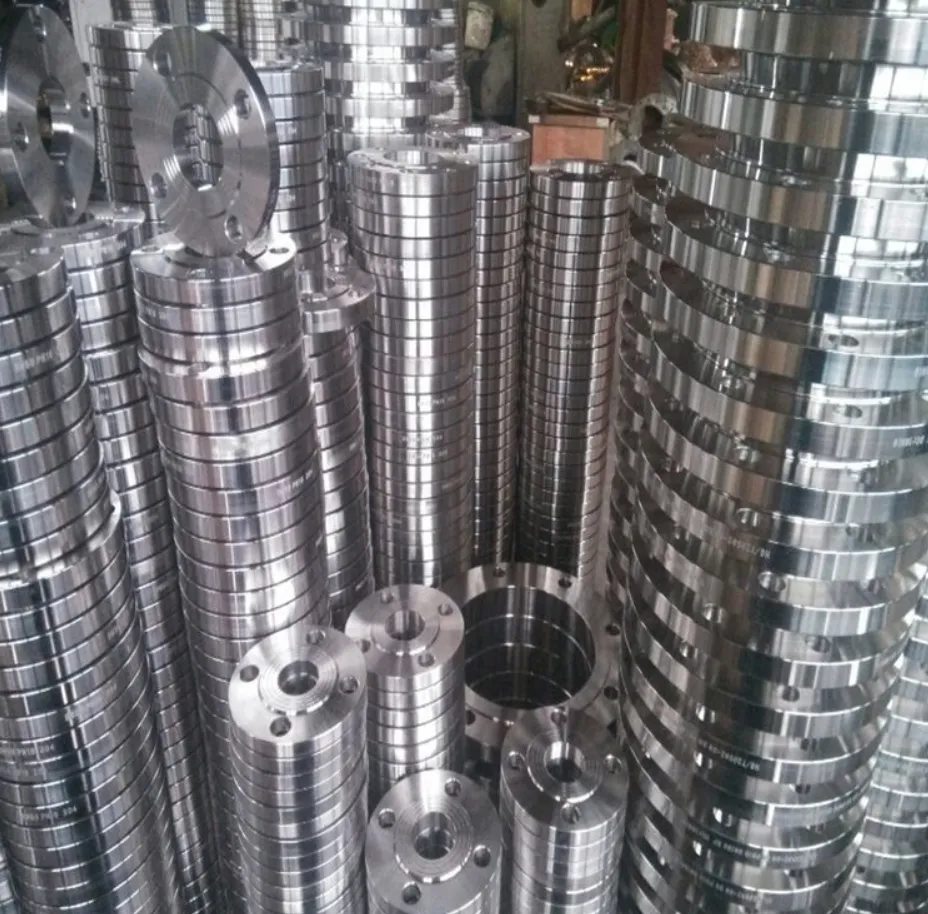
The alloy's chemistry centers on nickel as the base (58% minimum), with chromium (20-23%) providing oxidation resistance, molybdenum (8-10%) delivering pitting and crevice corrosion resistance, and a niobium plus tantalum addition (3.15-4.15%) that stabilizes the microstructure against sensitization during welding. We've tested hundreds of heats over the years, and the consistency of this composition is what makes ASTM B564 forgings so predictable in service.
| Element | Composition (%) | Primary Function |
|---|---|---|
| Nickel | 58.0 min | Matrix stability, corrosion resistance |
| Chromium | 20.0-23.0 | Oxidation and acid resistance |
| Molybdenum | 8.0-10.0 | Pitting/crevice corrosion resistance |
| Niobium + Tantalum | 3.15-4.15 | Carbide stabilization, weld integrity |
| Iron | 5.0 max | Cost reduction, minor strength |
| Carbon | 0.10 max | Controls carbide precipitation |
| Manganese | 0.50 max | Deoxidation |
| Silicon | 0.50 max | Deoxidation |
Compared to Inconel 718, which relies on gamma-prime precipitation and requires precise aging cycles, 625 is far more forgiving during hot working and doesn't demand the same tight heat treatment windows. That's an advantage we lean on heavily when producing complex forged shapes with varying wall thicknesses, because we don't have to worry about differential aging response across the part.
Why Does ASTM B564 Matter For Nickel Alloy Forgings?
ASTM B564 is the standard specification for nickel alloy forgings, and it governs everything from chemical composition limits and mechanical property requirements to heat treatment condition, non-destructive testing acceptance criteria, and marking requirements. Buyers who specify B564 on a purchase order are protecting themselves from receiving forgings that look right on paper but haven't actually undergone the solution annealing and testing sequence the standard demands.
We get asked constantly whether B564 and B446 (the bar and forging stock standard) are interchangeable. They aren't. B446 covers the wrought bar or billet used as raw stock, while B564 governs the finished forged product after it has been formed, heat treated, and tested. A supplier who only certifies to B446 hasn't actually verified the forging itself meets mechanical property requirements after forming operations, which can alter grain flow and properties compared to the starting stock.
Mechanical Property Requirements Under ASTM B564
| Property | Requirement (Grade 1, Inconel 625) |
|---|---|
| Tensile Strength | 120,000 psi (827 MPa) minimum |
| Yield Strength (0.2% offset) | 60,000 psi (414 MPa) minimum |
| Elongation | 30% minimum |
| Reduction of Area | 40% (typical mill practice) |
| Hardness | 35 HRC max (typical, buyer-specified) |
| Solution Anneal Temperature | 1093-1204°C (2000-2200°F) |
We routinely see purchase orders that specify hardness limits tighter than the base ASTM requirement, particularly for sour service applications governed by NACE MR0175/ISO 15156. In those cases we work the hardness ceiling down to 22 HRC or lower depending on the customer's material requirements sheet, because standard B564 hardness allowances aren't automatically sour-service compliant.
How Is a Custom Inconel 625 Forging Actually Produced?
The forging process for Inconel 625 is unforgiving of shortcuts, and this is where we see the biggest quality gaps between suppliers who understand nickel superalloys and those who treat it like just another steel forging job.
Step 1: Raw Material Selection and Incoming Inspection
We start with vacuum induction melted plus vacuum arc remelted (VIM+VAR) or electroslag remelted (ESR) ingot, depending on the cleanliness requirements of the application. Every heat comes with a mill certificate that we verify against ASTM B446 chemistry before it ever touches our forging press.
Step 2: Heating and Temperature Control
Inconel 625 has a narrow forging temperature window compared to carbon steel. We heat billets to 1120-1180°C and monitor closely because overheating even by 30-40°C risks incipient melting at grain boundaries, while underheating below 950°C causes cracking due to the alloy's high work hardening rate. Our furnace operators track this with multiple thermocouples rather than relying on a single zone reading, because we've seen what happens when a batch gets even a slight temperature gradient.
Step 3: Open-Die or Closed-Die Forging
For simpler shapes like discs, blocks, and shafts, we use open-die forging on hydraulic presses ranging from 800 to 3,150 tons. For more complex geometries like flanges, elbows, and fittings, closed-die forging in matched dies gives tighter dimensional control and better material yield.
Step 4: Solution Heat Treatment
This is the step that separates a properly processed B564 forging from a cheap import. We solution anneal at 1038-1149°C followed by rapid water quenching, which dissolves carbides and secondary phases back into solution and restores the corrosion resistance and ductility that hot working can degrade.
Step 5: Machining and Non-Destructive Testing
After rough or finish machining, forgings undergo ultrasonic testing per ASTM A388, and depending on the application, liquid penetrant testing per ASTM E165 or radiographic testing for critical welded structures.
| Process Stage | Typical Duration | Key Control Parameter |
|---|---|---|
| Incoming inspection | 1-2 days | Chemistry, ingot certification |
| Heating for forging | 4-8 hours | Temperature uniformity ±15°C |
| Forging operation | 1-3 days | Reduction ratio, grain flow |
| Solution annealing | 1 day | Furnace temp, quench speed |
| Rough machining | 2-5 days | Stock allowance for finish |
| NDT and final inspection | 1-2 days | UT, PT, dimensional |
| Final machining and marking | 2-4 days | Per drawing tolerances |
Which Industries Actually Rely on Inconel 625 Forged Parts?
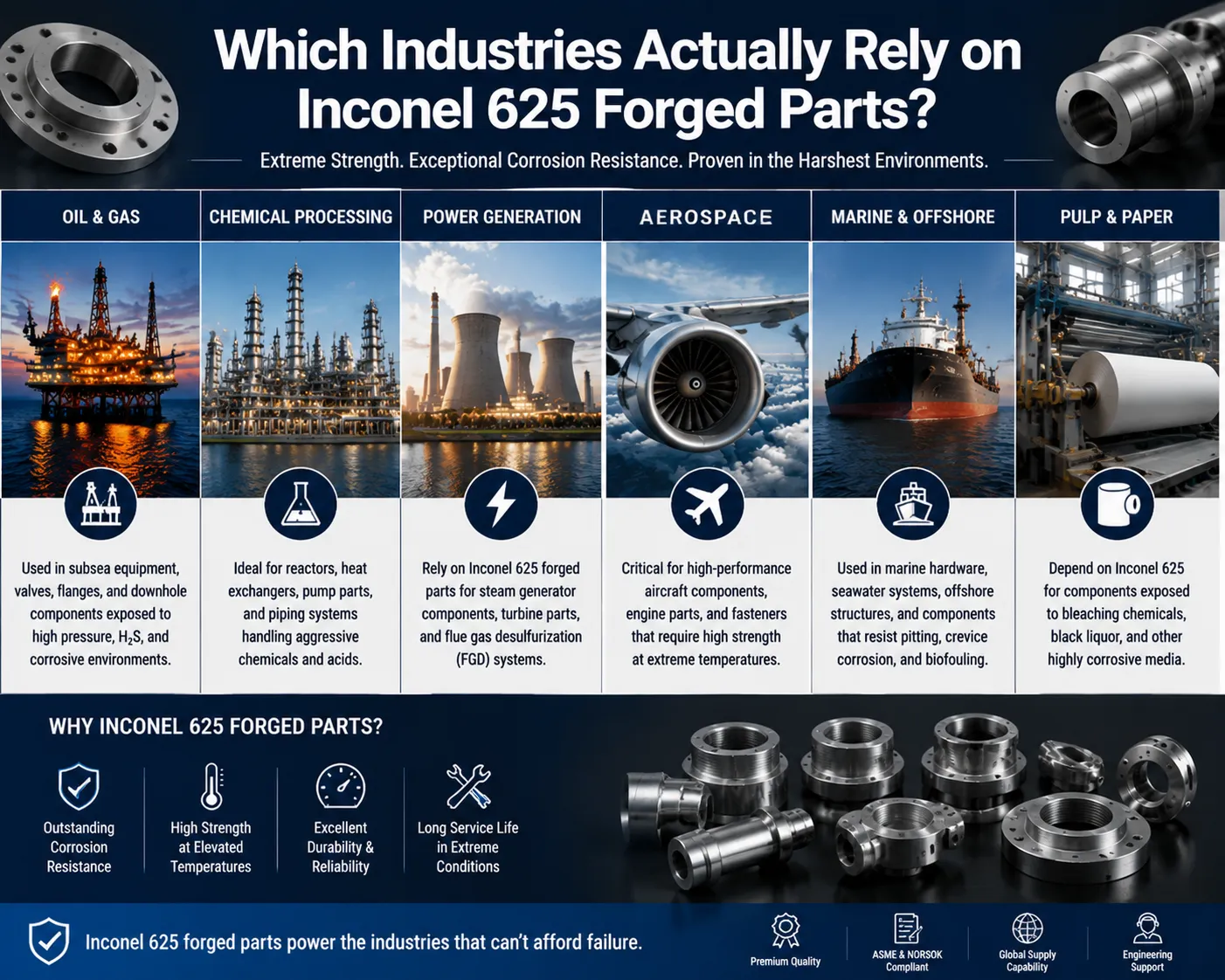
We supply into markets where failure isn't an inconvenience, it's a catastrophe, and that reality shapes every decision we make in our shop.
Oil and Gas Production: Subsea wellhead components, valve bodies, and Christmas tree parts see H2S and CO2 partial pressures that would destroy standard 316 stainless within months. Our forged 625 flanges and fittings routinely go into NACE-compliant sour gas service where the alloy's resistance to sulfide stress cracking is non-negotiable.
Aerospace and Gas Turbine: Combustor liners, exhaust system components, and engine mounting hardware benefit from 625's combination of high-temperature strength and fatigue resistance up to 980°C.
Chemical Processing: Reactor vessels, agitator shafts, and heat exchanger components handling phosphoric acid, seawater, and mixed acid environments depend on the molybdenum content for crevice corrosion resistance that chromium alone can't provide.
Marine and Desalination: Pump shafts, propeller hub components, and RO membrane housing hardware operate continuously in chloride-rich seawater where pitting resistance is the primary failure mode we're designing against.
Nuclear: Instrumentation tubing supports and structural forgings in reactor coolant systems require the combination of radiation stability and corrosion resistance that 625 delivers.
What Forged Part Shapes and Sizes Can Be Manufactured?
Customers frequently assume forging limits them to simple round shapes, but that's an outdated view of modern forging capability.
| Product Type | Typical Size Range | Common Applications |
|---|---|---|
| Forged flanges | DN15 to DN1200 | Piping systems, pressure vessels |
| Forged discs/blocks | Up to 2,500 mm diameter | Aerospace, custom machined parts |
| Forged shafts | Up to 6,000 mm length | Pumps, agitators, turbines |
| Forged elbows/tees | 1/2" to 24" NPS | Pipeline fittings |
| Forged rings | 200-3,000 mm OD | Bearing housings, seal rings |
| Forged valve bodies | Up to 24" bore | Subsea and surface valves |
| Forged fittings | 1/2" to 48" NPS | Reducers, caps, couplings |
We've produced everything from 8 kg instrumentation fittings to 6-ton disc forgings for turbine applications, and the engineering challenge scales differently at each end. Small parts demand tight dimensional tolerance and surface finish control, while large parts demand uniform grain flow and internal soundness verification through the full cross-section.
How Does Custom Inconel 625 Forging Compare to Casting or Bar Stock Machining?
This question comes up in nearly every technical discussion we have with procurement teams, and the answer depends heavily on the loading conditions the part will see.
| Factor | Forging | Casting | Bar Stock Machining |
|---|---|---|---|
| Grain structure | Continuous, directional flow | Random, potential porosity | Continuous but not shape-optimized |
| Fatigue resistance | Highest | Lowest | Moderate-high |
| Internal defects risk | Low | Moderate-high (shrinkage, porosity) | Low |
| Material cost | Moderate | Lower for complex shapes | High for large parts |
| Lead time | Moderate | Shorter for high volume | Fast for simple shapes |
| Best use case | Pressure-retaining, load-bearing parts | Complex geometries, lower stress | Small quantity, simple shapes |
| Mechanical property consistency | High | Variable | High |
Forging wins decisively for anything pressure-retaining or subject to cyclic loading, because the deformation process closes internal voids and orients the grain structure along the direction of principal stress. We tell customers plainly: if your part sees fatigue loading or pressure containment, don't substitute a casting to save cost, because the failure mode difference isn't marginal, it's categorical.
What Certifications and Documentation Should Buyers Require?
We've seen too many buyers get burned by suppliers who provide a generic mill certificate and call it compliance. A legitimate ASTM B564 forging package should include:
- Mill test certificate (MTC) with heat number traceability to original ingot
- Chemical composition report matching ASTM B446/B564 limits
- Mechanical test report (tensile, yield, elongation, hardness) from the actual heat treatment lot
- Ultrasonic testing report per ASTM A388 with acceptance criteria referenced
- Positive Material Identification (PMI) report using XRF or OES
- NACE MR0175 compliance statement, if applicable
- Third-party inspection certificate (SGS, BV, TUV, or equivalent) for critical service
- Dimensional inspection report against approved drawing
We provide full documentation packages as standard practice, not as a premium add-on, because we've found that customers who skip this due diligence upfront almost always pay for it later in field failures or rejected shipments at the port.
What Quality Control Steps Prevent Field Failures?
In our experience, the majority of Inconel 625 forging failures trace back to one of three root causes: improper solution annealing leaving residual carbide networks, inadequate ultrasonic inspection missing subsurface laminations, or chemistry drift outside the niobium/tantalum window that compromises weld heat-affected zone performance.
We built our quality process around catching these specific failure modes rather than just running generic checklists. Every solution-annealed forging gets a hardness map across multiple points, not just a single spot check, because we've found that uneven quenching on thick-section parts can leave localized hard spots that a single hardness reading would miss entirely. We also run intergranular corrosion testing per ASTM G28 on critical batches destined for sour service or seawater applications, even when it's not explicitly called out in the purchase order, because we'd rather catch a marginal heat in our lab than have a customer discover it after installation.
What Does Lead Time and Pricing Actually Look Like?
Buyers researching custom forgings for the first time are often surprised by both the cost premium over carbon steel and the lead time required for proper processing.
| Order Type | Typical Lead Time | Relative Cost vs. 316SS |
|---|---|---|
| Standard flanges (stock sizes) | 4-6 weeks | 6-8x |
| Custom small forgings (under 50 kg) | 6-8 weeks | 5-7x |
| Custom medium forgings (50-500 kg) | 8-12 weeks | 6-9x |
| Large custom forgings (500+ kg) | 12-18 weeks | 7-10x |
| Rush/expedited orders | 3-5 weeks (surcharge applies) | +15-25% premium |
Nickel content pricing volatility affects Inconel 625 more than most alloys, since nickel represents the majority of the raw material cost basis. We advise customers ordering large quantities to lock in pricing against the London Metal Exchange nickel index at the time of order confirmation, since spot price swings of 10-15% within a single quarter aren't unusual.
Frequently Asked Questions
Is Inconel 625 forging suitable for cryogenic service?
Yes, Inconel 625 retains excellent toughness and ductility down to -196°C, making it suitable for cryogenic flanges and fittings in LNG applications. Its face-centered cubic crystal structure doesn't undergo the ductile-to-brittle transition that carbon steel experiences at low temperatures, which is why we regularly supply forged components for LNG regasification terminals and cryogenic valve bodies.
What's the difference between Inconel 625 Grade 1 and Grade 2 under ASTM B564?
Grade 1 requires standard solution annealing while Grade 2 involves a modified heat treatment for specific applications, though most commercial forgings default to Grade 1 unless the customer specifies otherwise. We confirm the required grade with every customer before production because misapplied heat treatment cycles are one of the most common documentation errors we catch during order review.
Can Inconel 625 forgings be welded without post-weld heat treatment?
Yes, one of 625's biggest advantages is that it doesn't require post-weld heat treatment in most applications, unlike precipitation-hardened alloys such as 718. The solid-solution strengthening mechanism means welding doesn't trigger the same sensitization or strain-age cracking risks, though we still recommend proper interpass temperature control during multi-pass welds.
How does forged Inconel 625 perform against hydrogen embrittlement?
Inconel 625 shows strong resistance to hydrogen embrittlement compared to high-strength steels, making it a preferred choice for hydrogen service and sour gas applications. We've supplied forged valve bodies for hydrogen processing units where standard alloy steels would require hydrogen bake-out procedures that 625 simply doesn't need.
What surface finish options are available for Inconel 625 forged parts?
Standard machined finish typically runs 125-250 Ra microinches, while critical sealing surfaces can be finished to 32-63 Ra through grinding and lapping operations. We match surface finish requirements to the specific sealing or fit-up application rather than defaulting to a single standard across all parts.
Does ASTM B564 cover both bar-forged and ring-rolled products?
ASTM B564 covers forgings in general including hand-forged, press-forged, and ring-rolled configurations, as long as the final mechanical properties and heat treatment meet the specification requirements. Ring rolling is particularly common for flange blanks and large-diameter fitting bodies because it produces favorable circumferential grain flow.
What's the minimum order quantity for custom Inconel 625 forgings?
We accept orders starting from single prototype pieces for engineering validation up through multi-ton production runs, though per-unit pricing improves significantly above 500 kg total order weight due to furnace loading efficiency. Smaller prototype orders typically carry a setup cost premium that production quantities absorb more efficiently.
How do I verify a supplier's ASTM B564 certification is authentic?
Request the original mill test certificate with heat number traceability and independently verify chemistry and mechanical properties against a third-party lab if the order value justifies it, since fraudulent or reused certificates remain a real risk in the global supply chain. We encourage customers to request split samples for independent PMI verification on any order above a certain value threshold, and we've never refused such a request.
Can Inconel 625 forgings be supplied with dual certification to NACE MR0175?
Yes, but dual certification requires the hardness and heat treatment parameters to specifically meet NACE MR0175/ISO 15156 requirements, which are often stricter than baseline ASTM B564 hardness allowances. We flag this requirement at the quotation stage because retrofitting NACE compliance onto an already-processed batch usually isn't possible without re-heat-treating the entire lot.
What causes Inconel 625 forgings to fail inspection most often?
The most common rejection causes we encounter are ultrasonic indications from incomplete forging consolidation in thick sections, hardness values exceeding buyer specifications due to inadequate quench rates, and dimensional deviations from insufficient machining stock allowance. We address the first two through tighter in-process controls during forging and heat treatment, and the third through closer collaboration with customers during the drawing review stage before production begins.
Working With MWalloys
We've built our reputation on producing Inconel 625 forgings that meet ASTM B564 requirements on paper and perform to that standard in the field, which are two different achievements that not every supplier delivers consistently. Whether you need a single prototype flange for qualification testing or a production run of subsea valve bodies, our team reviews your drawing, confirms the correct grade and heat treatment condition, and provides a documentation package that will hold up to any third-party audit.
If you have a drawing ready or just a set of operating parameters and need help specifying the right forging approach, contact our engineering team directly for a technical review and quotation.
Verifiable Sources
- ASTM International. "ASTM B564-19: Standard Specification for Nickel Alloy Forgings." ASTM Standards.
- ASTM International. "ASTM B446: Standard Specification for Nickel-Chromium-Molybdenum-Columbium Alloy Rod and Bar."
- Special Metals Corporation. "INCONEL Alloy 625 Technical Data Sheet."
- NACE International/ISO. "NACE MR0175/ISO 15156: Petroleum and Natural Gas Industries - Materials for Use in H2S-Containing Environments."
- ASTM International. "ASTM A388: Standard Practice for Ultrasonic Examination of Steel Forgings."
- ASTM International. "ASTM G28: Standard Test Methods for Detecting Susceptibility to Intergranular Attack in Wrought Nickel-Rich Alloys."
Ready to discuss your custom Inconel 625 forging requirements? Send us your drawing or specification sheet today and our engineering team will respond with technical feedback and a formal quotation within two business days.