

51CrV4 is a medium-carbon, chromium-vanadium alloy steel developed for components that require high tensile strength, strong fatigue resistance, and reliable performance after quenching and tempering. When processed with proper heat treatment it provides an excellent balance of toughness and spring performance for automotive and industrial springs, high-strength fasteners, torsion bars, and similar load-bearing parts. Selecting 51CrV4 is appropriate when you need predictable hardenability, resistance to wear under cyclic loading, and good dimensional stability during heat treatment, provided you accommodate limited weldability and follow recommended machining and tempering practices.
1. What is 51CrV4 steel?
51CrV4 (DIN material number 1.8159, sometimes compared with SAE/AISI 6150 family types) is a quenched and tempered alloy steel optimized for spring and high-strength parts. With roughly 0.47–0.55% carbon, near 1.0% chromium and small vanadium additions, the grade hardens well in oil or polymer quenches and produces tempered martensite that combines strength, fatigue resistance and reasonable toughness. Use it when you need repeatable mechanical properties from a mass manufacture process and when you can control heat treatment rather than rely on fusion welding for assembly.
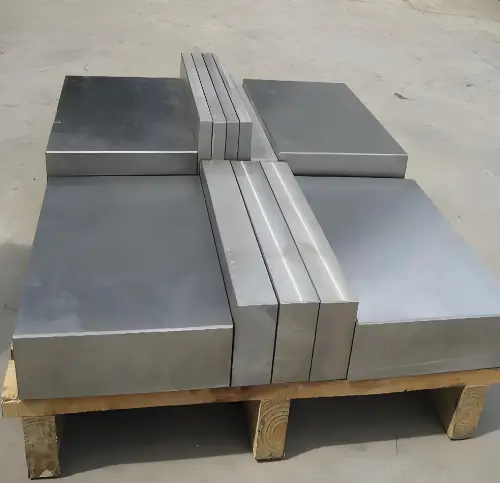
2. Standards and international equivalents
When specifying 51CrV4 on drawings or in procurement, use the following cross references so suppliers and labs align on chemistry and test standards:
| Designation system | Typical label |
|---|---|
| DIN / EN | 51CrV4, Material No. 1.8159 |
| SAE / AISI | often compared to 6150 (note: not identical; check spec) |
| JIS | SUP10 or close equivalents in spring steel family |
| Common trade names | 50CrV4 / 51CV4 variants from European mill datasheets |
Always attach the exact EN or DIN document and required inspection plan when ordering to remove ambiguity.
3. Chemical composition (table and commentary)
Below is the composition band you will typically see when ordering material to EN / DIN tolerances. Mill certificates should be provided to confirm actual assay for each delivery heat.
| Element | Typical EN bands (wt %) |
|---|---|
| Carbon (C) | 0.47 – 0.55 |
| Silicon (Si) | up to 0.40 |
| Manganese (Mn) | 0.70 – 1.10 |
| Phosphorus (P) | ≤ 0.025 |
| Sulfur (S) | ≤ 0.025 |
| Chromium (Cr) | 0.90 – 1.20 |
| Vanadium (V) | 0.10 – 0.25 |
| Copper / Nickel / other | usually minimal; specified when needed |
Why these elements matter
-
Carbon governs hardenability and final hardness range. The 0.5% band gives strong strength potential after quench and temper.
-
Chromium improves hardenability and wear resistance while contributing to tempering resistance.
-
Vanadium is a microalloy element that refines grain size, raises strength and improves toughness at given hardness levels.
-
Low P and S minimize embrittlement risks and improve finishability.
Confirm actual chemical values on the mill certificate, because small variations influence heat treatment response and final mechanical values.
4. Metallurgical behavior and microstructure
Microstructure after correct processing
-
As-rolled or normalized 51CrV4 prior to quench will show ferrite plus pearlite in typical micrographs.
-
After hardening and appropriate tempering the predominant microstructure is tempered martensite with carbides that contain chromium and vanadium. Vanadium carbides are fine and help limit grain growth during austenitization.
-
Grain size control through proper austenitizing temperature and short hold times yields better fatigue life and lower distortion.
Practical note
-
Vanadium traces slow prior austenite grain growth, making the steel less sensitive to slight overheating in the furnace compared with plain chromium steels. This supports stable strength across batches when industrial furnaces are used.
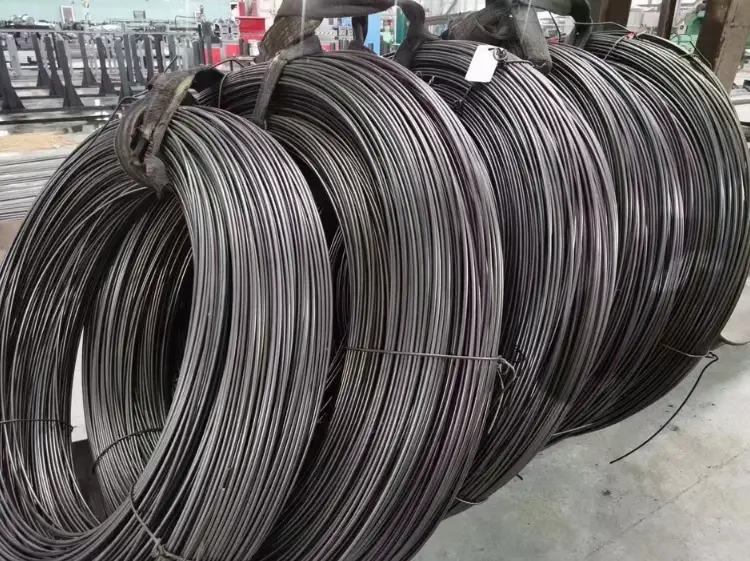
5. Mechanical properties — typical ranges and table
Actual mechanical values depend on cross section, heat treatment and test standard. The ranges shown below are typical for quenched and tempered 51CrV4 processed to engineering spring or shaft conditions.
| Condition | Tensile strength (MPa) | Yield strength 0.2% (MPa) | Elongation A (%) | Hardness HRC |
|---|---|---|---|---|
| Normalized / annealed | 700 – 900 | 500 – 650 | 12 – 18 | 20 – 30 HRC |
| Quenched and tempered (medium) | 900 – 1100 | 700 – 900 | 8 – 14 | 35 – 48 HRC |
| Quenched and tempered (high strength) | 1000 – 1200 | 800 – 1000 | 6 – 12 | 40 – 52 HRC |
Notes
-
For components requiring fatigue life, select tempering that balances hardness and toughness rather than simply maximizing strength.
-
Impact energy at low temperatures is variable and depends on temper level; if low temperature service is expected, include charpy testing in acceptance.
6. Heat treatment: recommended cycles and effects
Typical austenitizing and tempering windows for 51CrV4. Adjust for section size and furnace type.
| Step | Typical range |
|---|---|
| Austenitize temperature | 820 – 860 °C |
| Holding time | 10 – 30 minutes per 25 mm section, adjust for mass |
| Quench medium | Oil or polymer quenches; avoid water for large cross sections |
| Tempering temperature for balance | 180 – 250 °C for spring temper; 350 – 550 °C to reduce hardness and raise toughness |
| Tempering cycles | 1 to 2 cycles; dual tempering improves dimensional stability |
Practical guidance
-
For spring applications aim for tempering at the lower end to preserve resilience. For heavy duty shafts or components where toughness is prioritized, temper at higher temperatures to reduce brittleness.
-
Always test representative samples to set final cycle parameters for production. Mill samples and coupons are valuable for process validation.
7. Hardenability and quench selection; distortion control
Hardenability
-
51CrV4 provides good hardenability for small to medium sections. Larger sections may not fully transform to martensite with mild quenches, so assess with Jominy end-quench tests if part geometry is critical.
Quench selection
-
Oil quench or polymer quenches yield a controlled cooling rate that reduces cracking and distortion while still achieving the necessary martensitic structure. For thin sections a faster quench may be acceptable, but internal stresses and cracking risk increase.
Distortion control techniques
-
Use interrupted quenching and low temperature martempering for critical geometry.
-
Apply fixtures that constrain the part during quench where feasible.
-
Consider sub-zero processing only if retained austenite must be reduced.
-
Implement controlled furnace ramp rates and uniform loading to minimize gradients.
8. Weldability and joining considerations
Welding 51CrV4 is not recommended as a first choice for weld-critical designs because:
-
It has moderate to poor weldability due to carbon and alloy content that promotes hard, brittle heat affected zones.
-
Preheat and post weld heat treatment are necessary to avoid cracking in many cases. For most production scenarios, mechanical joining, interference fits, or designing components to be formed and heat treated as a single unit are preferable.
If welding is unavoidable
-
Use low hydrogen electrodes, preheat to recommended temperature (typically 150–250 °C), and perform post weld tempering or stress relief according to a qualified welding procedure specification.
-
Have a welding procedure qualification and perform non-destructive testing where safety is critical.
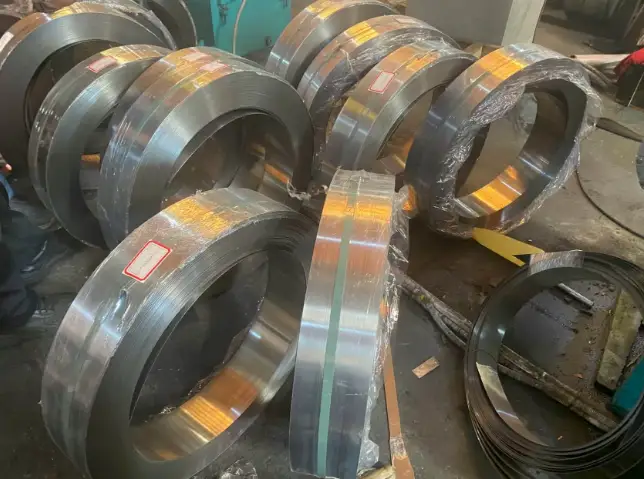
9. Fabrication: machining, cold forming, grinding tips
Machining
-
51CrV4 machines like many medium-carbon alloy steels. Hardness will influence tool wear. Use sharp carbide inserts, rigid setups, and adequate coolant to prolong tool life.
-
Roughing should be done before final heat treatment where possible. If machining after hardening is required, use grinding or carbide tooling rated for the intended hardness.
Cold forming and forming limits
-
Cold bending and forming are possible in the normalized condition. After quench and temper the steel is not suited to cold forming. For spring manufacturing, initial forming often occurs before final temper.
Grinding and finishing
-
For final dimension control and surface finish, centerless grinding or surface grinding after tempering is common. Maintain wheel selection appropriate to the hardness band to avoid glazing and burning.
10. Surface treatments, coatings and corrosion considerations
Basic corrosion note
-
51CrV4 is not stainless. For any environment with humidity or corrosive agents use protective coatings. Typical choices include phosphate + oil for springs, electroplated zinc where appropriate, or paint systems for larger parts.
Common surface processes
-
Shot peening improves fatigue life for springs and torsion bars by inducing compressive residual stresses.
-
Induction hardening of bearing surfaces may be considered but requires process trials because local heating changes microstructure and may necessitate subsequent tempering to relieve stresses.
-
Nitriding is possible on specific chemistries but needs process evaluation because the base alloy is optimized for quench and temper rather than diffusion hardening.
Designers should include surface treatment specifics on purchase documents to ensure supplier compliance with lifecycle and warranty expectations.
11. Common applications and case examples
51CrV4 finds use across automotive, tooling, and industrial hardware where cyclic loading and resilient strength are needed.
| Application | Why 51CrV4 fits |
|---|---|
| Leaf and coil springs | Good spring back, fatigue resistance, and repeatable tempering response |
| Torsion bars and stabilizer rods | High tensile strength with reasonable toughness |
| High strength fasteners | When tensile loads and some flexibility are needed |
| Chisels, hacksaw blades, shears | Wear resistance with ability to temper to required toughness |
| Shafts and pins | Where strength and wear resistance are important and welding is avoided |
Case note
-
Automotive suspension components often use heat treated spring steels similar to 51CrV4 because they require long-term fatigue performance under variable loading. Suppliers usually deliver calibrated coils or blanks that are finally surface coated and shot peened.
12. Specification and purchasing checklist for factory pricing
When requesting quotes and aiming for 100% factory price transparency from mills or traders, include:
-
Exact EN/DIN grade: 51CrV4, 1.8159 and clause references.
-
Required condition: hot rolled, cold rolled, normalized, or quenched and tempered.
-
Mechanical requirements: tensile, yield, elongation, hardness targets.
-
Heat treatment schedule or acceptance conditions.
-
Surface finish and coating requirements.
-
Sample testing requirements: PMI, chemical analysis, tensile test report, hardness chart, charpy at specified temperature if needed.
-
Traceability: heat number linked to mill certificate.
-
Delivery form: bar, strip, plate, coil, or blanks.
-
Tolerances and special inspection (ultrasound, magnetic particle) if safety critical.
Requesting a factory price often means direct purchase from a mill or authorized distributor. Always compare offered mill certificates and lead times. Mills will quote by weight and may provide lower unit costs for larger rolled lengths or pallet quantities.
13. Quality control and testing
Minimum tests to require for critical parts
-
Chemical composition via mill certificate and spot check spectroscopy.
-
Tensile test and proof load where specified.
-
Hardness profile across cross section for quenched parts.
-
Charpy impact testing if the part operates at low temperatures or has dynamic shock loads.
-
Non-destructive testing: magnetic particle or liquid penetrant on critical surfaces after heat treatment; ultrasound for large forgings.
Sampling plans
-
Follow ISO, EN or client specific acceptance plans. For mass production, establish statistical process control metrics for heat treatment variation, hardness drift and distortion.
14. Storage, handling and traceability
-
Store coils and bars indoors and off concrete to avoid moisture contact.
-
For long storage apply light oil and rotate stock to avoid long-term exposure.
-
Maintain heat number traceability from mill certificate through manufacturing steps to finished part. This is critical when field failures must be investigated.
15. Environmental, health and safety notes
-
During machining and grinding, use dust extraction. Metal dust can pose inhalation hazards.
-
Quenching oils are flammable; handle and store in compliance with workplace safety codes. During quench operations collect and treat waste oil per local environmental regulations.
-
Shot peening and surface finishing should use PPE and local capture to control airborne particulates.
16. Frequently Asked Questions (FAQ)
-
What is the exact chemical makeup of 51CrV4?
The typical range is 0.47–0.55% C, 0.70–1.10% Mn, up to 0.40% Si, about 0.90–1.20% Cr, and 0.10–0.25% V. Request the mill certificate for each heat. -
Is 51CrV4 the same as AISI 6150?
They are often compared and used interchangeably in trade, but always check chemical and mechanical tolerances in the supplier datasheet because small differences may exist. -
Can I weld parts made from 51CrV4?
Welding is challenging. Preheat and post weld heat treatment are needed to avoid cracking. For critical parts avoid welding when possible. -
What quench medium should I use?
Oil or polymer quenchants are typical to balance hardenability with reduced risk of quench cracking and distortion. Choice depends on section size. -
What hardness can be achieved?
After quench and temper the grade commonly reaches between 35 and 52 HRC depending on tempering temperature and target properties. -
Is shot peening recommended for springs?
Yes, shot peening is a standard finishing process for springs to improve fatigue life by inducing compressive residual stress at the surface. -
What alternatives should I consider?
For higher toughness at similar strength consider other chromium-vanadium grades or alloy families. For better weldability choose lower carbon, nickel enriched steels. Always match the grade to application demands. -
What tests should I require on delivery?
Mill certificate for chemistry, hardness and tensile tests, and NDT when geometry or safety requires it. Include sampling frequency in the purchase order. -
How does vanadium affect properties?
Vanadium refines grain size and forms fine carbides that boost yield strength and toughness without requiring higher carbon. This helps with fatigue resistance. -
Are there any special storage rules?
Keep material indoors, dry, and documented with heat numbers. For coated or shot peened parts, avoid stacking that damages the finish.
17. Buying and specification template
Use this short template when you prepare RFQs to get accurate factory pricing:
-
Material: 51CrV4 (EN 1.8159).
-
Chemistry tolerance: EN limits required, attach target bands.
-
Delivery condition: Hot rolled / normalized / quenched & tempered (specify T and HRC).
-
Mechanical requirements: Tensile, yield, elongation, hardness.
-
Heat treatment: Provide a/ temp cycles or request supplier to specify and approve on sample.
-
Surface finish: Shot peened / phosphate & oil / painted / zinc plated.
-
Inspection: Mill cert 3.1 or 3.2, hardness chart, tensile, NDT as required.
-
Traceability: Heat number required on all parts.
-
Quantity, dimensions, packaging and lead time.