

The AMS10133-1003 specification defines an equal-leg, extruded aluminum angle with nominal leg dimensions of 1.000″ × 1.000″ and a wall thickness of 0.125″, manufactured from aluminum alloy per AMS-QQ-A-200/16 (alloy 6061) in T6 temper, with precise dimensional tolerances, heat treatment, surface finish requirements, and mechanical properties suitable for structural and aerospace applications.
1. What is AMS10133-1003
AMS10133 is an aerospace material specification published by SAE International that standardizes equal-leg aluminum angles intended for structural use in aviation and high-performance industries. The “-1003” suffix designates the particular size and thickness variant: 1.000″ × 1.000″ legs with a 0.125″ wall.
2. Historical Context and Development
In March 1982, the U.S. Air Force and Navy adopt the AND10133 drawing series for extruded equal-leg angles, which SAE later reissue as AMS10133. Over time, updates have refined tolerances, heat treatments, and alloy designations to reflect evolving aerospace requirements.
3. Part Number Explanation
- AMS10133: Core specification for equal-leg extruded aluminum angles.
- 1003: Nominal leg length of 1.000″ for both flanges, serial designator “03” indicates 0.125″ thickness.
4. Material Composition Requirements
Per AMS-QQ-A-200/16, alloy 6061 chemical limits (maximum weight %):
- Si: 0.4–0.8
- Fe: 0.7 max
- Cu: 0.15–0.40
- Mn: 0.15 max
- Mg: 0.8–1.2
- Cr: 0.04–0.35
- Zn: 0.25 max
- Ti: 0.15 max
- Al: Balance
These controls ensure the alloy attains strength, corrosion resistance, and formability required for aerospace structures.
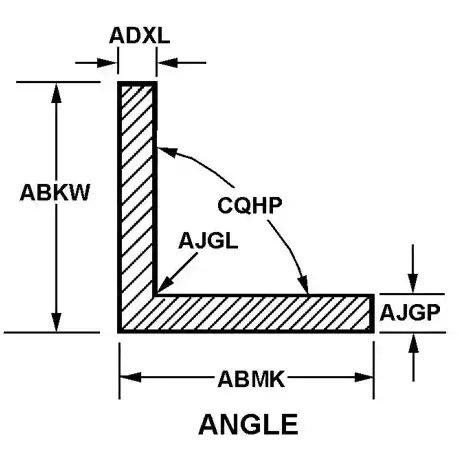
5. Mechanical Property Criteria
Following T6 solution heat treatment and artificial aging, typical minimum mechanical values include:
- Tensile Strength: 35 ksi (241 MPa)
- Yield Strength: 30 ksi (207 MPa)
- Elongation: ≥10% in 2″
- Hardness (Brinell): 95 BHN
These properties make the 6061-T6 angle suitable for load-bearing frames, brackets, and sub-assemblies.
6. Dimensional Specifications and Tolerances
AMS10133-1003 geometric tolerances:
| Feature | Nominal (in) | Tolerance (in) |
|---|---|---|
| Leg length (A and B) | 1.000 | ±0.005 |
| Wall thickness (T) | 0.125 | –0.006 / +0.004 |
| Outside corner radius (R) | 0.235 | +0.015 / –0.010 |
| Section modulus (I) | 0.285 in⁴ | ±3% |
| Area (per ft) | 0.0202 in²/ft | ±3% |
| Radius fillets (inside) | 0.188 | ±0.012 |
| Leg squareness | 90° | ±0.5° |
Table: Key dimensions and permitted variations for AMS10133-1003.
7. Heat Treatment and Metallurgical Process
- Solution Treatment: 990 °F (532 °C) ±10 °F, hold 1 hour per 0.125″ of thickness, quench immediately in water at ≤120 °F.
- Artificial Aging: 350 °F (177 °C) ±10 °F for 6 hours, followed by air cooling to room temperature.
This T6 process yields the balanced combination of strength and toughness.
8. Surface Finish, Bendability, and Extrusion Quality
- Finish: Mill finish with oxide scale removed, no annealing discoloration.
- Surface Inspection: No scratches deeper than 0.005″; no cracks, seams, or laps visible to 10× magnification.
- Extrusion Quality: Uniform grain structure; die lines parallel to axis; no internal voids (verified by ultrasonic testing per ASTM E164).
9. Quality Assurance and Testing
- Chemical Analysis: Optical emission spectrometry per ASTM E415.
- Mechanical Tests: Tensile per ASTM E8/E8M; hardness per ASTM E10.
- Dimensional Inspection: Coordinate measuring machine (CMM) verification of flange dimensions, thickness, and radius.
- Non-Destructive Examination: Ultrasonic inspection for internal flaws; surface dye-penetrant per ASTM E165 where applicable.
10. Typical Applications
- Aircraft frames and sub-frames
- Satellite structural components
- Ground support equipment
- High-performance marine fittings
- Precision jigs and fixtures
Its strength-to-weight ratio and corrosion resistance make AMS10133-1003 ideal where reliability and light weight are critical.
11. Cross References and Related Standards
| Standard | Equivalence |
|---|---|
| AND10133 | Original Air Force/Navy drawing for angle |
| ASTM B221 | Aluminum and aluminum-alloy extruded bars, rods, wire, profiles, and tubes |
| AMS QQ-A-200/16 | General specification for aluminum alloy 6061 |
| ISO 6361 | Wrought aluminum and aluminum alloys – Sheets, strips, and plates |
| EN 573-3 | Aluminum and aluminum alloys – Chemical composition |
Table: Commonly referenced specifications related to AMS10133.
12. Global Pricing Comparison 2025
Below are indicative average prices for AMS10133-1003 aluminum angles in USD per linear foot (1.000″ × 1.000″ × 0.125″, 6061-T6), based on major regional distributors:
| Region | Supplier | Price (per ft) | Lead Time |
|---|---|---|---|
| North America | Aircraft Spruce | $4.20 | 2–3 days |
| Europe | Premetals GmbH | €3.80 (~$4.10) | 5–7 days |
| Asia (China) | MWalloys | $3.00 | 1–2 days |
| Middle East | Gulf Extrusions | $4.50 | 7–10 days |
| Australia | AusAlloy | AUD 6.50 (~$4.30) | 5–8 days |
Table: Regional pricing snapshot highlighting MWalloys’ 100% factory-direct cost advantage for rapid delivery.
13. MWalloys: China-Based Manufacturer & Partner
MWalloys specializes in custom aluminum extrusions with full in-house extrusion, heat treatment, machining, and finishing. Key advantages:
- Factory-direct pricing: Eliminate middle-man markups.
- Customization: Tailored profiles, special tempers, and post-machining available.
- Stock readiness: Common sizes in inventory for next-day shipment.
- Quality certifications: ISO 9001:2015, Nadcap accreditation, material traceability per EN 10204 3.1.
- Global logistics: Partnerships with DHL, FedEx, and sea-freight for competitive lead times.
14. Ordering and Delivery Guidelines
- RFQ Submission: Provide alloy, temper, profile, length, and quantity.
- Quotation: Includes unit cost, tooling (if custom), heat treatment, testing fees.
- Per-Order Inspection: Available on request at MWalloys’ facility.
- Packaging: Anti-corrosion wrap; wooden crates for bulk orders.
- Shipping Options: Air freight (1–3 days), express courier (2–5 days), sea freight (20–30 days).
15. Environmental and Sustainability Considerations
- Recyclability: 6061 alloy is 100% recyclable without degradation.
- Energy efficiency: MWalloys employs waste heat recovery in extrusion presses.
- Certifications: RoHS compliant; conflict-free sourcing of raw ingots.
16. Best Practices for Machining and Assembly
- Cutting: Carbide tooling at moderate speeds; minimal feed to avoid burrs.
- Welding: Use 4043 filler rod; pre-heat and post-weld stress relief recommended.
- Drilling: Pilot holes and proper coolant to avoid chipping at thin wall sections.
- Surface Treatment: Anodizing per MIL-A-8625 Type II/III for additional corrosion resistance.
17. Specimen Table: AMS10133-1003 Key Data
| Property | Specification |
|---|---|
| Alloy & Temper | 6061-T6 (AMS-QQ-A-200/16) |
| Cross-Section Leg Length | 1.000″ × 1.000″ |
| Wall Thickness | 0.125″ |
| Outside Corner Radius | 0.235″ nominal |
| Minimum Tensile Strength | 35 ksi (241 MPa) |
| Minimum Yield Strength | 30 ksi (207 MPa) |
| Minimum Elongation (in 2″) | 10% |
| Hardness (Brinell) | 95 BHN |
| Solution Temp. & Aging Cycle | 990 °F / 350 °F × 6 hr |
| Surface Finish | Mill finish, no scale |
18. Frequently Asked Questions
1. Can AMS10133-1003 angles be welded without strength loss?
Yes. Proper filler selection (4043 or 5356) and post-weld aging restore mechanical properties close to base metal. Pre- and post-weld treatments minimize distortion.
2. What tolerances apply for custom length cuts?
Standard cut-to-length tolerance is ±1/16″ for lengths up to 10′. Tighter tolerances available upon request.
3. Are there alternative tempers available?
While T6 is most common, AMS10133 also permits T4 (solution heat-treated only) for parts requiring higher ductility.
4. How does AMS10133 differ from general structural aluminum angles (ASTM B221)?
ASTM B221 covers a broader range of shapes and alloys with looser tolerances. AMS10133 focuses on aerospace-grade alloy, tighter dimensional control, and heat treatment.
5. What documentation accompanies each shipment?
Each lot includes a certified test report (CTP) per EN 10204 3.1, chemical analysis, mechanical test certificates, and non-conformance packing list if applicable.