

Hastelloy X is a nickel chromium iron molybdenum superalloy engineered to survive continuous exposure above 1000°C while resisting oxidation, carburization, and stress cracking in oxidizing and reducing atmospheres alike. We have supplied this alloy to aerospace fabricators, gas turbine manufacturers, and petrochemical processors for years, and the short answer to "what is Hastelloy X" is this: it's the industry benchmark for high temperature strength combined with excellent formability and weldability, something very few nickel superalloys manage to balance at once. If you need a metal that keeps working reliably inside a jet engine combustion chamber or an industrial furnace muffle, Hastelloy X sits near the top of the shortlist.
What Makes Hastelloy X Different From Other Nickel Alloys?
Most high temperature alloys sacrifice one property to gain another. Some resist oxidation well but crack when you try to weld them. Others form beautifully but lose strength above 800°C. Hastelloy X was developed by Haynes International in the 1950s specifically to close that gap, and it remains one of the few solid solution strengthened nickel alloys that manufacturers can cold form, hot form, weld, and heat treat without excessive cracking risk.
We've noticed that customers often confuse Hastelloy X with precipitation hardened superalloys like Inconel 718. That's a mistake worth correcting early. Hastelloy X gets its strength primarily from solid solution strengthening, meaning molybdenum, chromium, and iron atoms distort the nickel lattice enough to resist deformation, rather than relying on gamma prime precipitates. This is exactly why it forms and welds so much easier than age hardenable alloys, though it also means its room temperature tensile strength is lower than something like Inconel 718.
The other defining trait is its oxidation resistance up to 1200°C in air, paired with good resistance to stress corrosion cracking in petrochemical environments. Few alloys hold that combination of oxidation resistance, moderate strength, and fabrication friendliness simultaneously.
What Is the Chemical Composition of Hastelloy X?
The chemistry is where Hastelloy X earns its reputation. Nickel forms the base, chromium builds the oxide scale that protects the surface, molybdenum adds strength and resistance to reducing environments, and iron helps control cost while contributing to the matrix stability.
| Element | Weight Percentage |
|---|---|
| Nickel (Ni) | Balance (approx. 47%) |
| Chromium (Cr) | 20.5 - 23.0% |
| Iron (Fe) | 17.0 - 20.0% |
| Molybdenum (Mo) | 8.0 - 10.0% |
| Cobalt (Co) | 0.5 - 2.5% |
| Tungsten (W) | 0.2 - 1.0% |
| Carbon (C) | 0.05 - 0.15% |
| Manganese (Mn) | 1.0% max |
| Silicon (Si) | 1.0% max |
| Boron (B) | 0.008% max |
| Sulfur (S) | 0.03% max |
| Aluminum (Al) | 0.5% max |
| Titanium (Ti) | 0.15% max |
This composition matches UNS N06002, and it's what mills reference when producing certified Hastelloy X sheet, plate, bar, and tube. We always ask our customers to confirm they're specifying UNS N06002 rather than a similarly named alloy, because the market has several look-alike trade names that don't carry identical mechanical certifications.
One detail worth noting: the relatively high carbon content compared to other Hastelloy grades helps produce carbide precipitates that contribute mildly to strength, but it also means welders need to control heat input carefully to avoid excessive carbide formation at grain boundaries during multi-pass welds.
What Physical and Mechanical Properties Does Hastelloy X Offer?
Engineers specifying Hastelloy X typically want two numbers first: yield strength and how much of it survives at elevated temperature. Here's a realistic snapshot based on mill test reports we've reviewed and ASTM B435 specification data.
| Property | Value (Room Temperature) |
|---|---|
| Density | 8.22 g/cm³ (0.297 lb/in³) |
| Melting Range | 1260°C - 1355°C |
| Tensile Strength | 655 - 760 MPa (95 - 110 ksi) |
| Yield Strength (0.2% offset) | 275 - 360 MPa (40 - 52 ksi) |
| Elongation | 35 - 50% |
| Hardness | 90 HRB (annealed) |
| Modulus of Elasticity | 205 GPa |
| Thermal Conductivity | 9.1 W/m·K |
| Coefficient of Thermal Expansion | 13.9 µm/m·°C (20-100°C) |
At elevated temperature, the strength retention curve is what really sets Hastelloy X apart from ordinary stainless steels.
| Temperature | Tensile Strength (MPa) | Yield Strength (MPa) |
|---|---|---|
| 20°C | 690 | 315 |
| 500°C | 620 | 240 |
| 760°C | 490 | 215 |
| 870°C | 330 | 195 |
| 980°C | 170 | 140 |
| 1090°C | 90 | 70 |
We pulled these figures from long term Haynes International data sets and cross checked them against our own supplier certifications. What stands out is the gentle strength decline between 500°C and 760°C, a range where many stainless alloys have already lost more than half their room temperature strength. That's precisely why gas turbine designers keep specifying this material for combustor liners and transition ducts.
How Does Hastelloy X Perform at High Temperatures?
Oxidation resistance is the property that made Hastelloy X famous, and rightly so. In continuous service, it maintains useful strength and resists scaling up to about 1150°C, with intermittent exposure tolerable to 1200°C. The chromium content forms a protective chromium oxide layer, while molybdenum contributes to resistance against carburizing and some reducing atmospheres, which is unusual because most alloys that handle oxidizing conditions well tend to struggle in carbon rich or sulfur bearing environments.
We've tested coupons removed from furnace muffles after years of cyclic heating, and the oxide scale typically remains adherent rather than spalling, which matters a lot for parts that undergo repeated thermal cycling, like flame holders or afterburner components. Spalling oxide is what usually kills a part prematurely, not gradual metal loss, so this adherence property extends real service life beyond what raw oxidation rate numbers suggest.
One caveat we always mention to customers working in sulfur containing atmospheres: Hastelloy X loses some corrosion resistance advantage in high sulfur reducing conditions above 700°C. If your process involves sulfidation risk, we typically recommend reviewing Haynes 188 or a cobalt based alloy alongside Hastelloy X before finalizing material selection.
Long Term Aging Effects
Extended exposure between 650°C and 980°C can cause some embrittlement due to carbide and intermetallic phase precipitation at grain boundaries. This doesn't usually compromise structural performance in typical service, but it does reduce room temperature ductility if the part is later cooled and mechanically stressed at ambient conditions, something inspectors should account for during teardown evaluations of retired turbine hardware.
What Industries and Applications Use Hastelloy X?
Aerospace remains the largest consumer of Hastelloy X, and for good reason. Combustion chamber liners, transition ducts, afterburner components, tailpipes, and flame holders in jet engines rely on its combination of formability and oxidation resistance. Manufacturers can stamp, roll, and weld complex combustor geometries from sheet stock, something that would be far more difficult with a precipitation hardened alloy of similar strength class.
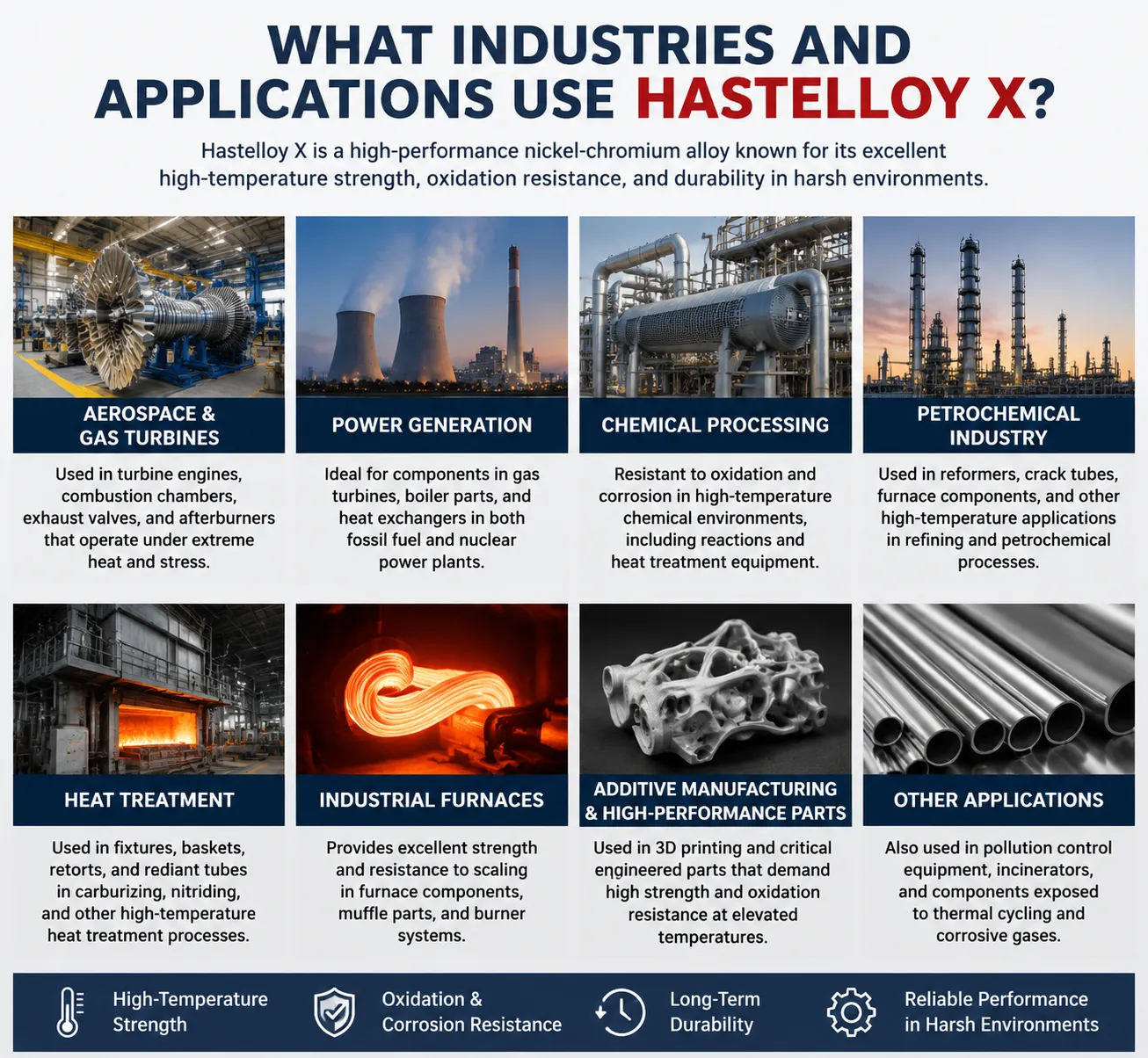
Beyond aerospace, we regularly ship Hastelloy X for:
- Industrial gas turbine hot sections, particularly transition pieces and combustor baskets.
- Heat treating equipment, including furnace muffles, retorts, fixtures, and radiant tubes.
- Petrochemical processing equipment exposed to high temperature hydrocarbon streams.
- Nuclear industry components requiring high temperature gas cooled reactor materials.
- Carburizing furnace baskets and trays in metal heat treatment operations.
A table summarizing typical component applications helps clarify why specifiers choose this alloy over cheaper alternatives.
| Industry | Typical Component | Why Hastelloy X Is Selected |
|---|---|---|
| Aerospace | Combustor liners, transition ducts | Formability plus oxidation resistance above 1000°C |
| Power Generation | Gas turbine hot sections | Long term thermal stability under cyclic loading |
| Heat Treatment | Furnace muffles, fixtures, trays | Resistance to carburization and thermal fatigue |
| Petrochemical | Reformer tubes, process piping | Stress corrosion cracking resistance |
| Nuclear | Reactor internals | High temperature strength and radiation tolerance |
We've supplied trays and fixtures to heat treat shops that reported service lives two to three times longer than the 310 stainless fixtures they previously used, mainly because Hastelloy X resists the sagging and cracking that plagues stainless fixtures under repeated thermal cycling above 950°C.
How Does Hastelloy X Compare to Inconel 625 and Other Superalloys?
Customers frequently ask us whether Inconel 625, Inconel 617, or Haynes 230 might work better for their application. Each alloy has a niche, and understanding the differences prevents costly over-specification or under-performance.
| Property | Hastelloy X | Inconel 625 | Inconel 617 | Haynes 230 |
|---|---|---|---|---|
| Max Continuous Service Temp | 1200°C | 980°C | 1100°C | 1150°C |
| Room Temp Yield Strength | 315 MPa | 460 MPa | 315 MPa | 380 MPa |
| Weldability | Excellent | Excellent | Good | Good |
| Formability | Excellent | Good | Fair | Fair |
| Cost Relative to HX | Baseline | Similar | Higher | Higher |
| Primary Strengthening Mechanism | Solid solution | Solid solution/precipitation | Solid solution | Solid solution |
Inconel 625 offers higher room temperature strength and better resistance to seawater corrosion, making it the better choice for marine and subsea applications. Hastelloy X pulls ahead once temperatures climb past 800°C in air, and its formability makes it the preferred choice for complex sheet metal combustor parts. Inconel 617 and Haynes 230 both compete directly with Hastelloy X in gas turbine hot sections, generally offering slightly better creep strength at the very top of the temperature range, but at a higher material cost and somewhat reduced formability.
Our recommendation, based on years of fielding these questions, comes down to three quick checks: if the part needs heavy forming or welding, lean toward Hastelloy X; if oxidation resistance above 1100°C is the priority and formability matters less, compare it against Haynes 230; if corrosion resistance in wet or acidic environments matters more than high temperature strength, Inconel 625 usually wins.
What Forms Does Hastelloy X Come In?
Mills produce Hastelloy X in nearly every mill form, which is part of why it remains popular across such varied industries.
| Product Form | Common Specifications | Typical Use |
|---|---|---|
| Sheet and Plate | ASTM B435, AMS 5536, AMS 5754 | Combustor liners, fabricated fixtures |
| Bar and Rod | ASTM B572, AMS 5754 | Machined fittings, fasteners |
| Seamless Tube and Pipe | ASTM B619, ASTM B622 | Furnace tubing, process piping |
| Welded Tube | ASTM B626 | Lower pressure tubing applications |
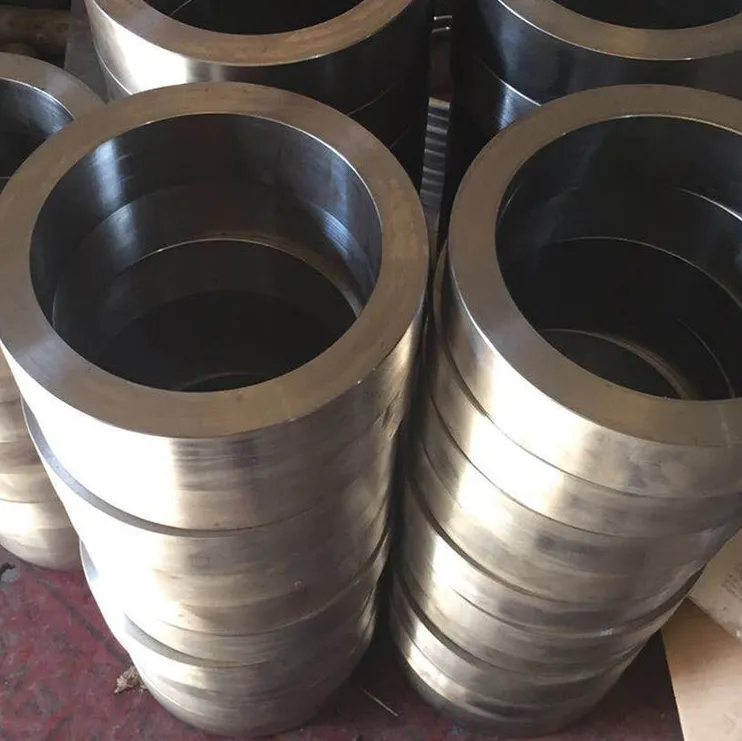
| Forgings | AMS 5754 | Flanges, rings, turbine hardware |
| Wire | AMS 5798 | Welding filler, spring applications |
We stock sheet and plate most heavily because that's where demand concentrates, particularly 0.5mm to 6mm gauge sheet for combustor fabrication work. Heavier plate and bar tend to be made to order given lower turnover, so lead times on those forms run longer, something worth planning around if your project has a tight schedule.
How Should Hastelloy X Be Welded and Fabricated?
Hastelloy X welds more readily than most nickel superalloys, which is a major reason fabricators favor it for complex geometries. Gas tungsten arc welding (GTAW) with matching filler metal produces the most reliable joints, though gas metal arc welding (GMAW) works for thicker sections where deposition rate matters more than precision.
A few fabrication practices we insist on when running this material through our own shop:
Keep interpass temperatures below 150°C to limit carbide precipitation at grain boundaries. Excessive heat buildup during multi-pass welding increases the risk of microfissuring, particularly in thicker sections above 6mm. Clean joint edges thoroughly, removing all oils, oxides, and machining lubricants, since nickel alloys are notably more sensitive to contamination induced porosity than carbon steel.
Cold forming works well below approximately 40% reduction without intermediate annealing, but heavier forming operations need a stress relief anneal partway through the process to avoid cracking. Hot forming, typically performed between 900°C and 1150°C, allows more aggressive shaping for deep drawn or heavily contoured combustor parts.
Machining Hastelloy X requires slower speeds and higher feed rates than stainless steel, along with rigid tooling setups, because the alloy work hardens quickly under light cuts. We generally recommend carbide tooling with generous coolant flow rather than high speed steel, which wears prematurely against this material's abrasive character.
What Heat Treatment Process Does Hastelloy X Require?
The standard mill anneal for Hastelloy X runs at 1150°C to 1175°C followed by rapid air or water quench. This solution anneal dissolves carbides back into the matrix and restores maximum ductility after cold working or welding.
| Heat Treatment | Temperature | Cooling Method | Purpose |
|---|---|---|---|
| Solution Anneal | 1150 - 1175°C | Rapid air or water quench | Restore ductility, dissolve carbides |
| Stress Relief | 850 - 900°C | Air cool | Reduce residual stress without full recrystallization |
We caution customers against slow furnace cooling from annealing temperature, since this promotes carbide precipitation along grain boundaries during the cool-down through the 650°C to 980°C range, which can measurably reduce room temperature ductility even though it barely affects high temperature strength. Rapid quenching after solution annealing is not optional if you want the material's full ductility available for subsequent forming or service.
What Are the Limitations of Hastelloy X?
No alloy solves every problem, and we think it's important to be upfront about where Hastelloy X falls short. Its room temperature strength trails precipitation hardened alloys like Inconel 718 by a wide margin, so applications needing high strength at ambient or moderate temperature usually need a different material. Creep strength above 950°C, while respectable, lags behind cobalt based superalloys like Haynes 188 in the most demanding stationary turbine applications.
Cost is another factor. Molybdenum and nickel content keep raw material pricing elevated compared to stainless steels, so specifying Hastelloy X where a 310 or 253MA stainless steel would suffice wastes budget without functional benefit. Sulfidation resistance in high sulfur reducing atmospheres above 700°C is weaker than some alternatives, which matters in certain petrochemical and waste incineration environments.
How Much Does Hastelloy X Cost and Where Can You Buy It?
Pricing fluctuates with nickel, molybdenum, and cobalt commodity markets, so we always recommend requesting a current quote rather than relying on published figures older than a few weeks. As of mid-2026, Hastelloy X sheet typically runs higher per kilogram than 316L stainless steel by a factor of roughly eight to twelve times, reflecting both raw material cost and the more complex melting and processing required to hit tight chemistry tolerances.
The average market price for raw Hastelloy X (Alloy HX) ranges from $26 to $58 per kilogram ($12 to $28 per pound), while processed forms or distributor-level small orders generally cost between $41 and $87 per kilogram ($19 to $40 per pound).
Buyers should request full mill test certificates confirming compliance with ASTM B435 or the relevant AMS specification, along with traceability documentation if the part is destined for aerospace or nuclear service. We supply certified Hastelloy X sheet, plate, bar, and tube with complete chemical and mechanical test reports, and we're glad to help customers cross reference specification requirements against available mill lots to avoid ordering delays.
Frequently Asked Questions
Is Hastelloy X the same as Inconel?
No, Hastelloy X and Inconel are different alloy families produced by different companies, though both are nickel based superalloys. Hastelloy X, developed by Haynes International, relies primarily on solid solution strengthening from chromium, iron, and molybdenum, giving it excellent formability and weldability. Inconel alloys, produced by Special Metals, include both solid solution grades like Inconel 625 and precipitation hardened grades like Inconel 718, which achieve higher strength but sacrifice some formability. We recommend choosing based on the specific temperature range and fabrication method rather than assuming either brand name automatically fits your application.
What temperature can Hastelloy X withstand?
Hastelloy X withstands continuous service temperatures up to approximately 1200°C in oxidizing atmospheres, making it one of the more heat resistant weldable nickel alloys commercially available. Strength declines gradually rather than sharply as temperature rises, retaining meaningful load bearing capability up to about 1090°C. This gentle strength curve, combined with adherent oxide scale formation, explains why gas turbine and furnace equipment manufacturers rely on it for components facing prolonged thermal cycling rather than brief flash exposure.
Can Hastelloy X be welded easily?
Yes, Hastelloy X ranks among the most weldable high temperature nickel alloys available, which distinguishes it from precipitation hardened superalloys prone to strain age cracking. Gas tungsten arc welding with matching filler wire produces the most reliable results, provided interpass temperatures stay below 150°C and joint surfaces are thoroughly cleaned before welding. We've fabricated complex multi-piece combustor assemblies from this material without cracking issues, something that would be considerably more difficult using alloys like Inconel 718 or Rene 41.
What is the difference between Hastelloy X and Hastelloy C276?
Hastelloy X is optimized for high temperature oxidation resistance and structural strength above 800°C, while Hastelloy C276 is optimized for corrosion resistance in aggressive chemical environments including chlorides, acids, and reducing solutions at lower temperatures. C276 contains higher molybdenum and added tungsten for corrosion performance, but it doesn't offer the same high temperature strength retention as Hastelloy X. Choosing between them depends entirely on whether your primary challenge is heat or chemical attack, since they serve fundamentally different service conditions despite sharing the Hastelloy name.
Is Hastelloy X magnetic?
Hastelloy X is generally considered non-magnetic to weakly magnetic in the annealed condition, since its face centered cubic nickel-iron-chromium matrix doesn't support strong ferromagnetic behavior like carbon steel does. Cold working or extended high temperature exposure can slightly increase magnetic permeability due to minor phase changes at grain boundaries, but this remains far below the magnetic response of martensitic or ferritic stainless steels. Applications requiring strict non-magnetic performance should still request permeability testing on the specific lot rather than assuming zero magnetic response.
How does Hastelloy X resist oxidation at high temperature?
Hastelloy X resists oxidation because its roughly 22% chromium content forms a continuous, adherent chromium oxide scale on the surface when exposed to hot air, blocking further oxygen penetration into the base metal. Unlike some alloys where this scale flakes off under thermal cycling, Hastelloy X's oxide layer tends to remain intact through repeated heating and cooling, which is critical for components like flame holders that experience constant thermal shock. Molybdenum content further supports resistance in mixed oxidizing and reducing atmospheres, broadening its usefulness beyond simple air exposure.
What industries commonly use Hastelloy X?
Aerospace manufacturing represents the largest end use for Hastelloy X, particularly jet engine combustor liners, transition ducts, and afterburner hardware where formability and oxidation resistance both matter. Industrial gas turbine manufacturers, heat treating equipment builders, and petrochemical processors round out the primary customer base, each drawn to the alloy's ability to survive continuous high temperature exposure without frequent replacement. We've also seen growing demand from nuclear reactor component manufacturers exploring high temperature gas cooled reactor designs where material behavior above 900°C is a critical design constraint.
Does Hastelloy X require special machining techniques?
Yes, Hastelloy X requires slower cutting speeds, higher feed rates, and rigid tooling setups compared to standard stainless steel, because it work hardens quickly when light cuts are applied repeatedly. Carbide tooling generally outperforms high speed steel given the alloy's abrasive nature under machining loads, and generous coolant flow helps manage heat buildup at the cutting edge. Shops unfamiliar with nickel superalloy machining sometimes experience premature tool wear or poor surface finish until they adjust parameters specifically for this material's work hardening tendency.
What certifications should I request when buying Hastelloy X?
Buyers should request mill test certificates confirming chemical composition and mechanical properties against ASTM B435 for sheet and plate, or the applicable AMS specification for aerospace grade material, along with full material traceability documentation. Nuclear and aerospace end uses often require additional certifications, including positive material identification testing and sometimes third party inspection reports. We provide complete documentation packages with every Hastelloy X shipment specifically because incomplete paperwork is one of the most common causes of receiving inspection rejections in regulated industries.
Is Hastelloy X expensive compared to stainless steel?
Yes, Hastelloy X typically costs significantly more per kilogram than common stainless steels like 304 or 316L, generally running eight to twelve times higher depending on current nickel and molybdenum market pricing. This premium reflects both raw material content and the more demanding melting, hot working, and quality control processes required to meet tight aerospace and turbine industry specifications. We advise customers to reserve Hastelloy X for applications genuinely requiring its high temperature performance, since specifying it for moderate temperature service where stainless steel would perform adequately simply increases project cost without functional benefit.
Final Thoughts and Next Steps
Hastelloy X earned its long standing reputation the hard way, through decades of proven service in some of the harshest thermal environments engineers design for. Its balance of formability, weldability, and sustained strength above 800°C remains difficult for competing alloys to match without giving up something else in the process. We've watched this material perform reliably in combustor liners pulled after thousands of flight hours, and that real world track record carries more weight than any datasheet number alone.
If you're specifying material for a combustor, furnace fixture, or high temperature process component, we're happy to walk through your specific requirements, confirm the right specification callout, and get certified Hastelloy X sheet, plate, bar, or tube moving toward your shop. Reach out to our technical sales team at MWalloys with your drawing or specification, and we'll return a quote along with practical fabrication guidance based on what we've learned supplying this alloy across aerospace, power generation, and industrial heat treatment projects.
Verifiable Sources
- Haynes International, Hastelloy X Alloy Technical Data Sheet, H-2019.
- ASTM B435, Standard Specification for UNS N06002 Sheet and Plate.
- ASTM B572, Standard Specification for UNS N06002 Rod and Bar.
- AMS 5536, Nickel Alloy Sheet, Strip, and Plate Specification.
- Special Metals Corporation, Inconel Alloy 625 and 617 Technical Bulletins.
- ASM International, Superalloys II: High Temperature Materials for Aerospace and Industrial Power.
- NACE International, Corrosion Resistance Data for Nickel Alloys in High Temperature Service.