

Hastelloy is a registered trademark of Haynes International designating a family of high-performance nickel-based superalloys engineered to resist severe corrosion, oxidation, and mechanical degradation in environments where stainless steels, duplex alloys, and standard nickel grades fail, with the most widely specified grades being Hastelloy C276 (UNS N10276) and Hastelloy C22 (UNS N06022), both nickel-chromium-molybdenum alloys delivering corrosion rates below 0.1 mm/year in acids, chloride solutions, and mixed industrial process streams that destroy conventional engineering metals within months. At MWalloys, we supply Hastelloy in plate, sheet, bar, pipe, tube, fittings, and wire to chemical plants, pharmaceutical manufacturers, offshore platforms, and power generation facilities globally.
Understanding what Hastelloy is, how its different grades perform, and when to specify it over competing materials requires more than reading a datasheet. It requires knowing the metallurgical reasons behind each grade's strengths and limitations, the environments where the premium cost is genuinely justified, and the fabrication practices that preserve its corrosion resistance through the manufacturing process. This article provides that complete picture.
What Is Hastelloy and Who Produces It Commercially?
Hastelloy is a proprietary alloy family name owned by Haynes International, Inc., headquartered in Kokomo, Indiana, USA. The name itself does not describe a single alloy: it covers a broad range of nickel-based compositions unified by their design objective of providing superior resistance to corrosion and high-temperature degradation beyond what iron-based alloys can achieve.
In practical engineering usage, "Hastelloy" has become a semi-generic term that engineers apply to any nickel-chromium-molybdenum corrosion-resistant alloy of similar composition, even when the material is not produced by Haynes International. This parallels how "Inconel" (a Special Metals trademark) is used semi-generically for nickel-chromium alloys. The correct technical approach is to specify both the trade name and the UNS (Unified Numbering System) designation to prevent ambiguity during procurement.
Who Manufactures Hastelloy Alloys?
While Haynes International holds the Hastelloy trademark, the equivalent compositions defined by UNS numbers are produced by multiple qualified mills worldwide:
| Manufacturer | Country | Key Brands / Designations |
|---|---|---|
| Haynes International | USA | Hastelloy (original trademark holder) |
| Special Metals Corporation | USA | Corronel, related Ni alloys |
| VDM Metals (Thyssenkrupp) | Germany | Nicrofer grades |
| Sandvik | Sweden | Sanicro grades |
| Nippon Yakin Kogyo | Japan | NI alloy equivalents |
| Outokumpu | Finland | Nickel alloy equivalents |
| Baosteel / Jiuquan | China | N10276, N06022 equivalents |
At MWalloys, we source from both Western original mills and qualified alternative producers, verifying compliance through full chemical analysis and corrosion testing on each incoming heat. The UNS designation (N10276 for C276, N06022 for C22) is our primary quality control anchor regardless of the producing mill.
The Naming Convention Behind Hastelloy Designations
Hastelloy grades are identified by letter-number combinations that reflect their development sequence rather than their composition:
- B series (B, B2, B3): Nickel-molybdenum alloys optimized for reducing acid resistance.
- C series (C, C276, C22, C2000, C4): Nickel-chromium-molybdenum alloys for broad corrosion resistance.
- G series (G, G3, G30): Nickel-chromium-molybdenum-copper alloys for phosphoric and sulfuric acid.
- N series (N): Nickel-molybdenum-chromium for molten salt and nuclear service.
- W series (W): Nickel-chromium-molybdenum-tungsten for welding applications.
- X series (X): Nickel-chromium-iron-molybdenum for high-temperature oxidation resistance.
The "C" in C276 and C22 stands for the C-family chemistry base, not for any specific element. The numbers 276 and 22 are sequential development identifiers assigned during Haynes International's research program.
What Is the History and Development of Hastelloy Alloys?
The Hastelloy family has a history spanning nearly a century, driven by industrial demand for materials that could survive increasingly aggressive chemical process environments.
Timeline of Key Hastelloy Developments
| Year | Development | Significance |
|---|---|---|
| 1926 | Original Hastelloy A (Ni-Mo) | First commercial nickel-molybdenum corrosion alloy |
| 1930s | Hastelloy B introduced | Improved HCl resistance; first widely adopted grade |
| 1930s | Hastelloy C introduced | First Ni-Cr-Mo alloy; broad corrosion resistance |
| 1960s | Hastelloy C276 developed | Reduced C and Si to solve weld sensitization of original C |
| 1970s | Hastelloy B2 developed | Low iron B-series; improved reducing acid performance |
| 1973 | Hastelloy G introduced | Ni-Cr-Mo-Cu for phosphoric and sulfuric acid |
| 1980s | Hastelloy C22 developed | Higher Cr than C276; better oxidizing acid resistance |
| 1989 | Hastelloy C4 introduced | High-temperature C-family grade |
| 1990s | Hastelloy C2000 developed | Highest-PREN C-family; broadest single-grade coverage |
| 1990s | Hastelloy B3 developed | Improved B-family with thermal stability and fabricability |
| 2000s | Hastelloy G35 introduced | High Cr variant for oxidizing acid |
| 2010s | Continued refinement | Improved cleanness, tighter composition control |
The development from original Hastelloy C to C276 illustrates a recurring theme in alloy development: identifying field failure modes and eliminating their root cause through composition adjustment. Original Hastelloy C had excellent corrosion resistance in the base metal but suffered intergranular corrosion in heat-affected zones after welding, caused by carbide and silicide precipitation during cooling. C276 solved this by reducing carbon to 0.010% maximum and silicon to 0.08% maximum, essentially eliminating the precipitate-forming elements while maintaining the nickel-chromium-molybdenum base chemistry.
The subsequent development of C22 followed the same pattern: C276 performed inadequately in oxidizing acid environments encountered in flue gas desulfurization systems and pharmaceutical cleaning protocols. Raising chromium from 15.5% to 21% while adjusting molybdenum downward produced C22, which handles mixed and oxidizing environments that exceed C276's capability.
What Are the Main Hastelloy Grades and Their UNS Designations?
The Hastelloy family encompasses more grades than most engineers realize. The following table covers all commercially significant grades with their UNS numbers, compositional families, and primary applications.
Complete Hastelloy Grade Reference Table
| Grade | UNS Number | Alloy Family | Primary Alloying | Key Application |
|---|---|---|---|---|
| Hastelloy B | N10001 | Ni-Mo | Mo 28% | Early reducing acid grade (largely replaced) |
| Hastelloy B2 | N10665 | Ni-Mo | Mo 28%, low Fe | Concentrated HCl, reducing acids |
| Hastelloy B3 | N10675 | Ni-Mo | Mo 28.5%, low Cr | Improved B-series; reducing acids, better thermal stability |
| Hastelloy C | N10002 | Ni-Cr-Mo | Cr 15.5%, Mo 17% | Original C-family (sensitization issues; largely obsolete) |
| Hastelloy C4 | N06455 | Ni-Cr-Mo | Cr 16%, Mo 16%, Ti | High-temperature stability version of C-family |
| Hastelloy C276 | N10276 | Ni-Cr-Mo-W | Cr 15.5%, Mo 16%, W 3.75% | Most widely used CRA; reducing and mixed environments |
| Hastelloy C22 | N06022 | Ni-Cr-Mo-W | Cr 21%, Mo 13.5%, W 3% | Mixed and oxidizing acid environments |
| Hastelloy C2000 | N06200 | Ni-Cr-Mo-Cu | Cr 23%, Mo 16%, Cu 1.6% | Broadest single-alloy corrosion coverage |
| Hastelloy G | N06007 | Ni-Cr-Mo-Cu | Cr 22%, Mo 6.5%, Cu 2% | Phosphoric and sulfuric acid |
| Hastelloy G3 | N06985 | Ni-Cr-Mo-Cu | Cr 22%, Mo 7%, Cu 2% | Improved G series |
| Hastelloy G30 | N06030 | Ni-Cr-Mo-Cu | Cr 30%, Mo 5%, Cu 2% | High oxidizing acid; phosphoric acid |
| Hastelloy G35 | N06035 | Ni-Cr-Mo | Cr 33.2%, Mo 8.1% | Highly oxidizing environments |
| Hastelloy N | N10003 | Ni-Mo-Cr | Mo 16%, Cr 7% | Molten salt; nuclear reactor service |
| Hastelloy W | N10004 | Ni-Mo-Cr | Mo 24.5%, Cr 5% | Welding filler metal (obsolete as base metal) |
| Hastelloy X | N06002 | Ni-Cr-Fe-Mo | Cr 22%, Fe 18%, Mo 9% | High-temperature oxidation; gas turbines |
| Hastelloy S | N06635 | Ni-Cr-Mo | Cr 15.5%, Mo 14.5% | High-temperature oxidation + moderate corrosion |
Which Hastelloy Grades Are Most Commonly Specified in 2026?
Based on procurement patterns at MWalloys across chemical processing, offshore energy, pharmaceutical, and power generation markets in 2026:
| Rank | Grade | Market Share (Approx.) | Primary Driving Industry |
|---|---|---|---|
| 1 | C276 | ~45% of Hastelloy volume | Chemical processing, oil/gas |
| 2 | C22 | ~30% of Hastelloy volume | FGD, pharma, nuclear |
| 3 | B3 | ~8% of Hastelloy volume | HCl and reducing acid plants |
| 4 | X | ~6% of Hastelloy volume | Aerospace, gas turbine |
| 5 | C2000 | ~4% of Hastelloy volume | Most aggressive mixed environments |
| 6 | G30 | ~3% of Hastelloy volume | Phosphoric acid production |
| 7 | Others | ~4% | Specialty applications |
C276 and C22 together account for approximately 75% of all Hastelloy consumed globally, which is why this article focuses most of its technical depth on these two grades.
What Are the Chemical Compositions of Key Hastelloy Grades?
Chemical composition is the foundation of Hastelloy performance. The following detailed tables cover the grades most relevant to engineering specification work.
C276 vs C22 Detailed Composition Comparison
| Element | Hastelloy C276 (N10276) Min/Max (%) | Hastelloy C22 (N06022) Min/Max (%) | Role in Corrosion Performance |
|---|---|---|---|
| Nickel (Ni) | Balance (~57%) | Balance (~56%) | Base matrix; SCC immunity; electrochemical stability |
| Chromium (Cr) | 14.5 / 16.5 | 20.0 / 22.5 | Passive film stability; oxidizing acid resistance |
| Molybdenum (Mo) | 15.0 / 17.0 | 12.5 / 14.5 | Reducing acid resistance; pitting resistance |
| Tungsten (W) | 3.0 / 4.5 | 2.5 / 3.5 | Synergistic pitting + crevice resistance |
| Iron (Fe) | 4.0 / 7.0 | 2.0 / 6.0 | Controlled residual |
| Cobalt (Co) | Max 2.5 | Max 2.5 | Controlled residual |
| Carbon (C) | Max 0.010 | Max 0.010 | Minimized: prevents HAZ carbide sensitization |
| Silicon (Si) | Max 0.08 | Max 0.08 | Minimized: prevents silicide precipitation |
| Manganese (Mn) | Max 1.0 | Max 0.50 | Deoxidation |
| Phosphorus (P) | Max 0.025 | Max 0.025 | Impurity control |
| Sulfur (S) | Max 0.010 | Max 0.010 | Impurity control; hot ductility |
| Vanadium (V) | Max 0.35 | – | Minor residual in C276 |
Hastelloy B3, C2000, X and G30 Compositions
| Element | B3 (N10675) | C2000 (N06200) | X (N06002) | G30 (N06030) |
|---|---|---|---|---|
| Nickel (Ni) | Balance (~65%) | Balance (~59%) | Balance (~47%) | Balance (~43%) |
| Chromium (Cr) | 1.0 – 3.0% | 22.0 – 24.0% | 20.5 – 23.0% | 28.0 – 31.5% |
| Molybdenum (Mo) | 27.0 – 32.0% | 15.0 – 17.0% | 8.0 – 10.0% | 4.0 – 6.0% |
| Tungsten (W) | 3.0% max | – | 0.2 – 1.0% | 1.5 – 4.0% |
| Iron (Fe) | 1.0 – 3.0% | 3.0% max | 17.0 – 20.0% | 13.0 – 17.0% |
| Copper (Cu) | – | 1.3 – 1.9% | – | 1.0 – 2.4% |
| Cobalt (Co) | 3.0% max | 2.0% max | 0.5 – 2.5% | 5.0% max |
| Carbon (C) | 0.010% max | 0.010% max | 0.05 – 0.15% | 0.03% max |
| Silicon (Si) | 0.10% max | 0.08% max | 0.50 – 1.0% | 1.0% max |
The compositional difference between Hastelloy B3 and the C-family is dramatic. B3 is essentially a nickel-molybdenum binary alloy with minimal chromium, optimized purely for reducing acid resistance. Adding chromium would improve oxidizing acid resistance but simultaneously reduce reducing acid performance because chromium raises the alloy's electrode potential toward the transpassive range in reducing media. B3 is the correct choice when the service environment is exclusively reducing and no oxidizing species are present or can enter the system during upsets or cleaning.
What Mechanical and Physical Properties Do Hastelloy Alloys Deliver?
Hastelloy alloys are not selected purely for corrosion resistance. Their mechanical properties must be adequate for the structural requirements of the application, and understanding these properties is essential for pressure vessel design and structural calculations.
Room Temperature Mechanical Properties Comparison
| Property | C276 | C22 | B3 | X | G30 | Test Standard |
|---|---|---|---|---|---|---|
| Tensile Strength (MPa) | 790 min | 690 min | 760 min | 655 min | 690 min | ASTM E8 |
| Yield Strength (MPa, 0.2%) | 355 min | 310 min | 345 min | 255 min | 310 min | ASTM E8 |
| Elongation (%) | 40 min | 45 min | 40 min | 35 min | 40 min | ASTM E8 |
| Hardness (Rockwell B) | ~90 | ~85 | ~88 | ~85 | ~85 | ASTM E18 |
| Charpy Impact (J, RT) | ~100 | ~110 | ~95 | ~90 | ~100 | ASTM E23 |
Elevated Temperature Strength Retention for C276 and C22
| Temperature (°C) | C276 Tensile (MPa) | C276 Yield (MPa) | C22 Tensile (MPa) | C22 Yield (MPa) |
|---|---|---|---|---|
| 20 | 790 | 355 | 690 | 310 |
| 100 | 740 | 310 | 660 | 280 |
| 200 | 700 | 285 | 630 | 260 |
| 300 | 670 | 270 | 610 | 250 |
| 400 | 650 | 260 | 595 | 240 |
| 500 | 620 | 250 | 570 | 230 |
| 600 | 580 | 240 | 540 | 220 |
| 700 | 510 | 230 | 480 | 210 |
| 800 | 380 | 200 | 360 | 185 |
Physical Properties of Key Hastelloy Grades
| Physical Property | C276 | C22 | B3 | X |
|---|---|---|---|---|
| Density (g/cm³) | 8.89 | 8.69 | 9.22 | 8.22 |
| Melting range (°C) | 1325 – 1370 | 1357 – 1399 | 1370 – 1418 | 1260 – 1355 |
| Thermal conductivity (W/m·K, 20°C) | 10.2 | 10.1 | 11.1 | 11.3 |
| Modulus of elasticity (GPa) | 205 | 211 | 219 | 205 |
| Coefficient of thermal expansion (µm/m·°C) | 11.2 | 12.7 | 10.6 | 13.3 |
| Electrical resistivity (µΩ·m) | 1.30 | 1.14 | 1.37 | 1.18 |
| Magnetic permeability | < 1.002 | < 1.002 | < 1.002 | < 1.002 |
The non-magnetic character of all Hastelloy grades (permeability below 1.002) is a practically important property for applications near magnetic compasses, MWD (measurement-while-drilling) tools, MRI equipment, and degaussed naval vessels. All Hastelloy C-family and B-family alloys are austenitic in structure and remain non-magnetic in all service conditions.
How Does Hastelloy Resist Corrosion and What Environments Can It Handle?
The corrosion resistance of Hastelloy alloys operates through the same passive film mechanism as stainless steel, but with a more stable and self-repairing passive oxide layer enabled by the high nickel base and the synergistic effects of chromium, molybdenum, and tungsten.
The Passive Film Mechanism in Hastelloy
When Hastelloy is exposed to an oxidizing or aqueous environment, chromium in the alloy reacts with oxygen to form a thin (2 – 5 nanometer) chromium oxide (Cr₂O₃) passive layer. The key differences between this film and the equivalent film on stainless steel are:
- Greater stability range: The high nickel content shifts the alloy's electrode potential, widening the potential window over which the passive film is thermodynamically stable.
- Molybdenum enhancement: Molybdenum enriches the passive film at the metal-oxide interface, reducing the ionic conductivity of the film and slowing corrosion current even when local film defects occur.
- Tungsten synergy: Tungsten interacts with molybdenum at pit initiation sites, disrupting the electrochemical processes that propagate pits before they can grow.
- Self-repair: Film damage is repaired within milliseconds in oxygen-containing environments because the driving force for chromium oxidation is strong at all normal operating conditions.
Corrosion Rate Data Across Key Environments
| Environment | 316L SS | Duplex 2507 | C276 | C22 | C2000 |
|---|---|---|---|---|---|
| 65% HNO₃, boiling | Fails rapidly | Fails | 19.1 mpy | 2.1 mpy | 1.8 mpy |
| 10% HCl, 70°C | Fails | Fails | 5.8 mpy | 7.3 mpy | 6.5 mpy |
| 20% H₂SO₄, boiling | Fails | Fails | 9.5 mpy | 11.2 mpy | 8.9 mpy |
| FeCl₃ (10%), 50°C | Fails rapidly | Moderate | 4.2 mpy | 1.1 mpy | 0.8 mpy |
| Seawater (ambient) | Pitting | No pitting | No pitting | No pitting | No pitting |
| H₂S sour service | SCC risk | Acceptable | Excellent | Excellent | Excellent |
| 10% HNO₃ + 2% HF | Fails | Fails | 35.4 mpy | 8.7 mpy | 7.2 mpy |
| Acetic acid (glacial) | Acceptable | Good | Excellent | Excellent | Excellent |
mpy = mils per year. Values approximate from published test data; exact conditions vary by source.
Pitting Resistance Equivalent Number (PREN) for Hastelloy Grades
PREN = %Cr + 3.3 × (%Mo + 0.5 × %W) + 16 × %N
| Grade | Cr (%) | Mo (%) | W (%) | PREN (approx.) | Classification |
|---|---|---|---|---|---|
| C276 | 15.5 | 16.0 | 3.75 | ~72 | Outstanding pitting resistance |
| C22 | 21.0 | 13.5 | 3.0 | ~71 | Outstanding pitting resistance |
| C2000 | 23.0 | 16.0 | 0 | ~76 | Outstanding pitting resistance |
| B3 | 1.5 | 28.5 | 3.0 | ~98 | Mathematical artifact; no Cr passive film |
| G30 | 30.0 | 5.0 | 2.0 | ~50 | Very Good |
| X | 22.0 | 9.0 | 0.5 | ~54 | Very Good |
| 316L (reference) | 17.0 | 2.2 | 0 | ~24 | Moderate |
| Super duplex 2507 (ref) | 25.0 | 4.0 | 0 | ~42 | Good |
Note: The B3 PREN value is mathematically high due to extreme molybdenum content but is not meaningful in the standard PREN context because B3's near-zero chromium content means it does not form a chromium-based passive film. Its corrosion resistance in reducing acids operates through a completely different mechanism.
Types of Corrosion That Hastelloy Resists
| Corrosion Type | C276 Resistance | C22 Resistance | Notes |
|---|---|---|---|
| Uniform (general) corrosion | Excellent | Excellent | Both alloys superior in most acids |
| Pitting corrosion (chloride) | Excellent | Excellent | PREN ~70 for both |
| Crevice corrosion | Very Good | Excellent | C22 advantage at elevated temperature |
| Stress corrosion cracking | Excellent | Excellent | Ni content > 40% provides immunity |
| Intergranular corrosion | Very Good | Very Good | Low C prevents sensitization |
| Galvanic corrosion | Noble behavior | Noble behavior | Both are noble; protect coupled metals |
| Erosion-corrosion | Good | Good | Better than SS but not best for abrasion |
| Microbiologically influenced corrosion | Very Good | Very Good | Ni alloys resist MIC better than SS |
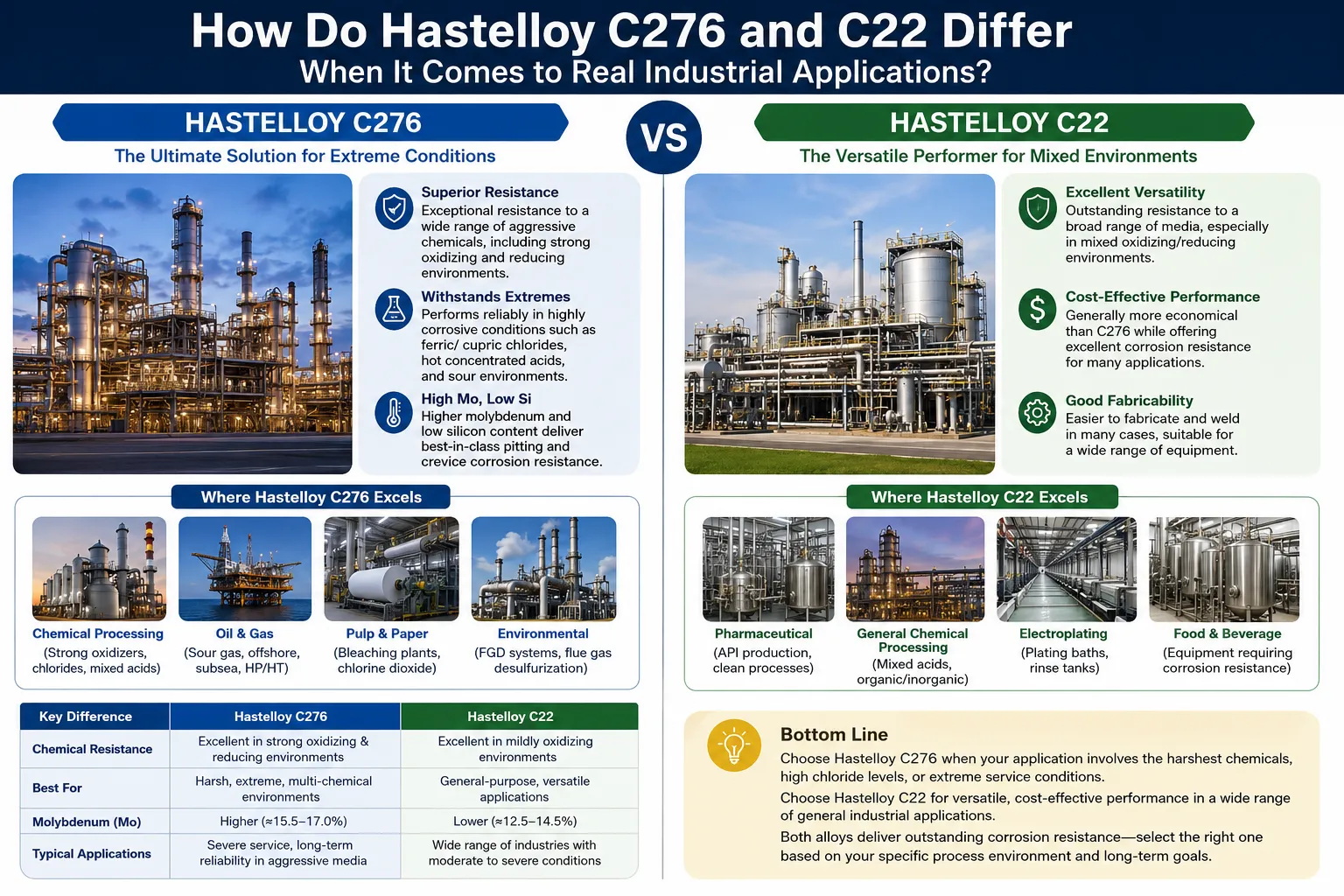
How Do Hastelloy C276 and C22 Differ When It Comes to Real Industrial Applications?
The C276 vs C22 selection question is the most frequently asked Hastelloy topic we encounter at MWalloys. The answer is nuanced and depends heavily on the specific corrosive environment.
The Fundamental Composition-Performance Relationship
The core difference between C276 and C22 reduces to a trade-off between chromium and molybdenum:
- C276 prioritizes molybdenum (16% Mo, 15.5% Cr): Superior in reducing acids where molybdenum's electrochemical effect dominates.
- C22 prioritizes chromium (21% Cr, 13.5% Mo): Superior in oxidizing environments where chromium passive film stability dominates.
Neither alloy is universally superior. The correct selection requires a genuine characterization of the process environment's oxidizing/reducing character.
Side-by-Side Application Performance Comparison
| Application / Environment | C276 Performance | C22 Performance | Recommended Choice |
|---|---|---|---|
| FGD absorber tower | Good (8 – 12 yr life) | Excellent (18 – 25 yr life) | C22 |
| HCl acid plant | Excellent | Good | C276 |
| Pharmaceutical CIP (HNO₃ cycles) | Moderate | Excellent | C22 |
| Sulfuric acid (20%), hot | Excellent | Good | C276 |
| Nuclear waste (HNO₃ based) | Moderate | Excellent | C22 |
| Mixed acid chemical plant | Moderate | Excellent | C22 |
| H₂S sour service | Excellent | Excellent | Either (C276 slight advantage) |
| Pulp mill bleach plant (ClO₂) | Good | Excellent | C22 |
| Seawater service | Excellent | Excellent | Either |
| Hydrofluoric acid | Not recommended | Not recommended | Monel 400 instead |
| Phosphoric acid (wet process) | Good | Good | Either; G-series may be better |
| Pesticide manufacturing | Excellent | Good | C276 |
Cost Comparison and When the Upgrade Makes Financial Sense
| Cost Factor | C276 | C22 |
|---|---|---|
| Typical plate price premium vs 316L | ~8× | ~10× |
| C22 premium over C276 | Baseline | +15 – 25% |
| FGD service life (absorber liner) | 8 – 12 years | 18 – 25 years |
| Annualized cost (C276 at 10yr) | 100% of C276/10 | N/A |
| Annualized cost (C22 at 20yr) | N/A | ~60% of C276 annual cost |
| Payback period for C22 upgrade in FGD | – | First inspection cycle |
The lifecycle cost analysis almost invariably favors C22 over C276 in any application that has significant oxidizing character. The additional upfront cost is recovered within the first service interval through extended equipment life and reduced maintenance shutdowns.
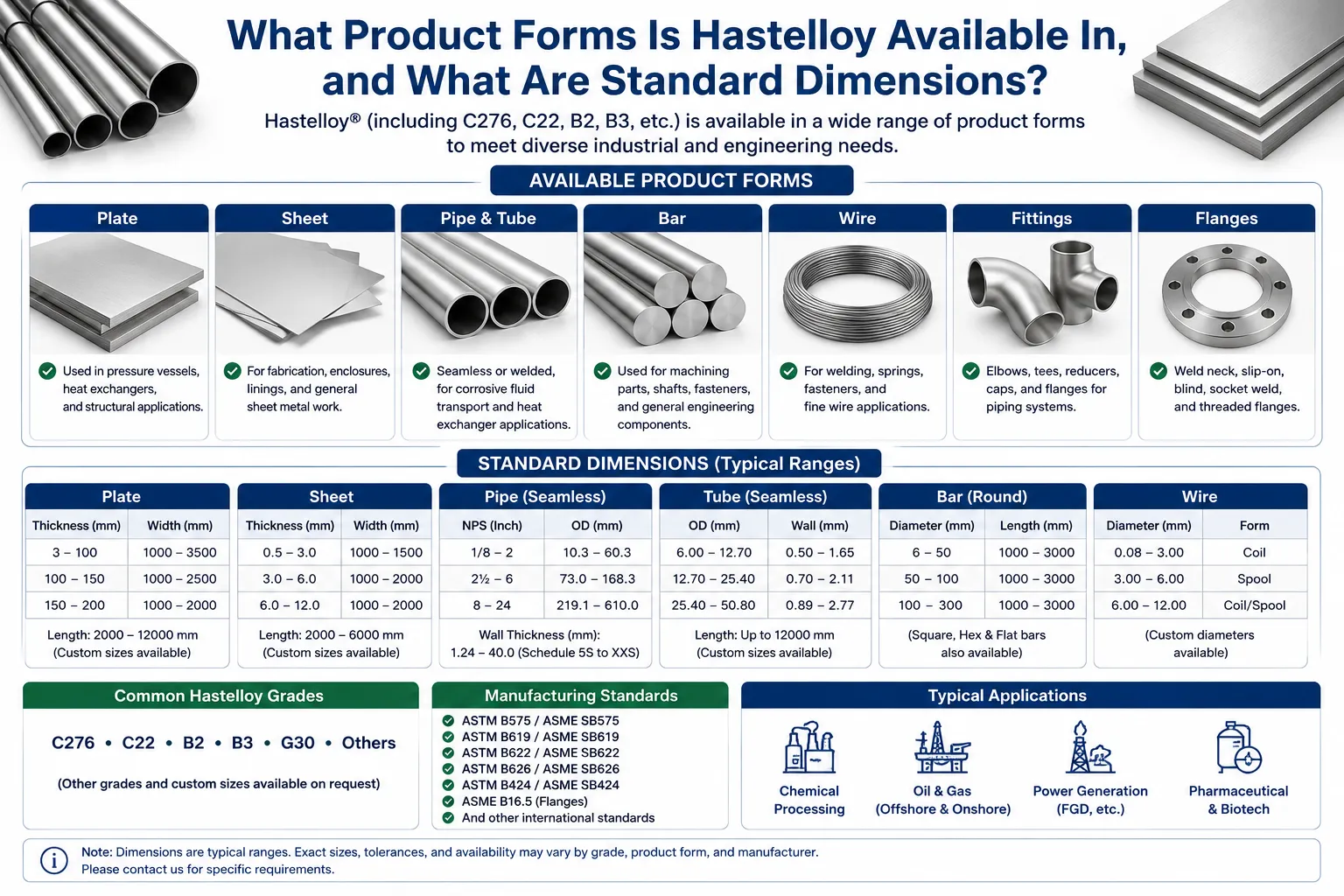
What Product Forms Is Hastelloy Available In, and What Are Standard Dimensions?
Hastelloy is commercially available in virtually all standard wrought product forms. Understanding which product forms are most available from stock versus requiring mill production orders affects project schedule planning.
Available Product Forms and Applicable Standards
| Product Form | ASTM Standard | ASME Standard | Typical Thickness/Diameter Range |
|---|---|---|---|
| Plate and sheet | B575 | SB-575 | 0.5mm – 100mm thick |
| Bar (hot rolled) | B574 | SB-574 | 6mm – 300mm diameter |
| Seamless pipe and tube | B622 | SB-622 | 6mm – 300mm OD |
| Welded pipe | B619 | SB-619 | 6mm – 600mm OD |
| Welded tube | B626 | SB-626 | 6mm – 150mm OD |
| Fittings | B366 | SB-366 | Per ASME B16.9/B16.11 |
| Flanges | B564 (forgings) | SB-564 | Per ASME B16.5/B16.47 |
| Wire | B Wire (custom) | – | 0.05mm – 12mm |
| Strip and narrow coil | B575 | SB-575 | 0.1mm – 6.35mm thick |
| Forgings | B564 | SB-564 | Custom shapes |
Stock Availability at MWalloys
At MWalloys, we maintain strategic inventory in the highest-demand Hastelloy C276 and C22 product forms to support urgent project requirements:
| Product Form | Stocked Grades | Standard Sizes | Lead Time (from stock) |
|---|---|---|---|
| Plate (C276) | N10276 | 3 – 75mm thick, various widths | 1 – 5 business days |
| Plate (C22) | N06022 | 3 – 50mm thick, various widths | 1 – 5 business days |
| Seamless pipe (C276) | N10276 | 1/4" – 8" NPS | 3 – 10 business days |
| Seamless pipe (C22) | N06022 | 1/4" – 6" NPS | 3 – 10 business days |
| Bar (C276) | N10276 | 6mm – 150mm diameter | 3 – 7 business days |
| Bar (C22) | N06022 | 6mm – 100mm diameter | 3 – 7 business days |
| Fittings (C276) | N10276 | 1/4" – 8" | 1 – 5 business days |
| Welding wire (C22) | ERNiCrMo-10 | 1.6mm, 2.4mm straight | 1 – 5 business days |
How Is Hastelloy Correctly Fabricated, Welded, and Machined?
Fabrication of Hastelloy requires techniques and precautions that differ significantly from carbon steel and even austenitic stainless steel practice. Errors at the fabrication stage can permanently compromise corrosion resistance.
Welding Hastelloy Alloys
Welding is the most critical fabrication operation for corrosion-resistant performance. The following table covers the key parameters for C276 and C22:
| Welding Parameter | C276 | C22 | General Rule |
|---|---|---|---|
| Matching filler (GTAW) | ERNiCrMo-4 | ERNiCrMo-10 | Match or upgrade filler |
| Cross-compatible filler | ERNiCrMo-10 can weld C276 | ERNiCrMo-10 | C22 filler upgrades C276 welds |
| Shielding gas | 100% Ar | 100% Ar | No active gas additions |
| Back purge | 100% Ar (O₂ < 50 ppm) | 100% Ar | Essential for root pass |
| Preheat | Not required < 25mm | Not required < 25mm | Avoid: promotes sensitization |
| Interpass temperature | < 150°C | < 150°C | Critical limit |
| Post-weld heat treatment | Not required (most applications) | Not required | PWHT rarely needed |
| Post-weld surface treatment | Mandatory: pickling or electroclean | Mandatory | Removes heat tint |
The Critical Importance of Post-Weld Heat Tint Removal
One of the most consequential and most overlooked fabrication steps is removal of the heat tint (the discolored oxidized zone) from the plate surface adjacent to welds. This chromium-depleted zone can be 5 – 10 times less corrosion resistant than the parent metal, making it the first area to corrode in service.
| Method | Effectiveness | Procedure |
|---|---|---|
| HNO₃ + HF pickling | Excellent | 10% HNO₃ + 2% HF; 15 – 30 min; rinse; passivate |
| Electrochemical cleaning | Very Good | Citric or phosphoric acid electrolyte; portable equipment |
| Glass bead blast + passivation | Good | Dedicated non-iron media; no carryover from steel blasting |
| Stainless wire brush + passivation | Acceptable | Dedicated SS brush only; never carbon steel brush |
Critical contamination rules:
- Never use grinding wheels, wire brushes, or abrasives previously used on carbon steel.
- Never use chloride-containing cutting fluids or lubricants.
- Never allow sulfur-bearing compounds to contact Hastelloy at any temperature.
- Always use dedicated tooling that has not contacted iron-containing materials.
Machining Hastelloy
Hastelloy's machinability rating (approximately 20 – 30% of B1112 free-machining steel) reflects its strong work-hardening tendency and high strength. Successful machining requires:
| Machining Factor | Requirement | Consequence of Non-Compliance |
|---|---|---|
| Cutting speed | 15 – 30 m/min (turning) | Too high: rapid tool wear; galling |
| Feed rate | 0.15 – 0.30 mm/rev | Too low: rubbing and work hardening |
| Tool material | Carbide mandatory; coated preferred | HSS acceptable only for light finishing |
| Coolant | Sulfur-free synthetic flood coolant | Sulfur causes intergranular attack |
| Tool path | Continuous cut; no dwelling | Dwelling causes work hardening and tool damage |
| Depth of cut | 2 – 4mm roughing; 0.5mm finishing | Shallow cuts cause rubbing |
Forming and Heat Treatment
Cold forming of Hastelloy in the annealed condition is feasible but requires increased forming forces due to higher yield strength compared to mild steel. After any hot forming operation above 900°C, a full solution anneal (minimum 1121°C followed by rapid quench) must be performed before the component enters corrosive service.
The sensitization temperature range (500 – 900°C) must never be used for stress relief. Conventional stress relief in this range causes precipitation of chromium-depleted intermetallic phases that destroy corrosion resistance. The only acceptable thermal treatment for restoring full properties is full solution annealing.
What Standards and Specifications Govern Hastelloy Alloys in Pressure Vessel and Industrial Applications?
Primary Standards Reference Table
| Standard | Body | Scope | Key Hastelloy Grades Covered |
|---|---|---|---|
| ASTM B575 | ASTM | Plate, sheet, strip | C276 (N10276), C22 (N06022), B3, C2000 |
| ASTM B574 | ASTM | Bar, rod | C276, C22, B3, C2000, G30 |
| ASTM B622 | ASTM | Seamless pipe and tube | C276, C22, B3, G30 |
| ASTM B619 | ASTM | Welded pipe | C276, C22 |
| ASTM B626 | ASTM | Welded tube | C276, C22 |
| ASTM B366 | ASTM | Pipe fittings | C276 (WPHC276), C22 (WPHC22) |
| ASTM B564 | ASTM | Forgings | C276, C22 |
| ASME SB-575 | ASME | Plate (pressure vessel) | Same as B575, ASME Code approved |
| ASME SB-622 | ASME | Pipe (pressure vessel) | Same as B622, ASME Code approved |
| NACE MR0175 / ISO 15156 | AMPP/ISO | Sour service | C276, C22 qualified with conditions |
| AWS A5.14 | AWS | Welding wire | ERNiCrMo-4 (C276), ERNiCrMo-10 (C22) |
| EN 10095 | CEN | High-temp alloy sheet | European equivalents |
ASME Allowable Stresses for C276 and C22
| Temperature (°C) | C276 Allowable Stress (MPa) | C22 Allowable Stress (MPa) |
|---|---|---|
| 40 (ambient) | 148 | 138 |
| 100 | 140 | 132 |
| 200 | 132 | 123 |
| 300 | 127 | 117 |
| 400 | 123 | 113 |
| 500 | 118 | 103 |
| 538 | 108 | 90 |
These values from ASME Section II Part D are used directly in pressure vessel wall thickness calculations. C276 shows slightly higher allowable stresses than C22 at all temperatures due to its higher molybdenum content providing additional solid solution strengthening.
How Does Hastelloy Compare to Inconel, Monel, and Stainless Steel in Engineering Selection?
Comprehensive Alloy Family Comparison
| Property | Hastelloy C276 | Hastelloy C22 | Inconel 625 | Monel 400 | 316L SS | Duplex 2205 |
|---|---|---|---|---|---|---|
| Base metal | Nickel | Nickel | Nickel | Nickel-Copper | Iron | Iron |
| Cr (%) | 15.5 | 21 | 22 | 0 | 17 | 22 |
| Mo (%) | 16 | 13.5 | 9 | 0 | 2.2 | 3 |
| PREN | ~72 | ~71 | ~52 | N/A | ~24 | ~35 |
| Oxidizing acid resistance | Moderate | Excellent | Good | Poor | Limited | Limited |
| Reducing acid resistance | Excellent | Good | Moderate | Good | Limited | Limited |
| Seawater pitting | Excellent | Excellent | Excellent | Excellent | Poor | Good |
| Chloride SCC resistance | Excellent | Excellent | Excellent | Excellent | Poor above 60°C | Good |
| HF acid resistance | Poor | Poor | Poor | Excellent | Poor | Poor |
| Max service temp (°C) | 1038 (oxidizing atm) | 1038 | 982 | 450 | 870 | 300 |
| NACE MR0175 | Yes | Yes | Yes | Yes (with conditions) | Limited | Yes |
| Relative cost | ~8× 316L | ~10× 316L | ~9× 316L | ~5× 316L | 1× | ~2× 316L |
| Weldability | Excellent | Excellent | Excellent | Good | Very Good | Moderate |
Selection Decision Framework
Choose Hastelloy C276 when:
- The primary corrosive medium is reducing acids (HCl, dilute H₂SO₄, H₂S)
- Mixed environments are present but reducing character dominates.
- Sour oil and gas service requires both H₂S resistance and seawater immunity.
- Budget is constrained and reducing-only environment analysis confirms adequacy.
Choose Hastelloy C22 when:
- Any oxidizing species are present (HNO₃, FeCl₃, Cl₂, H₂O₂, bleach)
- The environment alternates between oxidizing and reducing conditions.
- FGD scrubbing, pharmaceutical CIP, or nuclear waste processing is the application.
- Maximum crevice corrosion resistance at elevated temperatures is required.
Choose Inconel 625 when:
- Fatigue performance in seawater is the primary concern (flexible risers, bellows)
- Weld cladding or overlay is required.
- High strength at temperature combined with corrosion resistance is needed.
- Niobium content adds value (weld stabilization, no post-weld heat treatment needed)
Choose Monel 400 when:
- Hydrofluoric acid service at any concentration is involved.
- Cost must be minimized while maintaining nickel alloy corrosion performance.
- Seawater service without HF is the application and Monel's lower cost is attractive.
Choose 316L stainless when:
- The environment is mild (atmospheric, fresh water, dilute acids at ambient temperature)
- Cost is the primary driver and corrosion requirements can be met with lower-alloy material.
- Availability and fabrication simplicity outweigh corrosion performance concerns.
FAQs: What Engineers and Procurement Professionals Ask About Hastelloy
1: Is Hastelloy the same as stainless steel?
No, Hastelloy is fundamentally different from stainless steel: Hastelloy is a nickel-based alloy (containing 56 – 70% nickel as the primary element) while stainless steel is an iron-based alloy (iron is the primary element at 60 – 75%). This distinction produces dramatically different corrosion performance, temperature capability, and cost. Stainless steel (including 316L, duplex 2205, and super duplex 2507) achieves corrosion resistance through a chromium-based passive film that becomes unstable in many reducing acids, concentrated chloride solutions, and environments combining both oxidizing and reducing species. Hastelloy's nickel-rich matrix provides greater electrochemical stability across a wider range of corrosive conditions, and the addition of molybdenum (8 – 28% depending on grade) provides reducing acid resistance that no iron-based alloy can match. The practical consequence of this difference is that Hastelloy is specified when stainless steel has already failed or when corrosion analysis predicts stainless steel will fail within an unacceptable timeframe. The cost difference (Hastelloy C276 costs approximately 8 times more per kilogram than 316L stainless) is justified by the dramatically extended service life in aggressive environments, which typically makes Hastelloy the lower-cost option over the full equipment lifecycle.
2: What is Hastelloy C276 used for?
Hastelloy C276 (UNS N10276) is primarily used in chemical processing equipment, oil and gas production hardware, pollution control systems, and pharmaceutical manufacturing where the service environment contains reducing acids such as hydrochloric acid, hydrogen sulfide, or dilute sulfuric acid combined with chloride-containing process streams that cause rapid failure of stainless steels. Specific applications include: heat exchangers in HCl service, reactor vessels in organic acid and reducing acid chemical plants, valve bodies and pump housings in sour oil and gas production, sour service downhole tubulars and completion equipment, flue gas desulfurization absorber components (though C22 is increasingly preferred in this application), pharmaceutical reactor vessels handling reducing process chemistries, and pollution control scrubbers. C276 is available in every standard product form: plate, sheet, bar, pipe, tube, fittings, flanges, and wire. ASTM B575 (plate), B574 (bar), and B622 (pipe and tube) are the primary material specifications, with ASME SB-series equivalents for pressure vessel Code construction. A key advantage of C276 is its excellent weldability using ERNiCrMo-4 filler, which allows complex fabricated assemblies to be constructed with confidence that weld joints will not become preferential corrosion sites.
3: What is the difference between Hastelloy C276 and C22?
The critical difference between Hastelloy C276 and C22 is their chromium content and resulting performance in oxidizing environments: C276 contains 15.5% chromium and excels in reducing acid service, while C22 contains 21% chromium and outperforms C276 by a factor of 5 to 10 in oxidizing acid environments and mixed acid conditions. Both alloys belong to the same nickel-chromium-molybdenum-tungsten family and look identical as metal products: the distinction is entirely in composition and resulting electrochemical behavior. In 65% boiling nitric acid (a strongly oxidizing test), C276 corrodes at approximately 19 mils/year while C22 corrodes at approximately 2 mils/year. In concentrated hydrochloric acid (a strongly reducing test), C276 performs slightly better than C22. For environments containing both oxidizing and reducing species (the majority of real industrial processes), C22 consistently demonstrates better practical performance because its higher chromium content maintains a stable passive film even when oxidizing species drive the electrochemical potential toward the transpassive range. The cost premium of C22 over C276 is typically 15 to 25%, and in most applications with any oxidizing character, this premium pays back rapidly through extended service life.
4: Can Hastelloy be used at high temperatures?
Yes, Hastelloy alloys can be used at elevated temperatures, with the operational limits depending strongly on the specific grade: Hastelloy X and Hastelloy S are specifically designed for sustained high-temperature service up to approximately 1175°C in oxidizing atmospheres, while the corrosion-optimized C-family grades (C276, C22) are generally limited to structural service below 500°C where their allowable stresses are listed in ASME Code tables. Hastelloy X (N06002) is the primary Hastelloy grade for high-temperature aerospace applications including gas turbine combustion liners, transition ducts, and industrial furnace components. Its high chromium (22%) and iron (18%) content provides excellent oxidation resistance, while molybdenum (9%) contributes solid solution strengthening at temperature. The C-family grades (C276, C22) maintain strength up to approximately 538°C per ASME Code allowable stresses, but above this range creep becomes the limiting mechanism and allowable stresses are not listed. For combined high-temperature service and corrosion resistance (such as in waste incinerators or chemical plant reactors operating above 500°C), Hastelloy X or the Inconel 600 family are generally more appropriate than the corrosion-optimized C-family grades.
5: Is Hastelloy magnetic?
No, Hastelloy alloys are non-magnetic in all normal conditions, with relative magnetic permeability below 1.002, because their high nickel content stabilizes an austenitic (face-centered cubic) crystal structure that does not support ferromagnetic domain formation. This non-magnetic character is practically important for applications near magnetic compasses (maritime navigation requires non-magnetic materials within the compass safe distance), MWD (measurement-while-drilling) tools in directional oil and gas drilling (where the tool housing must not distort geomagnetic field measurements), MRI equipment rooms (where ferromagnetic materials create safety hazards and image artifacts), and degaussed naval vessels (where magnetic signature reduction requires non-magnetic structural materials). Unlike austenitic stainless steels (304, 316L) that can develop magnetic response after cold working or at sub-zero temperatures through deformation-induced martensite formation, Hastelloy's very high nickel content (56 – 70%) makes martensite formation essentially impossible under any practical manufacturing condition or service temperature. The non-magnetic property of Hastelloy is stable regardless of cold work level, prior heat treatment history, or service temperature down to cryogenic conditions.
6: How does Hastelloy perform in hydrofluoric acid?
Hastelloy C276 and C22 are NOT recommended for use in hydrofluoric acid service: HF causes rapid attack on nickel-chromium-molybdenum alloys because fluoride ions destabilize the chromium oxide passive film that protects these materials. Monel 400 (nickel-copper alloy) and Hastelloy B3 (nickel-molybdenum alloy) are the correct choices for HF service. Monel 400 withstands HF at most concentrations because nickel and copper both form stable fluoride compounds in HF that protect the base metal. Hastelloy B3, with minimal chromium and very high molybdenum, also performs reasonably in certain HF conditions. The C-family Hastelloy grades (C276, C22, C2000) contain significant chromium (15 – 23%), which is attacked by fluoride ions, making them unsuitable for HF acid systems. This is a commonly misunderstood limitation: engineers who specify C276 for "all acids" without checking HF compatibility create equipment that fails rapidly and unexpectedly. At MWalloys, we routinely encounter specifications that incorrectly call out C276 for HF service, and our technical review process catches and corrects these errors before material is supplied. Always verify the specific acid compatibility of your chosen Hastelloy grade against the actual process chemistry.
7: What is the price of Hastelloy C276 per kilogram?
Hastelloy C276 plate prices typically range from approximately $38 to $55 USD per kilogram in mid-2026 for standard thicknesses in plate form, with significant variation based on product form, thickness, width, quantity, and market conditions. Hastelloy C22 carries a premium of approximately 15 to 25% over equivalent C276 product forms. The price structure reflects raw material costs (nickel, molybdenum, and tungsten are all significant cost drivers), the complexity of the melting process (vacuum induction melting followed by vacuum arc remelting or electroslag remelting), and the lower production volumes compared to stainless steel. Tube and pipe products are typically 20 to 40% higher per kilogram than equivalent plate, reflecting the additional manufacturing steps. Welding wire (ERNiCrMo-4 for C276, ERNiCrMo-10 for C22) carries the highest per-kilogram premium due to the drawing and packaging operations. Price comparison with stainless steel: C276 plate costs approximately 7 to 9 times more per kilogram than 316L plate of equivalent dimensions. However, lifecycle cost comparisons in corrosive service typically show Hastelloy as the lower-cost option because its dramatically longer service life (often 3 to 10 times that of stainless steel) reduces maintenance, replacement, and production-loss costs over the equipment design life.
8: Does Hastelloy require any special heat treatment?
Hastelloy C-family alloys (C276, C22, C2000) must be supplied in the solution-annealed condition (minimum 1121°C followed by rapid quench) and must not be stress relieved in the sensitization range of 500 – 900°C, which would precipitate damaging intermetallic phases and completely destroy the corrosion resistance that makes these alloys valuable. The solution anneal dissolves all precipitates into the nickel matrix, producing a single-phase austenitic microstructure with maximum corrosion resistance and optimal ductility. The rapid quench (water quench or forced air cool) prevents re-precipitation during cooling. Standard stress relief treatments used for carbon steel (typically 600 – 650°C) fall directly within the sensitization range for Hastelloy and must never be applied. After welding, no post-weld heat treatment is required for most Hastelloy applications: the very low carbon content (0.010% maximum) minimizes carbide precipitation during the weld thermal cycle, and the high nickel base provides adequate toughness in the as-welded condition. If a complete solution anneal is required after welding (for example, to homogenize the weld metal and HAZ in a critical assembly), this must be performed at the full 1121°C+ anneal temperature, not at any intermediate temperature.
9: What certifications should I require when purchasing Hastelloy?
For most industrial applications, Hastelloy material should be purchased with an EN 10204 Type 3.1 material test certificate as the minimum, which provides chemical analysis and mechanical test results certified by the manufacturer's quality control department with full heat number traceability; critical applications in pressure vessels, offshore, nuclear, or pharmaceutical service require Type 3.2 certification with independent third-party inspection witness. The Type 3.1 certificate must include: full chemical analysis confirming compliance with the UNS N10276 or N06022 composition limits, mechanical test results (tensile strength, yield strength, elongation) from the specific heat, product form (plate/pipe/bar), heat number and lot number for traceability, applicable material standard (ASTM B575/B574/B622 or ASME SB equivalents), and physical marking on the material confirming the heat number. Supplemental certifications frequently required include: NACE MR0175 / ISO 15156 compliance statement with hardness verification for sour service, ASTM G28 intergranular corrosion test results for critical corrosion service, positive material identification (PMI) results from XRF analysis, and for nuclear applications, full NQA-1 documentation package. MWalloys provides Type 3.1 certification as standard on all Hastelloy orders and Type 3.2 with advance notice for critical applications.
10: How do I know if I need Hastelloy or if a cheaper alloy will work?
The decision to specify Hastelloy should be based on a structured corrosion assessment comparing predicted corrosion rates in the actual service environment against an acceptable maximum rate (typically 0.1 mm/year for structural applications), with Hastelloy justified when lower-cost alternatives exceed this threshold or when failure consequences (safety, environmental, or production impact) make the cost premium economically rational. The assessment process begins with complete characterization of the corrosive medium: all chemical species (not just the primary acid), their concentrations under both normal and upset conditions, operating temperature range, halide ion content, pH, and whether the environment is primarily oxidizing or reducing in character. Against this environment profile, corrosion rate data from published test results (Haynes International technical bulletins, NACE publications, ASM Corrosion Handbook) provides preliminary screening. If the predicted corrosion rate for 316L or duplex stainless steel exceeds 0.5 mm/year, Hastelloy should be evaluated. If the rate for C276 exceeds 0.5 mm/year, C22, C2000, or zirconium alloys should be considered. Lifecycle cost analysis that includes equipment replacement, maintenance labor, production downtime, and consequence-of-failure costs almost always shows Hastelloy to be cost-competitive in severe corrosive service despite its high initial material cost. At MWalloys, our technical engineering team provides complimentary material selection consultation for complex corrosion cases.
Conclusion: Choosing the Right Hastelloy Grade Requires More Than a Datasheet
Hastelloy represents one of the most consequential material selection decisions in chemical plant engineering, offshore construction, pharmaceutical manufacturing, and power generation. The family's breadth, from B3's extreme reducing acid specialization to C22's mixed-environment versatility, means there is a Hastelloy grade optimized for nearly any corrosive challenge.
The critical success factors in Hastelloy selection and use:
- Never default to C276 without assessing whether the environment has oxidizing character: C22 outperforms C276 in the majority of real industrial process environments.
- Specify by UNS number (N10276 for C276, N06022 for C22) not just trade name.
- Require EN 10204 Type 3.1 certification as minimum; Type 3.2 for critical applications.
- Remove heat tint after all welding operations: this single step prevents the majority of HAZ-initiated corrosion failures.
- Never stress relieve Hastelloy below 900°C: the sensitization range destroys corrosion resistance.
- Use dedicated tooling free from iron contamination in all fabrication operations.
- Base selection on lifecycle cost, not initial material price: Hastelloy almost invariably wins the economic argument in severe corrosive service.
Source Hastelloy C276, C22, and All Grades from MWalloys
MWalloys supplies the complete Hastelloy alloy family in plate, sheet, bar, pipe, tube, fittings, flanges, and wire with full EN 10204 Type 3.1 and 3.2 certifications, from ASME SB-series standards for pressure vessel construction to NACE MR0175 compliant supply for sour service applications.
Our Hastelloy supply capabilities include:
- C276 and C22 in stock for most common product forms with same-week delivery.
- Cut-to-size plate and sheet by waterjet, bandsaw, or plasma cutting.
- Full ASME SB-575, SB-574, SB-622 certification for Code construction.
- PMI (XRF) on every piece as standard practice.
- Technical consultation on grade selection, environment compatibility, and fabrication.
- Emergency supply for maintenance and shutdown requirements.
- Competitive pricing with same-day quotation response.
Contact MWalloys today to discuss your Hastelloy requirements. Submit a technical inquiry through our website or speak directly with our alloy selection engineering team for application-specific recommendations and same-day quotations.
Verified and Authoritative Sources
- Haynes International – Hastelloy C-276 Alloy Technical Brochure (H-2002E); Hastelloy C-22 Alloy Technical Brochure (H-2019C); Hastelloy B-3 Alloy Technical Brochure (H-2063).
- ASTM International – ASTM B575: Standard Specification for Low-Carbon Nickel-Chromium-Molybdenum Alloy Plate, Sheet, and Strip.
- ASTM International – ASTM B574: Standard Specification for Low-Carbon Nickel-Molybdenum-Chromium Alloy Rod.
- ASTM International – ASTM B622: Standard Specification for Seamless Nickel and Nickel-Cobalt Alloy Pipe and Tube.
- ASME Boiler and Pressure Vessel Code, Section II, Part B – Nonferrous Material Specifications. American Society of Mechanical Engineers.
- ASME Boiler and Pressure Vessel Code, Section II, Part D – Properties (Allowable Stresses). American Society of Mechanical Engineers.
- NACE International (AMPP) – NACE MR0175 / ISO 15156: Petroleum and Natural Gas Industries – Materials for Use in H₂S-Containing Environments. Parts 1, 2, and 3.
- AWS A5.14 / ASME SFA-5.14 – Specification for Nickel and Nickel-Alloy Bare Welding Electrodes and Rods. American Welding Society.
- ASM International – ASM Handbook, Volume 13A: Corrosion: Fundamentals, Testing, and Protection. ASM International. ISBN 978-0-87170-705-5.
- ASM International – ASM Handbook, Volume 13B: Corrosion: Materials. ASM International. ISBN 978-0-87170-707-9.
- Schweitzer, P.A. – Corrosion Engineering Handbook, 2nd Edition. CRC Press. ISBN 978-0-8493-8234-2.
- Fontana, M.G. – Corrosion Engineering, 3rd Edition. McGraw-Hill. ISBN 978-0-07-021463-7.
- ASTM International – ASTM G28: Standard Test Methods for Detecting Susceptibility to Intergranular Corrosion in Wrought, Nickel-Rich, Chromium-Bearing Alloys.
- EN 10204:2004 – Metallic Products: Types of Inspection Documents. European Committee for Standardization, Brussels.
- Crook, P. – "Hastelloy Corrosion-Resistant Alloys: Principles and Practices." Haynes International Technical Paper, 1994.
- ISO 15156-3:2020 – Petroleum and Natural Gas Industries – Materials for Use in H₂S-Containing Environments – Part 3: Cracking-Resistant CRAs and Other Alloys. ISO, Geneva.