

ASME B18.21.1 is the American National Standard that sets dimensional requirements, physical properties, and test methods for common inch-series washers used with unified screw threads — primarily helical spring-lock washers (split/spring lock), tooth-type lock washers, and plain flat washers. This document provides manufacturers, purchasers, designers, and quality engineers with the consensus criteria needed to specify, produce, inspect, and source washers that will behave predictably in assembly and service.
What the standard covers and why it matters
ASME B18.21.1 provides the dimension tables, designation schemes, allowable tolerances, physical property expectations, and referenced test methods required for washers used in unified-inch fastener systems. It standardizes items that might otherwise vary by vendor, reducing risk during design, procurement, and field installation. For critical assemblies where vibration, thermal cycling, or safety are concerns, specifying washers to this standard helps ensure repeatable performance and compatibility across suppliers.
ASME B18 committee publications are part of a family of fastener standards governing bolts, screws, nuts and washers. B18.21.1 sits alongside other ASME/ANSI fastener specifications (for example B18.2.1 for bolt dimensions) and frequently references or cross-applies established test standards like SAE J419 for decarburization and ASTM F1941 for electrodeposited coatings. Engineers often specify multiple documents together (the ASME dimensional standard plus material and finish standards) to create a complete purchasing specification.
Washer types included and their functions
The standard covers three broad families:
-
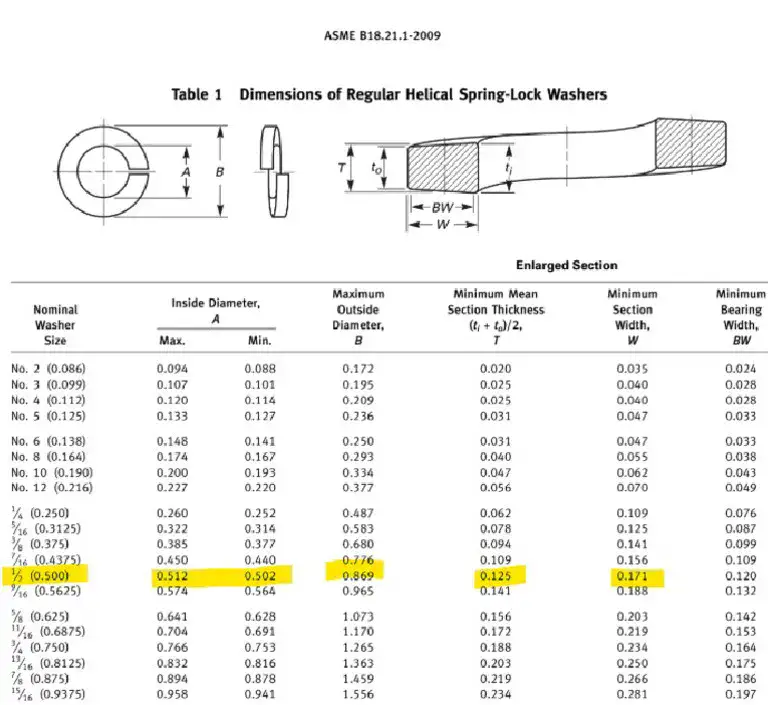
Helical spring-lock washers (split, twisted washers commonly called “split lock” or “spring lock”): provide axial spring force and bite to resist loosening under vibration.
-
Tooth-type lock washers (internal or external tooth): feature radially arranged teeth to increase friction against mating surfaces and fastener heads.
-
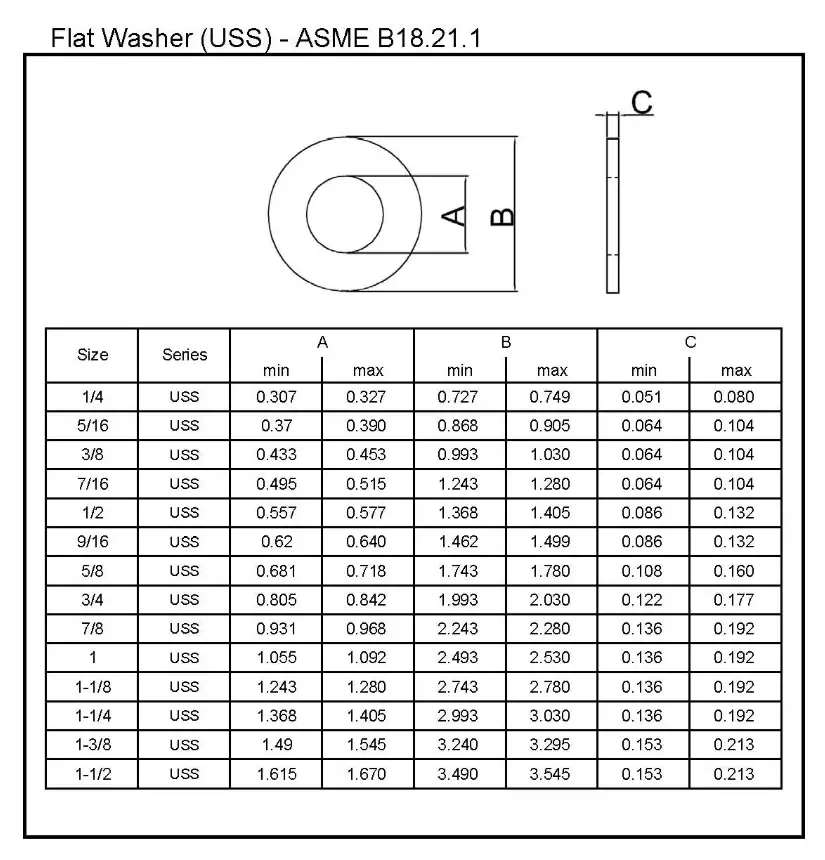
Plain flat washers (various series widths and thicknesses): used to distribute load, protect surfaces, set spacing, or control bearing area.
Each family is further subdivided by series (regular, heavy, extra duty, high-collar, narrow/wide), giving designers options for clamp stiffness and fit.
Scope limits, nominal sizes and series designations
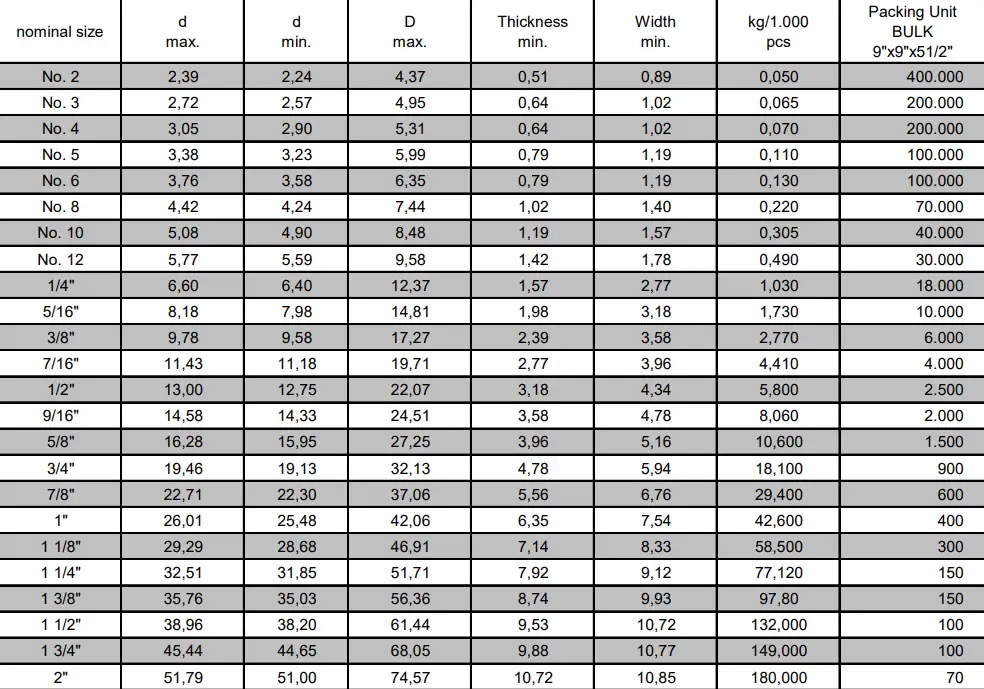
The standard’s dimensional tables cover unified-inch nominal thread sizes within defined ranges for each washer type. For example, helical washers are tabulated from very small unified sizes up through several inches; tooth washers have their own size limits. The tables use series names that indicate profile characteristics and intended load capability (e.g., regular, extra duty). Because the document contains many precise numerical dimensions and tolerances, users should consult the specific table matching the washer family and nominal thread size when exact numbers matter.
Dimensional concepts and how to read the tables
Key dimensions shown in the standard include:
-
Inside diameter (ID) — nominal clearance over a bolt shank or thread major diameter.
-
Outside diameter (OD) — bearing area extent.
-
Thickness (T) — section thickness; for helical washers additional heights (free and compressed) may be tabulated.
-
Series designation — gives clues to thickness and OD relative to nominal ID.
The standard assigns tolerances to these dimensions; manufacturers must hold tolerances to the listed limits unless purchaser and supplier have agreed different values. When converting a design to manufacture, designers should choose the series that matches the required bearing stiffness and the available space in the assembly.
Materials, hardness, heat-treat and decarburization limits
ASME B18.21.1 does not limit users to a single material but specifies physical property ranges and testing to ensure performance. Typical materials include low-carbon steel, alloy steel, stainless steels, silicon bronze and other copper alloys depending on corrosion resistance needs. For helical spring-lock washers, required hardness ranges and limits for decarburization are included. Where ferrous materials are hardened or heat treated, the standard references decarburization measurement practices (for example SAE J419). This protects against surface carbon loss that would reduce fatigue strength of spring washers.
Typical material property notes (summary)
-
Low-carbon steel: common for general service, usually supplied with specified plating/coating.
-
Alloy steel: used where greater hardness or spring performance needed; heat treat controlled and decarburization checked.
-
Stainless steel (300/400 series): used where corrosion resistance trumps maximum spring force.
-
Copper alloys (silicon bronze, nickel-copper-aluminum): selected when galvanic compatibility or marine performance required.
Finishes, plating and corrosion controls
Finish options frequently called out by purchasers include zinc platings, hot-dip galvanizing, black oxide, cadmium (less common due to environmental rules), and specialty coatings such as zinc-nickel. Because plating thickness alters bore clearances and may affect fit, the standard’s dimensional notes and referenced coating specifications (for example ASTM F1941 for electrodeposited finishes) should be read together with B18.21.1. Purchasers should specify required coating class and whether post-plate baking for hydrogen relief is needed for high-hardness parts.
Manufacturing, inspection and testing called out by the standard
ASME B18.21.1 references testing methods for:
-
Hardness checks on spring washers.
-
Decarburization evaluation for heat-treated ferrous washers (SAE J419).
-
Dimensional inspection (gauging per tables).
-
Coating and corrosion tests will often follow ASTM coating standards or purchaser-specified methods (salt spray, coating thickness).
Quality teams commonly build inspection plans around the standard’s tables plus additional purchaser requirements (sampling plans, lot marking, material certificates).
Practical selection criteria for procurement and design
When selecting a washer to conform with ASME B18.21.1, consider:
-
Nominal thread size of the mating fastener (select matching ID series).
-
Clamp stiffness required (spring washers provide higher axial compliance than plain washers).
-
Surface finish and environment (choose corrosion-resistant materials or specific platings).
-
Assembly space (some series have higher collars or thicker sections).
-
Interaction with torque (some lock washers change torque-turn behavior).
-
Regulatory or industry constraints (e.g., banned coatings, aerospace traceability).
Request manufacturer production records, hardness certificates, and coating certification when assemblies demand traceable quality. Commercial suppliers typically label their product literature with the ASME designation to indicate compliance.
Installation, torque interaction and performance considerations
Spring-type lock washers reduce loosening risk by adding axial preload and friction at the bearing surfaces. Nonetheless, modern studies and best practice recommendations highlight that lock washers are not a universal substitute for proper joint design. In many applications, use of a prevailing-torque nut, thread-locking adhesive, or a mechanical locking device may offer superior durability under repeated vibration or thermal cycling. When using helical or tooth washers, evaluate torque-turn curves during prototype trials, and ensure the washer does not flatten to the point of losing spring effect under expected clamp loads.
Quality assurance, traceability and purchaser requirements
A robust procurement specification will combine ASME B18.21.1 (dimensional and physical requirements) with:
-
Material specifications (e.g., ASTM A/or UNS numbers).
-
Heat-treatment process control and acceptance criteria, plus SAE J419 decarburization test results for heat-treated items.
-
Coating standard and corrosion resistance acceptance (ASTM or Mil-spec where applicable).
-
Packaging, lot marking and certificate of conformity (CoC) requirements.
Specify inspection sampling plans or 100% inspection for critical items; require retained records for traceability in safety-critical assemblies.
Differences versus international standards
International equivalents may exist but differ in dimension series and tolerance philosophy. ISO or EN washer standards use metric base sizes and sometimes different series definitions. For global procurements, convert nominal sizes carefully and require conformity to either ASME B18.21.1 or to the chosen ISO/EN standard, never mix tables without verification. For hybrid assemblies that use both metric and inch fasteners, prefer washers specified to the corresponding thread system to avoid clearance or interference problems.
Typical applications, failure modes and mitigation
Applications: general machinery, HVAC, automotive repair, structural connections, electrical equipment, heavy equipment fastenings.
Common failure modes: washer flattening (loss of spring action), corrosion/pitting leading to loss of bite, decarburization-related surface weakness in heat-treated parts, incorrect fit due to coating thickness or wrong series choice.
Mitigation: specify corrosion-resistant materials, require decarburization testing for hardened washers, perform prototype torque testing, and include coating thickness allowances in dimensional calls.
Quick reference tables
Table A — Washer families and typical use (summary)
| Washer family | Typical use | Advantages | Key caution |
|---|---|---|---|
| Helical spring-lock | Prevent loosening under light to medium vibration | Adds axial compliance and bite | Flattening reduces effectiveness |
| External tooth lock | High friction at mating surface | Good for painted or soft surfaces | Teeth may damage surface |
| Internal tooth lock | Bite under bolt head or nut | Keeps profile low | Not suitable for coarse threads without fit check |
| Plain flat washer | Load distribution, spacing | Protects surfaces, reduces bearing stress | No anti-loosen function |
(This table summarizes typical engineering uses; consult the standard for exact size/series mapping.)
Table B — Material selection checklist
| Environment | Preferred materials/finish | Notes |
|---|---|---|
| General interior | Carbon steel, zinc plate (per ASTM F1941 classes) | Economical; check for hydrogen embrittlement controls on hardened parts |
| Marine/ corrosive | Stainless 316 / 316L or duplex, or appropriate plated steel | Use compatible fasteners to avoid galvanic corrosion |
| High temperature | Alloy steels with high-temp coatings or high-temp bronze | Verify coating stability and mechanical properties |
| Electrical contact | Copper alloys (silicon bronze) | Consider conductivity and plating compatibility |
(Consult ASME B18.21.1 for material property expectations for each washer family.)
Table C — Picking series by design requirement (simplified)
| Requirement | Preferred series type |
|---|---|
| Tight space, low profile | Narrow/regular plain washers or low-collar tooth washers |
| High vibration resistance & moderate clamp | Extra duty helical spring-lock series |
| Maximum bearing area | Wide plain washer series |
| Surface protection + anti-loosen | Use washer plus threadlocker or prevailing nut |
Purchasing checklist
-
Specify ASME B18.21.1 compliance in purchase order.
-
Add material spec (ASTM or UNS number), heat treat requirement and hardness range if needed.
-
State finish/coating standard and required salt spray time or coating class (reference ASTM F1941 if electrodeposited).
-
Require decarburization certificate per SAE J419 for heat-treated spring washers.
-
Define sampling/inspection plan and required documentation (CoC, material test reports).
Frequently asked questions (FAQs)
1) Is ASME B18.21.1 only about inch sizes?
Yes. B18.21.1 covers unified-inch washers. For metric washers consult ISO/EN documents that cover metric washer families.
2) Can I substitute a plain washer for a spring-lock washer?
Only if the design does not require the spring action or anti-rotation bite. Plain washers spread load but do not add axial spring force. Prototype testing recommended when changing washer type.
3) Where does SAE J419 fit in?
SAE J419 provides methods for measuring decarburization in ferrous parts; B18.21.1 references it when decarburization limits apply to heat-treated spring washers. Request test reports when ordering hardened washers.
4) Does coating change washer dimensions?
Yes. Electrodeposited coatings add thickness that may affect bore clearance and fits. Specify finish class and whether nominal dimensions should include or exclude plating allowances. ASTM F1941 covers electrodeposited coating classes commonly used on fasteners.
5) Are lock washers banned in professional practice?
Not banned industry-wide. Some sectors prefer alternative locking methods based on test data. Select locking method using data from prototype and field testing for the specific joint.
6) How do I control hydrogen embrittlement risk?
For plated high-hardness parts, require appropriate post-plate baking or recommend mechanical zinc processes that avoid hydrogen uptake. Refer to ASTM F1941 guidance and industry plating advisories.
7) Do I get full interchangeability across suppliers if I specify B18.21.1?
Specifying the standard greatly improves interchangeability but also include material and finish details to avoid surprises. Certain series or finishes may not be stocked by all vendors.
8) What inspection evidence should I demand?
Typical evidence: material certificates, hardness test reports, decarburization test reports (if heat-treated), coating thickness measurement, dimensional inspection report. Add any lot traceability if required.
9) How do tooth washers interact with painted surfaces?
Tooth washers bite into paint and substrate, which increases friction but may reduce paint corrosion protection. If surface finish integrity matters, consider designs that protect coatings or use alternatives.
10) What is the single best practice for reliable joints?
Use a systems approach: correct washer family, correct material/finish, proper torque specification, and empirical testing under expected loads and environment. Locking elements are only one component of a robust joint.
Closing practical note
For design drawings and procurement wording include: “Washer: ASME B18.21.1 [year edition], washer family [helical spring / tooth / plain], nominal thread size, series (e.g., regular, extra duty), material (e.g., Carbon Steel, ASTM Axxx or UNS xxx), finish (ASTM F1941 class or other), decarburization and hardness requirements (per SAE J419 when applicable), inspection sampling plan and certificates required.” This compact phrase prevents ambiguity and reduces back-and-forth with suppliers.