

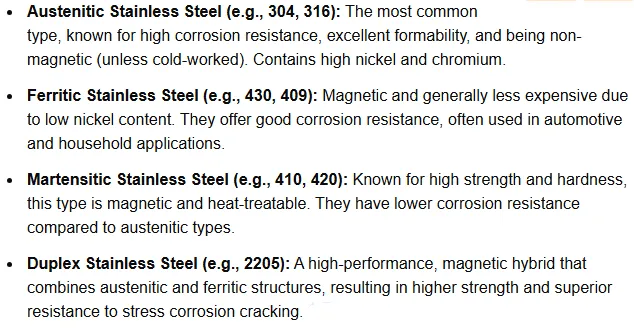
The four primary types of stainless steel are Austenitic, Ferritic, Martensitic, and Duplex. These categories are classified based on their crystalline microstructure, which directly dictates their mechanical properties, corrosion resistance, and suitability for specific industrial applications. Austenitic steels (e.g., 304, 316) are identified by their Face-Centered Cubic (FCC) structure, offering superior formability and corrosion resistance. Ferritic steels (e.g., 430) possess a Body-Centered Cubic (BCC) structure, providing magnetic properties and stress corrosion cracking resistance. Martensitic steels (e.g., 410) also utilize a BCC structure but with higher carbon content, allowing for heat treatment and hardening. Duplex steels (e.g., 2205) feature a mixed microstructure of approximately 50% austenite and 50% ferrite, delivering nearly double the yield strength of austenitic grades.
At MWalloys, we recognize that selecting the correct alloy requires more than just knowing these names. It demands a deep understanding of how alloying elements interact to define performance in harsh environments.
Executive summary and selection snapshot
For fast decision making, here is a concise comparison you can print and pin to a specification sheet:
| Family | Typical alloy drivers | Strength range | Corrosion resistance | Formability | Weldability | Typical applications |
|---|---|---|---|---|---|---|
| Austenitic | Chromium + nickel, some molybdenum or nitrogen | Moderate yield, high toughness | Excellent general corrosion resistance, excellent in many chloride environments (with Mo) | Excellent cold-forming | Excellent with appropriate procedures | Food equipment, chemical plants, cookware, cryogenics |
| Ferritic | Chromium-rich, little or no nickel | Moderate strength, brittle at low temperature risk in some grades | Good resistance to stress corrosion cracking, moderate general corrosion resistance | Moderate, limited cold workability for some grades | Moderate, grain growth control needed | Automotive trim, kitchenware, exhaust systems |
| Duplex | Balanced Cr-Ni with higher Cr and N; mixed microstructure | High strength (about 1.5× austenitic) | Very good pitting and crevice resistance | Moderate | Requires controlled procedures to preserve phase balance | Oil and gas, seawater hardware, chemical process equipment |
| Martensitic | Chromium + higher carbon | Can reach very high hardness after quench | Lower than other families; moderate in mildly corrosive media | Poor to moderate | Difficult; preheat and tempering often required | Cutlery, shafts, valves, wear components |
This snapshot helps engineers and buyers identify which family probably meets baseline project needs. The subsequent sections give in-depth technical explanation, procurement guidance, and tables that compare common grades.
How stainless steel families are defined: metallurgy and microstructure
Stainless steels are grouped by the dominant crystal structure of the iron matrix at room temperature plus the intended property-development route. The most useful practical classification uses four families: austenitic, ferritic, duplex, and martensitic. Each family forms due to particular alloying element balances:
-
Austenitic steels maintain a face-centered cubic matrix at room temperature through nickel, manganese, or nitrogen additions. This structure gives high toughness and excellent ductility.
-
Ferritic steels retain a body-centered cubic structure stabilized by chromium and low nickel content. They are typically magnetic.
-
Duplex steels intentionally produce a roughly balanced mixture of austenite and ferrite. The result is higher yield strength and improved resistance to localized corrosion.
-
Martensitic steels transform to a body-centered tetragonal phase during rapid cooling when carbon content is sufficient. This martensite is hardenable by heat treatment and is magnetic.
From a materials selection viewpoint, these microstructural differences drive mechanical behavior, corrosion resistance, heat treatment response, magnetic properties, and fabrication rules. The rest of this article unpacks each family in detail so procurement and engineering teams can write correct specifications and purchase the right grade for the operating environment.
Austenitic stainless steel
What defines austenitic stainless steel?
Austenitic stainless steels have an austenite matrix at room temperature. The microstructure is face-centered cubic. Nickel is the principal austenite stabilizer in the 300 series; manganese and nitrogen often substitute in 200 series grades. Typical chromium content is in the range 16–20 percent for common grades; nickel content varies.
Key properties
-
Corrosion resistance: Generally excellent. Molybdenum-bearing variants increase resistance to pitting and crevice corrosion in chloride environments.
-
Ductility and toughness: Very high toughness down to cryogenic temperatures.
-
Formability: Excellent. Most deep drawing operations use austenitic grades.
-
Magnetism: Essentially non-magnetic in solution-treated condition. Cold work can induce some magnetism locally.
-
Heat treatment: Cannot be hardened by ordinary heat treatments. Strengthening is by cold work or specific precipitation-hardening variants.
Common commercial grades and their attributes
| Grade | Typical composition drivers | Notable attributes | Typical uses |
|---|---|---|---|
| 304 (A2) | ~18% Cr, ~8% Ni | General-purpose, good forming, welding | Kitchenware, tanks, architecture |
| 316 (A4) | 16–18% Cr, 10–14% Ni, Mo added | Better pitting resistance in chlorides | Marine, chemical processing |
| 321, 347 | Ti or Nb stabilized | Resistance to sensitization during welding | Exhausts, high-temperature service |
| 2205 (duplex) note: not austenitic but often mentioned in same context | — | higher strength | oil and gas components |
Type 304 is the most widely used general-grade. Type 316 is chosen when chloride pitting resistance matters. The austenitic family forms the bulk of global stainless production in many surveys because of their versatility and favorable fabrication behavior.
Fabrication notes for engineers and buyers
-
Welding: Austenitic steels weld easily using standard processes. Use filler metals matched for corrosion resistance. Beware of sensitization in some grades which can cause intergranular corrosion unless stabilized or solution-treated.
-
Cold work: Cold forming increases strength due to strain hardening but reduces ductility. Where post-forming welding follows, plan for stress-relief or solution anneal where necessary.
-
Surface finish: Mirrored and No. 4 brushed finishes are common; they affect corrosion performance in thin films and crevices.
Typical testing and acceptance criteria
-
Chemical analysis (spectro or wet chemistry) to verify Ni, Cr, Mo, C, N content
-
Mechanical tests: tensile, yield, elongation
-
Corrosion tests: pitting potential or ASTM G48 if chloride service is expected
-
Hardness and microstructure review after welding where applicable
Ferritic stainless steel
What defines ferritic stainless steel?
Ferritic stainless steels have a body-centered cubic ferritic matrix at room temperature. Chromium content is usually in the 10.5–30 percent range while nickel is low or absent. They are magnetic and not hardenable by heat treatment.
Key properties
-
Corrosion resistance: Good general resistance; stress corrosion cracking resistance tends to be superior to austenitics in some chloride conditions.
-
Strength and toughness: Moderate strength; toughness can be limited, especially at low temperature or in certain high-chromium grades.
-
Formability: Reasonable, but limited relative to austenitics for deep drawing.
-
Weldability: Possible, but grain coarsening during welding can reduce toughness; post weld heat treatment is rarely used.
Common grades and applications
| Grade | Characteristic | Typical uses |
|---|---|---|
| 430 | ~17% Cr, no Ni | Decorative trim, kitchen appliances |
| 409 | Engineered for exhaust systems | Automotive mufflers, catalytic converter housings |
| 434 | Higher Cr and Ti stabilization | Some chemical uses |
Ferritic stainless steels are attractive where nickel prices drive cost sensitivity. They offer good oxidation resistance at moderate temperatures and reasonable performance in mildly corrosive environments.
Fabrication notes
-
Plan forming operations to avoid cracking at bends where available ductility margin is low.
-
Welding requires filler metals compatible with ferritic chemistry. Control heat input to prevent excessive grain growth.
-
When strength near that of duplex or austenitics is required, ferritics are less often used.
Duplex stainless steel
What makes duplex different?
Duplex stainless steels intentionally produce roughly equal portions of austenite and ferrite in the microstructure. This combination yields higher strength than austenitic grades plus improved resistance to chloride-induced localized corrosion. Duplex microstructure provides a blend of desirable traits from both families.
Typical duplex grades and composition trends
-
2205 is the most common duplex grade. It has higher chromium and molybdenum than 300-series austenitics and also contains nitrogen to stabilize austenite and increase strength.
-
Super-duplex grades contain higher alloy content for extreme pitting resistance.
Key properties
-
Strength: Yield strength generally about 1.5 times that of comparable austenitic grades.
-
Corrosion performance: Excellent resistance to pitting and crevice corrosion due to higher Cr, Mo, and N. Often chosen where chloride stress and localized attack risk exist.
-
Weldability: Requires careful control; welding can shift the phase balance. If heat input and cooling rates are not controlled, undesirable phases can form, reducing toughness and corrosion resistance.
Applications
Duplex stainless steel is common in oil and gas transport, seawater handling, heat exchangers in chemical plants, and other environments where combined strength and corrosion resistance are required.
Fabrication notes and procurement tips
-
Specify appropriate filler metals and pre/post-weld procedures to maintain a 50/50 phase balance.
-
For fabricated pressure equipment, include requirements for N content, ferrite measurement, and post-weld solution treatment when necessary.
-
Consider corrosion testing protocols such as ASTM G48 or electrochemical pitting potential for qualification.
Martensitic stainless steel
What defines martensitic stainless steel?
Martensitic stainless steels contain sufficient carbon to form a hard martensitic microstructure when cooled from the austenitizing temperature. The resulting matrix is body-centered tetragonal and magnetic. They are heat-treatable to high hardness levels and are commonly used for wear resistance and cutting edges.
Key properties
-
Hardness: Can be hardened to high Rockwell values through quench and temper cycles.
-
Strength: High when quenched and tempered.
-
Corrosion resistance: Lower than austenitic and duplex families; appropriate for mild environments or where protective surface finishes are used.
-
Formability: Limited in hardened state; better in annealed condition.
-
Weldability: Challenging. Preheat and controlled interpass temperatures often required; post-weld tempering usually necessary.
Common grades and uses
| Grade | Typical carbon range | Typical use |
|---|---|---|
| 410 | ~0.15% C | General-purpose martensitic, knives, valve parts |
| 420 | Higher C up to ~1.0% | Cutlery blade steels |
| 440C | High C and chromium | Bearing and wear components with high hardness |
Processing notes
-
For components requiring tight dimensional control and high hardness, specify quench and temper schedules and include hardness tests per order.
-
For welded assemblies, design to minimize heat-affected zones that require re-tempering.
Comparative tables for procurement
Mechanical properties comparison (typical ranges)
Note: Values below are representative ranges for commonly specified grades; use manufacturer datasheets for design limits.
| Family | Typical yield strength MPa | Typical tensile strength MPa | Typical elongation % |
|---|---|---|---|
| Austenitic (304/316) | 200–350 | 500–750 | 40–60 |
| Ferritic (430) | 150–300 | 350–550 | 20–40 |
| Duplex (2205) | 450–600 | 700–900 | 20–35 |
| Martensitic (410/420 heat treated) | 300–1200 (depends on temper) | 600–1600 | 5–25 |
Corrosion ranking for chloride environments (qualitative)
| Family | Relative pitting resistance |
|---|---|
| Super-duplex > Duplex > Austenitic Mo-bearing (316) > Ferritic > Martensitic |
Temperature and oxidation limits (practical guidance)
-
Austenitic: Continuous service up to around 800–870 °C for some grades; above that creep and scaling become concerns.
-
Ferritic: Good oxidation resistance up to moderate temperatures; grain growth risk at high welding temperatures.
-
Duplex: Good service to moderately high temperatures but careful with exposure above about 300–350 °C due to embrittlement risks from intermetallic phases.
-
Martensitic: High-temperature strength limited; tempering required to control properties.
Strategic Selection Criteria for Engineering Applications
When MWalloys consults with clients, we advise using a "Failure Mode First" approach. Rather than picking a grade based on tradition, analyze how the part is most likely to fail.
1. Environment and Chemistry
-
Chloride Presence: If the environment is salt water or coastal, 304 is insufficient. Move to 316, or if load-bearing, Duplex 2205.
-
Acids: Reducing acids (sulfuric) require different alloys than oxidizing acids (nitric).
-
PREN Calculation: Use the formula
PREN=%Cr+3.3(%Mo)+16(%N)to rank pitting resistance theoretically.
2. Mechanical Load
-
If the design is weight-sensitive (e.g., transport tankers), the high strength of Duplex allows for thinner walls, which compensates for the higher per-kg cost of the material.
-
For wear parts (blades, valves), Martensitic is the only logical choice among the standard four.
3. Fabrication and Installation
-
Welding: If heavy gauge welding is required, Austenitic is forgiving. Duplex requires strict heat input controls to maintain the phase balance. Ferritic grades in thick sections can suffer from grain growth and brittleness.
-
Forming: For deep drawing (sinks, pots), Austenitic 304 is unmatched.
Industry Insights: The "Hidden" Fifth Type
While the prompt focuses on the four main types, an authoritative guide must acknowledge Precipitation Hardening (PH) stainless steels. Grades like 17-4PH offer a unique combination of the corrosion resistance of austenitics with the high strength of martensitics, achieved through the addition of Copper, Niobium, or Aluminum and an aging heat treatment process. Aerospace and advanced manufacturing sectors frequently rely on PH grades.
Why Source from MWalloys?
In a market flooded with generic material certifications, MWalloys stands apart through technical integrity. We do not just supply metal; we supply certainty.
-
Verification: We utilize X-ray Fluorescence (XRF) analyzers to verify alloying elements before shipment.
-
Traceability: Full mill test reports (MTRs) link every batch to its furnace origin.
-
Expertise: Our team understands the nuances between a 304L that barely meets the standard and one optimized for maximum corrosion resistance.
Manufacturing and fabrication considerations
Forming
-
Prefer austenitic when deep drawing and extensive forming are required.
-
Ferritic and martensitic need larger bend radii and controlled work hardening.
Welding
-
Austenitics weld readily with matched filler metals. For 300 series specify 308/316 weld wires where needed.
-
Ferritics: control heat input to limit grain growth.
-
Duplex: use duplex filler wires; maintain phase balance by controlling interpass temperature and cooling rates.
-
Martensitic: preheat and post-weld temper are typically needed to prevent cracking.
Heat treatment
-
Austenitic: solution anneal at ~1050–1100 °C then quench to restore corrosion resistance after heavy processing.
-
Ferritic: not normally heat treated for strengthening.
-
Duplex: solution treatment may be required to dissolve unwanted phases after welding.
-
Martensitic: require quench and temper cycles to reach final properties.
Surface finishing and corrosion performance
-
Surface roughness and crevices concentrate corrosion attack. Specify surface finish requirements to meet chloride exposure demands. Passivation treatments (e.g., nitric acid passivation) are standard for many food and medical applications.
Selection checklist for design engineers and purchasers
Use this checklist to frame a specification or RFQ.
-
Operating environment: chloride level, pH, temperature range, presence of oxidizing/reducing species.
-
Mechanical requirements: yield, tensile strength, elongation, hardness.
-
Forming and fabrication: can the part be hot or cold formed, welded on-site, require post-weld heat treatment?
-
Surface finish and cosmetic needs: mirror, brushed, pickled, passivated.
-
Standards and traceability: specify ASTM/EN/UNS numbers, mill test certificates, and any required NDT.
-
Acceptance tests: hardness, tensile tests, pitting resistance, salt spray if relevant.
-
Supply chain: required lead time, certified mills, chemical analysis tolerance, and preferred stock suppliers.
-
Lifecycle costs: consider replacement intervals, maintenance, and repairability rather than only upfront metal cost.
Including this checklist in procurement documents will reduce specification ambiguity and speed supplier qualification.
Quality control, specifications and typical test methods
When writing technical purchase documents include:
-
Chemical composition verification: Spectro analysis with acceptance ranges consistent with ASTM A240, EN 10088, or applicable standard.
-
Mechanical testing: Tensile test to ASTM A370 or equivalent; hardness to Rockwell or Vickers depending on the family.
-
Microstructure checks: Phase balance for duplex (quantitative ferrite measurement), grain size for ferritics and austenitics after welding.
-
Corrosion testing: ASTM G48 pitting and crevice corrosion tests for chloride exposure; ASTM B505 or ISO 11130 for specific passivation requirements.
-
Non-destructive testing: Radiography or ultrasonic testing for pressure-retaining welded fabrications.
Include acceptance criteria in purchase orders so suppliers can plan process controls.
Cost drivers, availability and lead time considerations
Key cost drivers:
-
Nickel content: major influence on price for austenitic alloys.
-
Molybdenum and nitrogen: added alloying elements in duplex and 316 raise cost.
-
Heat treatment and special surface finishing: increase processing cost.
-
Certification and testing requirements: mill certificates, full material traceability, and specialized corrosion testing add time and expense.
Procurement tip: Where price sensitivity is high and chloride exposure is low, a ferritic grade may deliver required performance at lower cost. For severe marine environments, duplex or super-duplex may reduce lifecycle cost despite higher upfront price.
Practical specifications examples (short templates)
Example line item for a 316 sheet supply
316 stainless steel sheet, ASTM A240/A240M, Type 316, thickness 2.0 mm ±0.1 mm, surface finish 2B, annealed and pickled, mill test certificate EN 10204 3.1, chemical composition within ASTM tolerance, tensile strength ≥ 515 MPa, elongation ≥ 40%.
Example line item for duplex pipe
Duplex 2205 seamless tube, UNS S32205, ASTM A789, schedule 40, welded fittings matched to base material, ferrite content 30–70% in parent metal after welding, electropolished OD, NDT 100% radiography on circumferential welds.
Clear specification language like this reduces supplier questions and avoids substitutions.
Stainless Steel Selection & Properties FAQ
1. Which stainless steel family gives the best corrosion resistance in seawater?
Grades like Duplex 2205 or Super-Duplex 2507 typically offer the best balance of strength and resistance to pitting and crevice corrosion in seawater. This is due to their higher levels of Chromium, Molybdenum, and Nitrogen. While Austenitic 316 is a marine standard, it may be outclassed by Duplex in aggressive chloride conditions.
2. When should I choose martensitic grades?
3. Can I weld duplex stainless steel in a standard fabrication shop?
4. Is ferritic stainless steel magnetic?
5. Which stainless steel is best for food-contact surfaces?
Austenitic 304 and 316 are the industry standards for food contact. 304 is used where chlorides are low. Use 316 where exposure to salts (chlorides) or aggressive cleaning chemicals increases the corrosion risk. Always specify a smooth surface finish and proper passivation for hygiene.
6. What is sensitization and which family is vulnerable?
7. How does cold working affect stainless steel selection?
8. Are ferritic grades cheaper than austenitic?
9. How do I specify corrosion testing for a critical application?
- ASTM G48: For pitting and crevice corrosion resistance.
- Electrochemical Testing: To determine the pitting potential.
- Service-Mimic Tests: Exposure tests using the actual chemicals and temperatures of your process.
10. Can stainless steel fail by fatigue in corrosive environments?
Practical procurement appendix: specification checklist and sample clauses
Technical clause examples for RFQ
-
Material designation: “UNS S30400, ASTM A240, solution annealed and pickled, product form: sheet, thickness: 2.0 mm ±0.1 mm.”
-
Certification: “Supply chain must provide EN 10204 3.1 MTC. Include chemical analysis, tensile test report, and heat number traceability.”
-
Acceptance: “Delivery accepted only after review of MTC and receipt inspection including dimensional check, visual surface check, and one tensile test per lot.”
-
Corrosion testing: “For equipment intended for sea water, furnish laboratory pitting potential data or equivalent G48 testing on representative samples.”
-
Welding: “Provide procedure qualification record (PQR) for key welds, including filler metal designation, preheat, interpass, NDT results.”
Purchasing tips
-
Ask suppliers for mill certificates tied to heat numbers.
-
If lead time is critical, specify acceptable substitute grades and require written approval for any substitution.
-
For critical components consider factory audits of supplier quality systems and traceability.
Closing recommendations from MWAlloys
MWAlloys recommends the following practical approach for specifying stainless material:
-
Start from the operating environment and mechanical needs, not from the desired family name.
-
If chloride pitting or crevice corrosion risk exists, consider duplex or molybdenum-bearing austenitics.
-
If heavy forming and welding are needed, start with austenitic 300 series and specify stabilization or low-carbon grades when sensitization is a risk.
-
For wear or cutting applications, check martensitic hardened grades and include hardness and temper specifications.
-
For cost-sensitive, non-critical corrosion environments consider ferritic grades but verify low-temperature toughness and forming limitations.