

MWAlloys offers a comprehensive range of high-quality welding neck flanges designed to meet the stringent demands of various industries, including oil and gas, chemical, and power generation. Our welding neck flanges are engineered for durability, precision, and exceptional performance under high pressure and temperature conditions. Available in a variety of sizes, materials, and pressure ratings, MWAlloys’ welding neck flanges are ideal for applications where robust, long-term connections are required.
What is a Weld Neck Flange Used For?
A weld neck flange is used to connect pipes, valves, pumps, and other equipment in a piping system. The flange’s long tapered neck ensures a smooth transition from the pipe to the flange, minimizing the stress concentration at the connection and providing superior strength and durability. Typically, weld neck flanges are used in high-pressure and high-temperature applications, such as in the oil and gas industry, chemical processing, and power generation systems.
What is the Difference Between a Flange and a Weld Neck Flange?
The key difference between a general flange and a weld neck flange lies in the design. A welding neck flange features a long, tapered neck that is welded directly to the pipe, providing a stronger, more secure connection. This design helps distribute stresses evenly across the joint, making it ideal for high-stress environments. In contrast, other types of flanges, such as slip-on flanges or blind flanges, have different connection methods that may not offer the same level of durability and strength as a weld neck flange.
What is the Difference Between Weld Neck Flanges and Plate Flanges?
Weld neck flanges and plate flanges differ mainly in their design and installation methods. A weld neck flange has a long, tapered neck that ensures a seamless connection when welded to the pipe, which is ideal for high-stress and high-pressure applications. Plate flanges, on the other hand, are flat and are typically used in lower-pressure systems where high mechanical strength is not as critical.
What is the ASME Standard for Long Weld Neck Flanges?
The American Society of Mechanical Engineers (ASME) provides the standards for flanges, including weld neck flanges. The ASME B16.5 standard governs the dimensions, tolerances, and pressure-temperature ratings for flanges ranging from 1/2" to 24" in diameter. For larger sizes, ASME B16.47 is used. These standards ensure the quality, consistency, and compatibility of weld neck flanges in various industrial applications.
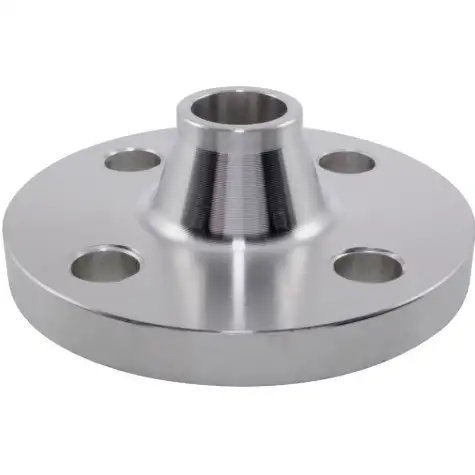
ASME B16.5 Welding Neck Flange Dimensions (NPS ½" to 24")
(All dimensions in millimeters/inches - Raised Face/Ring Type Joint)
| Parameter | Symbol | NPS Range | Pressure Class (Example Values) | Notes |
|---|---|---|---|---|
| Nominal Pipe Size | NPS | ½" to 24" | - | Sizes: ½, ¾, 1, 1½, 2, 3, 4, 6, 8, 10, 12, 14, 16, 18, 20, 24 |
| Outside Diameter | OD | Varies | Class 150: 90 mm (3.5") – 755 mm (29.75") Class 600: 95 mm (3.75") – 815 mm (32") |
Increases with NPS & class |
| Flange Thickness | tf | Varies | Class 150: 9.5 mm (0.38") – 44.5 mm (1.75") Class 2500: 30 mm (1.18") – 178 mm (7") |
Thicker for higher classes |
| Raised Face Height | RF | All | 1.6 mm (0.06") for NPS ≤ 24" (Class 150-300) 6.4 mm (0.25") for Class ≥600 |
RF diameter varies by NPS |
| Bolt Circle Diameter | BCD | All | Class 150: 60.3 mm (2.38") – 749 mm (29.5") | Centerline of bolt holes |
| Hub Diameter (Base) | X | Varies | Class 150: 30 mm (1.19") – 521 mm (20.5") | Connects to pipe weld |
| Hub Diameter (End) | A | Matches Pipe | Equal to pipe OD (e.g., NPS 2": 60.3 mm) | Aligns with pipe outer diameter |
| Length Through Hub | H | Varies | Class 150: 14 mm (0.56") – 83 mm (3.25") | Longer for higher classes |
| Weld Bevel Angle | - | All | 37.5° ± 2.5° | ASME B16.25 standard |
| Bolt Hole Diameter | d | All | M12 to M64 (e.g., Class 150 NPS 2": 15.9 mm / ⅝") | Matches bolt size |
| Number of Bolts | n | Varies | Class 150: 4 (NPS ½") – 16 (NPS 24") | Increases with NPS & class |
| Flange Bore | B | Varies | Matches pipe ID (Schedule-dependent) | Machined to pipe inner diameter |
Key Standards & Material Specifications
| Standard | Pressure Classes | Materials (Common) | Temperature Range |
|---|---|---|---|
| ASME B16.5 | 150, 300, 400, 600, 900, 1500, 2500 | ASTM A105 (C.S.), A182 F316 (SS), A350 LF2 (LT) | -29°C to 538°C (-20°F to 1000°F) |
| EN 1092-1 | PN 6, 10, 16, 25, 40 | P245GH (C.S.), 1.4401 (SS), C22.8 (Alloy) | -196°C to 600°C |
| ASME B16.47 | Series A/B (150-900) | A694 F65 (HSLA), A182 F51 (Duplex) | Depends on material grade |
Notes:
-
Bore (B): Must match pipe wall thickness (e.g., Sch 40, 80, XXS).
-
Face Types: Raised Face (RF), Flat Face (FF), Ring-Type Joint (RTJ).
-
RTJ Grooves: Dimensions per ASME B16.5 Table 3-2.1 (e.g., R/RX ring profiles).
-
Tolerances:
-
OD: ±1.5 mm (NPS ≤ 24")
-
Thickness: +3.2 mm / -0.8 mm
-
Bolt Hole Alignment: ±0.8 mm
-
Important: Always reference latest ASME B16.5 (2020) or EN 1092-1:2018 standards for project specifications. Dimensions vary by pressure class, material, and facing type.
Example Values (NPS 4", Class 300):
-
OD: 190 mm (7.5")
-
tf: 22.3 mm (0.88")
-
BCD: 152.4 mm (6.0")
-
Bolt Holes: 8 × 19.1 mm (¾")
-
Hub Base (X): 108 mm (4.25")
-
H: 38 mm (1.5")
WELD NECK FLANGE (WNF) CATALOGUE
*Standards: ASME B16.5 (½"–24"), ASME B16.47 Series A/B (26"–60"), EN 1092-1 (DN15–DN600)*
| Parameter | ASME B16.5 | ASME B16.47 | EN 1092-1 (PN) | Material Grades |
|---|---|---|---|---|
| Size Range | NPS ½" to 24" | NPS 26" to 60" | DN 15 to DN 600 | - |
| Pressure Classes | 150, 300, 400, 600, 900, 1500, 2500 | Series A: 150–900 Series B: 75–900 |
PN 6, 10, 16, 25, 40 | - |
| Face Types | RF, FF, RTJ, LMF | RF, RTJ | RF, FF, RTJ | - |
| Raised Face (RF) Height | 1.6 mm (≤24") 6.4 mm (≥600#) |
6.4 mm | PN ≤16: 1.0–2.0 mm PN ≥25: 3–4 mm |
- |
| Bolt Holes | 4–16 holes Dia: 15.9–44.5 mm |
12–56 holes Dia: 28.7–57.2 mm |
4–40 holes Dia: 11–56 mm |
- |
| Hub Taper | Min. 7° | Min. 7° | Min. 5° | - |
| Standards Reference | ASME B16.5-2020 | ASME B16.47-2020 | EN 1092-1:2018 | - |
| Material Grades | ASTM A105 (C.S.) A182 F304/316 (SS) A350 LF2 (LT) |
A694 F52 (HSLA) A182 F51 (Duplex) |
P265GH (C.S.) 1.4301 (SS) C22.8 (Alloy) |
C.S. = Carbon Steel SS = Stainless Steel LT = Low Temp |
| Temp Range | -29°C to 538°C | -46°C to 593°C | -196°C to 600°C | - |
| Surface Finish | 125–250 µin Ra (RF face) | 125–250 µin Ra | 3.2–6.3 µm Ra | Note: RF faces serrated |
| Marking | Heat No., Material, Size, Class, Std. | Manufacturer ID, Class, Size, Material | CE Mark, PN, DN, Material Code | - |
| Packaging | Wooden crates/Steel pallets | Anti-rust paper + PVC caps | Euro pallets + edge protectors | - |
| Lead Time | 4–8 weeks (std.) 2 weeks (rush) |
6–10 weeks | 3–6 weeks | - |
DIMENSIONAL TABLE (EXAMPLE: NPS 3", CLASS 150)
| Dimension | ASME B16.5 | EN 1092-1 (PN16) | ASME B16.47 (Series A) |
|---|---|---|---|
| OD (A) | 127 mm | 140 mm | - |
| Thickness (tf) | 16.7 mm | 18 mm | - |
| Hub Base (X) | 54 mm | 60 mm | - |
| Hub Length (H) | 22 mm | 20 mm | - |
| Bolt Circle (BCD) | 88.9 mm | 100 mm | - |
| Bolt Holes (n × d) | 4 × 19.1 mm | 4 × 18 mm | - |
| Bore (B) | Sch 40: 77.9 mm | DN80: 78.1 mm | - |
PRESSURE-TEMPERATURE RATINGS
| Class | Max WP @38°C (psi) | Max WP @200°C (psi) | PN Equiv. |
|---|---|---|---|
| 150# | 290 psi | 230 psi | PN 20 |
| 300# | 750 psi | 620 psi | PN 50 |
| 600# | 1500 psi | 1250 psi | PN 100 |
| PN 40 | 580 psi | 520 psi | Class 300 |
ORDERING SPECIFICATION
| Field | Example Entry |
|---|---|
| Standard | ASME B16.5 / EN 1092-1 |
| Type | Weld Neck Flange (WNF) |
| Size | NPS 8" / DN 200 |
| Pressure Class | Class 300 / PN 40 |
| Face Type | RF (Raised Face) / RTJ (Ring Type) |
| Material | ASTM A182 F316 / EN 1.4401 |
| Qty | 24 pcs |
| Coating | None / Xylan / Galvanized |
NOTES:
-
Bore (B): Match pipe schedule (e.g., Sch 40, 80, 160).
-
RTJ Grooves: Follow ASME B16.5 Table 3-2.1 (R, RX, BX profiles).
-
Tolerances:
-
OD: ±1.5 mm (NPS ≤24") / ±3 mm (NPS >24")
-
Thickness: +3.2 mm, -0.8 mm
-
-
Inspection: MPI/LPT per ASME Sect V, hydrotest per customer req.
-
Certification: EN 10204 3.1 / ASME Sect II + Mill Test Reports.
⚠️ Warning: Always verify flange/pipe material compatibility and temperature de-rating per ASME B16.34.
global price comparison table for Weld Neck Flanges in 2025
| Region | Material | Size (inches) | Pressure Class | Price (USD per unit) |
|---|---|---|---|---|
| China | Carbon Steel | 1" to 24" | 150 to 2500 | $20 - $150 |
| United States | Stainless Steel | 1" to 24" | 150 to 2500 | $50 - $300 |
| India | Alloy Steel | 1" to 24" | 150 to 2500 | $30 - $180 |
| Europe | Carbon Steel | 1" to 24" | 150 to 2500 | $40 - $250 |
| Middle East | Stainless Steel | 1" to 24" | 150 to 2500 | $60 - $350 |
| Australia | Alloy Steel | 1" to 24" | 150 to 2500 | $50 - $320 |
Key Factors Affecting Price:
-
Material Type: Carbon steel is the most affordable, while stainless and alloy steels tend to be pricier due to material costs.
-
Size: Larger sizes and higher pressure classes generally increase the price due to the complexity and strength required.
-
Region: Prices vary by region due to local demand, manufacturing costs, and supply chain factors.
When to Use Long Weld Neck Flange?
Long weld neck flanges are typically used in systems where the pipe must endure high-stress conditions, such as in high-pressure pipelines, where fatigue, vibration, and extreme temperatures are common. The long neck allows for a better alignment and smooth flow transition between the pipe and flange, reducing stress concentrations and enhancing the overall integrity of the connection.
How to Connect a Weld Neck Flange?
A weld neck flange is connected to a pipe by welding the flange's long neck directly to the pipe’s end. This welding process creates a strong, permanent bond that is capable of handling high-pressure applications. Proper welding techniques are crucial to ensure the integrity of the joint, and the process is typically carried out using processes like TIG (Tungsten Inert Gas) welding or MIG (Metal Inert Gas) welding, depending on the material.
What are the Disadvantages of a Weld Neck Flange?
While weld neck flanges offer superior strength and durability, they can be more expensive and require more labor and material for installation compared to other types of flanges. The installation process also requires skilled labor, and the flange's long neck design may increase the overall size and weight of the system, making it less suitable for applications where space or weight constraints are important.
Are Weld Neck Flanges Raised Face or Flat Face?
Weld neck flanges can be found with either a raised face (RF) or flat face (FF) design. The raised face is the most common and features a raised ring on the flange surface, which helps to improve the sealing of the connection. Flat face flanges, on the other hand, are typically used for lower-pressure applications and have a flat, smooth surface that meets directly with the gasket.
What is the Bevel Angle of a Weld Neck Flange?
The bevel angle of a weld neck flange is typically 37.5 degrees, which is designed to accommodate welding techniques like butt welding. This bevel allows for the creation of a high-quality, strong joint when welding the flange to the pipe.
What is the Bore of a Weld Neck Flange?
The bore of a weld neck flange refers to the inner diameter of the flange's neck. It is designed to match the outer diameter of the pipe it connects to, ensuring a seamless and efficient flow of materials. The bore size is critical for maintaining the performance of the piping system and ensuring that the flange can handle the intended pressure and flow rate.
What is a Slip-On Weld Flange?
A slip-on weld flange is a type of flange that is slipped over the pipe and then welded both inside and outside to secure it in place. Unlike weld neck flanges, slip-on flanges do not have a long tapered neck. While they are easier to install and less costly, they are not as suitable for high-pressure applications as weld neck flanges.
How to Secure a Flange?
Flanges are typically secured using bolts that connect the flange to another flange or component. A gasket is placed between the flanges to create a seal and prevent leaks. The bolts are tightened evenly to ensure a secure and tight connection, and the gasket material used will depend on the pressure, temperature, and material compatibility of the system.
When to Use Weld Neck vs. Slip-On Flange?
Weld neck flanges are ideal for high-pressure, high-temperature applications where a secure, robust connection is needed. Slip-on flanges are more suitable for lower-pressure applications where ease of installation and cost are more important than strength.
Are Weld Neck Flanges Used for Pressure Temperature?
Yes, weld neck flanges are often used in applications where both pressure and temperature are critical factors. Their robust design, including the long tapered neck, helps distribute the stresses caused by high pressure and temperature, making them a preferred choice in industries such as oil and gas, chemical processing, and power generation.
What Class is a Weld Neck Flange?
Weld neck flanges are available in various pressure classes, typically ranging from 150 to 2500, with each class indicating the maximum pressure the flange can withstand. Higher pressure classes are used in more demanding applications, where the flange must endure higher forces.
What are the Advantages of Weld Neck Flanges?
The primary advantages of weld neck flanges include:
- Superior Strength: The tapered neck design provides a smooth transition and reduces stress concentrations.
- Durability: Ideal for high-pressure and high-temperature systems.
- Leak-Free Connections: The welding process creates a permanent, leak-proof seal.
- Versatility: Suitable for a wide range of industrial applications.
What is the Strongest Type of Flange?
The weld neck flange is considered one of the strongest types of flanges due to its design, which minimizes stress at the connection point. It is capable of handling high-pressure and high-temperature conditions, making it the preferred choice for demanding industrial systems.
How to Fit a Slip-On Flange?
To fit a slip-on flange, the flange is slid over the pipe, and the inside and outside of the flange are welded to secure it in place. It is then bolted to another flange or component using the appropriate number and size of bolts.
FAQs for Weld Neck Flanges
What is the difference between a slip-on flange and a weld neck flange?
A slip-on flange is easier to install but not suitable for high-pressure applications, while a weld neck flange is designed for robust, high-pressure systems.
Can weld neck flanges be used in both high and low-pressure systems?
Yes, but they are most commonly used in high-pressure systems due to their strength and durability.
Are weld neck flanges compatible with all pipe materials?
Weld neck flanges can be used with a wide range of materials, including steel, stainless steel, and alloys, depending on the application requirements.
What is the cost difference between weld neck and slip-on flanges?
Weld neck flanges tend to be more expensive due to their complex design and superior performance in high-pressure applications.
What is the standard flange size for welding neck flanges?
Welding neck flanges are available in various sizes, from 1/2" to 24" and larger, depending on the requirements of the system.
Can weld neck flanges be used in extreme temperatures?
Yes, they are designed to withstand both high temperatures and pressures.
What materials are used to make weld neck flanges?
Weld neck flanges are typically made from carbon steel, stainless steel, alloy steel, and other high-strength materials.
How do I ensure a leak-proof connection with a weld neck flange?
Ensure proper welding techniques and use a compatible gasket to achieve a leak-free seal.
Can I retrofit a slip-on flange to a weld neck flange?
Yes, but the retrofit process will depend on the specific requirements of the piping system.
What is the pressure rating for MWAlloys' weld neck flanges?
Our weld neck flanges are available in multiple pressure ratings, from 150 to 2500, suitable for a wide range of applications.