
Choosing between high-chrome white iron and manganese steel for an industrial screen comes down to one question, is the wear you are fighting impact-dominated or abrasion-dominated. High-chrome iron, typically 25 to 28 percent chromium with a hard carbide matrix, wins on pure sliding abrasion from fine, hard particulate like silica sand or crushed limestone fines. Manganese steel, the classic 12 to 14 percent Hadfield alloy, wins wherever repeated impact loading work-hardens the surface faster than it wears away, which is why crusher jaw liners and heavy impact screen decks still default to manganese after more than a century of mining industry use. Get that distinction wrong and you will either crack a brittle high-chrome plate under hammer blows or watch a manganese screen wear through in months because it never saw enough impact to trigger its own hardening response. We size wear plate and screen media against this exact tradeoff for customers running everything from coal washing plants to aggregate crushers, and this article walks through the metallurgy, the selection logic, and the practical numbers behind it.
We have replaced enough prematurely worn screen panels to know that the sales literature on this topic tends to oversimplify, presenting high-chrome as the universal upgrade over manganese without explaining where manganese still legitimately outperforms it. The truth sits in the wear mechanism, not in which alloy has the higher listed hardness number on a data sheet.
What Actually Causes Wear on an Industrial Screen?
Screen wear happens through a combination of three distinct mechanisms, and most real-world screen failures involve more than one acting simultaneously. Sliding abrasion occurs when fine particles slide across the screen surface under their own weight and the vibrating motion of the deck, gradually scratching and removing surface material through a process called micro-cutting. Impact wear occurs when larger rocks or lumps strike the screen surface with enough kinetic energy to deform or chip the surface locally, common on the feed end of a screen where material first lands. Gouging abrasion, a more severe combination of the two, happens when large, sharp-edged material both impacts and drags across the surface, tearing out material in a way that neither pure sliding nor pure impact alone produces.
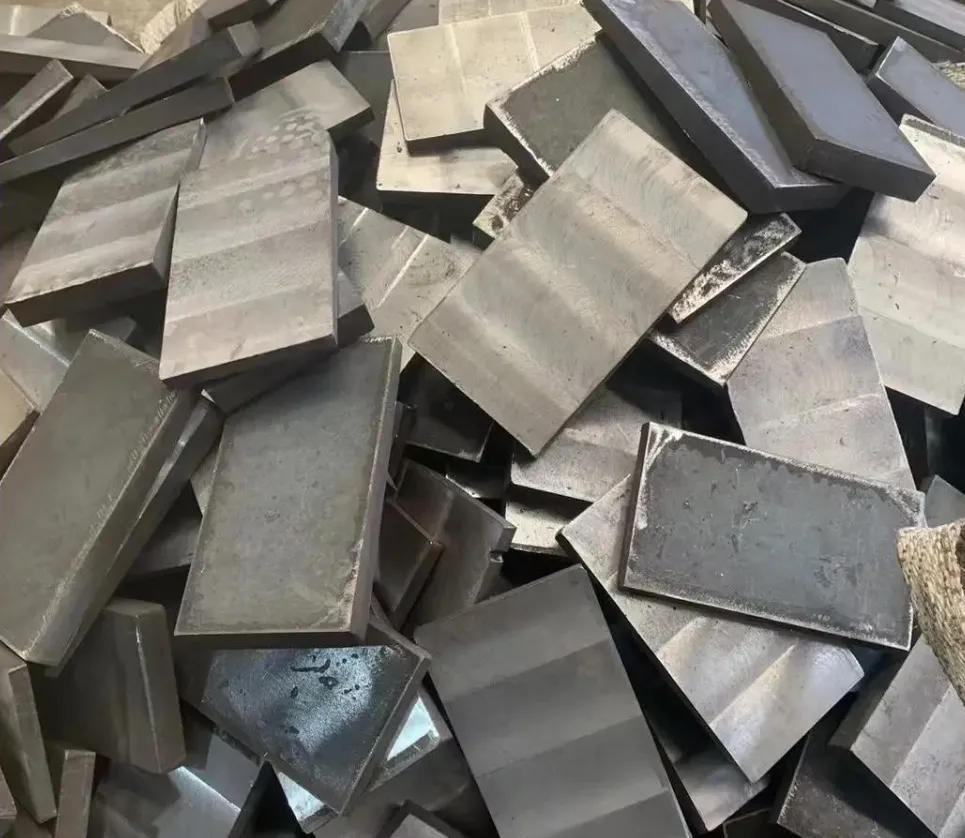
The mineral hardness of the material being screened matters enormously here. Quartz and silica sand, common in aggregate and sand processing, register around 7 on the Mohs hardness scale, hard enough to abrade even quenched and tempered steel plate relatively quickly. Coal and softer ores register considerably lower, which is part of why coal screening operations can sometimes get away with lighter-duty wear materials than a hard rock quarry running the same tonnage.
| Wear Mechanism | Dominant Cause | Typical Screen Location | Best-Suited Alloy Response |
|---|---|---|---|
| Sliding abrasion | Fine hard particles sliding across surface | Mid to discharge end of screen deck | High hardness, fine hard carbides (high-chrome iron) |
| Impact wear | Large lumps striking surface | Feed end, transfer points | Work hardening capacity, toughness (manganese steel) |
| Gouging abrasion | Sharp, large particles under load | Crusher discharge screens, primary screening | Combination approach, composite wear plates |
| Erosion | High-velocity fine particles, often with liquid | Wet screening, slurry applications | Corrosion-resistant hard facing, ceramic composites |
We walk customers through which mechanism dominates their specific screen zone before recommending a material, because a single screen deck often needs different wear solutions at the feed end versus the discharge end, something a one-size-fits-all quote misses entirely.
What Is High-Chrome White Iron and Why Does It Resist Abrasion So Well?
High-chrome white iron, sometimes called high-chromium cast iron or abrasion-resistant white iron, gets its wear resistance from a microstructure containing hard chromium carbides embedded in a tougher steel-like matrix. The chromium content, typically ranging from 15 to 28 percent depending on the specific grade, combines with carbon during solidification to form these carbides, which register between 1500 and 1800 on the Vickers hardness scale, dramatically harder than the quartz particles they are designed to resist.
The key insight we explain to buyers unfamiliar with this alloy family is that the carbides themselves do the wear resisting, while the surrounding matrix provides enough toughness to hold those carbides in place under load. Get the carbide volume fraction too high relative to the matrix, and the material becomes brittle enough to crack under impact loading, which is precisely why high-chrome iron performs poorly in impact-dominated applications despite its superior abrasion numbers.
| High-Chrome Grade | Chromium Content | Carbon Content | Typical Hardness (HRC) | Best Application |
|---|---|---|---|---|
| 15% Cr white iron | 14-18% | 2.0-3.0% | 50-56 | Moderate abrasion, some impact tolerance |
| 20% Cr white iron | 18-23% | 2.3-3.0% | 55-60 | Balanced abrasion/impact, general screening |
| 27% Cr white iron | 25-28% | 2.3-3.0% | 58-64 | Severe sliding abrasion, minimal impact |
| Martensitic high-chrome (heat treated) | 12-20% | 2.0-3.3% | 58-65 | Maximum hardness for fine particle abrasion |
We specify heat-treated martensitic high-chrome grades for the discharge ends of aggregate screens processing fine crushed stone, where the wear mode is almost purely sliding abrasion from small, hard particles and impact loading is minimal. Heat treatment matters here specifically because as-cast high-chrome iron retains some retained austenite in its matrix, and a proper destabilization and tempering cycle converts that austenite to harder martensite, adding several points of hardness that translate directly into service life.
What Is Manganese Steel and How Does Work Hardening Actually Work?
Manganese steel, universally called Hadfield steel after its 1882 inventor Sir Robert Hadfield, contains roughly 12 to 14 percent manganese along with about 1 to 1.4 percent carbon, and its defining characteristic is a work hardening response that no other common engineering alloy matches. In its as-cast, water-quenched condition, manganese steel is actually relatively soft, typically 200 Brinell, soft enough to machine with conventional tools before it enters service. Impact loading in the field then transforms that soft surface into a hard, wear-resistant layer through a mechanism called strain-induced martensite transformation combined with severe grain deformation and twinning.
This is the property that makes manganese steel almost irreplaceable in impact-heavy applications despite its comparatively modest starting hardness. Every hammer blow, every rock impact, drives the surface hardness up, sometimes reaching 500 to 550 Brinell at the immediate wear surface after sufficient service, while the material just beneath that surface stays tough and ductile, absorbing the impact energy without cracking. A crusher jaw liner in heavy service essentially builds its own case-hardened surface layer over its operating life, something a high-chrome iron component structurally cannot do since its hardness comes from the cast carbide structure rather than deformation-induced transformation.
The practical consequence for screen applications: manganese steel performs best where it actually gets struck hard and often enough to trigger this hardening response. A manganese screen panel in a low-impact, pure sliding abrasion zone never develops that hardened surface and simply wears at its base 200 Brinell hardness, which explains why manganese sometimes underperforms high-chrome iron in applications people assumed would favor it, purely because the impact energy present was not sufficient to activate the alloy's real strength.
| Manganese Steel Grade | Manganese Content | As-Cast Hardness (Brinell) | Work-Hardened Surface (Brinell) | Standard Reference |
|---|---|---|---|---|
| Standard 12% Mn (Grade A) | 11-14% | 170-230 | 450-550 | ASTM A128 Grade A |
| Molybdenum-alloyed Mn steel | 11-14% Mn + 0.9-1.2% Mo | 200-230 | 500-550 | ASTM A128 Grade B/C |
| Chromium-alloyed Mn steel | 11-14% Mn + 1.5-2.5% Cr | 210-240 | 500-560 | ASTM A128 Grade D |
We specify the molybdenum and chromium alloyed variants for the heaviest impact duty, since the additional alloying elements improve yield strength and resistance to cracking under repeated heavy blows compared to the unalloyed standard grade, an upgrade that costs more per ton but often pays back through fewer emergency liner replacements on a heavily loaded primary screen.
High-Chrome vs Manganese, Which One Actually Fits Your Screen?
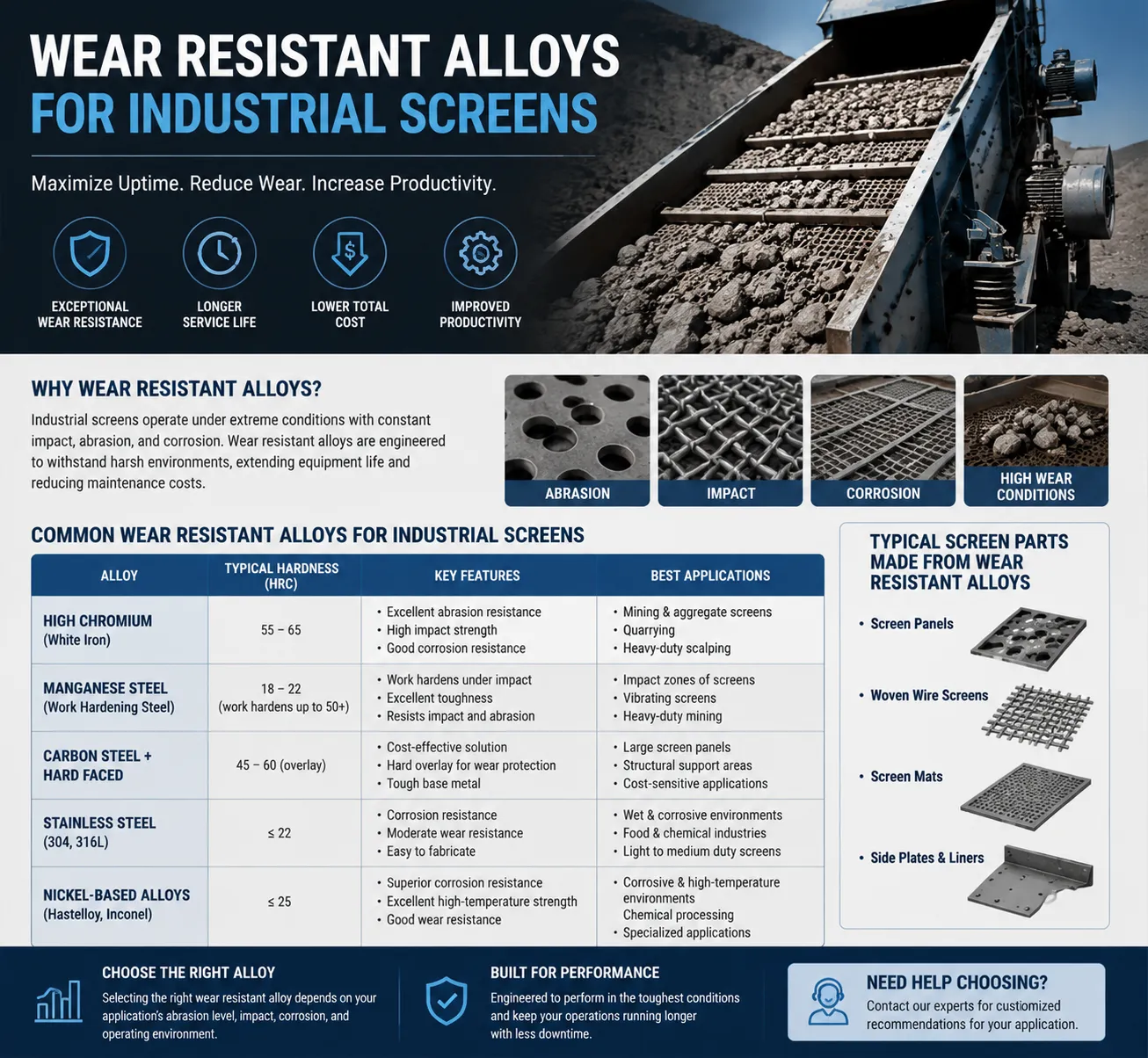
We built this comparison because it is the single question every procurement call eventually circles back to, and the honest answer is that neither alloy is universally superior.
| Factor | High-Chrome White Iron | Manganese Steel |
|---|---|---|
| Best wear mechanism | Sliding/fine particle abrasion | Impact and gouging abrasion |
| Starting hardness | Very high (50-65 HRC) | Moderate (170-230 BHN) |
| In-service hardening | None, hardness is fixed at manufacture | Significant, surface hardens under impact |
| Impact tolerance | Poor to moderate, can crack or chip | Excellent, designed for repeated impact |
| Weldability | Poor, requires specialized procedures | Good, standard manganese welding electrodes available |
| Typical cost per kg | Higher | Lower to moderate |
| Ideal screen zone | Discharge end, fine screening decks | Feed end, primary crusher screens |
| Failure mode when misapplied | Cracking, spalling under impact | Rapid wear without hardening benefit |
We tell customers running a two-stage screening operation to consider a mixed approach on a single deck, high-chrome panels toward the discharge where particles are finer and impact is minimal, manganese liners at the feed end where large lumps land with real force. This hybrid specification costs more to engineer upfront but consistently outlasts a single-material deck that compromises on both ends of the wear spectrum.
What Other Wear-Resistant Alloys Show Up in Screen Applications?
High-chrome and manganese dominate the conversation, but they are not the only materials we see specified, particularly as customers look for solutions to specific wear problems those two classic alloys do not solve well.
| Alloy/Material | Key Property | Typical Screen Use |
|---|---|---|
| AR400/AR500 abrasion-resistant steel plate | Through-hardened martensitic steel, moderate hardness | Structural screen frames, moderate wear zones |
| Chromium carbide overlay (CCO) plate | Hard carbide weld overlay on mild steel base | Chute liners, transition zones, cost-sensitive wear areas |
| Ceramic composite panels (alumina tile) | Extremely high hardness, low toughness | Ultra-fine screening, slurry handling |
| Polyurethane screen panels | Elastic, high resilience, low weight | Wet screening, noise reduction, fine aggregate |
| Rubber screen panels | High resilience, excellent noise dampening | Wet applications, sticky material handling |
| Nickel-hard iron (Ni-Hard) | Nickel and chromium alloyed white iron | Moderate abrasion with some impact tolerance |
Ceramic composite and polyurethane panels deserve mention because they solve a completely different problem, weight and noise rather than pure wear life, and we increasingly see customers specify polyurethane for wet screening applications where blinding, the clogging of screen apertures by sticky fines, matters more than raw abrasion resistance. Chromium carbide overlay plate has carved out a strong niche in chute and transition areas adjacent to screens because it delivers most of the wear performance of solid high-chrome iron at a fraction of the weight and cost, applied as a weld overlay on a standard mild steel backing plate rather than cast as a solid wear component.
How Do Governing Standards Define These Wear Alloys?
Buyers writing specifications need to reference the correct standard, since a mill certificate claiming "manganese steel" without a grade designation tells you almost nothing about actual composition or expected performance.
| Standard | Governing Body | Scope |
|---|---|---|
| ASTM A128 | ASTM International | Austenitic manganese steel castings, Grades A through E |
| ASTM A532 | ASTM International | Abrasion-resistant white iron castings, Classes I, II, III |
| ASTM A800 | ASTM International | Steel castings, similar or standard grade requirements |
| ISO 21988 | International Organization for Standardization | Alloyed white cast irons for abrasion resistant applications |
| AS 2074 | Standards Australia | Cast steels, including manganese steel grades used across mining sector |
ASTM A532 in particular breaks high-chrome white iron into distinct classes based on chromium content and intended application, Class I covering lower chromium content grades better suited to moderate abrasion, Class II and III covering the higher chromium content used in the most severe sliding abrasion service. We always ask for the specific class reference on a purchase order rather than a generic "high chrome iron" description, because a Class I casting substituted for a specified Class III component will underperform and can void a warranty claim against the wear part supplier.
How Should You Actually Select an Alloy for Your Specific Screen Application?
We run through a practical checklist with every customer rather than defaulting to whichever alloy happens to be cheaper that quarter.
Material hardness of what you are screening comes first, since Mohs hardness above 6, common with quartz-bearing ores and silica sand, pushes the decision toward high-chrome iron on sliding sections regardless of impact considerations. Particle size and drop height at each screen zone matters next, because large lumps dropping from height onto a screen deck generate impact energy that favors manganese, while fine, already-crushed material sliding across a discharge section favors high-chrome. Moisture content changes the calculation too, since wet, sticky material can blind a hard, smooth high-chrome surface more readily than a slightly more compliant manganese or polyurethane surface, and blinding reduces screening efficiency even when the wear rate itself looks acceptable. Operating temperature deserves a mention since high-chrome iron can become brittle at low ambient temperatures in cold climate operations, a consideration mining operations in northern latitudes have learned the hard way after winter cracking incidents that summer operation never revealed. Total tonnage and replacement logistics factor into total cost of ownership, since a component that costs more per unit but lasts three times longer reduces both material spend and, often more importantly, the labor and downtime cost of shutting down a screening circuit to swap worn panels.
| Selection Factor | Favors High-Chrome | Favors Manganese Steel |
|---|---|---|
| Material hardness (Mohs) | Above 6 | Below 5, softer ores |
| Impact energy at screen zone | Low | High |
| Ambient temperature | Moderate to warm | Includes cold climates |
| Screen position | Discharge, fines handling | Feed end, primary crushing interface |
| Budget priority | Longer life, higher upfront cost | Lower upfront cost, good impact durability |
How Do You Weld and Fabricate These Wear Alloys Without Cracking Them?
Fabrication approach differs dramatically between the two alloy families, and this is an area where we see a lot of costly mistakes from shops that treat wear plate welding like standard structural steel welding.
Manganese steel welds successfully with the right procedure, using manganese-matched filler electrodes and strict interpass temperature control, generally keeping interpass temperature below 260°C to avoid carbide precipitation at grain boundaries that would embrittle the heat-affected zone. We never preheat manganese steel before welding, contrary to the instinct many welders bring from carbon steel work, because preheating manganese steel actually increases the risk of that embrittling carbide precipitation rather than reducing cracking risk. Water quenching or forced air cooling immediately after each weld pass, sometimes called interpass quenching, keeps the heat-affected zone from lingering in the temperature range where carbides form.
High-chrome white iron presents a much harder fabrication challenge, since its hard carbide microstructure is inherently brittle and prone to cracking under welding thermal stress. We generally avoid direct fusion welding on high-chrome iron wear components entirely, instead mechanically fastening cast wear panels using bolted or clamped attachment systems designed into the panel from the casting stage. Where welding on high-chrome material is unavoidable, typically for minor repair rather than initial fabrication, it requires controlled preheat, nickel-based filler metal for ductility at the joint, and slow, controlled cooling to avoid the thermal shock that would otherwise crack the surrounding brittle base material.
| Fabrication Consideration | Manganese Steel | High-Chrome White Iron |
|---|---|---|
| Weldability | Good with matched procedure | Poor, avoid where possible |
| Preheat requirement | None, avoid preheating | Required if welding is necessary |
| Attachment method | Welding or bolting both viable | Bolting/mechanical fastening preferred |
| Repair approach | Standard manganese electrode buildup | Specialized nickel filler, limited scope |
| Machining | Difficult once work-hardened, machine before service | Extremely difficult, typically ground rather than machined |
What Does Total Cost of Ownership Actually Look Like Across These Materials?
Purchase price per kilogram tells an incomplete story that we push back on whenever a customer asks us to simply quote the cheapest wear plate available.
| Alloy | Relative Material Cost | Typical Service Life (screening application) | Replacement Labor Consideration |
|---|---|---|---|
| Manganese steel (standard) | Baseline (1.0x) | 6 to 18 months, impact-dependent | Moderate, weldable for field repair |
| High-chrome white iron | 1.3x to 1.8x baseline | 12 to 36 months, abrasion-dependent | Higher, often requires panel replacement rather than repair |
| Chromium carbide overlay plate | 1.5x to 2.0x baseline | 18 to 30 months | Moderate, bolted panel systems common |
| Polyurethane panels | 0.8x to 1.2x baseline | 6 to 24 months, application-dependent | Low, quick panel swap systems standard |
Service life ranges vary enormously by actual operating conditions, and any supplier quoting a single fixed number without asking about your material, tonnage, and screen position is guessing. We calculate cost per ton of material processed rather than cost per kilogram of wear plate whenever a customer gives us enough operating data to do so, since that number actually reflects what the plant controller cares about at the end of the fiscal year.
Frequently Asked Questions
Which is harder, high-chrome white iron or manganese steel?
High-chrome white iron starts considerably harder, typically 50 to 65 HRC as manufactured, compared to manganese steel's initial 170 to 230 Brinell hardness. However, manganese steel work-hardens under impact to reach 450 to 550 Brinell at the wear surface during actual service, which means the comparison depends entirely on whether the application generates enough impact energy to trigger that hardening response. In pure sliding abrasion without significant impact, high-chrome iron's fixed high hardness wins outright.
Can you use high-chrome white iron in a jaw crusher application?
Generally no, jaw crusher liners see severe impact and gouging loads that high-chrome iron's brittle carbide structure cannot reliably absorb without cracking or chipping. Manganese steel remains the industry standard for jaw crusher liners specifically because its work-hardening response and inherent toughness handle repeated heavy impact far better than any cast iron alternative. High-chrome iron performs best downstream of crushing, in screening and chute applications with lower impact energy.
How long does manganese steel take to fully work harden in service?
The work hardening process begins with the very first impacts and continues progressively over the component's service life, typically reaching near-maximum surface hardness within the first several weeks to a few months of active duty depending on impact frequency and energy. There is no fixed universal timeframe since hardening rate depends entirely on how much and how hard the material actually gets struck. Components in continuous heavy impact service harden faster than those seeing occasional, lighter impacts.
Why does my manganese steel screen panel wear out faster than expected?
Premature wear on manganese steel most commonly indicates insufficient impact energy at that screen location to trigger the alloy's work hardening response, leaving the material at its softer as-cast hardness throughout its service life. This typically means manganese was specified for a zone that actually experiences primarily sliding abrasion rather than impact, making high-chrome iron or a hard facing alternative the more appropriate material for that specific location. Reviewing the actual wear mechanism at that screen position usually reveals the mismatch.
Is chromium carbide overlay plate a good substitute for solid high-chrome castings?
Yes, in many applications, chromium carbide overlay plate delivers comparable surface hardness and wear resistance to solid high-chrome castings while weighing significantly less, since only a thin hard-facing layer sits atop a standard mild steel backing plate. This makes it particularly attractive for chute liners and transition areas where weight reduction simplifies installation and structural support requirements. Solid castings remain preferable for high-stress structural wear components where the backing plate itself needs to share load-bearing duty.
Does adding nickel or molybdenum improve manganese steel performance?
Yes, molybdenum and chromium alloying additions to standard manganese steel, covered under ASTM A128 Grades B through D, improve yield strength and resistance to cracking under the heaviest impact loads compared to the unalloyed base grade. These alloyed variants cost more but reduce the risk of premature cracking in the most demanding primary crushing and heavy impact screening applications, often justifying the added cost through reduced unplanned replacement frequency.
Can high-chrome white iron crack in cold weather operation?
Yes, high-chrome white iron's inherent brittleness increases at low temperatures, and operations in cold climates have documented cracking incidents during winter months that did not occur during warmer operating periods with identical loading conditions. This is a genuine engineering consideration for mining and aggregate operations in northern latitudes, and some operators specify a tougher, slightly lower chromium grade or switch to manganese steel for components exposed to sustained sub-zero ambient temperatures.
What is the difference between AR plate and high-chrome white iron for screen wear parts?
AR plate, such as AR400 or AR500, is a through-hardened martensitic steel with moderate hardness and considerably better toughness than high-chrome white iron, making it suitable for structural wear applications with moderate abrasion and some impact tolerance. High-chrome white iron delivers significantly higher hardness for pure sliding abrasion resistance but sacrifices the toughness AR plate offers. Screen frames and structural components generally use AR plate, while the actual wear-facing screen media more often uses high-chrome iron or manganese steel depending on the wear mechanism present.
How do you know if your screen wear problem is impact or abrasion dominated?
Examining the wear pattern on your current worn-out screen panels tells most of the story, since impact-dominated wear shows localized deformation, dents, and sometimes cracking concentrated where large material lands, while abrasion-dominated wear shows more uniform, gradual thinning and smoothing across the surface. Tracking where on the screen deck failures occur first, feed end versus discharge end, also reveals the dominant mechanism, since feed zones typically see more impact while discharge zones see more pure sliding abrasion from finer material.
Are ceramic wear panels better than metal alloys for industrial screens?
Ceramic composite panels offer superior hardness and wear life in specific applications, particularly ultra-fine screening and slurry handling, but their brittleness makes them unsuitable for any application with meaningful impact loading, where they will crack rather than deform. Metal alloys, particularly manganese steel and high-chrome iron, remain the more versatile and impact-tolerant choice for the majority of industrial screening applications, with ceramics reserved for specific niche wear problems metal alloys handle less efficiently.
Verifiable Sources
ASTM A128, Standard Specification for Steel Castings, Austenitic Manganese, ASTM International.
ASTM A532, Standard Specification for Abrasion-Resistant Cast Irons, ASTM International.
ISO 21988, Alloyed White Cast Irons for Abrasion Resistant Applications, International Organization for Standardization.
ASM International, ASM Handbook Volume 1, Properties and Selection: Irons, Steels, and High-Performance Alloys, sections on austenitic manganese steel and white cast irons.
Hadfield, R.A., Original metallurgical papers on manganese steel, referenced in ASM historical alloy development records.
Society for Mining, Metallurgy and Exploration (SME), Mining Engineering Handbook, wear material selection chapter for comminution and screening equipment.
Australian Standard AS 2074, Cast Steels, Standards Australia.
Ready to Specify the Right Wear Alloy for Your Screening Operation?
If your screen deck is wearing out faster than your budget can absorb, or you are designing a new screening circuit and need to match the right alloy to each wear zone, guessing between high-chrome and manganese options costs real money in downtime and premature replacement. Our team at MWalloys reviews your actual material characteristics, particle size, and impact conditions before recommending a wear solution, not a one-size-fits-all catalog part. Contact our materials engineering team today to get a screen wear assessment built around your specific operating conditions.