
W1 tool steel remains one of the most economical high carbon tool steels on the market, and when users respect its limitations regarding toughness and distortion, it delivers excellent cutting performance, high hardness and very sharp edges at a fraction of the cost of alloyed grades. In practical terms that means W1 from a controlled source such as MWalloys is an ideal choice in hand tools, simple dies, gauges and short‑run cold work tooling, while engineers should move to oil hardening or air hardening steels once impact loading, complex geometry or tight dimensional tolerances become critical.
What is W1 tool steel in practical engineering terms?
Classification and naming
W1 sits in the water hardening tool steel family within the AISI tool steel classification. The letter “W” refers to water hardening practice, not tungsten content. Key points:
- Type: Plain high carbon tool steel.
- AISI / SAE designation: W1.
- Typical standards:
- ASTM A681 Tool Steels Alloy.
- SAE J437 / J438.
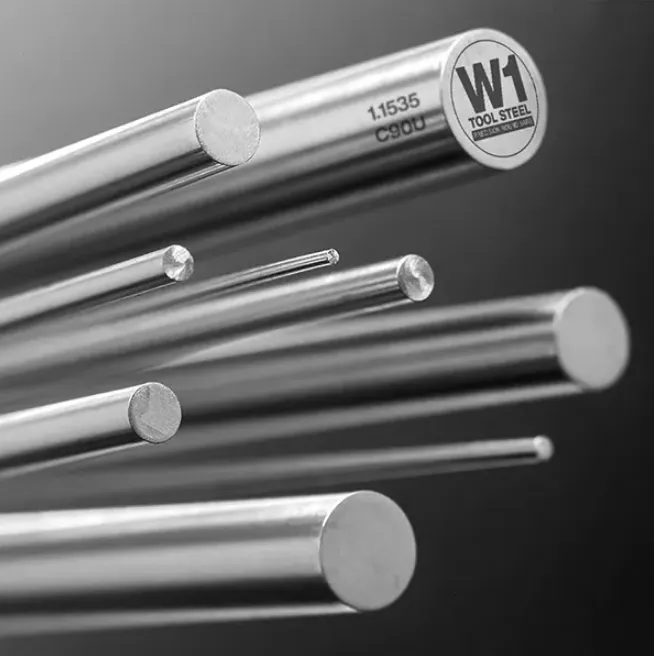
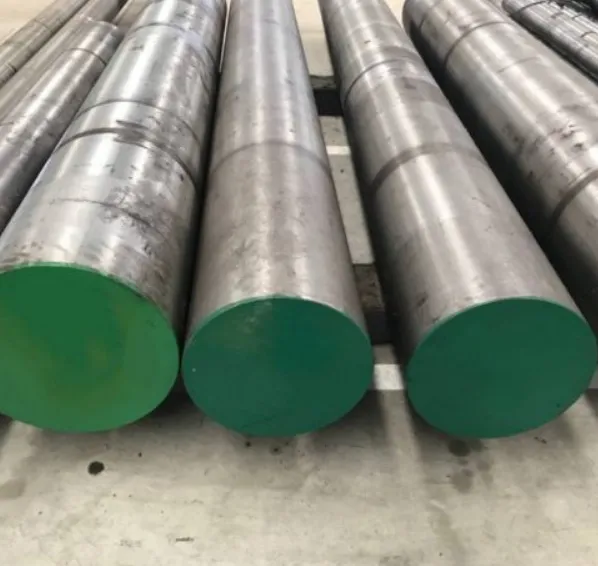
- Product forms: rounds, flats, plates, precision ground stock, drill rod, wire, sometimes forged blocks.
In most modern specifications W1 contains very little alloy content beyond carbon, manganese and silicon. That puts it close to high grade plain carbon steel, but with tighter control over composition, cleanliness and hardenability intended to meet tool performance requirements.
Why W1 is still widely used
Despite the availability of more advanced grades, W1 still sees heavy use because:
- It reaches very high hardness levels after water quench
- Heat treatment routines are straightforward and can be carried out with basic equipment
- Cost per kilogram remains low compared with oil hardening or air hardening tool steels
- Cutting edges can be ground extremely sharp and polished easily
- Many legacy tools and prints still call out W1
At the same time, engineers must keep in mind that W1 has:
- Limited toughness compared with alloyed cold work steels
- Pronounced risk of cracking and distortion during quench
- Modest wear resistance compared with high alloy grades such as D2 or M2
- Very low tempering temperatures relative to high speed steels
So W1 suits low to medium duty applications where edge sharpness, cost and ease of heat treatment outweigh needs regarding impact resistance and dimensional stability.
If your project requires W1 tool steel, contact MWalloys for a free quote.
How does W1 tool steel composition influence performance?
Typical chemical composition of W1
Values in the table come from common industry references and MWalloys internal data ranges. Individual producers may vary slightly.
| Element | Typical content (weight percent) | Role in W1 behavior |
|---|---|---|
| Carbon C | 0.70 – 1.00 | Governs achievable hardness, wear resistance and edge retention. Higher end of range gives harder but less tough material. |
| Manganese Mn | 0.10 – 0.40 | Improves hardenability slightly and assists deoxidation during steelmaking. Excess levels reduce toughness. |
| Silicon Si | 0.10 – 0.35 | Deoxidizer, slightly increases strength. Excess levels can raise brittleness. |
| Phosphorus P | ≤ 0.025 (max) | Impurity; controlled tightly to reduce embrittlement and improve toughness. |
| Sulfur S | ≤ 0.025 (max) | Impurity; controlled tightly to avoid hot shortness and cracking. |
| Chromium Cr | sometimes ≤ 0.20 | Some melts contain a trace to tweak hardenability and wear performance. |
| Vanadium V | sometimes ≤ 0.10 | Trace additions refine grain size and improve edge stability. |
Not every W1 chemistry includes chromium or vanadium; plain carbon variants still dominate supply. MWalloys can provide heat certificates that show exact ranges and residual contents, which is important when users need consistent response during heat treatment.
Carbon content and its effect on hardness and toughness
Carbon level sits at the heart of W1 performance:
- Below roughly 0.75 percent carbon
- Maximum hardness drops slightly
- Toughness improves
- Suitable in tools needing a combination of strength and some ductility
- Around 0.90 percent carbon
- Very high hardness potential after quench
- Edge retention improves significantly
- Shock resistance drops
In practice, most commercial W1 supplies cluster near 0.90 percent carbon, targeting the best compromise between edge holding and toughness in hand tools and light duty dies.
Role of manganese and silicon
W1 intentionally keeps alloying modest. Manganese and silicon appear in low percentages:
- Manganese
- Slightly helps through‑section hardening
- Binds sulfur to create manganese sulfide, reducing hot shortness
- Excess levels could drop toughness, which is why W1 limits remain modest
- Silicon
- Strengthens ferrite
- Provides deoxidation during steelmaking
- Can increase temper resistance a little
Together they give W1 enough hardenability to transform fully in small sections during water quench while keeping microstructure reasonably tough below the brittle hardness threshold.
Cleanliness and inclusion control
Tool steels like W1 often see service in sharp cutting edges and thin sections. Nonmetallic inclusions, particularly large sulfide or oxide particles, act as crack initiators under stress. High quality W1:
- Controls sulfur and phosphorus stringently
- Uses secondary refining or controlled ladle practice
- Targets small, finely dispersed inclusions
From a procurement viewpoint, requesting mill certificates and, where critical, ultrasonic or macroetch inspection from suppliers such as MWalloys reduces risk of unexpected brittle failures in service.
Which mechanical properties define W1 in service?
Typical hardness ranges
The central reason clients pick W1 lies in the high hardness levels reachable through simple water quench.
| Condition | Approximate hardness | Notes |
|---|---|---|
| Annealed | 175 – 217 HB | Soft enough to machine readily before hardening. |
| Quenched, untempered | 64 – 67 HRC | Maximum hardness, rarely kept in practice due to brittleness. |
| Tempered at 150 – 200 °C | 62 – 64 HRC | Common in cutting tools requiring extreme sharpness. |
| Tempered at 200 – 300 °C | 58 – 62 HRC | Compromise between hardness and toughness in punches, small dies. |
| Tempered at 350 – 400 °C | 52 – 58 HRC | Used where higher impact loading exists and wear demands drop slightly. |
Exact values depend on carbon content, section size, quench severity and tempering duration. Thin tools cool faster during quench and may reach slightly higher hardness compared with thicker sections.
Strength, toughness and wear behavior
Beyond hardness numbers, engineers care about:
- Yield and tensile strength
- In fully hardened and tempered condition, tensile strength can exceed 2000 MPa in thin sections.
- Yield strength increases with hardness but ductility falls.
- Toughness
- W1 exhibits moderate toughness at hardness below roughly 58 HRC.
- At higher hardness levels, Charpy V‑notch values drop sharply.
- Sharp corners, thin webs and abrupt section changes require conservative practice in quenching to avoid cracking.
- Wear resistance
- Mainly governed by high carbon martensite and dispersed carbides.
- Adequate in short to medium production runs involving mild to moderate abrasion.
- Not comparable to high alloy cold work grades where chromium and molybdenum carbides dominate wear behavior.
In simple terms, W1 suits tools where high hardness and sharp edges matter more than extended life under heavy abrasive wear or high impact.
Dimensional stability and distortion
Water quench introduces steep thermal gradients in parts, combined with the large volume increase from austenite to martensite transformation. Effects include:
- Distortion in length or flatness
- Out‑of‑round conditions in pins or punches
- Risk of cracking at internal stress concentrators
Sections under roughly 20 mm thick typically through‑harden reliably. Larger sections may show hardness gradients from surface to core. Engineers often design W1 tools slightly oversize, then grind final dimensions after heat treatment.
Later sections give more detail on techniques that improve dimensional control.
How should W1 tool steel be heat treated in industry?
Heat treatment practice has enormous influence on performance. The following parameters represent typical starting values, not absolute prescriptions. Always align final settings with supplier data and tool dimensions.
Summary of common heat treatment cycles
| Step | Temperature range | Purpose | Notes |
|---|---|---|---|
| Annealing | 760 – 790 °C then slow cool | Soften stock, refine microstructure, relieve stresses | Often applied to bar or plate before machining. |
| Normalizing (optional) | 800 – 830 °C air cool | Refine grain, homogenize structure | Sometimes used after heavy forging. |
| Preheat | 400 – 650 °C | Reduce thermal shock on entering austenitizing range | Can use single or two‑step preheat. |
| Austenitizing | 770 – 820 °C | Form austenite with dissolved carbon | Hold only long enough to equalize. |
| Quench | Water or very fast polymer | Transform to martensite | Agitation needed, but gentle to limit warpage. |
| Tempering | 150 – 400 °C | Balance hardness and toughness, relieve stresses | Temper immediately after reaching hand‑warm condition. |
Each step has nuances that influence cracking risk and resultant hardness.
Annealing practice
Suppliers like MWalloys usually ship W1 in spheroidize annealed or fully annealed condition. When extra softening is required before heavy machining:
- Heat slowly to 760 – 790 °C
- Hold long enough to equalize temperature through section
- Cool in furnace at a controlled rate, typically 10 – 20 °C per hour down to about 540 °C
- Then air cool to room temperature
This cycle produces a fine pearlitic or spheroidized structure, with hardness around 180–200 HB, giving good machinability and stable behavior during subsequent heat‑treatment.
Austenitizing and quenching
Correct austenitizing practice balances complete transformation with limited grain growth:
- Preheat
- Raise temperature gradually to about 400–600 °C.
- On large or complex parts, a two‑step preheat near 400 °C then around 650 °C can help reduce thermal shock.
- Austenitize
- Target range roughly 770–800 °C for most sections.
- Thickness and carbon content influence exact choice.
- Soak time typically 10–20 minutes once core reaches target temperature in small tools.
- Excessive time or temperature promotes grain coarsening and higher brittleness.
- Quench
- Use agitated water at roughly 20–30 °C.
- Direct quench from austenitizing furnace into quench tank.
- Move parts in a gentle up‑and‑down or circular motion to reduce vapor blanket persistence while avoiding severe agitation.
- Remove when temperature falls below about 100 °C and part feels hand‑warm.
Some shops sometimes adopt mild oil quench on very thin or intricate W1 tools to reduce cracking risk. That practice may slightly lower hardness and through‑hardening depth, so process validation is essential before series production.
Tempering strategies
Tempering should start as soon as parts reach hand‑warm condition after quench. Leaving fully hardened W1 untempered risks cracking due to retained internal stresses.
General rules:
- Single temper at 150–200 °C
- Used in cutting tools that require maximum edge hardness and high wear performance under light loading.
- Retained hardness can exceed 62 HRC.
- Temper at 200–300 °C
- Common choice in punches and tools subjected to somewhat higher impact.
- Hardness in range 58–62 HRC with improved toughness.
- Temper at 350–400 °C
- Used rarely in W1, because other grades often serve heavy‑duty roles better.
- Hardness drops to roughly mid‑50s HRC, with improved toughness relative to higher hardness conditions.
Hold times typically sit in the range of one hour minimum at temperature, with a rule of thumb of at least one hour per 25 mm of thickness. For sections under 25 mm, one hour is generally adequate.
Where critical, double tempering can help relieve residual stresses further, especially after grinding.
Where is W1 tool steel typically used in tooling and components?
Application profile
W1 occupies a niche where users need:
- Very sharp cutting edges
- Able to heat treat with basic furnaces and water tanks
- Relatively low material cost per piece
- Reasonable wear resistance in low to medium volume production
Common industrial and workshop uses include:
- Hand woodworking tools
- Chisels
- Plane blades
- Scrapers
- Hand tools in metalworking and maintenance
- Taps and dies for manual threading of mild steels
- Reamers, hand broaches
- Scribes, punches, drift pins
- Simple cold work tooling
- Low‑volume blanking and forming dies
- Shear blades handling light gauge softer metals
- Bending tools where friction and abrasive wear remain modest
- Measuring and layout tools
- Squares, straightedges
- Gauges that require good stability and polish
Many of these tools have relatively small cross sections, which suits water hardening grades.
Sectors where W1 still dominates
Although high alloy tool steels often replace W1 in mass production dies and punches, W1 keeps a foothold in several sectors:
- Woodworking and carpentry hand tools
- Model making, instrument manufacture, and fine mechanical workshops
- Maintenance and repair operations where on‑site heat treatment with torches or simple furnaces remains common
- Educational settings demonstrating basic heat treatment principles
In these environments, the ability to harden and temper W1 using simple methods, including local heating with a torch on small tools, can be more attractive than the extended control demands of high alloy grades.
Situations where W1 may not be ideal
Engineers should avoid W1 in several circumstances:
- High production stamping dies handling abrasive sheet materials
- Tools exposed to heavy shock loading or impact
- Complex parts with large section changes or sharp internal corners
- Components requiring tight dimensional stability after heat treatment
- Hot work tools or high speed cutting tools seeing elevated temperatures
For such cases, moving to oil hardening (O1), air hardening (A2, A6), or high alloy cold work steels (D2, M2) brings better life expectancy, even though initial cost and heat treatment requirements increase.
How does W1 compare with O1, A2 and other cold work tool steels?
Comparison with alternative grades often drives material selection decisions. The table below summarizes typical characteristics.
Comparative overview
| Grade | Hardening medium | Typical alloy content | Cost level | Wear resistance | Toughness | Dimensional stability | Typical uses |
|---|---|---|---|---|---|---|---|
| W1 | Water | Plain carbon with low Mn, Si | Lowest | Moderate | Low to moderate | Modest, prone to distortion | Hand tools, simple dies, gauges |
| O1 | Oil | Cr, Mn, W, small V | Low to medium | Higher than W1 | Better than W1 | Better, yet not equal to air hardening | General purpose cold work dies and punches |
| A2 | Air | Cr, Mo, Mn | Medium | High | Good | Very good | Blanking dies, punches, shear blades |
| D2 | Air | High Cr, Mo, V | Medium to high | Very high | Moderate | Good | Long run tooling in abrasive service |
| S7 | Air or oil | Cr, Mo, Si | Medium to high | Moderate | Very high impact resistance | Good | Shock resistant tools, chisels, rams |
| M2 | Air | High Mo, W, V | High | High at elevated temp | Moderate | Good | High speed cutting tools |
Key takeaways:
- W1 wins on material cost and heat treatment simplicity.
- O1 gives better toughness and lower distortion while retaining reasonable cost, frequently replacing W1 in small dies and punches.
- A2 and D2 serve best where production volume and wear demands justify cost and more complex processing.
Practical selection considerations
When a print simply specifies “tool steel”, engineers and buyers often have freedom to select. Decision factors include:
- Section size and geometry complexity
- Required life in cycles or meters cut
- Available heat treatment facilities
- Tolerance requirements after heat treatment
- Budget constraints and scrap costs
In many workshops, W1 remains preferred where:
- Pieces are small and not heavily stressed
- Slight distortion can be handled during final grinding
- Production runs stay short
- Skilled toolmakers value the “feel” of W1 during grinding and sharpening
MWalloys technical staff routinely discuss such trade‑offs with clients, helping match grade choice to process, design and economic objectives.
What machining and grinding practices work best with W1?
Machinability in annealed condition
In spheroidize annealed condition, W1 machines roughly similar to a high quality plain carbon steel near 0.90 percent carbon. Machining features:
- Drilling, turning, milling and tapping proceed smoothly using conventional high speed steel or carbide tooling.
- Chip behavior remains consistent, without extreme instability.
- Cutting speeds can exceed those recommended in alloyed tool steels due to lower alloy content, though care still helps avoid work hardening on the surface.
Typical recommendations for rough planning:
- Cutting speed with high speed steel tools: 18–25 m/min in turning and facing.
- Cutting speed with carbide tools: 120–180 m/min depending on setup rigidity.
- Use of appropriate cutting fluids improves tool life and surface integrity.
In procurement terms, this relatively easy machinability reduces manufacturing cost before heat treatment.
Machining in hardened condition
Once hardened and tempered above roughly 58 HRC, W1 becomes difficult to machine conventionally. Options include:
- Grinding using suitable wheels and coolants
- Electrical discharge machining in certain geometries
- Hard turning with advanced ceramic or CBN tools on rigid machines
Grinding remains the most reliable approach, particularly for final dimensions on punches, dies and gauges.
Grinding recommendations
To avoid grinding burns and microcracks on hard W1:
- Select wheel specification suited to high carbon tool steel, often white or pink aluminum oxide with relatively open structure.
- Use adequate coolant flow with appropriate filtration to avoid abrasive pickup.
- Take multiple light passes rather than one heavy removal pass, especially near sharp corners or thin webs.
- Allow parts to equalize to room temperature between grinding stages if significant material removal occurs.
Post‑grind stress relieving temper sometimes helps where parts show high residual stress and slight movement after machining.
How stable is W1 during quenching and tempering, and how can distortion be reduced?
Factors that drive distortion and cracking
Water hardening grades inherently face higher quench severity than oil or air hardening steels. Distortion arises from several sources:
- Thermal gradients during quench
- Transformation strains from austenite to martensite
- Non‑uniform section thickness or asymmetric geometry
- Residual stresses from prior machining or grinding
Cracking risk increases where:
- Sharp corners or deep keyways concentrate stresses
- Cross sections differ dramatically within one part
- Machining left high tensile surface stresses, particularly in turned sections
Design practices that help W1 survive heat treatment
To improve survival rates and dimensional control:
- Use generous radii at internal corners where possible.
- Maintain uniform cross sections, or at least avoid abrupt transitions between thin and thick regions.
- Provide stock allowance on critical surfaces, expecting final grind after heat treatment.
- Avoid deep blind holes or sharp grooves with small root radii.
- Deburr all edges before quench, since burrs act as crack initiators.
Where a design cannot change, switching grade to O1 or A2 may represent a better engineering decision.
Process strategies to control movement
Shops can implement process control steps to tame W1 behavior:
- Stress relief before finish machining
- Heating to roughly 600–650 °C followed by slow cooling helps reduce machining‑induced stresses.
- Controlled preheat and austenitizing
- Avoiding overshoot in temperature and holding only long enough to saturate sections prevents coarse grain growth that invites cracking.
- Directional quenching
- Immersing parts in quench medium in consistent orientation can reduce bending or twisting.
- Plates, blades and thin rectangles benefit from edge‑wise immersion, not flat‑wise.
- Straightening during tempering
- Slight bending corrections sometimes succeed if carried out promptly while part is still at temper temperature and before final temper cool‑down.
However, there are limits. If distortion risk appears unacceptable despite these strategies, design or grade changes become necessary.
What must buyers check when sourcing W1 from suppliers?
Key specification items on purchase orders
To ensure consistent quality and predictable heat treatment response, purchasers should define:
- Material designation
- AISI W1 or equivalent national standard number.
- Condition of supply
- Annealed, spheroidize annealed, or hardened and tempered to a particular hardness.
- Dimensional tolerances and finish
- Hot rolled, precision ground, cold drawn, peeled, centerless ground.
- Mechanical property requirements
- Maximum hardness in annealed state.
- Hardness range required in hardened bar or plate if supplied in that condition.
- Testing and certification
- Mill test reports with chemical composition and hardness.
- Where critical, ultrasonic inspection or other NDT requirements.
MWalloys typically supplies W1 with full traceability and can match client‑specific standards or corporate specifications where required.
Example material specification table
The following table illustrates the level of detail that often appears in a technical purchase description.
| Parameter | Typical requirement |
|---|---|
| Steel grade | AISI W1, ASTM A681, MWalloys quality level |
| Product form | Round bar, ground, 20 mm diameter |
| Delivery condition | Annealed ≤ 207 HB |
| Chemical composition | Within supplier’s W1 range, with C 0.85–0.95 percent, P and S ≤ 0.025 percent |
| Length | 3 m random, or cut lengths on request |
| Straightness | e.g. 1.0 mm per 1000 mm max deviation |
| Surface | Free from scale, seams deeper than defined limit, cracks and laps |
| Certification | EN 10204 3.1 test certificate or equivalent |
Clear definitions help avoid disputes and make sure W1 from different heats behaves consistently during downstream processing.
How does MWalloys supply W1 tool steel to industry?
Although this article focuses on technical aspects, supply chain reliability directly influences project success.
Product ranges commonly available from MWalloys
MWalloys typically maintains W1 stock in the following forms:
| Form | Size range (indicative) | Typical condition | Common uses |
|---|---|---|---|
| Round bar / drill rod | 2 mm – 100 mm diameter | Annealed, precision ground or cold drawn | Punches, pins, small shafts, hand tools |
| Flat bar | 10 × 3 mm up to 300 × 50 mm | Annealed, hot rolled or ground | Dies, shear blades, wear strips |
| Plate | 10 – 100 mm thickness | Annealed, flame cut to size on request | Large dies, plates, fixtures |
| Cut‑to‑length pieces | According to drawing | Annealed | Prototypes, small batch production |
Lead times vary with size and finish requirements. MWalloys can often provide cutting, basic machining, and pre‑hardening on request, supporting clients who lack in‑house equipment.
Value‑added services for W1 users
To support engineers and buyers, MWalloys often provides:
- Guidance during grade selection relative to application needs
- Recommendations on heat treatment windows based on section size
- Advice on comparable grades where international equivalents or second sources are required
- Assistance in interpreting test certificates and correlating values with plant experience
This partnership‑style approach helps clients avoid typical pitfalls associated with plain carbon water hardening tools, such as cracking or inconsistent hardness.
How does W1 behave in relation to corrosion, surface finishing and welding?
Corrosion behavior
W1 contains no deliberate corrosion resistant alloying beyond trace chromium in some variants. Characteristics:
- In humid environments, W1 rusts readily if not protected.
- Fine ground surfaces and polished edges corrode faster if exposed to moisture, fingerprints and cutting fluids without cleaning.
- Long‑term storage requires rust preventive oils, VCI packaging, or controlled humidity.
For tools subjected to intermittent wet conditions, surface treatments such as black oxide, phosphate coatings, or thin hard chrome layers can provide practical protection, though base steel still rusts if coatings become damaged.
Surface treatments and coatings
Several finishing options can enhance performance:
- Nitriding or nitrocarburizing
- Creates hard compound layers and diffusion zones that raise surface hardness and wear resistance.
- Treatment temperature remains below tempering range used earlier to avoid softening bulk material.
- Hard chrome plating
- Improves wear resistance and corrosion resistance on selected surfaces.
- Requires attention to hydrogen embrittlement; post baking near 180–200 °C helps mitigate risk.
- PVD coatings
- TiN, TiCN or similar coatings on cutting tool edges raise wear life.
- Surface must be clean and free from grinding burns or microcracks to gain full benefit.
MWalloys can often coordinate such treatments through partner facilities where clients request turnkey solutions.
Weldability considerations
Plain high carbon tool steels like W1 respond poorly to conventional welding due to:
- High crack sensitivity in heat‑affected zones
- Significant hardness variations near weldments
- Risk of distortion and loss of dimensional control
If welding on W1 becomes unavoidable, for example during repair of dies:
- Preheating to a moderate temperature reduces thermal gradients and cracking
- Low hydrogen welding consumables and controlled heat input become essential
- Post‑weld stress relief and local re‑heat treatment improve microstructure in welded regions
However, design changes or selective insert replacement often represent better long‑term solutions than welding of heavily loaded tools in W1.
How do cost and lifecycle considerations affect W1 selection?
Material and processing cost comparison
W1’s appeal begins with low alloy content and simple hardening practice:
- Raw material price per kilogram sits at the lower end of tool steel options.
- Heat treatment can be carried out in basic furnaces and water quench tanks, reducing equipment cost.
- Cycle durations are relatively short compared with high alloy grades that require higher temperatures and controlled atmosphere furnaces.
Against that, engineers must consider:
- Risk of scrap due to cracking during quench in complex parts.
- Additional stock and grinding needed to correct distortion.
- Shorter tool life where wear and impact loads are high.
In many low volume applications, total lifecycle cost still favors W1, particularly in hand tools or maintenance jigs that see intermittent use.
Tool life and maintenance
Tool life in W1‑based components depends heavily on operating conditions:
- In light duty cutting of softer materials, tools may run adequately for extended intervals.
- In abrasive environments, edges dull more rapidly than D2 or high speed steel equivalents.
- Regrinding frequency increases in tougher service conditions, though ease of sharpening partly compensates.
Maintenance crews often appreciate W1 because:
- It sharpens quickly on standard grinding wheels or stones.
- It gives a keen edge when honed carefully.
- It behaves predictably once an appropriate heat treatment regime has been established in a particular plant.
When evaluating total cost of ownership, factors such as downtime, sharpening labor and scrap parts must join material price in the calculation.
Frequently asked questions about W1 tool steel
W1 Tool Steel: Water-Hardening & Performance FAQ
1. What is W1 tool steel primarily used in?
W1 is primarily used for hand tools and simple cold-work applications such as chisels, punches, woodworking blades, reamers, and hand taps. Its combination of low cost and high achievable hardness makes it ideal for tools where extreme toughness is not the primary requirement.
2. Is W1 considered a water-hardening steel?
3. How hard can W1 tool steel get after heat treatment?
After a proper water quench, W1 can reach a maximum hardness of 64 to 67 HRC. After tempering to balance toughness, it is typically used in the 58 to 64 HRC range, depending on whether the tool needs a razor-sharp edge or better impact resistance.
4. Can W1 be quenched in oil instead of water?
5. How does W1 differ from O1 tool steel?
6. Is W1 tool steel easy to machine?
7. Does W1 rust easily?
8. Can W1 be used in hot-work tooling?
It loses its hardness rapidly when exposed to temperatures above 200 degrees C. For applications involving high heat, such as forging dies or hot extrusion, you should use a dedicated hot-work steel like H13.
9. What is the typical tempering range for W1?
Most W1 tools are tempered between 150 degrees C and 350 degrees C. Tempering at the lower end (150-200 degrees C) preserves high hardness for cutting edges, while higher temperatures (300+ degrees C) improve toughness for tools subject to shock.