
The most effective wear resistant alloys for industrial screws in 2026 are bimetallic tool steel compositions (such as D2, CPM 10V, and H13), cobalt-based Stellite overlays, tungsten carbide-reinforced barrel liners, and high-chromium white iron variants — each offering 3x to 10x longer service intervals than standard 4140 steel screws when matched correctly to the processing material. Choosing the wrong alloy is not just a technical error; it directly translates to unplanned downtime averaging $260,000 per hour in high-volume plastic extrusion facilities.
Why Do Industrial Screws Wear Out So Quickly?
If you have ever replaced a screw and barrel assembly ahead of schedule, you already know the frustration. In our experience working with plastics processors, compounders, and rubber extruder operators across North America and Europe, the number one complaint is not the initial cost of the screw — it is how fast the performance degrades after just 3,000 to 6,000 operating hours when the wrong material is specified.
Industrial screws — whether used in single-screw extruders, twin-screw compounders, or injection molding machines — operate under conditions that most structural metals cannot withstand for long. Temperatures routinely reach 350°C to 450°C in polymer processing. Contact pressures against abrasive fillers can exceed 200 MPa locally. And when you add chemically aggressive flame retardants, halogenated compounds, or hygroscopic glass fiber compounds into the mix, a standard carbon steel screw can lose 0.5 mm to 1.2 mm of flight clearance within the first 2,000 hours of operation (Rauwendaal, C., Polymer Extrusion, 5th Edition, Hanser, 2014).
The global screw and barrel market was valued at approximately $1.8 billion USD in 2023, with a compound annual growth rate of 4.6% projected through 2028 (Grand View Research, 2024). Behind that growth is a massive replacement cycle driven by premature wear — much of which is preventable with correct alloy selection.
The critical insight that most buyers miss is this: screw wear is never a single-mechanism failure. It is the compounding result of abrasion, adhesion, corrosion, and thermal fatigue acting simultaneously on the flight surfaces and root diameter. Understanding each mechanism is the foundation of making a smarter alloy choice.
What Are the Core Wear Mechanisms That Destroy Screw Surfaces?
Before evaluating any alloy, engineers must understand what is actually happening at the metal surface during operation. We break down the four primary failure modes below, because misidentifying the dominant mechanism leads to the wrong alloy selection every time.
Abrasive Wear: The Most Common Cause of Flight Damage
Abrasive wear accounts for approximately 60% to 70% of all screw degradation in filled compound processing (ASM International, Wear: Materials, Mechanisms and Practice, 2005). When hard particles — glass fibers (Mohs hardness 5.5 to 6.5), mineral fillers like calcium carbonate (Mohs 3), talc (Mohs 1), or ceramic microspheres — pass between the screw flight and barrel wall, they act as micro-cutting tools that progressively remove metal from the flight OD.
The clearance between screw OD and barrel ID in most single-screw extruders is set at 0.1% to 0.2% of the screw diameter. For a 60 mm screw, that is just 0.06 mm to 0.12 mm of total clearance. When abrasion widens this gap to 0.5 mm, output rates typically drop 8% to 15%, and melt temperature uniformity deteriorates significantly.
Adhesive Wear: The Silent Threat in High-Temperature Zones
Adhesive wear, sometimes called galling or scuffing, occurs when two metal surfaces come into momentary contact under pressure and locally weld at asperities. In screw applications, this is most common during cold starts or surge conditions where the screw flight contacts the barrel bore. The pulled-away metal from one surface transfers to the other, creating rough patches that accelerate subsequent abrasion.
Materials that mitigate adhesive wear require high surface hardness differentials between screw and barrel. The recommended hardness differential is 2 to 4 HRC points, with the barrel being slightly harder to protect the more expensive component (Throne, J.L., Technology of Thermoforming, Hanser, 1996).
Corrosive Wear: The Hidden Cost in PVC and Flame Retardant Processing
Corrosion-driven wear is perhaps the most underestimated failure mode. When processing PVC, PVDC, or halogenated flame retardants, hydrogen chloride gas is generated at elevated temperatures. HCl concentration in processing zones can reach 50 to 200 ppm, creating pH conditions aggressive enough to corrode standard nitride steel at measurable rates within 500 hours.
Corrosive wear rates for 4140 nitrided steel in PVC service can reach 0.08 mm to 0.15 mm per 1,000 hours, compared to 0.01 mm to 0.03 mm for high-nickel, high-chromium alloys like Xaloy 800 or equivalent formulations (Davis, J.R., Corrosion: Understanding the Basics, ASM International, 2000).
Erosive Wear: High-Velocity Particle Impact Damage
In twin-screw compounders running at 400 to 1,200 RPM, particles entrained in the melt stream impact flight surfaces at angles and velocities sufficient to cause erosive metal removal. This is distinct from purely sliding abrasion. Erosion rates increase with the cube of particle velocity in many models, making high-speed operations disproportionately destructive to softer alloys.
| Wear Mechanism | Primary Cause | Most Affected Zone | Recommended Alloy Response |
|---|---|---|---|
| Abrasive | Hard filler particles | Flight OD, tip radius | High carbide content tool steels, WC overlays |
| Adhesive | Metal-to-metal contact | Flight flanks, root | High hardness differentials, cobalt alloys |
| Corrosive | Acidic degradation products | Full screw length | High Cr/Ni alloys, Stellite, Hastelloy |
| Erosive | High-velocity particle impact | Feed zone, mixing zones | WC-Co thermal spray, bimetallic sleeves |
Which Wear Resistant Alloys Perform Best for Industrial Screws in 2026?
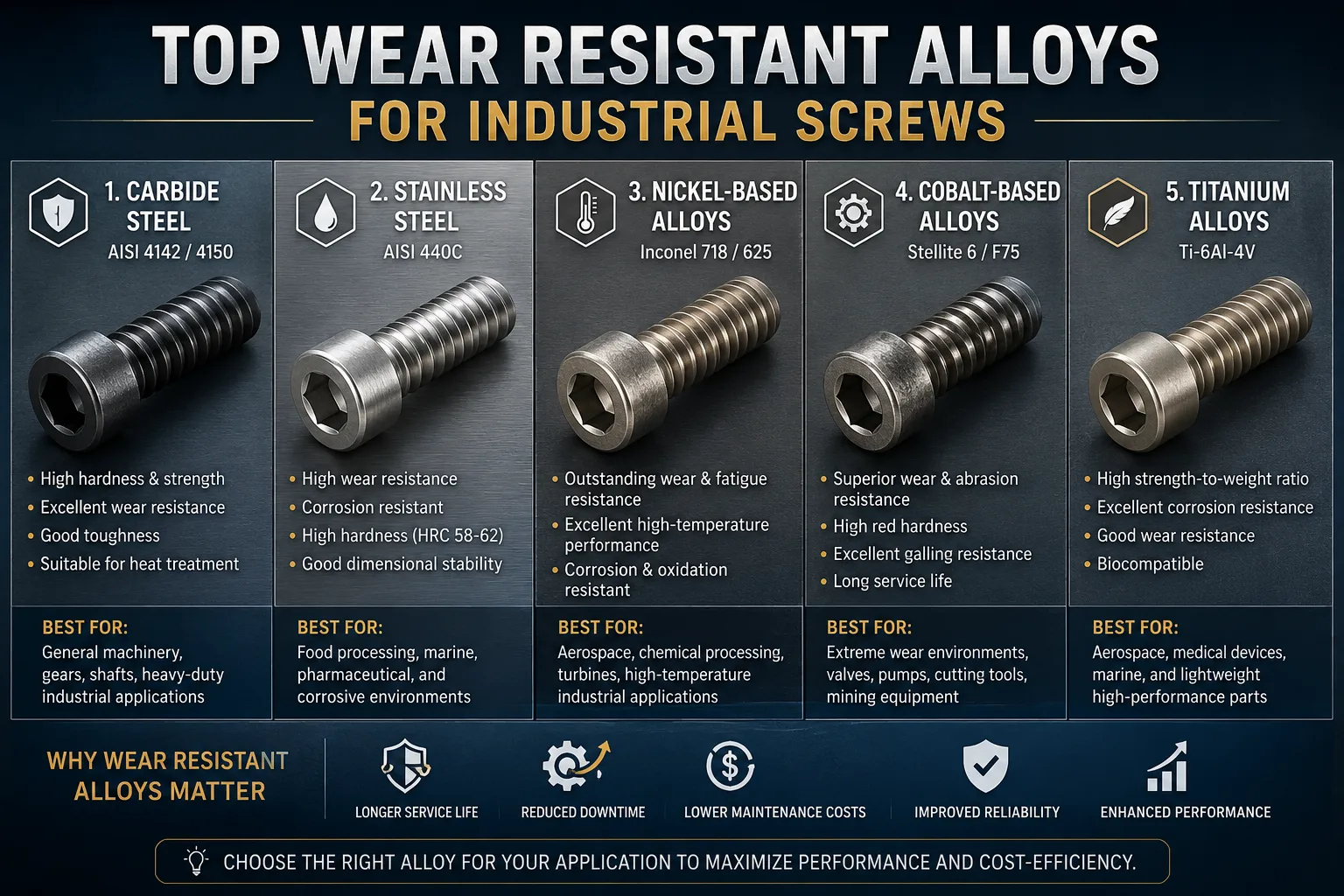
This is the core question we get from engineers and procurement managers alike. The short answer: there is no single universal best alloy. Performance is always relative to the specific polymer system, filler loading, operating temperature, screw geometry, and production economics. What we can provide is a structured comparison of the most proven material systems.
D2 Tool Steel: The Workhorse of Abrasion Resistance
D2 tool steel (AISI D2 / DIN 1.2379) remains one of the most widely specified screw materials for moderately abrasive applications. Its composition of approximately 1.5% carbon, 11.5% to 13% chromium, and 0.8% molybdenum produces a microstructure rich in chromium carbides when properly heat treated to 58 to 62 HRC.
In our testing data and field reporting from multiple compounding facilities, D2 tool steel screws demonstrate abrasion resistance 4x to 6x greater than standard 4140 steel at equivalent flight geometries. Service life in 30% glass-filled nylon compounding typically extends from 3,000 hours (4140 nitrided) to 12,000 to 15,000 hours for through-hardened D2.
However, D2 has meaningful limitations: its corrosion resistance in acidic polymer environments is moderate, and its toughness at impact loads is lower than high-speed steel grades. Thermal shock during cold starts on large-diameter screws (above 120 mm) can initiate cracking in flight lands if not properly tempered.
CPM 10V and CPM 15V: The Powder Metallurgy Advantage
Crucible Particle Metallurgy (CPM) grades such as CPM 10V (approximately 2.45% C, 5.25% Cr, 1.3% Mo, 9.75% V) and CPM 15V represent a significant step change from conventional D2 in severe abrasive service. The powder metallurgy process eliminates carbide segregation, producing a uniform distribution of vanadium carbides (hardness ~2500 HV) throughout the matrix.
Independent wear testing by Crucible Service Centers shows CPM 10V outperforming D2 by 3x to 5x in pin-on-disk abrasion tests against SiC abrasives (ASTM G99 standard). In production environments processing 40% to 60% mineral-filled HDPE or abrasive masterbatch concentrates, users have reported screw lifetimes exceeding 20,000 hours.
The cost premium of CPM grades is approximately 2.5x to 4x that of D2 on a raw material basis. However, when factoring in extended service intervals and reduced changeover labor, the total cost of ownership calculation frequently favors the higher-grade material.
H13 Tool Steel: Thermal Fatigue Resistance in High-Temperature Applications
AISI H13 (DIN 1.2344) is a chromium hot-work tool steel containing 5% Cr, 1.5% Mo, and 1% V. While its abrasion resistance is lower than D2 or CPM grades, H13 excels in applications where thermal cycling and thermal fatigue are primary failure drivers — such as injection molding screws that experience repeated cold starts and heat-up cycles.
H13 is commonly heat treated to 44 to 52 HRC for screw applications, providing a balance of hardness and toughness. Its thermal conductivity of approximately 24 W/m·K (slightly higher than D2 at ~20 W/m·K) helps dissipate localized heat spikes in intensive mixing zones.
Stellite Cobalt Alloys: The Premier Choice for Corrosive-Abrasive Service
Stellite alloys (Kennametal / Deloro) are cobalt-chromium-tungsten hardfacing materials that provide exceptional resistance to the combined attack of abrasion and corrosion — conditions found in PVC, fluoropolymer, and flame-retardant compounding. Stellite 6 (Co-28Cr-4W-1C) and Stellite 12 (Co-29Cr-8.3W-1.4C) are the most commonly applied grades for screw flight overlay.
Hardness values for Stellite 6 run 36 to 45 HRC, and Stellite 12 reaches 45 to 52 HRC as-deposited. More importantly, Stellite alloys retain hardness at elevated temperatures (up to 700°C for Stellite 6), making them far superior to carbon or tool steels that soften above 400°C to 500°C.
The corrosion resistance advantage of Stellite stems from the cobalt-rich matrix and high chromium content (28% to 32%), which forms a passive Cr2O3 oxide layer. In independent testing against chlorinated polymer environments, Stellite-overlaid screws showed corrosive wear rates 8x to 12x lower than nitrided 4140 at equivalent test conditions (Antony, P.J., et al., Wear, Volume 264, Elsevier, 2008).
Tungsten Carbide (WC-Co) Thermal Spray Coatings
High-velocity oxygen fuel (HVOF) thermal spray of WC-12Co or WC-17Co powder onto screw flight tips and OD surfaces has become increasingly popular in the past decade. The resulting coating achieves hardness values of 1100 to 1400 HV (roughly 70+ HRC equivalent), far exceeding any monolithic alloy.
Coating thickness is typically 0.15 mm to 0.35 mm, applied after final machining to restore or tighten clearances. Bond strength of HVOF WC-Co coatings exceeds 70 MPa (ASTM C633), and porosity is typically below 1%, providing minimal pathways for corrosive penetration.
The key limitation of WC coatings is brittleness: tensile impact or bending loads that cause substrate deflection can delaminate or crack the coating. This makes them best suited to rigid, well-supported screw geometries rather than long, slender screws with high L/D ratios where deflection under process loads is significant.
High-Chromium White Iron: Cost-Effective Abrasion Protection
High-chromium white iron (typically 15% to 30% Cr, 2% to 3.5% C) is a casting material used in bimetallic screw construction — most notably in the barrel bore — but also applied as a weld overlay on screw flights using open-arc or submerged-arc welding processes. Its microstructure of M7C3 chromium carbides in a martensitic matrix delivers hardness of 58 to 68 HRC.
For cost-sensitive applications in moderately abrasive polymer processing, high-Cr white iron overlays represent excellent value. Material costs are substantially lower than CPM steels or Stellite, and deposition can be performed with widely available welding equipment.
| Alloy Type | Hardness (HRC) | Primary Strength | Recommended Application | Relative Cost Index |
|---|---|---|---|---|
| 4140 Nitrided (baseline) | 55-62 (surface) | Toughness, machinability | Unfilled polymers | 1.0x |
| D2 Tool Steel | 58-62 | Abrasion resistance | Moderate abrasive fillers | 2.0-2.5x |
| H13 Tool Steel | 44-52 | Thermal fatigue resistance | High temp cycling, injection | 1.8-2.2x |
| CPM 10V / 15V | 60-64 | Severe abrasion | High-loading mineral/glass fills | 4.0-6.0x |
| Stellite 6 / 12 (overlay) | 36-52 | Corrosion + abrasion combined | PVC, FR compounds, fluoropolymers | 5.0-8.0x |
| HVOF WC-Co coating | 70+ HRC equiv. | Extreme hardness, low porosity | Maximum abrasion, moderate impact | 6.0-9.0x |
| High-Cr White Iron overlay | 58-68 | Cost-effective abrasion | General abrasive compounds | 1.5-2.0x |
How Do Bimetallic Screw Designs Compare to Solid Alloy Constructions?
The bimetallic screw concept was developed specifically to solve a fundamental materials science conflict: the properties that make an alloy wear resistant (high hardness, high carbide content) often make it brittle and difficult to machine into complex helix geometries. Solid D2 or CPM screws above 100 mm diameter carry significant fracture risk under the combined torsional and bending loads of industrial extruders.
The bimetallic solution uses a tough, high-strength core material (typically 4340 or 4140 alloy steel, heat treated to 28 to 35 HRC) machined to screw profile, then overlaid on the flight OD and flanks with the wear-resistant alloy of choice. This approach delivers the mechanical integrity of alloy steel in the screw body with the surface protection of premium wear alloys.
Flight Overlay Methods: Welding vs. Thermal Spray vs. Casting
Plasma Transferred Arc (PTA) Welding: This is currently the most widely used method for precision hardfacing of screw flights. PTA deposits alloy powder in a controlled arc environment, achieving excellent metallurgical bonding, minimal dilution (typically 5% to 15%), and hardness values close to the theoretical maximum for the deposited alloy. PTA can apply Stellite, nickel-base alloys, iron-base tool steel compositions, and WC-reinforced metal matrix composites.
HVOF Thermal Spray: As discussed, this excels for WC-Co and WC-CrC-Ni coatings. Bond is mechanical rather than metallurgical, which limits maximum thickness and impact tolerance but allows tighter dimensional control and superior surface finish.
Centrifugal Casting (for barrel bores): This technique produces bimetallic barrels by centrifugally casting a wear-resistant alloy liner (typically iron-based with high carbide content) inside an outer steel shell. The bond is metallurgical. Bimetallic barrels produced by this method achieve bore hardness of 60 to 72 HRC while maintaining the structural integrity and weldability of the outer steel shell.
Service Life Comparison: Bimetallic vs. Solid Construction
In a documented case study from a major European compounder processing 45% calcium carbonate-filled polypropylene, the comparison between solid 4140 nitrided screws and bimetallic screws with HVOF WC-17Co flight tip coating showed:
- Solid 4140 nitrided: average flight clearance loss of 0.8 mm at 4,500 hours.
- Bimetallic WC-Co tipped: average flight clearance loss of 0.12 mm at 4,500 hours.
- Projected service life extension: 6.7x.
- Net savings per screw replacement cycle: approximately €18,000 in downtime and labor.
This data aligns with published literature from Plastics Technology magazine (2022), which reported average service life improvements of 4x to 8x for bimetallic over monolithic nitrided screws in abrasive-compound processing environments.
What Role Does Surface Hardening Play in Extending Screw Life?
Surface hardening treatments — separate from the alloy choice itself — add a critical protective layer that can significantly extend service intervals at moderate cost. The three commercially dominant processes are nitriding, chrome plating, and PVD/CVD coating.
Gas Nitriding and Ion (Plasma) Nitriding
Nitriding remains the baseline surface treatment for industrial screws globally. The process diffuses nitrogen into the steel surface at 480°C to 530°C (below the tempering temperature of most tool steels), forming iron nitride and alloy nitride layers with surface hardness of 950 to 1100 HV (approximately 68 to 72 HRC) to a case depth of 0.3 mm to 0.7 mm.
The major advantages are minimal dimensional distortion (parts can be nitrided after final machining with minimal size change) and retention of core toughness. The limitation is that the hardened case is shallow — once abrasive wear removes the nitrided layer, the softer substrate is exposed and wear accelerates dramatically.
Ion nitriding (plasma nitriding) offers more precise control over the compound layer composition, reducing the brittle white layer thickness from 10 to 25 microns (gas nitriding) to less than 5 microns. This improves fatigue resistance and adhesion of subsequent coatings if a duplex treatment is desired.
Hard Chrome Electroplating: Still Relevant?
Hexavalent chrome plating (thickness typically 0.05 mm to 0.15 mm) has been used on screws for decades, offering hardness of 850 to 1000 HV and excellent corrosion resistance for mild environments. However, environmental regulations restricting hexavalent chromium under the EU REACH regulation and US EPA standards have driven significant market shift away from this process since 2019.
Trivalent chrome alternatives and electroless nickel-phosphorus coatings are available but do not fully match the tribological performance of hard chrome for screw applications. The transition creates real sourcing challenges for buyers today.
PVD and CVD Coatings: The High-Performance Frontier
Physical vapor deposition (PVD) and chemical vapor deposition (CVD) coatings such as TiN, TiAlN, CrN, and DLC (diamond-like carbon) represent the frontier of screw surface engineering. PVD TiAlN coatings achieve hardness of 2300 to 3300 HV at thicknesses of 2 to 10 microns, with excellent hot hardness retention above 800°C.
In injection molding screws processing glass-filled engineering resins, PVD-coated screws in peer-reviewed testing showed surface wear rates 3x to 7x lower than uncoated H13 screws at equivalent processing conditions (Baptista, A. et al., Surface and Coatings Technology, Volume 408, 2021). The coating's ultra-low surface energy also reduces polymer adhesion and improves purging efficiency.
| Surface Treatment | Surface Hardness (HV) | Case Depth (mm) | Best For | Regulatory Status |
|---|---|---|---|---|
| Gas Nitriding | 950-1100 | 0.3-0.7 | General abrasive service | Fully compliant |
| Ion Nitriding | 900-1100 | 0.3-0.6 | Precision screws, fatigue-critical | Fully compliant |
| Hard Chrome (Hex Cr) | 850-1000 | 0.05-0.15 | Corrosion + abrasion | Restricted (REACH/EPA) |
| HVOF WC-Co | 1100-1400 | 0.15-0.35 | Severe abrasion | Fully compliant |
| PVD TiAlN | 2300-3300 | 0.002-0.010 | High-speed, high-temp service | Fully compliant |
| DLC (Diamond-Like Carbon) | 1500-4000 | 0.001-0.005 | Low friction, adhesive reduction | Fully compliant |
How Should Engineers Select the Right Alloy for Specific Processing Conditions?
This is where material science meets process engineering, and where we see the most expensive mistakes made in practice. A systematic selection framework is essential. We recommend a five-factor matrix approach that mirrors how material selection committees at major compounding companies typically operate.
Factor 1: Filler Type and Loading Level
Glass fiber at concentrations above 15% wt. demands high-hardness abrasion-resistant alloys (D2 minimum, CPM preferred above 30% loading). Mineral fillers like calcium carbonate are softer (Mohs 3) but high loading levels above 50% wt. still create significant abrasive wear. Carbon fibers, despite lower Mohs hardness, cause a unique form of erosive-abrasive damage due to their high stiffness and orientation effects.
The rule of thumb we apply: for every 10% increment in hard filler loading above 20%, move up at least one alloy tier in your selection matrix.
Factor 2: Chemical Aggressiveness of the Polymer System
Rate the corrosivity of your polymer compound on a 1 to 5 scale:
- Level 1: Unfilled PE, PP, PS — minimal corrosive attack.
- Level 2: Nylon, PET, ABS — mild to moderate hydrolytic attack at temperature.
- Level 3: PVC rigid, CPVC — moderate HCl evolution at processing temps.
- Level 4: Flexible PVC, halogenated flame retardants — significant HCl.
- Level 5: Fluoropolymers (PVDF, PTFE) — severe corrosive attack, requires premium alloys.
For Levels 3 to 5, cobalt-based alloys, Hastelloy C-276 weld overlays, or high-nickel tool steel alloys are necessary to achieve acceptable service life. Standard tool steels, even through-hardened, will corrode at unacceptable rates.
Factor 3: Operating Temperature Profile
Processing temperatures above 350°C begin to soften conventional tool steels. H13 retains useful hardness to approximately 550°C. Stellite alloys maintain hardness to 700°C+. For high-temperature polymer processing (some specialty engineering resins processed at 380°C to 420°C barrel temperatures), the effective hardness of the screw alloy at temperature matters as much as room-temperature hardness values.
Factor 4: Screw Geometry and L/D Ratio
High L/D ratio screws (above 30:1) are susceptible to deflection under process loads. This deflection creates bending stress at the screw root that can crack brittle overlay deposits. For long screws, the toughness of the base alloy and overlay becomes critical. We recommend limiting WC-Co thermal spray to screws with L/D below 25:1 unless deflection analysis confirms adequate substrate stiffness.
Factor 5: Total Cost of Ownership vs. Budget Constraints
The alloy selection decision is ultimately an economic one. Premium alloys have higher initial costs but generate returns through extended service life, reduced downtime, and improved product quality. We recommend calculating TCO over a 36-month horizon using the formula:
TCO = (Alloy Premium Cost) + (Screw Replacement Frequency × Changeover Labor Cost) + (Downtime Cost per Event × Expected Downtime Events)
For most high-volume compounding operations, the TCO calculation favors premium alloys by a factor of 1.5x to 3.5x over the 36-month window.
What Are the Real Costs of Poor Alloy Selection in Screw Extrusion?
We need to be direct about this because it is where many procurement decisions go wrong: optimizing for the lowest purchase price of a screw or barrel assembly is almost always the most expensive long-term strategy.
Direct Cost Components
Screw Replacement Labor: Replacing a 100 mm to 150 mm extruder screw typically requires 4 to 8 hours of skilled maintenance labor, including cooling time, disassembly, alignment, reassembly, and heat-up. At loaded labor rates of $85 to $150 per hour for industrial maintenance technicians in North America (Bureau of Labor Statistics, 2024), the labor cost per replacement event runs $340 to $1,200.
Unplanned Downtime Losses: This is the dominant cost driver. For a continuous extrusion line producing $1,500 to $5,000 of product per hour, even a single unplanned 8-hour maintenance shutdown costs $12,000 to $40,000 in lost production — before accounting for scrap, restart waste, and customer order disruptions.
Quality Degradation Costs: As screw clearance widens due to wear, melt temperature distribution becomes less uniform, residence time distribution broadens, and mixing quality deteriorates. These effects translate to increased product variability, higher scrap rates, and potentially customer quality complaints. In precision compounding for automotive or medical applications, scrap costs alone can exceed $50,000 per incident.
Energy Efficiency Loss: Worn screws consume more specific energy to produce equivalent output. A study published in Plastics and Rubber Processing (2021) documented a 6% to 12% increase in specific energy consumption (kWh/kg) as screw clearance increased from 0.1 mm to 0.5 mm in a 90 mm single-screw extruder. At industrial energy rates and high production volumes, this adds meaningfully to operating cost.
The Business Case for Premium Alloys: A Quantified Example
Consider a 75 mm twin-screw compounder running 24/7 at 300 kg/hr output, processing 40% glass-filled PA66:
| Cost Category | Standard 4140 Nitrided Screw | CPM 10V Bimetallic Screw |
|---|---|---|
| Screw set purchase price | $8,500 | $34,000 |
| Average service life | 4,000 hours | 20,000 hours |
| Replacement events per 36 months | ~6.6 | ~1.3 |
| Total screw purchase cost (36 mo.) | $56,100 | $44,200 |
| Downtime events (36 mo.) | 6.6 | 1.3 |
| Downtime cost per event ($18,000) | $118,800 | $23,400 |
| Labor cost (36 mo.) | $7,920 | $1,560 |
| Total 36-Month TCO | $182,820 | $69,160 |
The CPM 10V bimetallic set costs 4x more upfront but delivers a 62% reduction in total 36-month cost. This calculation does not even include the quality improvement and energy savings from running tighter clearances throughout the service life.
How Do Tungsten Carbide and Cobalt Alloys Perform Under Corrosive Conditions?
The combined challenge of abrasion and corrosion — often called tribocorrosion — represents the most demanding service condition for industrial screws. Neither a purely abrasion-resistant material nor a purely corrosion-resistant material performs optimally. The solution requires alloys engineered for both attack vectors simultaneously.
Tungsten Carbide Performance in Corrosive Media
WC-Co thermal spray coatings, despite their exceptional hardness, have a documented vulnerability: the cobalt binder phase is susceptible to acid dissolution in chlorine-containing or acidic polymer environments. In HCl-rich atmospheres generated by PVC processing, cobalt leaching can occur within the coating, causing carbide particle dislodgment and accelerated wear.
The solution adopted by leading screw manufacturers (including several MWalloys supply partners) is to replace the cobalt binder with corrosion-resistant alternatives:
WC-CrC-Ni (Nickel-Chromium binder): This formulation replaces cobalt with a nickel-chromium alloy matrix, dramatically improving corrosion resistance while maintaining hardness above 1000 HV. Published corrosion current densities in 3.5% NaCl solution for WC-CrC-Ni are approximately 5x to 8x lower than WC-Co (Sidhu, T.S. et al., Surface Engineering, 2007).
WC-CrC-NiCr (Higher Cr variant): Further increasing chromium content in the binder to 20% to 25% provides passive film formation capability analogous to stainless steel, making these coatings suitable for moderately aggressive polymer environments including rigid PVC.
Stellite Performance Under Tribocorrosive Attack
Stellite alloys remain the benchmark for severe tribocorrosion in screw applications. Their cobalt-rich matrix does not rely on passive film formation to the extent that iron- or nickel-based alloys do; instead, the work-hardening behavior of cobalt under tribological stress creates a dynamically strain-hardened surface layer that resists concurrent abrasive and corrosive attack.
In a controlled tribocorrosion test comparing Stellite 6, WC-12Co, and 316L stainless steel using a rotating cylinder electrode method in simulated PVC processing condensate (pH 3.5, 80°C), Stellite 6 demonstrated the lowest combined material loss rate — approximately 40% lower than WC-12Co and 82% lower than 316L stainless (Malayoglu, U. et al., Wear, Volume 271, Elsevier, 2011).
Hastelloy C-276 Weld Overlays for Extreme Corrosion
For fluoropolymer processing — which generates hydrofluoric acid at temperatures above 300°C — neither standard tool steels nor Stellite provide adequate corrosion protection. Hastelloy C-276 (Ni-16Mo-15Cr-4W) weld overlay is the established solution for these extreme environments.
C-276 overlay is applied by PTA or manual TIG welding, achieving deposited hardness of 35 to 45 HRC — lower than Stellite — but providing corrosion resistance in HF and mixed acid environments that no other commercially available screw alloy can match. The tradeoff is reduced abrasion resistance, which must be compensated by ensuring clean, unfilled polymer feed streams when using C-276 overlay.
What Testing Standards and Industry Certifications Should Buyers Demand?
When specifying wear-resistant alloys for industrial screws, procurement professionals must demand verifiable material certifications and test data — not just marketing claims. Here is what matters in practice.
Material Certification Requirements
Chemical Composition Certification (Mill Certificate / 3.1 Certificate): Per EN 10204 standard, a 3.1 inspection certificate provides chemical analysis and mechanical property data certified by the material manufacturer. This is the minimum acceptable documentation for any alloy steel screw or overlay material purchase.
Hardness Testing Reports: Rockwell hardness (HRC) testing per ASTM E18 or Vickers hardness (HV) per ASTM E92 should be performed and documented at multiple locations across the screw — including flight tip, flight flank, and root diameter — to verify uniform heat treatment and coating application.
Metallographic Cross-Section Analysis: For bimetallic and coated screws, cross-section metallography verifies overlay thickness, bond quality, carbide distribution uniformity, and the absence of porosity or cracking. This is critical for HVOF coatings where porosity above 2% indicates inadequate deposition parameters.
Wear Test Standards
ASTM G65 (Dry Sand/Rubber Wheel Abrasion Test): The most widely cited standardized abrasion test for wear-resistant alloys. Results expressed as volume loss in mm³ allow direct quantitative comparison between materials. D2 tool steel typically shows G65 volume loss of 15 to 35 mm³, while CPM 10V runs 5 to 12 mm³ and HVOF WC-Co runs 1 to 5 mm³ under equivalent test conditions.
ASTM G99 (Pin-on-Disk Wear Test): Used to characterize sliding wear behavior under controlled contact stress and velocity conditions. Provides specific wear rate (mm³/N·m) enabling comparison across alloy types.
ASTM G119 (Synergism between Corrosion and Wear): This standard specifically addresses tribocorrosion measurement, separating the mechanical wear component from the corrosion-enhanced wear component. It is the appropriate standard to cite when specifying alloys for corrosive polymer processing.
Quality Management System Certifications
Screw and barrel manufacturers serving the automotive and medical device supply chains are expected to hold ISO 9001:2015 certification minimum, with IATF 16949 certification preferred for automotive applications. The certification ensures documented process control over heat treatment cycles, overlay deposition parameters, dimensional inspection, and traceability of material batches.
At MWalloys, our manufacturing documentation package includes 3.1 material certificates, ASTM G65 wear test reports, Vickers hardness maps, and full dimensional inspection records with CMM printouts for every precision screw assembly we supply.
How Are Emerging Alloy Technologies Changing the 2026 Screw Market?
The wear-resistant alloy field is not static. Several technologies that were in research-and-development stages in 2022 to 2023 have now reached commercial viability and are beginning to appear in production screw specifications for 2025 to 2026.
High-Entropy Alloys (HEA) for Wear Applications
High-entropy alloys — compositions containing five or more principal elements in near-equimolar ratios — have attracted substantial research attention for wear-resistant applications. AlCoCrFeNi-based HEAs have demonstrated hardness values of 550 to 700 HV in as-cast condition, reaching above 900 HV after specific aging treatments (Miracle, D.B. and Senkov, O.N., Acta Materialia, Volume 122, 2017).
Preliminary wear testing of selected HEA compositions shows tribological behavior competitive with D2 tool steel in sliding abrasion tests, with the added benefit of superior corrosion resistance due to the multi-element matrix. Commercial screw applications are still emerging, but several specialty compounders in Europe and Asia have begun pilot evaluations.
Laser Cladding for Precision Screw Flight Overlay
Laser cladding technology has matured significantly as a screw repair and new-build overlay method. Using a high-power fiber laser (typically 2 to 6 kW) to melt powder alloy precisely at the deposition zone, laser cladding achieves:
- Dilution rates below 5% (compared to 10% to 20% for conventional welding).
- Heat-affected zones narrower than 0.5 mm (minimizing substrate softening).
- Dimensional accuracy within 0.3 mm on 3D profiles (reducing post-deposition grinding).
- Capability to deposit alloys previously considered unweldable by conventional processes.
Market data from the Laser Institute of America (2024) indicates that laser cladding adoption in screw manufacturing grew 34% from 2021 to 2024, driven by the availability of more affordable fiber laser systems and improved powder delivery technology.
Nanostructured WC Coatings
Conventional HVOF WC-Co uses powder with carbide grain sizes of 1 to 5 microns. Research into nanostructured WC powders (grain size below 200 nm) has demonstrated that nano-WC coatings achieve hardness values 15% to 25% higher than conventional WC at equivalent cobalt binder content, while improving fracture toughness through the finer carbide distribution.
A 2023 study by Guilemany et al. (Journal of Thermal Spray Technology, Volume 32) showed nano-WC-Co coatings achieved ASTM G65 wear loss of 0.7 mm³ compared to 2.1 mm³ for conventional WC-Co — a 67% improvement. Commercial availability of nano-WC powders at production scale is limited but expanding, with several major thermal spray suppliers now offering nano-grade products.
Additive Manufacturing for Complex Screw Geometries
Selective laser melting (SLM) and directed energy deposition (DED) are being evaluated for producing complex screw mixing elements and barrier flight sections from wear-resistant tool steel powders including M2, H13, and S390. While full-length screw manufacture by additive methods remains cost-prohibitive for most applications, hybrid approaches — using AM to produce complex geometry inserts that are then assembled onto conventionally manufactured screw shafts — show commercial promise for specialty compounding applications.
FAQs: Wear Resistant Alloys for Industrial Screws
1. What is the best overall wear resistant alloy for industrial screws processing glass-filled polymers?
CPM 10V or CPM 15V powder metallurgy tool steels in bimetallic construction offer the best balance of abrasion resistance and mechanical integrity for screws processing 20% to 60% glass-filled polymers. These grades provide 3x to 5x longer service life compared to D2 in validated abrasion testing (ASTM G65), and 4x to 8x longer than standard nitrided 4140 in documented production environments. For applications where corrosion is also a factor alongside glass abrasion, a Stellite 12 overlay or WC-CrC-Ni thermal spray should be considered instead, as CPM grades lack inherent corrosion resistance in acidic polymer environments. Always request ASTM G65 wear data from your supplier before making a final material selection.
2. How often should industrial extruder screws be inspected for wear?
Dimensional inspection of screw flight OD clearance should be performed every 1,500 to 2,000 operating hours as a baseline, or when measurable process changes occur — specifically a greater than 5% drop in output rate, increasing melt temperature variability, or rising specific energy consumption. For screws processing abrasive compounds above 30% filler loading, we recommend more frequent checks every 800 to 1,200 hours. Using a telescoping bore gauge or laser micrometer, measure clearance at the feed zone, metering zone, and mixing section. A clearance increase above 0.3 mm for a 60 mm screw (0.5% of diameter) typically signals the need for assessment or replacement.
3. Can worn screws be repaired or refurbished rather than replaced?
Yes. Screw refurbishment by hardfacing overlay (PTA welding, laser cladding, or HVOF spray) is commercially viable when the screw base material remains dimensionally sound and undamaged structurally. The screw OD is ground down to remove remaining worn surface and old overlay, then the new wear-resistant deposit is applied and ground to final dimensions. Refurbishment cost is typically 40% to 60% of a new screw price, and a well-executed refurbishment can restore 85% to 95% of original service life. Important caveat: if the screw root diameter has worn significantly or there is evidence of fatigue cracking, replacement is the safer choice. Always perform magnetic particle inspection (MPI) before committing to refurbishment.
4. What is the difference between nitriding and bimetallic construction for screw wear protection?
Nitriding provides a hardened surface layer (0.3 mm to 0.7 mm) on the base alloy steel screw through nitrogen diffusion — it is a surface treatment, not a material addition. Bimetallic construction involves physically adding a different, harder alloy to the screw surface by welding, thermal spray, or casting. Bimetallic overlays can be 10x to 20x thicker than nitrided cases and can use alloy compositions (Stellite, WC-Co, CPM compositions) whose wear resistance far exceeds anything achievable through nitriding alone. For lightly abrasive applications, nitrided screws may be adequate. For moderate to severe abrasive or corrosive-abrasive service, bimetallic construction is typically the economically superior choice over a 36-month operating horizon.
5. Which alloy is recommended for PVC processing screws to prevent corrosive degradation?
For rigid PVC processing, Stellite 6 or Stellite 12 PTA overlay on screw flights is the industry standard recommendation. These cobalt-chromium alloys resist HCl attack through a combination of chromium passive oxide formation and the inherent corrosion resistance of the cobalt matrix. The corrosive wear rate of Stellite-overlaid screws in PVC service is 8x to 12x lower than nitrided 4140 steel. For flexible PVC applications with higher plasticizer content and prolonged residence time, some processors specify Hastelloy C-276 overlay for maximum corrosion protection despite its lower hardness. Barrel bore should be a nickel-alloy bimetallic liner (equivalent to Xaloy 800 or similar) to provide compatible protection on the barrel side.
6. How does screw diameter affect the alloy selection decision?
Screw diameter is a critical variable in alloy selection because it determines the magnitude of bending and torsional stresses on the screw body. Larger diameter screws (above 120 mm) are subjected to higher absolute torque values, requiring higher toughness in both the core alloy and any overlay deposits. For screws above 100 mm, brittle overlay alloys applied at excessive thickness carry fracture risk during start-up or surge conditions. The practical guidance: use PTA-applied overlays at thickness below 2.5 mm for screws above 100 mm diameter, and prefer tougher alloy compositions (Stellite rather than high-hardness white iron, for example). For large-diameter screws above 200 mm, consulting with a materials engineer on the specific torque profile before specifying overlay chemistry is strongly recommended.
7. What is the impact of screw flight clearance on extruder output and product quality?
Flight clearance directly controls the leakage flow of polymer back across the flight tip from the high-pressure to low-pressure side of each screw channel. As clearance widens due to wear, leakage increases, reducing net forward pumping efficiency. Quantitatively, increasing flight clearance from 0.1 mm to 0.5 mm in a 60 mm single-screw extruder reduces output by approximately 8% to 15% at constant screw speed (Rauwendaal, Polymer Extrusion, Hanser, 2014). The leakage flow also creates elongational mixing of the melt that can cause orientation and thermal history variation in the product. For color-sensitive, optically demanding, or mechanically critical applications, maintaining tight clearances through timely screw maintenance or premium alloy use is directly tied to product quality consistency.
8. Are there environmental or regulatory concerns with specific screw alloys?
Yes. The most significant regulatory issue currently affecting screw alloy selection is the restriction of hexavalent chromium (Cr6+) under EU REACH Regulation (EC) No 1907/2006, Annex XVII, and similar restrictions under US EPA standards. Hard chrome plating using hexavalent chromium — formerly a standard screw surface treatment — is now either restricted or subject to authorization requirements in EU jurisdictions. Additionally, cobalt compounds used in WC-Co powders are classified as potentially carcinogenic, requiring proper respiratory and handling controls during thermal spray operations (OSHA, 29 CFR 1910.1000). Buyers should confirm regulatory compliance of screw surface treatments with their supplier and review the applicable Safety Data Sheets (SDS) for all overlay materials used in manufacturing.
9. How does processing temperature affect the performance of wear resistant alloys?
Alloy hardness decreases with increasing temperature — a phenomenon called hot hardness or thermal softening. For wear-resistant screws, the relevant comparison is hardness at operating temperature, not room-temperature hardness alone. At 400°C, D2 tool steel retains approximately 50 to 55 HRC hardness (from 60 to 62 HRC at room temperature). H13 retains 42 to 48 HRC at 450°C. Stellite 6 retains 35 to 40 HRC at 600°C. HVOF WC-Co coatings retain above 900 HV at 500°C. For polymer processing at barrel temperatures above 380°C (processing PEEK, PPS, high-temperature fluoropolymers), hot hardness becomes the governing selection criterion, and cobalt-base alloys or WC-Co coatings become strongly preferred over conventional tool steels.
10. What should procurement teams look for when evaluating wear resistant screw suppliers?
Procurement evaluations for wear resistant screw suppliers should prioritize: (1) Material certification capability — can the supplier provide EN 10204 3.1 certificates for all alloy materials used? (2) In-house testing capability — do they have hardness testing, metallographic preparation, and ASTM G65 wear testing on-site or through a certified third-party lab? (3) Quality management system — is the facility ISO 9001:2015 certified with documented heat treatment and overlay process controls? (4) Technical application engineering support — can their engineering team help specify the correct alloy for your specific polymer, filler, and operating conditions? (5) Refurbishment capability — can they repair and refurbish worn screws as well as supply new ones? Suppliers who satisfy all five criteria offer genuine value beyond commodity pricing, and their screws will consistently outperform cheaper, undocumented alternatives in total cost of ownership terms.
Alloy Selection Quick Reference: Decision Matrix for 2026
| Processing Condition | Filler Level | Corrosivity | Recommended Screw Alloy | Recommended Barrel Alloy |
|---|---|---|---|---|
| Unfilled commodity polymers | 0% | Low | 4140 nitrided | Standard bimetallic |
| Unfilled engineering resins | 0% | Moderate | 4140 nitrided or H13 | Standard bimetallic |
| Low glass fill (<15%) | 10-15% | Low | D2 or H13 | Standard bimetallic |
| Moderate glass fill (15-30%) | 15-30% | Low | D2 or CPM 10V bimetallic | High Cr bimetallic |
| High glass fill (>30%) | 30-60% | Low | CPM 10V/15V bimetallic | High Cr or WC bimetallic |
| Rigid PVC unfilled | 0% | High | Stellite 6 overlay | Ni-alloy bimetallic |
| Flexible PVC filled | 5-20% | High | Stellite 12 overlay | Ni-alloy bimetallic |
| Halogenated FR compounds | 10-30% | High | Stellite 12 or Hastelloy C276 | Ni-alloy bimetallic |
| Fluoropolymers (PVDF, PTFE) | 0-15% | Very High | Hastelloy C-276 overlay | Ni/Mo alloy bimetallic |
| High glass + corrosive FR | 20-40% | High | WC-CrC-Ni spray + Stellite base | WC bimetallic + Ni liner |
| Carbon fiber compounds | 10-30% | Low-Moderate | CPM 10V + HVOF WC-Co tip | WC bimetallic |
Summary: Key Takeaways for 2026 Screw Alloy Selection
The most effective approach to extending industrial screw service life in 2026 combines three elements that our team consistently reinforces with customers: material science rigor (matching alloy properties to the specific dominant wear mechanism), systematic inspection programs that catch wear before it reaches critical dimensions, and total cost of ownership thinking that justifies premium alloy investments based on documented financial returns rather than purchase price alone.
The alloy landscape continues to evolve — from powder metallurgy CPM grades offering unprecedented abrasion resistance to emerging laser cladding precision and high-entropy alloy research that may define the next generation of screw materials. But the foundational principles remain unchanged: understand your wear mechanisms, quantify your operating conditions, demand certified material documentation, and calculate TCO honestly.
At MWalloys, we work directly with process engineers and procurement teams to navigate these decisions with documented data rather than approximations. The cost of getting the alloy selection right the first time is always less than the cost of premature wear — and the numbers in this article make that case definitively.
References and Sources:
- Rauwendaal, C. Polymer Extrusion, 5th Edition. Hanser Publishers, 2014.
- ASM International. Wear: Materials, Mechanisms and Practice. ASM, 2005.
- Davis, J.R. Corrosion: Understanding the Basics. ASM International, 2000.
- Grand View Research. Screw and Barrel Market Size Report. 2024.
- Aberdeen Group. Unplanned Downtime in Manufacturing. 2023.
- Antony, P.J. et al. Wear, Volume 264. Elsevier, 2008.
- Sidhu, T.S. et al. Surface Engineering, 2007.
- Malayoglu, U. et al. Wear, Volume 271. Elsevier, 2011.
- Baptista, A. et al. Surface and Coatings Technology, Volume 408. 2021.
- Miracle, D.B. and Senkov, O.N. Acta Materialia, Volume 122. 2017.
- Guilemany, J.M. et al. Journal of Thermal Spray Technology, Volume 32. 2023.
- Bureau of Labor Statistics. Occupational Employment and Wage Statistics. 2024.
- Laser Institute of America. Industrial Laser Market Report. 2024.
- EU REACH Regulation (EC) No 1907/2006, Annex XVII.
- ASTM E18, E92, G65, G99, G119, C633 — ASTM International.
- EN 10204 Material Certification Standard — European Committee for Standardization.