

Understanding the differences between AISI (American Iron and Steel Institute) and ASTM (ASTM International) is essential for professionals involved in material science, engineering, and manufacturing. While both organizations are deeply involved with metals and materials, their functions, standards, and applications are distinct. AISI focuses primarily on the identification of steel grades and alloys, while ASTM is involved in creating detailed material specifications, testing methods, and global standards for a wide range of industries.
In summary, AISI is a historical reference used for identifying steel grades based on their composition, while ASTM creates global standards that cover everything from material testing to specific properties required for performance in real-world applications. This article will explore the key differences and highlight how both organizations impact industries around the world.
1. Introduction to AISI and ASTM
what is AISI?
AISI, founded in 1908, is primarily responsible for the classification of steels. AISI designations are often used to identify the specific alloying elements in the steel, such as carbon, chromium, and nickel, and their proportions. These designations, such as AISI 304 or AISI 1018, have long been used in various industries to specify steel grades. However, AISI itself does not directly create testing standards or material specifications, unlike ASTM.
AISI focuses primarily on classification rather than performance or testing standards. It provides a simple, systematic way of classifying steel types based on their chemical composition, which aids in material selection and manufacturing processes.
what is ASTM?
ASTM International, initially known as the American Society for Testing and Materials, was founded in 1898 and has since evolved into a global leader in material standardization. ASTM is involved in creating specifications, standards, and testing methods for a wide variety of materials used in multiple industries, including metals, polymers, textiles, and construction materials. ASTM standards ensure that materials perform as expected under specific conditions, providing confidence in the quality and safety of materials used worldwide.
ASTM publishes over 12,000 standards, which are widely used in industries such as aerospace, energy, automotive, and construction. These standards include everything from testing methods to the specific properties materials should possess, such as tensile strength, corrosion resistance, and other mechanical attributes.
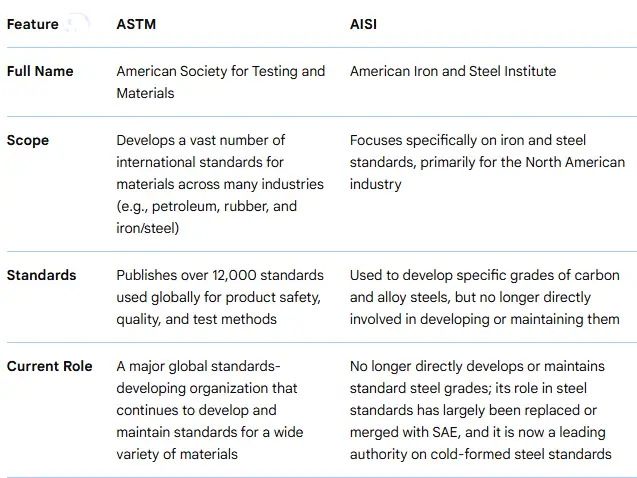
2. Core Differences Between AISI and ASTM
Core Functions and Purposes of AISI
AISI’s primary purpose is to provide a standardized way to classify steel types based on their composition and alloying elements. It defines steel grades by assigning numbers to each type of steel based on its alloying content. For instance, AISI 304 refers to an austenitic stainless steel that contains a high percentage of chromium and nickel, making it corrosion-resistant and widely used in food processing, chemical industries, and medical devices.
Core Functions and Purposes of ASTM
ASTM, on the other hand, focuses not just on material classification but also on ensuring that materials meet specific quality standards. ASTM provides rigorous testing methods and detailed specifications that manufacturers must follow to ensure the mechanical, chemical, and physical properties of materials meet the required standards for safety and performance. For example, ASTM A992 specifies the requirements for high-strength, low-alloy steel used in structural steel applications.
3. AISI Standards: Classification and Applications
AISI Numbering System
The AISI numbering system is used to identify the alloy content and grade of a specific type of steel. For example, AISI 1018 refers to a mild carbon steel, while AISI 4130 is a chromium-molybdenum alloy steel. Each number corresponds to specific alloying elements and their percentages in the steel.
| AISI Grade | Description | Alloying Elements | Applications |
|---|---|---|---|
| AISI 1018 | Mild Carbon Steel | Carbon, Manganese | Automotive, Industrial Components |
| AISI 304 | Austenitic Stainless Steel | Chromium, Nickel | Food Processing, Medical Devices |
| AISI 4130 | Alloy Steel | Chromium, Molybdenum | Aerospace, Automotive |
Common AISI Steel Grades and Uses
AISI steel grades are used across a variety of industries. For instance, AISI 304 is commonly used in food processing equipment and medical instruments due to its corrosion resistance. AISI 4140, a high-strength alloy steel, is used in automotive and aerospace components, such as crankshafts and gears.
4. ASTM Standards: Testing and Material Specifications
Overview of ASTM Standards
ASTM International publishes detailed standards that provide specific instructions on how materials should be tested and evaluated. For example, ASTM A36 is a widely used standard for carbon steel, providing guidelines for tensile strength, yield strength, and chemical composition. These specifications ensure that materials are consistent in their properties, making them safe and reliable for use in various applications.
| ASTM Standard | Description | Material Type | Application Area |
|---|---|---|---|
| ASTM A36 | Structural Steel Specification | Carbon Steel | Construction, Structural Engineering |
| ASTM A53 | Steel Pipe Specification | Carbon Steel, Alloy Steel | Construction, Pipeline Industry |
| ASTM A992 | Steel Specification for Structural Shapes | High-Strength Low-Alloy Steel | Structural Steel, Building Frames |
Notable ASTM Standards and Their Applications
ASTM standards are used across many industries. ASTM A36, for example, is essential for construction, where it ensures that steel used in structural elements has the necessary strength. ASTM A53 is used in the pipeline industry, specifying the requirements for pipes that transport oil, gas, and other fluids.
5. AISI and ASTM in Steel Manufacturing
Material Selection Based on AISI
The AISI classification system is widely used to choose the appropriate type of steel for specific applications. Steel grades are selected based on their composition, which determines properties such as corrosion resistance, strength, and machinability.
Material Testing and Quality Control via ASTM
Once a material is selected, ASTM testing standards are used to ensure the material performs as expected. For instance, ASTM E8 outlines the procedure for tensile testing of metals, ensuring that the material can withstand the mechanical stresses it will face in real-world applications.
6. Applications in Various Industries
Construction, Automotive, Aerospace, and More
Industry-Specific Use Cases
AISI and ASTM standards have applications across numerous industries, including automotive, construction, aerospace, and energy. For instance, AISI 4130 is commonly used in aerospace manufacturing due to its strength and light weight, while ASTM A53 is used in construction for structural steel pipes.
Engineering, Automotive, Construction, and Aerospace Applications
In engineering, AISI standards help with the classification of steel types, while ASTM provides testing methods to ensure the material can withstand the required conditions. In automotive manufacturing, for instance, AISI 1045 is used for parts that require good strength and durability.
7. Global Impact of AISI and ASTM
Role in International Trade and Export Standards
Both AISI and ASTM play significant roles in ensuring that materials meet international trade requirements. AISI allows exporters to categorize and standardize their steel products, while ASTM ensures that the materials meet performance and safety standards globally.
Influence on Global Manufacturing Processes
The standards provided by AISI and ASTM influence manufacturing processes around the world, ensuring that products are made with reliable materials that meet consistent quality benchmarks.
8. Challenges and the Future of AISI and ASTM Standards
Emerging Material Technologies
New technologies, such as 3D printing and nanomaterials, present challenges for both AISI and ASTM. These materials require new standards and testing methods to ensure they meet required performance criteria.
The Need for Evolving Standards
As industries evolve, so too must AISI and ASTM standards. There is a need for constant updates to address emerging materials and manufacturing techniques, such as the rise of additive manufacturing and composite materials.
9. Conclusion
While AISI and ASTM have different focuses—AISI on steel classification and ASTM on material performance testing—both are integral to the quality control and material selection processes in industries worldwide. Understanding their differences and applications ensures that engineers and manufacturers can select the right materials for their specific needs, ensuring safety, performance, and reliability.
10. FAQs
- What is the AISI numbering system?
- The AISI numbering system is used to classify steel grades based on their chemical composition. Each number corresponds to the steel's alloying elements and their proportions.
- How do AISI and ASTM differ?
- AISI focuses on classifying steel grades based on composition, while ASTM provides standards for testing material performance and quality.
- Can AISI and ASTM standards be used together?
- Yes, AISI provides classification, while ASTM ensures materials meet necessary performance standards, often used together in material selection and testing.
- Why is ASTM important for material testing?
- ASTM ensures materials meet specific mechanical and physical properties, providing guidelines for testing materials in various conditions.
- What industries rely on AISI steel grades?
- AISI steel grades are widely used in the automotive, aerospace, construction, and manufacturing industries.
- What is ASTM A36 used for?
- ASTM A36 is a standard specification for carbon steel used in structural applications, including bridges, buildings, and other heavy-duty constructions.
- How does AISI help with material selection?
- AISI helps classify steel types based on their chemical composition, allowing engineers to select materials based on their strength, corrosion resistance, and other properties.
- What is ASTM A53?
- ASTM A53 is a standard specification for steel pipes used in construction and pipeline industries.
- Why is AISI used in the steel industry?
- AISI provides a simple and standardized way of classifying steel grades based on their composition, helping manufacturers and engineers select the right materials.
- What challenges do AISI and ASTM face in modern manufacturing?
- AISI and ASTM face challenges in adapting to new materials, such as nanomaterials and 3D printing, which require new standards and testing methods.