

Maraging steels such as grade C350 currently hold the top position among commercially producible metallic alloys for highest measured tensile strength, routinely reaching yield and ultimate tensile strengths in the ~2,300–2,500 MPa range; however, other material families including bulk metallic glasses, tungsten heavy alloys, nickel superalloys, and advanced titanium grades compete closely when strength is evaluated together with density, temperature stability, toughness, or manufacturability.
1. What “strongest” means in engineering terms
Strength can mean several different properties depending on the design requirement. The most common measures are ultimate tensile strength (UTS), 0.2% offset yield strength, compressive strength, hardness, and specific strength (strength divided by density). Fracture toughness, fatigue strength, and creep resistance are also critical because a material with very high UTS but poor toughness may fail catastrophically under impact or cyclic loads. Therefore, naming a single “strongest” alloy requires specifying the metric and the service conditions: room temperature static load, high temperature creep, dynamic impact, or lowest weight for a given load.
Practical selection therefore balances absolute strength with density, toughness, thermal stability, corrosion resistance, manufacturability, and cost. The remainder of the article surveys the leading families and shows where each one is strongest in a practical sense.
2. Short list of contenders and how they compare
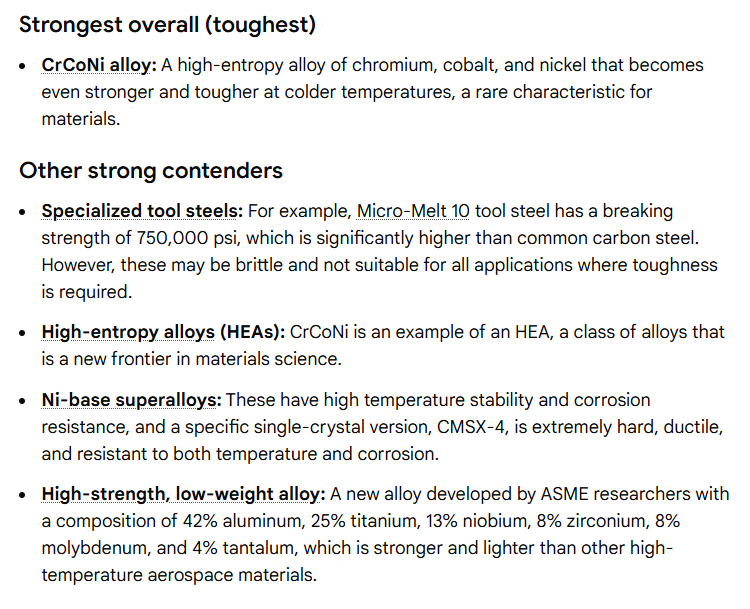
Here are the families most often cited when engineers look for top strength:
-
Ultra-high-strength maraging steels (for highest measured UTS and yield in commercial steels).
-
Bulk metallic glasses (BMGs) and amorphous metal alloys (very high yield strength per unit weight but limited ductility).
-
Tungsten heavy alloys and refractory-metal composites (exceptional strength combined with extreme density and high-temperature capability).
-
Nickel-based superalloys such as Inconel 718 (excellent tensile and creep strength at elevated temperatures).
-
High-strength titanium alloys (Ti-6Al-4V and variants provide high specific strength and good toughness).
-
Emerging high-entropy alloys and optimized additive-manufactured microstructures (promising but still maturing for widespread, standardized use).
Each category excels under particular constraints. The next sections break these down into metallurgy, typical property ranges, and service envelopes.
3. Maraging steels: metallurgy, processing, peak performance, limits
What they are
Maraging steels are a special class of ultra-low-carbon, nickel-iron steels that gain strength by precipitation of intermetallic compounds during an aging heat treatment rather than by carbon hardening. Their name is a contraction of martensite and aging. Typical alloys include grades referred to by numbers such as 200, 250, 300, and 350 (C350 is often referred to as “maraging 350”).
Why they are very strong
The strength derives from finely dispersed intermetallic precipitates (for example Ni3Ti) that impede dislocation motion. Because carbon is minimal, these steels retain toughness and can be welded and machined in the soft condition then aged to reach ultra-high strengths.
Typical strengths and behavior
Aged maraging-350 alloys can achieve yield strengths and ultimate tensile strengths above 2,300 MPa and approaching or exceeding 2,500 MPa in some processed condition reports. They retain good notch toughness compared with other steels at similar strength levels, and their room-temperature fracture performance is comparatively good for such high strengths.
Limitations and tradeoffs
Maraging steels are heavy relative to titanium and can lose some of their advantageous properties at higher service temperatures. Their high strength depends on careful heat treatment; overaging or improper processing reduces performance.
4. Bulk metallic glasses: extreme strength with constrained ductility
Basic description
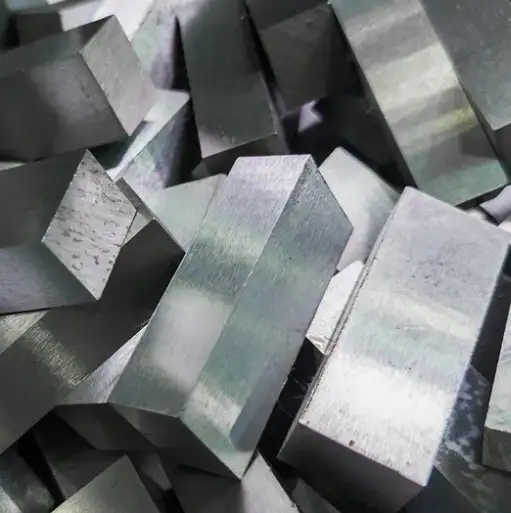
Bulk metallic glasses or amorphous metals are alloys cooled rapidly to avoid crystallization and end up with a disordered atomic structure. Zr-based or Pd-based BMGs are common research and some commercial compositions.
Mechanical characteristics
BMGs show very high yield and compressive strengths relative to crystalline alloys, with reported yield strengths near 1.7–2.0 GPa for some Zr-based compositions. Specific strengths can be excellent given moderate densities. However, many BMGs fracture brittly in tension without measurable plastic strain unless geometry or constraint is changed.
Where BMGs are competitive
Because of high elastic limits and surface hardness, BMGs fit specialized applications: precision springs, wear-resistant coatings, microelectromechanical components, and some sporting goods. The brittleness and difficulties in forming large, thick sections limit structural uses where impact or cyclic loads occur.
5. Refractory and heavy alloys: tungsten heavy alloys and specialized composites
Tungsten heavy alloys (WHA)
Tungsten heavy alloys are typically tungsten with nickel, iron, copper, or cobalt binders and are available as sintered and worked products. WHAs have very high density (16–19 g/cm³), high modulus, and high strength when processed correctly. Typical ultimate tensile strengths for commercially available WHAs can be in the 700–1,200 MPa range, with specially processed, worked WHA achieving higher UTS values.
Refractory-metal systems
Pure refractory metals such as tungsten, molybdenum, and tantalum have extremely high melting points and maintain stiffness at temperature, but they are brittle in wrought form and require alloying or special processing to be structurally useful. For extreme-temperature structural parts, refractory alloys or composites are often the only choice.
Tradeoffs
The enormous density of WHA makes them unsuitable when weight is a design constraint. They shine where mass, radiation shielding, or thermal inertia are beneficial.
6. Superalloys and high-temperature strength: Inconel 718 and relatives
What superalloys offer
Nickel-chromium-based superalloys combine good tensile strength, creep resistance, and corrosion resistance at elevated temperatures. Alloys such as Inconel 718 are age-hardenable and have been engineered for gas turbines, rocket hardware, and other high-stress, high-temperature components.
Typical strengths
Properly heat treated Inconel 718 can deliver yield strengths and UTS in the range of about 900–1,250 MPa at room temperature, with excellent retention of strength at several hundred degrees Celsius. Data sheets and manufacturer technical bulletins give detailed temperature-dependent values and strengthening heat-treatment cycles.
Application space
Superalloys are a first choice where parts must perform reliably under sustained high temperatures and oxidative environments — turbine discs, fasteners in engines, and structural components in aerospace.
7. Titanium alloys: high specific strength with corrosion resistance
Why titanium is attractive
Titanium alloys such as Ti-6Al-4V (grade 5) offer a high ratio of strength to density, excellent corrosion resistance, and good fatigue performance in many conditions. That combination makes them common in aerospace, medical implants, and high-performance sporting goods.
Strength figures
Ti-6Al-4V tensile strength varies with processing and heat treatment, but values often range from about 900 MPa for annealed conditions up to ~1,150 MPa or higher for carefully processed forms. Some specialized processing reports higher bearing or notch strengths for constrained geometries.
Tradeoffs
Titanium alloys are more expensive to process and machine, and their wear resistance is limited compared with hardened steels without surface treatments.
8. Emerging classes: high-entropy alloys and additive-manufactured alloys
High-entropy alloys (HEAs) mix five or more principal elements to create novel microstructures. Some HEAs have demonstrated very high yield strengths and good fracture resistance in laboratory tests. Additive manufacturing opens microstructural control that can push conventional alloys into new strength regimes via controlled cooling and tailored heat-affected zones. These fields are active research areas and promise further improvements, but widespread standards and long-term operational data are still developing.
9. Quantitative comparison tables
Table 1: Representative tensile and yield properties (typical ranges; actual values depend on heat treatment and processing)
| Alloy family | Representative UTS (MPa) | Representative yield (MPa) | Density (g/cm³) | Typical service strength notes |
|---|---|---|---|---|
| Maraging steel (C350 aged) | 2,300–2,500+ | ~2,300 | ~8.0 | Ultra-high room-temperature strength with reasonable toughness. |
| Bulk metallic glass (Zr-based) | 1,700–2,000 (yield/compressive) | ~1,700–1,900 | 6.0–6.6 | Very high elastic limit; limited tensile ductility. |
| Tungsten heavy alloy (W-Ni-Fe) | 700–1,250 (varies with processing) | ~500–800 | 16.5–18.5 | High density, good compressive strength; high UTS in worked WHA. |
| Inconel 718 (Ni-based superalloy) | 900–1,300 (temp dependent) | 700–1,100 | 8.1–8.3 | Retains strength at elevated temperatures. |
| Ti-6Al-4V (Grade 5) | 900–1,450 (process dependent) | 800–1,100 | 4.4–4.5 | Excellent specific strength and corrosion resistance. |
Table 2: Density and melting range snapshot
| Alloy family | Typical density (g/cm³) | Melting / phase change notes |
|---|---|---|
| Maraging steel | ~7.8–8.1 | Steel melting range; strength from precipitation heat treatment |
| Bulk metallic glass | 6.0–7.0 | Glass transition and crystallization temperatures govern formability |
| Tungsten heavy alloy | 16.5–18.5 | Very high melting point of tungsten base; binder lowers work temperature |
| Nickel superalloy | ~8.1 | Stable up to several hundred Celsius with retained properties |
| Titanium alloys | 4.4 | Lower density enables better specific strength |
10. How testing, heat treatment, and manufacturing alter peak strength
Two components often determine whether a given alloy will reach top-of-class strengths: metallurgical condition and post-processing.
-
Heat treatment: Precipitation aging, solution treatment, and controlled quench cycles are critical for maraging steels and superalloys. Improper cycling reduces precipitate hardening and thus peak strength.
-
Thermomechanical processing: Rolling, forging, and cold work change dislocation densities and grain structures, frequently raising strength at the expense of ductility. WHAs that receive swaging or rolling have reported higher UTS values than as-sintered blanks.
-
Additive manufacturing: Layered builds produce anisotropy and unique microstructures; careful post-build heat treatment is required to achieve consistent properties.
-
Surface treatments and coatings: For wear resistance and surface fatigue, nitriding, shot peening, or hard coatings can extend functional life without changing bulk tensile numbers.
Because of these dependencies, published property ranges are indicative and must be validated for each process route during design.
11. Application-driven selection and typical uses
Making a rational material choice requires matching the alloy family to the requirement:
-
Highest possible static tensile strength in a machined part: maraging steel for high-load structural inserts and tooling.
-
High-temperature rotating parts exposed to oxidation: nickel superalloys such as Inconel 718.
-
Heavy mass for ballast or radiation shielding where density matters: tungsten heavy alloys.
-
Lightweight, high specific strength structural parts: titanium alloys, especially where corrosion resistance is needed.
-
Micro-precision springs and wear surfaces that need high elastic limits: bulk metallic glasses, when geometry and loading are well controlled.
A design team should always confirm material property data from supplier datasheets and run component-level testing that mirrors in-service loads.
To ensure comparability and reliability, designers use standards for mechanical testing and material specification:
-
Tensile testing: ASTM E8 / ISO 6892 standards define specimen geometry and test methods for tensile properties.
-
Heat-treatment specifications and composition controls: AMS and ASTM material specifications govern superalloys and WHA families.
-
Data sheets: Manufacturer technical bulletins from recognized producers (for example, Special Metals for Inconel) supply validated heat-treatment schedules and temperature-dependent strengths.
Refer to official standards organizations and manufacturer datasheets when specifying materials for safety-critical applications.
13. Frequently asked questions (FAQs)
-
Which single alloy is the absolute strongest?
There is no single alloy that is universally strongest because “strength” depends on metric and operating conditions. For room-temperature tensile strength in commercial alloys, maraging C350 grades are among the highest reported. -
Are bulk metallic glasses stronger than steels?
In yield and elastic limit per unit volume, some BMGs outperform conventional steels, but they frequently lack tensile ductility and toughness, which limits structural usage. -
What alloy should I choose for high-temperature strength?
Nickel-based superalloys such as Inconel 718 and advanced powder alloys are standard for moderate to high temperature strength and creep resistance. -
Can additive manufacturing make stronger alloys?
Additive processes can produce unique microstructures and locally higher strengths, but control of porosity, anisotropy, and post-build heat treatment is essential. -
Do denser alloys mean stronger alloys?
Not necessarily. Tungsten heavy alloys are dense and strong, but titanium offers superior specific strength (strength divided by density) and may be a better choice where weight matters. -
How does heat treatment change maraging steel?
Aging after solution treatment precipitates intermetallics that raise strength dramatically; aging schedule controls peak properties and toughness tradeoffs. -
Are high-strength alloys brittle?
Some are. Extremely high UTS in some alloys correlates with reduced ductility or fracture toughness. Material selection must balance strength against fracture risk. -
Are these properties reproducible in production?
Yes, but only with controlled chemistry, strict heat-treatment, and validated process control. Supplier quality systems and material certifications are vital. -
How should I test for strength in my application?
Use representative specimen geometry and replicate service loads. Tensile tests to ASTM E8 combined with fatigue and fracture toughness testing provide a complete picture. -
Where do I find authoritative material data?
Use manufacturer datasheets, ASM/MatWeb entries, peer-reviewed journals, and ASTM/AMS specifications for vetted, usable data.
14. Closing summary
If the single goal is maximum room-temperature tensile strength in a commercially producible metal, maraging grades such as C350 currently lead the field. If designers put strength in context with weight, temperature, toughness, or corrosion resistance, other families such as titanium alloys, nickel superalloys, tungsten heavy alloys, and bulk metallic glasses can be better choices. Each alloy family demands trusted supplier data and validated processing to reach their peak properties.