
A slitter and longitudinal cutting line is the industrial backbone for converting wide master coils into precisely dimensioned narrower coils or strips; when selected and specified correctly it yields minimal material waste, consistent edge quality, and high throughput while lowering downstream processing cost. For procurement teams and plant engineers the most critical purchase factors are the line’s mechanical layout, slitting technology (rotary, shear, razor), tension and recoiling control, automation level, and the supplier’s ability to match metallurgy, coil sizes, and production speed to product requirements. MWalloys supplies factory-price slitting solutions with full customization options to fit light-gauge aluminium foils through heavy carbon steel coils for automotive, appliance, and construction sectors.
1. What a slitter / longitudinal cutting line does
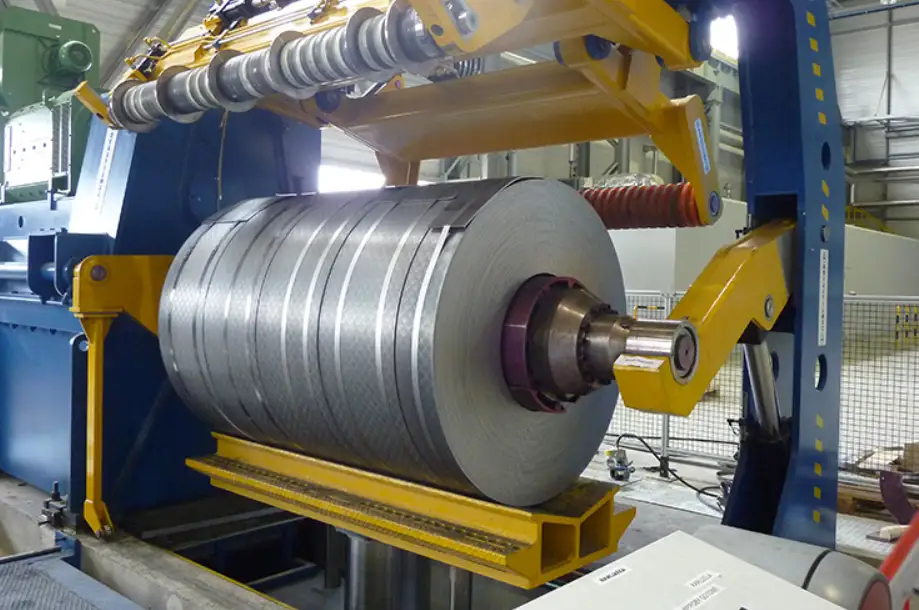
A slitting line takes a mother coil and produces multiple narrower coils or flat strips by making longitudinal cuts along the coil width. This process converts a single wide coil into saleable widths or feedstock for downstream forming and welding processes. Slitting lines may include uncoilers, edge guiding, levelers, slitting stations, scrap handling, tension control, and recoilers or cut-to-length modules.
2. Core components and their function
Below is a concise component-by-component breakdown every buyer should know.
| Component | Purpose | Key sizing/selection note |
|---|---|---|
| Coil car / loading cradle | Moves heavy master coils to decoiler | Must match coil weight and ID/OD |
| Uncoiler / decoiler | Supports and pays out coil under controlled torque | Hydraulic or pneumatic braking options |
| Coil entry shear / crop shear | Trims coil tails to prepare for threading | Required for continuous operation |
| Loop pit and dancer | Buffer to absorb speed changes and maintain tension | Size affects threading frequency |
| Edge guiding system | Keeps coil centered through slitting knives | Critical for narrow-width accuracy |
| Leveler / flattening unit | Reduces coil camber and surface defects | Required for precision applications |
| Slitting station (rotary / shear / razor) | Performs longitudinal cutting | Choose technology by material & thickness |
| Scrap winders / trim removal | Collects and compacts edge trim | Scrap management planning reduces waste |
| Tension control (brakes, tensioner) | Maintains strip tension before/after slitter | Essential for coil flatness and edge quality |
| Recoiler / winder | Forms slit strips into daughter coils | Must permit required coil weight and rewind speed |
| Cut-to-length (optional) | Cross-cuts strips into sheets | Adds complexity but expands output types |
| HMI and PLC controller | Central operator interface and recipe storage | Look for remote connectivity and traceability |
Each component affects final economics and product quality; for example the choice of slitter type dictates allowable thickness, edge burr, and maintenance cadence.
3. Common slitting technologies and when to use each
Slitting systems come in three principal designs; selecting the correct one is central to performance.
Rotary slitter (rotary knives)
-
Mechanism: rotating circular knives (male and female or top/bottom) shear the strip.
-
Strengths: high speed, continuous operation, suitable for moderate thicknesses and production runs with many narrow widths.
-
Typical use: cold-rolled steel, stainless, aluminium for coil-to-coil slitting.
Shear slitter (scissor or shear-cut)
-
Mechanism: upper and lower circular knives with overlapping cutting action; often called shearing slitter.
-
Strengths: cleaner edge with lower burrs, tolerates thicker gauges, good for heavy-gauge and coated materials.
-
Typical use: thicker steel plates that need good edge condition for welding or stamping.
Razor slitter
-
Mechanism: stationary razor blades that sever the material by slicing, not shearing.
-
Strengths: excellent for very thin gauges and foil where minimal burr and edge deformation matter.
-
Typical use: aluminium foil, very thin stainless, and delicate coated surfaces.
Selection rule of thumb: for very thin and delicate materials pick razor, for high-speed coil-to-coil production choose rotary, and for heavy gauges requiring low burr choose shear-style slitters. The wrong choice increases scrap rate and offline finishing cost.
4. Typical line layouts and optional modules
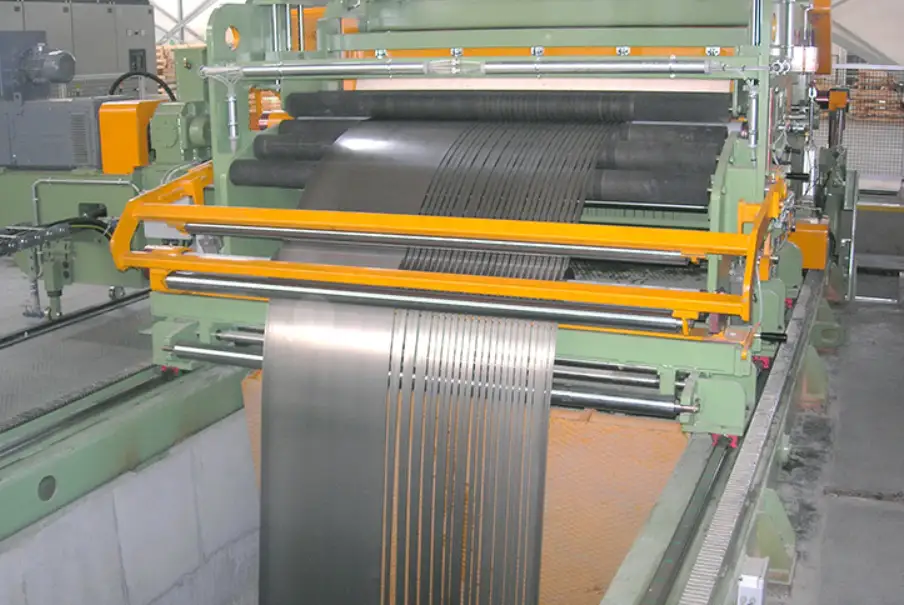
Slitter lines are modular; manufacturers assemble the modules needed for specific applications. Common configurations include:
-
Basic coil-to-coil slitting line: decoiler → slitting station → recoiler. Low capital and footprint.
-
Slitting + leveler line: adds a leveler upstream for flatness-critical strips.
-
Slitting + CTL (cut-to-length): allows output of sheets instead of recoiled strips. Useful for sheet sale or stamping shops.
-
Automated loading + coil changeover: heavy-duty installations include automatic coil cars, robotic coil handling, and splice tables for near-continuous operation.
-
In-line inspection and laser measurement: for high-value strips requiring surface certification.
Include optional modules when product mix demands: e.g., a precision edge guide for narrow strips, a temper pass for spring strip, or a corona/cleaning station for painted coils.
5. Material types, thickness ranges, and coil parameters
Slitting lines process a broad range of materials. Typical ranges:
-
Aluminium (light gauge): 0.02 mm up to 3 mm in specialty lines.
-
Cold-rolled steel: 0.25 mm to 3 mm typical for rotary lines.
-
Hot-rolled carbon steel: often 0.6 mm and thicker (with shear slitters preferred).
-
Stainless steel: 0.1 mm to 2.0 mm depending on surface finish requirements.
-
Copper / brass / foil: razor slitters used for very thin gauges.
Coil parameters to specify in RFQ:
-
Master coil width (mm).
-
Thickness range (min–max).
-
Coil inside diameter (ID) and outside diameter (OD) ranges.
-
Maximum coil weight (kg).
-
Surface condition (oiled, painted, pre-coated, bright).
Precise specification prevents mis-matched machinery and reduces the need for retrofit.
6. Key performance metrics and how to read them
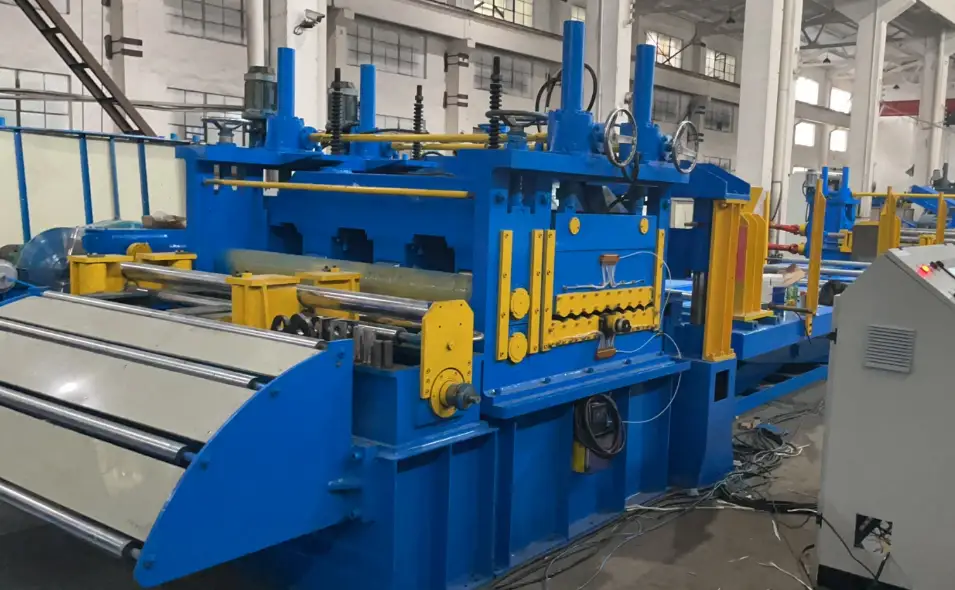
When evaluating manufacturers, compare the following metrics on equal terms.
| Metric | What it means | Buyer note |
|---|---|---|
| Line speed (m/min) | Maximum processing speed | Higher is not always better; depends on material & rewind capability |
| Recoil Tolerance (mm) | Variation in daughter coil width | Tighter tolerance reduces scrap and post-process trimming |
| Production capacity (t/day) | Realistic throughput | Check with typical thickness and coil change times |
| Changeover time (min) | Time to change to another coil/width | Short changeovers increase effective uptime |
| Edge burr (µm) | Measured burr height | Lower burr reduces downstream burr removal costs |
| Power consumption (kW) | Energy draw at rated speed | Useful for TCO modeling |
| Automation level (PLC/HMI) | Recipe storage, automatic threading, splice | Higher automation reduces labor but raises capex |
Note: manufacturers often quote maximum technical speed under ideal conditions; request verified performance numbers on the same material gauge you plan to run.
7. Automation, controls, and Industry 4.0 readiness
Modern slitting lines include advanced control features:
-
Recipe management for quick product changeovers
-
Closed-loop tension control using load cells and dancer feedback
-
Automatic edge-guiding with cameras or mechanical sensors
-
Remote diagnostics, production logging, and SPC (statistical process control) modules
-
Integration with ERP for traceability and production planning
When evaluating control systems request demonstration of:
-
Human-machine interface layout and language support
-
Data export formats for traceability (CSV, XML, OPC UA)
-
Cybersecurity provisions and remote access policy
Fully automated solutions can increase throughput and reduce scrap, but require better-level local support and a documented spare-parts strategy to avoid extended downtime.
8. Quality, edge condition and post-slit handling
Edge quality is a decisive factor for many buyers. Parameters to inspect on acceptance:
-
Edge burr height and consistency: measured with profilometers
-
Edge TIR (total indicator runout): affects winding quality
-
Surface scratches or coating delamination: depends on knife type and entry rollers
-
Rewind coil concentricity and tightness: measured by weight and dimensional checks
Post-slit handling options:
-
Edge trim compactors and balers to manage scrap
-
Automatic strip separators to prevent entanglement on recoilers
-
Labeling and packing stations for immediate shipping readiness
A strong QA program should include incoming coil verification, in-line inspections, and final sample logs for each daughter coil. This reduces customer disputes and rejects.
9. Safety, ergonomics, and regulatory considerations
Slitting lines involve heavy moving parts, sharp edges, and stored energy. Key safety features to require:
-
Area guarding with interlocks and light curtains
-
Emergency stop architecture with dual-channel safety PLCs
-
Lockout/tagout procedures and clear maintenance manuals
-
Noise and dust control per local regulations
-
Operator ergonomics: raised platforms, reachable HMI, good lighting
Compliance with CE, ANSI, or local machine safety standards is mandatory in many jurisdictions; ensure manufacturer provides conformance certificates and wiring diagrams.
10. Installation, commissioning, and site prerequisites
Before equipment delivery confirm:
-
Building clearances for coil car, decoiler, and recoiler path
-
Floor load capacity and anchoring points
-
Power supply: voltage, frequency, and dedicated transformer needs
-
Compressed air and hydraulic supply (if required)
-
Crane capacity for coil handling and mechanical installation
-
Environmental controls for sensitive coated or foil materials
Detailed site surveys and pre-shipment checklists often avoid costly rework and delay during commissioning.
11. Maintenance program and spare-parts plan
A proper maintenance plan increases uptime:
-
Daily: knife inspection, lubrication points, safety checks
-
Weekly: tension sensor calibration, belt and roller inspection
-
Monthly: gearbox oil check, motor vibration analysis
-
Quarterly / yearly: replanning for knife replacement, roller re-grinding, PLC backups
Recommended spare parts kit (minimum):
-
Set of top/bottom knives (rotary / shear)
-
Bearings for idlers and recoiler shafts
-
Quick-change shear parts and seals
-
PLC and HMI spare module
-
Electronic sensors (edge guide, tension)
Manufacturers often provide service contracts; compare response times, remote diagnostics, and local partner networks when comparing TCO.
12. Cost drivers and realistic TCO model
Capital and operational costs depend on:
-
Material handling automation (higher capex, lower labor)
-
Precision levelers and inspection systems
-
Slitting technology: shear systems cost more up front but lower finishing cost for heavy gauge
-
Expected scrap rate and energy consumption
-
Service, training, and spare parts availability
A simple TCO model should include:
-
Purchase price
-
Installation and commissioning cost
-
Annual maintenance and spare parts (percentage of capex)
-
Energy and consumables (knives, lubricants)
-
Labor cost (operators, technicians)
-
Expected productivity and scrap savings
Ask vendors to provide validated run-rate case studies on identical materials; validated figures are more useful than idealized specs.
13. How to prepare an accurate RFQ
A precise RFQ accelerates quotation accuracy. Include:
-
Detailed material list (chemistry or class, surface, thickness range)
-
Production targets (t/month, typical coil sizes)
-
Required daughter coil widths and tolerances
-
Minimum acceptable edge quality (burr max, edge chamfer)
-
Required automation features and data integrations
-
Site details: power, crane, floor load, temperatures
-
Warranty terms and spare parts list expectations
-
Expected acceptance tests and sample sign-off procedure
Vendors can price correctly only when given consistent and complete technical inputs.
14. Case studies and application examples
Short application snapshots highlight typical plant scenarios.
Automotive stamping supplier
Challenge: convert 1,500 mm wide CR steel into 10 specific narrow widths at high repeatability. Solution: high-speed rotary slitter line with automatic edge guide and recoilers; installed SPC for edge quality; improved yield by 3%.
Appliance manufacturer
Challenge: slitting pre-painted aluminium coils without coating damage. Solution: razor slitter with soft-entry idlers and clean-room handling; reduced scrap due to minimized surface contact.
Structural steel coil processor
Challenge: heavy-gauge hot-rolled coils required low-burr edges for welding. Solution: shear-type slitter combined with leveling and straightening; reduced downstream rework.
These examples show how matching technology to application delivers measurable gains.
15. Full specification comparison tables
Table A: Typical slitter line variants and core specs
| Variant | Thickness range | Max speed (typical) | Best for | Notes |
|---|---|---|---|---|
| Light-gauge rotary | 0.02–1.0 mm | 150–400 m/min | Aluminium, thin stainless | High throughput |
| Medium-gauge rotary | 0.2–3.0 mm | 80–250 m/min | CR steel, coated coils | Balanced speed & strength |
| Shear slitter | 1.0–12.0 mm | 30–120 m/min | Thick steel, low burr | Higher torque & maintenance |
| Razor slitter | 0.01–0.3 mm | 50–200 m/min | Foil, very thin alloys | Requires precise tension control |
Table B. Key acceptance test checklist (minimum)
| Test | Acceptance criterion |
|---|---|
| Daughter coil width tolerance | ±0.5 mm or per spec |
| Edge burr measurement | ≤ specified µm |
| Coil concentricity | ≤ specified mm runout |
| Production run test | 2-hour continuous run at rated speed |
| Data logging | Production recipe and logs stored and exportable |
16. FAQs
-
What’s the difference between a slitting line and a cut-to-length line?
A slitting line makes longitudinal cuts to produce narrower coils; a cut-to-length line cross-cuts coils into sheets of specific lengths. Some systems combine both functions in one footprint for flexibility. -
How do I pick between rotary, shear, and razor slitters?
Match the knife principle to your material thickness and surface sensitivity: razor for ultra-thin foil, rotary for high-speed coil-to-coil, shear for heavy-gauge low-burr requirements. -
What tolerances can I expect on width and edge burr?
Good lines achieve ±0.3–0.5 mm width tolerance and burr figures depend on knife type and wear; request manufacturer measurement methods and sample reports. -
How frequently are knives changed or sharpened?
Frequency depends on material and production hours; typical rotary knives last hundreds to thousands of tons, shear knives require more frequent regrinding. Track knife life and maintain spares. -
Can a slitting line handle painted or pre-coated coils?
Yes, with proper entry rollers, soft-contact guides, and controlled tension to prevent coating damage. Vendor experience with coated materials is important. -
What automation features deliver the fastest ROI?
Automatic coil change, recipe storage, and closed-loop tension control reduce labor and scrap. Remote diagnostics decrease downtime response time. -
What safety certifications should I demand?
CE for EU, ANSI for North America, and machine-specific safety documentation. Ensure safety PLC architecture and guarding meet local codes. -
What’s a realistic lead time for a customized line?
Depends on scope; typical delivery and commissioning range from 12 to 36 weeks. Fast-tracked builds require confirmed site readiness. -
How do I calculate required recoiler torque and rewind speed?
Recoiler sizing depends on strip width, thickness, yield strength, and desired rewind tension; vendors provide torque calculations based on your material specs. -
What spare parts must be on-site at start-up?
Knives, bearings, PLC spare module, belts, and critical sensors. Agree a spare-parts kit with supplier for first 12 months.
17. Closing recommendations and next steps
For buyers and engineers preparing to procure a slitting or longitudinal cutting line:
-
Build an RFQ with exact materials, target throughput, coil sizes, and required edge quality.
-
Request validated run sheets from vendors showing performance on your materials.
-
Insist on clear acceptance tests including multi-hour continuous runs at rated speed.
-
Compare total cost of ownership not just capex: include energy, spare parts, and local service availability.
-
Opt for a partner who offers customization, training, and a documented spare-parts strategy.
MWalloys provides factory-direct pricing, in-house engineering for custom configurations, and full technical documentation including installation checklists and operator training packages. Contact us with your material list and production goals to receive a tailored quotation.