

SKD11 is a high-carbon, high-chromium cold-work tool steel (JIS SKD11) that gives outstanding wear resistance and stable hardness in the HRC 56–62 range after proper quenching and tempering. It is the common Japanese equivalent to D2/1.2379 family steels and is widely used for cutting tools, stamping dies, shear blades, and wear parts where edge retention and abrasion resistance are crucial. SKD11 trades slightly lower hardenability for generally better toughness and dimensional stability versus some D2 variants, making it an excellent choice for medium-to-high precision cold-work tooling when surface wear is the dominant failure mode.
1. What is SKD11 Tool Steel?
SKD11 belongs to the high-carbon, high-chromium cold-work tool steels. It forms a large volume fraction of hard chromium carbides after heat treatment which gives very good abrasion resistance and edge retention. Typical hardness after quenching and tempering ranges from HRC 56 up to about HRC 62, depending on tempering and final microstructure. Designers pick SKD11 when the primary design driver is resistance to abrasive wear, while still needing reasonable toughness and dimensional control in finished dies and blades. For chemical composition and standard equivalences see JIS G 4404 and related tables.
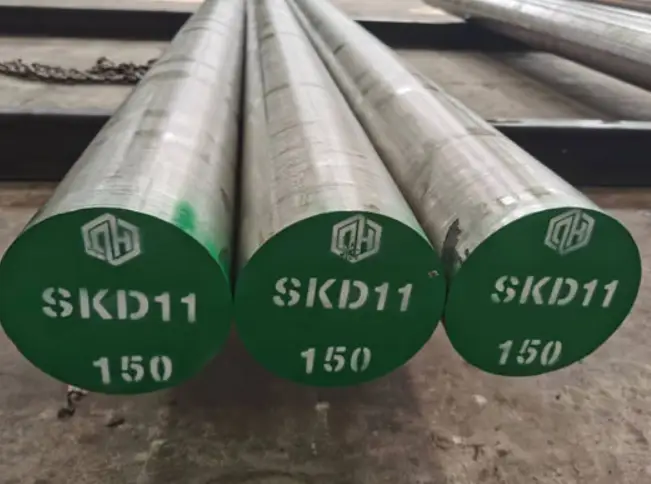
2. Chemical makeup and industry equivalents
What SKD11 contains (typical composition)
The chemistry determines why SKD11 behaves the way it does. The most relevant elements and their typical ranges are shown below.
| Element | Typical range (wt%) | Role and effect |
|---|---|---|
| Carbon (C) | 1.40 - 1.60 | High carbon produces abundant carbides for wear resistance and high achievable hardness |
| Chromium (Cr) | 11.0 - 13.0 | Forms hard chromium carbides; improves hardenability and abrasion resistance |
| Molybdenum (Mo) | 0.8 - 1.2 | Raises hardenability and temp strength; refines carbides |
| Vanadium (V) | 0.2 - 0.5 | Promotes fine, stable vanadium carbides that improve wear life |
| Silicon (Si) | ≤0.4 | Deoxidizer; small effect on strength |
| Manganese (Mn) | ≤0.6 | Affects hardenability and tensile strength |
| Phosphorus, Sulfur (P, S) | ≤0.03 each | Kept low to avoid embrittlement |
Source reference JIS SKD11 datasheet and consolidated industry tables.
Equivalents and naming
Common cross-references:
-
JIS: SKD11 (primary designation)
-
AISI/SAE / DIN: Often cross-listed with D2 / 1.2379 / X153CrMo12 family, though small chemistry and processing differences exist between suppliers.
Note: equivalence is practical, not absolute. Heat treatment practices and impurity levels may change the effective performance between suppliers.
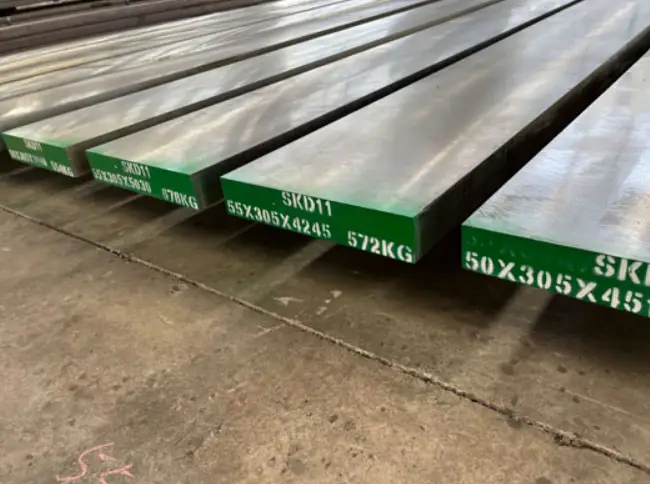
3. Key mechanical and physical properties
Below are representative mechanical figures after a standard quench and temper cycle. Exact numbers depend on final tempering temperature, processing path, and measurement method.
| Property | Typical range or value | Comments |
|---|---|---|
| Hardness (quenched + tempered) | HRC 56 - 62 | Higher hardness yields higher wear resistance, lower toughness |
| Tensile strength | ~1500 - 2200 MPa (depends on HRC) | Increases with hardness; depends on heat treatment. |
| Toughness (impact) | Moderate for high-carbon high-chrome steels | Better than some high-chromium D2 variants if processed carefully |
| Thermal conductivity | Lower than low-carbon steels | Affects cooling rates during heat treatment |
| Density | ~7.7 - 7.8 g/cm3 | Typical for chromium-molybdenum tool steels |
Representative values are drawn from technical datasheets and published heat treatment studies; treat them as guide numbers for design decisions.
4. Microstructure and why it matters
After appropriate austenitizing, quenching, and tempering, SKD11 contains a matrix of tempered martensite and a dispersion of chromium-rich carbides (M23C6 type and MC-type carbides where V and Mo contribute). The carbide network controls abrasion resistance and edge retention. Fine, well-distributed vanadium carbides improve microstructural stability and cutting-edge durability. Overly coarse carbides reduce toughness and encourage crack initiation under heavy shock loading.
Control points for metallurgy teams:
-
Avoid overheating during austenitizing to limit carbide coarsening.
-
Use controlled cooling to get a martensitic matrix with minimal retained austenite.
-
Double tempering at recommended temperatures stabilizes hardness and improves toughness.
5. Heat treatment - practical cycles and effects
Typical shop cycle (practical)
Below is a practical heat treatment sequence frequently used for SKD11. Fine-tune for part size, section thickness and required hardness.
| Step | Temperature (°C) | Hold time | Cooling medium | Purpose |
|---|---|---|---|---|
| Stress relief / anneal (optional before rough machining) | 800 - 850 | 1-3 h | Furnace cool | Soften for machining; improve machinability |
| Preheat | 650 - 750 | until uniform | - | Avoid thermal shock when entering austenitize stage |
| Austenitize (hardening) | 1000 - 1050 (common) | 10-30 min depending on section | Air quench (or oil for very thick sections) | Dissolve carbides; form austenite |
| Quench | room temp air (air-hardening type) or oil for large sections | N/A | Air (SKD11 is air hardening but large sections sometimes require oil) | Transform to martensite |
| Temper | 150 - 200 (low) or 480 - 530 (secondary) typical | 2 x 2 h common | Air cool | Stabilize martensite and adjust toughness/hardness tradeoff |
Notes:
-
SKD11 is often processed using an air-cooling hardening step because of its high Cr and Mo content, but very large tools may need oil quench to avoid core soft spots.
-
Tempering temperature controls final hardness: lower tempering keeps higher HRC but reduces toughness. Many toolmakers use a double tempering step for stability.
Effect of tempering temperature
Laboratory studies and field experience show a clear hardness vs tempering temperature curve with local maxima and tempering resistance peaks in the medium temper range (around 480–520°C) because of complex carbide transformations. To balance hardness and impact resistance, many shops select tempering cycles tailored to end-use conditions rather than aiming for maximum HRC.
Reference experimental studies on tempering effects for SKD11 provide quantitative guidance for metallurgists.
6. Machinability, grinding, and surface finishing
SKD11, being high-carbon and carbide-rich, is relatively abrasive to cutting tools. Best practices:
-
Machine in softened condition (annealed) when possible to reduce tool wear and control distortion.
-
Use carbide tooling for roughing and PCD/CBN for finishing operations where high precision and long tool life are required.
-
Grinding to final dimensions often requires specified coolant flow, sharp abrasives, and frequent wheel dressing to avoid glazing.
-
Electrodischarge machining (EDM) is frequently used for complex dies; finish-grind after EDM to restore surface integrity and remove recast layer.
Surface treatments (nitriding, PVD coatings) improve life for specific shear or extrusion applications but must be selected to match operating temperature and frictional environment.
| Feature | SKD11 (JIS) | D2 / 1.2379 (AISI/DIN) | Practical note |
|---|---|---|---|
| Chemical family | High C, ~12% Cr, Mo, V | Very similar: high C, ~12% Cr, Mo, V | Often treated as equivalents; minor composition and supplier differences matter. |
| Hardenability | Good (air hardening) | Often slightly higher in some D2 versions | D2 may give a denser chromium carbide network; in some contexts D2 outwears SKD11. |
| Toughness | Moderate-good | Often slightly lower for some high-chrome D2s | SKD11 sometimes preferred where fracture resistance matters |
| Typical uses | Precision dies, shear blades, punches, long-run blanking dies | Heavy-duty dies, cutting tools, shear blades | Selection depends on wear environment and shock loading |
| Heat treatment | Air or oil quench depending on section | Frequently oil quench in heavy sections | Heat treat specifics determine final properties |
Designers should treat SKD11 and D2 as close relatives but verify vendor certificates and process history. Material lot, inclusion control, and heat treatment produce the decisive differences in service life.
8. Common applications
| Product | Why SKD11 is used | Typical service challenge |
|---|---|---|
| Punches and dies for blanking | High edge retention under abrasive contact | Edge chipping from impact; require balanced toughness |
| Shear blades and slitter knives | Excellent wear life, maintain sharpness | Heat checking if cyclic thermal loads occur |
| Plastic extrusion and pelletizing blades | Resists abrasive fillers and sharp particles | Carbide pullout if improper temper |
| Pad printing plates / stamping dies | Dimensional stability and fine edge profile | Surface finish control and burr during EDM |
| Wear strips, bushings | Long wear life in sliding conditions | Corrosion not primary concern; lubrication important |
Case notes: spectrums of applications confirm SKD11’s suitability for cold-work tooling where abrasive wear drives component life. Supplier datasheets and technical PDFs illustrate field examples in packaging, automotive blanking, and plastic tooling.
9. Surface treatments and coatings that extend life
Common surface treatments to enhance SKD11 performance:
-
Nitriding: Produces a hard diffused layer that improves sliding wear and fatigue resistance for some die applications.
-
PVD coatings (TiN, TiCN, CrN): Boost surface hardness and reduce friction; best for cutting and forming tools.
-
Carburizing: Not common for high-chrome tool steels due to chromium barrier for carbon diffusion.
-
Shot peening: Introduces compressive surface stress to reduce crack initiation under cyclic loading.
Choose treatment based on operating temperature, lubrication, and expected failure modes.
10. Failure modes and remedies - practical troubleshooting
Common failures and targeted actions:
-
Edge chipping: Often caused by impact overload or carbide pullout. Remedy: reduce hardness slightly, increase tempering temperature, or redesign part geometry to reduce shock.
-
Abrasion wear along surfaces: Normal for abrasive contacts. Remedy: apply surface coatings, use higher hardness temper, or change material to a higher-alloy wear steel if appropriate.
-
Cracking from retained austenite instability: Remedy: add intermediary temper cycles to stabilize, control quench rates, and consider cryogenic treatment to transform retained austenite before tempering if needed.
-
Dimensional distortion: Remedy: perform rough machining in annealed state and final heat treat after finish grinding where possible; use symmetric fixturing during heat treat.
These practical steps reflect shop-floor metallurgy and toolroom experience.
11. Procurement, specifications, and quality control
When buying SKD11 material for critical tooling, specify:
-
Exact standard and grade (JIS SKD11) and supplier heat number.
-
Chemistry certificate and traceability for C, Cr, Mo, V content.
-
Delivery condition (annealed, pre-hardened, ground) and required hardness tolerance.
-
Inclusion cleanliness or acceptable non-metallic inclusion levels for precision dies.
-
Heat treatment procedure or request pre-hardened state if intended to skip in-house HT.
Quality checks on receipt:
-
Verify chemistry via certificate and random spectro check.
-
Measure hardness and microstructure on a test coupon.
-
Check dimensional tolerances when supplied in pre-ground condition.
12. Frequently asked questions (FAQ)
Q1: Is SKD11 the same as D2?
A1: They are very close in composition and performance and often treated as practical equivalents. However, small differences in chemistry, maker processes and heat treatment can give measurable differences in hardenability, toughness, and wear resistance. Check supplier certificates when interchangeability matters.
Q2: What hardness can I expect after proper heat treatment?
A2: Typical hardened and tempered hardness lies between HRC 56 and HRC 62. Exact hardness depends on austenitizing, quench medium, section thickness, and temper schedule.
Q3: Can SKD11 be air quenched?
A3: Yes. SKD11 is often air-hardening thanks to high chromium and molybdenum. For very thick sections, oil quenching may be used to ensure core hardness uniformity.
Q4: Is SKD11 good for impact loading?
A4: It has moderate toughness but is primarily designed for abrasion resistance. If heavy impact is expected, consider materials specifically selected for toughness or temper SKD11 to lower hardness and increase impact strength.
Q5: What heat treatment temper yields best balance?
A5: Many shops use double tempering in the 480–530°C range for a balance of wear resistance and toughness; lower temp tempering yields maximum HRC but reduces toughness. Refer to lab tempering studies for precise curves.
Q6: How should I machine SKD11?
A6: Machine in annealed state when possible. Use carbide tooling for roughing and CBN/PCD for precision finishing. EDM plus finish grinding is a common approach for complex dies.
Q7: Are coatings recommended?
A7: Coatings such as PVD TiN or CrN and nitriding can extend service life, but choose them based on temperature, lubrication, and the friction regime.
Q8: How to avoid carbide pullout?
A8: Control austenitizing temperature and time to prevent excessive carbide coarsening. Optimize tempering to stabilize matrix and reduce the propensity for carbide detachment under cyclic loads.
Q9: Where is SKD11 commonly used?
A9: Stamping dies, shear blades, slitter knives, stamping plates, and precision tooling in automotive, packaging, and plastics industries.
Q10: What testing should I request from suppliers?
A10: Chemistry certificate (spectro), hardness readings, and microstructure cross-section showing carbide distribution. For critical tools, request traceability to heat number and non-destructive testing where appropriate.
13. Short bibliography and sources used for this article
Key technical references and datasheets consulted while preparing this material:
-
JIS SKD11 chemical composition and datasheet information.
-
D2 / 1.2379 equivalence and comparative tables (industry datasheets).
-
Vacuum Furnace technical notes on SKD11 heat treatment cycles.
-
Research publication on tempering temperature effects in SKD11.
-
Manufacturer and supplier datasheets describing applications and processing examples.
Final notes for MWalloys procurement and marketing
-
For product pages and SEO: include clear technical tables (composition, mechanical properties, heat treatment), a downloadable PDF datasheet with cert sample, and application photos. Provide long-form expert content like this article for search relevance and featured snippet potential.
-
For product listings: offer both "pre-hardened and ground" and "annealed for machining" options, and state factory price with MOQ and delivery timeframes. Provide comparative tables (SKD11 vs D2) and an FAQ set to capture People Also Ask queries.
-
For trust signals (EEAT): publish author byline with metallurgical credentials, link to test certificates and production photos, and include customer case studies that highlight life improvements under MWalloys supplied SKD11 tooling.