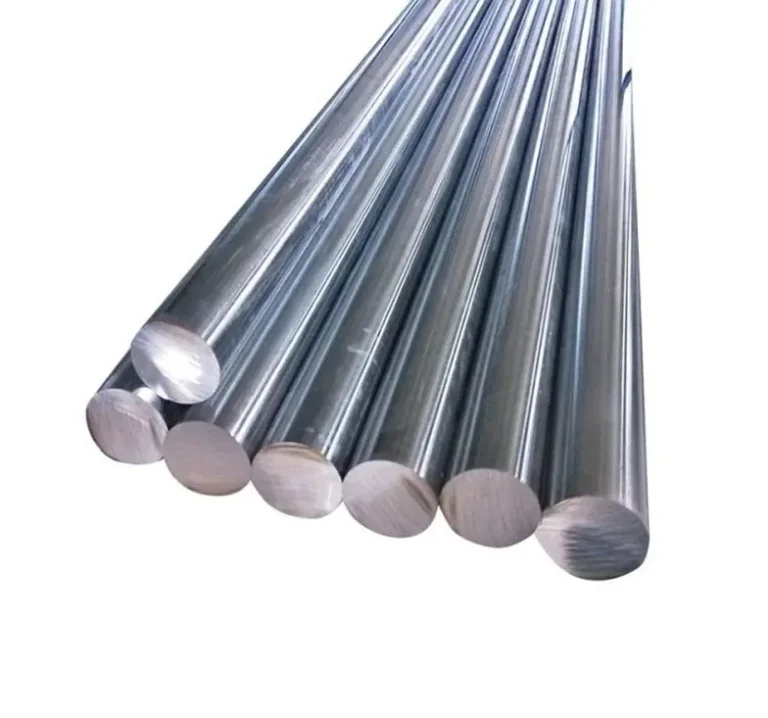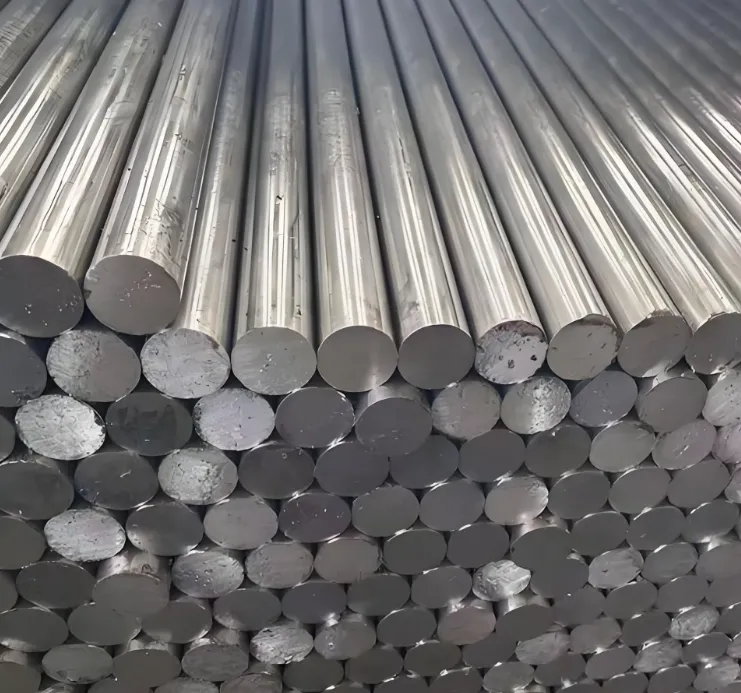

MWalloys AISI 1045 steel round bar (also sold as S45C or C45) is one of the safest “high value per dollar” choices when a project needs a stronger shaft, pin, axle, or general machine part than low carbon steel can deliver, while still keeping sourcing simple, machining predictable, and heat treatment flexible. In practical terms, 1045 round bar sits in the sweet spot between mild steel and alloy steels: it can be supplied in large stock, it responds well to quench and temper or induction hardening, and it remains a cost-controlled option that procurement teams can buy repeatedly with stable specifications.
What is AISI 1045 steel round bar, and when is it the right material choice?
AISI 1045 is a medium carbon steel with nominal carbon near 0.45 percent. That carbon level is the key: it enables meaningful hardening and strength increases after heat treatment, yet it does not push the material into the high carbon category where brittleness, crack sensitivity, or processing complexity rise quickly.
In round bar form, 1045 is widely used because:
- Round geometry matches rotating parts such as shafts, spindles, rollers, and pins.
- Stock availability is broad, covering hot rolled bars and precision finished bars.
- Heat treatment response is strong compared with 1018 or 1020.
- Cost remains lower than chromium molybdenum alloy steels such as 4140, especially in large diameters and high tonnage orders.
Typical scenarios where 1045 is a strong fit:
- General machinery shafts with moderate torque requirements.
- Hydraulic cylinder tie rods (depending on design and plating requirements).
- Pins, bushings, keys, studs, and wear sleeves.
- Gears and sprockets in moderate service, commonly with surface hardening.
- Axles, rollers, and agricultural equipment components.
- Forged parts later machined to final size.
Situations where engineers often select a different grade:
- Very thick sections needing deep hardening throughout the cross section (4140 or 4340 often wins).
- Low temperature impact requirements (alloy steels with controlled toughness may be required).
- Heavy welding fabrication (lower carbon grades reduce risk).
- Corrosion environments without coating (stainless or plated solutions).

Which standards and equivalents match 1045 (S45C, C45), and why do names vary?
Many buyers search “1045 steel round bar” while others search “S45C bar” or “C45 round bar.” These are closely related material families defined by different national standards. The naming difference reflects regional specification systems, not a completely different metal.
Common equivalents used in purchasing
| Common name | Standard system | Typical designation | Notes used in trade |
|---|---|---|---|
| AISI 1045 | USA (AISI/SAE) | 1045 | Often ordered per ASTM A29 chemical limits |
| C45 / C45E | Europe (EN) | EN 10083 C45, C45E | “E” usually indicates tighter P and S limits |
| 1.0503 | Europe material number | EN 1.0503 | Frequently paired with EN 10083 |
| S45C | Japan (JIS) | JIS G4051 S45C | Common in automotive and machinery supply chains |
| CK45 | Older DIN usage | CK45 | Legacy naming, still seen in catalogs |
Important procurement point: “equivalent” does not mean identical on every line item. Limits on phosphorus, sulfur, residuals, and the referenced test standard can differ. A reliable purchase order states both the grade and the governing standard, plus the supply condition and testing expectations.
What is the chemical composition of 1045 steel, and how does each element affect performance?
1045 performance comes from a balanced composition: enough carbon to harden, manganese to support strength and hardenability, and low residual levels to keep machining and toughness stable.
Typical chemical composition range (reference values used in many supply chains)
| Element | Typical range (wt %) | Role in service and processing |
|---|---|---|
| Carbon (C) | 0.43 to 0.50 | Strength, hardness potential, heat treat response |
| Manganese (Mn) | 0.60 to 0.90 | Hardenability support, strength, deoxidation |
| Silicon (Si) | 0.15 to 0.35 | Deoxidation, modest strength contribution |
| Phosphorus (P) | max 0.040 | Kept low to protect toughness |
| Sulfur (S) | max 0.050 | Impacts machinability and transverse ductility |
| Iron (Fe) | balance | Base metal |
Notes engineers often care about:
- Higher carbon within the band raises achievable hardness after quench and temper, yet also raises crack sensitivity if quench is aggressive.
- Sulfur can be specified tighter when ductility or fatigue resistance matters. Free-machining variants exist in other families, though standard 1045 stays moderate.
- Cleanliness and residuals (not always listed in basic composition) affect fatigue performance in rotating parts. Procurement can request steelmaking route, vacuum degassing, or inclusion control when needed.
What mechanical properties can you expect from 1045 round bar in different supply conditions?
Mechanical properties vary heavily with supply condition: hot rolled, normalized, annealed, cold drawn, or quenched and tempered. Diameter also matters because thicker sections cool slower during heat treatment.
Below ranges reflect common industry outcomes; project-critical designs should use mill test data or qualified heat treat results.
Typical mechanical properties by condition (indicative values)
| Supply condition | Tensile strength (MPa) | Yield strength (MPa) | Elongation (%) | Hardness |
|---|---|---|---|---|
| Hot rolled (typical) | 570 to 700 | 310 to 450 | 14 to 20 | 170 to 220 HB |
| Normalized | 600 to 750 | 350 to 500 | 14 to 18 | 180 to 230 HB |
| Annealed | 550 to 680 | 300 to 430 | 16 to 22 | 160 to 210 HB |
| Cold drawn | 650 to 850 | 450 to 650 | 8 to 16 | 200 to 260 HB |
| Quenched and tempered (typical engineering range) | 750 to 1000+ | 550 to 850+ | 10 to 16 | 22 to 32 HRC (approx.) |
How to interpret this table:
- Hot rolled and normalized conditions suit general machining and moderate strength needs.
- Cold drawn raises strength via strain hardening and improves dimensional consistency, yet reduces ductility.
- Quenched and tempered opens the door to higher strength levels, but section size and quench method determine uniformity through the radius.
What engineers should check before locking design values
- Bar diameter and expected property gradient from surface to core.
- Condition at delivery stated on the MTC (mill test certificate).
- Heat treat specification: a simple “Q&T” note is not enough without hardness or strength targets.
- Test location (surface, mid-radius, core) when large diameters are involved.
How does heat treatment change 1045 steel, and what results are realistic?
Heat treatment is where 1045 earns its reputation. It can be processed across a wide range: anneal to soften, normalize to refine structure, quench and temper to raise strength, or induction harden to create a hard wear layer while keeping a tougher core.
Common heat treatment options and what each one achieves
| Process | Typical aim | Typical outcome in parts |
|---|---|---|
| Full anneal | Softening and machinability | Lower hardness, stable machining, less tool wear |
| Normalizing | Grain refinement, consistency | More uniform properties than hot rolled |
| Quench and temper | Strength and toughness balance | Higher tensile and yield with controlled hardness |
| Induction hardening | Surface wear resistance | Hard case plus tougher core |
| Stress relief | Distortion control after machining | Reduces residual stresses, improves dimensional stability |
Typical temperature windows used in industry (project confirmation required)
| Heat treatment step | Common temperature range (°C) | Key control points |
|---|---|---|
| Austenitizing prior to quench | 820 to 870 | Hold time depends on section size |
| Quench media | water, polymer, oil | Water increases hardness, raises crack risk |
| Tempering | 400 to 650 | Higher temper lowers hardness, raises toughness |
| Normalizing | 840 to 900 (air cool) | Improves uniformity and machinability |
| Annealing | 760 to 800 (furnace cool) | Produces softer structure |
Induction hardening on 1045: what buyers usually ask
Induction hardening is popular because medium carbon chemistry supports a hard martensitic case without needing alloy additions.
Typical targets seen in machine components:
- Surface hardness often in the 50 to 60 HRC band (depends on process control).
- Case depth selected based on wear mode and bending stress, often a few millimeters.
- Core condition remains tougher when the core is not fully transformed.
Key caution: case depth and hardness uniformity depend on coil design, frequency, power density, scan speed, and quench timing. A drawing should state the hardness range, effective case depth definition, and test method.
Hardenability limits: why 1045 is not a “deep hardening” steel
1045 can harden significantly near the surface; deep sections may not fully transform to martensite at the core after quench, especially when diameter is large. This is a main reason many designers shift to 4140 in thick shafts.
Can 1045 be machined, welded, or formed reliably?
How machinability behaves in real shops
1045 machines well in annealed, normalized, or cold drawn conditions. Tooling choice depends on hardness and surface condition.
- In softer conditions, turning and milling are straightforward with common carbide grades.
- In higher hardness states, tool wear rises and cutting parameters need adjustment.
- Cold drawn bars often produce consistent chips and stable diameters, useful in high volume CNC work.
Procurement tip: specifying a hardness band (example: 180 to 220 HB) can reduce variation between batches and stabilize machining cost.
Welding 1045: what is feasible, what raises risk
1045 is weldable, yet welding requires disciplined procedure control due to carbon content.
Common practices used by fabricators:
- Preheat to reduce cooling rate and hydrogen cracking risk.
- Low hydrogen consumables and dry handling.
- Controlled interpass temperature.
- Post weld heat treatment when geometry and service justify it.
When welding is a major part of manufacturing, engineers often choose a lower carbon grade to reduce procedure complexity. If 1045 welding is unavoidable, the WPS should be qualified with the actual section thickness.
Forming and forging notes
1045 can be hot forged and then normalized or annealed before final machining. Forging can enhance grain flow and fatigue performance in some geometries. Cold forming is more limited compared with low carbon steels due to higher flow stress.
Where is 1045 steel round bar used, and which industries buy it most?
1045 is a staple grade in mechanical power transmission and general equipment because it balances strength, wear resistance potential, and price stability.
Common component list (round bar starting stock)
- Drive shafts, pump shafts, motor shafts.
- Pins, hinge pins, clevis pins, cylinder pins.
- Studs, tie rods, threaded bars (with correct processing).
- Rollers, guide posts, wear sleeves.
- Axles, spindles, hubs (depending on duty cycle).
- Gears and sprockets, frequently with induction hardened teeth.
- General purpose machine parts in jigs, fixtures, tooling bases.
Industry segments that frequently specify 1045
- Industrial machinery and automation.
- Agricultural machinery.
- Material handling equipment.
- Construction equipment components.
- Mining support equipment with wear surfaces.
- Power transmission and gearbox supply chains.
- Job shops producing machined parts from stocked bar.
Engineering reality: 1045 wins many bids because it meets performance requirements without stepping into higher alloy cost, and it remains globally available.
How does 1045 compare with 1018, 1020, 1050, and 4140 in engineering terms?
Designers often choose between mild steel, medium carbon steel, and alloy steel. The correct selection depends on section thickness, heat treatment, fatigue life, and purchase budget.
Material comparison table used in early stage selection
| Grade | Category | Heat treat response | Relative machinability | Typical reason to choose |
|---|---|---|---|---|
| 1018 / 1020 | Low carbon steel | Limited through hardening | High | Welded structures, simple shafts, low cost |
| 1045 | Medium carbon steel | Strong response, moderate hardenability | Good | Shafts, pins, parts needing higher strength or induction hardening |
| 1050 | Higher medium carbon | Higher hardness potential | Moderate | Wear parts, higher strength targets with more processing control |
| 4140 | Cr Mo alloy steel | High hardenability, better deep hardening | Moderate | Thick shafts, high stress parts, better toughness at strength |
| 4340 | Ni Cr Mo alloy | Very high hardenability | Moderate | Heavy duty shafts, high impact service |
1045 vs 4140: the decision point most buyers face
1045 advantages:
- Lower material cost in many markets.
- Easy sourcing in many bar forms.
- Excellent surface hardening behavior.
4140 advantages:
- Better hardenability in large diameters.
- Higher strength potential with good toughness after Q&T.
- Better performance consistency through section thickness.
A practical rule many engineers use: if the shaft diameter becomes large and the design needs uniform strength through the radius, 4140 often becomes the safer option. If the design mainly needs surface wear resistance and moderate core strength, 1045 plus induction hardening is frequently cost-effective.
What bar forms and surface finishes can you purchase, and how do they affect tolerance?
“1045 steel round bar” is not one single product. The steel grade stays similar, yet bar manufacturing route changes surface, straightness, diameter control, and total cost.
Common bar supply forms
| Bar type | Typical surface | Dimensional accuracy | Common use cases |
|---|---|---|---|
| Hot rolled round bar | Mill scale | Moderate | General machining with stock allowance |
| Cold drawn round bar | Clean, drawn finish | Better | CNC parts needing tighter diameter consistency |
| Turned and polished | Smooth, bright | Good | Parts needing better surface quality |
| Turned, ground, and polished | Precision ground | Very high | Bearings seats, tight fit shafts |
| Peeled bar | Uniform surface | Good | Improved surface quality on larger diameters |
Choosing the right form prevents hidden cost. Hot rolled bar may look cheaper per kilogram, yet extra machining time, tool wear, and scrap can erase the savings. Precision ground bar costs more, but may eliminate secondary operations and improve fit reliability.
What size range, tolerances, and weight calculations matter during purchasing?
Diameter range and length options buyers request most
Most supply chains carry 1045 round bar from small diameters up through large solid rounds. The exact range depends on mill and finishing route. Procurement usually specifies:
- Diameter and tolerance class
- Random length or fixed length
- Straightness requirement
- End condition (sawn, flame cut, faced)
- Surface condition (black, peeled, bright, ground)
Typical tolerance expectations by bar type (illustrative)
| Supply type | Typical diameter control | Straightness expectation | Notes |
|---|---|---|---|
| Hot rolled | Wider | Moderate | Allow machining stock |
| Cold drawn | Tighter | Better | Good fit with automated feeders |
| Ground | Tightest | Best | Higher cost, highest consistency |
Since tolerance classes vary by standard and mill, the purchase order should cite the applicable tolerance specification, or state the numeric tolerance directly.
Weight calculation buyers use when quoting freight and budget
Theoretical weight helps estimate shipping and unit cost. The common calculation uses density of steel near 7850 kg/m³.
| Item | Formula | Notes |
|---|---|---|
| Cross-sectional area (m²) | π × (D/2)² | D in meters |
| Volume (m³) | Area × Length | Length in meters |
| Mass (kg) | Volume × 7850 | Typical engineering approximation |
Procurement tip: quote comparisons should state whether pricing is by theoretical weight or by scale weight, and how allowable variance is handled.
What quality documentation and inspection should procurement request?
Engineering teams care about predictable performance; procurement teams care about repeatability, traceability, and dispute prevention. The correct documents reduce risk in both directions.
Standard documentation package used in industrial purchasing
| Document or test | What it confirms | When it matters most |
|---|---|---|
| MTC per EN 10204 3.1 (or equivalent) | Heat number traceability, chemistry, mechanical test results | Most industrial orders |
| Chemical analysis | Grade compliance | All orders with strict spec |
| Mechanical testing | Strength and elongation in stated condition | Safety critical parts |
| Hardness testing | Heat treat control, machinability band | Q&T, induction plans |
| UT (ultrasonic testing) | Internal soundness | Large diameter shafts, fatigue risk |
| Dimensional inspection | Diameter, ovality, straightness | Precision bars |
| Surface inspection | Seams, laps, decarb concerns | Induction hardening, fatigue |
Topics that affect fatigue life and should not be ignored
Many top ranking technical pages mention “mechanical properties” yet do not go deep into fatigue drivers. In rotating shafts, these factors often matter more than simple tensile strength:
- Surface condition and machining marks
- Decarburization depth from hot rolling or heat treatment
- Inclusion content and cleanliness
- Straightness and residual stress
- Fit and fillet radii design
A procurement spec can request decarb limits or require removal via peeling or grinding when fatigue is central to performance.
How should you specify 1045 round bar on a purchase order to avoid mistakes?
Ambiguous orders lead to wrong hardness, wrong surface, or wrong tolerance. A clean purchase description includes:
- Grade and standard: AISI 1045 per ASTM A29, or EN 10083 C45, or JIS G4051 S45C
- Product form: round bar, hot rolled or cold drawn or TGP
- Size: diameter and length, plus tolerance requirement
- Supply condition: annealed, normalized, cold drawn, Q&T with hardness target
- Testing: MTC 3.1, hardness test method, UT level if required
- Surface: black, peeled, polished, ground, decarb control
- Packaging: bundling, rust prevention, end caps, labeling needs
Example wording procurement teams often use in RFQs:
- “AISI 1045 round bar, cold drawn, diameter 50.00 mm h9, fixed length 3.0 m, hardness 180 to 220 HB, MTC EN 10204 3.1, straightness max X mm per meter.”
What stock, pricing logic, and supply planning should buyers expect from MWalloys?
MWalloys positions 1045 steel round bar as a high turnover industrial product with purchasing-friendly availability.
What “large stock” should mean in real sourcing terms
A dependable stock program typically includes:
- Common diameters held in hot rolled and cold drawn conditions
- Multiple length options aligned with container loading and local trucking limits
- Batch traceability with stable documentation
- Capability to process: cutting to length, peeling, turning, grinding, polishing
- Heat treatment support via qualified partners when Q&T is needed
What drives factory price in 1045 round bar procurement
Pricing is affected by:
- Bar type: hot rolled vs cold drawn vs ground
- Diameter and length: large diameters and fixed lengths can shift yield
- Order volume: bundle, truckload, container
- Testing: UT, extra mechanical testing, tighter chemistry
- Delivery terms: EXW, FOB, CIF, plus packaging level
A procurement team can reduce total cost by matching bar type to the real tolerance and surface needs, rather than defaulting to the highest finish.
What are common technical pitfalls with 1045 round bar, and how can you prevent them?
Pitfall 1: expecting uniform hardness in a thick bar after quench
1045 hardenability is limited compared with alloy steels. Prevention steps:
- Validate diameter vs quench method
- Specify property requirements at a defined radius
- Consider 4140 if deep uniform properties are mandatory
Pitfall 2: ignoring decarburization before induction hardening
Decarb can reduce achievable surface hardness and fatigue strength. Prevention:
- Specify peeled or ground stock if needed
- Define max decarb depth
- Confirm surface prep prior to induction
Pitfall 3: ordering “1045” without stating condition
Hot rolled 1045 and Q&T 1045 are very different products in machining behavior and strength. Prevention:
- Always state supply condition and hardness range
- Require MTC and hardness results
Pitfall 4: welding without procedure discipline
Prevention:
- Preheat, low hydrogen practice, controlled cooling
- Post weld heat treatment when design requires it
- Consider alternate grade in weld-heavy designs
FAQs about AISI 1045 steel round bar (S45C / C45)
1. What is 1045 steel best used in?
1045 is the "go-to" for shafts, pins, axles, rollers, and general machine parts that require higher strength than mild steel (like 1020). It offers the flexibility of being used in its normalized condition or being further enhanced via quench and temper or induction hardening.
2. Is AISI 1045 the same as C45 or S45C?
In global trade, C45 (EN 10083) and S45C (JIS) are widely treated as equivalents to AISI 1045. While their carbon ranges (approx. 0.43–0.50%) overlap, minor differences in allowable residual elements (like P and S) exist. Always specify the governing standard (ASTM, EN, or JIS) on your purchase order to ensure compliance.
4. What hardness can 1045 reach after heat treatment?
1045 responds exceptionally well to heat treatment. Typical outcomes include:
| Process | Target Hardness |
|---|---|
| Normalized | 170–210 HBW |
| Quench & Temper (Q&T) | 22–32 HRC |
| Induction Hardened (Surface) | 50–60 HRC |
The induction hardening potential makes it a favorite for wear-resistant components with a tough core.
6. Is 1045 steel weldable?
Welding is feasible but significantly more challenging than with 1020. Due to the higher carbon content, 1045 requires mandatory preheating (typically 150–260°C) and low-hydrogen electrodes to prevent hydrogen-induced cracking. Post-weld heat treatment (PWHT) is often recommended to relieve stresses.
7. What is the difference between 1045 and 4140?
AISI 4140 is a chromium-molybdenum alloy steel with much higher hardenability and better strength in thick sections. 1045 is a plain carbon steel, which is more cost-effective and easier to machine. Choose 4140 for extreme loads; choose 1045 for moderate-duty parts or surface-hardened applications.
8. What is the machinability of 1045 compared with 1018?
1045 machines well but generates higher cutting forces and tool wear than 1018. In the annealed or normalized condition, it produces a superior surface finish compared to mild steel, which can be prone to "tearing."
9. Should I buy hot rolled or cold drawn 1045 round bar?
Hot Rolled (HR): Best for parts where significant machining will remove the surface layers anyway; more cost-effective for large diameters.
Cold Drawn (CD): Offers tighter dimensional tolerances and a smoother finish, often improving throughput for automated CNC Swiss or screw machines.
10. What documents should I request when buying 1045?
Always request a Material Test Certificate (MTC) per EN 10204 3.1. Ensure it includes:
- Chemical Analysis: Verification of C, Mn, Si, P, S.
- Mechanical Properties: Tensile, Yield, and Elongation in the supply condition.
- Hardness: Brinell or Rockwell results.
- Ultrasonic Testing (UT): Crucial for large diameters to detect internal voids.