

Monel 400 plate is a nickel-copper alloy flat product certified under ASTM B127, offering exceptional corrosion resistance in seawater, hydrofluoric acid, and reducing environments, with tensile strength typically ranging from 70 to 85 ksi and service temperatures up to 1000°F (538°C). At MWalloys, we stock ASTM B127-certified Monel 400 plates in thicknesses from 1/8 inch to 4 inches, with custom cutting, precision tolerancing, and mill-certified documentation available for immediate shipment. Whether you are a structural engineer specifying materials for offshore platforms or a procurement manager sourcing specialty alloys for chemical processing equipment, this resource covers everything you need to make an informed decision.
If your project requires the use of Monel 400 Plate, you can contact us for a free quote.
What Exactly Is Monel 400 Plate and How Is It Different From Other Nickel Alloys?
Monel 400 is a binary nickel-copper solid solution alloy that has been in commercial production since the early 20th century. The alloy was originally developed by Ambrose Monell and first produced by the International Nickel Company (INCO) around 1906. Unlike many modern engineered alloys that rely on complex multi-element additions, Monel 400 achieves its performance primarily through a high nickel content — typically 63 to 70 percent — balanced with approximately 28 to 34 percent copper, along with small amounts of iron, manganese, silicon, and carbon.
What makes Monel 400 plate distinct from other nickel-base alloys on the market is its specific combination of mechanical toughness and corrosion resistance across a wide range of chemical environments. Alloys like Hastelloy C-276 or Inconel 625 introduce additional elements such as molybdenum, chromium, and niobium to achieve performance in oxidizing or high-temperature environments. Monel 400, by contrast, performs exceptionally well in reducing conditions and neutral chloride environments — situations where many stainless steels suffer localized or stress corrosion cracking.
In plate form, Monel 400 is rolled to flat dimensions and can be produced in hot-rolled or cold-rolled conditions. Hot-rolled plate tends to have a slightly rougher surface finish and is used in heavy structural and pressure vessel applications. Cold-rolled sheet and plate offer tighter dimensional tolerances and smoother surfaces, which matter in applications like heat exchanger cladding and chemical processing liners.
We at MWalloys have seen engineers mistake Monel 400 for Monel K-500, which adds aluminum and titanium to precipitation-harden the alloy and significantly increase yield strength. For most plate applications in chemical processing, marine, and oil and gas environments, Monel 400 provides the right balance of cost, machinability, and corrosion performance without requiring the added expense of K-500.
How Does the Nickel-Copper Ratio Affect Material Performance?
The nickel-to-copper ratio in Monel 400 is not arbitrary. Nickel provides the primary corrosion resistance mechanism in reducing acids and contributes to the alloy's toughness at cryogenic temperatures. Copper adds resistance to hydrofluoric acid and improves resistance to non-oxidizing mineral acids, including dilute sulfuric acid. The solid solution formed between nickel and copper is stable across the entire composition range, meaning there is no phase separation that would create preferential corrosion zones at grain boundaries.
This phase stability is one reason Monel 400 plate retains its properties after prolonged thermal exposure, provided temperatures stay below the precipitation range (above 600°F/315°C, some ordering reactions can begin in certain environments, but this is generally not a concern in standard service). The alloy does not harden by heat treatment, which simplifies post-weld processing and reduces the risk of heat-affected zone cracking.
What Does ASTM B127 Certification Mean for Monel 400 Plate?
ASTM B127 is the standard specification published by ASTM International that covers nickel-copper alloy (UNS N04400) plate, sheet, and strip. When a Monel 400 plate carries ASTM B127 certification, it means the material has been manufactured, tested, and documented according to specific requirements governing chemistry, mechanical properties, heat treatment, surface condition, dimensional tolerances, and marking.
This standard is jointly maintained with ASME and appears in the ASME Boiler and Pressure Vessel Code as SB-127. For engineers working on pressure vessels, heat exchangers, and process equipment, ASME SB-127 compliance is often a mandatory requirement. The practical difference between ASTM B127 and ASME SB-127 is minimal in terms of material requirements, but the ASME version carries additional code compliance documentation that may be required for jurisdictional approval.
What Testing Is Required Under ASTM B127?
Under ASTM B127, manufacturers must perform and document:
| Test Type | Requirement |
|---|---|
| Chemical Analysis | Per heat of material, all elements within specified limits |
| Tensile Testing | One test per lot, per condition, per thickness range |
| Hardness Testing | Required when material is supplied in annealed condition |
| Grain Size Determination | Required for fine-grain practice when specified |
| Nondestructive Examination | Optional per purchaser specification, e.g., ultrasonic testing |
| Visual and Dimensional Inspection | All plates must meet dimensional tolerances |
The standard defines several supply conditions: hot-rolled and annealed (most common for plate), cold-rolled and annealed (for sheet and thin plate), and as-rolled (without annealing, less common). Each condition has specific mechanical property requirements that the material must meet before it leaves the mill.
Why Does Mill Certification Matter to Procurement Teams?
Mill test reports (MTRs) are the documentary backbone of any certified plate procurement. At MWalloys, every plate in our ASTM B127 stock is accompanied by an MTR that traces the material back to its heat number, the originating mill, and the specific test results for that heat. This documentation is not merely a formality — it enables engineers and quality managers to verify conformance without repeated testing and provides legal traceability in the event of in-service failures.
When procurement managers request certified Monel 400 plate from MWalloys, we provide full MTRs with each order, including chemical composition by heat, mechanical properties by lot, and any third-party inspection reports requested at the time of order.
What Are the Chemical Composition Requirements for Monel 400 Plate?
The chemical composition of Monel 400 (UNS N04400) is tightly controlled under ASTM B127. The table below shows the allowable element ranges as specified by the standard and as cross-referenced with producer specifications from recognized mills.
ASTM B127 Chemical Composition Requirements for Monel 400 (UNS N04400)
| Element | Minimum (%) | Maximum (%) |
|---|---|---|
| Nickel + Cobalt | 63.0 | — |
| Copper | 28.0 | 34.0 |
| Iron | — | 2.5 |
| Manganese | — | 2.0 |
| Carbon | — | 0.30 |
| Silicon | — | 0.50 |
| Sulfur | — | 0.024 |
The nickel-plus-cobalt combined minimum of 63 percent reflects the standard's allowance for cobalt as a minor companion element in nickel production. In practice, commercially produced Monel 400 typically contains 65 to 68 percent nickel, with cobalt rarely exceeding 1 percent.
Carbon content deserves special attention for welding applications. Higher carbon within the 0.30 percent maximum can sensitize the alloy to intergranular attack during prolonged exposure in certain environments. For critical corrosion-sensitive applications, procurement specifications often request material with carbon below 0.15 percent, which is well within the ASTM range but provides additional safety margin.
Sulfur is controlled tightly because sulfur inclusions act as initiation sites for pitting corrosion and can also cause hot cracking during welding. The 0.024 percent maximum keeps sulfur at a level where these risks are manageable in properly executed fabrication.
What Mechanical Properties Can Engineers Expect From ASTM B127 Monel 400 Plate?
Mechanical properties for Monel 400 plate depend on the supply condition (annealed versus as-rolled or cold-worked) and the plate thickness. Engineers specifying this alloy need to understand both the minimum ASTM-required values and the typical achieved values from high-quality mill production.
Minimum Mechanical Properties per ASTM B127
| Property | Hot-Rolled Annealed | Cold-Rolled Annealed |
|---|---|---|
| Tensile Strength (min) | 70,000 psi (483 MPa) | 70,000 psi (483 MPa) |
| Yield Strength 0.2% Offset (min) | 28,000 psi (193 MPa) | 28,000 psi (193 MPa) |
| Elongation in 2 inches (min) | 35% | 35% |
| Hardness (Rockwell B, max) | 80 | 85 |
Typical achieved values from certified mill plate often exceed minimums:
| Property | Typical Achieved Value |
|---|---|
| Tensile Strength | 76,000 to 85,000 psi (524 to 586 MPa) |
| Yield Strength | 32,000 to 45,000 psi (221 to 310 MPa) |
| Elongation | 40 to 50% |
| Hardness (Rockwell B) | 65 to 75 |
These typical values reflect the ductile nature of annealed Monel 400. The high elongation values mean the material can absorb significant plastic deformation before fracture, which is critical in pressure vessels and structural applications where overload must not result in sudden brittle failure.
Physical Properties Relevant to Design
| Physical Property | Value |
|---|---|
| Density | 8.80 g/cm³ (0.319 lb/in³) |
| Melting Range | 2370 to 2460°F (1299 to 1349°C) |
| Thermal Conductivity at 70°F | 12.5 BTU/hr·ft·°F (21.6 W/m·K) |
| Coefficient of Thermal Expansion | 7.7 × 10⁻⁶/°F (13.9 × 10⁻⁶/°C) |
| Electrical Resistivity | 482 ohm·circ mil/ft at 70°F |
| Specific Heat | 0.102 BTU/lb·°F at 70°F |
| Magnetic Permeability | Low, essentially non-magnetic in annealed condition |
The relatively low thermal conductivity compared to carbon steel (which runs around 26 BTU/hr·ft·°F) has design implications for heat exchangers. Monel 400 is still widely used in heat exchanger service, but designers must account for the thermal conductivity difference when calculating heat transfer areas.
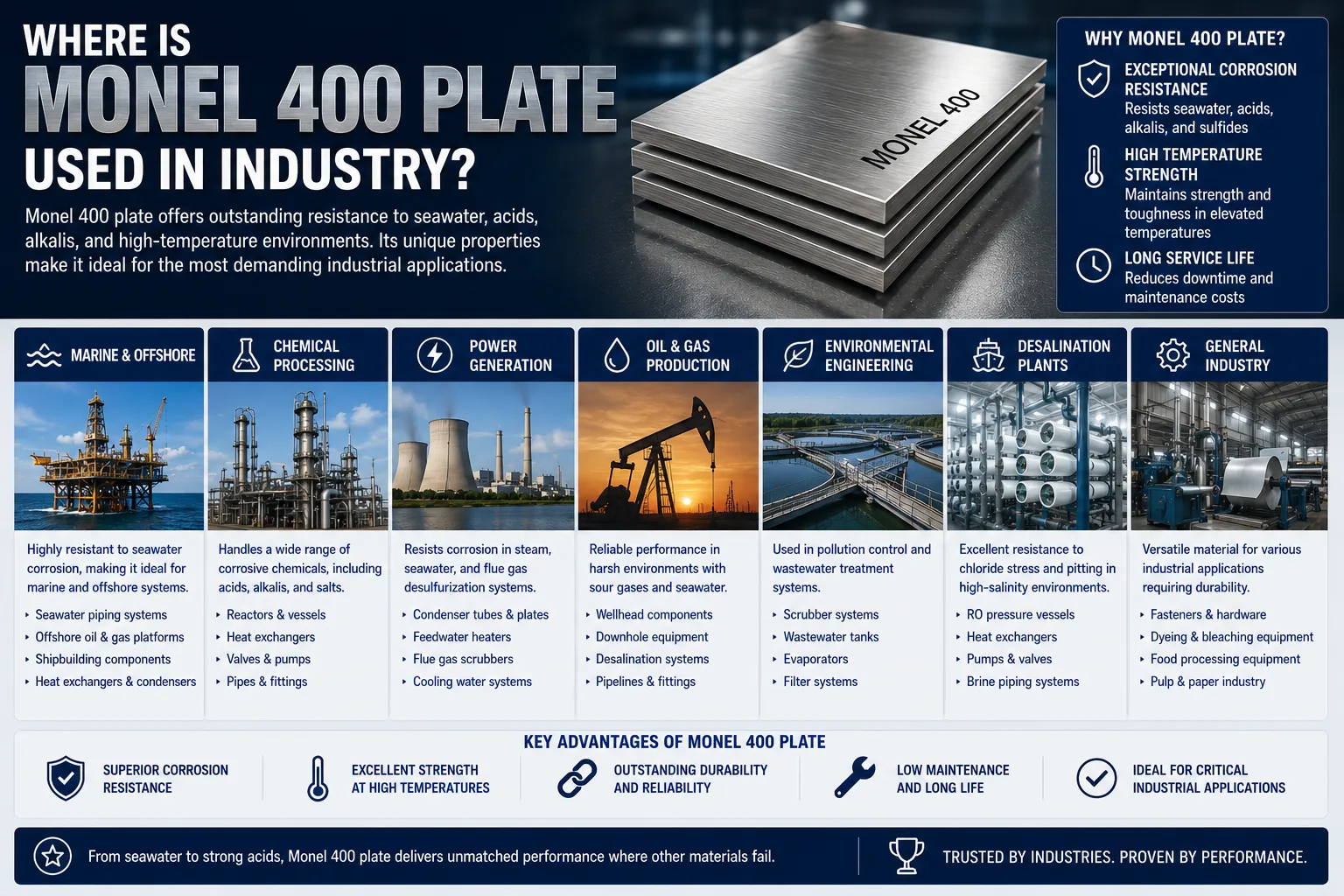
Where Is Monel 400 Plate Used in Industry?
The breadth of industries that specify Monel 400 plate reflects the alloy's versatility. We have shipped ASTM B127 certified plate to customers across marine, chemical processing, oil and gas, aerospace, and nuclear sectors. Below is a detailed breakdown of major application areas.
Marine and Offshore Applications
Seawater is one of the most demanding corrosion environments for metals. The combination of chloride ions, dissolved oxygen, biological activity, and varying temperatures creates conditions that destroy many common alloys within months. Monel 400 plate has a decades-long track record in:
- Seawater piping system flanges and valve bodies.
- Pump impeller housings and casings.
- Submarine hull fittings and through-hull penetrations.
- Offshore platform structural components in splash zones.
- Propeller shaft sleeves and bearing housings.
- Desalination plant components.
The alloy's resistance to stress corrosion cracking in chloride environments is particularly valuable in offshore applications where stress corrosion cracking of 300-series stainless steels has caused well-documented equipment failures.
Chemical Processing Equipment
In chemical plants, Monel 400 plate is used wherever the process stream involves:
- Hydrofluoric acid (HF) at essentially all concentrations and temperatures.
- Hydrochloric acid (HCl) in dilute concentrations under reducing conditions.
- Sulfuric acid in certain concentration and temperature ranges.
- Caustic soda (NaOH) solutions at elevated temperatures.
- Neutral salt solutions
- Organic acids such as acetic and formic acid.
The alloy is particularly notable for HF service, where it is one of very few metals that can handle concentrated HF without rapid dissolution. This makes it almost irreplaceable in alkylation unit equipment in petroleum refining.
Oil and Gas Industry
In upstream and midstream oil and gas, Monel 400 plate appears in:
- Christmas tree components and wellhead equipment.
- Valve bodies and trim for sour service.
- Downhole tool components.
- Separator vessel cladding.
- Piping flanges in H₂S-containing service.
While Monel 400 is not immune to attack by wet hydrogen sulfide under all conditions, it generally outperforms carbon steel and austenitic stainless steels in many sour service environments when properly specified.
Nuclear and Defense Industries
Monel 400's low corrosion rate in uranium processing solutions and its resistance to various nuclear plant process fluids led to its early adoption in nuclear applications. Plate forms are used in:
- Uranium hexafluoride (UF₆) processing equipment.
- Naval nuclear propulsion system components.
- Munitions manufacturing equipment exposed to acids.
How Does Monel 400 Plate Perform Against Corrosion Compared to Stainless Steel?
This question comes up in nearly every technical conversation we have with engineers evaluating material upgrades from stainless steel to nickel alloys. The answer depends heavily on the specific environment, but a structured comparison helps clarify the decision.
Comparative Corrosion Performance: Monel 400 vs. Common Stainless Grades
| Environment | 304 Stainless | 316 Stainless | Monel 400 |
|---|---|---|---|
| Seawater (ambient) | Poor to Fair | Fair | Excellent |
| Chloride SCC susceptibility | High | Moderate | Very Low |
| Hydrofluoric acid | Not suitable | Not suitable | Excellent |
| Dilute HCl (reducing) | Not suitable | Not suitable | Good |
| Caustic soda (hot) | Fair | Fair | Excellent |
| Dilute H₂SO₄ (reducing) | Poor | Poor | Good |
| Pitting resistance (PREN) | ~18 | ~24 | Not pitting-susceptible in same manner |
| Maximum service temperature | 870°C oxidizing | 870°C oxidizing | 538°C reducing recommended |
The fundamental mechanism behind Monel 400's superior performance in chloride environments is its absence of a chromium oxide passive film. Stainless steels rely on a thin chromium oxide film that can break down in concentrated chloride solutions, particularly at elevated temperatures, leading to pitting and stress corrosion cracking. Monel 400 does not depend on this passive film mechanism; instead, its corrosion resistance comes from the thermodynamic stability of the nickel-copper alloy itself in reducing and neutral environments.
This difference is critical for engineers who have experienced stress corrosion cracking failures in stainless steel heat exchangers or seawater piping. Replacing wetted surfaces with Monel 400 plate can eliminate the root cause of the failure mode rather than just extending service intervals.
What Custom Cutting Services Are Available for Monel 400 Plate?
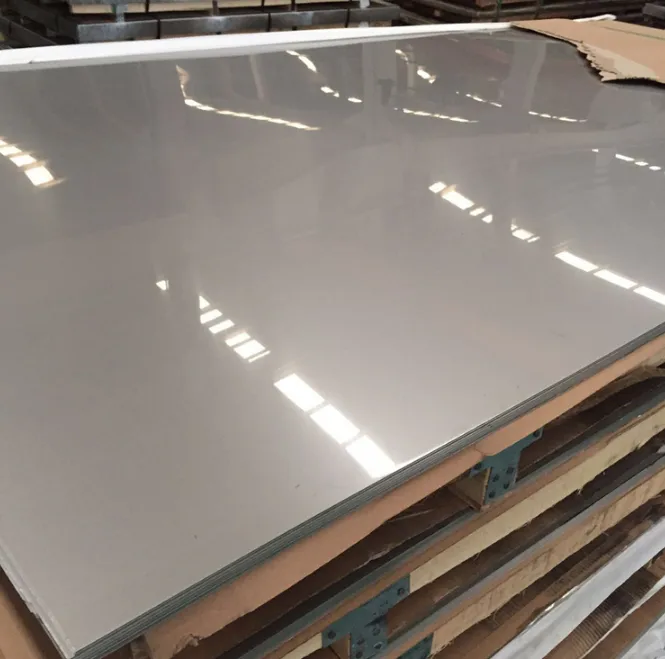
One of the most common requirements we receive from fabricators and engineering procurement contractors is custom-cut Monel 400 plate. Mill plates typically arrive in standard sizes — commonly 48 x 96 inches, 60 x 120 inches, or 96 x 240 inches — and must be cut to customer-specified dimensions before they can be used in fabrication. At MWalloys, we offer several custom cutting methods, each suited to different thickness ranges, tolerance requirements, and budget constraints.
Waterjet Cutting
Waterjet cutting uses a high-pressure stream of water mixed with abrasive garnet particles to cut Monel 400 plate without introducing heat. This is important because heat-affected zones can alter the microstructure and residual stress distribution of the material. Waterjet cutting is suitable for:
- Thicknesses from 0.125 inch up to approximately 6 inches
- Parts requiring tight dimensional tolerances (±0.005 inch achievable)
- Complex contours and internal cutouts
- Applications where surface finish adjacent to the cut is critical
The main limitation of waterjet cutting is cut speed — it is slower than plasma or laser cutting, which increases per-unit cost for high-volume orders. However, for specialty alloy plate like Monel 400, where material cost dominates the total part cost, the precision and quality advantages of waterjet cutting typically outweigh the additional processing time.
Plasma Cutting
Plasma cutting uses an ionized gas jet to melt and remove material. Modern precision plasma systems can cut Monel 400 plate up to approximately 2 inches thick with tolerances of ±0.030 to ±0.060 inch. Plasma cutting is faster than waterjet for medium thicknesses and is well-suited for:
- Structural shapes and blanks where tight tolerances are not required.
- High-volume production runs where speed matters.
- Plates above the practical range of laser cutting.
Post-cut cleanup of the heat-affected zone is typically required when plasma-cut Monel 400 plates will be welded, as the HAZ may show slightly different corrosion characteristics than the base metal.
Laser Cutting
Fiber laser cutting produces the highest dimensional precision among thermal cutting methods and is practical for Monel 400 plate up to approximately 0.75 to 1 inch thickness. Laser-cut edges are smooth and require minimal secondary processing. This method is preferred for:
- Thin plate and sheet applications.
- Parts with very fine feature details.
- Orders requiring rapid turnaround with minimal post-processing.
Sawing and Shearing
For straightforward rectangular cuts, band sawing and guillotine shearing are cost-effective options. Band sawing is suitable across a wide thickness range and produces minimal heat. Shearing is practical for thinner plate (generally below 0.5 inch for Monel 400 given its strength) and produces a straight cut line without any heat input.
Custom Cutting Tolerance Summary
| Cutting Method | Practical Thickness Range | Typical Tolerance | Heat Input |
|---|---|---|---|
| Waterjet | 0.125 to 6 inches | ±0.005 to ±0.015 in | None |
| Fiber Laser | Up to 1 inch | ±0.005 to ±0.010 in | Low |
| Precision Plasma | Up to 2.5 inches | ±0.030 to ±0.060 in | Moderate |
| Band Saw | All standard thicknesses | ±0.030 to ±0.060 in | Minimal |
| Guillotine Shear | Up to 0.5 inch | ±0.015 to ±0.030 in | None |
How Are Monel 400 Plates Fabricated and Welded in the Field?
Understanding fabrication requirements is essential for engineers and fabricators who receive Monel 400 plate from MWalloys and need to process it into finished components. Improper fabrication practices can degrade the alloy's corrosion performance and mechanical integrity even when the base material is perfectly certified.
Machining Monel 400 Plate
Monel 400 is machinable but requires different practices than carbon steel:
- Work hardening: The alloy work-hardens rapidly during cutting. This means using aggressive cuts with sharp tooling rather than light skimming passes that allow the workpiece surface to harden before the cutting edge engages.
- Cutting speeds: Recommended cutting speeds are lower than for carbon steel. Carbide tooling at 100 to 200 surface feet per minute is typical for turning; high-speed steel tooling works at lower speeds.
- Lubrication: Sulfur-free cutting fluids are preferred to avoid sulfur contamination that could cause issues in certain corrosion environments.
- Rigidity: Monel 400's toughness means machining operations require rigid setups to prevent chatter and vibration that would produce poor surface finish and accelerate tool wear.
Welding Monel 400 Plate
Monel 400 is weldable by most fusion processes. The most common methods used in fabrication are:
Gas Tungsten Arc Welding (GTAW/TIG): Preferred for critical applications requiring high weld quality and full penetration. Uses ERNiCu-7 filler metal (Monel 70/30 equivalent) with argon or argon-helium shielding gas.
Gas Metal Arc Welding (GMAW/MIG): Used for higher deposition rate applications with ERNiCu-7 wire electrode. Requires careful control of heat input to avoid hot cracking.
Shielded Metal Arc Welding (SMAW): Uses ENiCu-7 coated electrodes. Practical for field repairs and situations where gas shielding is not feasible. Weld quality is generally slightly lower than GTAW.
Submerged Arc Welding (SAW): Used for thick plate butt welds in production environments. Requires specially formulated fluxes compatible with nickel-copper alloys.
Key Welding Precautions
- Joint preparation must be clean and free of oil, paint, and sulfur-containing compounds.
- Pre-weld cleaning with acetone or another appropriate solvent is standard practice.
- Interpass temperature should be kept below 300°F (150°C) to minimize residual stress and distortion.
- Post-weld heat treatment is generally not required for corrosion resistance, but stress relief may be specified for pressure vessel code applications.
- Back purging with argon is recommended for GTAW root passes on pipe and pressure vessel plate.
Cold Forming and Hot Forming
Monel 400 plate can be cold-formed using conventional equipment. Its high ductility (35 to 50 percent elongation) accommodates substantial cold bending, pressing, and rolling. Because the alloy work-hardens, intermediate annealing at 1700 to 1900°F (927 to 1038°C) may be required for severe forming operations.
Hot forming is performed in the range of 1600 to 2200°F (871 to 1204°C). The plate should be preheated uniformly, and work should be completed before the temperature drops below 1600°F (871°C) to avoid forming in a range where the alloy may be less ductile due to ordering reactions.
What Are the Available Sizes, Dimensions, and Stock Availability at MWalloys?
At MWalloys, we maintain one of the most comprehensive inventories of ASTM B127 certified Monel 400 plate among specialty alloy distributors. Below is a representative stock size guide. Actual inventory fluctuates with demand and mill production schedules, and we encourage procurement teams to contact us directly for real-time availability and lead times.
Standard Stock Plate Sizes at MWalloys
| Thickness (inches) | Common Mill Widths | Common Mill Lengths |
|---|---|---|
| 1/8 (0.125) | 36, 48, 60 in | 96, 120, 144 in |
| 3/16 (0.1875) | 36, 48, 60 in | 96, 120, 144 in |
| 1/4 (0.250) | 48, 60 in | 96, 120, 144, 240 in |
| 3/8 (0.375) | 48, 60 in | 96, 120, 144, 240 in |
| 1/2 (0.500) | 48, 60 in | 96, 120, 144, 240 in |
| 5/8 (0.625) | 48, 60 in | 96, 120 in |
| 3/4 (0.750) | 48, 60 in | 96, 120 in |
| 1 (1.000) | 48, 60 in | 96, 120 in |
| 1.25 to 2 | 48 in | 96, 120 in |
| 2.5 to 4 | 48 in | 96 in |
Non-standard thicknesses and widths can be sourced from our mill partners with lead times typically ranging from 6 to 14 weeks depending on quantity and market conditions. We recommend procurement managers working on long-lead projects contact our technical sales team early in the project timeline to lock in pricing and availability.
Surface Finish Options
Monel 400 plate is typically supplied with a hot-rolled and annealed surface finish (2D equivalent), which has a dull matte appearance. For applications requiring a smoother surface — such as hygienic process equipment or lining applications — we can source or arrange processing to achieve:
- 2B finish (cold-rolled, annealed, skin-passed).
- No. 4 finish (brushed, 150-grit equivalent).
- Custom polished finishes per customer specification.
How Should Monel 400 Plate Be Inspected and Tested Before Use?
Incoming inspection of Monel 400 plate is a critical step that MWalloys strongly recommends, particularly for pressure-critical or safety-critical applications. The following inspection protocols align with industry best practices and ASTM B127 requirements.
Chemical Verification
For initial lots or new supplier qualification, optical emission spectroscopy (OES) or X-ray fluorescence (XRF) analysis can verify that the major elements (nickel, copper, iron, manganese) fall within ASTM B127 limits. XRF is faster and non-destructive but may be less accurate for light elements like carbon and sulfur. Full wet chemistry or combustion analysis is the gold standard for complete composition verification.
Dimensional Inspection
ASTM B127 references dimensional tolerances published in ASTM A480/A480M for plate thickness, width, length, flatness, and squareness. Key tolerances to verify include:
| Dimension | Tolerance per ASTM A480M (typical hot-rolled plate) |
|---|---|
| Thickness (≤1 inch) | +0.030 / -0.010 inch |
| Width | +0.250 / -0.000 inch |
| Length | +0.500 / -0.000 inch |
| Flatness (per 8-foot) | 0.25 inch maximum deviation |
| Out of square (per 8-foot) | 0.125 inch maximum |
Mechanical Property Verification
If MTR mechanical properties need independent confirmation, tensile testing per ASTM E8 can be performed on samples cut from the plate. Most ASTM B127 material from reputable mills will significantly exceed the minimums, so tensile testing is often done for quality confidence rather than concern about non-conformance.
Nondestructive Examination
For applications requiring freedom from internal discontinuities — such as pressure vessel plate or clad plate bond verification — ultrasonic testing (UT) per ASTM A578 or ASTM E114 protocols can be specified. MWalloys can arrange third-party UT inspection prior to shipment when requested in the purchase order.
What Are the Pricing Factors and How Should Procurement Managers Budget?
Monel 400 plate pricing is significantly higher than carbon steel and even many stainless steel grades. Understanding what drives the cost helps procurement managers build accurate budgets and make rational sourcing decisions.
Primary Cost Drivers
Raw material: nickel and copper market prices
Nickel is the dominant cost driver for Monel 400. The London Metal Exchange (LME) nickel price fluctuates based on global supply and demand, with significant price movements driven by stainless steel production demand (which accounts for the majority of global nickel consumption), battery electric vehicle supply chains, and geopolitical factors affecting mining operations in major producing countries (Indonesia, Philippines, Russia, Canada).
Since Monel 400 is approximately 65 percent nickel, a $5,000 per metric ton change in LME nickel translates to roughly $3.25 per pound increase in raw material cost for the alloy. Copper, at approximately 30 percent of the alloy, adds additional exposure to LME copper price movements.
Thickness and weight
Heavier plates cost more in absolute terms but may have lower per-pound prices than thinner plates due to rolling economics. Custom thicknesses that deviate from standard mill rolling schedules carry a premium.
Quantity
Larger orders receive mill-direct pricing that can be substantially lower than standard distributor pricing for small quantities. Minimum order quantities at the mill level are typically 2,000 to 5,000 pounds per thickness, though MWalloys can supply smaller quantities from stock at standard rates.
Certification level
Standard ASTM B127 MTR documentation is included at no additional cost at MWalloys. Additional certifications such as NACE MR0175 compliance statement, third-party inspection reports, or Lloyds/DNV/ABS marine classification society certification add to the documentation processing cost.
Cutting and processing
Custom cutting, surface finishing, and non-standard packaging add to the base material cost. We recommend requesting a fully processed quote (material plus cutting plus shipping) rather than comparing only base material prices.
Cost Comparison: Monel 400 vs. Alternative Alloys
| Material | Approximate Price Range (USD/lb, 2025 market) |
|---|---|
| Carbon Steel A516-70 | $0.50 to $0.90 |
| 304 Stainless Plate | $1.80 to $3.00 |
| 316L Stainless Plate | $2.50 to $4.00 |
| Monel 400 Plate (ASTM B127) | $12.00 to $22.00 |
| Hastelloy C-276 Plate | $35.00 to $65.00 |
| Titanium Gr. 2 Plate | $18.00 to $30.00 |
These ranges are approximate and shift with raw material markets. Monel 400 is positioned as a mid-range specialty alloy — significantly more expensive than stainless steels but substantially less costly than high-performance nickel alloys like Hastelloy C-276 or Inconel 625. In applications where Monel 400 provides sufficient performance, choosing it over a more expensive alloy represents meaningful cost optimization.
Frequently Asked Questions (FAQs)
1. What is the difference between Monel 400 plate and Monel 400 sheet?
Monel 400 plate and sheet both refer to flat-rolled product in UNS N04400, but the distinction lies in thickness. Per ASTM standards, material 3/16 inch (4.76 mm) and thicker is classified as plate, while thinner flat-rolled product is classified as sheet or strip. Both plate and sheet are covered under ASTM B127. For structural and pressure vessel applications, plate is the standard form. Sheet is used in lining, cladding, and fabrication of lighter-duty components. At MWalloys, we stock both forms with full ASTM B127 certification, and our technical team can help you determine which form is appropriate for your specific application requirements.
2. Can Monel 400 plate be used in hydrofluoric acid service?
Yes. Monel 400 plate is one of the most established materials for hydrofluoric acid service and is widely specified in petroleum refinery alkylation units. The alloy resists both anhydrous HF and aqueous HF solutions across a broad concentration range, outperforming virtually all common engineering metals in this environment. NACE International and industry operators have documented its performance in HF alkylation service for decades. One important caveat: aerated or oxidizing HF conditions accelerate attack; Monel 400 performs best in HF environments that are reducing or deaerated. Procurement of Monel 400 for HF service should be accompanied by consultation with a corrosion engineer familiar with the specific process conditions.
3. Is Monel 400 magnetic?
Monel 400 in the annealed condition is essentially non-magnetic (low magnetic permeability). However, cold working can induce a small degree of ferromagnetism, and the alloy's magnetic response can vary depending on exact composition. Unlike austenitic stainless steels, which are clearly non-magnetic when annealed but can become magnetic when cold-worked, Monel 400's magnetic behavior is generally considered low-permeability across both annealed and lightly cold-worked conditions. For applications where strict non-magnetism is required — such as certain naval or electronic applications — the magnetic permeability should be specifically measured and specified. MWalloys can assist in sourcing material with documented low magnetic permeability when required.
4. What welding filler metal should be used with Monel 400 plate?
The standard filler metal for welding Monel 400 to itself is ERNiCu-7 for GTAW and GMAW processes, or ENiCu-7 for SMAW. These fillers maintain compositional compatibility with the base metal and produce welds with corrosion resistance closely matching the parent material. When joining Monel 400 to carbon steel or stainless steel, ERNiCu-7 is still commonly used for the Monel side, but the joint design and filler selection must consider the dilution effects from the dissimilar metal. For pressure vessel code work, qualified welding procedures per ASME Section IX are required. MWalloys can supply welding filler metals and consumables alongside Monel 400 plate if needed.
5. What is the maximum service temperature for ASTM B127 Monel 400 plate?
Monel 400 retains useful mechanical properties up to approximately 1000°F (538°C) in reducing environments. However, the alloy should not be used in oxidizing atmospheres at elevated temperatures, as it will oxidize rapidly above approximately 600°F (315°C). In steam service, Monel 400 performs well up to about 800°F (427°C). At temperatures above 600°F, some ordering of the nickel-copper lattice can occur, which may slightly increase strength and reduce ductility, but this is generally not a problem in normal service. The ASME Boiler and Pressure Vessel Code publishes allowable stresses for SB-127 Monel 400 at elevated temperatures, which designers should use directly rather than extrapolating from room-temperature properties.
6. Does Monel 400 plate require post-weld heat treatment?
Post-weld heat treatment (PWHT) is generally not required for Monel 400 plate welds from a corrosion resistance standpoint, as the alloy does not sensitize in the heat-affected zone the way some stainless steels do. However, stress relief annealing may be required by the applicable fabrication code (such as ASME Section VIII) for thick sections or designs where residual weld stresses could compromise integrity. If PWHT is performed, the recommended temperature range is 1650 to 1750°F (899 to 954°C) followed by rapid cooling. Slow furnace cooling through the 600 to 1000°F (315 to 538°C) range should be avoided to prevent embrittlement from ordering reactions.
7. How does Monel 400 plate compare to copper-nickel alloys like 70-30 CuNi?
Monel 400 contains about 65 percent nickel with 30 percent copper, while 70-30 copper-nickel (UNS C71500) contains about 70 percent copper and 30 percent nickel. Despite superficially similar compositions, their properties differ substantially. Monel 400 has much higher tensile strength, superior performance in reducing acid environments, and better resistance to stress corrosion cracking. Copper-nickel alloys are more economical and perform very well in seawater due to their biofouling resistance, but they are not suited to acid service where Monel 400 excels. The choice between the two depends primarily on the specific corrosion environment and mechanical requirements. For acid service, Monel 400 is the clear choice; for seawater piping at lower pressures and temperatures, 70-30 CuNi may provide adequate performance at lower cost.
8. What quality certifications does MWalloys provide with Monel 400 plate orders?
MWalloys provides full mill test reports (MTRs) compliant with ASTM B127 with every plate order as standard. These documents include heat number traceability, chemical composition by heat, mechanical properties by lot, and confirmation of supply condition and heat treatment. Additional certifications available upon request include ASME SB-127 dual certification, NACE MR0175/ISO 15156 compliance statements for sour service applications, third-party inspection reports from recognized agencies (SGS, Intertek, Bureau Veritas), and marine classification society certificates (DNV, Lloyd's Register, ABS, BV) for marine and offshore applications. Requests for additional documentation must be specified at the time of purchase order placement.
9. Can Monel 400 plate be used in cryogenic applications?
Yes. Monel 400 maintains excellent toughness at cryogenic temperatures, making it suitable for liquefied gas service. The alloy's face-centered cubic (FCC) crystal structure means it does not undergo a ductile-to-brittle transition at low temperatures, unlike ferritic or martensitic steels. Monel 400 plate has been used in liquid nitrogen, liquid oxygen, and LNG applications. For formal cryogenic pressure vessel design under ASME code, engineers should reference the allowable stress tables for temperatures down to -325°F (-198°C) published in Section II of the ASME BPVC. Impact testing (Charpy V-notch) at the minimum design metal temperature may be required for code applications.
10. What is the typical lead time for custom-cut Monel 400 plate from MWalloys?
Lead time for custom-cut Monel 400 plate from MWalloys depends on whether the required thickness and width are in stock or require mill ordering. In-stock standard thicknesses (1/4 inch through 1 inch in common widths) can typically be cut to customer dimensions and shipped within 3 to 7 business days for orders up to approximately 5,000 pounds. Larger orders from stock may require 1 to 2 weeks for processing and documentation. For non-stock thicknesses or very large orders requiring mill production, lead times range from 6 to 14 weeks. MWalloys recommends contacting our sales team at the earliest stage of your project so we can reserve stock or place mill orders in time to meet your fabrication schedule.
Verifiable Sources
The technical content in this article is based on the following authoritative standards, publications, and reference sources. MWalloys recommends that engineers and procurement professionals consult these primary sources directly for formal design and specification work:
- ASTM International. ASTM B127-22: Standard Specification for Nickel-Copper Alloy (UNS N04400) Plate, Sheet, and Strip. ASTM International, West Conshohocken, PA.
- ASME Boiler and Pressure Vessel Code, Section II, Part B: Nonferrous Material Specifications, SB-127. American Society of Mechanical Engineers, New York, NY.
- Special Metals Corporation. Monel Alloy 400 Technical Bulletin SMC-080. Special Metals Corporation, Huntington, WV.
- NACE International (now AMPP). NACE MR0175/ISO 15156: Petroleum and Natural Gas Industries — Materials for Use in H2S-Containing Environments in Oil and Gas Production.
- ASM International. ASM Handbook, Volume 2: Properties and Selection: Nonferrous Alloys and Special-Purpose Materials. ASM International, Materials Park, OH.
- ASM International. ASM Handbook, Volume 13A: Corrosion: Fundamentals, Testing, and Protection. ASM International, Materials Park, OH.
- ASTM International. ASTM A480/A480M: Standard Specification for General Requirements for Flat-Rolled Stainless and Heat-Resisting Steel Plate, Sheet, and Strip. (Referenced for dimensional tolerances applicable to nickel alloy plate.)
- Schweitzer, Philip A. Corrosion Engineering Handbook, Second Edition: Corrosion of Linings and Coatings. CRC Press/Taylor & Francis, Boca Raton, FL.
- Shoemaker, Larry E. and Smith, George D. "A Century of Monel Metal: 1906-2006." JOM, August 2006, pp. 22-26. The Minerals, Metals & Materials Society.
- London Metal Exchange (LME): Nickel Price Data and Historical Pricing.
- ASME Section IX: Welding, Brazing, and Fusing Qualifications. American Society of Mechanical Engineers, New York, NY.
- TWI (The Welding Institute). Guidance on Welding Nickel-Copper Alloys.