

Monel alloys and stainless steel are two of the most commonly used materials in a wide range of industries. They each have distinct properties, advantages, and applications that make them suitable for specific conditions and uses. When comparing Monel to stainless steel, the question often arises: which material is superior?
The answer is not straightforward because both Monel and stainless steel have their own unique benefits. While Monel alloys are known for their exceptional resistance to corrosion, especially in harsh environments such as seawater, acidic solutions, and high-temperature conditions, stainless steel offers impressive strength, versatility, and cost-effectiveness. Ultimately, the choice between Monel and stainless steel depends on the specific application, environmental conditions, and budget.
1. Introduction to Monel and Stainless Steel
Overview of Monel Alloys
Monel is a group of nickel-copper alloys that are prized for their excellent resistance to corrosion, particularly in harsh environments such as seawater, acidic solutions, and high-temperature applications. The most commonly used Monel alloy is Monel 400, which contains around 67% nickel and 30% copper, with small amounts of iron, manganese, carbon, and silicon. These alloys exhibit great strength and toughness, making them ideal for use in marine, chemical, and oil industries.
Overview of Stainless Steel
Stainless steel, on the other hand, is a steel alloy primarily made of iron, chromium, and nickel, with variations that include elements like molybdenum and titanium. Stainless steel is known for its resistance to rust, staining, and corrosion. It’s versatile and widely used across industries such as construction, food processing, medical devices, and transportation. The most common types of stainless steel are 304 and 316, with 316 offering superior corrosion resistance due to the addition of molybdenum.
2. Material Composition and Types
Monel Composition and Variations
Monel alloys typically consist of a blend of nickel and copper, with varying compositions depending on the alloy type. The two most common Monel alloys are:
-
Monel 400: Contains 63-70% nickel and 28-34% copper, along with iron, manganese, and silicon.
-
Monel K-500: A high-strength version of Monel with the addition of aluminum and titanium to enhance hardness and fatigue resistance.
Stainless Steel Composition and Variations
Stainless steel, categorized by different grades, varies in its composition, especially in the amounts of chromium and nickel. Some common grades include:
-
304 Stainless Steel: Composed of 18% chromium and 8% nickel, this is the most commonly used stainless steel.
-
316 Stainless Steel: Contains 16-18% chromium, 10-14% nickel, and 2-3% molybdenum for enhanced corrosion resistance, especially in chloride environments.
3. Corrosion Resistance
How Monel Resists Corrosion
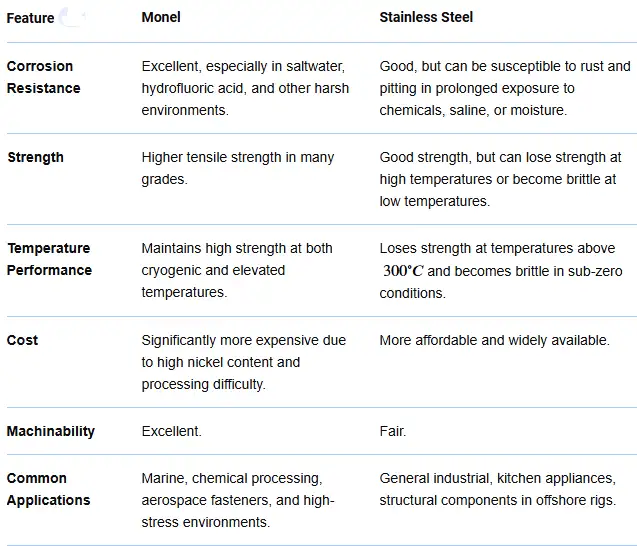
Monel is particularly resistant to corrosion in marine environments and is highly resistant to pitting, crevice corrosion, and stress corrosion cracking. The high nickel content provides excellent resistance to a wide variety of acids and alkalis, making Monel ideal for applications in chemical processing and desalination.
How Stainless Steel Resists Corrosion
Stainless steel is also highly resistant to corrosion due to its chromium content, which forms a thin, self-healing oxide layer on the surface. However, its resistance can be compromised in environments with high chloride concentrations (e.g., seawater), which is where Monel tends to outperform stainless steel.
Comparison of Performance in Different Environments
-
Monel: Superior performance in seawater, acidic environments, and high-temperature applications.
-
Stainless Steel: Performs well in most industrial environments but may not be as resistant as Monel in highly corrosive conditions such as saltwater.
4. Mechanical Properties
Strength and Durability of Monel
Monel alloys, especially Monel 400, have a high tensile strength of around 70-85 ksi and good durability under extreme conditions. These alloys exhibit excellent toughness and fatigue resistance, even at elevated temperatures.
Strength and Durability of Stainless Steel
Stainless steel is known for its high tensile strength and excellent impact resistance. For example, 304 stainless steel offers tensile strength of 70 ksi, while 316 stainless steel offers slightly higher tensile strength.
Tensile Strength, Hardness, and Toughness
Monel alloys generally offer good tensile strength, though stainless steel can be stronger in some grades, especially in high-strength alloys like 17-4PH stainless steel. However, Monel tends to outperform stainless steel in toughness and resistance to cracking.
5. Temperature and Pressure Tolerance
Monel’s Performance in High Temperatures and Pressures
Monel alloys maintain their strength and corrosion resistance at elevated temperatures, making them suitable for applications in boilers, pressure vessels, and engines. They can withstand temperatures up to 1,000°F (537°C) without losing structural integrity.
Stainless Steel’s Performance in Varying Temperatures and Pressures
Stainless steel also performs well at high temperatures, with certain grades able to handle temperatures up to 2,000°F (1,093°C). Stainless steel is often used in high-pressure systems, such as reactors and heat exchangers.
Application Examples
-
Monel: Used in marine engines, chemical reactors, and valves exposed to high-pressure environments.
-
Stainless Steel: Common in industrial piping, heat exchangers, and building structures.
6. Weldability and Fabrication
Ease of Welding Monel
Monel alloys are challenging to weld because of their tendency to form brittle phases during cooling. Specialized techniques such as TIG welding and the use of filler metals designed for Monel are often necessary.
Ease of Welding Stainless Steel
Stainless steel is relatively easier to weld compared to Monel. Most grades of stainless steel can be welded using standard welding techniques, though some high-carbon stainless steels may require special care to prevent cracking.
Challenges and Considerations During Fabrication
-
Monel: Requires careful control of welding parameters to avoid defects.
-
Stainless Steel: Offers more flexibility in fabrication but may need passivation to ensure proper corrosion resistance.
7. Cost Comparison
Monel’s Cost Factors
Monel is more expensive than stainless steel due to the high cost of nickel and copper in its composition. The cost can vary depending on the alloy grade and market prices for raw materials.
Stainless Steel’s Cost Factors
Stainless steel is more cost-effective, especially when using grades like 304 or 316. The price of stainless steel can fluctuate based on the cost of nickel, chromium, and molybdenum.
Economic Considerations for Businesses
-
Monel: Higher initial cost but may offer long-term savings due to superior corrosion resistance in extreme environments.
-
Stainless Steel: Lower upfront cost, but may require more frequent maintenance or replacement in highly corrosive applications.
8. Applications of Monel
Monel is primarily used in industries where corrosion resistance and high strength are essential. Common applications include:
-
Marine engineering: Propeller shafts, pumps, and valves
-
Chemical processing: Heat exchangers and reactors
-
Aerospace: Engine components and fuel systems
-
Oil and gas: Offshore platforms and subsea equipment
9. Applications of Stainless Steel
Stainless steel is versatile and used in a wide range of industries, including:
-
Construction: Structural elements, roofing, and facades
-
Medical: Surgical instruments and implants
-
Food processing: Equipment and utensils
-
Automotive: Exhaust systems and body panels
10. Environmental and Sustainability Considerations
Sustainability of Monel
Monel’s recyclability is good, but its use of rare and expensive metals like nickel and copper may limit its overall environmental friendliness. Mining for these metals can have a higher environmental impact.
Sustainability of Stainless Steel
Stainless steel is highly recyclable and often made with recycled materials, making it a more sustainable choice overall. It’s also more commonly available and has a lower environmental impact in its production.
Recycling Potential and Environmental Impact
Stainless steel has a clear advantage in terms of environmental impact due to its widespread recyclability and relatively lower use of rare materials compared to Monel.
11. Conclusion
Both Monel and stainless steel offer unique benefits depending on the specific application. Monel is better for environments that require superior corrosion resistance, particularly in harsh chemical and marine applications, while stainless steel is better for cost-sensitive projects and offers versatility across a wide range of industries.
12. Frequently Asked Questions (FAQs)
1. Is Monel more resistant to corrosion than stainless steel?
Yes, Monel is generally more resistant to corrosion, especially in seawater and acidic environments.
2. Can Monel be welded easily?
Monel is more difficult to weld compared to stainless steel and requires specialized techniques.
3. What is the cost difference between Monel and stainless steel?
Monel is significantly more expensive than stainless steel due to the cost of its raw materials.
4. Which material is stronger, Monel or stainless steel?
Monel offers good strength, but stainless steel can be stronger in certain high-strength grades.
5. Can stainless steel be used in marine environments?
Stainless steel can be used in marine environments but may be susceptible to pitting in seawater, unlike Monel.
6. Which material is better for high-temperature applications?
Both Monel and stainless steel can withstand high temperatures, but Monel is better for extreme temperature fluctuations.
7. Is Monel used in the aerospace industry?
Yes, Monel is used in aerospace applications due to its strength and resistance to high-temperature corrosion.
8. Can stainless steel rust?
Stainless steel can rust under certain conditions, especially when exposed to high chloride concentrations.
9. Is Monel environmentally friendly?
Monel has a higher environmental impact due to its use of rare metals but is recyclable.
10. Which material is more cost-effective?
Stainless steel is more cost-effective for most applications, while Monel is better suited for high-performance environments.