

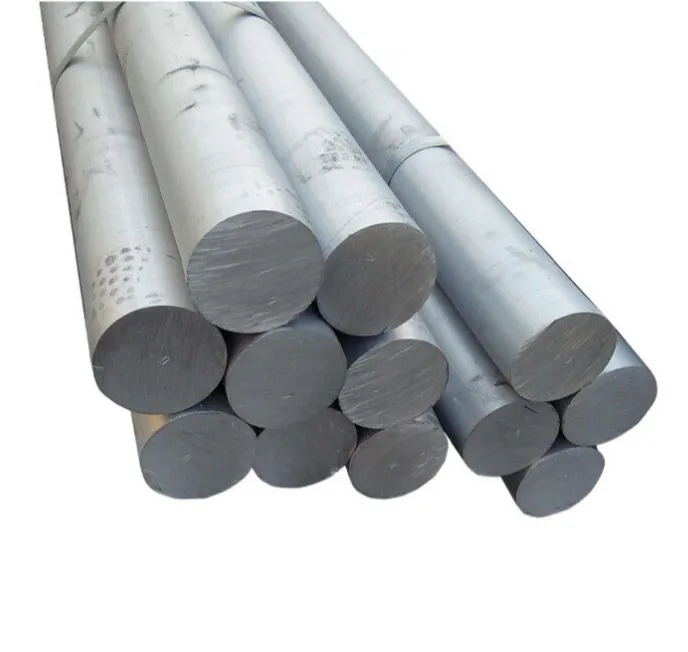
Our abrasion resistant (AR) steel round bar is specifically engineered to withstand the most punishing industrial environments. Characterized by high Brinell hardness (HBW) and exceptional toughness, these wear-resistant bars—available in AR400, AR500, and AR600 grades—are the preferred choice for heavy-duty shafts, pins, bushings, and conveyor components.
As a specialized supplier, we provide abrasion resistant steel round bars that balance surface hardness with core ductility, ensuring long-term durability under high-impact conditions. All our stock is quenched and tempered (Q&T) to meet rigorous ASTM and international standards, ensuring your machinery operates with minimal downtime.
If your project requires the use of Abrasion Resistant Steel, you can contact us for a free quote.
Key Supply Capabilities:
-
Hardness Levels: 360 to 600 HBW (AR360, AR400, AR450, AR500, AR600).
-
Size Range: Custom diameters from 20mm to 500mm with precision tolerances.
-
Processing: In-house CNC cutting, heat treatment, and surface grinding.
-
Compliance: Full traceability with Mill Test Certificates (MTC) provided.
Why do engineers specify abrasion resistant round bar instead of standard alloy bar?
Round bar wear parts show up everywhere: conveyor rollers and shafts, scraper pins, bucket hardware, bushings, mixer shafts, agricultural pivots, crusher components, and many “simple” cylindrical parts that silently consume maintenance budgets. Standard steels like 1045 or 4140 often meet strength targets, yet they lose material quickly once sand, ore, clinker, or aggregate becomes part of the contact.
Abrasion resistant (AR) steels target a different failure mode. The goal is not only tensile strength, it is resistance to material removal under:
- sliding abrasion from fine particles.
- three body abrasion where grit rolls between surfaces.
- gouging abrasion from larger rocks or sharp chunks.
- impact abrasion where repeated blows combine with scratching.
Round bar in AR400 or AR500 hardness classes often replaces surface hardening shortcuts (flame hardening, induction hardening of mild steel) when the plant wants consistent properties through a working depth, predictable wear life, and simpler spares management.
From a maintenance perspective, the biggest value appears when downtime cost dominates material cost. A slightly higher bar price is quickly justified if the component lasts longer, reduces changeouts, and avoids secondary damage to housings or mating parts.
What do AR400 and AR500 mean in round bar purchasing?
AR400 and AR500 are hardness class names used throughout industry. The numbers roughly track nominal Brinell hardness, meaning:
- AR400 usually sits near 360 to 440 HBW.
- AR500 usually sits near 460 to 540 HBW.
A key nuance: many AR grades originated in plate markets, with mill proprietary practices. Round bar supply frequently uses similar quenched and tempered metallurgy, yet it may not be covered by a single universal “AR400 bar” ASTM standard. That reality makes purchase language and documentation more important than the label printed on a quote.
What to request instead of relying on a label
A robust requisition defines:
- hardness range (HBW preferred, measured per ASTM E10 or ISO 6506).
- location and frequency of hardness testing (surface, mid radius, multiple positions on long bars).
- heat treatment condition (quenched and tempered).
- chemistry limits, or an approved mill grade.
- straightness, surface condition, diameter tolerance.
- certification requirements (MTC, EN 10204 3.1 when needed).
Table 1. Typical hardness bands used in AR round bar trade
| Hardness class name | Common target hardness (HBW) | Typical Rockwell C indication (approx.) | Practical notes |
|---|---|---|---|
| AR360 | 320 to 390 | about 34 to 41 HRC | better toughness, easier machining |
| AR400 | 360 to 440 | about 38 to 45 HRC | broad industrial “default” wear class |
| AR450 | 420 to 480 | about 43 to 49 HRC | step up wear life, fabrication gets tighter |
| AR500 | 460 to 540 | about 47 to 54 HRC | high abrasion resistance, impact limits apply |
Rockwell conversion depends on microstructure and test method, so treat conversions only as screening values. Brinell remains the normal acceptance tool.
Which wear mechanisms does AR steel round bar handle well?
Wear rarely comes from a single mechanism. A good selection starts with identifying the dominant removal mode.
Sliding abrasion and three body abrasion
This is the classic “sandpaper” case. Harder steel generally loses less material. AR500 often excels here when impact is low and parts can be replaced on schedule.
Gouging abrasion
Large sharp rocks cut and plow. Hardness helps, yet toughness matters since deep grooves can link with microcracks. AR400 often performs better than expected in mixed abrasion plus impact.
Impact abrasion
Repeated blows can crack very hard steel, especially near welds, keyways, cross holes, or sharp shoulders. In impact abrasion, a slightly softer, tougher bar can outlast a harder bar that fractures early.
Adhesive wear and galling
Steel on steel sliding without lubricant can lead to galling. AR steel is not a stainless substitute. Sometimes a bronze bushing, polymer liner, or hardfacing overlay solves the real problem.
Table 2. Wear mode versus hardness choice
| Dominant condition | Typical symptom | AR400 suitability | AR500 suitability | Common design or process add ons |
|---|---|---|---|---|
| Fine particle abrasion | steady diameter loss | high | very high | seals, scrapers, dust control |
| Mixed abrasion plus impact | chips, spalls | very high | medium | radiused transitions, thicker section |
| Heavy gouging | deep scoring | high | high if impact limited | hardfacing at edges, sacrificial sleeves |
| Adhesive wear | galling, heat | medium | medium | lubrication, dissimilar mating materials |
In real plants, a single component can see different zones. One end may see abrasive fines, another end may see shock loads. That often drives split designs, like AR500 wear sleeve on an AR400 core, or a replaceable AR500 insert rather than an entire AR500 shaft.
What metallurgy gives AR400 and AR500 their wear resistance?
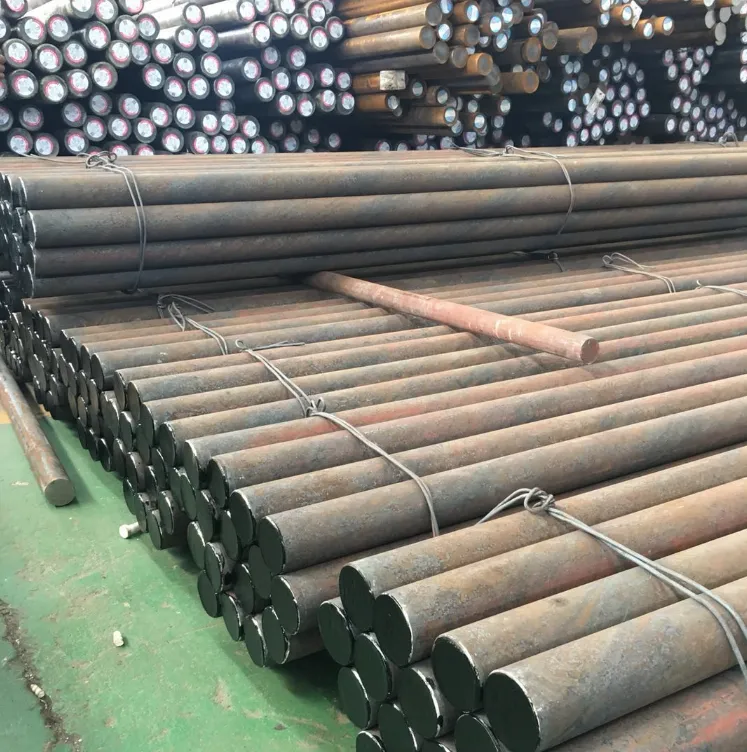
Most AR400 and AR500 products rely on a quenched and tempered martensitic or tempered martensitic microstructure. The production route typically includes:
- controlled chemistry selection
- hot rolling
- austenitizing and quenching to create martensite.
- tempering to reach the target hardness while restoring usable toughness.
Chemistry trends, without pretending every mill is identical
AR steels often use medium carbon levels with alloy additions (manganese, chromium, molybdenum, nickel, boron in some practices) that improve hardenability. Higher hardenability helps reach uniform properties through thicker diameters.
In bar products, section size is crucial. A diameter that is easy to harden through at AR400 may show a softer core at AR500 unless the mill design and quench setup support that size.
Table 3. What typically changes when moving from AR400 to AR500 supply
| Attribute | AR400 class trend | AR500 class trend | Why it matters |
|---|---|---|---|
| Target temper level | higher temper temperature | lower temper temperature | lower temper keeps hardness higher |
| Toughness margin | usually higher | usually lower | impacts crack resistance |
| Weldability window | wider | narrower | hydrogen cracking sensitivity rises with hardness |
| Machining effort | lower | higher | tool wear and heat increase |
A useful mental model: AR500 buys wear life through hardness, paid back with tighter fabrication discipline.
What mechanical properties can be expected from AR400 and AR500 round bar?
Hardness is the headline. Still, mechanical performance includes tensile strength, yield strength, impact toughness, and fatigue behavior, all influenced by heat treatment and section size.
Many mills provide typical tensile ranges, yet procurement should treat those values as informative, not guaranteed, unless the order explicitly requires tensile testing to a defined standard.
Table 4. Typical property ranges seen in quenched and tempered AR bars (non contractual reference)
| Property | AR400 class typical | AR500 class typical | Notes |
|---|---|---|---|
| Brinell hardness (HBW) | 360 to 440 | 460 to 540 | acceptance usually by hardness |
| Tensile strength | roughly 1200 to 1600 MPa | roughly 1450 to 1900 MPa | depends on chemistry and temper |
| Yield strength | roughly 900 to 1300 MPa | roughly 1100 to 1500 MPa | varies with test method |
| Elongation | roughly 8 to 14 percent | roughly 6 to 12 percent | lower at higher hardness |
| Charpy impact | moderate to good | moderate | thickness and temperature matter |
Hardness conversion quick reference
Table 5. Approximate hardness cross reference (screening only)
| HBW | Approx. HRC | Typical wear class shorthand |
|---|---|---|
| 360 | 38 | AR360 to AR400 low |
| 400 | 42 | AR400 nominal |
| 450 | 47 | AR450 nominal |
| 500 | 51 | AR500 nominal |
| 540 | 54 | AR500 high |
Use conversion tables only to communicate with teams used to Rockwell. Acceptance should stay in Brinell unless the specification states otherwise.
How should AR400 be chosen versus AR500 in real equipment?
The common online advice is “higher hardness equals better wear.” That is incomplete. The better question is: will the component survive long enough to wear out, or will it crack, bend, or fail at a notch?
A practical selection logic
Choose AR400 when:
- impact is moderate to high.
- fabrication includes welding, cross drilling, or sharp geometry.
- the part sees mixed wear plus shock.
- downtime cost is high and failure by cracking is unacceptable.
- the plant needs a forgiving material across multiple equipment types.
Choose AR500 when:
- abrasion is severe and impact is controlled.
- the part is replaceable and cracking risk is low.
- the geometry is smooth with generous radii.
- welding can be minimized, or executed with strict controls.
- the duty cycle resembles sliding contact with abrasive fines.
Table 6. Decision matrix used by many maintenance and design teams
| Question | If answer trends “yes” | Better starting point |
|---|---|---|
| Does the part take repeated impact or shock loads? | yes | AR400 |
| Are weld repairs likely during service life? | yes | AR400 |
| Is abrasive fine material the dominant removal mode? | yes | AR500 |
| Is there a keyway, cross hole, or sharp shoulder in the design? | yes | AR400 or redesign geometry |
| Is the bar diameter large and through hardness uniformity critical? | yes | confirm hardenability, consider AR400 or a qualified AR500 source |
A frequent best practice: prototype with AR400, then upgrade to AR500 only when wear rate remains the limiting factor after geometry and operating conditions are corrected.
Where is industrial abrasion resistant steel round bar used?
AR round bar use depends on whether the plant prefers “wear parts as consumables” or “wear parts as engineered components.” Both models exist.
Mining and quarrying
- crusher shafts and pins in wear zones.
- conveyor components in transfer points.
- chute hardware, impact rolls.
- scalper and screen support components.
Bulk material handling and ports
- ship loader wear rollers.
- reclaimers, stackers, bucket wheel components (selectively).
- guide rollers and wear pins.
Cement and aggregates
- mixer shafts, paddles, liners with round wear elements.
- screw conveyor wear components.
Agriculture and recycling
- shredder shafts and wear pins.
- auger components in abrasive feedstocks.
- bale handling pins with embedded grit exposure.
Table 7. Application examples with common selection
| Application | Typical damage | Common choice | Notes |
|---|---|---|---|
| Conveyor guide rollers | abrasive fines on OD | AR500 sleeve or bar | minimize impact, seal bearings |
| Scraper pins | abrasive plus bending | AR400 | toughness matters |
| Mixer shafts | abrasion plus torsion | AR400, sometimes AR450 | watch keyway design |
| Chute hinge pins | abrasive dust, shock | AR400 | lubrication plus sealing extends life |
| Wear bushings | sliding with grit | AR500 or AR450 | consider replaceable bushing concept |
AR steel does not replace good sealing and lubrication. A hard bar running in abrasive slurry without seals still wears quickly.
What machining and cutting practices work well with AR400 and AR500 bar?
Machining AR bar is possible, yet it is not the same experience as 1045 or annealed 4140. The high hardness produces higher cutting forces and faster tool wear. Process planning matters, especially with AR500.
Turning and milling
- rigid workholding reduces chatter and insert chipping.
- carbide tooling is typical, with wear resistant coatings.
- avoid tool rubbing, keep chip load adequate to cut under work hardened skin.
- manage heat with coolant strategy aligned with shop practice.
Drilling and tapping
Cross holes and threads act like stress risers, so design should minimize them in high hardness bars. When drilling is required:
- use solid carbide drills or high performance cobalt tools.
- keep feed consistent, avoid dwelling at breakthrough.
- consider thread milling rather than tapping in AR500 class.
Saw cutting
Band saw blade selection and coolant control affect productivity. Many shops request bar supply cut to length with optimized saw settings to avoid production bottlenecks.
Table 8. Machining practicality comparison
| Operation | AR400 practicality | AR500 practicality | Typical shop tactic |
|---|---|---|---|
| Rough turning | good | moderate | coated carbide, stable setup |
| Finish turning | good | moderate to difficult | sharp insert geometry, controlled speed |
| Drilling | moderate | difficult | premium drills, steady feed |
| Tapping | moderate | difficult | thread milling, lubrication |
| Keyway milling | moderate | difficult | redesign preferred, or EDM if available |
If machining time dominates total part cost, sometimes a “core plus wear sleeve” design reduces machining in the hard layer while keeping wear life high.
What welding practices reduce cracking risk in AR400 and AR500 round bar?
Welding is where many AR projects fail, not due to poor intentions, but due to hardness and hydrogen effects. The higher the hardness, the more sensitive the heat affected zone becomes to hydrogen assisted cracking.
Foundational controls
- clean joint surfaces, remove scale, oil, moisture.
- low hydrogen consumables, handled and stored correctly.
- controlled preheat and interpass temperature.
- avoid excessive restraint, use proper fit up.
- slow cooling when needed, avoid cold drafts on thick sections.
Preheat strategy
Preheat depends on thickness, restraint, ambient temperature, consumable type, and the specific mill chemistry. A single “one size” number is risky, yet a starting point table helps project planning.
Table 9. Typical preheat starting points used in shops (confirm via WPS and engineering review)
| Material class | Thin section, low restraint | Medium section or moderate restraint | Thick section or high restraint |
|---|---|---|---|
| AR400 class | 75°C to 150°C | 150°C to 200°C | 200°C to 250°C |
| AR500 class | 150°C to 200°C | 200°C to 260°C | 260°C to 315°C |
These ranges are not a substitute for a qualified welding procedure specification. They are planning values commonly used in repair welding and fabrication when starting a qualification program.
Filler metal selection
Many welders assume matching strength filler is always best. In wear parts, a slightly lower strength, higher toughness filler can reduce cracking risk and improve joint reliability. Engineering review is necessary, particularly when the weld carries structural load.
Post weld heat treatment
Post weld heat treatment on AR steels can reduce hardness and change wear behavior. It may reduce residual stress, yet it can also reduce abrasion performance. Many projects avoid PWHT unless the joint design, code, or cracking history demands it.
What design details extend wear life beyond material selection?
Material selection is only one lever. Geometry and assembly choices often control whether the bar wears uniformly, galls, bends, or cracks.
Avoiding stress risers
High hardness materials dislike sharp transitions. Good practice includes:
- generous radii at shoulders
- smooth blends at diameter steps.
- avoidance of undercuts and sharp tool marks.
- careful chamfer design at cross holes.
Replaceable wear concept
A common winning architecture:
- tough core shaft (AR400 class or alloy steel).
- replaceable AR500 wear sleeve.
- sacrificial bushings that can be swapped without replacing the shaft.
Alignment and contamination control
Misalignment turns sliding wear into edge loading and spalling. Seals and scrapers reduce grit ingress, lowering wear rate more than a hardness jump in many cases.
Table 10. Design and maintenance actions with high ROI
| Action | What it prevents | Typical impact on service life |
|---|---|---|
| Improve sealing at bearing zones | grit ingress | often doubles life in dusty duty |
| Add grease grooves and correct lubricant | adhesive wear, galling | major improvement in pins and bushings |
| Increase shoulder radii | fatigue crack initiation | reduces unexpected fracture |
| Use replaceable sleeves | expensive shaft replacement | lowers downtime and spares cost |
| Balance hardness with toughness | brittle fractures | avoids “hard but cracked” failures |
How do AR400 and AR500 behave in low temperature service?
Low temperature toughness is not guaranteed by a hardness label. Some quenched and tempered steels keep excellent impact toughness, others do not. If service occurs in cold climates, procurement should request Charpy testing at a meaningful temperature.
Key points:
- verify CVN requirements in the purchase order if brittle fracture risk exists.
- request heat specific results on the MTC.
- consider a grade designed with low temperature toughness targets if needed.
What standards and test methods support reliable AR round bar supply?
Since “AR400 bar” is not always tied to a single universal standard, test methods become the language of trust.
Common test and documentation tools include:
- Brinell hardness testing per ASTM E10 or ISO 6506.
- tensile testing per ASTM A370 when required.
- chemistry reporting per ASTM A751.
- ultrasonic testing per ASTM A388 when internal soundness is critical.
- EN 10204 certification types in international projects.
Table 11. Quality controls that matter in AR bar purchasing
| Risk | Control method | What to request on PO |
|---|---|---|
| wrong hardness | hardness test map | test at ends, mid length, multiple points |
| soft core in large diameter | through section checks | radial hardness checks, or qualified size limit |
| poor internal soundness | UT | ASTM A388 acceptance level |
| lost traceability after cutting | marking control | heat number transfer to cut pieces |
| decarburized surface | machining allowance | define surface condition, request peeled or ground |
Decarburization and scale can hide at the surface. When the component relies on surface hardness, specify surface condition and machining allowance so the final surface still sits inside the hardness band.
What does “global supply” mean in AR400 and AR500 round bar?
Global supply is not only shipping. It includes consistent documentation, dimensional capability, and repeatable metallurgy across mills. AR bar is often project driven, so lead time planning matters.
A practical global supply approach typically includes:
- selecting mills with proven quenched and tempered bar capability in the required diameters
- confirming maximum diameter that still meets through hardness requirements
- specifying surface finish that matches machining strategy (black, peeled, turned, ground)
- packaging that protects bars from corrosion and handling damage during ocean freight
- certificate packages that satisfy customer audit systems
MWalloys supports these needs by aligning material selection with duty cycle, then coordinating hardness verification, traceable documentation, and export packaging suitable for long transit.
How should a purchase order be written to avoid receiving the wrong wear bar material?
Table 12. Purchase order template content that reduces disputes
| Specification item | Example wording | Why it matters |
|---|---|---|
| Material | abrasion resistant steel round bar, AR400 class | sets intent |
| Hardness range | 360 to 440 HBW (AR400) or 460 to 540 HBW (AR500) | acceptance criteria |
| Heat treatment | quenched and tempered | links to microstructure |
| Diameter, length | 75 mm x 3000 mm | sizing |
| Tolerances | h9, or stated plus minus | machining planning |
| Surface condition | peeled and turned, or centerless ground | decarb control, finish |
| Straightness | max deviation per meter | shaft performance |
| Testing | Brinell per ASTM E10, frequency defined | prevents soft spots |
| UT (optional) | ASTM A388 level defined | internal soundness |
| Certification | MTC, EN 10204 3.1 if needed | traceability |
| Marking | heat number on each piece | receiving control |
| Packaging | end caps, rust preventive wrap | transit protection |
If the part will be welded, add WPS requirements, preheat expectations, and any additional tests after welding.
FAQs: Industrial Abrasion Resistant Steel Round Bar (AR400 and AR500)
Summary
Industrial abrasion resistant steel round bar in AR400 and AR500 classes delivers meaningful wear life gains when the hardness band, section size capability, fabrication method, and duty cycle are matched correctly. AR400 is typically the most forgiving choice across real plant conditions with impact and repairs, while AR500 is a strong performer in high abrasion, low impact environments where geometry and welding can be tightly controlled. MWalloys supports AR round bar projects through hardness based specification, traceable certification packages, and global logistics planning that keeps maintenance schedules realistic.