

Inconel 718 round bar is a precipitation-strengthened nickel-chromium alloy (UNS N07718) that combines exceptional tensile and creep strength from cryogenic temperatures up to roughly 704°C (1300°F), very good corrosion resistance, and reliable weldability, making it one of the most widely used superalloy bars for aerospace rotating parts, fasteners, oil and gas components, and high-temperature industrial hardware. When supplied in solution-treated or aged conditions and processed to AMS/industry specifications, 718 round bar provides a cost-effective balance of strength, toughness, and fabricability for critical structural applications.
1. What is Inconel 718
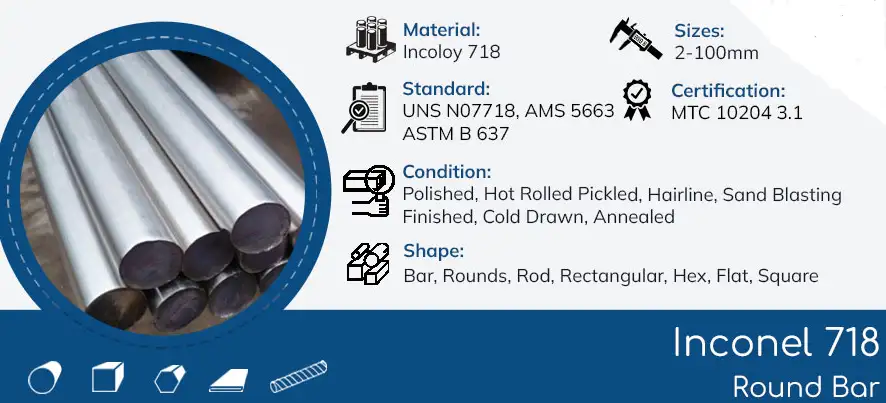
Inconel 718 is a nickel-iron-chromium base alloy strengthened primarily by precipitation of intermetallic phases designated γ′ (Ni3(Al,Ti)) and γ″ (Ni3Nb). It was developed to provide high yield and tensile strength with good ductility and fracture toughness together with oxidation and corrosion resistance at elevated temperatures. The alloy is non-magnetic in many conditions and is supplied as round bar in sizes from small diameters up to multi-inch drops depending on the producer and specification. Typical bar supply conditions are annealed/solution treated (soft) or age hardened (to higher strength).
2. Chemical composition and microstructure
Typical chemical composition (nominal ranges, weight percent)
The table below presents the commonly referenced composition windows used for Alloy 718 manufacturing rounds. Individual mill datasheets or specification sheets (AMS/ASTM) provide exact limits; use those for procurement or design.
| Element | Typical range (wt %) |
|---|---|
| Nickel (Ni) | Balance (≈50–55) |
| Chromium (Cr) | 17.0 – 21.0 |
| Iron (Fe) | Remainder (≈18–21) |
| Niobium (Nb, +Ta expressed as Nb) | 4.75 – 5.50 |
| Molybdenum (Mo) | 2.8 – 3.3 |
| Titanium (Ti) | 0.65 – 1.15 |
| Aluminum (Al) | 0.20 – 0.80 |
| Carbon (C) | ≤0.08 |
| Manganese (Mn) | ≤0.35 |
| Silicon (Si) | ≤0.35 |
| Sulfur (S) | ≤0.010 |
| Copper (Cu) | ≤0.30 |
Note: some vendors report Nb+Ta combined limits; trace control of oxygen, nitrogen and hydrogen is important for high-temperature performance and weldability. Refer to manufacturer data sheets for exact composition by heat lot.
Microstructural phases and what they do
-
Matrix: face-centered cubic (FCC) γ phase formed by Ni-Fe-Cr solution.
-
Strengthening precipitates:
-
γ″ (Ni3Nb) — coherent, disc-shaped precipitate; primary contributor to yield and creep strength in 718.
-
γ′ (Ni3(Al,Ti)) — contributes to overall elevated temperature strength and stability.
-
-
Carbides and µ/δ phases: may occur depending on processing; careful heat treatment controls δ phase to stabilize grain structure and avoid embrittlement. Changes in these phases strongly influence toughness and creep life.
3. Mechanical and physical properties
Below are typical mechanical properties for Inconel 718 round bar in common supply conditions. Values vary by bar diameter, heat treatment and specification.
Typical room-temperature mechanical properties (representative)
| Condition | Tensile strength (Rm) | Yield strength (0.2% YS) | Elongation (A%) | Hardness (HRC) |
|---|---|---|---|---|
| Solution-treated, annealed (soft) | ~1100–1400 MPa (160–200 ksi) | ~480–690 MPa (70–100 ksi) | 20–35% | 18–28 HRC |
| Aged (precipitation hardened, AMS 5663 type) | ~1200–1950 MPa (175–283 ksi) depending on condition | ~760–1550 MPa (110–225 ksi) | 10–20% | 35–44 HRC |
| Cold-worked + aged | can be higher (application dependent) | higher yield with reduced elongation | lower ductility | increased hardness |
Actual property curves depend on aging cycle, grain size and any cold work. When specifying fasteners or critical rotating parts, request specific mechanical test reports from the mill.
Physical and thermal properties
| Property | Typical value |
|---|---|
| Density | ≈0.296 lb/in³ (8.19 g/cm³) |
| Melting interval | ~1260–1350°C (2300–2460°F) |
| Thermal conductivity | relatively low compared to steels (temperature dependent) |
| Coefficient of thermal expansion | higher than ferritic steels; design for differential expansion in assemblies |
Designers must account for thermal expansion and low thermal conductivity when specifying interference fits or brazed joints.
4. Heat treatment, ageing cycles and strengthening mechanisms
The performance of 718 round bar depends strongly on solution and ageing heat treatment. The two-stage precipitation hardening sequence produces γ″ and γ′ precipitates; control of time and temperature produces the target balance of strength and toughness.
Typical heat-treatment cycles used for bars
| Process step | Typical parameters (example) | Purpose |
|---|---|---|
| Solution treatment (solution anneal) | 980–1100°C (1800–2010°F) for 1 hour/ inch section, air cool | Dissolve strengthening phases, homogenize, prepare for ageing |
| First ageing (primary) | 720–760°C (1325–1400°F) for 8 hours, air cool to 620–650°C | Precipitation of γ″ and γ′ begins |
| Second ageing (double ageing) | hold at ~620–650°C for 8 hours, air cool | Coarsening/stabilization of precipitates for final properties |
| Alternative AMS cycle | Solution at 1065°C, air cool, then 718°C for 8 hours plus 620°C for 8 hours | Common aerospace schedule used to optimize room temperature and elevated temperature properties |
Exact temperatures, dwell times and cooling rates must follow the chosen specification or the mill’s certified procedure. Deviations will change hardness, yield and creep life.
Metallurgical notes
-
γ″ is the dominant hardening phase in 718; overaging or prolonged exposure at certain temperatures can transform γ″ to δ or other phases, which reduces ductility and toughness.
-
Control of the δ phase is used intentionally in forgings to control grain size prior to final ageing.
-
For forgings and large-section bars, section size affects hold time; thicker bars require longer holds for uniform properties.
5. Standards, specifications and product forms
When procuring Inconel 718 round bar, quoting the correct specification ensures material traceability and appropriate mechanical/chemistry limits.
Common specifications and product standards
-
UNS N07718 — universal designation for alloy 718.
-
AMS 5662 — specification for wrought forms of alloy 718 in the solution-treated condition and certain added controls for aerospace.
-
AMS 5663 — aged/precipitation-hardened bar and rod specification.
-
ASTM B637 — standard for nickel and nickel-iron alloys, including some supply forms (check current ASTM listings for specific product forms).
-
Mill product data sheets (e.g., Special Metals, Carpenter Technology, ATI) include recommended cold work, machining allowances and guaranteed properties.
Typical product forms
-
Cold-drawn round bar (small diameters)
-
Hot-rolled or forged bar (larger diameters)
-
Annealed/solution treated bars for machining (ease of cutting)
-
Pre-aged bars for finished components (reduces post-machining heat treatment)
-
Precision ground bar for tight tolerances and concentricity
Be explicit in the purchase order: specify alloy, UNS/AMS/ASTM number, bar diameter and tolerance class, supply condition (solution treated or aged), required mechanical tests and NDT, and any melting practice (VIM, VAR) when required by critical applications.
6. Manufacturing, production and mill practices for round bars
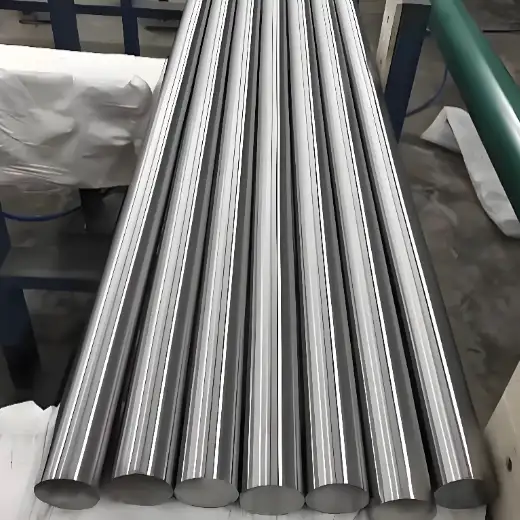
Understanding how bars are produced helps explain lead times, costs and where variability arises.
Typical melting and refining routes
-
Vacuum induction melting (VIM) followed by vacuum arc remelting (VAR) or electro-slag remelting (ESR) for critical aerospace stock. These processes improve cleanliness and segregation control.
-
Continuous casting with controlled homogenization for commodity bars.
-
Cold drawing and straightening to achieve tolerances and surface finish for precision bar.
Forging and rolling
-
Bars may be forged or hot worked at controlled temperatures to refine grain structure for higher toughness. The control of thermomechanical processing influences final creep life and fatigue resistance.
Stock sizes and tolerances
-
Many mills stock 718 round bar diameters from small metric sizes up to 12-inch diameter or larger by special order. Tolerances depend on whether raw, ground, or precision bar is required. Inventory charts vary; check supplier catalogs for available diameters and lead times.
7. Machining, fabrication and welding guidance
Inconel 718 is easier to machine in the annealed/solution condition and becomes more difficult after ageing when strength and hardness increase. Proper tooling and process parameters ensure productivity and part quality.
Machining tips
-
Machine after solution treatment where feasible; final age after machining if high properties are required.
-
Use rigid setups, positive rake carbide inserts, and low-to-moderate cutting speeds with heavy feed and depth of cut to avoid work hardening.
-
Flood coolant recommended to control temperature.
-
Allow for tool wear and use chip breakers to avoid entanglement.
Welding
-
718 is readily welded with appropriate filler metals and procedures; however, welds require controlled heat input and may be subject to cracking if contaminants or improper pre/post heat treatments are used.
-
Post-weld solution anneal and ageing are often required for weldments that must meet full mechanical properties.
-
Shielding gas and cleanliness are critical to avoid porosity and interstitial pickup.
8. Corrosion, oxidation and high-temperature performance
Alloy 718 shows good corrosion resistance in many environments and retains creep and tensile strength at elevated temperatures.
Corrosion behavior
-
Resistant to high-temperature oxidation up to roughly 982°C for short exposures and 704°C for long service depending on environment.
-
Good resistance to stress-corrosion cracking compared to some other nickel alloys, but environment and applied stress must be considered in design.
Creep and rupture
-
The γ″ precipitate provides creep resistance at service temperatures up to approximately 700°C; creep charts from the mill should be consulted for life predictions under stress and temperature. For critical long-term service, validated creep-rupture data from the supplier or standards organizations must be used.
9. Typical applications, selection notes and case observations
Inconel 718 round bar is used for demanding structural components where high strength and corrosion resistance are needed.
Common applications
-
Aerospace fasteners, shafts, turbine discs and spacers.
-
Oil and gas downhole tools and valves.
-
High-temperature industrial bolts and springs.
-
Nuclear reactor components where corrosion plus mechanical strength are required.
Selection checklist
-
If design requires high strength at temperatures above 650°C consider other high-temperature superalloys; 718 is optimized for up to about 704°C.
-
When machinability and lead time are critical, prefer solution treated bar and perform ageing after final machining.
-
For extreme cleanliness and fracture-critical parts, specify VIM/VAR melting and full certification.
10. Inspection, testing and quality control
For safety-critical or aerospace components, rigorous inspection and mill certification are essential.
Recommended tests and documentation on purchase
-
Chemical analysis and mill heat report.
-
Mechanical test report (tensile, yield, elongation).
-
Hardness reading.
-
NDT (ultrasonic or eddy current for internal flaws for large diameter bars).
-
Grain size and microstructure report if required.
-
Certification to AMS/ASTM forms and traceability to melting practices (VIM/VAR).
11. Procurement, inventory and cost drivers
Pricing of 718 round bar varies with nickel market, bar diameter, melting route, inventory, and post-treatments.
Cost factors
-
Nickel and niobium content: raw material costs.
-
Melting route: VAR/VIM increases price.
-
Supply condition: pre-aged/aged bars cost more than annealed bars due to additional processing.
-
Tolerance and precision: ground or precision bars cost more than as-rolled stock.
-
Certifications and testing: aerospace certification raises price and lead time.
When requesting quotes, include exact spec, diameter, length, finishing, and test requirements to get accurate pricing.
| Feature | Inconel 718 | Inconel 625 | Inconel 600 |
|---|---|---|---|
| Primary strengthening | Precipitation (γ″/γ′) | Solid solution and Nb/Mo additions | Solid solution (Cr content) |
| Typical use temperature | Up to ≈704°C | Good to ≈980°C for corrosion applications | Moderate elevated temperatures |
| Best for high strength/creep | Yes | No, greater corrosion resistance but lower strength | Lower strength than 718 |
| Fabricability | Good for a superalloy | Very good | Good |
Selecting 718 is driven by need for high strength plus decent corrosion performance rather than maximum oxidation resistance.
13. Practical tables engineers use
Table: Typical bar supply conditions and engineering notes
| Supply condition | Typical HRC | Machining ease | When to use |
|---|---|---|---|
| Solution treated (soft) | 20–28 HRC | Good | Machine then age |
| Pre-aged (AMS 5663) | 35–44 HRC | Difficult | Finished parts without post-machining heat treatment |
| Cold-worked + aged | >40 HRC | Poorer | High yield fasteners |
Table: Recommended procurement fields for P.O.
| Field | Example |
|---|---|
| Alloy designation | Inconel 718, UNS N07718 |
| Spec | AMS 5662 (solution), AMS 5663 (aged) |
| Melting route | VIM + VAR required for aerospace |
| Diameter & tolerance | 1.000" ±0.005" ground |
| Condition | Solution treated, unaged |
| Tests | Chemical, tensile, hardness, UT |
14. Frequently asked questions (FAQs)
-
What is the difference between AMS 5662 and AMS 5663 bar?
AMS 5662 covers alloy 718 in the solution-treated condition while AMS 5663 applies to bars supplied in the aged/precipitation hardened state. Aged bars have higher strength and hardness and are harder to machine. -
Can I machine Inconel 718 after ageing?
Yes but it is more difficult; recommended practice is to machine in the soft (solution) state and perform final ageing to obtain full mechanical properties. -
What temperature range is safe for continuous service?
718 performs well up to roughly 700°C (1300°F) for creep strength, with oxidation resistance data depending on environment; consult mill creep charts for long-term service. -
Do I need VAR or VIM melted material?
For critical aerospace or nuclear parts, yes; VAR or VIM+VAR reduces inclusions and segregation and is often required in specifications. -
How does 718 compare to 625 for corrosion resistance?
625 has superior general corrosion and pitting resistance in many environments, while 718 provides much higher mechanical strength. Choose based on whether strength or corrosion resistance is the dominant requirement. -
What is the dominant strengthening phase?
The γ″ (Ni3Nb) precipitate is the main contributor to yield and creep strength in 718. Overaging can reduce γ″ effectiveness. -
Can 718 be used at cryogenic temperatures?
Yes, 718 retains excellent toughness and strength at cryogenic temperatures when properly heat treated. -
Are there special corrosion precautions for seawater?
718 resists many corrosive media but seawater presents chloride risks; evaluate chloride stress-corrosion cracking susceptibility and consider alternative alloys or coatings for severe seawater exposure. Consult corrosion data for design. -
What non-destructive tests should be run on large bars?
Ultrasonic testing or eddy current inspection is common to detect internal flaws; some specs require radiography for forgings. Specify NDT level in the contract. -
How should I store and handle 718 bars?
Store in dry, covered conditions. Prevent surface contamination and mechanical damage. For long storage, control humidity and avoid galvanic contact with dissimilar metals.
15. Notes on designing with Inconel 718 round bars
-
Use conservative stress limits for long-term creep service; always consult supplier creep-rupture data.
-
Account for thermal growth in bolted/flange designs because 718 has higher expansion than some steels.
-
Specify finish and tolerances clearly; ground bars reduce machining allowances but increase cost.
16. Closing technical commentary
Inconel 718 round bar occupies an engineering niche where balanced high strength, good weldability and reasonable corrosion resistance are required within the temperature window to roughly 704°C. Proper selection of supply condition, melting route and heat treatment ensures a predictable combination of toughness and creep life. For mission-critical parts, require full traceability, VIM/VAR melting and the mill’s mechanical and microstructural certification.
Authoritative references
- INCONEL® alloy 718 technical bulletin — Special Metals Corporation (data sheet PDF)
- Alloy 718 Material Data Sheet — Carpenter Technology Corporation (heat treatment & properties)
- Alloy 718 data sheet — Zapp (technical properties and applications)
- Selected study on ageing effects and precipitates in Alloy 718 — TMS Superalloys conference paper (technical research)