

For piping that must survive highly corrosive environments, high temperatures, and heavy mechanical loading, MWalloys’ Inconel 625 seamless pipe provides a top-tier combination of corrosion resistance, high strength across a broad temperature range, excellent weldability, and long service life, offered at 100% factory pricing for competitive procurement.
1. Quick technical summary
Inconel 625 is a nickel-chromium-molybdenum-niobium alloy engineered to resist general and localized corrosion, oxidation, and chloride-induced stress-corrosion cracking, while delivering high tensile and creep strength from cryogenic temperatures up to roughly 980 °C (1800 °F). For piping in chemical plants, offshore systems, aerospace ground equipment, and power generation, seamless alloy 625 pipe gives the best combination of reliability and long-term economics where failure consequences are severe. Key selling points when buying factory-direct from MWalloys include certified material test reports, options for annealed or solution-treated conditions, and flexible cut-to-length supply.
2. What is Inconel 625: alloy fundamentals and intended uses
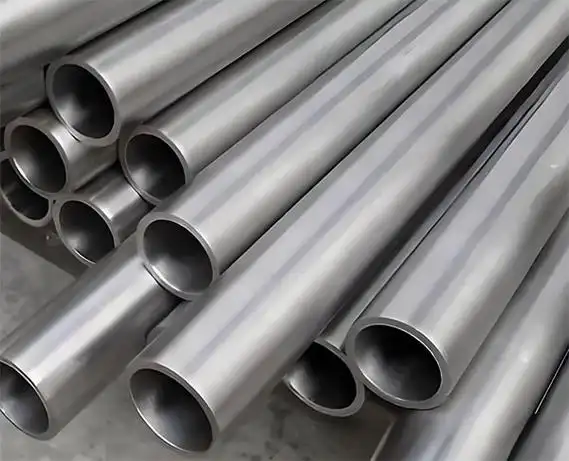
Inconel 625 (UNS N06625) is a nickel-based superalloy whose performance derives from a nickel-chromium matrix strengthened by solid-solution additions of molybdenum and niobium (columbium). It is not a precipitation-hardening alloy by design, which gives stable mechanical properties without complex aging cycles. The alloy was developed to resist both reducing and oxidizing corrosive media and to retain strength and toughness across a wide temperature band. Typical sectors that depend on alloy 625 pipe include chemical processing, offshore petroleum production, marine engineering, aerospace systems, nuclear components, and pollution-control equipment. For critical piping runs that face chloride-containing media, high temperatures, or cyclic thermal loading, seamless 625 pipe is often selected to minimize weld-related imperfections and maintain predictable fatigue life.
3. Chemical composition and microstructure
The chemical composition of Inconel 625 is tightly controlled to deliver a balance of corrosion resistance, ductility, and strength. The table below summarizes typical composition ranges used for pipe manufactured to common specifications. Exact limits vary by specification and manufacturer; purchasers should verify the MTC (material test certificate) for the batch supplied.
Table 1: Typical chemical composition of Inconel 625 (mass percent)
| Element | Typical range (wt%) |
|---|---|
| Nickel (Ni) | Balance (typically 58–65) |
| Chromium (Cr) | 20.0 – 23.0 |
| Molybdenum (Mo) | 8.0 – 10.0 |
| Niobium (Nb, columbium) + Tantalum (Ta) | 3.15 – 4.15 |
| Iron (Fe) | ≤ 5.0 |
| Carbon (C) | ≤ 0.10 |
| Manganese (Mn) | ≤ 0.50 |
| Silicon (Si) | ≤ 0.50 |
| Sulfur (S) | ≤ 0.01 |
| Phosphorus (P) | ≤ 0.015 |
| Aluminum (Al) | ≤ 0.40 |
| Titanium (Ti) | ≤ 0.40 |
Note: Composition is summarized from manufacturer data sheets and recognized technical literature for UNS N06625. Individual suppliers may publish narrow tolerances for special grades or heat lots.
Microstructure note: The as-supplied microstructure of annealed Inconel 625 is typically a face-centered cubic nickel matrix, with solid-solution strengthening from Mo and Nb. No deliberate precipitation-hardening phases are required for the alloy to achieve nominal strength; however, certain service conditions can produce carbides or intermetallic phases and these are controlled via process and thermal history.
4. Mechanical properties and temperature performance
Alloy 625 provides high tensile strength and excellent toughness over a broad temperature range. The alloy retains useful mechanical capability from cryogenic conditions through elevated service temperatures up to around 980 °C, depending on time at temperature and stress state.
Table 2: Representative mechanical properties (condition: annealed/solution treated)
| Property | Typical value |
|---|---|
| Room-temperature tensile strength (ultimate) | ~827–965 MPa (120–140 ksi) range depending on temper |
| Yield strength (0.2% offset) | ~415–620 MPa depending on temper and product form |
| Elongation (in 2 in / 50 mm) | Typically ≥ 30% |
| Hardness (Rockwell B/C) | Varied by condition; annealed lower, cold-worked higher |
| Creep resistance | Strong up to ~650–700 °C in many service cases; elevated creep at higher T depends on stress/time |
| Service temperature (short term) | Up to ~980 °C (1800 °F) for oxidation resistance |
| Magnetic behavior | Non-magnetic in annealed condition |
Mechanical data can shift with product form (pipe, tube, bar) and with different spec limits; always check the supplier MTC. For detailed tensile charts and elevated temperature data consult primary technical bulletins or certified material databases.
5. Corrosion performance and typical applications
Alloy 625 resists a wide range of corrosive environments: pitting and crevice attack in seawater, chloride stress-corrosion cracking, many reducing acids, and oxidizing atmospheres at high temperature. The niobium-molybdenum content enhances resistance to localized corrosion and raises the alloy’s strength in chloride-bearing media. Because of this combination of attributes, alloy 625 is commonly specified for:
-
Offshore risers, subsea piping, and connectors in marine service
-
Chemical process lines carrying chlorides, nitric acid, or organic acids
-
Heat-exchanger tubing and headers in aggressive coolant loops
-
Exhaust stacks, flue gas ducts, and high-temperature structural piping in power plants
-
Aerospace fuel and bleed-air piping where high temperature and corrosion meet
-
Nuclear auxiliary systems where both corrosion resistance and toughness are required
Field performance reports and manufacturer bulletins describe long service intervals in marine and chemical environments when the proper heat treatment and welding practices are followed.
6. Manufacturing: seamless pipe production, standards, and testing
Seamless pipe production begins with hot extrusion or rotary piercing to produce a solid billet with a central bore, followed by hot rolling and cold finishing to the required wall thickness and OD. For high-integrity piping, purchasers often specify seamless products to avoid weld seams that can concentrate stress and complicate nondestructive inspection.
Common specifications and norms for alloy 625 pipe include:
-
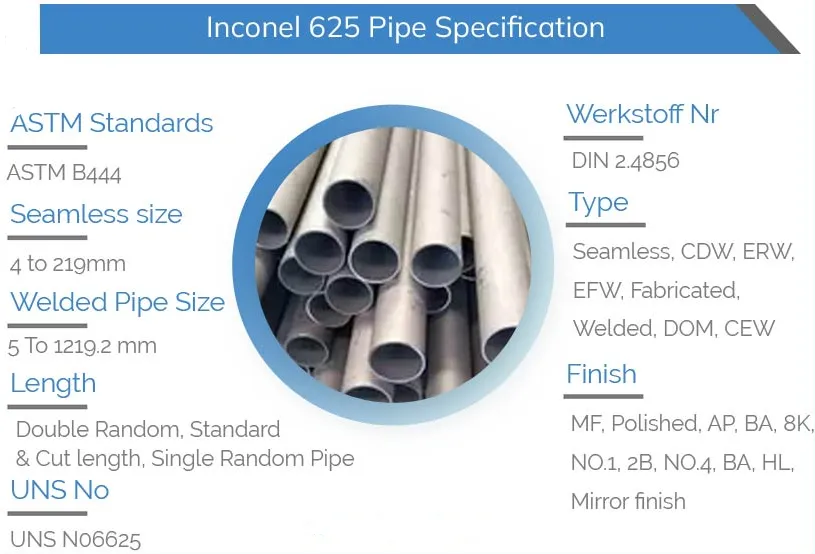
ASTM B444 — Seamless Nickel and Nickel Alloy Pipe.
-
AMS 5581 — Nickel alloy pipe specifications for aerospace and high-integrity uses.
-
ISO, DIN, and national standards equivalents are available and listed by major suppliers.
Quality testing commonly requested:
-
Full traceable MTC with chemical and mechanical test results
-
PMI (positive material identification) or spectrochemical analysis
-
Ultrasonic inspection or eddy current for critical runs
-
Hydrostatic testing and visual dimensional checks
-
Hardness testing and, where needed, PWHT records
7. Dimensional ranges, standards and equivalents
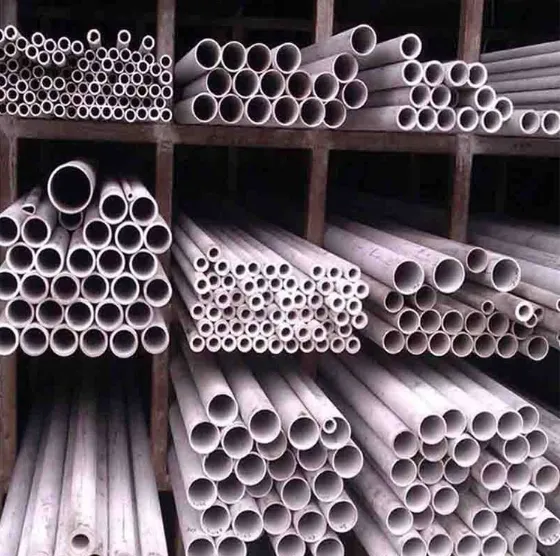
Seamless alloy 625 pipe is offered in a wide size range depending on mill capability and the spec ordered. Standard nominal bore (NB) sizes up to 8 inch NB are common from stock, while larger diameters can be produced to order.
Table 3. Typical dimensional/standard references
| Parameter | Typical range / example |
|---|---|
| Nominal sizes | 1/8" IPS up to 8" NB from stock; custom up to 20" IPS possible |
| Wall thickness | Schedule 5S through Sch 160 or custom heavy wall |
| End finishes | Plain end, beveled, threaded on request |
| Lengths | Randoms, cut-to-length, double random, single cut |
| Standards | ASTM B444, ASTM B751, AMS 5581, ISO 6207, ASME references |
| Material designation | UNS N06625, WERKSTOFF 2.4856 |
Buyers should specify both the dimensional standard (ASTM or ISO) and the required mill test report type to guarantee interchangeability and traceable certification.
8. Welding, fabrication, machining, and heat treatment
Welding and joining: Alloy 625 is readily welded by most common fusion processes and shows good weldability without the need for pre- or post-weld heat treatment for many applications. Typical filler metals are matching nickel-base alloys to maintain corrosion resistance in welded zones. For high-integrity or nuclear piping, follow the welding procedure specifications (WPS) and post-weld examination required by the purchaser.
Machining: The alloy is tougher to machine than common stainless steels due to its strength and work-hardening tendency. Recommended practices include rigid setups, sharp carbide tooling, adequate coolant, and conservative feeds. For thin-walled pipe, support to avoid vibration is essential.
Heat treatment: Solution annealing followed by rapid quench is standard to produce the annealed condition. Because alloy 625 is not intended to be precipitation-hardened, aging cycles are not typically used to raise strength. For specific high-temperature service, consult metallurgical guidance on whether stabilizing or other treatments are appropriate.
Practical tip from fabricators: where erosion-corrosion or high-temperature creep is a concern, consult with material engineers and the pipe mill to specify the required temper and NDT regime before fabrication begins.
9. Seamless versus welded 625 pipe
Table 4: Seamless vs welded alloy 625 pipe comparison
| Factor | Seamless pipe (benefits) | Welded pipe (benefits) |
|---|---|---|
| Integrity at high pressure | Fewer stress concentrators, higher predictable burst margins | Lower cost for large diameters, easier production for certain sizes |
| Fatigue performance | Generally superior due to absence of longitudinal seam | Seam design can be optimized; friction welded seams may perform well |
| Availability and cost | Typically more expensive per kilogram, limited by mill capacity | Typically lower purchase cost and faster delivery for some size ranges |
| Inspection complexity | Standard NDT and hydro tests; simpler weld profile | Requires weld inspection (RT/UT), possible PWHT in some specs |
| Corrosion risk | Reduced risk from seam-related defects | Corrosion resistant with proper welding practice and filler metal |
| Applications | Critical pressure piping, subsea, aerospace feedlines | Non-critical lines, large diameter low-pressure applications |
For mission-critical systems, buyers often prefer seamless 625 pipe despite higher unit cost due to the improved predictability of service performance. For MWalloys factory pricing, customers can request quotes for both seamless and welded forms to compare lifetime cost.
10. Pricing, procurement tips, and typical factory-direct cost table
Pricing for alloy 625 products is subject to market fluctuations, plate/ingot raw material cost, mill capacity, size, finish, and certification level. Recent market surveys and supplier price lists indicate per-kilogram ranges and per-meter pricing for standard seamless pipe. Typical ranges in recent supplier listings are shown below; use this only as a ballpark reference and request a current factory quote from MWalloys for live pricing.
Table 5. Representative factory-direct pricing ranges for Inconel 625 seamless pipe (indicative)
| Unit basis | Typical range (USD) | Notes |
|---|---|---|
| Per kg | $44 to $84 per kg depending on size and quantity | Prices reflect small- to medium-lot market listings in 2025 |
| Per meter (1"–2" typical schedules) | $150 to $500 per meter depending on OD and wall | Longer lengths and larger OD increase absolute price |
| Small sample pieces | Higher per-kg due to machining and handling | Minimum order quantities may apply |
| Lead time | Stock items: days to weeks; made-to-order seamless: weeks to months | Plan ahead for critical runs |
Procurement tips:
-
Specify the exact standard and MTC level required.
-
Request chemical and mechanical test certificates and positive material identification.
-
If the application is safety-critical, require full NDT and traceability to the heat number.
-
For offshore or subsea, confirm material treatment and any required qualifications for weld procedures.
-
Compare total installed cost, not only unit price, when deciding between seamless and welded options.
Price references: marketplace price listings and supplier catalogs from 2025 show similar ranges; always verify with your supplier.
11. Quality assurance, certifications, inspection, and traceability
For supply to regulated industries and major projects, insist on the following documentation and practices:
-
Mill Test Certificate (MTC) to EN 10204 3.1 or equivalent, listing chemical analysis and mechanical tests.
-
PMI or spectro test report for alloy confirmation.
-
Radiographic, ultrasonic, or eddy-current NDT records where specified.
-
Heat number traceability and batch identification on each piece.
-
Conformance to specified standards such as ASTM B444 or AMS documents, and any client-specific QA attachments.
-
For aerospace or nuclear projects, supplier audit status and certifications such as ISO 9001 or AS9100 may be required.
12. Purchasing checklist, storage, lifecycle and environmental notes
Before ordering
-
Define the working temperature, pressure, and chemical environment.
-
Decide seamless versus welded and the required schedule/thickness.
-
Specify full MTC requirements and NDT levels.
-
Confirm end finishes and any threading or beveling needs.
-
Request lead time and backlog information.
Storage and handling
-
Store indoors or under covers to avoid surface contamination.
-
Keep material labels intact and maintain heat number traceability.
-
Avoid contact with dissimilar metals or contaminants that could induce galvanic attack.
End-of-life and recycling
-
Nickel alloys are recoverable and carry resale value; segregate alloy 625 scrap for recycling.
-
Proper documentation helps in reclaim value and environmental compliance.
13. Frequently Asked Questions
-
What is the main difference between Inconel 625 pipe and stainless steel pipe?
Alloy 625 is a nickel-based superalloy with much higher resistance to localized corrosion, chloride stress-corrosion cracking, and higher temperature strength than typical stainless steels. For chloride-heavy environments and elevated temperatures, 625 is a safer long-term choice. -
Is Inconel 625 suitable for seawater service?
Yes. Alloy 625 shows strong resistance to pitting, crevice corrosion and chloride stress-corrosion cracking encountered in seawater, which is why it is widely used in marine and subsea applications. Proper fabrication and weld practice are essential. -
Do I need post-weld heat treatment for 625 pipe?
In many cases no, because alloy 625 is not a precipitation-hardening alloy. However, project specs or nuclear/aerospace requirements may still mandate specific PWHT and inspection. Follow applicable codes and engineering guidance. -
What inspection paperwork should I insist on?
At minimum, require an EN 10204 3.1 or equivalent MTC with chemical and mechanical test results, plus NDT records where specified. PMI confirmation on request is also common. -
How do seamless and welded pipes compare for fatigue life?
Seamless pipe generally offers superior fatigue performance because it lacks a longitudinal seam which can act as a stress concentrator. For cyclic loads, seamless is often preferred despite higher up-front costs. -
What are typical lead times for factory-direct supply?
Stock items can ship in days to weeks; made-to-order seamless pipe often requires several weeks to months depending on mill scheduling and quantity. Confirm lead time on the purchase order. -
Are there standard equivalents to UNS N06625?
Yes. Common equivalents include WERKSTOFF 2.4856 and some DIN/EN identifications; however verify chemistry and spec alignment before substitution. -
Can I weld 625 pipe to other nickel alloys or stainless steels?
Yes, but choose appropriate filler metal and procedure. Welding dissimilar metals requires attention to metallurgical compatibility and corrosion performance of the weld zone. -
What factors drive cost for alloy 625 pipe?
Raw nickel price, mill capacity, required certification level, size/weight, and whether the item is seamless or welded all affect cost. Ordering larger quantities and agreeing to standard mill sizes lowers unit cost. -
How should I specify the pipe on my RFQ to avoid confusion?
State: UNS N06625, ASTM or AMS spec (for example ASTM B444 or AMS 5581), pipe OD and schedule, length, end finish, required MTC per EN 10204 3.1 or equivalent, NDT requirements, and any special testing or packaging instructions.
Closing notes and next steps
MWalloys supplies certified, factory-priced Inconel 625 seamless pipe with traceable documentation and the ability to support project specifications. For exact pricing, heat-numbered MTC copies, lead times, and sample handling, request a formal quotation and include the pipe sizes, lengths, spec reference, and any inspection or certification requirements. Current market pricing estimates shown earlier are indicative; for live procurement numbers please request a factory quote.