

Inconel 625 round bar is a high-performance nickel-chromium-molybdenum-niobium alloy (UNS N06625) chosen when corrosion resistance, high strength without precipitation hardening, and stability at elevated temperatures are required; for shafts, fasteners, valve components, and structural parts in aerospace, marine, chemical and oil-and-gas equipment, the round-bar form delivers machinability and predictable mechanical behaviour while meeting rod-and-bar specifications such as ASTM B446 and AMS 5666.
1. What Inconel 625 round bar is and why engineers choose it
Inconel 625 is a nickel-based superalloy engineered for a balance of elevated strength and exceptional resistance to a wide spectrum of corrosive media. In round bar form, the alloy is supplied as hot- or cold-worked rod and bar stock that is suitable for turning, drilling, boring, and producing precision shafts, fasteners, and machined components. The alloy achieves high strength mainly through solid-solution hardening by molybdenum and niobium rather than through age-hardening, which means the stock does not require complex precipitation heat-treatment cycles to achieve its principal mechanical properties. This behaviour reduces process complexity for manufacturers who convert bar stock into finished components.
2. Chemical composition and metallurgical basis of properties
Key composition (typical ranges)
The performance of alloy 625 stems from its deliberate chemistry. Typical mass-percent ranges commonly specified for UNS N06625 are:
| Element | Typical content (wt %) |
|---|---|
| Nickel (Ni) | ~58 |
| Chromium (Cr) | 20 – 23 |
| Molybdenum (Mo) | 8 – 10 |
| Iron (Fe) | ~5 (balance variable) |
| Niobium + Tantalum (Nb + Ta) | 3.15 – 4.15 |
| Cobalt (Co) | ≤ 1.0 |
| Manganese (Mn) | ≤ 0.5 |
| Silicon (Si) | ≤ 0.5 |
| Aluminum (Al) | ≤ 0.4 |
| Titanium (Ti) | ≤ 0.4 |
| Carbon (C) | ≤ 0.10 |
| Phosphorus (P) | ≤ 0.015 |
| Sulfur (S) | ≤ 0.015 |
| Nitrogen (N) | ≤ 0.05 |
(Values above are representative of published data sheets and standard specifications for Alloy 625. Exact composition limits are defined in material specifications and purchase documents.)
Metallurgical role of principal elements
-
Nickel forms the austenitic matrix and provides base ductility and corrosion resistance.
-
Chromium contributes oxidation and general corrosion resistance.
-
Molybdenum enhances resistance to pitting and contributes to solid-solution strengthening.
-
Niobium (columbium) combines with carbon and other solutes to stabilize the matrix, increases high-temperature strength, and helps suppress carbide precipitation that would embrittle the alloy.
-
Minor additions (Ti, Al, Co) fine-tune phase stability and mechanical behaviour.
Because the alloy obtains most of its strength from these solid-solution mechanisms rather than from a martensitic or precipitation-hardening transformation, Inconel 625 remains stable across a wide temperature window and retains toughness after fabrication steps such as cold drawing or machining.
3. Mechanical properties and temperature limitations
Typical mechanical properties (annealed condition)
Properties depend on temper and source; below are representative values for annealed bar stock often encountered in supplier data sheets:
| Property | Typical value (annealed at room temperature) |
|---|---|
| Tensile strength (UTS) | 70 000 – 130 000 psi (480 – 900 MPa), depending on diameter and temper |
| Yield strength 0.2% offset | 30 000 – 65 000 psi (200 – 450 MPa) |
| Elongation in 2 in (50 mm) | 30 – 60% |
| Hardness (HRB) | ~90 – 100 (annealed) |
| Density | 8.44 g/cm³ (approx.) |
Note: Smaller-diameter, cold-worked rod often shows higher yield and tensile strengths than larger- diameter, fully annealed bar. Refer to supplier mill certificates for exact values per lot.
High-temperature behaviour and upper service limit
Alloy 625 maintains useful mechanical integrity from cryogenic temperatures up to near 980°C (approx 1800°F) depending on environment; continuous use temperatures are commonly specified to roughly 982°C for some service conditions, but creep and long-term strength diminish with time and temperature. For creep-critical components designers consult long-time elevated-temperature data and perform engineering life calculations.
Stress-rupture and fatigue
-
Stress-rupture strength: The alloy exhibits good rupture life at intermediate high temperatures because of the solid-solution strengthening by Mo and Nb.
-
Fatigue resistance: Inconel 625 has superior fatigue endurance in many corrosive and high-temperature conditions compared with stainless steels, which explains its use in turbine, marine, and chemical plants.
For design-critical components, use supplier-provided fatigue and creep curves and follow relevant codes (ASME, NACE) for life prediction and safety factors.
4. Standard sizes, specifications, and traceability
Common specifications for round bar
-
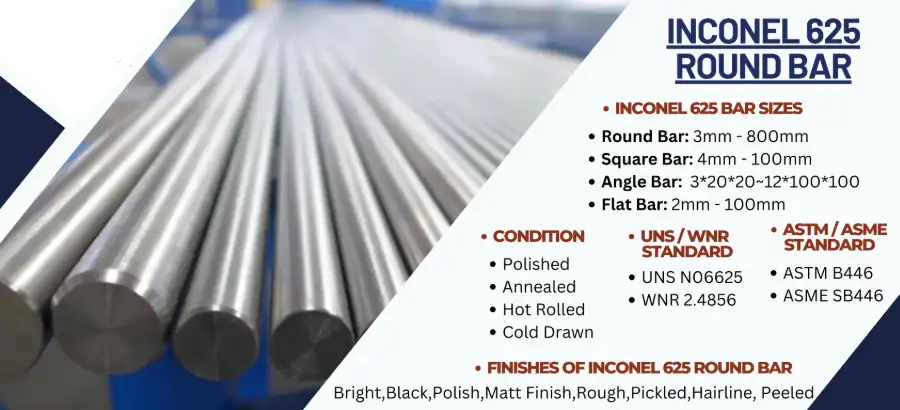
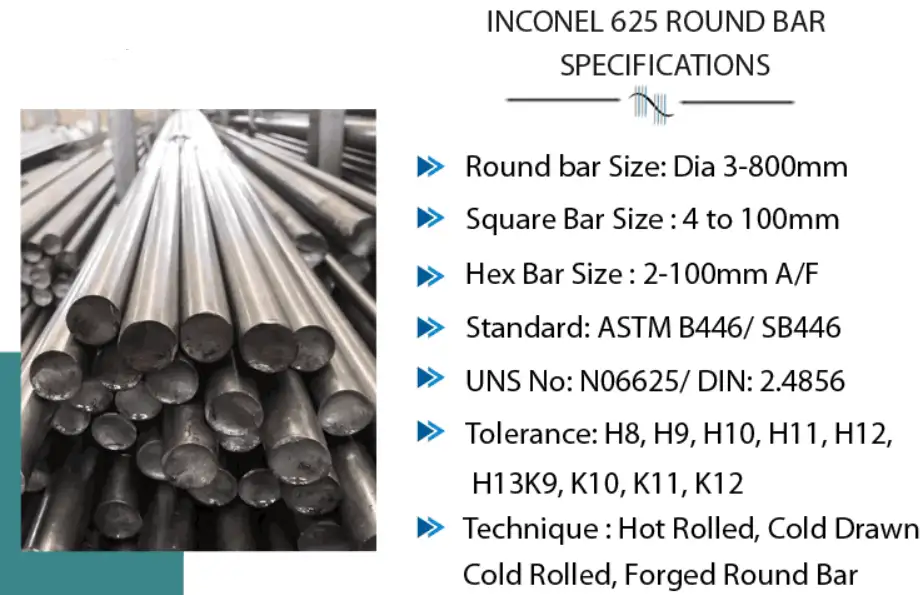
UNS designation: UNS N06625 (identifies the chemical family and general properties).
-
ASTM / ASME: ASTM B446 covers nickel alloy bar and rod (including 625) in hot-worked and cold-worked forms; ASME SB-446 is the corresponding code reference.
-
Aerospace / AMS: AMS 5666 and related AMS documents are often used where aerospace-level material source control and heat-treatment sequences are required.
Typical diameters and lengths
Manufacturers supply round bars in a range of standard diameters from small-diameter cold-drawn rod (5 mm and up) to large rough-turned bars (up to several inches, e.g., 4.25 in or more). Standard mill lengths commonly fall between 120 and 168 inches for many stock items, with cut-to-length options available from distributors. The supply condition (annealed, rough-turned, cold-drawn) is specified on purchase orders. Example supplier catalog entries show 3.5 in, 4.25 in diameters and lengths of 120–168 in for typical inventory items.
Traceability and mill test reports
Buyers should request a mill test report (MTR / material certificate) that shows chemical analysis, mechanical test results, heat number, heat-treatment condition, and conformity to ordered specification (e.g., ASTM B446, AMS 5666). For critical applications (aerospace, nuclear) full lot traceability and non-destructive testing documentation may be required.
SPECIFICATIONS
5. Fabrication: machining, forming, welding, and heat treatment
Machining round bar
Inconel 625 is machinable but more challenging than common stainless steels due to work-hardening tendency and high strength. Practical recommendations:
-
Use rigid setups to minimize chatter.
-
Carbide tooling with sharp geometry is preferred.
-
Light depth-of-cut, higher feed rates, and adequate coolant are common practice to control built-up edge and reduce work-hardening ahead of the tool.
-
Use positive rake tooling and back off on dwell times to avoid local heat build-up.
-
For countersinking and drilling, peck drills are common to clear chips.
Machining allowances depend on supply condition; rough-turned stock reduces cutting time compared with full-diameter annealed bar but costs more up front. Supplier guidance and tooling vendors provide cutting data for predictable cycle times. Rolled Alloys
Forming and cold work
Because the alloy work-hardens, forming by cold bending or cold drawing requires larger forces and intermediate anneals may be necessary for substantial reductions. Hot working is often used for heavy deformation.
Welding and joining
Alloy 625 has excellent weldability in common fusion processes and can be welded to itself and to some dissimilar alloys using matching filler wires (FM625 type) and qualified procedures. Preheating is generally not required, and post-weld heat treatment is seldom necessary because the alloy does not rely on ageing to develop strength. For dissimilar-metal welding, diffusion, galvanic compatibility, and residual stress should be assessed.
Heat treatment and annealing
Complete anneals (solution anneals) are used to restore ductility after heavy cold work. Typical annealing cycles are specified by the mill or standards; the precise temperatures and cooling rates are included in supplier datasheets and AMS documents. Controlled cooling avoids undesirable precipitates that could reduce toughness.
6. Corrosion resistance: environments, crevice/pitting behaviour, and testing
Alloy 625 provides strong general corrosion resistance in oxidizing and reducing aqueous environments and shows particular resistance to pitting, crevice corrosion, and stress-corrosion cracking in chloride-bearing media when compared with common stainless steels. Its molybdenum and nickel content enhance resistance to localized attack, and niobium addition improves stability against intergranular attack by tying up carbon.
Environments where 625 excels
-
Seawater components, especially where crevice corrosion and localized attack are concerns.
-
Acidic process streams (organic and mineral acids) where conventional stainless steels fail.
-
High-temperature oxidizing atmospheres because chromium and nickel form protective oxide layers.
Limitations and special cases
-
Highly reducing halogenated environments, molten salts, or fluids containing fluorides may still pose attack mechanisms and require corrosion testing.
-
Sulfidic high-temperature environments require evaluation; alloy 625 is good in many such environments but designers should perform corrosion coupons tests for service-specific predictions.
Testing standards
Corrosion performance is validated using standardized tests (e.g., ASTM salt-fog, pitting potential tests, and coupon exposure), and for sour-service oil-and-gas applications NACE MR0175 / ISO 15156 guidance is often applied.
7. Typical applications and selection guidance vs similar alloys
Representative applications for round bar
-
Turbine and pump shafts that see combined mechanical loading and aggressive fluids.
-
Fasteners and studs that need high strength and corrosion resistance.
-
Valve stems, actuator shafts, and critical machined wear components in marine and chemical plants.
-
Oil-and-gas downhole tooling where corrosion and high temperature coexist.
| Alloy | Why choose it over others |
|---|---|
| Inconel 625 | Very good combination of corrosion resistance and elevated-temperature strength without age hardening |
| Inconel 718 | Higher creep/strength at some temperatures due to precipitation hardening, but requires specific heat treatments |
| 316L stainless steel | Lower cost but poorer pitting and crevice resistance; choose 316L only when extreme corrosion performance is not required |
| Hastelloy C276 | Superior corrosion resistance in some chemical media but often higher cost; choose C276 for highly oxidizing acid service |
Selection should be driven by environment (chloride, acid, oxidizing), mechanical loads, weight and cost constraints, and fabrication requirements. For example, where machining ease and minimal post-weld heat treatment are important, alloy 625 has advantages over precipitation-hardened alloys.
8. Inspection, testing, and quality assurance for bar stock
Typical inspection matrix included with critical orders
-
Chemical analysis (full element report) per specification limits.
-
Mechanical tests (tensile, yield, elongation) performed on representative specimens.
-
Hardness testing as required.
-
Non-destructive testing (NDT) where required: ultrasonic testing for internal defects, PMI / spectroscopy for chemistry spot checks.
-
Surface finish and dimensional inspection to verify roundness and tolerances.
Certifications and compliance
For critical uses, require mill test report traceable to each heat number and relevant specification callouts (ASTM B446, AMS numbers). For oil-and-gas sour service, confirm compliance or compatibility with NACE MR0175 / ISO 15156 requirements.
9. Supply, lead times, cost considerations and sourcing tips
Stock vs made-to-order
-
Stocked rough-turned or annealed bars reduce lead time but come at variable cost premiums depending on diameter.
-
Made-to-order sizes are appropriate for non-standard diameters or special certifications but increase lead time and lot-cost.
Cost drivers
-
Alloying content (nickel, molybdenum, niobium) drives the raw-material cost. Nickel market volatility directly affects price.
-
Processing (rough turning, cold drawing, special heat treatment) and certification level (aerospace AMS, nuclear traceability) add to cost.
Sourcing tips for purchasing managers
-
Request multiple quotes specifying the exact specification (e.g., UNS N06625, ASTM B446 Grade 1, desired supply condition).
-
If fatigue-critical, ask for supplier fatigue or stress-rupture data.
-
For international procurement, confirm export paperwork and customs codes for alloyed nickel products.
10. Tables engineers rely on (practical quick reference)
Table A: Standard chemical control examples (reference ranges)
| Element | Min (%) | Max (%) |
|---|---|---|
| Ni | 58.0 | balance |
| Cr | 20.0 | 23.0 |
| Mo | 8.0 | 10.0 |
| Nb + Ta | 3.15 | 4.15 |
| Fe | — | 5.0 |
| C | — | 0.10 |
(Always use the ordering specification for contractual limits.)
Table B: Representative mechanical values (annealed)
| Diameter | Tensile (MPa) | Yield 0.2% (MPa) | Elongation (%) |
|---|---|---|---|
| Small rod (cold drawn) | 700 – 900 | 350 – 600 | 30 – 45 |
| Large bar (annealed) | 480 – 650 | 200 – 450 | 40 – 60 |
(Values illustrative; supplier MTR is authoritative.)
11. Practical engineering design notes and failure modes
-
Avoid relying on room-temperature mechanical numbers when parts will experience elevated temperature creep; perform time-temperature-life analysis.
-
Watch for galling in threaded parts; use coatings or compatible materials and lubrication.
-
Fatigue-sensitive parts should be designed with surface finish and residual stress mitigation in mind because surface defects shorten life.
-
Hydrogen embrittlement is not a primary failure mode for 625, but sour environments should be evaluated per NACE guidance.
12. Procurement checklist for an engineer or buyer
-
Specify UNS N06625 and the exact standard (ASTM B446 / AMS 5666 etc.).
-
State supply condition: annealed, rough-turned, or cold-drawn.
-
Request full MTR with heat number and chemical analysis.
-
List required mechanical tests and NDT if applicable.
-
Declare any special process control: low sulfur, low phosphorous, or NACE compliance.
13. FAQs
Q1: Is Inconel 625 magnetic?
A1: Inconel 625 is essentially austenitic and non-magnetic in the annealed condition. Cold working can introduce slight magnetic responses in localized zones, but for most engineering purposes the alloy is treated as non-magnetic.
Q2: Can Inconel 625 be hardened by heat treatment?
A2: No precipitation hardening treatment is required or typically effective for 625 because it is strengthened primarily by solid-solution alloying. Extensive heat treatment can be used to anneal or solutionize but will not produce the same precipitation-strengthened condition seen in alloys like 718.
Q3: What specification should I call out when ordering bar stock?
A3: Commonly ASTM B446 (bar and rod) and AMS 5666 (aerospace) are used. Also specify UNS N06625 for clarity.
Q4: Is welding Inconel 625 difficult?
A4: No; 625 is considered readily weldable with matching filler wires such as FM625. Preheat is usually unnecessary and post-weld heat treatment is not universally required, but welding procedure qualification is important for critical parts.
Q5: How should I specify testing for corrosion-sensitive applications?
A5: Include coupon exposure tests, pitting potential determinations, and specify compliance with industry corrosion standards pertinent to the service. For oil-and-gas sour service reference NACE MR0175 / ISO 15156.
Q6: How does diameter affect mechanical properties?
A6: Smaller diameters that are cold drawn or cold finished typically have higher yield and tensile strengths than large, fully-annealed bars. Always get MTR values for the specific heat and diameter.
Q7: Will Inconel 625 corrode in seawater?
A7: In many seawater applications Inconel 625 performs very well, especially where crevice and pitting resistance are important. However local conditions such as temperature, oxygenation, biofouling, and flow regime should be assessed with coupons for confirmation.
Q8: Is machining cycle time long compared with stainless steel?
A8: Typically yes. Expect longer cycle times and higher tooling wear relative to common stainless grades. Use recommended carbide tooling and rigid fixturing to optimise throughput.
Q9: Can I use Inconel 625 bar for cryogenic service?
A9: Yes. The alloy retains toughness at cryogenic temperatures, making it suitable for low-temperature applications in which corrosion resistance remains acceptable.
Q10: Where can I find authoritative datasheets and standards?
A10: Manufacturer technical bulletins (Special Metals), material datasheets (Rolled Alloys, MatWeb/ASM), and the specification documents for ASTM B446 and AMS 5666. See the reference list for links.
14. How this content was developed and guidance for technical validation
This document synthesizes mill data sheets, specification summaries, and manufacturer technical bulletins to present a practical, engineering-level reference for Inconel 625 round bar. For purchase or safety-critical design, always confirm the precise chemical and mechanical limits on the mill test report and consult the controlling standard for any code-required testing. The specific figures shown here are representative and require verification against supplier documentation before application in final design or procurement.
15. Quick checklist for design engineers
-
Call out UNS N06625 and the controlling standard (ASTM B446 or AMS 5666).
-
Specify supply condition and diameter tolerance.
-
Request full MTR per heat and mechanical test results.
-
Validate corrosion resistance with coupons when service is aggressive.
-
Set machining allowances and tooling strategy with the manufacturer.
-
For critical applications require NDT and traceability.
16. Closing practical notes
Inconel 625 round bar is a practical choice when a long service life in hostile environments and good mechanical performance without complex thermal treatments is required. Its supply as round bar enables efficient production of shafts and machined components while preserving the alloy's advantageous corrosion and high-temperature behaviour. For long-term reliability, pair material selection with environment-specific testing and strict procurement traceability.